Year: 2019

03 Sep 2019

Near miss between science craft and Starlink satellite shows need to improve orbital coordination

A European satellite that measures the Earth’s winds using lasers had a close encounter with one of SpaceX’s Starlink constellation yesterday in a situation that illustrates the growing inadequacy of existing systems for global coordination of orbital issues. It’s getting crowded up there, and email and phone calls between HQs soon won’t cut it.

The near miss was announced yesterday on Twitter by the European Space Administration’s Operations team on Twitter. It explained, perhaps a mite sensationally, that “for the first time ever, ESA has performed a ‘collision avoidance manoeuvre’ to protect one of its satellites from colliding with a ‘mega constellation’ .”

To be clear, and as ESA explained, these maneuvers are actually very common — but they’re almost always to avoid debris and dead satellites, not currently active ones. These days when you launch a satellite, you’re generally very careful to put it in an orbit that has been carefully calculated to not intersect with that of any other satellite. Pretty straightforward, right?

But things happen, for instance a thruster misfires or another maneuver goes wrong, and suddenly a satellite that was going to pass within a safe distance of another one is actually going to get much, much closer. That’s what seems to have happened here: the Starlink satellite, one of 60 launched earlier this year, somehow found itself on a potential collision course.

SpaceX and ESA exchanged emails on August 28, when the chance of the two craft colliding was around 1 in 50,000; they determined no action was necessary. But a subsequent update from the U.S. Air Force’s tracking infrastructure changed that estimate to about 1 in 600. That’s well below the 1 in 10,000 chance standard for taking measures. (This isn’t just guesswork but allowing for jitter in measurements and other noise that enter tracking of fast-moving orbital objects.)

Here’s where the hiccup happened. With the new and scary probability of a collision, either ESA or SpaceX had to change orbit — again, something that happens a lot, but in this case needs to be coordinated clearly with the other. What if they both adjusted their orbit the same way and increased the chance of disaster?

Unfortunately, SpaceX was not aware of the new probability estimate from the Air Force, and as such persevered in its decision not to adjust its satellite’s trajectory. As a result, the ESA had to make its own maneuver — not fun when the craft in question is performing extremely sensitive measurements using a high-powered lidar system.

Why would SpaceX not want to do anything? Apparently they weren’t in possession of the new, higher estimate.

“A bug in our on-call paging system prevented the Starlink operator from seeing the follow on correspondence on this probability increase,” SpaceX said in a statement. “Had the Starlink operator seen the correspondence, we would have coordinated with ESA to determine best approach with their continuing with their maneuver or our performing a maneuver.”

Ultimately there was no collision and both satellites are happily orbiting the Earth, though Aeolus does have a touch less fuel than before. The problem is not that a satellite had to swerve a bit, because that happens all the time. The problem is that it was an encounter with an active satellite and communications between the two operators was inadequate.

“Nobody did anything wrong. Space is there for everybody to use,” ESA’s Holger Krag told Forbes. “Basically on every orbit you can encounter other objects. Space is not organized. And so we believe we need technology to manage this traffic.”

Visualization of space debris around Earth.

With plans by SpaceX, Amazon, OneWeb and others to launch constellations of hundreds or thousands of satellites over the years, the possibility of another such encounter is very likely. And a system that worked when there were vanishingly few encounters between active satellites likely won’t work when those encounters are a daily or hourly occurrence.

“This example shows that in the absence of traffic rules and communication protocols, collision avoidance depends entirely on the pragmatism of the operators involved. Today, this negotiation is done through exchanging emails – an archaic process that is no longer viable as increasing numbers of satellites in space mean more space traffic,” said Krag in an ESA news post.

“No one was at fault here, but this example does show the urgent need for proper space traffic management, with clear communication protocols and more automation. This is how air traffic control has worked for many decades, and now space operators need to get together to define automated maneuver coordination,” he continued.

Naturally AI is being brought into the discussion, but also other common-sense rules and improvements to an aging system that is no longer able to be ignored. It plans to make these proposals more solid later this year and hopefully put them into action.

03 Sep 2019

Starship Technologies CEO Lex Bayer on focus and opportunity in autonomous delivery

Starship Technologies is fresh off a recent $40 million funding round, and the robotics startup finds itself in a much-changed market compared to when it got its start in 2014. Founded by software industry veterans including Skype and Rdio co-founder Janis Friis, Starship’s focus is entirely on building and commercialization fleets of autonomous sidewalk delivery robots.

Starship invented this category when it debuted, but five years later it’s one of a number of companies looking to deploy what essentially amounts to wheeled, self-driven coolers that can carry small packages and everyday freight including fresh food to waiting customers. CEO Lex Bayer, a former sales leader from Airbnb, took over the top spot at Starship last year and is eager to focus the company’s efforts in a drive to take full advantage of its technology and experience lead.

The result is transforming what looked, to all external observers, like a long tail technology play into a thriving commercial enterprise.

“We want to do 100 universities in the next 24 months, and we’ll do about 25 to 50 robots in each campus,” Bayer said in an interview about his company’s plans for the future.

03 Sep 2019

Google releases Android 10

Android 10 is now available, assuming you have a phone that already supports Google’s latest version of its mobile operating system. For now, that’s mostly Google’s own Pixel phones, though chances are that most of the phones that were supported during the beta phase will get updated to the release version pretty soon, too.

Since the development of Android pretty much happens in the open these days, the release itself doesn’t feature any surprises. Just like with the last few releases, chances are you’ll have to look twice after the update to see whether your phone actually runs the latest versions. There are plenty of tweaks in Android 10, but some of the most interesting new features are a bit hidden and (at least in the betas) off by default.

The one feature everybody has been waiting for is a dark mode and here, Android 10 doesn’t disappoint. The new dark theme is now ready for your night-time viewing, with the promise of improved battery life for your OLED phone and support from a number of apps like Photos and Calendar. Over time, more apps will automatically switch to a dark theme as well, but right now, the number seems rather limited and a bit random, with Fit offering a dark mode while Gmail doesn’t.

The other major tweak is the updated gesture navigation. This remains optional — you can still use the same old three-button navigation Android has long offered. It’s essentially a tweak of the navigation system the launched with Android Pie. For the most part, the new navigation gestures work just fine and feel more efficient than those in Pie, especially when you try to switch between apps. Swiping left and right from the screen replaces the back button, which isn’t immediately obvious, and a slightly longer press on the side of the screen occasionally opens a navigation drawer. I say ‘occasionally,’ because I think this is the most frustrating part of the experience. Sometimes it works, sometimes it doesn’t. The trick to opening the drawer, it seems, is to swipe at an angle that’s well above 45 degrees.

Also new is an updated Smart Reply feature that now suggests actions from your notifications. If a notification includes a link, for example, Smart Reply will suggest opening it in Chrome. Same for addresses, where the notification can take you right to Google Maps, or YouTube videos that you can play in — you guessed it — Youtube. This should work across all popular messaging apps.

There are also a couple of privacy and security features here, including the ability to only share location data with apps while you use them and a new Privacy section in Settings that gives you access to controls for managing your web and app history, as well as your ad settings in a slightly more prominent place.

The new Google Play system updates, the company can now also push important security and privacy fixes right to the phone from the Google Play store, which allows it to patch issues without having to go through the system update process. Given the slow Android OS upgrade cycles, that’s an important new feature, though it, too, is an evolution of Google’s overall strategy to decouple these updates and core features from the OS updates.

Two other interesting new features are still in beta or won’t be available until later this year, but Google prominently highlights Focus mode, which allows you to silence specific apps for a while and which is now in beta, and Live Caption, which will launch in the fall on Pixel phones and which can automatically caption videos and audio across all apps. I’ve been beta testing Focus Mode for a bit and I’m not sure it has really made a difference in my digital wellbeing, but the ability to mute notifications from YouTube during the workday, for example, has probably made me a tiny bit more productive.

Oh, and there’s also native support for foldable phones, but for the time being, there are no foldable phones on the market.

Like with most recent releases, those are just some of the highlights. There are plenty of small tweaks, too, and chances are you’ll notice a few new fonts and visual tweaks here and there. For the most part, though, you can continue to use Android like you always have. Even major changes like the updated gesture controls are optional. It’s very much an evolutionary update, but that’s pretty much the case for any mobile OS these days.

03 Sep 2019

Daily Crunch: Facebook might remove Like counts

The Daily Crunch is TechCrunch’s roundup of our biggest and most important stories. If you’d like to get this delivered to your inbox every day at around 9am Pacific, you can subscribe here.

1. Now Facebook says it may remove Like counts

Instagram is already testing something similar in seven countries, including Canada and Brazil. Instead of showing the total number of Likes for a post, it displays the names of just a few mutual friends who have Liked it.

Jane Manchun Wong spotted Facebook prototyping the hidden Like counts in its Android app. When we asked the company, it confirmed that it’s considering a test to remove Like counts, though this isn’t live for any users yet.

2. WeChat restricts controversial video face-swapping app Zao, citing ‘security risks’

Zao went viral in China this weekend for its realistic face-swapping videos. But following controversy about its user policy, messaging platform WeChat restricted access to the app.

3. OpenGov raises $51M to boost its cloud-based IT services for government and civic organizations

The company was co-founded by Palantir’s Joe Lonsdale to help governments and other civic organizations organize, analyze and present financial data and more, using cloud-based architecture.

GettyImages 981328812

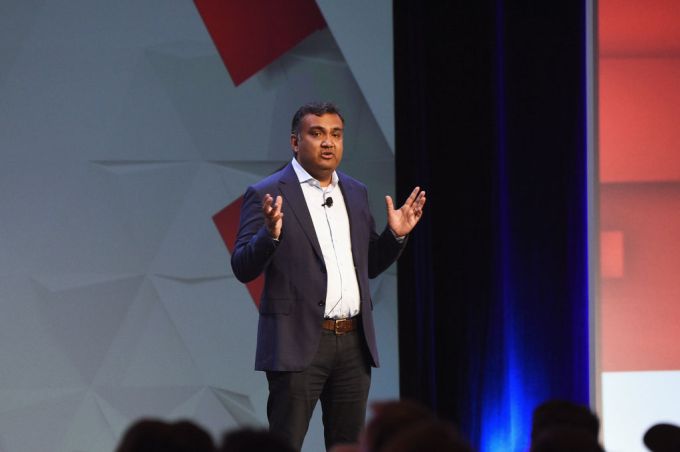
ANAHEIM, CA – JUNE 21: YouTube Chief Product Officer Neal Mohan speaks onstage during the YouTube Keynote: Building Communities and the Next Generation of Media Companies Panel during VidCon. (Photo by FilmMagic/FilmMagic for YouTube)

4. YouTube’s Neal Mohan is coming to Disrupt SF

YouTube has found itself front-and-center in the recent debates about free speech, the internet and how the online world is shaping our offline lives, so there will be plenty to talk about when Mohan joins us at Disrupt.

5. Kabbage acquires Radius Intelligence, the marketing tech firm with a database of 20M small businesses

It’s been a tumultuous period for Radius, which announced a merger with its big competitor Leadspace last year, only to quietly cancel the deal three months later. Two months after that, it replaced its longtime CEO.

6. Apple still has work to do on privacy

Natasha Lomas examines whether iPhones are generally superior to Android devices when it comes to security. (Extra Crunch membership required.)

7. This week’s TechCrunch podcasts

On Equity, Alex and Kate share their thoughts on Peloton’s finances and prospects. And on this week’s Original Content, we review the Netflix series “The Dark Crystal: Age of Resistance.”

03 Sep 2019

Deadline alert: Only 4 days to save on passes to Disrupt SF 2019

October is right around the corner, and if you want to get the lowest possible price on your passes to Disrupt San Francisco 2019 you have just four days left to make it so. Depending on which pass you buy, you can save up to $1,300, but only if you buy your Disrupt SF pass before the deadline expires at 11:59 p.m. (PST) on September 6.

Some of the tech and investment industry’s greatest leaders, minds and makers will be on hand to share their work, insight and advice. It’s a great opportunity to learn from the people who’ve paved the way. Three full days of programming across four different stages will keep you engaged and inspired. Here’s just one example to pique your interest, and you can check out the full Disrupt agenda here.

Curious about the future of flight? You won’t want to miss our Main Stage interview with Sebastian Thrun, CEO of Kitty Hawk. Thrun’s bonafides are nothing short of impressive. Through X, the Google moonshot factory he founded, he helped take self-driving cars from theory to reality. He’s also co-founder and executive chairman of Udacity, the $1 billion online education startup. His current endeavor involves bringing two aircraft — the one-person Flyer and a two-person autonomous taxi called Cora — to market. We can’t wait to hear his take on the future of flight.

Curious about capital? Then head on over to the Extra Crunch Stage to hear John Geiger (John Geiger Company) and Kathryn Petralia (Kabbage) talk about alternative ways founders can raise cash without talking to investors. Say what?!

Curious about Startup Alley? Get a head start on your networking strategy by perusing our directory of startups exhibiting in Startup Alley. Be sure to stop by and meet our TC Top Picks — these 45 outstanding startups represent the best in their respective tech categories.

And of course, you won’t want to miss the Startup Battlefield. It’s a fast-paced pitch-a-thon featuring the very best early-stage startups. Watch them pitch and demo under pressure to a tough panel of expert tech and VC judges. Who will win the day — and the $100,000 prize?

Disrupt San Francisco 2019 takes place on October 2-4 — just one month away. But the early bird pricing disappears promptly at 11:59 p.m. (PST) on September 6. Buy your discounted tickets now, save a bundle and we’ll see you in San Francisco.

Is your company interested in sponsoring or exhibiting at Disrupt San Francisco 2019? Contact our sponsorship sales team by filling out this form.

03 Sep 2019

Joseph Gordon-Levitt is coming to Disrupt SF 2019

Joseph Gordon-Levitt is perhaps best known for his acting across films like 10 Things I Hate About You, 500 Days of Summer, and Snowden. But times weren’t always peachy for Gordon-Levitt as a creative. After leaving the movie business to go to college, he realized the limits of the industry on his potential as a creative. He decided he wanted to take his creativity into his own hands and launched a message board where he’d post films, songs, etc.

But what started as a side hobby has turned into a production company in its own right, using technology to allow dozens of people to collaborate on a creative project together. And, more importantly, it gives each contributor fair credit for their work, paying out individual creatives based on how much of their work was featured in the final product.

Obviously, it goes without saying that we’re thrilled to have Joseph Gordon-Levitt join us at TechCrunch Disrupt SF in October.

Far too rarely do we see creatives supported by the platforms where they post their work. With the current media landscape, and the ever-growing dominance of social media, the relationship between platform and creative is strained at best. And more importantly, it incentivizes all the wrong things.

From an interview in VentureBeat:

If what you’re going for is posting on YouTube, or Instagram, or platforms that monetize through the ad model, where they’re really just going for sheer volume and have the ability to manipulate people through ads, virality is the measure of success. And I think this is exactly at the heart of what’s interesting to me about doing [HitRecord]. I think if that is your measure of success, you’re going to undermine a lot of what’s actually meaningful and joyful about creativity. And I’m actually concerned for the human race’s creative spirit, because so much of our collective creativity is now destined for these platforms that are monetized by this sort of attention economy model. And it twists one’s understanding of one’s own creativity, and what the value of being creative is.

At Disrupt SF, we’ll discuss the growth of the HitRecord platform, plans for that fresh $6.4 million in Series A funding, and how founders can seize this moment to provide collaborative tools that align creatives with the platforms they’re using.

Disrupt SF runs October 2 to October 4 at the Moscone Center in the heart of San Francisco. Tickets are available here.

03 Sep 2019

Mozilla flips the default switch on Firefox tracking cookie blocking

From today Firefox users who update to the latest version of the browser will find a pro-privacy setting flipped for them on desktop and Android smartphones, assuming they didn’t already have the anti-tracking cookie feature enabled.

Mozilla launched the Enhanced Tracking Protection (ETP) feature in June as a default setting for new users — but leaving existing Firefox users’ settings unchanged at that point.

It’s now finishing what it started by flipping the default switch across the board in v69.0 of the browser.

The feature takes clear aim at third party cookies that are used to track Internet users for creepy purposes such as ad profiling. (Firefox relies on the Disconnect list to identify creepy cookies to block.)

The anti-tracking feature also takes aim at cryptomining: A background practice which can drain CPU and battery power, negatively impacting the user experience. Again, Firefox will now block cryptomining by default, not only when user activated.

In a blog post about the latest release Mozilla says it represents a “milestone” that marks “a major step in our multi-year effort to bring stronger, usable privacy protections to everyone using Firefox”.

“Currently over 20% of Firefox users have Enhanced Tracking Protection on. With today’s release, we expect to provide protection for 100% of ours users by default,” it predicts, underlining the defining power of default settings.

Firefox users with ETP enabled will see a shield icon in the URL bar to denote the tracker blocking is working. Clicking on this icon takes users to a menu where they can view a list of all the tracking cookies that are being blocked. Users are also able to switch off tracking cookie blocking on a per site basis, via this Content Blocking menu.

While blocking tracking cookies reduces some tracking of internet users it does not offer complete protection for privacy. Mozilla notes that ETP does not yet block browser fingerprinting scripts from running by default, for example.

Browser fingerprinting is another prevalent privacy-hostile technique that’s used to track and profile web users without knowledge or consent by linking online activity to a computer’s configuration and thereby tying multiple browser sessions back to the same device-user.

It’s an especially pernicious technique because it can erode privacy across browser sessions and even different browsers — which an Internet user might be deliberately deploying to try to prevent profiling.

A ‘Strict Mode’ in the Firefox setting can be enabled by Firefox users in the latest release to block fingerprinting. But it’s not on by default.

Mozilla says a future release of the browser will flip fingerprinting blocking on by default too.

The latest changes in Firefox continue Mozilla’s strategy — announced a year ago — of pro-actively defending its browser users’ privacy by squeezing the operational range of tracking technologies.

In the absence of a robust regulatory framework to rein in the outgrowth of the adtech ‘industrial data complex’ that’s addicted to harvesting Internet users’ data for ad targeting, browser makers have found themselves at the coal face of the fight against privacy-hostile tracking technologies.

And some are now playing an increasingly central — even defining role — as they flip privacy and anti-tracking defaults.

Notably, earlier this month, the open source WebKit browser engine, which underpins Apple’s Safari browser, announced a new tracking prevention policy that puts privacy on the same footing as security, saying it would treat attempts to circumvent this as akin to hacking.

Even Google has responded to growing pressure around privacy — announcing changes to how its Chrome browser handles cookies this May. Though it’s not doing that by default yet.

It has also said it’s working on technology to reduce fingerprinting. And recently announced a long term proposal to involve its Chromium browser engine in developing a new open standard for privacy.

Though cynics might suggest the adtech giant is responding to competitive pressure on privacy by trying to frame and steer the debate in a way that elides its own role in data mining Internet users at scale for (huge) profit.

Thus its tardy privacy pronouncements and long term proposals look rather more like an attempt to kick the issue into the long grass and buy time for Chrome to keep being used to undermine web users’ privacy — instead of Google being forced to act now and close down privacy-hostile practices that benefit its business.

03 Sep 2019

The next Apple Watch could feature sleep tracking

Details have surfaced about one of the potentially key features of the next Apple Watch — sleep tracking. Bloomberg originally reported that Apple has been working on a sleep tracking feature, and 9to5mac now details how the implementation could work.

The new feature would work on the next Apple Watch. The new device could be unveiled at Apple’s iPhone event next week or at a later event this fall. It’s unclear whether existing devices will also support the new feature.

You don’t need any extra hardware to enable sleep tracking — an Apple Watch strapped on your wrist is enough. When enabled, the Apple Watch will track your movements using the accelerometer. Apple also plans to take advantage of the heart rate sensor. Interestingly, the company could also leverage the microphone to listen for noises.

When you wake up, you can check the quality of your night in the Health app on your iPhone. According to 9to5mac, there will be a new Sleep app on the Apple Watch as well.

As most people use their phone as an alarm clock, Apple would mirror your alarm on your Apple Watch. This way, the alarm would play on the Apple Watch first and use the iPhone as a backup. You could limit the alarm on the Apple Watch to vibration only. This feature would be particularly handy for couples who don’t have the same schedule.

When it comes to battery life, Apple could send you a notification to remind you to charge your Apple Watch before going to bed. Remember that the Apple Watch has a tiny battery, so it charges in no time. You could easily get enough battery life in just a few minutes.

That feature would work particularly well with the next iPhone. Rumor has it that Apple will add reverse wireless charging to the new iPhone. It means that you would be able to put your Apple Watch on the back of your iPhone to charge it directly from your iPhone.

And if you’ve been a long time Apple Watch user, Apple could also let you pick a second Apple Watch and turn it into a dedicated sleep tracker. You’d just have to switch from one Apple Watch to another when you go to bed.

03 Sep 2019

YouTube claims it removed 5x more hateful content in Q2, including 100K+ videos, 17K+ channels

In an update today, YouTube is claiming to have made significant progress in removing harmful video on its platform following a June update to its content policy which prohibited supremacist and other hateful content. The company says it has this quarter removed over 100,000 videos and terminated over 17,000 channels for hate speech — a 5x increase over Q1. It also removed nearly double the number of comments to over 500 million, in part due to an increase in hate speech removals.

The company, however, is haphazardly attempting to draw a line between what’s considered hateful content and what’s considered free speech.

This has resulted in what the U.S. Anti-Defamation League, in a recent report, referred to as a “significant number” of channels that disseminate anti-Semitic and white supremacist content being left online, following the June 2019 changes to the content policy.

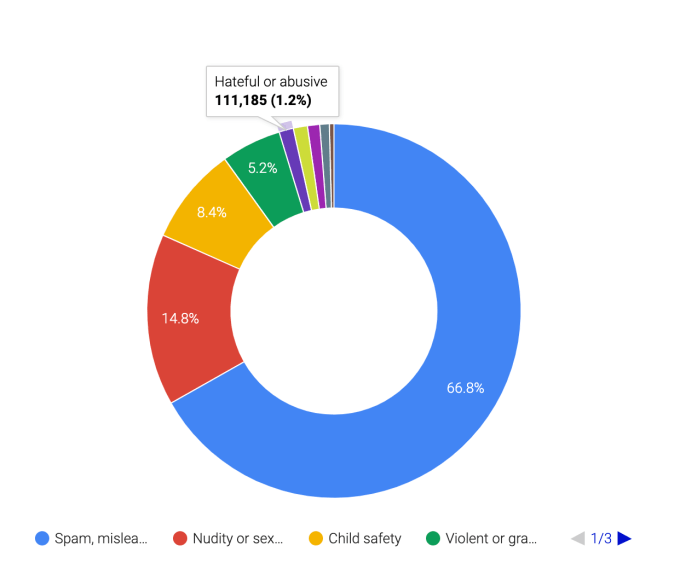
videos removed by reason

YouTube CEO Susan Wojcicki soon thereafter took to the YouTube Creator blog to defend the company’s position on the matter, arguing for the value that comes from having an open platform.

“A commitment to openness is not easy. It sometimes means leaving up content that is outside the mainstream, controversial or even offensive,” she wrote. “But I believe that hearing a broad range of perspectives ultimately makes us a stronger and more informed society, even if we disagree with some of those views.”

Among the videos the ADL had listed were those that featured anti-Semitic content, anti-LGBTQ messages, those denied the Holocaust, featured white supremacist content, and more. Five of the channels it cited had, combined, over 81 million views.

YouTube still seems to be unsure of where it stands on this sort of content. While arguably these videos would be considered hate speech, much seems to be left online. YouTube also flip-flopped last week when it removed then quickly reinstated the channels of two Europe-based, far-right YouTube creators who espouse white nationalist views.

Beyond the hate speech removals, YouTube also spoke today of the methodology it uses to flag content for review.

It will often use hashes (digital fingerprints) to automatically catch copies of known prohibited content ahead of it being made public. This is a common way platforms remove child sexual abuse images and terrorist recruitment videos. However, this is not a new practice and its mention in today’s report could be to deflect attention from the hateful content and issues around that.

In 2017, YouTube said also increased its use of machine learning to help it find similar content to those that have already been removed, even before the videos are viewed. This is effective for fighting spam and adult content, YouTube says. In some cases, this can also help to flag hate speech, but machines don’t understand context so human review is still required to make the nuanced decisions.

Fighting spam is fairly routine these days, as it accounts for the majority of the removals — in Q2, nearly 67% of the videos removed were spam or scams.

Over 87% of the 9 million totals videos removed in Q2 were removed by automated systems, YouTube said. An upgrade to spam detection systems in the quarter led to a more than 50% increase in channels shut down for spam violations, it also noted.

The company said that more than 80% of the auto-flagged videos were removed without a single view in Q2. And it confirmed that across all of Google, there are over 10,000 people tasked with detecting, reviewing, and removing content that violates its guidelines.

Again, this over 80% figure largely speaks to YouTube’s success in using automated systems to remove spam and porn.

Going forward, the company says it will soon release a further update to its harassment policy, first announced in April, that will aims to prevent creator-on-creator harassment — as seen recently with the headline-grabbing YouTube creator feuds and the rise of “tea” channels.

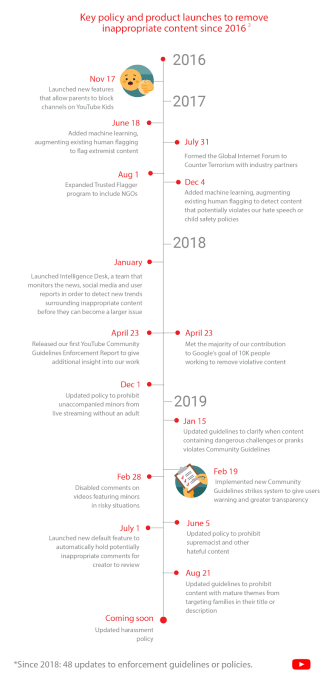
YouTube additionally shared a timeline of its content policy milestones and related product launches.

YT resptime v24 ai remove 01 2

The update from YouTube comes at a critical time for the company, just ahead of a reported $200 million settlement with the FTC over alleged violations of child privacy laws. The fine serves as a stark reminder that, for years now, the viewers of these hate speech-filled videos haven’t only been adults interested in researching extremist content or engaging in debate, but also millions of children who today turn to YouTube for information about their world.

03 Sep 2019

The NFL joins TikTok in multi-year partnership

The NFL and social video app TikTok today announced a multi-year partnership to bring NFL content to worldwide fans, just ahead of the NFL’s 100th season kick off on September 5. The partnership includes the launch of an official NFL account on the video platform, as well as a series of NFL-themed hashtag challenges, and other marketing opportunities for brands around the NFL content.

The first hashtag challenge, #WeReady, starts today and runs through Thursday. It encourages fans to show pride for their favorite NFL team while using the #WeReady hashtag. Several popular TikTok creators and NFL clubs will join the fans in the challenge.

TikTok will also have a presence at Soldier Field in Chicago for the Sept. 5 kickoff, where TikTok fans will be about to create videos and show their love for teams and players in an NFL-themed experience.

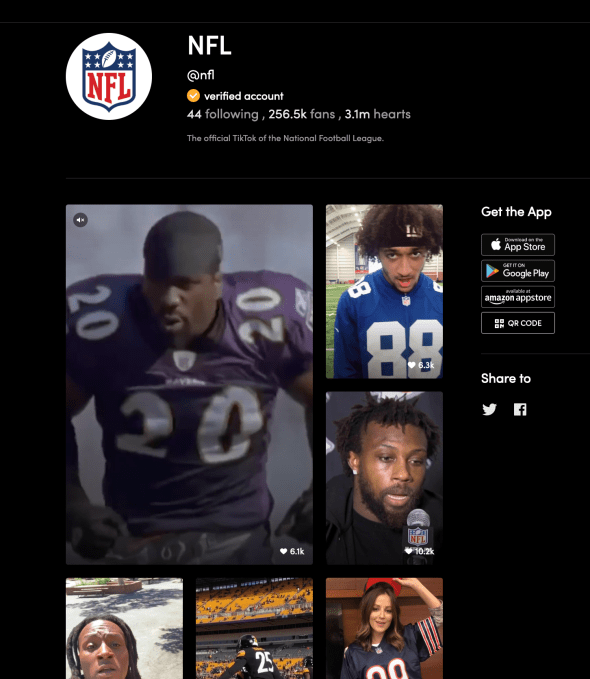
At launch, the NFL’s Tiktok account already features several videos, ranging from behind-the-scenes action to highlights, to funny memes and even inspirational content.

nfl on tiktok“We’re thrilled to partner with a powerhouse in the sports industry like the NFL to bring new life and a fresh perspective to the sports entertainment experience,” said Mayan Scharf, Global Partnerships, TikTok. “TikTok is a destination where fans can feel like they are a part of the team and we look forward to showcasing content from the NFL that is exciting, authentic and surprising to TikTok community,” he said.

While TikTok is better known for its meme-like, short-form videos featuring lip-syncing, displays of talent like dance, cosplay, comedy, art, and more, the company says that sports content is also a popular category on its service.

The NFL, meanwhile, is not averse to jumping on early with emerging platforms — whether that’s live-streaming video on Twitter, being the first sports league on Snapchat Discover, or launching an Alexa voice app, for example.

In addition, the NFL looks for opportunities that give it the ability to reach international fans, like when it distributed game highlights and recaps on Facebook. This is of particular importance at a time when ratings have become more of a concern for the sports league. Though it finally recovered last season from a multi-year ratings slump, the NFL knows that fans outside the U.S. are also worth courting as they can be just as loyal and engaged.

“Partnering with TikTok is a natural extension of our media strategy,” said Blake Stuchin, Vice President, Digital Media Business Development for the NFL, in a statement. “The platform reaches a fast-growing global audience of NFL fans and future fans. The NFL programming and hashtag challenges are a perfect way to kick off the NFL’s 100th season – with fun, new content that will entertain fans and invites them to celebrate and experience their NFL fandom in a way that’s authentic to the unique experience of TikTok,” he said.