Year: 2019

28 Aug 2019

Ahead of FTC ruling, YouTube Kids is getting a website

Ahead of the official announcement of an FTC settlement which could force YouTube to direct under-13-year-old users to a separate experience for YouTube’s kid-friendly content, the company has quietly announced plans to launch its YouTube Kids service on the web. Previously, parents would have to download the YouTube Kids app to a mobile device in order to access the filtered version of YouTube.

By bringing YouTube Kids to the web, the company is prepared for the likely outcome of an FTC settlement which would require the company to implement an age-gate on its site, then redirect under-13-year-olds to a separate kid-friendly experience.

In addition, YouTube Kids is gaining a new filter which will allow parents to set the content to being preschooler-appropriate.

The announcement, published to the YouTube Help forums, was first spotted by Android Police.

It’s unclear if YouTube was intentionally trying to keep these changes from being picked up on by a larger audience (or the press) by publishing the news to a forum instead of its official YouTube blog. (The company tells us it publishes a lot of news the forum site. Sure, okay. But with an FTC settlement looming, it seems an odd destination for such an announcement.)

It’s also worth noting that, around the same time as the news was published, YouTube CEO Susan Wojcicki posted her quarterly update for YouTube creators. The update is intended to keep creators abreast of what’s in store for YouTube and its community. But this quarter, her missive spoke solely about the value in being an open platform, and didn’t touch on anything related to kids content or the U.S. regulator’s investigation.

However, it’s precisely YouTube’s position on “openness” that concerns parents when it comes to their kids watching YouTube videos. The platform’s (almost) “anything goes” nature means kids can easily stumble upon content that’s too adult, controversial, hateful, fringe, or offensive.

The YouTube Kids app is meant to offer a safer destination, but YouTube isn’t manually reviewing each video that finds its way there. That has led to inappropriate and disturbing content slipping through the cracks on numerous occasions, and eroding parents’ trust.
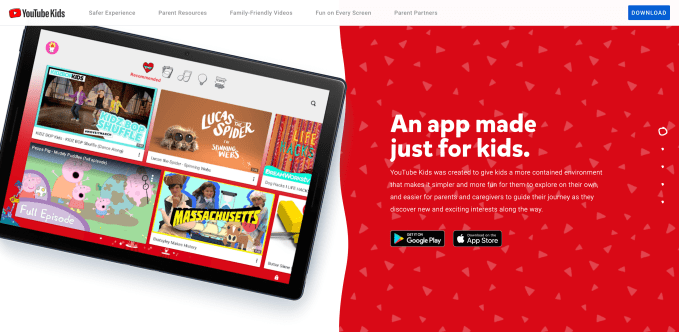
youtube kids website

Because many parents don’t believe YouTube Kids’ algorithms can filter content appropriately, the company last fall introduced the ability for parents to whitelist specific videos or channels in the Kids app. It also rolled out a feature that customized the app’s content for YouTube’s older users, ages 8 through 12. This added gaming content and music videos.

Now, YouTube is further breaking up the “Younger” content level filter, which was previously 8 and under, into two parts. Starting now, “Younger” applies to ages 5 through 7, while the new “Preschool” filter is for the age 4 and under group. The latter will focus on videos that promote “creativity, playfulness, learning, and exploration,” says YouTube.

YouTube confirmed to TechCrunch that its forum announcement is accurate, but the company would not say when the YouTube Kids web version would go live, beyond “this week.”

The YouTube Kids changes are notable because they signal that YouTube is getting things in place before an FTC settlement announcement that will impact how it handles kids content and the site’s continued use by young children.

It’s possible that YouTube will be fined by the FTC for its violations of COPPA, as Musical.ly (TikTok) was earlier this year. One report, citing unnamed sources, says the FTC’s YouTube settlement has been finalized and includes a multimillion-dollar fine.

YouTube will also likely be required to implement an age-gate on its site and in its apps that will direct under-13-year-olds to the YouTube Kids platform instead of YouTube proper. The settlement may additionally require YouTube to stop targeting ads on videos aimed at children, as has been reported by Bloomberg. 

We probably won’t see the FTC issuing a statement about its ruling ahead of this Labor Day weekend, but it may do so in advance of its October workshop focused on refining the COPPA regulation — an event that has the regulator looking for feedback on how to properly handle sites like YouTube. 



28 Aug 2019

Ahead of FTC ruling, YouTube Kids is getting a website

Ahead of the official announcement of an FTC settlement which could force YouTube to direct under-13-year-old users to a separate experience for YouTube’s kid-friendly content, the company has quietly announced plans to launch its YouTube Kids service on the web. Previously, parents would have to download the YouTube Kids app to a mobile device in order to access the filtered version of YouTube.

By bringing YouTube Kids to the web, the company is prepared for the likely outcome of an FTC settlement which would require the company to implement an age-gate on its site, then redirect under-13-year-olds to a separate kid-friendly experience.

In addition, YouTube Kids is gaining a new filter which will allow parents to set the content to being preschooler-appropriate.

The announcement, published to the YouTube Help forums, was first spotted by Android Police.

It’s unclear if YouTube was intentionally trying to keep these changes from being picked up on by a larger audience (or the press) by publishing the news to a forum instead of its official YouTube blog. (The company tells us it publishes a lot of news the forum site. Sure, okay. But with an FTC settlement looming, it seems an odd destination for such an announcement.)

It’s also worth noting that, around the same time as the news was published, YouTube CEO Susan Wojcicki posted her quarterly update for YouTube creators. The update is intended to keep creators abreast of what’s in store for YouTube and its community. But this quarter, her missive spoke solely about the value in being an open platform, and didn’t touch on anything related to kids content or the U.S. regulator’s investigation.

However, it’s precisely YouTube’s position on “openness” that concerns parents when it comes to their kids watching YouTube videos. The platform’s (almost) “anything goes” nature means kids can easily stumble upon content that’s too adult, controversial, hateful, fringe, or offensive.

The YouTube Kids app is meant to offer a safer destination, but YouTube isn’t manually reviewing each video that finds its way there. That has led to inappropriate and disturbing content slipping through the cracks on numerous occasions, and eroding parents’ trust.

youtube kids website

Because many parents don’t believe YouTube Kids’ algorithms can filter content appropriately, the company last fall introduced the ability for parents to whitelist specific videos or channels in the Kids app. It also rolled out a feature that customized the app’s content for YouTube’s older users, ages 8 through 12. This added gaming content and music videos.

Now, YouTube is further breaking up the “Younger” content level filter, which was previously 8 and under, into two parts. Starting now, “Younger” applies to ages 5 through 7, while the new “Preschool” filter is for the age 4 and under group. The latter will focus on videos that promote “creativity, playfulness, learning, and exploration,” says YouTube.

YouTube confirmed to TechCrunch that its forum announcement is accurate, but the company would not say when the YouTube Kids web version would go live, beyond “this week.”

The YouTube Kids changes are notable because they signal that YouTube is getting things in place before an FTC settlement announcement that will impact how it handles kids content and the site’s continued use by young children.

It’s possible that YouTube will be fined by the FTC for its violations of COPPA, as Musical.ly (TikTok) was earlier this year. One report, citing unnamed sources, says the FTC’s YouTube settlement has been finalized and includes a multimillion-dollar fine.

YouTube will also likely be required to implement an age-gate on its site and in its apps that will direct under-13-year-olds to the YouTube Kids platform instead of YouTube proper. The settlement may additionally require YouTube to stop targeting ads on videos aimed at children, as has been reported by Bloomberg. 

We probably won’t see the FTC issuing a statement about its ruling ahead of this Labor Day weekend, but it may do so in advance of its October workshop focused on refining the COPPA regulation — an event that has the regulator looking for feedback on how to properly handle sites like YouTube. 



28 Aug 2019

Microsoft wants to bring exFAT to the Linux kernel

ExFAT, the Extended File Allocation Table, is Microsoft’s file system for flash drives and SD cards, which launched in 2006. Because it was proprietary, mounting these drives and cards on Linux machines generally involved installing additional software. Today, however, Microsoft announced that it is supporting the addition of exFAT to the Linux kernel and publishing the technical specifications for exFAT.

“It’s important to us that the Linux community can make use of exFAT included in the Linux kernel with confidence. To this end, we will be making Microsoft’s technical specification for exFAT publicly available
to facilitate development of conformant, interoperable implementations.”

In addition to wanting it to become part of the Linux kernel, Microsoft also says that it hopes that the exFAT specs will become part of the Open Invention Network’s  Linux definition. Once accepted, the code would benefit “from the defensive patent commitments of OIN’s 3040+ members and licensees,” the company notes.

Microsoft and Linux used to be mortal enemies — and some in the Linux community definitely still think of Microsoft as anti-open source. These days, though, Microsoft has clearly embraced open source and Linux, which is now the most popular operating system on Azure and, optionally, part of Windows 10, thanks to its Windows Subsystem for Linux. It’ll still be interesting to see how the community will react to this proposal. The aftertaste of Microsoft’s strategy of  “embrace, extend and extinguish” still lingers in the community, after all, and not too long ago, this move would’ve been interpreted as yet another example of this.

28 Aug 2019

Microsoft wants to bring exFAT to the Linux kernel

ExFAT, the Extended File Allocation Table, is Microsoft’s file system for flash drives and SD cards, which launched in 2006. Because it was proprietary, mounting these drives and cards on Linux machines generally involved installing additional software. Today, however, Microsoft announced that it is supporting the addition of exFAT to the Linux kernel and publishing the technical specifications for exFAT.

“It’s important to us that the Linux community can make use of exFAT included in the Linux kernel with confidence. To this end, we will be making Microsoft’s technical specification for exFAT publicly available
to facilitate development of conformant, interoperable implementations.”

In addition to wanting it to become part of the Linux kernel, Microsoft also says that it hopes that the exFAT specs will become part of the Open Invention Network’s  Linux definition. Once accepted, the code would benefit “from the defensive patent commitments of OIN’s 3040+ members and licensees,” the company notes.

Microsoft and Linux used to be mortal enemies — and some in the Linux community definitely still think of Microsoft as anti-open source. These days, though, Microsoft has clearly embraced open source and Linux, which is now the most popular operating system on Azure and, optionally, part of Windows 10, thanks to its Windows Subsystem for Linux. It’ll still be interesting to see how the community will react to this proposal. The aftertaste of Microsoft’s strategy of  “embrace, extend and extinguish” still lingers in the community, after all, and not too long ago, this move would’ve been interpreted as yet another example of this.

28 Aug 2019

Only 3 days left for early-bird pricing on passes to Disrupt SF 2019

It’s a countdown to savings, startup fans. Calculate it any way you like — 72 hours, 4,320 minutes or 259,200 seconds — you have just three days left to save up to $1,300 with early-bird pricing on passes to Disrupt San Francisco 2019. The deadline strikes at exactly 11:59 p.m. (PST) on August 30. Buy your early-bird pass right now and save.

One of the many reasons Disrupt SF draws more than 10,000 people from around the world is to hear an impressive array of speakers — leading experts and top players in the startup world. They’ll address crucial topics like security and the challenges of protecting your most valuable asset: your customers and their data.

That issue applies to startups and multinationals alike, and we’re thrilled to have Google’s Heather Adkins, IOActive’s Jennifer Sunshine Steffens and Duo’s Dug Song join us to discuss how to build a secure startup from the ground up without slowing growth. That’s just one example — you can peruse the Disrupt agenda here.

Need more reasons to attend Disrupt SF on October 2-4? Let us count the ways. Networking — with more than 1,200 early-stage startups and sponsors exhibiting in Startup Alley, you’ll find opportunity upon opportunity to build your network. Whether you’re an investor hunting for a startup to round out your portfolio, a founder in search of an angel or a software engineer cruising for a new gig, Startup Alley is your networking mecca.

Want to prepare ahead of time? We’ve got you. Search our directory of startups exhibiting in Startup Alley. Then be sure to take advantage of CrunchMatch, our free business-matching platform. Once you fill out your profile, CrunchMatch automatically matches companies based on mutual business interests and goals. It suggests meetings and sends out invitations (which recipients can easily accept or decline).

Don’t miss the always-epic Startup Battlefield. We have a fierce cadre of early-stage startups ready to take the Main Stage to launch, pitch and demo their product to the world and a tough panel of judges. Oh yeah — they’re also competing for $100,000 and a chance to change the trajectory of their business. It’s a live-action thrill ride and an opportunity to see the next generation of household tech names — it can and has happened. Fitbit, Mint, Box and a host of other companies launched at a TechCrunch event.

Disrupt San Francisco 2019 takes place October 2-4, but you have only three days left to take advantage of our early-bird pricing and save up to $1,300. Don’t waste time counting the minutes. Buy your tickets before the deadline hits at 11:59 p.m. (PST) on August 30. We can’t wait to see you in San Francisco!

Is your company interested in sponsoring or exhibiting at Disrupt San Francisco 2019? Contact our sponsorship sales team by filling out this form.

28 Aug 2019

Hulu debuts an expanded Live TV Guide on web, Apple TV and Roku

Yesterday, Hulu began rolling out an updated version of its mobile app sporting the brand-new interface the company first unveiled at CES in January. However, it was missing one of the pre-announced and more-requested features: Hulu’s revamped and expanded live TV guide. Today, that updated Live Guide is launching — but only to select TV platforms for the time being.

The updated Live Guide is coming today to Hulu.com on the web, Roku devices, and Apple TV.

As promised at CES, Hulu’s expanded TV guide will now allow viewers to scroll to see what’s airing in the next two weeks, as well as schedule recordings on upcoming shows, movies, and sporting events.

It’s also easier to navigate, as filters like “Recent,” “My Channels,” “News,” “Movies,” and “Kids” have now been relocated from the top of the grid to the left-hand side.

A green vertical line with a lightning bolt icon overlaid on the guide will help you to visualize how much of the program or movie has aired so far.

hulu live guide

Users can also add channels from the guide to their “My Channels” list, which is now available from the Live Guide itself, as well as from the Home page.

This update follows Hulu’s revamp of its mobile app on Tuesday, which dropped the confusing “Lineup” section from the Home screen, while adding a way to see more content in each section.

Getting the Hulu interface right is a big priority for the company, given that its last big makeover didn’t go down all that well. At one point, a complaint about Hulu’s redesign became the most-upvoted item on the company’s user feedback forums, as many agreed that Hulu’s user interface was too difficult to navigate and had a confusing layout.

In the many months since, Hulu has been working to make changes to address user complaints by rolling out the live grid guide initially, then tweaking its appearance and functionality over time.

Unlike Sling TV, PlayStation Vue, or YouTube TV, for example, Hulu has been challenged with merging its vast on-demand library and original content with a more traditional live TV service.

Today, Hulu with Live TV is available on a range of devices — including the web, mobile, Apple TV, Fire TV, Echo Show, Xbox One, Windows 10, Chromecast, Android TV, Nintendo Switch, VIZIO SmartCast TVs, and select Samsung and LG smart TVs. But the updated Live Guide is only coming to a subset of those — Hulu.com on the web, Roku and Apple TV — as of today.

Hulu says it will roll out to more platforms and devices “soon.”


28 Aug 2019

Instacart CFO Ravi Gupta to exit for Sequoia Capital

Instacart‘s chief financial officer and chief operating officer, Ravi Gupta, will exit the on-demand grocery delivery company at the end of the year to “return to his investing roots,” the company told TechCrunch this morning. The executive will join Sequoia Capital as a partner on the growth team beginning in January.

The company’s vice president of finance and strategy, Sagar Sanghvi, has been promoted to CFO, a critical role as the company gears up for an initial public offering as soon as next year. Instacart is actively searching for a COO replacement.

Valued at nearly $8 billion, Instacart has raised a total of $1.9 billion in venture capital funding since it was founded in 2012. Co-founder and CEO Apoorva Mehta has remained mum on any details surrounding the company’s IPO plans, telling TechCrunch last fall that a float “will be on the horizon.”

Sagar Sanghvi CFO Instacart

Instacart’s vice president of finance and strategy, Sagar Sanghvi, has been promoted to CFO.

After a decade at the investment firm KKR, Gupta joined Instacart in 2015 to manage both the company’s finances and operations as its first CFO and COO. He’s worked closely with Sequoia for some time; the firm first invested in Instacart prior to Gupta’s hiring, leading an $8.5 million Series A financing in 2013. Sequoia’s outspoken partner Michael Moritz sits on the company’s board of directors.

Roelof Botha, another Sequoia partner, says the venture capital firm helped San Francisco-based Instacart recruit Gupta to the C-suite years ago: “With Ravi now returning to his passion of investing, he can help other visionaries – like Apoorva – turn their dreams into reality,” Botha said in an emailed statement. “Ravi’s operational and investing experience, along with his strong work ethic and humility, will make him an invaluable partner to founders and our team.”

When Gupta joined Instacart to oversee finance, corporate development and strategic business initiatives in what was a newly created role, the business, a newly minted “unicorn,” had only 300 employees. Today, Instacart has roughly 1,000 full-time employees and another 100,000 “shoppers,” or contract workers who fulfill the online grocery orders.

“In 2015, I met Apoorva and he shared his vision for Instacart with me,” Gupta said in an emailed statement. “I was truly inspired and knew this was a team I wanted to join and a company I wanted to help build.”

Following his departure, Gupta will continue to advise Instacart on a variety of matters, the company said.

Instacart is announcing another two high-level hires this morning. Jakii Chu has joined the company as its chief marketing officer after nearly five years at sports merchandising business Fanatics, where she was senior vice president of e-commerce.

Chris Rogers, the former managing director of Apple Canada, has been hired as its vice president of retail. Rogers will be based in Instacart’s Toronto office, which Instacart opened earlier this year, reporting to chief business officer Nilam Ganenthiran.

Instacart delivers groceries to 5,500 cities across the U.S. and Canada, making deliveries from some 20,000 stores. Earlier this year, Instacart began its expansion into alcohol delivery. The service is now available in 20 states.

A graduate of Y Combinator, Instacart is also backed by D1 Capital Partners, Coatue Management, Thrive Capital, Canaan Partners, Andreessen Horowitz and several others.

28 Aug 2019

Inkitt raises $16M led by Kleiner Perkins to publish crowdsourced novels in ‘mini-episodes’

The traditional world of publishing has been challenged hard by the digital revolution. Reading as a pastime has been in significant decline, in part because of the proliferation of screens and options for what to watch and do on them. On the other hand, Amazon has led the charge in changing the economics of publishing: the returns on book sales, and profits to publishers and writers, have all seen margins squeezed in the e-reader universe.

A Berlin-based startup called Inkitt has built a crowdsourced publishing platform to buck those trends. It believes that there is still a place for reading in our modern world, if it’s presented in the right way (more on that below), and today it is announcing a $16 million round of funding that underscores its success to date — the Inkitt community today has 1.6 million readers and 110,000 writers with some 350,000 uploaded stories, with a run-rate of $6 million from a new “bite-sized”, immersive reading app it launched earlier this year called Galatea — and its ambitions going forward.

How big are those ambitions? Ali Albazaz, Inkitt’s founder and CEO, said the mission is to build the “Disney of the 21st century.” Digital novels are just the beginning, in his view: plans include a move into audio, TV, games and film, “and maybe even theme parks.”

But before we ride a rollercoaster based on The Millennium Wolves — one of the best sellers on the platform, with $1 million dollars in sales in the first six months of its release; 24-year-old author Sapir Englard is using her royalties to finance her jazz studies at Berklee in Boston, Massachusetts — Inkitt is starting small.

In addition to continuing to search for authors that might make good Galatea fodder, it’s going to add 10 new languages in addition to English, along with more data science to improve readership and connecting audiences with the stories that are most engaging to them. The company has sourced some of its most successful works from places like India and Israel, so the thinking is that it’s time to make sure non-English readers in those countries are also getting a look in.

“It’s a long plan, and we’re working on it step by step,” Albazaz said in an interview this week. “We are looking for the best talents and the best stories, wherever they are being told. We want to find them, unearth them and turn them into globally successful franchises.”

The Series A is being led by Kleiner Perkins, with participation also from HV Holtzbrinck Ventures, angel investor Itai Tsiddon, Xploration Capital, Redalpine Capital, Speedinvest, and Earlybird. Inkitt is not disclosing its valuation, but it had raised $5 million before this (including this seed round led by Redalpine).

Fiction for the people

Inkitt got its start several years ago with a very basic idea: an app for people (usually unsigned authors) to upload excerpts of fictional works in progress, or entire fiction manuscripts — novels specifically — to connect them with readers to provide feedback. It would gather data that it collected from these readers to provide more insights into what people wanted to read, to feed its algorithm, and to give feedback to the writers.

It was a simple concept that competed with a plethora of other places where unpublished writers can get their work out there (including Kindle).

But then, six months ago, that concept of data-based, crowdsourced writing and reading took an interesting turn with the launch of Galatea.

With this, Inkitt selects the stories that perform the best on its first app — most readers, most often completed reading, best feedback, most recommended, and so on — and its in-house team of editors and developers reformat them for Galatea as short-form, bite-sized “mini episodes” that come with specific effects attuned to each page you read to make the experience more immersive.

This includes features like sound, haptic effects like the phone vibrating with crashes and heartbeats, fire spreading across the screen in a burning moment, and a requirement for users to swipe to proceed to the next section. (It’s a fitting name for the app: Galatea was the ivory statue that Pygmalion carved that came to life.)

IMG A405C80C7A84 1

As Albazaz describes it, Galatea was created as a response to the generation of consumers whose attention is constantly being diverted through notifications, and who have become used to getting information in short bursts.

“Nowadays you have Snapchat, Instagram and the rest, and they all send you notifications, but when you read you need a lot of attention,” he said.

So the solution was to cut down the page size to a paragraph at a time.

“Instead of flipping pages as you would on an e-reading app, you flip paragraphs.” These take up no more than about 20% of the screen, he said.

A reader gets one “episode” (about 15 minutes of reading, with several pages of text) free every day, so in theory you could read books on Galatea without paying anything, but typically people buy credits to continue reading a bit more than that each day, and it works out on average to about $12 per book in revenue. Inkitt is now adding about 100 users each day.

In addition to making this about tailoring a reading app to what consumers are most likely to do on a screen today, it’s about rethinking the model for how to source literature to disseminate in the first place.

“We all love stories and the way we create and consume them is evolving continuously,” said KP partner Ilya Fushman. “Inkitt’s rich and dynamic story format is rapidly capturing the imagination of a new generation of readers. Their content marketplace is connecting consumers with authors around the globe to entertain and democratize publishing.”

To date, the focus has very much been on original content that Inkitt has sourced itself. The basic model leaves a lot on the table, though. For one, what about all of the literature that has already been published in the world that either hasn’t really hit the right chord yet with readers, or classics, or popular works that might just be a little more interesting with the Galatea treatment?

On the other hand, the Galatea model seems to be inherently biased towards the most obvious “hits” — page turners that are engaging from the get-go, or are written on themes that have already proven to be popular. What about the wider body of literature that might not be accessible page-turners but are definitely worthwhile reading, stories that might one day become a part of the literary canon. For every Harry Potter series, some still want and need a Finnegan’s Wake or Milkman.

Albazaz has an answer for both of those: he says that his startup has already been approached by a number of publishers to work on ways of using its platform for their own works, and so that is something you might imagine will get turned on down the line. And he acknowledged the blockbuster element of the work on the platform now, but said that as it grows and scales its audience, it will be looking for works that appeal to a wider range of tastes.

The company’s business is a veritable David to Amazon’s Goliath, but one think Inkitt has going for it is that it offers those who will take a chance on its platform a promise of making a good return.

Albazaz claims that the average writer on Galatea earns 30 to 50 times more than what would be earned via Amazon, which he calls “a horrible partner to work with as a publisher.” He wouldn’t comment exactly on the royalties split is on Inkitt, or whether that higher figure is due to more readers or a better cut (or both), except that he said that there are simply “more readers” of your work, “making you more money.”

It’s also a more flexible platform in another regard: if you want to publish elsewhere at the same time, you can. “No one is locked in,” he said. “Our mission statement, which we have across the wall in our office, is to be the fairest and most objective publisher. That’s the only way you will discover hidden talents.”

28 Aug 2019

Building brands on Amazon, investing in customer success, quantum computing, and virtual reality

Extra Crunch student discount

It’s back-to-school season, and we’ve lined up a special Extra Crunch promotion for students. We are offering students a special subscription rate of $50 per year (regular price: $150) with similar discounts for international members. All you have to do is send an email using your school address to extracrunch@techcrunch.com and our founder success team will get you all squared away. We also offer volume discounts for student groups.

How to use Amazon and advertising to build a D2C startup

It seems like every week there is a well-funded team launching another new direct-to-consumer (D2C) brand. From mattresses to pet treats, digital-native vertical brands are seeing peak attention and funding from both founders and VCs. Part of the reason for all that attention is that it has never been easier to use the tools of the internet to build these brands from the ground up, opening up formerly closed markets.

Ecommerce consultancy VMG Ignite’s Matt Altman and Tyler Elliston discuss their framework to using Amazon as a commerce platform with Facebook ads to build a new D2C brand. It’s a deep and lengthy piece filled with actionable insights that can really help jumpstart your new product or category, or at the very least, giving you insight into how many of these modern brands come into being.

3. Product display ads (Limited to Amazon advertising console users only)

PDAs live on each product page below the buy box and a few other spaces on the product page. These ads can be used in a variety of ways since they allow up to a 50 character headline and a logo.

Three great ways to use them are for defense, frequently bought together, and competitor targeting.

Defense – You can buy placements on your own product pages to keep competitors off your listings. These are great to keep customers focused on buying your product since there are several ads featured on each product page.

Frequently bought together (FBT)– This is a great opportunity most sellers don’t take advantage of. On every product page, there is an unpaid placement of items that are FBT. With the click of a button, all of these items will be added to your cart and it takes very few actual sales to claim these positions. FBT can be used to target your own products to increase basket size or complementary products to drive incremental sales from future placements on product pages.

Competitor targeting– You can also target competitor ASINs (Amazon Standard Identification Number) to be the last ad a person sees before adding a competitor’s product to their cart. Make sure to use your 50 character headline to call out why your product is the better choice. Bonus Tip: Add coupons to the products you feature in these ads to grab attention and increase click-through.

28 Aug 2019

SpaceX’s Dragon completes record-setting third Space Station resupply mission

A SpaceX Dragon capsule that set down in the Pacific Ocean on Tuesday after having been docked at the International Space Station since late July became the first such vehicle to do three of those trips. SpaceX uses its Dragon cargo capsule to ferry experiment materials, supplies and more to and from the ISS, and it also refurbishes and reflies these capsules when possible as part of its ongoing mission to make spaceflight more reusable, and therefore more economical.

After it splashed down yesterday, SpaceX recovered the capsule from the ocean and returned it to shore. The vehicle is loaded with return cargo from the ISS, with almost 2,700 lbs of materials and results from experiments, which NASA staff on the ground will now examine and study. Dragon carried over 5,000 lbs of stuff to the Space Station, and over half of that was related to science and research missions. One of the return cargo items is actually a spherical robot called CIMON, and is basically a space-based smart speaker companion.

CIMON new1609

CIMON, an AI companion robot that spent time on the ISS before returning aboard SpaceX’s Dragon capsule.

SpaceX’s cargo Dragon is well-suited for carrying sensitive materials back to Earth because it remains intact through re-entry, but the company’s next version, Crew Dragon, will hope to return astronauts as well as supplies and objects when it begins operation, hopefully with initial crewed flights either late this year or next.