Year: 2019

27 Aug 2019

Through crowdsourcing, Cerberus Interactive wants to take location based gaming to the masses

Sami Khan began his work in the startup world by marketing mobile-based investment services like Acorns.

Now the marketer who helped grow that business to a nearly $1 billion valuation is turning his attention to location based gaming in the hopes that he can take on leading contender, Niantic, with a faster, more flexible, and fan driven approach to game development with his new startup, Cerberus Interactive.

Khan’s pitch is that he’s taking the skills he’d honed building up services like Acorns or the browser extension for bargain hunters, Honey, to game development to make games more viral from their inception.

The biggest thing is how do you de-risk what is perceived as a hit driven industry?” Khan asks. “Games are closer to digital apps than back in the days of the console and companies should ship it like an ecommerce concept… If adoption of the game is going to be the decision factor of whether a game fails or succeeds…why isn’t the adoption fo the game tested before the title is built or while the game is being conceived?”

So for his first foray into gaming, Khan is combining a crowd-sourced approach to the development of the game and applying it to what many people think is gaming’s next big frontier —  the location based game phenomenon that hit its stride with Niantic’s Pokemon GO.

Right now in location based games you have the behemoth which is Niantic,” says Khan. “Right now the gaming industry looks at location based games as its own sub genre. But when we look at location based games, we believe that location based games have an aspect that it is a game mechanic within other games.” 

The first game that Cerberus is developing is a base building simulator akin to a title like “Age of Empires” but based on real-world locations. “Simulation games or casual games with location built in will have a bonus or an advantage over the stationary games that we play today,” says Khan.

The “Atlas Empires” title that Cerberus is currently developing is being made in concert with the gamers who might want to play it. So far, an undisclosed number of customers are already paying to have a say in certain aspects of the game’s development — kind of like a premiere tier within a crowdfunding campaign.

Khan, a New Orleans native who splits his time between Los Angeles and Austin, has enlisted some marquee investors in his bid to challenge both the traditional ways in which games have been developed and the current industry leader.

Strategic investor MobilityWare has signed on to back the company along with individual investors like Steve Huffman, the co-founder and chief executive of Reddit, and Blake Chandler, the chief business officer of the runaway social network hit, TikTok.

Khan traces his love of games to his time visiting his cousins in Bangladesh and playing “Prince of Persia” on an early Toshiba laptop. “I remember sitting around the computer, watching my oldest cousin play because my dad didn’t want any of the kids touching the laptop,” Khan says.

So far the beta version of “Atlas Empires” has had 50,000 downloads and has about 1,000 daily players, Khan says. The commercial version of the game is expected to go live in the first quarter of 2020, says Khan.
 

27 Aug 2019

Anthony Levandowski, former Google engineer at center of Waymo-Uber case charged with stealing trade secrets

Anthony Levandowski, the former Google engineer and serial entrepreneur who was at the center of a trade secrets lawsuit between Uber and Waymo, has been indicted by a federal grand jury on theft of trade secrets.

The indictment, which is posted below, charges Levandowski with 33 counts of theft and attempted theft of trade secrets while working at Google, where he was an engineer and one of the founding members of the group that worked on Google’s self-driving car project. He is scheduled to be arraigned on the charges on August 27 at 1:30 p.m. before U.S. Magistrate Judge Nathanael M. Cousins.

If convicted, Levandowski faces a maximum sentence of 10 years and a fine of $250,000, plus restitution, for each violation.

TechCrunch has reached out to Pronto AI, Levandowksi’s new startup, for comment. We will update the story once the company, Levandowksi or his attorneys respond.

The charges stem from Levandowski’s time at Google’s self-driving project, where he led its light detecting and ranging (lidar) engineering team, according to the indictment. The indictment alleges that in the months before his departure, Levandowski downloaded from secure Google repositories numerous engineering, manufacturing, and business files related to Google’s custom lidar and self-driving car technology. Levandowski worked on the project from 2009 until he resigned from Google without notice on January 27, 2016.

Levandowski left Google and started Otto, a self-driving trucking company that was then bought by Uber. Waymo later sued Uber for trade secret theft.

Waymo alleged in the suit, which went to trial, that Levandowski stole trade secrets, which were then used by Uber.  The case went to trial, but was settled in February 2018. Under the settlement, Uber has agreed to not incorporate Waymo’s confidential information into their hardware and software. Uber also agreed to pay a financial settlement which included 0.34% of Uber equity, per its Series G-1 round $72 billion valuation. That calculated at the time to about  $244.8 million in Uber equity.

“We have always believed competition should be fueled by innovation, and we appreciate the work of the U.S. Attorney’s Office and the FBI on this case,” a A Waymo spokesperson said in a statement provided to TechCrunch.

The prosecution is being handled by the Office of the U.S. Attorney, Northern District of California’s new Corporate Fraud Strike Force and is the result of an investigation by the FBI.

“All of us have the right to change jobs,” said U.S. Attorney David L. Anderson, “none of us has the right to fill our pockets on the way out the door.  Theft is not innovation.”

This is a developing story.

Levandowski Indictment by TechCrunch on Scribd

27 Aug 2019

Hulu redesigns its iOS app for better discovery

At this year’s CES event, Hulu announced plans to trial an updated version of its user interface that would do away with the confusing landing page called “Lineup.” At the time, the company said it was considering both  “Hulu Picks” option or an “Unwatched in My Stuff” screen as a replacement for “Lineup.” Today, Hulu’s new interface is rolling out across iOS devices, the company says.

The Hulu interface launched in 2017 was not always well-liked — something Hulu had acknowledged after a complaint became the most upvoted item on Hulu’s customer feedback forums a couple of years ago. Users felt the interface was too difficult to navigate and the layout was confusing, among other things.

Some of Hulu’s challenges were around the fact that it was trying to merge an on-demand library with a live TV service, while also finding room to promote its original content.

But some of its other design choices were just odd — like its decision to make a single piece of content the main focus for many of its screens, for example. Meanwhile, its landing page “Lineup” never really made sense, either. Its name hinted at some form personalization, but instead, it was more often filled with suggestions of what Hulu was promoting, like “The Handmaid’s Tale.”

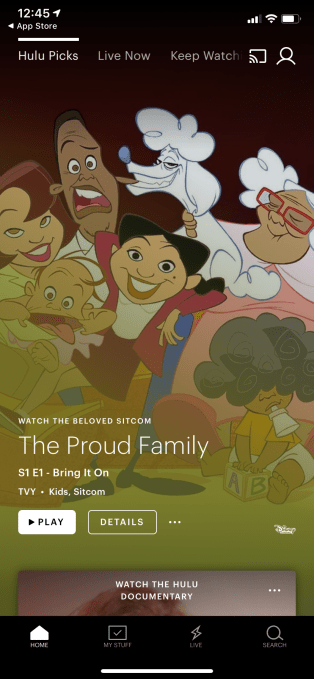
The updated iOS interface ditches “Lineup,” and replaces it with “Hulu Picks.” This is more clearly a collection of things to watch that’s curated by Hulu staff, rather than algorithmically derived by user viewing behavior.

Image from iOS 7

However, the other landing page Hulu had been considering, “Unwatched in My Stuff,” is still available, just a few swipes over.

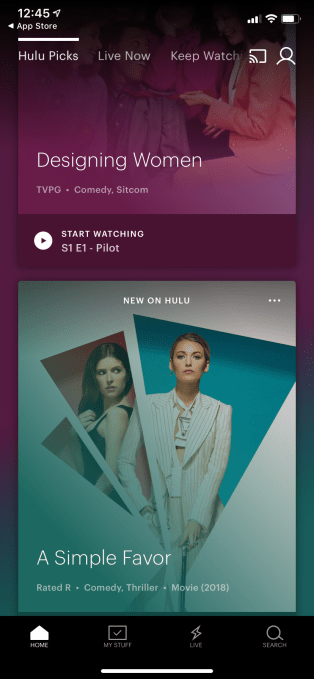
While Hulu still gives a single piece of content the focus on its main screens on the iPhone, it’s now easier to see there’s more content available if you swipe down, as the top of the next item’s card is peeking up from the bottom of the screen.

On iPhone, this means you can see two items at a time. On iPad, you can see two rows totaling 6 cards on the app’s main screen when in landscape mode.

Image from iOS 8

This same format applies not only to “Hulu Picks,” but also to neighboring screens like “Live Now,” “Unwatched in My Stuff,” “My Channels,” and the genre-based sections like “Sports,” “News,” “TV,” “Movies,” “Kids,” “Hulu Originals,” and others. Ony the “Keep Watching” screen retains the more traditional thumbnails.

This seems like a small change, but it goes a long way to increase the discoverability of Hulu content, as it reduces how many times you have to swipe to see more suggestions.

Image from iOS 6

Other changes touted at CES like adding expanded metadata next to content (genre, rating, year) or the ability to mark content as “unwatched” haven’t made an appearance. (Plenty of items still lack a rating). The 14-day live TV guide mentioned at CES isn’t available on iOS, either.

Hulu didn’t publicly announce the launch of the iOS redesign, but did confirm it’s rolling out now, only to iOS. They said other devices will get the update “soon.”

27 Aug 2019

SAP covers hot topics at TechCrunch’s Sept. 5 Enterprise show in SF

You can’t talk enterprise software without talking SAP, one of the giants in a $500 billion industry. And not only will SAP’s CEO Bill McDermott share insights at TC Sessions: Enterprise 2019 on September 5, but the company will also sponsor two breakout sessions.

The editors will sit down with McDermott and talk about SAP’s quick growth due, in part, to several $1B+ acquisitions. We’re also curious to hear about his approach to acquisitions and his strategy for growing the company in a quickly changing market. No doubt he’ll weigh in on the state of enterprise software in general, too.

Now about those breakout sessions. They run in parallel to our Main Stage set and we have a total of two do-not-miss presentations for you to enjoy. On September 5, you’ll enjoy 3 breakout sessions – 2 from SAP and one from Pricefx. You can check out the agenda for TC Sessions: Enterprise, but we want to shine the light on the sponsored sessions to give you a sense of the quality content you can expect.

  • Innovating for a Super-Human Future 
    Martin Wezowski (SAP)
    We talk about change, but what are the mechanics and the dynamics behind it? And how fast is it? The noted futurist will discuss what it means to be an innovator is transforming faster than before, and this transformation is deeply rooted in the challenges and promises between cutting edge tech and humanism. The symbiosis between human creativity & empathy and machine intelligence opens new worlds for our imagination in a time when “now” has never been so temporary, and helps us answer the question: “What is human, and what is work in a superhuman future?” (Sponsored by SAP)
  • Pricing From Day One
    Madhavan Ramanujam (Simon Kucher and Partners, Gabriel Smith) and Darius Jakubik (Pricefx) A key ingredient distinguishing top performing companies is clear focus on price. To maximize revenue and profits, pricing should be a C level / boardroom consideration. To optimize pricing, you should think about price when determining which products and features to bring to market; put the people, process and technology in place to optimize it; and maintain flexibility to adjust strategy and tactics to respond to changing markets. By doing so, companies unlock the single greatest profit lever that exists. (Sponsored by Pricefx)
  • Cracking the Code: From Startup to Scaleup in Enterprise Software 
    Ram Jambunathan (SAP.iO), Lonnie Rae Kurlander (Medal), Caitlin MacGregor (Plum) and Dimitri Sirota (BigID) The startup journey is hard. Data shows that 70% of upstart tech companies fail, while only 1% of these startups will go on to gain unicorn status. Success in enterprise software often requires deep industry experience, strong networks, brutally efficient execution, and a bit of luck. This panel brings together three successful SAP.iO Fund-backed enterprise startups for an open discussion on lessons learned, challenges of scaling, and why the right strategic investors or partners can be beneficial even at early-stages. (Sponsored by SAP)

TC Sessions: Enterprise 2019 takes place in San Francisco on September 5. It’s a jam-packed day (agenda here) filled with interviews, panel discussions and breakouts — from some of the top minds in enterprise software. Buy your ticket today and remember: you receive a free Expo-only pass to TechCrunch Disrupt SF 2019 for every ticket you buy.

27 Aug 2019

Only 4 days left until prices go up on passes to Disrupt SF 2019

Calling all budget-conscious, bargain-loving members of the early-stage startup community. Here’s a real quick way for you to save up to $1,300 on your pass to Disrupt San Francisco 2019 (October 2-4). Buy your passes before early bird pricing flies the coop. You have until 11:59 p.m. (PST) on August 30. That just four days left to reap serious savings.

TechCrunch’s flagship event is an epic, three-day startup adventure spanning the tech spectrum. Join more than 10,000 attendees, 1,200 exhibiting early-stage startups and sponsors, take in the world-famous Startup Battlefield pitch competition, the TC Hackathon, the workshops and the Q&A sessions — and so much more.

Disrupt events are famous for incredible speakers across four unique stages and Disrupt SF will not disappoint. Let’s take a look at just some of the presentations you’ll enjoy.

  • Getting to IPO: PagerDuty CEO Jennifer Tejada led the company to a successful IPO earlier this year. She’ll join Box CEO, Aaron Levie to talk about how these two companies charted their path to an IPO, the pros and cons of doing so, and life after ringing the bell on Wall Street.
  • How to Raise My First Dollars: Venture funding may have boomed over the last decade, but the decisions around your initial funding are as tricky as ever. Hear how to take advantage of the current landscape from top Silicon Valley early-stage thinkers including pre-seed investor Charles Hudson of Precursor Ventures, early-stage investor Annie Kadavy of Redpoint Ventures, and Russ Heddleston, CEO of Docsend.
  • When Spies Meet Startups: Since leaving the world of intelligence, former NSA director Adm. Mike Rogers and ex-Israeli cyber-intelligence chief Nadav Zafrir talk shop about what startups need learn about security.
  • The Business and Ethics of Real Tech Diversity: There’s both a moral and a business imperative to building and fostering a diverse and inclusive workforce. Hear from Project Include’s Ellen Pao and Tracy Chou about what it takes to get there, and from Harry Glaser, General Manager and CMO of Sisense, on how focusing on diversity has positively impacted his bottom line.

That’s merely a taste of greatness, and we’ll be adding even more content in the coming weeks. You can check out the full agenda here.

Disrupt San Francisco 2019 runs from October 2-4. Early bird pricing ends in just four days — 11:59 p.m. on August 30. Don’t miss out — buy your pass and save up to $1,300.

Is your company interested in sponsoring or exhibiting at Disrupt San Francisco 2019? Contact our sponsorship sales team by filling out this form.

27 Aug 2019

Emojivision app turns your iPhone’s camera into a real-time emoji painting machine

Your iPhone is capable of some impressive feats of computational photography, and a new app created by developer Gabriel O’Flaherty-Chan shows one way all that power can be put to creative use. Emojivision lets you see the world as if it were made up entirely of emojis.

The free app (which induces an in-app purchase for $2.79 that unlocks more emoji packs) works by breaking down your iPhone’s camera sensor input to its color palette fundamentals, finding its nearest neighbor from a subset of emojis (organized thematically within the app) and then rebuilding the image with a filter that overlays the image, and that can run at 60fps so you’d be hard-pressed to spot any lag between it and a real-time feed.

Screen Shot 2019 08 27 at 12.33.38 PM

You can use the app to take selfies, interpret photos from your phone’s photo gallery, or just mess around with resolution to see how finely detailed, or how abstractly and yet obviously emoji-based you can get. This isn’t the app to go to if you’re looking for a hyper-realistic or clear visual interpretation of your face, but it is a fun thing to show your friends – and an impressive bit of software engineering, too.

O’Flaherty-Chan has create some noteworthy mobile software projects in the past – including when he managed to hack a fully playable version of Pokémon Yellow onto an Apple Watch. He’s currently working on building a gigantic real-time strategy game set within a procedurally-generated universe – like a ‘No Man’s Sky’ but with a focus on the RTS elements that should make for a very compelling and evolving approach to gathering resources and expanding your empire.

27 Aug 2019

Microsoft’s next Surface event is October 2

Microsoft just sent out invites for its next big event. Set for October 2 in New York, the unveiling comes exactly a year after the company’s last major Surface hardware launch. The timing is certainly right for one last major product push ahead of the holidays, as well.

Last year’s big event featured the launch of the Surface Pro 6 hybrid, Surface Studio 2, some software announcements and the launch of the Surface Headphone line. There are plenty of entries in Microsoft’s line that are due for a refresh, including Surface laptop and miniature Surface Go tablet.

The company also likes to launch at least one new product line at these things. As the Verge notes, the company’s long-rumored dual-screen tablet certainly seems overripe at this point, which at least two years of product research under its belt.

The above save the day invite, which was sent out to reporters today, subtly alludes to the inclusion of several convertible form factors, while paying homage to the Windows 10 logo.

27 Aug 2019

Meet with General Catalyst investors in September

TechCrunch will partner with General Catalyst for Include Office Hours on September 4th from 1:30pm – 3:30pm. Partners Niko Bonatsos and Kyle Doherty will meet with underrepresented and underserved entrepreneurs to provide key feedback and advice. Founders, apply here!

Founded in 2014, TechCrunch launched the Include Program in an effort to leverage the extensive TechCrunch network to facilitate opportunities for underserved groups and founders. The Include Office Hours Program is one such initiative.

TechCrunch collaborates with investors to host private 20-minute sessions with startups, where founders can ask for guidance on critical business issues. During September’s Include Office Hours, General Catalyst will be meeting with 12 lucky companies. To be considered for a session with these investors, fill out this application.

Unlike previous Office Hours, TechCrunch is looking for startups in the following verticals: Enterprise, B2B, Healthcare, Security, Infrastructure, Big Data, Artificial Intelligence, SaaS, Fintech, Digital Commerce, Travel, Real Estate, Marketplaces, Messaging, E-commerce, Gaming and Crypto.

Underserved and underrepresented founders include but are not limited to female founders, black, Latino/a, Asian, LGBTQ, veteran, formerly incarcerated and people with disabilities.

Let’s meet our investors:

Niko Bonatsos

GC Niko Bonatsos
Niko Bonatsos is a managing director at General Catalyst, a venture capital firm with approximately $5 billion in total capital raised. Working from the firm’s San Francisco Bay Area offices, Niko focuses his investment strategy on finding first-time technology founders with strong product instincts, a robust appetite for learning and a desire to create innovations with the potential to benefit millions of consumers or business end users.

In his eight years with GC, Niko has been instrumental in the firm’s investments in Snap (NYSE: SNAP), 6d.ai, Atrium, Audius, Cover, Hive, HubHaus, ClassDojo, Paribus (acquired by CapitalOne), and Wag!, among others.

Prior to joining General Catalyst, Niko attended Stanford University as a Fulbright Scholar, earning an MS in Management Science and Engineering. He has studied in several countries, earning additional degrees in Manufacturing Engineering & Management and Electrical Engineering & Computer Science, and worked as a part of the R&D team for Yokogawa Electric Corporation in Japan. Find Niko on Twitter and LinkedIn.

Kyle Doherty

Partner2

Kyle Doherty is a managing director at General Catalyst, a venture capital firm with offices in Boston, New York, Palo Alto and San Francisco and with approximately $5 billion in total capital raised. At GC, Kyle focuses on investing in large, greenfield opportunities in consumer internet and software companies. Notable investments he’s made at GC include Canva Common Networks, and GitLab.

Prior to joining General Catalyst, Kyle worked with Coatue Management, where he helped conceive and launch the firm’s private investment practice and grew it into a leading private technology investment platform. Before Coatue, Kyle spent time as an investor at Morgenthaler and as an equity analyst.

Kyle studied economics and finance at MIT and earned an MBA from Harvard Business School. Though now living in the Bay Area, he’s stayed true to his hometown roots and remains a big fan of the Celtics and the Patriots. On non-game weekends, he can be found hiking the great outdoors with his family and border collie, Brady.

If you are an investor, partner or managing director at a fund interested in hosting Include Office Hours, email neesha@techcrunch.com.

27 Aug 2019

Customer success isn’t an add-on – Start early to win later

What comes first: Sales or Customer Success? Many growing startups pressure themselves to start selling as soon as there’s a viable product to sell. “Set up Customer Success functions” goes on the to-do list. After all, we don’t have to worry for another year, right?

Using the proprietary Scale Studio dataset of hundreds of SaaS startups, we’ll look at the metrics that venture investors use to link your company’s valuation to success in Customer Success — then dive into the tactics for adapting your CS program to your company’s high-touch or low-touch sales model

A year passes, and the company’s first renewals come due. Everyone from the CEO on down scrambles to do whatever it takes to make those charter customers happy and win contract extensions. After all, those customers aren’t just any customers — they’re the company’s first references, critical to landing new business and raising funds from investors. Every effort goes into making them happy.

The problem is, of course, that bringing in the CEO and CTO and VP of Sales on every renewal isn’t exactly a scalable process. Nor the basis for a long-term Customer Success strategy. 

Customer Success — a formal, process-driven, value-creating operational activity — needs to be structured to scale. And it needs to be top-of-mind from day one. Here is a look at the data and strategic rationale for launching CS early in a startup’s growth to avoid inefficiency and mistakes down the line. 

The case for customer success: Valuation

To venture investors, a well-run CS operation at an early-in-revenue startup communicates that your company has a sophisticated go-to-market strategy with a customer-centric foundation. This can translate into a valuation boost along two paths: accelerated revenue growth and increased predictability. And growth is a key driver for valuation with venture investors

27 Aug 2019

Google Maps adds biking and ridesharing options to transit directions for multi-mode commutes

Google is introducing combo navigation directions that pair ridesharing and biking options with transit guidance. Starting today, when you search from directions using Google Maps and select the ‘transit’ tap, you’ll see ridesharing options included when the nearest station is a bit further than most people might expect to go on foot. Similarly, you’ll also see routes with bike suggestions for certain legs, all listed alongside routes that stick to just transit alone for a full range of options.

The new hybrid navigation options will include useful info life the cost of rideshare segments, as well as wait times and traffic conditions. You’ll be able to specify your preferred rideshare provider from this available through Google Maps in your area, and also pick which rideshare method you prefer (ie., pool or economy).

[gallery ids="1874327,1874326"]

Bikers will get route directions specific to the best paths and roads for bikes to takes, and in both cases, all of the available info will be fed into providing an overall ETA, so you can make an informed decision about which route and method of transportation to take depending on when you need to be where you’re going.

Google says that the combined transit/ridesharing navigation will start rolling out today on both Android and iOS, and that iOS users will start seeing the biking options today, with Android to follow in the coming weeks.