Year: 2019

26 Aug 2019

Why now is the time to get ready for quantum computing

For the longest time, even while scientists were working to make it a reality, quantum computing seemed like science fiction. It’s hard enough to make any sense out of quantum physics to begin with, let alone the practical applications of this less than intuitive theory. But we’ve now arrived at a point where companies like D-Wave, Rigetti, IBM and others actually produce real quantum computers.

They are still in their infancy and nowhere near as powerful as necessary to compute anything but very basic programs, simply because they can’t run long enough before the quantum states decohere, but virtually all experts say that these are solvable problems and that now is the time to prepare for the advent of quantum computing. Indeed, Gartner just launched a Quantum Volume metric, based on IBM’s research, that looks to help CIOs prepare for the impact of quantum computing.

To discuss the state of the industry and why now is the time to get ready, I sat down with IBM’s Jay Gambetta, who will also join us for a panel on Quantum Computing at our TC Sessions: Enterprise event in San Francisco on September 5, together with Microsoft’s Krysta Svore and Intel’s Jim Clark.

26 Aug 2019

Google falls to third place in worldwide smart speaker market

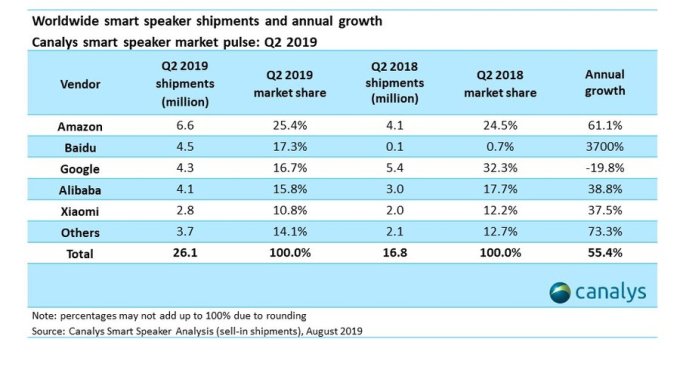
The global smart speaker market grew 55.4% in the second quarter to reach 26.1 million shipments, according to a new report from Canalys. Amazon continued to lead the race, accounting for 6.6 million units shipped in the quarter. Google, however, fell to the third spot as China’s Baidu surged ahead. Baidu in Q2 grew a sizable 3,700% to reach 4.5 million units, overtaking Google’s 4.3 million units shipped.

China’s market overall doubled its quarterly shipments to 12.6 million units, or more than twice the U.S.’s 6.1 million total. The latter represents a slight (2.4%) decline since the prior quarter.

Baidu’s growth in the quarter was attributed to aggressive marketing and go-to-market campaigns. It was particularly successful in terms of smart displays, which accounted for 45% of the products it shipped.

“Local network operator’s interests on the [smart display] device category soared recently. This bodes well for Baidu as it faces little competition in the smart display category, allowing the company to dominate in the operator channel,” noted Canalys Research Analyst Cynthia Chen.

Meanwhile, Google was challenged by the Nest rebranding in Q2, the analyst firm said.

The report also suggested that Google should to introduce a revamped smart speaker portfolio to rekindle consumer interest. The Google Home device hasn’t been updated since launch — still sporting the air freshener-style looks it had back in 2016. And the Google Home mini hasn’t received much more than a color change.

Instead, Google’s attention as of late has been on making it easier for device manufacturers to integrate with Google Assistant technology, in addition to its increased focus on smart displays.

Amazon, by comparison, has updated its Echo line of speakers several times while expanding Alexa to devices with screens like the Echo Spot and Show, and to those without like the Echo Plus, Echo Dot, Echo Auto, and others — even clocks and microwaves, as sort of public experiments in voice computing.

That said, both Amazon and Google turned their attention to non-U.S. markets in Q2, the report found. 50% of Amazon’s smart speaker shipments were outside the U.S. in Q2, up from 32% in Q2 last year. And 55% of Google’s shipments were outside the U.S., up from 42% in Q2 2018.

table ifnal final

Beyond the top 3 — Amazon, Baidu and now No. 3 Google — the remaining top 5 included Alibaba and Xiaomi, with 4.1 million and 2.8 million units shipped in Q2, respectively.

The rest of the market, which would also include Apple’s HomePod, totaled 3.7 million units.


26 Aug 2019

Facebook succeeds in blocking German FCO’s privacy-minded order against combining user data

Facebook has succeeded in blocking a pioneering order by Germany’s Federal Cartel Office earlier this year that would have banned it from combining data on users across its own suite of social platforms — Facebook, Instagram and WhatsApp — without their consent.

Pioneering because the antitrust regulator had liaised with EU privacy authorities during a long-running investigation of Facebook’s data-gathering activities — leading it to conclude that Facebook’s conduct in the German market where it also deemed it to hold a monopoly position amounted to “exploitative abuse”.

The Bundeskartellamt (FCO) order had been likened to a structural separation of Facebook’s businesses at the data level.

Facebook appealed, delaying application of the order, and today’s ruling by the Dusseldorf court grants a suspension (press release in German) — essentially kicking the matter into very long legal grass.

The FCO has a month to lodge an appeal. A spokeswoman confirmed to TechCrunch is will do so. But with the order suspended pending what could be years of appeals there’s little near-term prospect of any change to how Facebook does business based on this particular regulatory intervention.

It’s undoubtedly a major victory for Facebook — to win at the very first appeals layer — and a major blow for regulatory ‘innovation’ (for what of a better word) which sought to evolve the interpretation of current competition law to respond to the outgrowth and dominance of surveillance-based digital business model via applying privacy-focused conditions to data processing.

Europe’s data protection regulators do have the power to order the suspension of infringing data processing, under the bloc’s updated privacy framework (GDPR).

But so far very such orders are as rare as hen’s teeth — barring a recent threat to Google also by a German privacy regulator. (Just the threat of an order in that case triggered a voluntary suspension of the data processing in question.)

This made the FCO’s order against Facebook all the more notable for boldness and forethought. And means Facebook’s success in cutting it down at the first legal hurdle is a depressing result for those in the EU hoping platform power linked to privacy-hostile surveillance of Internet users might be regulated in a meaningful timeframe via an existing antitrust lens.

The European Commission’s own ‘big tech’ antitrust interventions have so far focused their attention elsewhere, in addition to taking years to conclude.

Commenting on the Düsseldorf Higher Regional Court’s decision today in a statement, FCO president Andreas Mundt said: “Data and data handling are decisive factors for competition in the digital economy. The Higher Regional Court of Düsseldorf has today responded differently than the Bundeskartellamt to key legal issues. These legal issues are highly significant for the future state of competition in the digital economy. We are convinced that we can act in this area based on the existing antitrust law. For this reason, we are going to appeal on points of law to the Federal Court of Justice to clarify these issues.”

We’ve also reached out to Facebook for comment.

Professor Rupprecht Podszun, a chair for civil law, German and European competition law at Heinrich Heine University, who has been following the FCO’s intervention, dubs the court ruling a “major blow” for the regulator.

“The FCO had accused Facebook of abusing its dominant position by unlawfully gathering and combining user data. Thus it had ordered Facebook to change its Terms & Conditions within a year. The judges from Düsseldorf have stopped enforcement of this decision now. They have serious doubts as to the lawfulness of the decision,” he said via email. “The case is regarded as a landmark case against the digital giants and it had gained worldwide recognition. To fail at the Düsseldorf court, at the very first step, is a bitter result.”

Podszun said the Düsseldorf court did not accept it follows from a possible violation of privacy rules that it is automatically a violation of antitrust rules if a dominant company is acting. That would require the court to see competitive damage — which it did not in this case.

Additionally, the court took the view that users decide autonomously whether they agree with Facebook’s T&Cs when signing up for the service. It also did not agree that consumers are exploited by Facebook’s data collection since they could continue to make the same data available to other companies.

From here on in he believes legal back and forth is likely to take years — hence, even if the FCO were to prevail at a higher court in future the impact on Facebook’s business at that point would likely be long out of date. (Meanwhile, earlier this year it emerged that Facebook is working on merging the back-end infrastructure of its three social networks — seeking to further collapse cross-platform user privacy, even as its scrambles discrete business units in a way that would complicate any regulatory order to break apart its business.)

“The Cartel Office had shown courage in its decision and had explored new paths. The Higher Regional
Court did not follow this reasoning. The FCO took a long shot by integrating a privacy investigation into the competition assessment. I have a lot of sympathy for that, because data has become a crucial competitive factor. Thus, I think that data collection must be a topic for antitrust law,” said Podszun.

“The law is at its limits with the internet giants. It is too slow. A final decision in a few years on the privacy terms of Facebook is too late either way. Before taking the decision, the FCO had investigated the case for three years. The Google Shopping procedure of the European Commission took seven years. You cannot tame these companies with such proceedings and lengthy litigation in court.”

“The decision is a wake-up call to legislators: If you want to regulate Google, Amazon, Facebook & Co., the existing tools are not enough,” he added. “A new version of the Antitrust Act is currently pending in Germany. This is an opportunity to change the legal bases. Also, the authorities for data protection need to step up their efforts – they seem to lack the bravery of the antitrust watchdog.”

Asked how legal bases need to change to enable local antitrust law to respond intelligently to data-mining platform giants, Podszun suggested four areas of focus — telling TechCrunch:

  • Competition law needs to get away from traditional market definition. There should be a rule that the authorities can interfere with companies like GAFA [Google, Apple, Facebook, Amazon] in cases where they move into new markets where they are not yet dominant but can easily tip the market. Conglomerate effects and digital ecosystems currently are a blind spot in competition law
  • There may be room for a new example of what constitutes an abuse in digital markets
  • The German Competition Office should have powers in consumer law fields (currently, there is no public enforcement of economic consumer protection issues in Germany). An integrated approach with consumer and competition issues could be helpful (including privacy, possibly). Privacy enforcers are particularly weak in Germany
  • Procedures need to be speeded up, e.g. by stricter time limits, less haggling over access to file, more technically savvy staff and more priority-setting by the authorities

“All very difficult – but it’s vital to have some fresh air here,” he added. “Whether this would have helped in the case under debate is a different question.”

26 Aug 2019

Downloads need to rank No. 1 on App Store is down 30% since 2016 for apps, up 47% for games

With the App Store’s big makeover in fall 2017, Apple attempted to shift consumers’ attention away from the Top Charts and more towards editorial content. But app developers still want to make it to the No. 1 position. According to new research from app store intelligence firm Sensor Tower, it’s become easier for non-game apps over the past few years to achieve the top ranking.

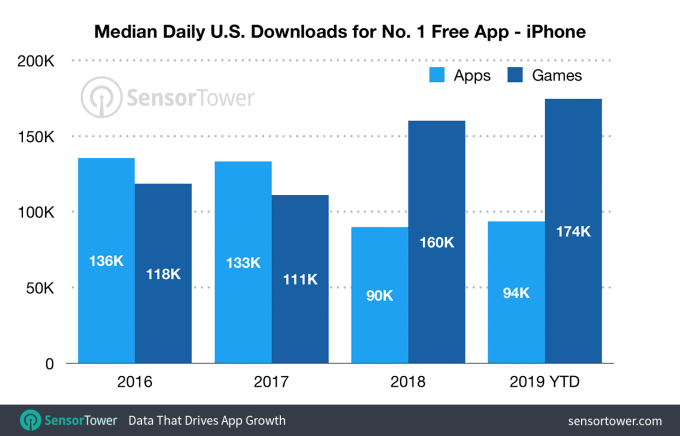
Specifically, the firm found that the median number of daily downloads required for non-game applications on the U.S. iPhone App Store to reach No. 1 decreased around 34% from 136,000 to 90,000 in 2018, then increased a little more than 4% to 94,000 this year.

At the same time, the number of non-game installs on the U.S. App Store had increased by 33% between Q1 2016 and Q1 2019.

These findings, Sensor Tower suggests, indicate that the U.S. market for the top social and messaging apps has become saturated, with downloads for top apps like Facebook and Messenger decreasing over time. In addition, no other apps have found the same level of success that Snapchat and Bitmoji did back in 2016 and 2017, the report adds.
median downloads no 1 ios

For example, Messenger saw 5 million U.S. App Store installs in November 2016 while Bitmoji and Snapchat passed 5 million installs in August 2016 and March 2017, respectively. And no other non-game app has topped 3.5 million installs in a single month since March 2017.

Meanwhile, the decline in downloads needed to reach the No. 1 spot on Google Play was even more significant.

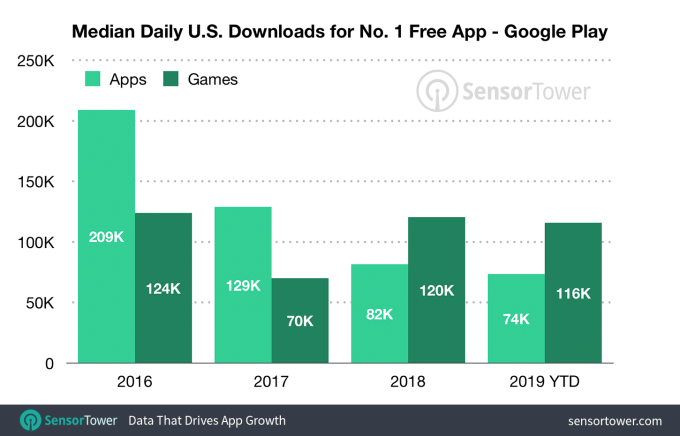
The median daily downloads for the top non-game app decreased by 65% from 209,000 in 2016 to 74,000 so far in 2019.

Similarly, the store saw a decrease in installs among top apps, including Messenger, Facebook, Snapchat, Pandora and Instagram. Messenger, for example, saw its yearly installs fall by 68% from nearly 80 million in 2016 to 26 million in 2018.

Games

With mobile games, however, it’s a different story across both app stores.

On the Apple App Store, it has taken 174,000 downloads for a game to reach the top of the rankings on any given day in 2019 — 85% more the 94,000 installs required for non-game app to reach the top of the charts.

This figure also represents an increase of 47% compared to the 118,000 median daily downloads required to top the charts back in 2016, Sensor Tower said.
median downloads no 1 google play

In part, this trend is due to the rise of hyper-casual gaming. So far in 2019, 28 games have reached the No. 1 position on the U.S. App Store, with hyper-casual games making up all but 4 of those. And of those four, only Harry Potter: Wizards Unite spent more than one day at the top of the charts. Meanwhile, hyper-casual games like aquapark.io and Colorbump 3D have spent 25 and 30 days at No. 1, respectively.

On Google Play, the median daily installs to reach the No. 1 position increased from 70,000 in 2017 to 116,000 so far in 2019, or 66% growth. Overall game downloads, however, decreased 16% from 646 million in Q1 2017 to 544 million in Q1 2019.

Similarly, 21 out of the 23 games that reached the top spot this year have been hyper-casual titles, like Words Story or Traffic Run.

Breaking the Top 10

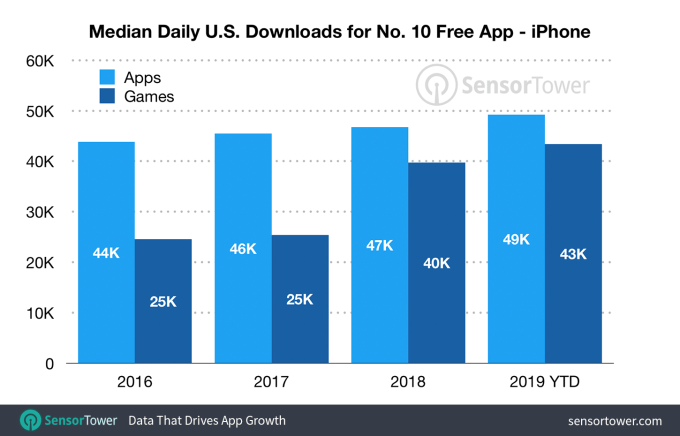
While topping the charts has gotten easier for non-game apps over the years, breaking into the top 10 has gotten more difficult. Median U.S. daily installs for the No. 10 free non-game app increased 11% from 44,000 in 2016 to 49,000 in 2019.
median downloads top 10 ios

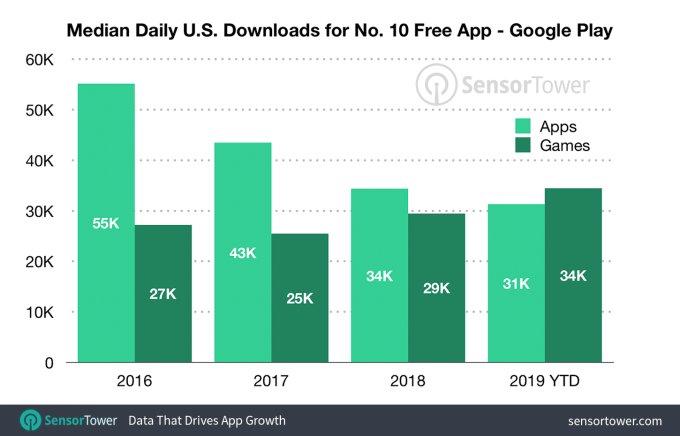
On Google Play, meidan daily installs for non-game apps fell nearly 50% from 55,000 median daily installs in 2016 to 31,000 in 2019.

For games, the No. 10 game’s spot on the App Store had 25,000 median daily installs in 2016 to 43,000 so far in 2019, and Google Play saw 26% growth from 27,000 to 34,000 during the same period.
median downloads top 10 google play

Categories making the Top 10

In terms of breaking into the top 10 by category, Photo & Video apps on the App Store present the most challenge. The category where YouTube, Instagram, TikTok and Snapchat reside saw a median daily amount of more than 16,000 downloads for the No. 10 app.

This was followed by Shopping (15,300 daily downloads for the No. 10 app), Social Networking (14,500), Entertainment (12,600), and Productivity (12,400).

On Google Play, Entertainment apps — like Hulu, Netflix and Bitmoji — need around 17,100 U.S. installs in a day to reach the top 10. This is followed by Shopping (10,800), Social (9,100), Music (8,200), and Finance (8000).

Beyond the U.S.

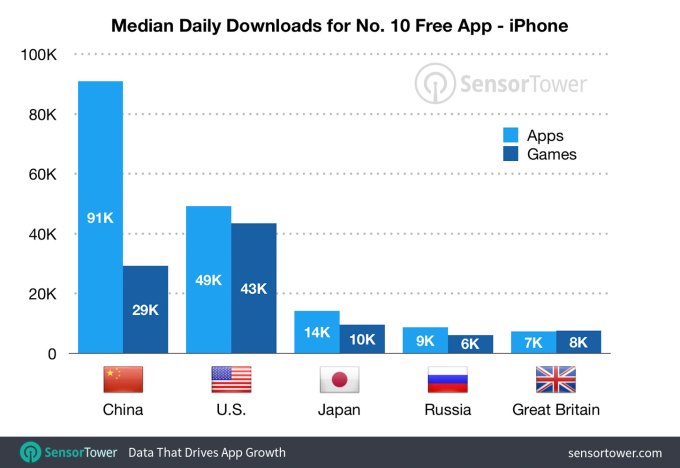
Outside the U.S., a non-game app needs approximately 91,000 downloads to reach the top 10 on the App Store in China — higher than the 49,000 installs needed in the U.S. For games, the U.S. is the most difficult to crack the top 10, with a median of 43,000 daily downloads for the No. 10 game.
median downloads top 10 by country ios

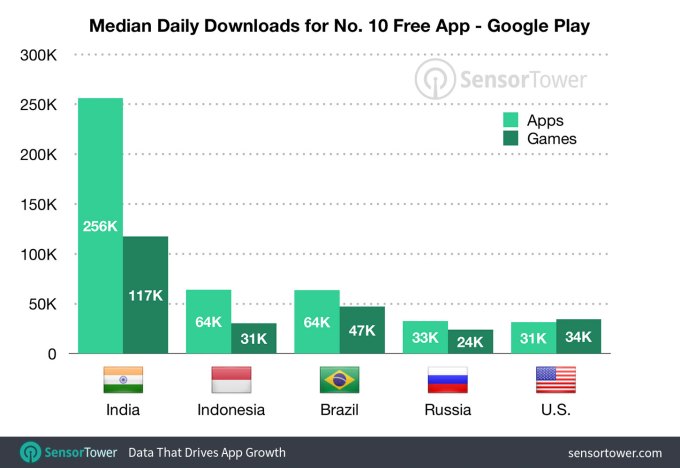
On Google Play, India required the most downloads to reach the top 10 with apps needing 256,000 downloads in a day and games needing 117,000 downloads.
median downloads top 10 by country google play

Of course, the App Store’s ranking algorithms — nor Google Play’s algorithms — rely on downloads alone to determine an app’s ranking. Apple takes into consideration downloads and velocity, among other undocumented factors. Google Play does something similar.

But these days, developers are more concerned with showing up highly ranked in app store searches than they are on top charts, where they’ll need to consider numerous other factors beyond downloads — like keywords, description, user engagement, and even app quality, among other things.




26 Aug 2019

Experimental U.S. Air Force space plane breaks previous record for orbital spaceflight

The Boeing-built X-37B space plane commissioned and operated by the U.S. Air Force has now broken its own record for time spent in space. Its latest mission has lasted 719 days as of today, which is one day longer than its last mission which ended in 2017, as noted by Space.com. It’s not an overall record, since geocommunications satellites typically have life spans of five years or more, but it’s nonetheless an impressive milestone for this secretive Air Force vehicle, which is all about testing and developing U.S. technologies related to reusable spaceflight and more.

The X-37B began its current mission in September 2018, when it launched atop a SpaceX Falcon 9 rocket. The specific details of the spacecraft’s missions are classified, but in addition to apparently spending ever increasing amounts of time up in space (each successive mission of the space plane has lasted longer), it’s also “operating experiments which can be returned to, and examined, on Earth.” These tests involve tech related to guidance, navigation, thermal protection, high-temperature materials and durability, flight and propulsion systems and more, which is basically not saying much since that’s just everything involved in space flight.

There’s no crew on board operating X-37-B, but the vehicle can autonomously descend back through Earth’s atmosphere and land horizontally on a runway, just like the NASA Space Shuttle used to do when it was in operation.

The X-37 program got kicked off in 1997, originally began by NASA, and it was then transferred to DARPA and the U.S. Air Force after that. The X-37B has flown four times, and in total, the first four missions added up to 2,085 days spent in space.

26 Aug 2019

Presight Capital raises $80M fund to connect US startups with Europe

Presight Capital, the international venture arm of Aperion Investment Group, is announcing that it’s closed its first fund of $80 million.

Aperion is the family office of German entrepreneur Christian Angermayer (pictured above), who previously co-founded pharmaceutical company  Ribopharma. Angermayer told me he sees his investments through Aperion are a way for him to continue building new startups.

“In my heart, I’m still an entrepreneur,” he said. “I have some character traits that are really good for an entrepreneur, but I’m not a good operator. I know that I’m not the guy who should run a company.”

Angermayer (who lives in London) said that with Presight, he’s taking on outside capital for the first time: $20 million of the Presight fund comes from Aperion, $60 million from other investors.

This will also allow him to start investing outside Germany and Europe — he started Presight with partner Fabian Hansen, who’s based in San Francisco, and the firm will back U.S. startups (with selective investments in Asia and Europe).

Fabian Hansen

Fabian Hansen

Angermayer and Hansen said that Presight generally invests in early-stage startups, alongside U.S. venture firms. In addition to the money, they can offer startups the connections and knowledge they need to expand into Europe, particularly when it comes to understanding the regulatory landscape.

They also said they have expertise in sectors like biotech, and can connect startups to Wall Street when it’s time to raise larger rounds.

In fact, according to a source with knowledge of the firm, investors in the fund include Wall Street figures like Galaxy Digital founder Mike Novogratz, Falcon Management President James Leitner and Moore Strategic Ventures. Other investors include Austrian entrepreneur Alexander Schuetz, international entrepreneur and investor Nicole Junkermann, the Schadeberg family office (that’s the family that owns Krombacher beer), Albright Stonebridge Group executive Michael Shtender-Auerbach, Stern Stewart Managing Partner Markus Pertl and actress Uma Thurman.

Presight has already made nine investments, five of them disclosed publicly:

While there’s a clear focus on biotech, Angermayer said he’s deliberately trying to invest across different industries, allowing him to “take a lot of learnings in one sector and apply it to new ones.”

He added, “That’s one of my deep beliefs: You can either be vertical or horizontal. For problem-solving, especially if things are new, you want to have a very holistic view of things.”

26 Aug 2019

Bedding startup Boll & Branch raises $100M

Boll & Branch, which sells sustainably-sourced sheets, pillows, mattresses and towels, is announcing that it has raised $100 million in a strategic investment from L Catterton’s Flagship Buyout Fund.

This looks like a big change from the company’s previous approach to  funding. It was self-funded for its first two years (resulting CEO Scott Tannen described as “a lot of maxed out credit cards and five mortgages on my house”), and even when it started looking at venture capital, it only raised a total of $12 million from a single institutional backer, Silas Capital.

In fact, when Recode wrote about Boll & Branch’s Series B last year, it described the startup as one “that wants to raise as little venture capital as possible.”

Tannen said that when he founded the company with his wife Missy, they wanted to “build a sustainable business from the ground up,” and that wasn’t just about the products — they didn’t want to build a company that was “ultimately designed from day one to be sold.”

As a result, he said, Boll & Branch has been profitable for the past four years and is now bringing in “nine-figure revenue.” He compared it to other L Catterton investments like The Honest Company and Peloton, companies that “have become the winner in the startup competition” and are ready to “really become household names.”

In a statement, L Catterton’s Nik Thukral described Boll & Branch as “one of the most beloved bedding brands” and said it “capitalizes on several compelling trends including the emergence of authentic, pure, and chemical free products that can be traced back to their origin, as well as consumers’ heightened focus on healthy living.”

The company’s next steps include expanding internationally — Tannen said that while the company doesn’t currently sell outside the United States, “It’s hard to imagine a country or market in the world that doesn’t make sense for Boll & Branch.”

It will also continue expanding the product lineup. Tannen hinted at “really interesting product introductions” coming in the next few months. They might not be the most obvious additions to the lineup, but he said these decisions come from asking, “What does the home goods brand of the future look like?”

He added, “That’s what we’re trying to be, versus trying to look in the shopping mall and just creating a new version of something [that already exists].”

26 Aug 2019

Watch the first look at ‘Star Wars: The Rise of Skywalker’ from Disney’s big fan event

Disney showed off some exciting new footage from Star Wars: The Rise of Skywalker, the final instalment of the newest Star Wars movie trilogy at its D23 expo this past weekend. Now, that footage is available online for everyone else to see.

The clip includes a swelling montage of clips from the previous two trilogies, and the last two movies of this series, which really adds a sense of the history and weight of the legacies involved here. Despite myself, I even found myself a tad nostalgic for the prequel movies, even though I despise them and would like them erased from existence and collective human memory.

The actual new footage comes towards the end, and is quite limited in terms of time and amount of content. But it does include some potentially spoiler-ish stuff, including a scene where Rey wields a dual-bladed red dark side lightsaber and there’s voiceover from someone who sounds a lot like Emperor Palpatine (who also showed up on the new poster revealed for the movie).

Anyways it looks amazing, and it’s coming out on December 20.

26 Aug 2019

VMware is bringing VMs and containers together, taking advantage of Heptio acquisition

At VMworld today in San Francisco, VMware introduced a new set of services for managing virtual machines and containers in a single view called Tanzu. The product takes advantage of the knowledge the company gained when it acquired Heptio last year.

As companies face an increasingly fragmented landscape of maintaining traditional virtual machines, alongside a more modern containerized Kubernetes environment, managing the two together has created its own set of management challenges for IT. This is further complicated by trying to manage resources across multiple clouds, as well as the in-house data centers. Finally, companies need to manage legacy applications, while looking to build newer containerized applications.

VMware’s Craig McLuckie and fellow Heptio co-founder, Joe Beda, were part of the original Kubernetes development team They came to VMware via last year’s acquisition. McLuckie believes that Tanzu can help with all of this by applying the power of Kubernetes across this complex management landscape.

“The intent is to construct a portfolio that has a set of assets that cover every one of these areas, a robust set of capabilities that bring the Kubernetes substrate everywhere — a control plane that enables organizations to start to think about [and view] these highly fragmented deployments with Kubernetes [as the] common lens, and then the technologies you need to be able to bring existing applications forward and to build new application and to support third party vendors bringing their applications into [this],” McLuckie explained.

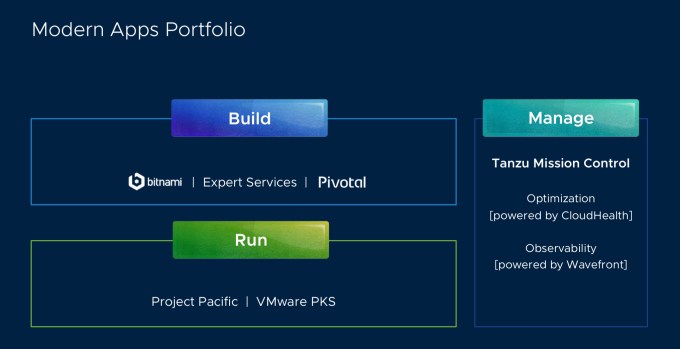
It’s an ambitious vision that involves bringing together not only VMware’s traditional VM management tooling and Kubernetes, but also open source pieces and other recent acquisitions including Bitnami and Cloud Health along with Wavefront, which it acquired in 2017. Although the vision was defined long before the acquisition of Pivotal last week, it will also play a role in this. Originally that was as a partner, but now it will be as part of VMware.

The idea is to eventually cover the entire gamut of building, running and managing applications in the enterprise. Among the key pieces introduced today as technology previews are the Tanzu Mission Control, a tool for managing Kubernetes clusters wherever the live and Project Pacific, which embeds Kubernetes natively into VSphere, the company’s virtualization platform, bringing together virtual machines and containers.

Screenshot 2019 08 26 08.07.38 1

VMware Tanzu. Slide: VMware

McLuckie sees bringing virtual machine and Kubernetes together in this fashion provides a couple of key advantages. “One is being able to bring a robust, modern API-driven way of thinking about accessing resources. And it turns out that there is this really good technology for that. It’s called Kubernetes. So being able to bring a Kubernetes control plane to Vsphere is creating a new set of experiences for traditional VMware customers that is moving much closer to a kind of cloud-like agile infrastructure type of experience. At the same time, Vsphere is bringing a whole bunch of capabilities to Kubernetes that’s creating more efficient isolation capabilities,” he said.

When you think about the cloud native vision, it has always been about enabling companies to manage resources wherever they live through a single lens, and this is what this set of capabilities that VMware has brought together under Tanzu, is intended to do. “Kubernetes is a way of bringing a control metaphor to modern IT processes. You provide an expression of what you want to have happen, and then Kubernetes takes that and interprets it and drives the world into that desired state,” McLuckie explained.

If VMware can take all of the pieces in the Tanzu vision and make this happen, it will be as powerful as McLuckie believes it to be. It’s certainly an interesting attempt to bring all of a company’s application and infrastructure creation and management under one roof using Kubernetes as the glue, and with Heptio co-founders McLuckie and Beda involved, it certainly has the expertise in place to drive the vision.

26 Aug 2019

Style recommendation startup Stylitics raises $15M

Stylitics, a startup powering outfit-based shopping recommendations for online retailers, is announcing that it has raised $15 million in Series B funding.

The company was initially known for ClosetSpace, a mobile app that provided consumers with outfit recommendations and inspiration.

While the app is still live, Stylitics’ focus has shifted to its retailer tools — for example, when you look at this blouse on the LOFT website or this shirt on the Banana Republic site, Stylitics is powering the “Ways to Wear It” and “Wear It With” widgets recommending other products that you could purchase to complete the outfit.

The company said it’s drawing on brand merchandising guidelines, engagement and purchase data from the retailer, broader trend data and stylists’ expertise to create these recommendations, which are updated as products sell out.

In an email, founder and CEO Reuben Deuskar (pictured above) added that Stylistics is able to provide useful recommendations from the start, without requiring time to train with a retailer’s data.

Stylitics

“We have billions of data points from powering outfitting on dozens of sites for more than four years, so we have a very good idea on Day One what an excellent and high performing outfit should look like for each product for a new customer,” Deuskar said.

Stylitics says it has driven $300 million for its retail partners — a group grown in the past year to include Ann Taylor, Calvin Klein, Chico’s, Gap, Kohl’s, Macy’s, Under Armour and White House Black Market.

The startup has now raised a total of $21 million. The new round was led by PeakSpan Capital, with participation from Trestle LP. PeakSpan co-founder Phil Dur is joining the Stylitics board.

“With the rapid growth of digital commerce, retailers are scrambling to keep pace with the consumer demand for more visually exciting and compelling shopping experiences,” Dur said in a statement.

The startup said it will use the money to grow its sales and marketing team while new developing new types of shoppable content and in-store experiences