Year: 2019

23 Aug 2019

FAA threatens $25,000 fine for weaponizing drones

It’s perfectly natural for a red-blooded American to, once they have procured their first real drone, experiment with attaching a flame thrower to it. But it turns out that this harmless hobby is frowned upon by the biggest buzzkills in the world… the feds.

Yes, the FAA has gone and published a notice that drones and weapons are “A Dangerous Mix.” Well, that’s arguable. But they’re the authority here so we have to hear them out.

“Perhaps you’ve seen online photos and videos of drones with attached guns, bombs, fireworks, flamethrowers, and other dangerous items. Do not consider attaching any items such as these to a drone because operating a drone with such an item may result in significant harm to a person and to your bank account.”

They’re not joking around with the fines, either. You could be hit with one as big as $25,000 for violating the FAA rules. Especially if you put your attack drone on YouTube.

That’s the ThrowFlame TF-19, by the way. TechCrunch in no way recommends or endorses this extremely awesome device.

Of course you may consider yourself an exception — perhaps you are a defense contractor working on hunter-killers, or a filmmaker who has to simulate a nightmare drone-dominated future. Or maybe you just promise to be extra careful.

If so, you can apply to the FAA through the proper channels to receive authorization for your drone-weaponizing operation. Of course, as with all other victimless crimes, if no one sees it, did a crime really occur? The FAA would no doubt say yes, absolutely, no question. So yeah, probably you shouldn’t do that.

wepdrone

23 Aug 2019

The Pad & Quill Gladstone Briefcase offers plenty of storage in a beautiful design

Pad & Quill makes some of the most handsome leather goods for the modern world and its Gladstone Leather Briefcase is no different. This bag harkens back to the day of gentleman with a newspapers tucked under their arms and an ascot on their head. This bag has an air of permanence and longevity and yet it’s designed for people with modern needs.

The bag features a smooth hinged top that opens to reveal a large opening. The bag doesn’t collapse inward when it’s empty or open; it retains its shape thanks to its sturdy structure making it easy to sort through the contents. The inside is lined with a tough herringbone fabric that seems like it will hold up well.

For me, the bag is heavy. It weighs over four pounds and that’s a lot for an empty bag. But with the weight comes confidence that it’s constructed out of durable leather.

[gallery ids="1873155,1873160,1873159,1873158,1873157,1873154,1873162"]

I’ve always been a big fan of Pad & Quill’s leather goods. I reviewed one of the company’s roll-top messenger bags last year and still use it. The leather has aged nicely with light scraps and scuffs adding to the character.

This bag has a traditional look thanks to the contrasting stitching. It might not be for everyone. It looks Western more than most modern leather goods. For me, I dig it as the stitches convey a sense of confidence in the quality. It looks the part.

Pad & Quill’s Gladstone bag has all the right organizational pockets. There’s a small exterior pocket on one side and a large, open pocket on the opposing side. Inside there’s a padded laptop pocket, a zippered pocket, and several small spots including a few spots for pens and pencils. This amount of organizational is rare in most leather bags. I’ve found most leather bags offer just a few compartments and instead look to the user to bring their own small bags to hold cables, cameras and the like.

This is a good size bag and able to easily hold a full-size laptop, DSLR and a lens or two. It’s thicker than a water bottle and has ample room to hold everything a person needs for a day.

The top is secured with a looping strap that feels a bit superficial. The hinges are tough enough to keep the top closed and the strap is a bit tough to secure. Maybe I need to use the bag a bit more. Over the couple weeks I carried this bag, I never used this strap nor felt like the top would accidentally open without it. Maybe this strap should be detachable?

The Gladstone costs $500 (though it’s on sale for $420 at time of publication) and it feels like it should last. It’s a lovely leather bag that uses a proven hinged opening. The leather is thick and durable. For me, that’s a winning combination.

23 Aug 2019

UK’s health data guardian sets a firm line for app development using patient data

The UK’s health data watchdog, the National Data Guardian (NDG), has published correspondence between her office and the national privacy watchdog which informed the ICO’s finding in 2017 that a data-sharing arrangement between an NHS Trust and Google-owned DeepMind broke the law.

The exchange was published following a Freedom of Information request by TechCrunch.

In fall 2015 the Royal Free NHS Trust and DeepMind signed a data-sharing agreement which saw the medical records of 1.6 million people quietly passed to the AI company without patients being asked for their consent.

The scope of the data-sharing arrangement — ostensibly to develop a clinical task management app — was only brought to light by investigative journalism. That then triggered regulatory scrutiny — and the eventual finding by the ICO that there was no legal basis for the data to have been transferred in the first place.

Despite that, the app in question, Streams — which does not (currently) contain any AI but uses an NHS algorithm for detecting acute kidney injury — has continued being used in NHS hospitals.

DeepMind has also since announced it plans to transfer its health division to Google. Although — to our knowledge — no NHS trusts have yet signed new contracts for Streams with the ad giant.

In parallel with releasing her historical correspondence with the ICO, Dame Fiona Caldicott, the NDG, has written a blog post in which she articulates a clear regulatory position that the “reasonable expectations” of patients must govern non-direct care uses for people’s health data — rather than healthcare providers relying on whether doctors think developing such and such an app is a great idea.

The ICO had asked for guidance from the NDG on how to apply the common law duty of confidentiality, as part of its investigation into the Royal Free NHS Trust’s data-sharing arrangement with DeepMind for Streams.

In a subsequent audit of Streams that was a required by the regulator, the trust’s law firm, Linklaters, argued that a call on whether a duty of confidentiality has been breached should be judged from the point of view of the clinician’s conscience, rather than the patient’s reasonable expectations.

Caldicott writes that she firmly disagrees with that “key argument”.

“It is my firm view that it is the patient’s perspective that is most important when judgements are being made about the use of their confidential information. My letter to the Information Commissioner sets out my thoughts on this matter in some detail,” she says, impressing the need for healthcare innovation to respect the trust and confidence of patients and the public.

“I do champion innovative technologies and new treatments that are powered by data. The mainstreaming of emerging fields such as genomics and artificial intelligence offer much promise and will change the face of medicine for patients and health professionals immeasurably… But my belief in innovation is coupled with an equally strong belief that these advancements must be introduced in a way that respects people’s confidentiality and delivers no surprises about how their data is used. In other words, the public’s reasonable expectations must be met.”

“Patients’ reasonable expectations are the touchstone of the common law duty of confidence,” she adds. “Providers who are introducing new, data-driven technologies, or partnering with third parties to help develop and test them, have called for clearer guidance about respecting data protection and confidentiality. I intend to work with the Information Commissioner and others to improve the advice available so that innovation can be undertaken safely: in compliance with the common law and the reasonable expectations of patients.

“The National Data Guardian is currently supporting the Health Research Authority in clarifying and updating guidance on the lawful use of patient data in the development of healthcare technologies.”

We reached out to the Royal Free NHS Trust and DeepMind for comment on the NDG’s opinion. At the time of writing neither had responded.

In parallel, Bloomberg reported this week that DeepMind co-founder, Mustafa Suleyman, is currently on leave from the company. (Suleyman has since tweeted that the break is temporary and for “personal” reasons, to “recharge”, and that he’s “looking forward to being back in the saddle at DeepMind soon”.)

The AI research company recently touted what it couched as a ‘breakthrough’ in predictive healthcare — saying it had developed an AI model for predicting the same condition that the Streams app is intended to alert for. Although the model was built using US data from the Department of Veterans Affairs which skews overwhelmingly male.

As we wrote at the time, the episode underscores the potential value locked up in NHS data — which offers population-level clinical data that the NHS could use to develop AI models of its own. Indeed, a 2017 government-commissioned review of the life sciences sector called for a strategy to “capture for the UK the value in algorithms generated using NHS data”.

The UK government is also now pushing a ‘tech-first’ approach to NHS service delivery.

Earlier this month the government announced it’s rerouting £250M in public funds for the NHS to set up an artificial intelligence lab that will work to expand the use of AI technologies within the service.

Last fall health secretary, Matt Hancock, set out his tech-first vision of future healthcare provision — saying he wanted “healthtech” apps and services to support “preventative, predictive and personalised care”.

So there are certainly growing opportunities for developing digital healthcare solutions to support the UK’s National Health Service.

As well as — now — clearer regulatory guidance that app development that wants to be informed by patient data must first win the trust and confidence of the people it hopes to serve.

23 Aug 2019

Samsung’s Note 10 is available today, starting at $949

Samsung’s settled into a nice little twice-yearly schedule for releasing flagships. That’s allowed the company double the opportunity to introduce some nice upgrades to their high-end Android handsets. Nearly six months after the release of the S10, the company just dropped the new Note line. Here’s a whole bunch of words I wrote about the 10+, the larger of the devices, which is helping distinguish the two lines with an utterly gigantic 6.8 inch screen.

Interestingly the Note 10 marks a rare (albeit very slight) step down in screen size over the last generation to a still large 6.3 inches. The company says it’s hoping that the smaller device will appeal to first time Note users and maybe even convince Galaxy S buyers to transfer over to S-Pen Station.

Samsung Galaxy Note10

The smaller size also helps keep the device just under $1,000, at $949. Which is become shockingly rarer amongst flagships these days. Even as fewer people are buyer phones, they keep getting more expensive. That certainly applies to the $1,100 Note 10+ and the $1,299 Note 10+ 5G (also available now, as a Verizon exclusive).

[gallery ids="1869169,1869168,1869167,1869165,1869164,1869163,1869162,1869160,1869159,1869158,1869157,1869156,1869152,1869154,1869155"]

The TLDR of last week’s review is that this is a very good phone that gets even better. Nothing particularly revolutionary, but it’s a nice design, great camera and just generally good stuff all the way around. If big and flashy is your thing, Samsung’s got you covered with the new Note.

23 Aug 2019

India exempts startups from long-standing ‘angel tax’

India today addressed a long-standing challenge that has been affecting the country’s booming startup ecosystem. As part of a raft of measures to boost overall economic growth from a five-year low, Finance Minister Nirmala Sitharaman said New Delhi is exempting startups from Section 56(2) — a provision more popularly known as an “angel tax” in the local income tax laws — that required startups to pay a certain tax if they received an investment at a rate higher than their “fair market valuation.”

Local tax authority in India does not recognize the discounted cash flow method that many investors use to value early-stage startups, and instead value the company for what it is worth currently, which as you can imagine, is very little. Investors assess a startup’s value based on what it could eventually become in the future.

Prior to today’s announcement, the government levied a 30% tax on affected startups. Sitharaman said any startup that is registered with the Department of Industrial Policy & Promotion, a government body, will be exempted from the angel tax. Those not registered will remain subjected to it, she said in a press conference Friday.

More than 24,000 startups are currently registered with the Department of Industrial Policy & Promotion. The law was originally introduced amid concerns that wealthy people could invest in bogus startups as a way to launder money.

“Angel tax was there to stop shell companies from creating capital from nowhere,” Piyush Goyal, a minister for commerce and industry as well as railways, said in a statement Friday.

The angel tax, which was introduced in 2012, impacted only the local investors, becoming a roadblock for many citizens from funding early-stage startups. The announcement today comes weeks after the Narendra Modi government said it would address this issue.

Many prominent investors, startup founders, analysts and other industry executives have long publicly criticized the angel tax, telling the government that it is severely hurting the health of the local ecosystem.

Anand Mahindra, chairman of Mahindra Group, said last year that the angel tax needs “immediate attention or else all chances of building a rival to Silicon Valley in India will be lost.”

Sreejith Moolayil, a founder of health food startup True Elements, said the existence of an angel tax would leave many entrepreneurs like him with no choice but to shut down their companies.

Late last year, India’s tax department sent a flurry of notices to startups demanding them to pay the angel tax on funds they received from individual investors. The notices sparked an uproar, with many calling it “harassment.”

“Hope this will address the concerns of DPIIT registered startups. The proposed cell should look into concerns of all startups including those who are already under notice,” said Ashish Aggarwal, who oversees Public Policy at industry body Nasscom, of today’s announcement.

The government will also set up a dedicated cell to address other tax problems that startups face, Sitharaman said. “A startup having any income-tax issue can approach the cell for quick resolution,” the ministry said in a statement.

Jayanth Kolla, founder and chief analyst at research firm Convergence Catalyst, told TechCrunch earlier that the angel tax was the primary reason early-stage startups in the nation were struggling to raise money from investors.

Even as Indian tech startups raised a record $10.5 billion in 2018, early-stage startups saw a decline in the number of deals they participated in and the amount of capital they received. Early-stage startups participated in 304 deals in 2018 and raised $916 million in funds last year, down from $988 million they raised from 380 rounds in 2017 and $1.096 billion they raised from 430 deals the year before, research firm Venture Intelligence told TechCrunch.

Sitharaman also announced the country was scrapping a recently introduced additional levy on foreign funds. The government would revoke the surcharge, which increased tax on foreign companies investing in India to over 40%, she said. She also promised to pay out all pending tax refunds owed to small and medium enterprises within 30 days. Companies have long complained that the tax authority takes too much time to refund the money owed to them.

23 Aug 2019

The 2020 Chevy Bolt EV now has a 259-mile range thanks to some cell chemistry tinkering

The 2020 Chevy Bolt EV now has 259 miles of range, a 9% increase from previous year models of the electric hatchback, according to the EPA.

To get there, the company focused on cell chemistry, not the battery pack. The GM brand did not add more battery cells or change the battery pack or the way it is integrated into the vehicle structure, a spokesperson confirmed.

Instead, Chevrolet’s battery engineering team made what the company described as “impactful changes to the cell chemistry.” The changes to the cell chemistry allowed the team to improve the energy of the cell electrodes, and ultimately enabled them to squeeze more range out of the battery.

The increase pushes the 2020 Chevy Bolt ahead of the Kia Niro and the standard range plus variant of the Tesla Model 3, with 239 and 240 miles of range respectively. Other versions of the Model 3, the long range and performance, have a much longer 310-mile range. It’s also just one mile better than the 258-mile range Hyundai Kona EV. Nissan Leaf Plus, the laggard in the group, can travel 226 miles on a single charge.

That might not seem like much. But in this small, yet growing pool of electric vehicle models, jumping from 238 to 259 miles  could help Chevrolet sell more Bolt EVs next year. It could also cannibalize sales this year.

The electric vehicle has never been a top seller for the GM brand, particularly compared to its top-selling SUVs and trucks. It has beat out some of its other Chevy models and sales are high enough for the company to stick with the compact hatchback for now.

GM delivered 23,297 Chevy Bolt EVs in 2017, the first model year of the electric vehicle. But the following year, deliveries fell 22% to 18,019. Sales have rebounded in the first half of the year.

The 2020 model year, which will be offered in two new exterior colors, is expected to arrive in dealerships later this year. The base price of the electric vehicle is $37,495, which includes destination and freight charges. Tax, title, license and dealer fees are excluded.

23 Aug 2019

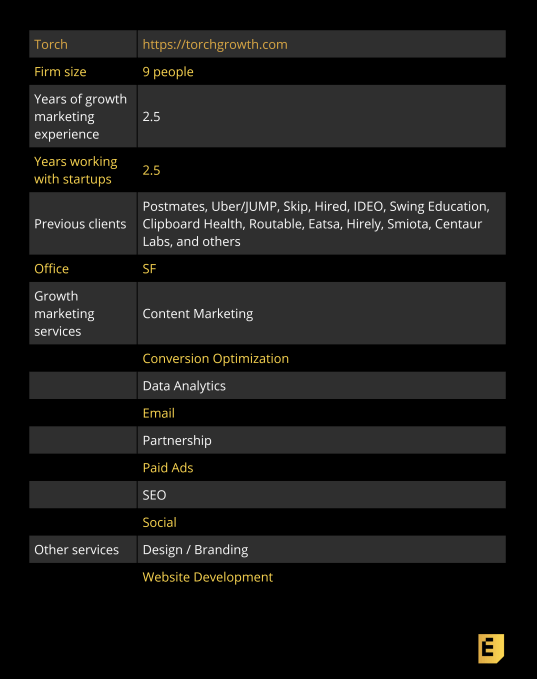
Verified Expert Growth Marketing Agency: Torch

CEO Jeremy OBriant never intended to create Torch, an agile growth marketing agency based in San Francisco. He started his career as a CPA, but after leading a growth team at Sidecar and running growth projects on his own, forming Torch was the most obvious thing to do. He now leads a team that implements “agile growth,” an iterative approach that involves setting clear goals and running smaller experiments over the course of monthly sprints. Learn more about their approach to growth, their ideal client, and more.

“Torch offers custom solutions to whatever you need. They are fast and deliver on what they promise. They are also scrappy and willing to try stuff to solve unique needs.” Head of Product in SF

Torch’s approach to growth

We aim to be the thought leaders of Agile Growth. We didn’t invent the term, but we are certainly becoming the leading voice of the process in the growth marketing world. Agile simply means being able to move quickly and with ease. We start with clearly defined business goals and prioritize growth tactics based on the impact, cost, and efficiency. Then collaborate with growth teams to execute a handful of items in recurring growth sprints, typically on a monthly cadence.”

On their ideal client

“Our ideal partner has product-market fit, is redefining their category, and is ready to scale in a sustainable way. We are very strategic in the types of businesses we work with and steer clear of doing narrow prescriptive tactics. We love to collaborate with partners that are open to taking a fresh strategic look at their entire growth stack and embrace the agile approach to discover the right strategy for their unique situation.”

designer fast facts 37

Below, you’ll find the rest of the founder reviews, the full interview, and more details like pricing and fee structures. This profile is part of our ongoing series covering startup growth marketing agencies with whom founders love to work, based on this survey and our own research. The survey is open indefinitely, so please fill it out if you haven’t already. 

Interview with Torch CEO Jeremy OBriant

Jeremy OBriant

Yvonne Leow: Tell me about your background and how you became a growth marketer. 

Jeremy OBriant: People are often surprised when I tell them I started my career as a CPA. I ended up working in the trenches on several M&A deals and heard lots of founding stories from entrepreneurs.

23 Aug 2019

Facebook really doesn’t want you to read these emails

Oh hey y’all, it’s Friday! It’s August! Which means it’s a great day for Facebook to drop a little news it would prefer you don’t notice. News that you won’t find a link to on the homepage of Facebook’s Newsroom — which is replete with colorfully illustrated items it does want you to read (like the puffed up claim that “Now You Can See and Control the Data That Apps and Websites Share With Facebook”.)

The blog post Facebook would really prefer you didn’t notice is tucked away in a News sub-section of this website — where it’s been confusingly entitled: Document Holds the Potential for Confusion. And has an unenticing grey image of a document icon to further put you off — just in case you happened to stumble on it after all. It’s almost as if Facebook is saying ‘definitely don’t click here‘…
ca update grey

So what is Facebook trying to bury in the horse latitudes of summer?

An internal email chain, starting September 2015, which shows a glimpse of what Facebook’s own staff knew about the activity of Cambridge Analytica prior to The Guardian‘s December 2015 scoop — when the newspaper broke the story that the controversial (and now defunct) data analytics firm, then working for Ted Cruz’s presidential campaign, had harvested data on millions of Facebook users without their knowledge and/or consent, and was using psychological insights gleaned from the data to target voters.

Facebook founder Mark Zuckerberg’s official timeline of events about what he knew when vis-a-via the Cambridge Analytica story has always been that his knowledge of the matter dates to December 2015 — when the Guardian published its story.

But the email thread Facebook is now releasing shows internal concerns being raised almost two months earlier.

This chimes with previous (more partial) releases of internal correspondence pertaining to Cambridge Analytica  — which have also come out as a result of legal actions (and which we’ve reported on previously here and here).

If you click to download the latest release, which Facebook suggests it ‘agreed’ with the District of Columbia Attorney General to “jointly make public”, you’ll find a redacted thread of emails in which Facebook staffers raise a number of platform policy violation concerns related to the “political partner space”, writing September 29, 2915, that “many companies seem to be on the edge- possibly over”.

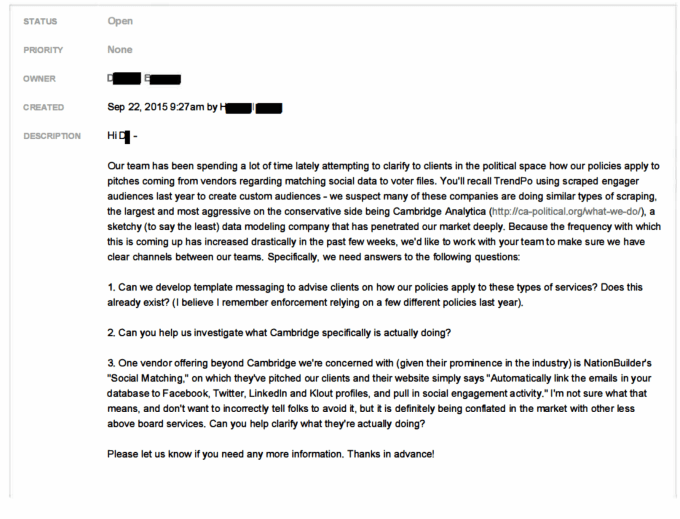
Cambridge Analytica is first identified by name — when it’s described by a Facebook employee as “a sketchy (to say the least) data modelling company that has penetrated our market deeply” — on September 22, 2015, per this email thread. It is one of many companies the staffer writes are suspected of scraping user data — but is also described as “the largest and most aggressive on the conservative side”.
Screenshot 2019 08 23 at 16.34.15

On September 30, 2015, a Facebook staffer responds to this, asking for App IDs and app names for the apps engaging in scraping user data — before writing: “My hunch is that these apps’ data-scraping is likely non-compliant”.

“It would be very difficult to engage in data-scraping activity as you described while still being compliant with FPPs [Facebook Platform Policies],” this person adds.

Cambridge Analytica gets another direct mention (“the Cambridge app”) on the same day. A different Facebook staffer then chips in with a view that “it’s very likely these companies are not in violation of any of our terms” — before asking for “concrete examples” and warning against calling them to ask questions unless “red flags” have been confirmed.

On October 13, a Facebook employee chips back into the thread with the view that “there are likely a few data policy violations here”.

The email thread goes on to discuss concerns related to additional political partners and agencies using Facebook’s platform at that point, including ForAmerica, Creative Response Concepts, NationBuilder and Strategic Media 21. Which perhaps explains Facebook’s lack of focus on CA — if potentially “sketchy” political activity was apparently widespread.

On December 11 another Facebook staffer writes to ask for an expedited review of Cambridge Analytica — saying it’s “unfortunately… now a PR issue”, i.e. as a result of the Guardian publishing its article.

The same day a Facebook employee emails to say Cambridge Analytica “is hi pri at this point”, adding: “We need to sort this out ASAP” — a month and a half after the initial concern was raised.

Also on December 11 a staffer writes that they had not heard of GSR, the Cambridge-based developer CA hired to extract Facebook user data, before the Guardian article named it. But other Facebook staffers chip in to reveal personal knowledge of the psychographic profiling techniques deployed by Cambridge Analytica and GSR’s Dr Aleksandr Kogan, with one writing that Kogan was their postdoc supervisor at Cambridge University.

Another says they are friends with Michal Kosinsky, the lead author of a personality modelling paper that underpins the technique used by CA to try to manipulate voters — which they described as “solid science”.

A different staffer also flags the possibility that Facebook has worked with Kogan — ironically enough “on research on the Protect & Care team” — citing the “Wait, What thread” and another email, neither of which appear to have been released by Facebook in this ‘Exhibit 1’ bundle.

So we can only speculate on whether Facebook’s decision — around September 2015 — to hire Kogan’s GSR co-founder, Joseph Chancellor, appears as a discussion item in the ‘Wait, What’ thread…

Putting its own spin on the release of these internal emails in a blog post, Facebook sticks to its prior line that “unconfirmed reports of scraping” and “policy violations by Aleksandr Kogan” are two separate issues, writing:

We believe this document has the potential to confuse two different events surrounding our knowledge of Cambridge Analytica. There is no substantively new information in this document and the issues have been previously reported. As we have said many times, including last week to a British parliamentary committee, these are two distinct issues. One involved unconfirmed reports of scraping — accessing or collecting public data from our products using automated means — and the other involved policy violations by Aleksandr Kogan, an app developer who sold user data to Cambridge Analytica. This document proves the issues are separate; conflating them has the potential to mislead people.

It has previously also referred to the internal concerns raised about CA as “rumors”.

“Facebook was not aware that Kogan sold data to Cambridge Analytica until December 2015. That is a fact that we have testified to under oath, that we have described to our core regulators, and that we stand by today,” it adds now.

It also claims that after an engineer responded to concerns that CA was scraping data and looked into it they were not able to find any such evidence. “Even if such a report had been confirmed, such incidents would not naturally indicate the scale of the misconduct that Kogan had engaged in,” Facebook adds.

The company has sought to dismiss the privacy litigation brought against it by the District of Columbia which is related to the Cambridge Analytica scandal — but has been unsuccessful in derailing the case thus far.

The DC complaint alleges that Facebook allowed third-party developers to access consumers’ personal data, including information on their online behavior, in order to offer apps on its platform, and that it failed to effectively oversee and enforce its platform policies by not taking reasonable steps to protect consumer data and privacy. It also alleges Facebook failed to inform users of the CA breach.

Facebook has also failed to block another similar lawsuit that’s been filed in Washington, DC by Attorney General Karl Racine — which has alleged lax oversight and misleading privacy standards.


23 Aug 2019

Nonprofits and NGOs: Exhibit at TechCrunch Disrupt SF 2019

Nonprofit groups and NGOs are now invited to apply for exhibit space in Startup Alley at TechCrunch Disrupt SF on Friday, October 4th.

Founded in 2014, TechCrunch Include leverages our extensive network to support underserved and underrepresented groups in tech. Two years ago, we began to invite nonprofit and NGO groups to exhibit at the conference, as well as provide tickets for the event. This year, TechCrunch will host 10 nonprofits or NGOs at the Moscone Center at Startup Alley inside Disrupt SF.

TechCrunch Disrupt’s Startup Alley is the heart of the conference show floor. Filled with early-stage startups, Startup Alley is the prime location to connect with startups, network with investors and engage with more than 100 corporate partners at the show. Participation in the Alley will give nonprofits and NGOs a unique opportunity to engage with the brightest tech talent, entrepreneurs and prominent investors from around the globe. Not to mention hundreds of press in attendance!

Nonprofits and NGOs are eligible if they support an underrepresented or underserved community in tech, have registered 501c3 or an equivalent status for at least three years and did not participate at a TC Disrupt in 2018. Organizations that are selected will be asked to engage with their communities regarding the conference after selection. Preference will be given to local organizations.

Applications are open now til Wednesday September 4th. Groups will be notified of their participation status September 6th. If you have additional questions, please email startupalley@techcrunch.com.

Apply now!

23 Aug 2019

Japan’s ispace now aims for a lunar landing in 2021, and a Moon rover deployment in 2023

One of the private companies aiming to deliver a commercial lunar lander to the Moon has adjusted the timing for its planned mission, which isn’t all that surprising given the enormity of the task. Japanese startup ispace is now targeting 2021 for their first lunar landing, and 2023 for a second lunar mission that will also include deploying a rover on the Moon’s surface.

The company’s ‘HAKUTO-R’ program was originally planned to to include a mission in 2020 that would involve sending a lunar orbital vehicle for demonstration purposes without any payloads, but that part of the plan has been scrapped in favor of focusing all efforts on delivering actual payloads for commercial customers by 2021 instead.

This updated focus, the company says, is due mostly to the speeding up of the global market for private launch services and payload delivery, including for things like NASA’s Commercial Lunar Payload Services program, wherein the agency is looking for a growing number of private contractors to support its own needs in terms of getting stuff to the Moon.

ispace itself isn’t on the list of 9 companies selected in round one of NASA’s program, but the Japanese company is supporting American non-profit Draper in its efforts, which was one fo the chosen. The Draper/ispace team-up happened after ispace’s initial commitment to its 2020 orbital demo, so its change in priorities makes sense given the new tie-up.

HAKUTO-R will use SpaceX’s Falcon 9 for its first missions, and the company has also signed partnerships with JAXA, Japan’s space agency, as well as new corporate partners including Suzuki, Sumitomo Corporation, Shogakukan, and Citizen Watch.