Year: 2019

22 Aug 2019

Watch YC CEO Michael Seibel chat startups, prices, and tech’s center of gravity

This week, nearly 200 startups convened at Y Combinator Demo Day to pitch venture capitalists, angels and other folks looking to spend some money.

YC chief executive officer Michael Seibel took some time out of his busy schedule to join us on a special episode of Equity, TechCrunch’s venture-capital-focused podcast. Given that we had Seibel to chat with, Kate and Alex decided to drop the regular format and riff interview-style about what the accelerator program is up to.

We discussed the new startup batch (roundups here, here, and here), recent changes to the program, rising deal prices, SAFEs versus convertible notes and the future of technology in San Francisco. Regarding price, here’s what Seibel had to say:

“It’s a competitive market where investors are bidding against each other. So if you see pricing go up you have to ask yourself the question, ‘where is the money supply coming from?’ The big trend over the last six years has been institutional investors moving from just kind of Series A funds and growth funds down to the seed level. When you looked at Demo Day when I was going through the first time it was full of angels – people investing off their own personal balance sheet. And if you look at the room today it’s full of funds. The reality is that, as the pool of capital increases in the seed world, the seed investors are competing against each other and one of the easier ways for investors to compete is to bid up price.”

But, Seibel continued, YC doesn’t necessarily consider the situation a net-positive, because companies that raise such huge rounds can spend money as though they had reached the fabled “product-market fit,” when in reality they have not. They just have money, which can feel the same but is not.

Ultimately, the thing that’s going to kill you, Seibel says, isn’t fundraising or who you raised from. The thing that’s going to kill you, he says, is that you didn’t build something your customers wanted.

Watch a clip from the interview here:

To hear more from Seibel and watch four more video clips discussing YC, the new class, and the startup game in San Francisco and beyond, become an Extra Crunch member. You can learn more and try it for free. 

22 Aug 2019

Pew: mobile and social media users in emerging markets have more diverse social networks

The latest study from Pew Research Center takes a look at the impact mobile technology, including the use of smartphones and social media, is having on the diversity of people’s social network in emerging markets. For the purpose of the study, Pew surveyed mobile users in eleven key markets: Mexico, Venezuela, Colombia, South Africa, Kenya, India, Vietnam, the Philippines, Tunisia, Jordan, and Lebanon. It found that users in these markets had broader social networks than those without smartphones and social media.

In the U.S., we’ve been concerned with social media’s ability to create “filter bubbles” — meaning how we surround ourselves online with people who hold the same opinions as us, which is then reinforced by social media’s engagement-focused algorithms. This leads us to believe, sometimes in error, that what we think is the most correct and most popular view.

According to Pew’s study, emerging markets are experiencing a somewhat different phenomenon.

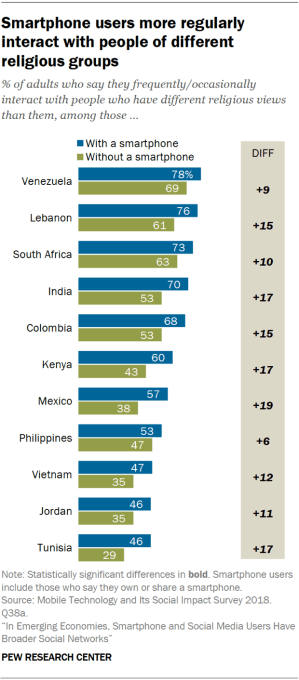
Instead of isolation, the study found that smartphone users in these markets, and particularly those who also used social media, were more regularly exposed to people with different racial and ethnic backgrounds, different religious preferences, different political parties, and different income levels, compared to those without a smartphone.

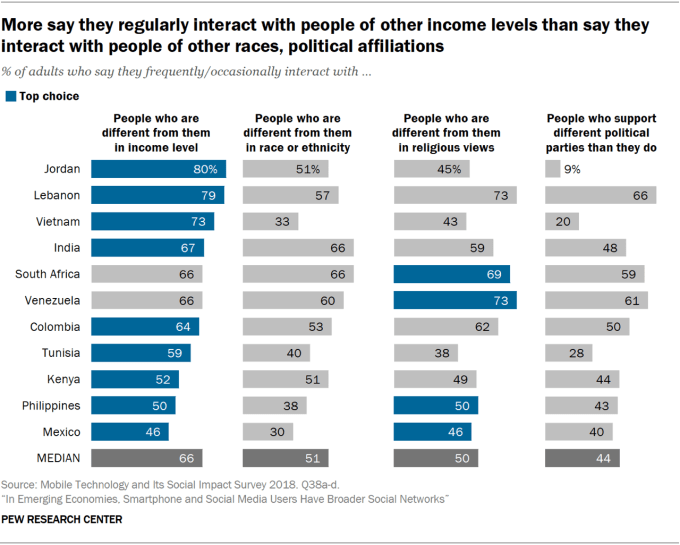
In Mexico, for example, 57% of smartphone owners regularly interacted with people of other religions, while only 38% of those without a smartphone did. And more than half (54%) interact with people who supported different political parties. They were also 24% more like to interact with people of different income levels, and 17% more likely to interact with people of different ethnic or racial backgrounds.

PI PG 2019.08.22 Social Networks Emerging Economies 0 01

These sorts of trends help up across the nations studied, Pew noted, with a median of 66% saying they interacted with people with different income levels, 51% saying they interacted with a those of different race or ethnicity, 50% saying they interacted with those having different religious views, and a median 44% saying they interacted with those who supported a different political party.

PI PG 2019.08.22 Social Networks Emerging Economies 2 03 1

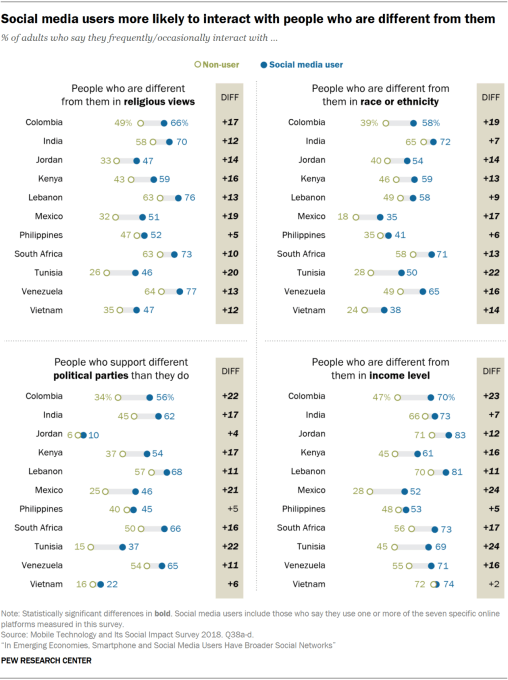
The use of social media and messaging apps was found to be a huge contributor here, as it made people more likely to encounter people different from them, the study also said.

PI PG 2019.08.22 Social Networks Emerging Economies 2 04

The report, however, isn’t claiming that smartphone and the related social media use are the cause of this increase in diversity in these people’s lives. There may be other reasons for that. Smartphone owners, in general, may have more resources and money — they own a smartphone, after all — and this alone could help expose them to a more diverse group of people.

That said, smartphones are helping people stay connected to distant family and friends, and build out online networks of people they don’t ever see in person.

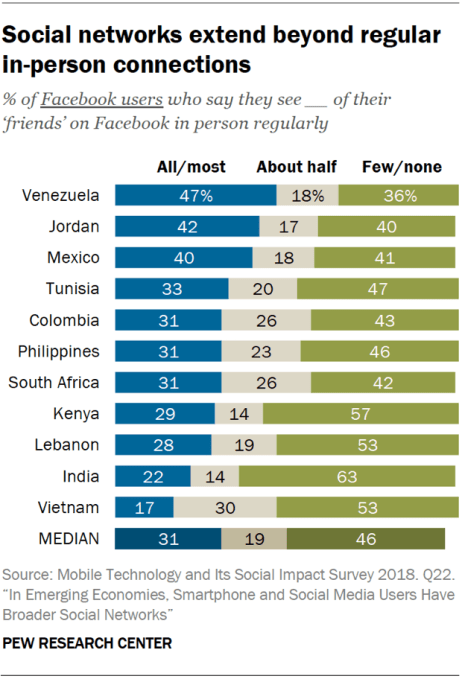
More than half of people in most of the surveyed countries said that only see half — or fewer — of the people they call or text in person. 93% said they keep in touch with far-flung contacts. And a median of 46% said they see their few or none of Facebook friends regularly.

PI PG 2019.08.22 Social Networks Emerging Economies 2 01

All this connecting isn’t seen as being fully positive, however.

An earlier Pew report found that users in these 11 countries believe the internet and social media are making people more divided in their opinions and only sometimes more accepting of different views. Exposure to diversity and acceptance of it are different things.

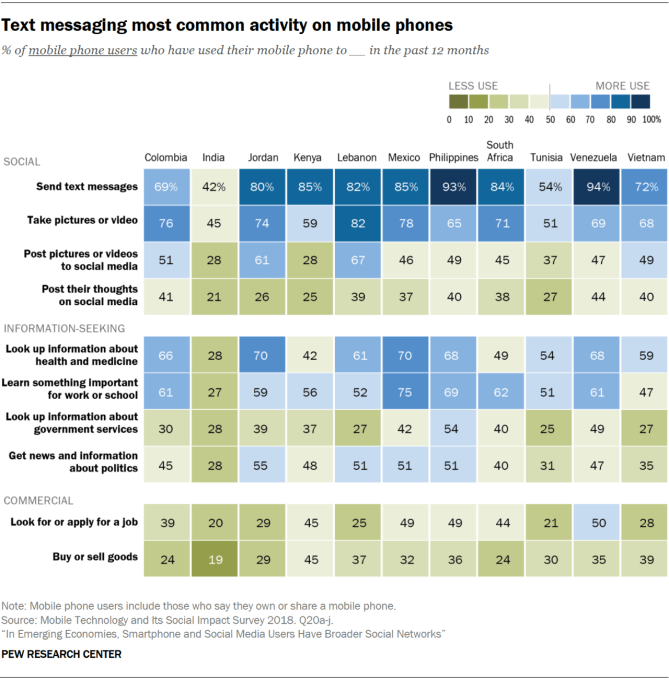
The new report also gets into how smartphones are used. For example, a median of 82% said they texted, 69% took photos or videos, 61% looked up health information, 47% looked up news and political information, and 37% looked up information about government resources.

PI PG 2019.08.22 Social Networks Emerging Economies 0 03

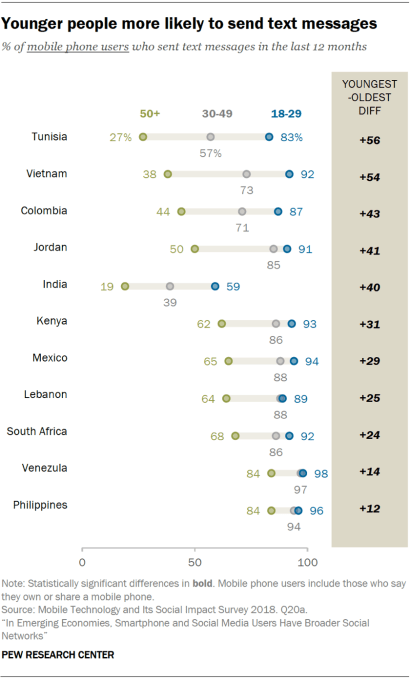
It also examined smartphones’ impact on digital divides, noting that people with access to these devices and social media, as well as younger people, those with higher levels of education and men, were gaining more benefits than others.

PI PG 2019.08.22 Social Networks Emerging Economies 0 04

The study is based on in-person interviews conducted by D3 Systems, Inc. and the results are based on national samples, notes Pew.

The full report is available here, with deeper dives on activities and data by individual countries.

22 Aug 2019

Amazon is acquiring 49% stake in India’s Future Coupons

Amazon, which has invested over $6 billion in India’s growing internet market, just invested a little more to expand its foothold in the the world’s second largest internet market. The U.S. e-commerce giant has acquired a 49% stake in Future Coupons, a group entity owned by India’s second largest retail chain Future Group, the latter said in a regulatory filing Thursday evening (local time).

In a statement to TechCrunch, an Amazon spokesperson said, “Amazon has agreed to invest in Future Coupons Limited, which is engaged in developing innovative value-added payment products and solutions such as corporate gift cards, loyalty cards, and reward cards primarily for corporate and institutional customers. This investment will enhance Amazon’s existing portfolio of investments in the payments landscape in India.”

“Pursuant to these agreements, Amazon has agreed to make an equity investment in Future Coupons Limited for acquiring a 49% stake comprising both, voting and non-voting shares. As part of the agreement, Amazon has been granted a call option,” Future Retail said in a filing (PDF) to the local stock exchange.

As part of the agreement, Amazon has the option to “acquire all or part of the Promoters’ shareholding in it Future Retail Limited” bwteeen the third and tenth year in “certain circumstances, subject to applicable law.” Future Coupons owns about 7.3% stake in Future Retail, according to past regulatory filings.

Financial terms of the deal were not disclosed.

“The Promoters have also agreed to certain share transfer restrictions on their shares in the Company for same tenure, including restrictions to not transfer shares to specified persons, a right of first offer in favour of Amazon, all of which are subject to mutually agreed exceptions (such as liquidity allowances and affiliate transfers). The transaction contemplated above is subject to obtaining applicable regulatory approvals and customary closing conditions,” Future Retail added.

Future Retail can’t directly sell stake in Amazon, so it is routing it through one of its entities. Future Retail runs over 2,000 stores, including “Big Bazaar” retail stores, across 400 cities in India.

This is a developing story. More to follow…

22 Aug 2019

Tumblr’s next step forward with Automattic CEO Matt Mullenweg

After months of rumors, Verizon finally sold off Tumblr for a reported $3 million — a fraction of what Yahoo paid for the once might blogging service back in 2013.

The media conglomerate (which also owns TechCrunch) was clearly never quite sure what to do with the property after gobbling it up as part of its 2016 Yahoo acquisition. All parties has since come to the conclusion that Tumblr simply wasn’t a good fit under either the Verizon or Yahoo umbrella, amounting to a $1.1 billion mistake.

For Tumblr, however, the story may still have a happy ending. By all accounts, its new home at Automattic is far better fit. The service joins a portfolio that includes popular blogging service WordPress.com, spam filtering service Akismet and long-form storytelling platform, Longreads.

In an interview, this week, Automattic founder and CEO Matt Mullenweg discussed Tumblr’s history and the impact of the poorly received adult content restrictions. He also shed some light on where Tumblr goes from here, including a potential increased focused on multimedia such as podcasting.

Brian Heater: I’m curious how [your meetings with Tumblr staff] went. What’s the feeling on the team right now? What are the concerns? How are people feeling about the transition?

22 Aug 2019

Mobile gaming is a $68.5 billion global business, and investors are buying in

By the end of 2019, the global gaming market is estimated to be worth $152 billion with 45% of that, $68.5 billion, coming directly from mobile games. With this tremendous growth (10.2% YoY to be precise) has come a flurry of investments and acquisitions, everyone wanting a cut of the pie. In fact, over the last 18 months, the global gaming industry has seen $9.6 billion in investments and if investments continue at this current pace, the amount of investment generated in 2018-19 will be higher than the 8 previous years combined.

What’s interesting is why everyone is talking about games and who in the market is responding to this and how.

The gaming phenomenon 

Today, mobile games account for 33% of all app downloads, 74% of consumer spend, and 10% of all time spent in-app. It’s predicted that in 2019, 2.4 billion people will play mobile games around the world – that’s almost one third of the global population. In fact, 50% of mobile app users play games, making this app category as popular as music apps like Spotify and Apple Music and second only to social media and communications apps in terms of time spent.

In the US, time spent on mobile devices has also officially outpaced that of television – with users spending 8 more minutes per day on their mobile devices. By 2021, this number is predicted to increase to over 30 minutes. Apps are the new primetime and games have grabbed the lion’s share.

Accessibility is the highest it’s ever been as barriers to entry are virtually non-existent. From casual games to the recent rise of the wildly popular hyper-casual genre of games which are quick to download, easy to play, and lend themselves to being played in short sessions throughout the day, games are played by almost every demographic stratum of society. Today, the average age of a mobile gamer is 36.3 (compared with 27.7 in 2014), the gender split is 51% female, 49% male, and one-third of all gamers are between the ages of 36-50. A far cry from the traditional stereotype of a ‘gamer’.

With these demographic, geographic, and consumption sea-changes in the mobile ecosystem and entertainment landscape, it’s no surprise that the game space is getting increased attention and investment, not just from within the industry, but more recently from traditional financial markets and even governments. Let’s look at how the markets have responded to the rise of gaming.

Image courtesy of David Maung/Bloomberg via Getty Images

Games on Games 

The first substantial investments in mobile gaming came from those who already had a stake in the industry. Tencent invested $90M in Pocket Gems and$126M in Glu Mobile (for a 14.6% stake), gaming powerhouse Supercell invested $5M in mobile game studio Redemption Games, Boom Fantasy raised $2M from ESPN and the MLB and Gamelynx raised $1.2M from several investors – one of which was Riot Games. Most recently, Ubisoft acquired a 70% stake in Green Panda Games to bolster its foot in the hyper-casual gaming market.

Additionally, bigger gaming studios began to acquire smaller ones. Zynga bought Gram Games, Ubisoft acquired Ketchapp, Niantic purchased Seismic Games, and Tencent bought Supercell (as well as a 40% stake in Epic Games). And the list goes on.

Wall Street wakes up

Beyond the flurry of investments and acquisitions from within the game industry, games are also generating huge amounts of revenue. Since launch, Pokemon Go has generated $2.3B in revenue and Fortnite has amassed some 250M players. This is catching the attention of more traditional financial institutions, like private equity firms and VCs, who are now looking at a variety of investment options in gaming – not just of gaming studios, but all those who had a stake in or support the industry.

In May 2018, hyper-casual mobile gaming studio Voodoo announced a $200M investment from Goldman Sachs’ private equity investment arm. For the first time ever, a mobile gaming studio attracted the attention of a venerable old financial institution. The explosion of the hyper-casual genre and the scale its titles are capable of achieving, together with the intensely iterative, data-driven business model afforded by the low production costs of games like this, were catching the attention of investors outside of the gaming world, looking for the next big growth opportunity.

The trend continued. In July 2018, private equity firm KKR bought a $400M minority stake in AppLovin and now, exactly one year later Blackstone announced their plan to acquire mobile ad-network Vungle for a reported $750M. Not only is money going into gaming studios, but investments are being made into companies whose technology supports the mobile gaming space. Traditional investors are finally taking notice of the mobile gaming ecosystem as a whole and the explosive growth it has produced in recent years. This year alone mobile games are expected to generate $55B in revenue so this new wave of investment interest should really come as no surprise.

A woman holds up her cell phone as she plays the Pokemon Go game in Lafayette Park in front of the White House in Washington, DC, July 12, 2016. (Photo: JIM WATSON/AFP/Getty Images)

Government intervention

Most recently, governments are realizing the potential and reach of the gaming industry and making their own investment moves. We’re seeing governments establish funds that support local gaming businesses – providing incentives for gaming studios to develop and retain their creatives, technology, and employees locally – as well as programs that aim to attract foreign talent.

As uncertainty looms in England surrounding Brexit, France has jumped on the opportunity with “Join the Game”. They’re painting France as an international hub that is already home to many successful gaming studios, and they’re offering tax breaks and plenty of funding options – for everything from R&D to the production of community events. Their website even has an entire page dedicated to “getting settled in France”, in English, with a step-by-step guide on how game developers should prepare for their arrival.

The UK Department for International Trade used this year’s Game Developers Conference as a backdrop for the promotion of their games fund – calling the UK “one of the most flourishing game developing ecosystems in the world.” The UK Games Fund allows for both local and foreign-owned gaming companies with a presence in the UK to apply for tax breaks. And ever since France announced their fund, more and more people have begun encouraging the British government to expand their program saying that the UK gaming ecosystem should be “retained and enhanced”. But, not only does the government take gaming seriously, the Queen does as well. In 2008, David Darling the CEO of hyper-casual game studio Kwalee was made a Commander of the Order of the British Empire (CBE) for his services to the games industry. CBE is the third-highest honor the Queen can bestow on a British citizen.

Over to Germany, and the government has allocated 50M euros of its 2019 budget for the creation of a games fund. In Sweden, the Sweden Game Arena is a public-private partnership that helps students develop games using government-funded offices and equipment. It also links students and startups with established companies and investors. While these numbers dwarf the investment of more commercial or financial players, the sudden uptick in interest governments are paying to the game space indicate just how exciting and lucrative gaming has become.

Support is coming from all levels

The evolution of investment in the gaming space is indicative of the stratospheric growth, massive revenue, strong user engagement, and extensive demographic and geographic reach of mobile gaming. With the global games industry projected to be worth a quarter of a trillion dollars by 2023, it comes as no surprise that the diverse players globally have finally realized its true potential and have embraced the gaming ecosystem as a whole.

22 Aug 2019

Hey students, launch your startup this year with this special Extra Crunch discount

Entrepreneurship is on the rise, and nowhere is that more true than on college campuses. Students are ditching boring office jobs to seek out their own opportunities, whether that is launching a bootstrapped app, contributing to an open-source project, or building a venture-scalable startup.

Here at Extra Crunch, our mission is to go behind the headlines that cross our desks here at TechCrunch every day to ask how founders build great startups. How did they get started? How did they raise funding? How did they hire, and how did they handle the immigration processes often associated with new hires? How did they build out marketing channels? And when all of those parts work out, how do they exit? We work relentlessly to bring that expert knowledge to our members every single day.

Whether you’re a lifelong entrepreneur who started your first business at five years old or just someone discovering that startups and building products can be a career onto themselves, we are here to help you every step of the way.

And now, we want to make it even easier to access that help. For back to school this year, we are offering students a special subscription rate of $50 per year (regular price: $150) with similar discounts for international members. All you have to do is send an email using your school address to extracrunch@techcrunch.com and our founder success team will get you all squared away.

And if you want to sign up your entire startup or entrepreneurship club — we are offering volume discounts as well for student groups. Reach out to Travis Bernard travis@techcrunch.com if you are interested in bulk student rates, and make sure you include how many students you have in your group.

The world needs more innovation and more entrepreneurship. We hope Extra Crunch can be your first step to the next category-defining company.

22 Aug 2019

Reliability concerns raised over pi-top’s STEM learning laptop

TechCrunch has learned of a safety issue and a number of product reliability questions being raised about a modular computer made by a London edtech startup that’s intended for children to learn coding and electronics.

The product, called the pi-top 3, is a Raspberry Pi-powered laptop with a keyboard that slides out to access a rail for breadboarding electronics.

A student at a US school had to be attended by a nurse after touching a component in the device which had overheated, leaving them with redness to their finger.

A spokesperson for Cornell Tech confirmed the incident to us — which they said had happened in June. We’ve withheld the name of the school at their request.

In an internal pi-top email regarding this incident, which we’ve also reviewed, it describes the student being left with “a very nasty finger burn”.

Cornell Tech’s spokesperson told us it has stopped using the pi-top 3 — partly in response to this incident but also because of wider reliability issues with the device. They said some of their grad students will be working on a project with the K-12 team next semester with the aim of creating an alternative that’s more reliable, affordable and safe.

We have also been told of concerns about wider reliability issues with the pi-top 3 by a number of other sources.

We asked pi-top for comment on the safety incident at Cornell Tech and for details of how it responded. The company provided us with a statement in which it claims: “pitop incorporates all possible safeguards into our products to ensure they are safe.”

“As soon as we became aware of this incident we immediately investigated what had happened,” it went on. “We discovered that the incident was a one-in-a-million occurrence. The user dropped a piece of metal, with a specific size and shape, under the unit. This fell in such a way that it touched a particular pin and caused a linear regulator to heat up. They received a small minor burn to the tip of one finger when they tried to recover that piece of metal.”

“This is the only reported incident where a user has been hurt whilst using one of our products,” pi-top added.

It is not clear how many pi-top 3 laptops have been sold to schools at this stage because pi-top does not break out sales per product. Instead it provided us with a figure for the total number of devices sold since it was founded in 2014 — saying this amounts to “more than 200,000 devices in 4 years which have been used by more than half a million people”.

pi-top also says it has sold products to schools in 70 countries, saying “thousands” of schools have engaged with its products. (The bright green color of the laptop is easy to spot in promotional photos for school STEM programs and summer camps.)

The London-based DIY hardware startup began life around five years ago offering a ‘3D-print it yourself‘ laptop for makers via the Kickstarter crowdfunding platform before shifting its focus to the educational market — tapping into the momentum around STEM education that’s seen a plethora of ‘learn to code’ toys unboxed in recent years.

pi-top has raised more than $20M in VC funding to date and now sells a number of learning devices and plug-in components intended for schools to teach STEM — all of which build on the Raspberry Pi microprocessor.

pi-top adds its own layer of software to the Pi as well as hardware additions intended to expand the learning utility (such as a speaker for the pi-top 3 and an “inventors kit” with several electronics projects, including one that lets kids build and program a robot).

The pi-top 3 — its third device — was launched in October 2017, priced between $285-$320 per laptop (without or with a Raspberry Pi 3).

The distinctively bright green laptop is intended for use by students as young as eight years old.

Unusual failure mode

In the internal email discussing the “Cornell failure diagnosis” — which is dated July 16 — pi-top’s head of support and customer success, Preya Wylie, conveys the assessment of its VP of technology, Wil Bennett, that the “unusual failure mode was likely caused by an electrical short on the male 34-pin connector on the underside of the protoboard”.

She goes on to specify that the short would have been caused by the metal SD-card removal tool that’s bundled with the product — noting this was “reported to have been somewhere underneath the protoboard at the time”.

“[Bennett] has recreated the same conditions on his bench in China and has seen the pi-top enter similar failure modes, with an electrical short and subsequent overheating,” she writes.

An additional complication discussed in the email is that the component is designed to stay on at all times in order that the pi-top can respond to the power button being pressed when the unit is off. Wylie writes that this means, if shorted, the component remains “very hot” even when the pi-top has been shut down and unplugged — as heat is generated by the pi-top continuing to draw power from the battery.

Only once the battery has fully depleted will the component be able to cool down.

In the email — which was sent to pi-top’s founder and CEO Jesse Lozano and COO Paul Callaghan — she goes on to include a list of four “initial recommendations to ensure this does not happen again”, including that the company should inform teachers to remove the SD-card removal tool from all pi-top 3 laptops and to remove the SD card themselves rather than letting students do it; as well as advising teachers/users to turn the device off if they suspect something has got lost under the protoboard.

Another recommendation listed in the email is the possibility of creating a “simple plastic cover to go over the hub” to prevent the risk of users’ fingers coming into contact with hot components.

A final suggestion is a small modification to the board to cut off one of the pins to “greatly reduce the chance of this happening again”.
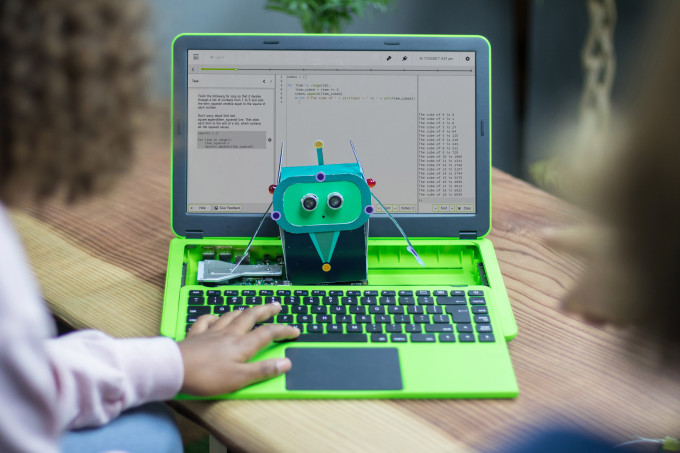
pi top 3

We asked pi-top to confirm what steps it has taken to mitigate the risk of pitop 3 components overheating and posing a safety risk via the same sort of shorting failure experienced by Cornell Tech — and to confirm whether it has informed existing users of the risk from this failure mode.

An internal pi-top sales document that we’ve also reviewed discusses a ‘back to school’ sales campaign — detailing a plan to use discounts to “dissolve as much pi-top [3] stock as we can over the next 8 weeks”.

This document says US schools will be targeted from mid August; UK schools/educators from early September; and International Schools Groups from early September. It also includes a strategy to go direct to US Private and Charter Schools — on account of “shorter decision making timelines and less seasonal budgets”.

It’s not clear if the document pre-dates the Cornell incident.

In response to our questions, pi-top told us it is now writing to pi-top 3 customers, suggesting it is acting on some of the initial recommendations set out in Wylie’s July 16 email after we raised concerns.

In a statement the company said: “Whilst it is highly unlikely that this would occur again, we are writing to customers to advise them to take a common-sense approach and switch off the unit if something has got lost inside it.  We are also advising customers to remove the SD card tool from the unit. These simple actions will make the remote possibility of a recurrence even less likely.”

In parallel, we have heard additional concerns about the wider reliability of the pi-top 3 product — in addition to the shorting incident experienced by Cornell.

One source, who identified themselves as a former pi-top employee, told us that a number of schools have experienced reliability issues with the device. One of the schools named, East Penn School District in the US, confirmed it had experienced problems with the model — telling us it had to return an entire order of 40 of the pi-top 3 laptops after experiencing “a large volume of issues”.

“We had initially purchased 40 pi-tops for middle level computers classes,” assistant superintendent Laura Witman told us. “I met one of the owners, Jesse, at a STEM conference. Conceptually the devices had promise, but functionally we experienced a large volume of issues. The company tried to remedy the situation and in the end refunded our monies. I would say it was learning experience for both our district and the company, but I appreciate how they handled things in the end.”

Witman did not recall any problems with pi-top 3 components overheating.

A US-based STEM summer camp provider that we also contacted to confirm whether it had experienced issues with the pi-top 3 — a device which features prominently in promotional materials for its program — declined to comment. A spokesman for iD Tech’s program told us he was not allowed to talk about the matter.

A separate source familiar with the pi-top 3 also told us the product has suffered from software reliability issues, including crashes and using a lot of processor power, as well as hardware problems related to its battery losing power quickly and/or not charging. This source, who was speaking on condition of anonymity, said they were not aware of any issues related to overheating.

Asked to respond to wider concerns about the pi-top 3’s reliability, pi-top sent us this statement:

pitop is a growing and dynamic company developing DIY computing tools which we believe can change the world for the better. In the past four and a half years we have shipped hundreds of thousands of products across our entire product range, and pitop hardware and software have become trusted assets to teachers and students in classrooms from America to Zimbabwe. pitop products are hard at work even in challenging environments such as the UN’s Kakuma refugee camp in Northern Kenya.

At the heart of our products is the idea that young makers can get inside our computers, learn how they work and build new and invaluable skills for the future. Part of what makes pitop special, and why kids who’ve never seen inside a computer before think it’s awesome, is that you have to build it yourself straight out of the box and then design, code and make electronic systems with it. We call this learning.

The nature of DIY computing and electronics means that, very occasionally, things can fail. If they do, pitop’s modular nature means they can be easily replaced. If customers encounter any issues with any of our products our excellent customer support team are always ready to help.

It is important to say that all electronic systems generate heat and Raspberry Pi is no exception. However, at pitop we do the very best to mitigate thanks to the cutting-edge design of our hardware. Faults on any of our products fall well below accepted thresholds. Although we are proud of this fact, this doesn’t make us complacent and we continually strive to do things better and provide our customers with world-class products that don’t compromise on safety.

Thousands of schools around the world recognise the fantastic benefits the pitop [3], pitop CEED, and pitop [1] brings as a Raspberry Pi-powered device. Our new flagship products, the pitop [4] and our learning platform, pitop Further, take coding education to the next level, as a programmable computing module for makers, creators and innovators everywhere. We are proud of our products and the enormous benefits they bring to schools, students and makers around the world.

Internal restructuring

We also recently broke the news that pi-top had laid off a number of staff after losing out on a large education contract. Our sources told us the company is restructuring to implement a new strategy. pi-top confirmed 12 job cuts at that stage. Our sources suggest more cuts are pending.

Some notable names departing pi-top’s payroll in recent weeks are its director of learning and research, William Rankin — formerly a director of learning at Apple — who writes on LinkedIn that he joined pi-top in March 2018 to “develop a constructionist learning framework to support pi-top’s maker computing platform”. Rankin left the business this month, per his LinkedIn profile.

pi-top’s chief education and product officer, Graham Brown-Martin — who joined the business in September 2017, with a remit to lead “learning, product design, brand development and communication strategy” to support growth of its “global education business, community and ecosystem” — also exited recently, leaving last month per his LinkedIn.

In another change this summer pi-top appointed a new executive chairman of its board: Stanley Buchesky, the founder of a US edtech seed fund who previously served in the Trump administration as an interim CFO for the US department for education under secretary of state, Betsy DeVos.

Buchesky’s fund, which is called The EdTech Fund, said it had made an investment in pi-top last month. The size of the investment has not been publicly disclosed.

Buchesky took over the chairman role from pi-top board member and investor Eric Wilkinson: A partner at its Series A investor, Hambro Perks. Wilkinson remains on the pi-top board but no longer as exec chairman.

The job cuts and restructuring could be intended to prepare pi-top for a trade sale to another STEM device maker, according to one of our sources.

Meanwhile pi-top’s latest device, the pi-top 4, represents something of a physical restructuring of its core edtech computing proposition which looks intended to expand the suggestive utility it offers teachers via multiple modular use-cases — from building drones and wheeled robots to enabling sensor-based IoT projects which could check science learning criteria, all powered by pi-top’s encased Raspberry Pi 4.

Out of the box, the pi-top 4 is a computer in a box, not a standalone laptop. (Though pi-top does plan to sell a range of accessories enabling it be plugged in to power a touchscreen tablet or a laptop, and more.)
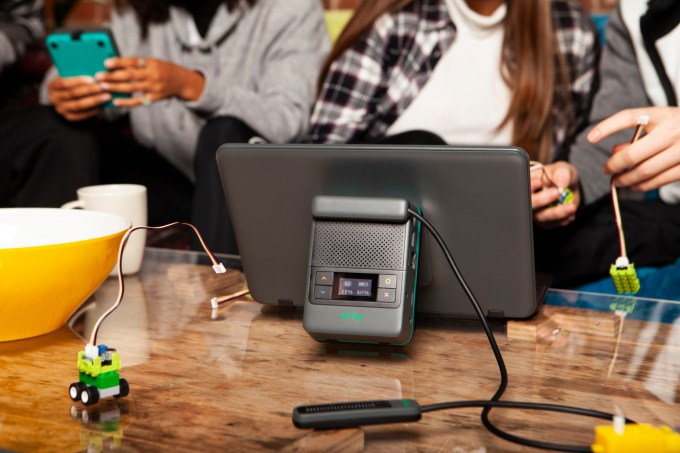
pi top 4 4

pi-top is in the process of bringing the pi-top 4 to market after raising almost $200,000 on Kickstarter from more than 500 backers. Early backers have been told to expect it to ship in November.

While pi-top’s predecessor product is stuck with the compute power of the last-gen Raspberry Pi 3 (the pi-top 3 cannot be upgraded to the Raspberry Pi 4), the pi-top 4 will have the more powerful Pi 4 as its engine.

However the latter has encountered some heat management issues of its own.

The Raspberry Pi Foundation recently put out a firmware update that’s intended to reduce the microprocessor’s operating temperature after users had complained it ran hot.

Asked whether the Foundation has any advice on encasing the Raspberry Pi 4, in light of the heat issue, founder Eben Upton told us: “Putting the Pi in a case will tend to cause it to idle at a higher temperature than if it is left in the open. This means there’s less temperature ‘in reserve’, so the Pi will throttle more quickly during a period of sustained high-intensity operation.”

“In general, the advice is to choose a case which is appropriate to your use case, and to update firmware frequently to benefit from improvements to idle power consumption as they come through,” he added.

TechCrunch’s Steve O’Hear contributed to this report

22 Aug 2019

US cell carriers team up to combat robocalls — but no deadline set

Twelve cell carriers, including the four largest — AT&T, Sprint, T-Mobile, and Verizon — have promised to make efforts to prevent spoofed and automated robocalls.

Announced Thursday, the pledge comes after 51 U.S. attorneys general brokered a deal that would see the telecom giants roll out anti-robocalling technologies, including a way of cryptographically signing callers to wipe out phone number spoofing. Known as STIR/SHAKEN, the system relies on every customer phone number having a unique digital signature which, when checked against the cell networks, validates that a caller is real. The carrier near-instantly invisibly approves the call and patches it through to the recipient.

Robocalls are a billion-dollar industry, but illegal. Many of these automated, robot-dialed calls imitate the area code to convince unsuspecting victims into picking up the phone. Often robocalls try to sell a product — or worse, try to trick victims into signing up for services they don’t need or con them out of cash.

The hope is that STIR/SHAKEN would weed out most robocalls. The system would verify real callers while the billions of illegal or spoofed robocalls made every year would fail.

So far to date, AT&T and Comcast have tested the new anti-robocalling system, and AT&T and T-Mobile have also teamed up to use the technology to fight robocalls. But the system works best when every carrier uses the technology, allowing calls to be checked even as they traverse between networks. By getting Verizon (which owns TechCrunch), Sprint and the other cell giants on board, the attorneys general hopes the cooperation will vastly reduce the number of robocalls each year..

CenturyLink, Charter, and U.S. Cellular have also signed up to the pledge.

There’s a catch: No deadline was set, allowing the carriers to take as long as necessary to roll out the technology. That may not be good news for those seeking immediate relief. Although all of the major networks have already made some progress in testing the new anti-robocalling system, few have said exactly when their service will be ready to roll out to consumers across the country.

The Washington Post first reported the news ahead of Thursday’s announcement.

The pledge comes just weeks after the Federal Trade Commission and the Justice Department took coordinated action against close to a hundred individuals and companies accused of making more than a billion illegal robocalls.

22 Aug 2019

Overstock CEO resigns after ‘deep state’ comments

Overstock .com announced today that CEO Patrick Byrne has resigned from his role as chief executive and board member. Another board member, Jonathan Johnson, will be taking over as Overstock’s interim CEO.

This follows the company’s eyebrow-raising press release earlier this month titled “Overstock.com CEO Comments on Deep State, Withholds Further Comment,” in which Byrne said he was confirming reports by journalist Sara Cater.

“Starting in 2015 I (operating under the belief that I was helping legitimate law enforcement efforts) assisted in what are now known as the ‘Clinton Investigation’ and the ‘Russian Investigation’ (in fact, I am the notorious ‘missing Chapter 1’ of the Russian investigation),” he wrote, going on to say that this was “the third time in my life I helped the Men in Black.”

Byrne and his attorney subsequently said that these comments were tied to his “romantic” relationship with Maria Butina, and that he wanted to shed light on the way federal law enforcement investigated Butina (who’s been accused of working as a Russian agent, and who is currently in prison after pleading guilty to a lesser charge).

Since then, the publicly-traded e-commerce company has seen its stock price tumble.

Today’s announcement also takes the form of a letter from Byrne, in which he said he “came forward in as carefully and well-managed fashion” as he could, but that it’s still had a detrimental effect on the company.

“Though patriotic Americans are writing me in support, my presence may affect and complicate all manner of business relationships, from insurability to strategic discussions regarding our retail business,” Byrne said. “Thus, while I believe that I did what was necessary for the good of the country, for the good of the firm, I am in the sad position of having to sever ties with Overstock, both as CEO and board member, effective Thursday August 22.”

Byrne’s letter ends on an optimistic note about Overstock’s future, pointing to both its retail business and “blockchain assets that seem poised to revolutionize capital markets, finance, and governance for the poor.”

As of 12:51pm Eastern, Overstock shares are up 8.5% since the start of trading.

22 Aug 2019

Daily Crunch: Apple plans Pro iPhones

The Daily Crunch is TechCrunch’s roundup of our biggest and most important stories. If you’d like to get this delivered to your inbox every day at around 9am Pacific, you can subscribe here.

1. Apple reportedly launching new iPhone Pro and iPads with better cameras, 16-inch MacBook Pro and new AirPods

Here come the leaks around Apple’s fall hardware event (rumored to be scheduled for September 10). According to Bloomberg, we’ll get new iPhones — including a new Pro model that replaces the XS line and adds a third, wider angle rear camera.

Beyond 2019, Apple also reportedly has plans for iPhones that support 5G in the next year, plus a more affordable HomePod.

2. Google ditches desserts as Q becomes Android 10

Google’s official reasoning is more diplomatic than, “we couldn’t think of anything that started with ‘Q.’ ” Instead, it says that the desserts simply weren’t universal enough for the 2.5 billion active devices it has deployed around the world.

3. Our 12 favorite startups from Y Combinator’s S19 Demo Day 2

Over the course of two days, the TechCrunch team witnessed more than 160 on-the-record startup pitches, spanning healthcare, B2B services, augmented reality and life extension. (Extra Crunch membership required.)

GWR UberIPO 050819 5

Image via Working Partnerships USA / Jeff Barrera

4. Hundreds of Uber and Lyft drivers to launch a protest caravan across California

Over 200 drivers in more than 75 cars plan to drive south to north — with more drivers joining along the way — to take dramatic action in advocating for California State Legislature bill AB5, and for a drivers’ union.

5. Eminem’s publisher accuses Spotify of copyright infringement in new lawsuit

Eight Mile Style has filed a lawsuit against Spotify, accusing the service of “blatant copyright infringement” in streaming “Lose Yourself” and other Eminem songs.

6. Splunk acquires cloud monitoring service SignalFx for $1.05B

SignalFx provides real-time cloud monitoring solutions, predictive analytics and more. The acquisition should make Splunk a far stronger player in the cloud space.

7. Google proposes new privacy and anti-fingerprinting controls for the web

If fully realized, this initiative will make it harder for online marketers and advertisers to track you across the web.