Year: 2019

22 Aug 2019

Inside the Porsche Taycan’s minimalist, all-digital interior

Porsche has taken the wraps off of the interior of the all-new, all-electric Porsche Taycan ahead of its world debut September 4. Gone are the buttons and the clutter. This is a minimalist and sleek interior for the modern digital age.

Porsche released Thursday several images of the interior. Earlier this week, TechCrunch was among numerous media outlets that had a chance to get an up close view of the interior (along with some other things we can’t talk about) and a chance to play around with the infotainment system.

Porsche didn’t just slap a bunch of screens in and call it a day. Here are the inside details and what stood out.

911 design lines

At first glance, the dashboard might give viewers a twinge of deja vu. And they wouldn’t be wrong.

Designers used the dashboard from the 1963 Porsche 911 as inspiration. And that’s evident in the pictures below, which shows a clean and sleek dashboard.

The 911 DNA is evident. But this isn’t some throwback. This is a modern vehicle with its own design story, which includes horizontal digital screens that are sandwiched between the upper and lower dash lines and stretch all the way over to the passenger seat.Taycan Interior 2

The elevated center console stretches down from the horizontal central screen to two air vents that are not the mechanically-operated louvres found most vehicles today. Instead, the direction of the airflow is controlled digitally via an 8.4-inch touch panel that is located just below the central screen. This touch panel houses the climate control system and includes a track pad with haptic feedback. The trackpad can also be used for quick address inputs.

Tucked under the touch panel is a small flat space to place a wallet or phone. Two cups holders and then a storage unit, which is equipped with wireless charging and two USB ports, completes the center console.


Porsche’s design team repeatedly talked to TechCrunch about the emphasis on the driver. And that shows. (The design team worked on the interface alone for 3.5 years.) Although there are plenty of passenger features here as well. From the driver’s seat, everything is in reach and without constantly looking over to the center display. Natural voice integration courtesy of Nuance is activated by a “Hey Porsche” trigger or simply pressing the voice button on the central display or dedicated button on the steering wheel.

The minimalist design continues to the all-digital instrument cluster. This free-standing panel, which houses the instrument cluster, has a slight curve to it. Interestingly, it doesn’t have the standard cowl or lip that is often used to prevent reflection. Instead, Porsche used glass coated with a vapor-deposited, polarizing filter.
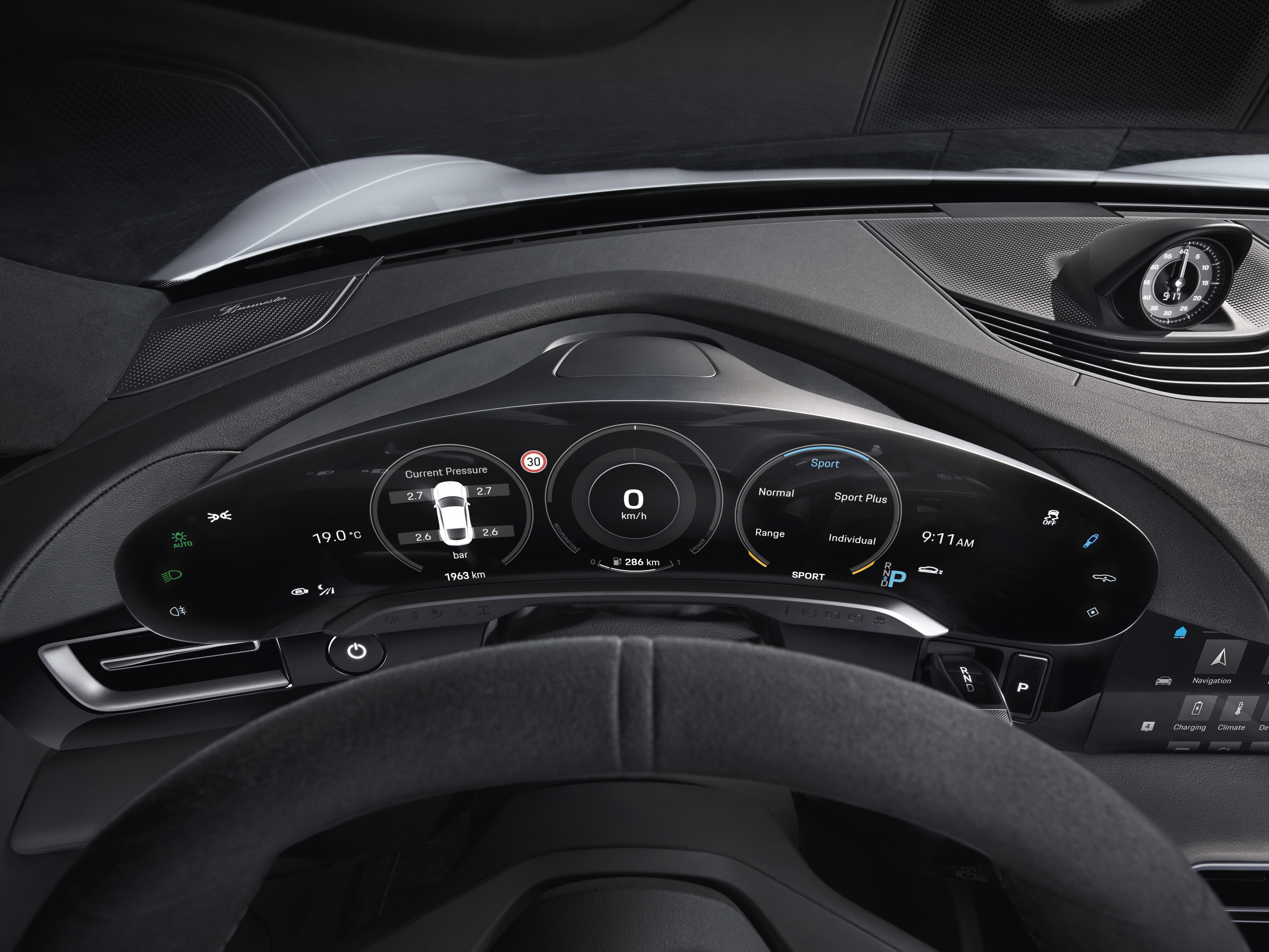
Porsche-Taycan-Interior-instrument

The digital instrument cluster is the highest point of the dashboard in the Porsche Taycan.

The Instrument Cluster

Inside the 16.8-inch cluster display, the driver will see three round instruments that display information. Drivers can customize what each of these instruments displays. Drivers can also remove the information for a more streamlined look in “pure mode.”

This pure mode displays only essential information such as speed, navigation or traffic sign recognition (so you know what the speed limit is). Pure mode, which manages to give the interior an even more minimalist look, could be a handy and fun feature for a Taycan owner on track day.

Perhaps one of the most functional features is the map mode. The map replaces the central power meter in this mode. But it really becomes useful when “full map mode” is turned on, which extends the map across the full display. TechCrunch wasn’t allowed to take photos of the interior during its visit to Porsche North America headquarters, so readers will have to imagine it a digital map taking up most of the instrument cluster.

Finally, just to the left and right of the main instrument cluster, drivers will see small, touch-control fields at the edges of the screen for operating the light and chassis functions. One of these buttons is a trigger key, which lets drivers customize what it operates.

All The Screens

The Porsche Taycan has several screens. Beyond the digital instrument cluster is a horizontal 10.9-central display. Directly below this is a tilted screen that houses climate control as well as a digital track pad that gives haptic feedback.

From the central screen and moving to the right, is a display for the passenger. The passenger display cannot be turned on if the driver is the only one in the vehicle, according to Oliver Fritz, director of driver experience at Porsche. The company is experimenting with streaming video on the passenger display and testing technology that would prevent the driver from being able to view the screen. Fritz emphasized that this idea was still in testing and Porsche won’t roll out streaming video unless it’s sure the driver cannot see the screen.

Dark Mode

Porsche designers have made “dark mode” the default in the instrument cluster and rest of the infotainment system. That can be changed to a white background, Porsche said. TechCrunch doesn’t recommend that though. The dark mode, and the ability to turn off the central 10.9-inch infotainment display and optional passenger one, should let drivers enjoy the road and escape the annoying “blue light” that is emanates from so many vehicles these days.

Interior colors and leather-free options

Porsche will offer a number of color combinations in the interior, including an all-black matte look, which TechCrunch viewed. The company’s design team didn’t reveal the total number of interior color combinations, but they did list a few. There will be four exclusive interior colors for the Taycan, a black-lime beige, blackberry, Atacama beige and Meranti brown. An optional interior accent package will include black matte, dark silver or neodyme, which is like a champagne gold color.

The doors and center consoles can have wood trim, matte carbon, embossed aluminum or fabric.

The company is also offering a leather-free trim interior, which includes the steering wheel. Porsche designer Thorsten Klein was careful not to call it vegan. He told TechCrunch that even synthetic materials can be treated using animal products. Porsche is pushing to source materials that don’t use these processes, but until then Porsche won’t use the vegan term.

Apple Music and more

Earlier this week, Porsche announced it will integrate Apple  Music into the Taycan, the first time the music streaming service has been offered as a standalone app within a vehicle.

But Apple Music is just one of the many features in the infotainment system. The user interface is laid out to always show a home, vehicle and messages button, which will lists notifications coming into the vehicle. The voice feature can also be used so the driver doesn’t need to glance at the screen.

Other buttons on the central screen include navigation, phone, settings, climate, news, calendar, charging information, weather and Homelink, which can be used to open the owner’s garage door.


22 Aug 2019

Who gets to own your digital identity?

“On the Internet, nobody knows you’re a dog,” was stated in the legendary New York Times cartoon that captured the spirit of privacy and anonymity in the early days of the internet. Even though anonymity is still a hot topic and sought after in the online world, times have changed. With the rise of online banking, social media, e-commerce and peer-to-peer services, a verified digital identity is a crucial ingredient in making any digital platform succeed.

Banking is one of the areas where the ability to verify one’s identity in a secure and compliant manner is a prerequisite to access basic services. Looking at the unbanked population of the world today, it is estimated that as many as 1.5 billion people lack access to everyday banking services due to their inability to prove their identity through a valid birth certificate, passport, proof of residency through utility bill or some other means to fulfill traditional KYC procedures.

In addition to accessing digital banking, most of us also have verified our identity through a plethora of services like Google, Facebook, Blizzard and the list goes on, through various means of identity verification that make up an interlinked web of interdependencies, where one of your identities vouch for your eligibility to access another service. Two-factor authentication or biometric identification often rely on your mobile phone, and when you choose to log in with Facebook, you authorize Facebook to represent you online. While this is often convenient for easy and quick access to the latest mobile app you want to try out, you are paying a price by allowing Facebook to share and sell not only your data but also your digital identity.

However, your digital identity is more than your login credentials. This is merely the authentication that connects you with the digital you. Your digital identity consists of thousands of data points that make up a profile of who you are and your preferences. Today, your digital identity is scattered all over the internet, where Facebook owns our social identity, retailers own our shopping patterns, credit agencies hold our creditworthiness, Google knows what we have been curious of since the dawn of the internet and your bank owns your payment history. As a result, we are all analyzed in detail to predict our future behavior and monetize our digital identities.

A verified digital identity is a crucial ingredient in making any digital platform succeed.

Not only do we lack ownership of our own data, but our fragmented digital identities where various third parties own bits and pieces only gives part of the picture, and also proposes vulnerabilities for those third parties. As an example, fraudsters have started to take advantage of this in countries with no national identifier by creating synthetic digital identities by signing up digital services and applying for credit. Even though the initial credit application is rejected, a credit file is automatically created, thus creating a digital paper trail for a non-existing person. With approximately 10 million new consumer credit files generated in the U.S. each year, synthetic identities can be very difficult to detect. Over time, these synthetic identities gain access to credit, and bank losses due to synthetic fraud are estimated to amount for somewhere between $1 billion and $2 billion each year.

In the wake of numerous exposures of how our data is exploited, with Cambridge Analytica as the most notable example, privacy becomes an increasing concern for the public, as well. Apple seeks to leverage this attention to digital privacy by taking a radically different approach than their counterparts with “sign in with Apple,” where privacy is the main selling point for using their service instead of Google and Facebook.

Blockchain is often proposed as the silver bullet to solve all our digital identity needs, something that has caught the attention of Mark Zuckerberg that addresses what he sees as the pros and cons of a decentralized approach to digital identity. As Facebook represents a quintessential man in the middle, losing ownership of all our identities is most likely the biggest con of a decentralized approach to digital identity in the eyes of Zuckerberg.

With the upcoming launch of Facebook’s cryptocurrency, Libra, the company has the potential to further strengthen its position as a leading provider of a global digital identity solution. Often overlooked with most of the attention directed toward the cryptocurrency, many point to the decentralized identity associated with Libra as the most interesting aspect of Facebook’s plans. A passage hidden away near the bottom of the documentation states: “An additional goal of the association is to develop and promote an open identity standard. We believe that decentralized and portable digital identity is a prerequisite to financial inclusion and competition.”

There is too much at stake when it comes to our digital identities to remain unvigilant.

A consolidated and verified digital identity would be beneficial to both users and providers of digital services. However, allowing Facebook or The Libra Association to be the custodian of our consolidated digital identity is a sinister trail for the future of both privacy and democracy.

On the other hand, the Holy Grail of decentralized identity, often named a self-sovereign identity, has its weaknesses, namely ourselves as human beings. We tend to be forgetful, and sometimes downright unreliable. Letting users keep the only key to access their digital identities is a recipe for disaster the moment someone forgets their password or pass away. There is nobody to call and no Forgot Password button to reclaim the ownership of the identity.

It is difficult to envision a future of digital identity without relying on some kind of identity custodian that maintains a verified connection between your physical and digital self, ensures that no data is used without consent, monitors malicious behavior and provides user support in case of a lost key. This is far from an easy solution and should be provided by a regulated entity. One thing is for sure, such a solution relies on trust and must give the end user full ownership of their own data, similar to data portability under GDPR.

There is too much at stake when it comes to our digital identities to remain unvigilant of what is going on, as shown numerous times through both data breaches where our personal data is compromised and manipulation of public opinion through social media.

No matter which technology or appointed custodian we deploy to solve this, our identities should belong to we the people rather than one corporation or consortium of corporations that seek to exploit our data for profit.

22 Aug 2019

Herschel’s Retreat brings classical simplicity to the laptop backpack

It’s finally Bag Week again! The most wonderful week of the year at TechCrunch. Just in time for back to school, we’re bringing you reviews of bags of all varieties: from backpacks to rollers to messengers to fanny packs.

I’ve been meaning to check out a Herschel bag for a while now, just to see what all the fuss is about. The Vancouver-based company has really exploded on the scene here in New York City over the past few years. The packs seemed to go from virtually non-existent to every backpack over night.

With Bag Week rapidly approaching, I asked Herschel to send along whichever laptop backpack they recommended, and received the Retreat in the mail. I’ll be honest, the bag is a bit of a 180 from my usual. Doing what I do for a living, I’ve adopted a bit of a more is more approach when it comes to backpacks — more pockets, more slots. I’ve got something for all of them.

CMB 7976

The Retreat presents a far more stripped-down approach. There’s the primary compartment with a slightly padded and fleece-lined laptop sleeve, and a medium-sized pocket on the outside with no zipper or snap. I appreciate the stripped-down approach — perhaps loosing some of my cables and gadgets could go a ways toward clearing my head. For now, however, it’s a bit too minimalistic for my day to day commuter backpack needs.

CMB 7972

I have, however, found a spot for it in my life as a handy gym bag. There’s not a ton of volume here, but it’s plenty sufficient for gym clothes and a pair of running shoes. It’s solid, too, for those days when you’re feeling liberated enough to leave the house with little more than your laptop. I need to get better than that, and reckon the Retreat could help.

The build is solid. Herschel completely eschews zippers here. Instead, the mountaineering-style pack has a top flap that closes with magnetic snaps at the end of long leather straps. There’s also a drawstring to better close the top compartment. That should keep things in, though I probably wouldn’t recommend getting caught in a downpour with a laptop inside.

CMB 7975

It’s nice to look at as well — the only drawback here being that you’re bound to see a lot of fellow travelers sporting the same model. Or heck, maybe that’s even more motivation to pick one up — you do you. The black and brown (though there are a full 38 color options from which to choose) is offset nicely by the red and white interior lining.

At $80 (and less, depending on where you buy), the price is also right for what amounts to a solid — if simple — bag.

22 Aug 2019

Google says China used YouTube to meddle in Hong Kong protests

Google has disabled 210 YouTube accounts after it said China used the video platform to sow discord among protesters in Hong Kong.

The search giant, which owns YouTube, followed in the footsteps of Twitter and Facebook, which earlier this week said China had used their social media sites to spread misinformation and discord among the protesters, who have spent weeks taking to the streets to demand China stops interfering with the semi-autonomous region’s affairs.

Earlier this week Twitter said China was using its service to “sow discord” through fake accounts as part of a “a coordinated state-backed operation.”

In a brief blog post, Google’s Shane Huntley said the company took action after it detected activity which “behaved in a coordinated manner while uploading videos related to the ongoing protests in Hong Kong.”

“This discovery was consistent with recent observations and actions related to China announced by Facebook and Twitter,” said Huntley.

In line with Twitter and Facebook’s findings, Google said it detected the use of virtual private networks — or VPNs — which can be used to tunnel through China’s censorship system, known as the Great Firewall. Facebook, Twitter and Google are all banned in China. But Google said little more about the accounts, what they shared, or whether it would disclose its findings to researchers.

When reached, a Google spokesperson only referred back to the blog post and did not comment further.

Over a million protesters took to the streets this weekend to peacefully demonstrate against the Chinese regime, which took over rule from the United Kingdom in 1997. Protests erupted earlier this year after a bid by Hong Kong leader Carrie Lam to push through a highly controversial bill that would allow criminal suspects to be extradited to mainland China for trial. The bill was suspended, effectively killing it from reaching the law books, but protests have continued, pushing back at claims that China is trying to meddle in Hong Kong’s affairs.

22 Aug 2019

Oracle directors give blessing to shareholder lawsuit against Larry Ellison and Safra Catz

Three years after closing a $9.3 billion deal to acquire Netsuite, several Oracle board members have written an extraordinary letter to the Delaware Court, approving a shareholder lawsuit against company executives Larry Ellison and Safra Catz over the 2016 deal. Reuters broke this story.

According Reuters’ Alison Frankel, three board members including former U.S. Defense Secretary Leon Panetta, sent a letter on August 15th to Sam Glasscock III, Vice Chancellory for the Court of the Chancellor in Georgetown, Delaware, approving the suit as members of a special Board of Directors entity known as the Special Litigation Committee.

The lawsuit is what is called in legal parlance, a derivative suit. According to the site Justia, this type of suit is filed in cases like this. “Since shareholders are generally allowed to file a lawsuit in the event that a corporation has refused to file one on its own behalf, many derivative suits are brought against a particular officer or director of the corporation for breach of contract or breach of fiduciary duty,” the Justia site explained.

The letter went onto say there was an attempt to settle this suit, which was originally launched in 2017, through negotiation outside of court, but when that attempt failed, the directors wrote this letter to the court stating that the suit should be allowed to proceed.

As Frankel wrote in her article, the lawsuit, which was originally filed by Firemen’s fund could be worth billions:

One of the lead lawyers for the Firemen’s fund, Joel Friedlander of Friedlander & Gorris, said at a hearing in June that shareholders believe the breach-of-duty claims against Oracle and NetSuite executives are worth billions of dollars. So in last week’s letter, Oracle’s board effectively unleashed plaintiffs’ lawyers to seek ten-figure damages against its own members, Frankel wrote

It’s worth pointing out, as we reported at the time of the Netsuite acquisition, that Larry Ellison was involved in setting up Netsuite in the late 1990s and was a major shareholder at the time of the deal.

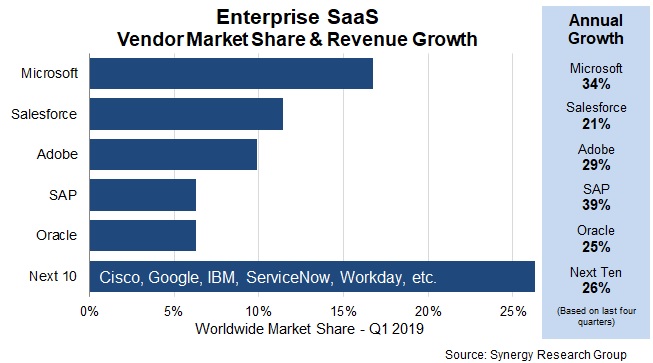
Oracle was struggling to find its cloud footing in 2016, and it was believed that by buying an established SaaS player like Netsuite, it could begin to build out its cloud business much faster than trying to develop something like it internally. A June Synergy Research SaaS marketshare report, while admitting the market was fragmented, still showed Oracle was far behind the pack in spite of that deal three years ago.

SaaS Q119 1

While there have been bigger deals in tech M&A history, including Salesforce’s acquisition of Tableau for $15.7 billion earlier this year, it’s still stands with some of the largest.

We reached out to Oracle regarding this story, but it declined to comment.


22 Aug 2019

VMware acquires Carbon Black for $2.1B and Pivotal for $2.7 billion

VMware today announced that it is acquiring Carbon Black, a publicly traded security company that focuses on securing modern cloud-native workloads. The price of the acquisition is about $2.1 billion.

In addition, VMware also confirmed the acquisition of Pivotal, which will have a value of about $2.7 billion. VMware’s revenue for the last quarter was $2.44 billion. That’s a big day for VMware.

“Building on another solid quarter, we are thrilled about announcing our intent to acquire Pivotal and Carbon Black,” said VMware CEO Pat Gelsinger in today’s announcement. “These acquisitions address two critical technology VMware, Inc. priorities of all businesses today — building modern, enterprise-grade applications and protecting enterprise workloads and clients. With these actions we meaningfully accelerate our subscription and SaaS offerings and expand our ability to enable our customers’ digital transformation.”

Indeed, these are two very different companies, but both Carbon Black and Pivotal focus on modern workloads. Pivotal focuses on building modern applications, thanks to its Cloud Foundry heritage and recently added support for Kubernetes, while Carbon Black provides the security features necessary to secure modern applications and infrastructures.

The two moves follow the company’s acquisition of Bitnami earlier this year, completing this triquetra of acquisitions that all aim to bring VMware’s technology into a future where VMs are only part of the equation.

Carbon Black was founded in 2002 and went public in early 2018. At the time of the IPO, it’s valuation was about $1.25 billion. Its stock traded as low as under $13 earlier this year, but it has since recovered to over $21. VMware will pay $26 per share in cash for the company and expects the deal to close by the end of January 2020.

“Today marks an exciting milestone for Carbon Black, VMware and the entire cybersecurity industry,” said Patrick Morley, CEO, Carbon Black, in the announcement. “We now have the opportunity to seamlessly integrate Carbon Black’s cloud-native endpoint protection platform into all of VMware’s control points. This type of bold move is exactly what the IT and security industries have been looking to see for a very long time. We look forward to working with the VMware team to continue delivering a modern security cloud platform to customers around the world. Additionally, we’re pleased that today’s transaction provides Carbon Black’s shareholders with immediate and substantial value.”

Updating…

22 Aug 2019

FCC approves $4.9B in funding for rural broadband improvements

The FCC has just approved nearly five billion dollars in subsidies for rural broadband operators to be paid out over the next ten years. Recipients of this windfall will have to “maintain, improve, and expand” their broadband infrastructure, especially in underserved areas.

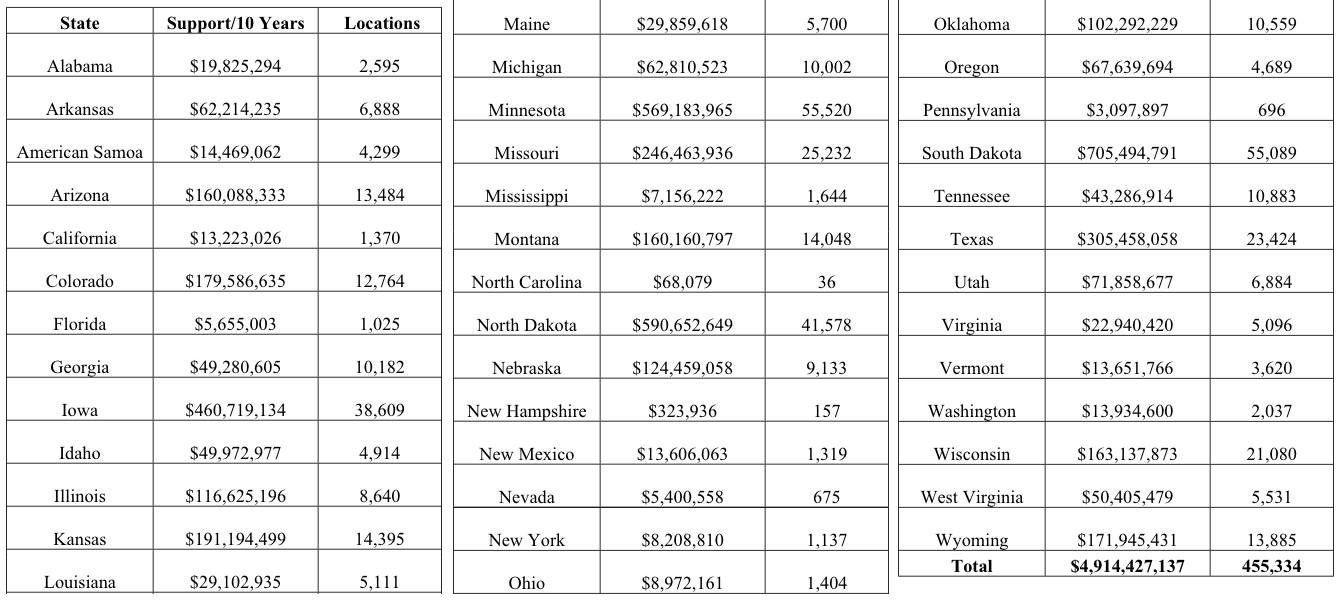
Carriers in 39 states, American Samoa, and many tribal lands will receive varying amounts of funding depending on the number of people they serve, the cost of providing that service, and so on. Naturally states with more people in rural areas receive more cash — you can see how your state made out in the chart below.

To be clear, this isn’t some spontaneous cash drop by the FCC; it has to decide how to distribute the funds it receives from fees and such, and one of the major efforts underway these days is improving rural broadband. But the specifics of how to disburse billions over a decade, who qualifies, how to verify their qualification and compliance with the terms — it’s a complex process and must be negotiated and approved, as this program eventually was.

It’s different, by the way, than CAF II and other funds, which are also directed at rural broadband but different methods, for example working directly with municipalities or contractors. I’ve asked the FCC for a bit more detail and will update if I hear back.

Rural carriers often have higher costs for deployment and maintenance, and have to pass that cost on to their subscribers. Considering rural broadband often has lower speed and reliability than urban connection, these poor folks end up paying more for less. The fund is meant to defray those costs, both for carrier and subscriber. If Uncle Sam is paying half the bill to roll out new fiber, that means the bottom line for Joe Six-Megabit goes down a bit too (ideally). Sure, it’s kind of trickle-down economics, but it doesn’t have to trickle far.

North and South Dakota are getting the lion’s share of the fund, with a combined $1.3 billion headed their way, and some 96,000 homes and businesses to be served. That’s an average of about $13,000 per site over ten years, or $114 per month per site. Sounds reasonable when you work it out that way — this isn’t just a subsidy but an investment.

Iowa, Minnesota, and Texas all are getting quite a bit as well, but don’t be jealous if you’re in, say, California, which is only getting $13 million over a decade to serve 1,300 new sites. There’s plenty of internet money swirling around California — it’s places that have more land than cash that the FCC needs to help out.

Here’s the full list of amounts and locations:

fcc states

22 Aug 2019

HP CEO steps down, citing ‘family health matter’

HP announced this afternoon that Dion Weisler is stepping down as President and CEO. The executive cited a “family health matter” in his decision, noting that he will be returning home to Australia.

The company already has a successor lined up, as its President of Imaging, Printing and Solutions, Enrique Lores, got unanimous approval from its board of directors. Lores will be assuming the top spot on November 1.

Developing….

22 Aug 2019

Frontier technologies are moving closer to the center of venture investment

As the technologies that were once considered science fiction become the purview of science, the venture capital firms that were once investing at the industry’s fringes are now finding themselves at the heart of the technology industry.

Investing in the commercialization of technologies like genetic engineering, quantum computing, digital avatars, augmented reality, new human-computer interfaces, machine learning, autonomous vehicles, robots, and space travel that were once considered “frontier” investments are now front-and-center priorities for many venture capital firms and the limited partners that back them.

Earlier this month, Lux Capital raised $1.1 billion across two funds that invest in just these kinds of companies. “[Limited partners] are now more interested in frontier tech than ever before,” said Bilal Zuberi, a partner with the firm.

He sees a few factors encouraging limited partners (the investors who provide financing for venture capital funds) to invest in the firms that are financing companies developing technologies that were once considered outside of the mainstream.

22 Aug 2019

Hulu and Amazon Prime Video chip away at Netflix’s dominance

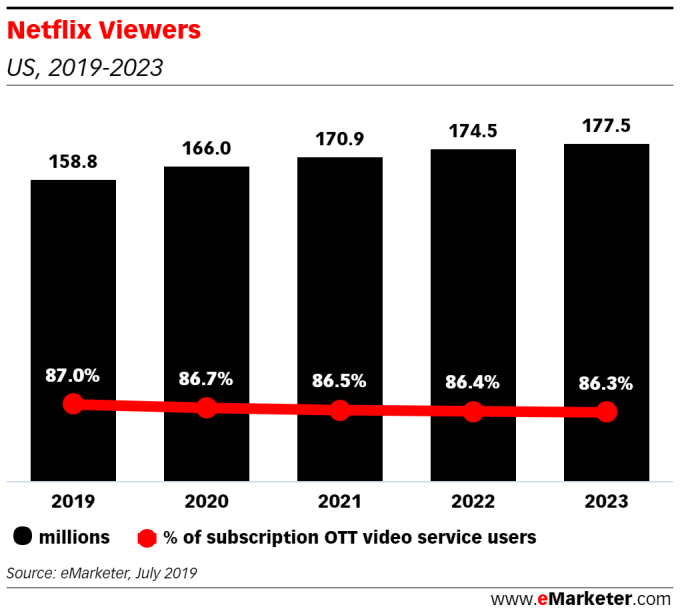
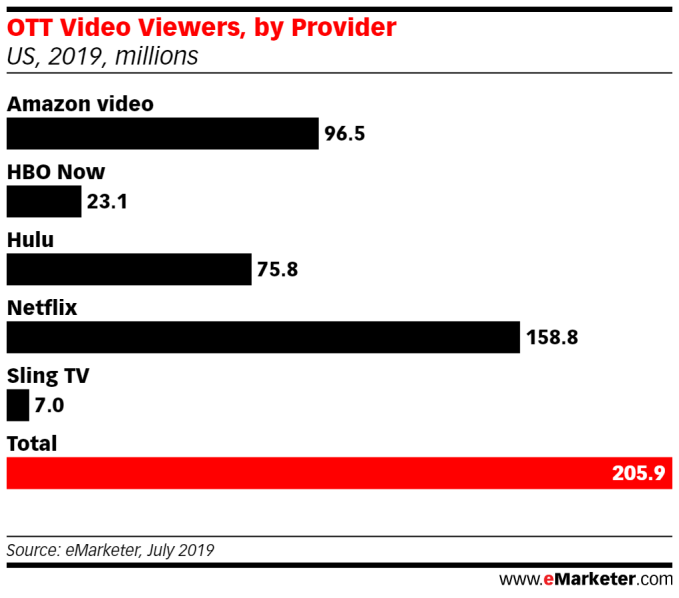
Netflix is still the No. 1 subscription streaming service in the U.S., according to a new report from eMarketer, but rivals including Amazon Prime Video and Hulu are starting to cut into its market share. The analyst firm forecasts 182.5 million U.S. consumers will subscribe to over-the-top streaming services this year, or 53.3% of the population. Netflix is still the too choice here, with 158.8 million viewers in 2019 and it is continuing to grow. However, its share of the U.S. over-the-top subscription market will decline even as its total subscriber numbers climb, the report said.

Though Netflix announced in Q2 the first drop in U.S. users in nearly a decade, eMarketer says Netflix will see strong growth throughout the rest of the year — up 7.6% over 2018. This will be driven by the new seasons of popular series like Orange is the New Black and Stranger Things, as well as Academy Award-winning director Martin Scorsese’s new movie, The Irishman.

But Netflix is no longer the only option for streaming video these days. Back in 2014, it had 90% of the market. In 2019, its share will have shrunk to 87%.

1 1

This decline in market share is attributed to the rise of rival services, like Hulu and Prime Video.

Hulu, for example, is estimated to reach 75.8 million U.S. viewers this year, or 41.5% of subscription service users. The number of viewers will also increase by 17.5% in 2019, but this is a drop from 2018’s big growth spurt of 49.6%

Prime Video, meanwhile will remain the second-largest subscription over-the-top video provider in the U.S. in 2019, the report says, with 96.5 million viewers. That’s up 8.8% over last year.

The firm estimates Prime Video will reach a third of the U.S. population by 2021.

2

Netflix market share dominance is about to face new threats as well, most notably from the Disney-Hulu-ESPN bundle, which is priced the same as a standard U.S. Netflix subscription.

“Netflix has faced years of strong competition for viewers, coming from streaming video platforms, pay-TV services, and even video games,” said eMarketer forecasting analyst Eric Haggstrom. “While there is no true ‘Netflix killer’ on the market, Disney’s upcoming bundle with Disney+, Hulu and ESPN+ probably comes closest. Netflix’s answer has been to stick to what has made it the market leader—outspending the competition on both licensed and original content, offering customers a competitive price,” he added.

Disney isn’t the only one with a new streaming service in the works, though.

Apple TV+ is poised to launch later this year, and is said to be spending $6 billion on content — far more than the $1 billion that had been reported. It’s also said to be considering a competitive $9.99 per month price point.

NBCUniversal and AT&T WarnerMedia are also poised to enter the market, the latter with HBO Max. And following the CBS-Viacom merger, the combined company is looking to beef up its own platforms, CBS All Access and the ad-supported Pluto TV, with the newly acquired content.

“The market for streaming video has been driven by an explosion in high-end original content and low subscription costs relative to traditional pay TV,” Haggstrom noted. “A strong consumer appetite for new shows and movies has driven viewer growth for services like Netflix, Hulu and Amazon Prime Video, as well as the broader market.”