Year: 2019

22 Aug 2019

Bose’s new portable home speaker sports Alexa and Google Assistant

Bose’s portable speaker offerings have tended toward the cheaper end of the spectrum — bringing colorful competition for companies like JBL. With the dryly named Portable Home Speaker, however, the company looks to split the difference between portable and premium. And it’s certainly priced for the latter.

The $349 speaker looks to something of a high end take on the dearly departed Amazon Tap. It’s pretty small for the price, with a large handle up top so it can be moved from room to room, accordingly.

Bose continues to take the diplomatic approach, using built in mics for both Google Assistant and Amazon Alexa. There’s also AirPlay 2 and Spotify Connect functionality built in, covering pretty much all of its bases outside of Bixby — that means, sadly, that it might not be able to talk to your fridge.

There are a handful of physical buttons up top, as well, including the every important mic-off. The device has an IPX4 water rating, which means it will handle some splashing or light rain, but don’t dunk the thing. It’s also pretty clear from the press materials that the speaker’s not designed to live outdoors, though the occasional picnic table should be fine.

The Portable Home Speaker arrives in stores on September 19. It’s already got plenty of competition, of course, and Sonos is set to add to the list with its own bluetooth speaker rumored to be in the works.

22 Aug 2019

Spotify matches Apple Music’s 3-month trial

Spotify’s battle with Apple Music is continuing to heat up. On Monday, the company introduced upgrades to its Premium Family plan which now offers parental controls and other exclusive features, like a family playlist. Today, Spotify is going head-to-head with Apple on its free trial offer. Previously, new users to the Spotify Premium subscription could try the service free for a month. Now it’s 3 months — the same as Apple Music.

The company notes this is not a limited-time promotion, the way some of those Spotify-Hulu bundles have been in the past. Instead, this is the new standard for how Premium trials will operate, and is rolling out today worldwide.

The 3-month trial will be offered across all of Spotify’s Premium plans, including its Individual and Student plans, where available, and the Family and Duo plans — the latter which is still in testing, and not globally available.

The trials are offered directly on Spotify’s website, not through in-app purchases or carrier billing plans.

“This has been a huge week for Spotify Premium with two milestones — we’re rolling out an upgraded Family plan and we’re offering the first 3 months of Premium for free to customers that have not tried Premium before,” said Spotify Chief Premium Business Officer Alex Norström, in a statement. “These moments show our commitment to providing our Premium subscribers with the best experience and allowing more listeners around the world access to all that Premium has to offer,” he said.

Since launch, Apple has offered longer, three-month free trials to interested subscribers. Initially, this was a point of contention between the tech company and artists because artists weren’t being paid royalties during the trial period. Taylor Swift used her clout to change that back in 2015, pushing Apple to pay artists during trials, at rates that were similar to Spotify and others.

While trial length is not the only factor involved in increasing conversions, a longer trial does allow a customer to become familiar with the service’s features and make it a more of a habit. And in the case of Apple Music and Spotify, it gives the service’s algorithms more time to personalize playlists and recommendations based on the user’s listening history.

The change to Spotify’s free trials follows a subscriber miss on its latest earnings, when it added 8 million subscribers — below estimates of 8.5 million. This figure includes those on a free trial, so by extending the trial period Spotify can bump these numbers up. In total, Spotify said it had 232 million monthly active users and 108 million paying subscribers at the end of June.

Apple Music, by comparison, announced 60 million subscribers in June. An April report by The WSJ also put it ahead in the key U.S. market.

22 Aug 2019

How Oculus squeezed sophisticated tracking into pipsqueak hardware

Making the VR experience simple and portable was the main goal of the Oculus Quest, and it definitely accomplishes that. But going from things in the room tracking your headset to your headset tracking things in the room was a complex process. I talked with Facebook CTO Mike Schroepfer (“Schrep”) about the journey from “outside-in” to “inside-out.”

When you move your head and hands around with a VR headset and controllers, some part of the system has to track exactly where those things are at all times. There are two ways this is generally attempted.

One approach is to have sensors in the room you’re in, watching the devices and their embedded LEDs closely — looking from the outside in. The other is to have the sensors on the headset itself, which watches for signals in the room — looking from the inside out.

Both have their merits, but if you want a system to be wireless, your best bet is inside-out, since you don’t have to wirelessly send signals between the headset and the computer doing the actual position tracking, which can add hated latency to the experience.

Facebook and Oculus set a goal a few years back to achieve not just inside-out tracking, but make it as good or better than the wired systems that run on high-end PCs. And it would have to run anywhere, not just in a set scene with boundaries set by beacons or something, and do so within seconds of putting it on. The result is the impressive Quest headset, which succeeded with flying colors at this task (though it’s not much of a leap in others).

What’s impressive about it isn’t just that it can track objects around it and translate that to an accurate 3D position of itself, but that it can do so in real time on a chip with a fraction of the power of an ordinary computer.

“I’m unaware of any system that’s anywhere near this level of performance,” said Schroepfer. “In the early days there were a lot of debates about whether it would even work or not.”

Our hope is that for the long run, for most consumer applications, it’s going to all be inside-out tracking.
The term for what the headset does is simultaneous localization and mapping, or SLAM. It basically means building a map of your environment in 3D while also figuring out where you are in that map. Naturally robots have been doing this for some time, but they generally use specialized hardware like lidar, and have a more powerful processor at their disposal. All the new headsets would have are ordinary cameras.

“In a warehouse, I can make sure my lighting is right, I can put fiducials on the wall, which are markers that can help reset things if I get errors — that’s like a dramatic simplification of the problem, you know?” Schroepfer pointed out. “I’m not asking you to put fiducials up on your walls. We don’t make you put QR codes or precisely positioned GPS coordinates around your house.

“It’s never seen your living room before, and it just has to work. And in a relatively constrained computing environment — we’ve got a mobile CPU in this thing. And most of that mobile CPU is going to the content, too. The robot isn’t playing Beat Saber at the same time it’s cruising though the warehouse.”

It’s a difficult problem in multiple dimensions, then, which is why the team has been working on it for years. Ultimately several factors came together. One was simply that mobile chips became powerful enough that something like this is even possible. But Facebook can’t really take credit for that.

More important was the ongoing work in computer vision that Facebook’s AI division has been doing under the eye of Yann Lecun and others there. Machine learning models frontload a lot of the processing necessary for computer vision problems, and the resulting inference engines are lighter weight, if not necessarily well understood. Putting efficient, edge-oriented machine learning to work inched this problem closer to having a possible solution.

Most of the labor, however, went into the complex interactions of the multiple systems that interact in real time to do the SLAM work.

“I wish I could tell you it’s just this really clever formula, but there’s lots of bits to get this to work,” Schroepfer said. “For example, you have an IMU on the system, an inertial measurement unit, and that runs at a very high frequency, maybe 1000 Hz, much higher than the rest of the system [i.e. the sensors, not the processor]. But it has a lot of error. And then we run the tracker and mapper on separate threads. And actually we multi-threaded the mapper, because it’s the most expensive part [i.e. computationally]. Multi-threaded programming is a pain to begin with, but you do it across these three, and then they share data in interesting ways to make it quick.”

Schroepfer caught himself here; “I’d have to spend like three hours to take you through all the grungy bits.”

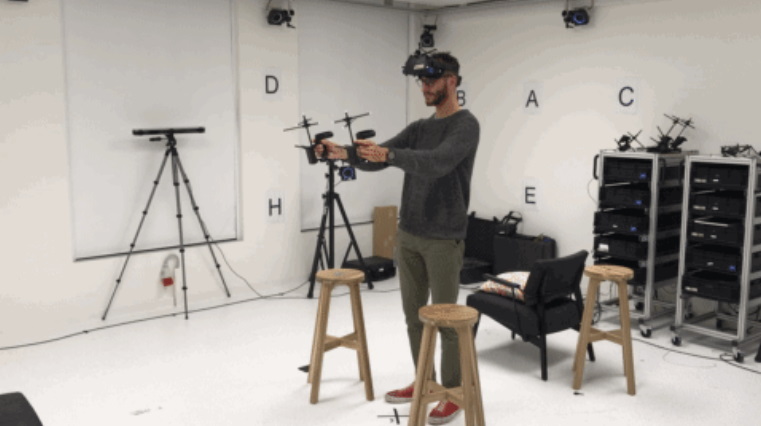
Part of the process was also extensive testing, for which they used a commercial motion tracking rig as ground truth. They’d track a user playing with the headset and controllers, and using the OptiTrack setup measure the precise motions made.

optitrack

Testing with the OptiTrack system.

To see how the algorithms and sensing system performed, they’d basically play back the data from that session to a simulated version of it: video of what the camera saw, data from the IMU, and any other relevant metrics. If the simulation was close to the ground truth they’d collected externally, good. If it wasn’t, the machine learning system would adjust its parameters and they’d run the simulation again. Over time the smaller, more efficient system drew closer and closer to producing the same tracking data the OptiTrack rig had recorded.

Ultimately it needed to be as good or better than the standard Rift headset. Years after the original, no one would buy a headset that was a step down in any way, no matter how much cheaper it was.

“It’s one thing to say, well my error rate compared to ground truth is whatever, but how does it actually manifest in terms of the whole experience?” said Schroepfer. “As we got towards the end of development, we actually had a couple passionate Beat Saber players on the team, and they would play on the Rift and on the Quest. And the goal was, the same person should be able to get the same high score or better. That was a good way to reset our micro-metrics and say, well this is what we actually need to achieve the end experience that people want.”

the computer vision team here, they’re pretty bullish on cameras with really powerful algorithms behind them being the solution to many problems.
It doesn’t hurt that it’s cheaper, too. Lidar is expensive enough that even auto manufacturers are careful how they implement it, and time-of-flight or structured-light approaches like Kinect also bring the cost up. Yet they massively simplify the problem, being 3D sensing tools to begin with.

“What we said was, can we get just as good without that? Because it will dramatically reduce the long term cost of this product,” he said. “When you’re talking to the computer vision team here, they’re pretty bullish on cameras with really powerful algorithms behind them being the solution to many problems. So our hope is that for the long run, for most consumer applications, it’s going to all be inside-out tracking.”

I pointed out that VR is not considered by all to be a healthy industry, and that technological solutions may not do much to solve a more multi-layered problem.

Schroepfer replied that there are basically three problems facing VR adoption: cost, friction, and content. Cost is self-explanatory, but it would be wrong to say it’s gotten a lot cheaper over the years. Playstation VR established a low-cost entry early on but “real” VR has remained expensive. Friction is how difficult it is to get from “open the box” to “play a game,” and historically has been a sticking point for VR. Oculus Quest addresses both these issues quite well, being at $400 and as our review noted very easy to just pick up and use. All that computer vision work wasn’t for nothing.

Content is still thin on the ground, though. There have been some hits, like Superhot and Beat Saber, but nothing to really draw crowds to the platform (if it can be called that).

“What we’re seeing is, as we get these headsets out, and in developers hands that people come up with all sorts of creative ideas. I think we’re in the early stages — these platforms take some time to marinate,” Schroepfer admitted. “I think everyone should be patient, it’s going to take a while. But this is the way we’re approaching it, we’re just going to keep plugging away, building better content, better experiences, better headsets as fast as we can.”

22 Aug 2019

Google ditches desserts as Q becomes Android 10

The dessert naming scheme was one of the best-loved legacies from Google past (though some were notably better than others). Every time the company got ready to release a new version of the mobile operating system, speculation would mount about which sweet foodstuff on which the company would ultimately settle. But while P offered confections a plenty, Q has been far less straightforward.

Quiche was questionable, at best — ditto for quesadillas and quinoa. With that giant question mark waiting for it with the next release, the company’s opted instead to abandon the beloved naming scheme. Of course, Google’s reasoning is far more diplomatic than, “we couldn’t think of anything that started with ‘Q.’”

HeroArticlePage 1500x850.max 1000x1000 1

Instead, it says that the desserts simply weren’t universal enough for the 2.5 billion active devices it has deployed around the world.

[W]e’ve heard feedback over the years that the names weren’t always understood by everyone in the global community. For example, L and R are not distinguishable when spoken in some languages.

So when some people heard us say Android Lollipop out loud, it wasn’t intuitively clear that it referred to the version after KitKat. It’s even harder for new Android users, who are unfamiliar with the naming convention, to understand if their phone is running the latest version. We also know that pies are not a dessert in some places, and that marshmallows, while delicious, are not a popular treat in many parts of the world.

Of course, universality is an unclear concept in the online age. And hey, look at Apple, which has gone far more regional with its California-themed desktop OSes. Honestly, however, it may be better to avoid the letter Q altogether in the a political climate that reads like the backdrop to a back spy novel. It’s just too bad the company had to take Raisinettes, Skittles and Twizzlers with it.

Also new is a slight rebrand of Android itself, with the text shifting from Android Green to black. “It’s a small change, but we found the green was hard to read, especially for people with visual impairments,” the company writes. “The logo is often paired with colors that can make it hard to see—so we came up with a new set of color combinations that improve contrast. “

22 Aug 2019

The CareVoice raises $10 million to develop better tech for insurance providers in Asia

The CareVoice, a Shanghai-based health insurance software startup with ambitions to expand throughout Asia, announced today that it has raised about $10 million in Series A funding.

The investment was led by LUN Partners Group and an undisclosed global investment manager that specializes in financial services, with participation from DNA Capital and returning investors SOSV and Artesian Capital. It will be used on research and development and to grow The CareVoice’s business in Hong Kong, which it entered last year. After that, the company plans to expand into other markets in Asia.

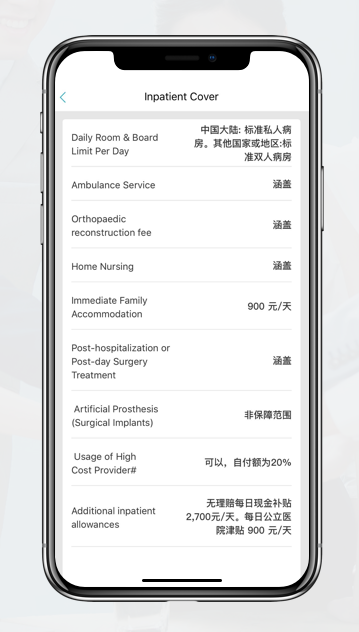
The CareVoice appFounded in 2014, The CareVoice started as an app that let patients leave reviews about medical providers before focusing on software like its flagship product, an SaaS solution that makes healthcare and insurance products more accessible to customers on mobile, with the goal of increasing sales and retention. There are several other startups in China focused on simplifying the process of buying health insurance, like Instony, Datebao, eBaoTech and Bowtie, but a representative for The CareVoice says it focuses less on sales tools and is instead building an end-to-end platform for insurers that can integrate with their existing solutions.

The startup is currently used by 15 insurance providers in China and Hong Kong, including Ping An and AXA. While The CareVoice’s focus has been on improving the enrollment process, customer experience and how claims are processed, it is currently developing 10 new insurance products with health insurance partners, essentially rebranding traditional insurance policies and making them easier to access.

The CareVoice also recently released a platform for insurers called CareVoiceOS, designed to enable insurers to create more customized plans and connect to other online healthcare services, and launched a new unit called StartupCare that allows startups to give founders and employees health benefits.

22 Aug 2019

Remediant lands $15M Series A to disrupt privileged access security

Remediant, a startup that helps companies secure privileged access in a modern context, announced a $15 million Series A today led by Dell Technologies Capital and ForgePoint Capital.

Remediant’s co-founders, Paul Lanzi and Tim Keeler, worked in biotech for years and saw a problem first-hand with the way companies secured privileged access. It was granted to certain individuals in the organization carte blanche, and they believed if you could limit access, it would make the space more secure and less vulnerable to hackers.

Lanzi says they started the company with two core concepts. “The first concept is the ability to assess or detect all of the places where privileged accounts exist and what systems they have access to. The second concept is to strip away all of the privileged access from all of those accounts and grant it back on a just-in-time basis,” Lanzi explained.

If you’re thinking that could get in the way of people who need access to do their jobs, as former IT admins, they considered that. Remediant is based a Zero Trust model where you have to prove you have the right to access the privileged area. But they do provide a reasonable baseline amount of time for users who need it within the confines of continuously enforcing access.

“Continuous enforcement is part of what we do, so by default we grant you four hours of access when you need that access, and then after that four hours, even if you forget to come back and end your session, we will automatically revoke that access. In that way all of the systems that are protected by SecureOne (the company’s flagship product) are held in this Zero Trust state where no one has access to them on a day-to-day basis,” Lanzi said.

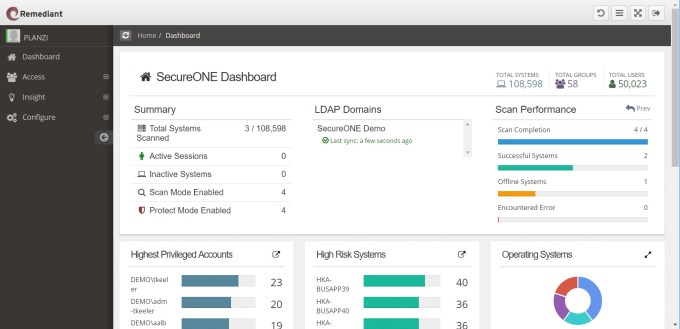
Remediant SecureONE Dashboard

Remediant SecureONE Dashboard. Screenshot: Remediant

The company has bootstrapped until now, and has actually been profitable, something that’s unusual for a startup at this stage of development, but Lanzi says they decided to take an investment in order to shift gears and concentrate on growth and product expansion.

Deepak Jeevankumar, managing director at investor Dell Technologies Capital says it’s not easy for security startups to rise above the noise, but he saw something in Remediant’s founders. “Tim, and Paul came from the practitioners viewpoint. They knew the actual problems that people face in terms of privileged access. So they had a very strong empathy towards the customer’s problem because they lived through it,” Jeevankumar told TechCrunch.

He added that the privileged access market hasn’t really been updated in two decades. “It’s a market ripe for disruption. They are combining the just-in-time philosophy with the Zero Trust philosophy, and are bringing that to the crown jewel of administrative access,” he said.

The company’s tools are installed on the customer’s infrastructure, either on-prem or in the cloud. They don’t have a pure cloud product at the moment, but they have plans for a SaaS version down the road to help small and medium sized businesses solve the privileged access problem.

Lanzi says they are also looking to expand the product line in other ways with this investment. “The basic philosophies that underpin our technology are broadly applicable. We want to start applying our technology in those other areas as well. So as we think toward a future that looks more like cloud and more like DevOps, we want to be able to add more of those features to our products,” he said.

22 Aug 2019

NASA’s new HPE-built supercomputer will prepare for landing Artemis astronauts on the Moon

NASA and Hewlett Packard Enterprise (HPE) have teamed up to build a new supercomputer, which will serve NASA’s Ames Research Center in California and develop models and simulations of the landing process for Artemis Moon missions.

The new supercomputer is called ‘Aitken,’ named after American astronomer Robert Grant Aitken, and it can run simulations at up to 3.69 petaFLOPs of theoretical performance power. Aitken is custom-designed by HPE and NASA to work with the Ames modular data centre, which is a project it undertook starting in 2017 to massively reduce the amount of water and energy used in cooling its supercomputing hardware.

Aitken employs second generation Intel Xeon processors, Mellanox InfiniBand high-speed networking, and has 221 TB of memory on board for storage. It’s the result of four years of collaboration between NASA and HPE, and it will model different methods of entry, descent and landing for Moon-destined Artemis spacecraft, running simulations to determine possible outcomes and help determine the best, safest approach.

This isn’t the only collaboration between HPE and NASA: The enterprise computer maker built a new kind of supercomputer able to withstand the rigors of space for the agency, and sent it up to the ISS in 2017 for preparatory testing ahead of potential use on longer missions, including Mars. The two partners then opened that supercomputer for use in third-party experiments last year.

HPE also announced earlier this year that it was buying supercomputer company Cray for $1.3 billion. Cray is another long-time partner of NASA’s supercomputing efforts, dating back to the space agency’s establishment of a dedicated computational modelling division and the establishing of its Central Computing Facility at Ames Research Center.

22 Aug 2019

Hundreds of Uber and Lyft drivers to launch a protest caravan across California

If you’re like me, chances are good you just distractedly clicked on this article while scrolling through your feed in, or while waiting for, a Lyft. Maybe, like me, you need that app to get to back-to-back meetings in different locations today, as you’re well on your way to at least a 60-hour workweek between the various things you do. Maybe you’re exhausted. Maybe the ride you just took, zoning out on your phone in an Uber on Quiet Mode, was actually a lifesaver.

And as you settle into each new driver’s backseat, en route to each new destination in your crazy busy life, maybe, like me, you find yourself somewhat unwittingly implicated in one of the most contentious ethical struggles of this generation – a struggle with profound implications for the future of work.

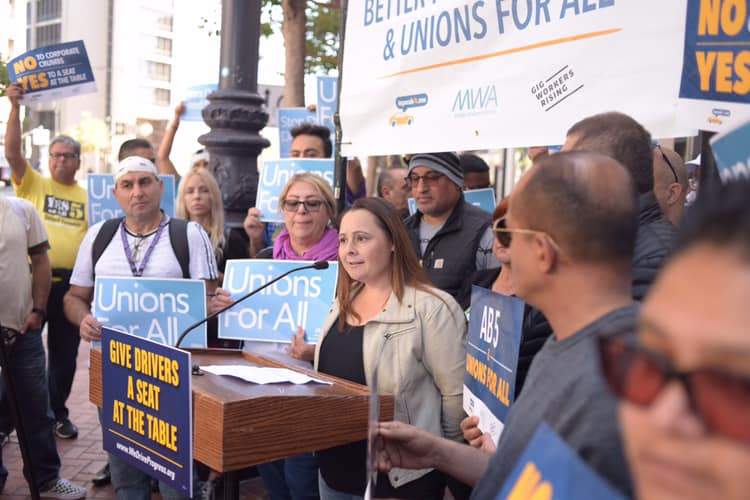
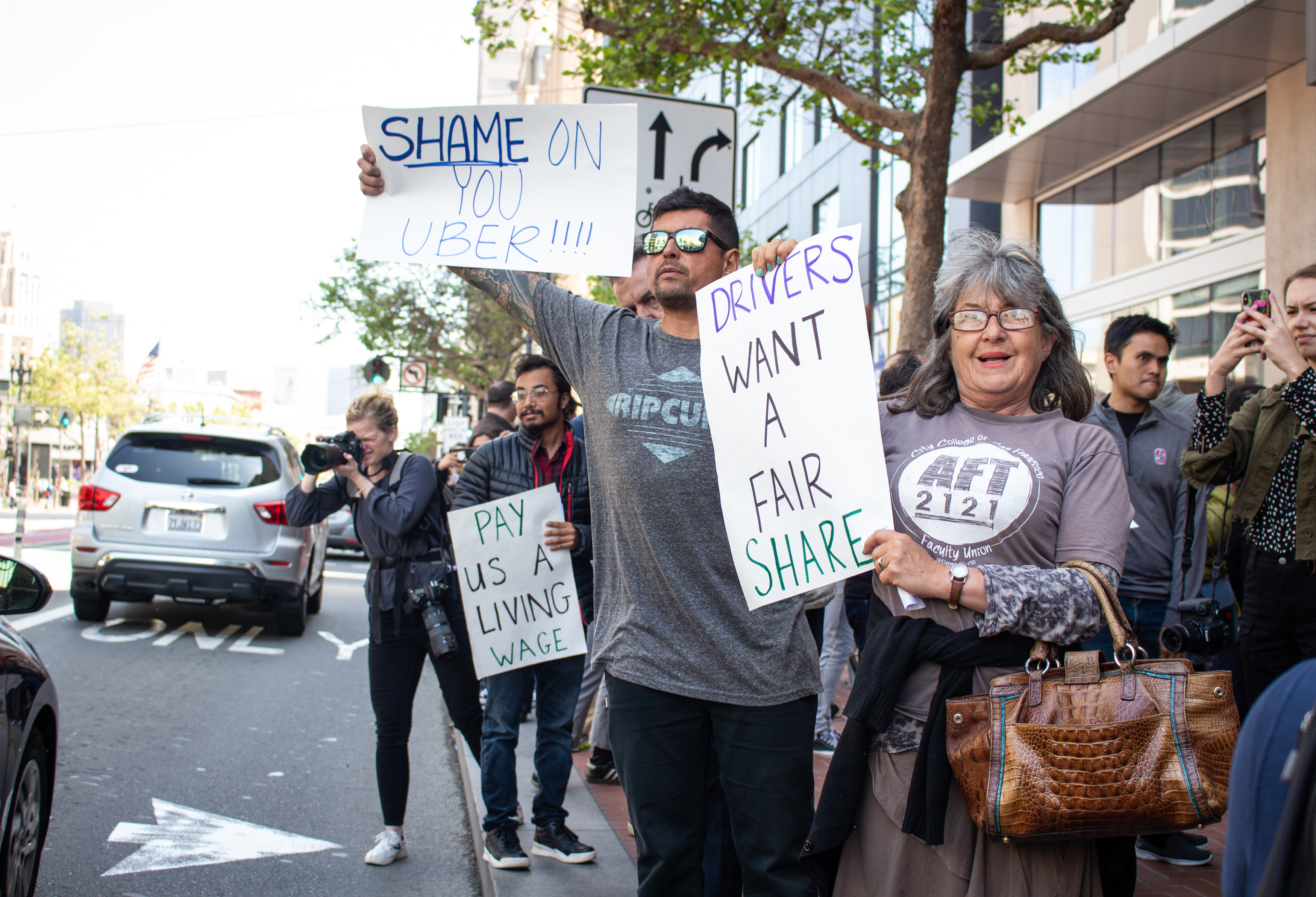
Yesterday, California-based advocacy organizations Gig Workers Rising and Mobile Workers Alliance announced that a caravan of Uber and Lyft drivers will drive from SoCal through San Francisco to Sacramento, next Monday, August 26 through Wednesday, August 28th. Over 200 drivers in more than 75 cars plan to drive south to north, with more drivers joining along the way, to take dramatic action in advocating for California State Legislature bill AB5, and for a drivers union. 

With AB5 almost certain to pass the CA Senate, this coming week presents a crucial moment in the history of gig work and tech more broadly: an opportunity for drivers to demonstrate the efficacy of 21st century labor modes of organizing, even as Uber and Lyft continue ramping up efforts to kill AB5, drop pay rates, and generally mistreat drivers.

For the first time, drivers will use their sole work tool, their cars, to demonstrate publicly (and likely disruptively, though I have no knowledge of the precise actions planned at this time) at key locations like outside Uber’s HQ in downtown San Francisco and the Capitol steps in Sacramento.

I recently had the chance to speak with Annette Rivero, one of the drivers and an organizer of the protest efforts. At the time we spoke, I didn’t know anything about Annette, not even whether she would allow me to use her last name. But this 37-year-old mother of five, a straight-A student and full-time-plus Lyft/Uber driver, told me the story of her life and career, without hesitation, even as it raised what I worried could be the possibility of retaliation against her and her colleagues.

As Annette opened up to me about drivers work conditions and their mental and physical health struggles, I found myself thinking that her family’s story puts human faces on and likely represents the trendline of an industry that, in only a decade, has moved a hundred billion dollars and given new meaning to the word “disrupt.”

I hope everyone with a stake in these issues – whether you work in tech or VC or just occasionally use your smartphone to summon a ride – will read her words and think about where all of us are headed, together.
67402994 1566413612992

Annette Rivero. Image via Annette Rivero

Greg Epstein: Annette, thank you very much for taking the time to talk with me for this TechCrunch series exploring technology and ethics, and what it might mean to use technology ethically and humanistically today. Can you share your full name or is that not something that you’re comfortable sharing? Either way is fine.

Annette Rivero: My name’s Annette Rivero.

Epstein: How old are you?

Rivero: I am 37.

Epstein: And what do you do for your work that you’re connected with what we’re speaking about?

Rivero: I drive for both Uber and Lyft .

Epstein: How long have you been doing that?

Rivero: About two years.

Epstein: Full-time, or how does your schedule work?

Rivero: Right now I’m driving full-time, so I drive about eight to nine hours and I try to drive every day.

Epstein: Seven days a week?

Rivero: Yes.

Epstein: You’ve been trying to do that for a long time?

Rivero: All summer I’ve been really trying. I mean, of course things happen and there’s always one or two days maybe where I don’t get to, but it’s definitely my goal because I only make $150 a day. So, if I miss a day, I try to work longer on the other days.

Epstein: That’s about 60 hours a week or so.

Rivero: Yeah.

Epstein: Wow. You’re a very hard worker, Annette.

Rivero: Oh, thanks.

Epstein: And you live somewhere in California?

Rivero: I live in San Jose, so South Bay area.

Epstein: So, you’re driving 60 hours a week or so, working for a tech company not far from the global epicenter of tech.

Rivero: That’s right.

Epstein: You must get a fair number of tech people in your car with you.

Rivero: Yes, I do.

Epstein: I’ll ask you more about yourself in a moment, but please tell me what you’re involved in and how we got connected for this interview.

Rivero: Around April, or May, I got involved with a group called Gig Workers Rising. I was very frustrated with some of the things going on between me and Uber. I was looking for somebody I could confide in, exchange stories, because I felt very alone, so I signed up with their Facebook group. They invited all their new members to a conference call, which I joined, and then from there they invited us to do a health survey to talk about the problems that we have with our health as far as rideshare goes. From there I’ve been at pretty much every action and meeting.

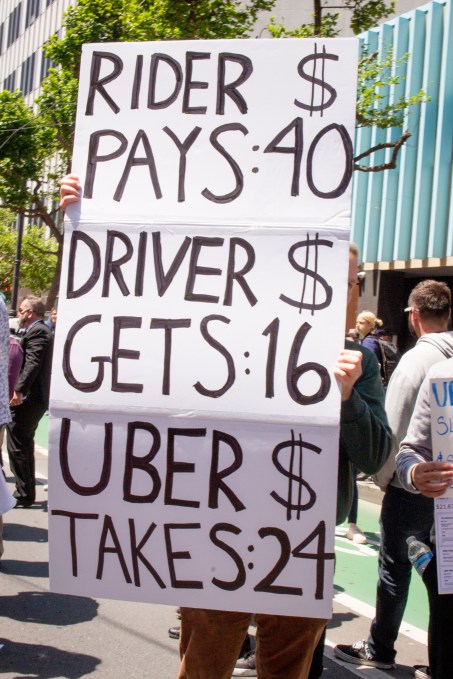
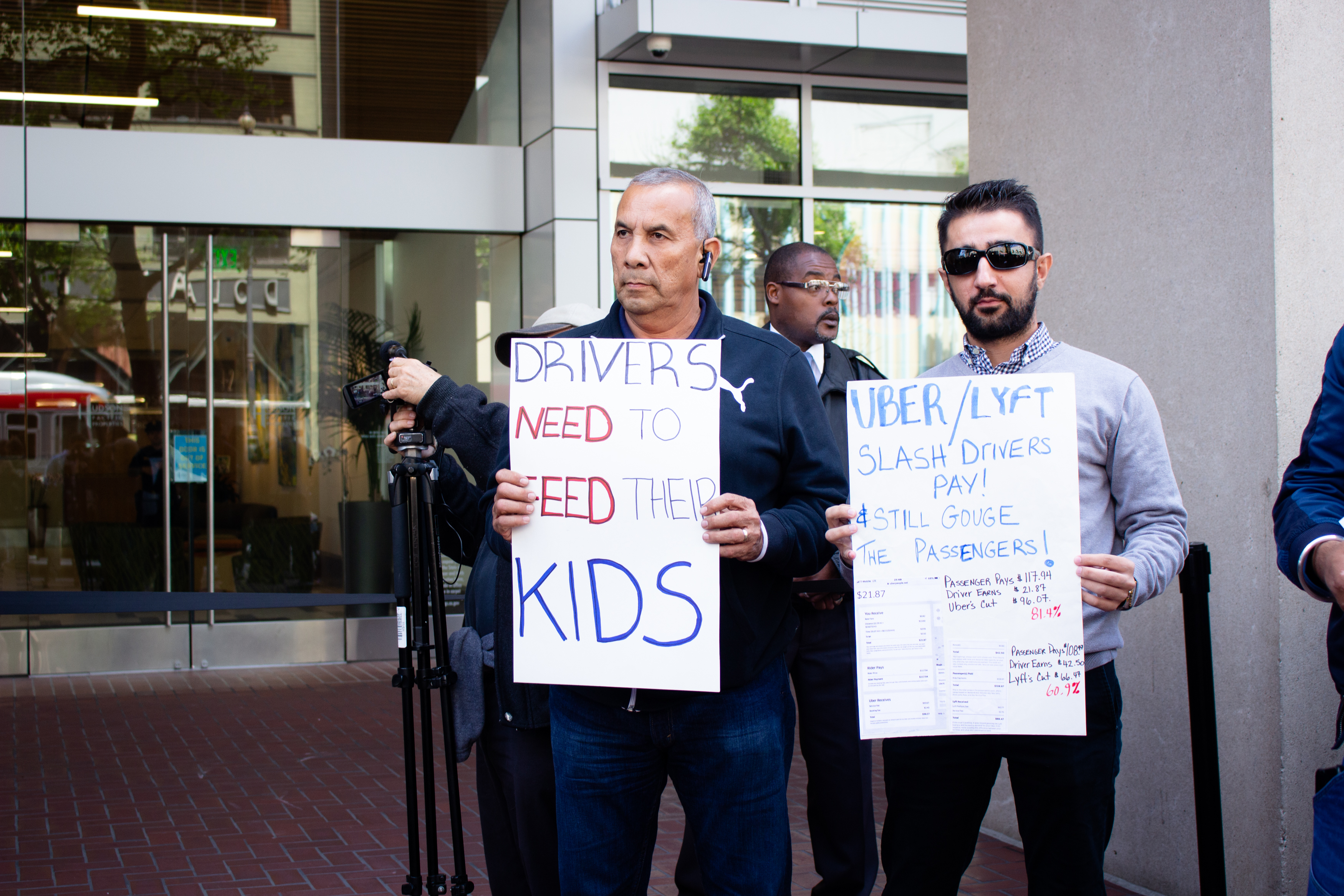
What we’re trying to do is let everyone know what’s going on. What the drivers are going through, the decreases in pay in contradiction to the increases in rates, and really let people know that they’re kind of manipulating the system to gain profits, but they’re taking those profits from people by paying extremely low rates.

Epstein: You mentioned a health survey: how are you doing health-wise?

Rivero: [When] that was all happening, I was extremely stressed; my anxiety was through the roof and I was probably pretty depressed because my situation was looking very bleak. They had already cut the surge at the end of last year, which probably cut rates about 40% at least. Then in the beginning of this year they cut the bonuses. A combination of those things cut the money I was making per week by two thirds. I was making about $1,500 working probably less than 40 hours. And now I work about 60 hours and I’m making barely a thousand dollars. I do feel better [now], but I think I feel better because I have a community of drivers that I work with and I talk to on a daily basis. And I am working on this project to bring light to the situation. I feel more empowered than I did before.
GWR UberIPO 050819 7

Image via Working Partnerships USA / Jeff Barrera

Epstein: Feeling empowered and being connected with people who are working together for the same cause is, generally speaking, a positive factor in health. I’m glad to hear that.

Rivero: Yeah.

Epstein: Can you tell me about the demonstration you’re about to participate in?

Rivero: Right now we’re preparing for an action to unite all the drivers in California from the north end to the south end and in the middle, which is something we haven’t been able to demonstrate yet. But [we are] going to show it’s not just one area.

We may have differences but we have one thing that’s the same and that is dissatisfaction with the way things are going with rideshare right now. Everything that’s going on is not okay and all drivers across the state have just had it. They’re just done with what’s going on. So, without giving too many details, we will be in pretty big cities throughout the state and we will be making sure that we’re seen.

Epstein: At this point it’s been announced you’ll be stopping in L.A., San Francisco and Sacramento.

Rivero: As far as what we will do in those cities, we want to keep that under wraps. But yes, we are caravaning from LA to Sacramento, and at each stop we will take an action, not just with the [driver] community but other important people in those cities.

Epstein: Sounds like whatever actions you and your colleagues are going to take are going to be the sorts of things that have never quite happened before. People interested in this issue are probably going to want to see what you all are going to do next week, huh?

Rivero: Yeah, definitely. And our message is definitely focused on not just legislators but the Senate and then Governor Newsom, because they’re our next targets — to get their attention, let them know what’s going on and how we feel. We know they’ve already heard some, but we’re trying to really drill it in.

Epstein: Gig Workers Rising is working specifically on this bill, California AB5, with regard to the status of employees and independent contractors and what rights and obligations companies like Uber and Lyft have towards contractors like yourself. What do you want to say about the bill in particular?

Rivero: All [AB5] is doing is defining even more what it means to be an employee and what it means to be an independent contractor. It doesn’t do anything else in my opinion. If there was something on the table about creating the appropriate protections, that applied more to gig workers for lack of a better word, I’m sure everybody would be looking at that.

But there isn’t, so this is what we have. And instead of having people working without protections and for extremely low labor costs, we have to do something. Because there’s a lot of people out there who are barely making it, barely surviving, can’t even put food on the table, can’t even afford healthcare.

And these companies should be held accountable for it. They should be held responsible for it.

It’s their responsibility as a business owner to give back to the community, not just take from the community. Redefining these two things is just going to help make that happen.

Epstein: I don’t mind saying I completely agree with you. If these companies want to exist, they don’t just have a right to exist purely to make their executives rich. We, the people, can take that right away from them by forcing them to shut down, unless they can show that their business model is actually decent for the human beings involved in it.

Rivero: Right. I wish more people felt the way you just worded that. People just don’t understand the power they have.

Epstein: Would you feel comfortable sharing a bit more about yourself, like who you are beyond working for Lyft and Uber, and how you got involved in driving for them originally?

Rivero: I basically worked in healthcare for about 14 years. I’m one of those people where I work hard and it doesn’t matter how much money I make, as long as the work makes me feel good. I work really hard. Throughout the years, I’ve learned many things about healthcare billing.

So, I got to a place where I was doing various things in one position, but didn’t feel like I was getting paid what I should have been paid, even though that’s contradictory to what I just said. I felt like I could be a manager and make more money so I can take care of my kids, send them to school.

And my parents are getting older. So I was thinking, I can also help both of my parents start to retire, because they’re not getting younger and they’re getting sicker.

So, I made a very scary decision to leave my job at Stanford where I was making about $80,000 a year. I decided to go back to school. Some people call me crazy, but I just feel like I’m worth more than that, and I think I could’ve made more than that. So I went back to school full-time to get my degree in business management.
FB IMG 1566413270651 1566413533542

Annette Rivero. Image via Annette Rivero

Epstein: When was this?

Rivero: This was about two and a half years ago.

Epstein: So, you were making $80,000 a year or so working in the healthcare system at Stanford University Hospital, essentially? Before that had you gone to college or no?

Rivero: No.

Epstein: And you grew up in the San Jose area, or somewhere else?

Rivero: Half of my life, I grew up in San Jose and then the other half I grew up in a small town called Hollister, an hour South of here. I always wanted to go back to school and it was just such a big thing for me and then I just felt like it was now or never.

Because the situation I was in, we lived in an apartment that was affordable and I had money saved up. It wasn’t impossible. But once I started driving about six months in, or maybe within those first six months, I started to notice a subtle decrease in pay, and it was so subtle, you could hardly tell.

Epstein: You started driving while you were going to school full-time, to put yourself through school?

Rivero: Mm-hmm.

Epstein: Wow.

Rivero: I only had to work about six hours a day.

Epstein: Only! You were working six hours a day and then you would go to class or study?

Rivero: Yeah. And I was only working like four, maybe five days, making more money then than I’m making now. And the classes I did take, I did get straight A’s, so thank you. It was possible. It’s not like something I made up or fabricated. And a lot of people were doing it.

I can’t tell you how many people I’ve met who drove and were going to school or went on elaborate vacations, making extra money off of Uber and Lyft. But you can’t do that now. It’s not possible.

Epstein: You were driving five, six hours a day, studying and getting straight A’s, and did you have a family?

Rivero: One of our kids is already grown, but we have four that we’re raising.

Epstein: What does your partner do during the day?

Rivero: He is a warehouse manager for a plumbing company; he works anywhere from eight to 12 hours a day.

Epstein: You are obviously both extremely hard workers, trying to better your lives. This is very impressive.

Rivero: Thank you.

Epstein: Tell me how it started to get worse.

Rivero: To break it down a little bit, when you first start on, they give you really great bonuses. Then, little by little, they make changes to your bonus amount.

They’ll either lower the amount that you receive or they’ll increase the rides. So gradually you don’t notice, but the amount extra you’re getting per ride is lowering.

After that, [rates] started to decrease, and surge rates changed. What they used to do is a multiplier So, if there is a ride I usually do that I can make $8 off of and there was a surge during that time, then it would say ‘times two.’ That means I would make $16 off of that ride.

Today, they put a dollar amount instead; let’s say they just put $2. That means that I’m only going to make an extra $2 on that eight, from making $16 during surge to $10 during surge. And a majority of rides are during those times of surge, before work and school, when everyone’s trying to get somewhere, after work and school when everyone’s trying to get home, or on weekends when everybody’s partying.

Epstein: Which means drivers like you have to work at some of the times when it would be most convenient to be with your families. I just last week did another column largely about the effects of people having to be constantly available that way.

Rivero: Right. I can’t always work those times because I need to be with my family. So, instead of making a little more money during those times when it’s busier, I have to work slow times and make less money. But the reason we’re making less money is because the system is oversaturated with drivers, and that’s been done intentionally.

They were giving out really large bonuses to get drivers on board. I recruited my dad and made $500 for recruiting him. They’re constantly having new drivers recruited and now they have so many drivers, they don’t have to pay a surge anymore.

Because there’s more than enough drivers on the road at all times. Which brings me to another point, which is they’re charging riders for high demand rates when it’s not even necessary because they have so many drivers on the road. They don’t need to charge high rates. There’s somebody around the corner.

Epstein: I stopped using Uber for ethical reasons, but I use Lyft. I live someplace where it’s really hard to get from my house to work with public transportation and I work three or more jobs while spending a lot of time with my young kid, so I’m constantly running from one place to another and I definitely don’t have time to park a car.

it’s amazing: no matter where I am, or when, there’s always a car within a few minutes. And I take all these rides and almost never get the same driver twice. And I go to other cities or states, even remote areas: there are Lyft drivers everywhere.

It’s amazing how many people, like yourself, they’ve put out onto the road. What is that like for you? What have you heard from colleagues or friends through Gig Workers Rising, about what this is like for them?

Rivero: A couple of friends can’t afford their medication. One of them has high blood pressure. I could lose a friend because he can’t afford his high blood pressure medicine, because he doesn’t make enough. But he doesn’t qualify for Medi-Cal because we have to file all that money we’re paying Uber and Lyft on our taxes.

It looks like we’re making all this money, but we’re not. I have another friend who had kidney failure last year because drivers don’t want to drink water. They don’t want to have to stop to go to the bathroom because then that stops them from making money.
GWR UberIPO 050819 4

Image via Working Partnerships USA / Jeff Barrera

Epstein: What do you do about stopping to go to the bathroom, Annette?

Rivero: When I drop the kids off in the morning at 7:15, I’ll have one coffee and I’ll probably have to go to the bathroom once. So I’ll stop either at a Starbucks, a grocery store, or a Target. Then I don’t eat until I get home, which is when I pick up the kids at 3:45 and then I take them home.

Epstein: So, you’re driving around all that time on one or two coffees, no water, and no food?

Rivero: That’s right.

Epstein: First of all, I’m concerned for you. It’s not particularly healthy to sit in a car for eight or nine hours a day. Do you stretch much?

Rivero: Yeah. Sometimes I’ll get out of the car. When people need help, I’ll get out and help them. If I’m-

Epstein: I’m always telling my drivers to get up and stretch because it’s really bad for a person to sit without even stretching their legs for eight, nine hours a day. But then… I say this with a smile and I actually really trust you, you seem like an amazing person. But, are you being safe out there? I mean, all those hours without eating or hydrating, that doesn’t seem like the best mindset to be driving in.

Rivero: I have a goal, every day, to make $150. [Recently,] at the end of [the night] I needed 30 more dollars, and I was like, “Okay, I’m tired and I want to stop.” But I wasn’t at the point where I was dangerously tired. When I say dangerously tired, I mean I have a migraine, my eyes are getting blurry, or I’m so tired I’ve made a mistake, like I was at the light and I could have turned right but I just wasn’t paying attention.

Something small like that. I’ve never caused an accident. I’m not irresponsible in that way, but I notice the subtle things about myself when I know it’s time to go home.

But yeah, without a doubt there are drivers out there who are driving beyond that moment when they realize they shouldn’t be driving. They’re driving anywhere from 10, maybe 14, maybe even 16 hours a day.

And the ones sleeping in their car don’t really sleep. How do you sleep in your car?

Epstein: Are a lot of drivers sleeping in their cars, in your experience?

Rivero: I know a lot of drivers sleep in their car.

Epstein: How do you know that?

Rivero: Well, friends. My dad sleeps in his car. My dad’s too proud to come sleep at my house, but he’ll stay in his car. And he’s not sleeping.

Epstein: Why? Because he doesn’t have someplace to go?

Rivero: He lives in Los Banos, about an hour and a half away. Not only that, he can’t really afford the gas to keep going back and forth every night.

Epstein: Right — if you’re driving Lyft or Uber, almost by definition you can’t afford to live in a high rent area, but of course most rides are in high rent areas. So almost by design, most of the drivers are living far away from where they’re working, and when you get them so exhausted that they can’t drive home, it sounds like they’re essentially living out of their cars for how many days a week.

Rivero: Exactly. I also know another person who, from the loneliness of sleeping in their car and just the loneliness of not talking to anybody, because drivers don’t talk to each other really. He became-

Epstein: Yeah. And there’s even this new… What is the mode again for Uber?

Rivero: Oh, the quiet mode?

Epstein: Can I just say that I find that disgusting? You’re going to make me work for how much? And then you’re going to act like you have the right to just tell me I’m a nuisance to you and don’t talk to you?

Rivero: I understand sometimes people want to just not say anything, but it’s the way that it’s been done that’s terrible. It’s really about why can’t people communicate and just say, “You know what? I’m so sorry but I’m exhausted today. I had a really long day,” or whatever.

You don’t even have to explain. You just have to say, “Do you mind if we just not conversate right now? Just not up for it.”

Epstein: Yes. Suck it up and use your words to say that you don’t want to use your words, bro.

Rivero: Exactly. And that’s how we’re treated on a daily basis from, not all riders, but there are riders that treat us that way.

Epstein: Anyway, I interrupted you earlier. We were talking about you and other drivers risking their health, some people risking the health of others on the road. People certainly putting their mental health at risk is something that I hear here: there’s a lot of loneliness, isolation.

Rivero: The person I was talking about that was lonely actually had a drug addiction: coke. And the coke was initially to stay awake, then became a bad habit because they were lonely and depressed and then they couldn’t stop.

Epstein: And that person’s still out there driving?

Rivero: Not at the moment. Money all went to the coke and they couldn’t pay the bills. Got a ticket, lost a license.

Epstein: Still, what I’m hearing is that these kinds of situations that people are being put into make that kind of story, and its dangers, more likely.

Rivero: Yes. Yes.
GWR UberIPO 050819 5

Image via Working Partnerships USA / Jeff Barrera

Epstein: So, now you’re part of a group taking action to try to bring about some change. What do you most want people to think about and feel when they see you and your fellow drivers, your fellow gig workers, your fellow human beings driving across the state of California and demonstrating next week?

Rivero: I want everybody to think about where they work and to imagine that one day they walk in and their boss tells them, “We’re going to make you an independent contractor today. Congratulations. You get to set your own schedule. You get to have the flexibility you want, but we’re no longer going to pay you your benefits, your retirement plan, or anything else we gave you as an employee.”

Because I have security guards in my building at home, who are independent contractors, who I thought were employees collecting benefits. Companies like Bench, who provide accounting and bookkeeping services, [have] admitted they want to provide the cheapest and fastest service possible.

What that’s going to do is put businesses out of business in [those industries], and they’re not going to be the last. So, I want people to think about their jobs; they could be next if we don’t put a stop to [the current practices of] Uber and Lyft, because they’re the example of where we’re going.

Epstein: There are certainly many billions of dollars involved in Uber and Lyft and a lot of relatively wealthy people feel that they have something riding on the success of those companies.

Is there anything else that you want to share in gearing up for these actions next week?

Rivero: Just that AB5 doesn’t take away anybody’s flexibility, it’s the companies that take away the flexibility. Because I know that that’s something that everyone’s stuck on right now, and it’s a lie. There’s no truth to it.

Epstein: The last question I ask at the end of all of my TechCrunch interviews about technology and ethics is, how optimistic are you about our shared human future? About the future that we all share together, as human beings?

Rivero: That’s a day by day question because I feel like things change so much. Some days it just feels like we go five steps back. Right now, in my world, we’ve gone way back. It’s just evolving. So I really can’t give a defined answer.

Epstein: That’s a good answer, regardless. Thank you very much.

22 Aug 2019

Google proposes new privacy and anti-fingerprinting controls for the web

Google today announced a new long-term initiative that, if fully realized, will make it harder for online marketers and advertisers to track you across the web. This new proposal follows the company’s plans to change how cookies in Chrome work and to make it easier for users to block tracking cookies.

Today’s proposal for a new open standard extends this by looking at how Chrome can close the loopholes that the digital advertising ecosystem can use to circumvent that. And soon, that may mean that your browser will feature new options that give you more control over how much you share without losing your anonymity.

Over the course of the last few months, Google started talking about a ‘Privacy Sandbox’ which would allow for a certain degree of personalization while still protecting a user’s privacy.

“We have a great reputation on security. […] I feel the way we earned that reputation was by really moving the web forward,” Justin Schuh, Google’s engineering director for Chrome security and privacy told me. “We provide a lot of benefits, worked on a lot of different fronts. What we’re trying to do today is basically do the same thing for privacy: have the same kind of big, bold vision for how we think privacy should work on the web, how we should make browsers and the web more private by default.”

Here is the technical side of what Google is proposing today: to prevent the kind of fingerprinting that makes your machine uniquely identifiable as yours, Google is proposing the idea of a privacy budget. With this, a browser could allow websites to make enough API calls to get enough information about you to group your into a larger cohort but not to the point where you give up your anonymity. Once a site has exhausted this budget, the browser stops responding to any further calls.

Some browsers also already implement a very restrictive form of cookie blocking. Google argues that this has unintended consequences and that there needs to be an agreed-upon set of standards. “The other browser vendors, for the most part, we think really are committed to an open web,” said Schuh, who also stressed that Google wants this to be an open standard and develop it in collaboration with other players in the web ecosystem.

“There’s definitely been a lot of not intentional misinformation but just incorrect data about how sites monetize and how publishers are actually funded,” Schuh stressed. Indeed, Google today notes that its research has shown that publishers lose an average of 52 percent of their advertising revenue when their readers block cookies. That number is even higher for news sites.

In addition, blocking all third-party cookies is not a viable solution according to Google because developers will find ways around this restriction by relying on fingerprinting a user’s machine instead. Yet while you can opt out of cookies and delete them from your browser, you can’t opt out of being fingerprinted since there’s no data stored on your machine (unless you regularly change the configuration of your laptop, the fonts you have installed and other identifiable traits that make your laptop uniquely yours).

What Google basically wants to do here is change the incentive structure for the advertising ecosystem. Instead of trying to circumvent a browser’s cookie and fingerprinting restrictions, the privacy budget, in combination with the industry’s work on federated learning and differential privacy, this is meant to give advertisers the tools they need without hurting publishers, while still respecting the users’ privacy. That’s not an easy switch and something that, as Google freely acknowledges, will take years.

“It’s going to be a multi-year journey,” said Schuh. “What I can say is that I have very high confidence that we will be able to change the incentive structures with this. So we are committed to taking very strong measures to preserve user privacy, we are committed to combating abuses of user privacy. […] But as we’re doing that, we have to move the platform forward and make the platform inherently provide much more robust privacy protections.”

Most of the big tech companies now understand that they have a responsibility to help their users retain their privacy online. Yet at the same time, personalized advertising relies on knowing as much as possible about a given user and Google itself makes the vast majority of its income from its various ad services. It sounds like this should create some tension inside the company. Schuh, however, argued that Google’s ad side and the Chrome team have their independence. “At the end of the day, we’re a web browser, we are concerned about our users base. We are going to make the decisions that are most in their interest so we have to weigh how all of this fits in,” said Schuh. He also noted that the ad side has a very strong commitment to user transparency and user control — and that if users don’t trust the ads ecosystem, that’s a problem, too.

For the time being, though, there’s nothing here for you to try out or any bits being shipped in the Chrome browser. For now, this is simply a proposal and an effort on the Chrome team’s part to start a conversation. We should expect the company to start experimenting with some of these ideas in the near future, though.

Just like with its proposed changes to how advertisers and sites use cookies, this is very much a long-term project for the company. Some users will argue that Google could take more drastic measures and simply use its tech prowess to stop the ad ecosystem from tracking you through cookies, fingerprinting and whatever else the adtech boffins will dream up next. If Google’s numbers are correct, though, that would definitely hurt publishers and few publications are in a position to handle a 50 percent drop in revenue. I can see why Google doesn’t want to do this alone, but it does have the market position to be more aggressive in pushing for these changes.

Apple, which doesn’t have any vested interest in the advertising business, has already made this more drastic move with the latest release of Safari. Its browser now blocks a number of tracking technologies, including fingerprinting, without making any concessions to advertisers. The results of this for publishers is in line with Google’s cookie study.

As far as the rest of Chrome’s competitors, Firefox has started to add anti-fingerprinting techniques as well. Upstart Brave, too, has added fingerprinting protection for all third-party content, while Microsoft’s new Edge currently focuses on cookies for tracking prevention.

By trying to find a middle path, Chrome runs the risk of falling behind as users look for browsers that protect their privacy today — especially now that there are compelling alternatives again.


22 Aug 2019

Crimson Education, a platform to help students get into top universities, nabs $5M at a $245M valuation

Earlier this year, the world turned very sour on a group of rich and famous parents who were exposed for having paid big money to get their not-so-academic offspring into competitive universities, using tactics like cheating on tests and more to get those offers. But even if you put illegal manoeuvres to one side, money and power have (frustratingly) long played roles in gaming the system to access higher learning.

Now, a startup that’s created an alternative route for those who are smart and willing to put in the work to get into those hallowed halls has raised some funding as it continues to grow. New Zealand’s Crimson Education, which has built a tech platform and consulting service to help students identify top schools and what they need to do in terms of academic and other activity to get in, has closed a $5 million round of funding. With this latest investment, the company is now valued at $245 million post-money, a big jump on the $160 million (NZ$220 million) valuation Crimson had in 2016 when Tiger Global invested $30 million.

This latest is a small but strategic round: the money is coming from Solborn Investment, the VC arm of the Korean holding company Solborn, and it’s specifically aimed at helping Crimson build out its business in that country (Korea has a huge population of young people who are very keen to study outside the country.) The startup has raised $42 million to date, and from what we understand it’s quietly gearing up to raise another round to double down on another new market for the company: students in the US, looking for better guidance to get into schools in the US.

The leap in Crimson’s valuation is due to the startup’s success, both in terms of student achievements and the business model that has been built around this.

The company currently works with 1,500 tutors and has had 20,000 students use its platform to date. There have been more than 60 offers of places at Ivy League schools to Crimson students; a further 160+ to Oxford, Cambridge and other competitive schools; and over 500 successful applications to the top 50 universities in the US.

As for the business model, pricing varies depending on the stage of the student (it offers programs for kids as young as 11), and what that student does — eg straight SAT tutoring or a full-service program that includes identifying schools, getting the right qualifications in order and applying — but in either case, it’s lucrative for Crimson. The average revenue per student in the US ranges between $5,000 and $10,000. Tutoring starts at $80 per hour, and $2,000 per module for the younger program.

These costs are not small — you might even say it sounds like an extra year or two of college education — and indeed some 15% of students get some form of financial aid to use Crimson.

Ivy League dogfooding

Crimson was started in 2014 after one of the founders, Jamie Beaton, decided he wanted to apply to top schools beyond his native New Zealand. He eventually ended up at Harvard, and on the way he identified a gap in the market for international students who wanted to do the same but found navigating how to map one country’s educational system and experience onto another’s. So, he decided to build his own experience and methods into a business with two equally ambitious co-founders (Sharndre Kushor, pictured below with Beaton, and Fangzhou Jiang). He was still a student at Harvard when the startup was incorporated, hence the “Crimson” of the name.

crimson education

The company today is based around not just a network of human tutors, but a set of proprietary algorithms to identify what a student needs to do and the likelihood of achieving it, an app, a popular YouTube channel, a Q&A board, and a “philanthropy” arm which is focused on providing financial aid to people to use Crimson, and to help Crimson students access and get scholarships and other financial aid to study.

Initially focused on international students who need help navigating the waters of applying to schools elsewhere, it turns out that domestic students need and want the same kind of advice and help, too.

Beaton is now 24, and unsurprisingly he has become something of a poster child for Crimson because of his own grit-and-determination success.

But to be clear, Beaton was not your average high school student, and he isn’t even your average over-achiever.

Before he turned 18, he’d done some 10 A-Levels (somewhat akin to AP exams in the US, but more rigorous. Focused on the whole of your last two years of school and mandatory, most people take only three focused on what they eventually want to major in in undergrad).

Beaton had made the effort to engage outside tutors to work with for all the subjects that his New Zealand high school could not accommodate, and engaged others to help him prepare for US-specific exams like the SAT, as well as work through the application process for the many schools whose admissions applications he filled out.

And since his undergrad years at Harvard, where he studied applied mathematics, he received a masters at Harvard in the subject, then an MBA and a masters of education at Stanford, and is now a Rhodes Scholar at Oxford studying public policy.

So as the company continues to grow, it will be worth watching how it navigates its brand, its message, and the inevitable involvement of more than the early adopting high-achievers who have used Crimson to date.

That is to say, the company naturally attracts parents and kids who — even if they are only fractionally as self-motivated as Beaton seems to be — will already have a lot of focus and academic ability and may therefore be predisposed to succeeding through the platform. How will that change as it grows in popularity, and how will Crimson measure its success?

In answer to the question, Beaton said that there is already a lot of academic analysis in place to make sure that Crimson is not effectively an echo chamber, providing help to those who are already well along the way to academic success. “When we bring a student on board we do a lot of academic assessments,” Beaton said. “We then look at baseline achievement level, and we can use that to track our contribution.”

Similarly, the aim is not just for prestigious schools — even though that is essentially what it is right now — it’s to find the right school and right subject for the right person.

If Crimson can capture that sucessfully, there is a lot of potential for the company to transcend the university admissions use case and provide an effective platform to replace those slightly stilted, standardised careers quizzes that exist today to help wayward teenagers figure out what they might want to do, and how to get there.

“This is about helping to unlock future opportunities and providing advice,” Beaton said. “You can’t just push students into something.”