Year: 2019

21 Aug 2019

YouTube is closing its private messages feature…and many kids are outraged

People love to share YouTube videos among their friends, which is why in mid-2017 YouTube launched a new in-app messaging feature that would allow YouTube users to private send their friends videos and chat within a dedicated tab in the YouTube mobile app. That feature is now being shut down, the company says. After September 18, the ability to direct message friends on YouTube itself will be removed.

The change was first spotted by 9to5Google, which noted that YouTube Messages came to the web in May of last year.

YouTube, in its announcement about the closure, doesn’t offer much insight into its decision.

While the company says that its more recent work has been focused on public conversations with updates to comments, posts, and Stories, it doesn’t explain why Messages is no longer a priority.

A likely reason, of course, is that the feature was under-utilized. Most people today are heavily invested in their own preferred messaging apps — whether that’s Messenger, WhatsApp, WeChat, iMessage or others.

Google, meanwhile, can’t seem to stop itself from building messaging apps and experiences. When YouTube Messages launched, Google was also invested in Allo (RIP), Duo, Hangouts, Meet, Google Voice, Android Messages/RCS, and was poised to transition users from Gchat (aka Google Talk) in Gmail to Hangouts Chat.

However, based on the nearly 500 angry comments replying to Google’s post about the closure, it seems that YouTube Messages may have been preferred by young users.

Younger…as in children.

 

Screen Shot 2019 08 21 at 9.39.38 AMScreen Shot 2019 08 21 at 9.39.23 AM

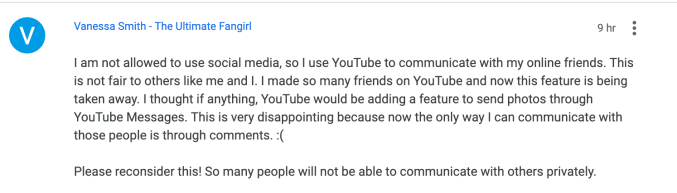
A sizable number of commenters are complaining that YouTube was the “only place” they could message their friends because they didn’t have a phone or weren’t allowed to give out their phone number.

Some said they used the feature to “talk to their mom” or because they weren’t allowed to use social media.

Screen Shot 2019 08 21 at 10.02.56 AMScreen Shot 2019 08 21 at 9.41.12 AM

It appears that many children had been using YouTube Messages as a sort of workaround to their parents’ block on messaging apps on their own phones, or as a way to communicate from their tablets or via web, likely without parents’ knowledge.

That’s not a good look for YouTube at this time, given its issues around inappropriate videos aimed at children, child exploitation, child predators, and regulatory issues.

The video platform in February came under fire for putting kids at risk of child predators. The company had to shut off comments on videos featuring minors, after the discovery of a pedophile ring that had been communicating via YouTube’s comments section.

Notably, the FTC is also now following up on complaints about YouTube’s possible violations of COPPA, a U.S. Children’s Privacy law. Child advocacy and consumers groups complain that YouTube has lured children under 13 into its digital playground, where it then collects their data and targets them with ads, without parental consent.

Though some people may have used YouTube Messages to promote their channel or to share videos with family members and friends, it’s clear this usage hadn’t gone mainstream. Otherwise, YouTube wouldn’t be walking away from a popular product.

The feature also had issues with spam — much like Google+ did —  as there were unwelcome requests from strangers, at times.

YouTube says users will still be able to share videos through the “Share” feature which connects to other social networks.

 

21 Aug 2019

Crossbeam gets $12.5M Series A to help companies organize their partnerships

When Crossbeam CEO and co-founder Bob Moore was working at previous startups, he noticed a problem around sharing information with potential partners. In fact, it was so acute he decided to create a startup to solve that problem, and today, Crossbeam announced a $12.5 million Series A round led by FirstMark Capital with participation from existing investors Uncork Capital and Slack Fund.

Moore says that in his previous jobs, he was encountering issues with getting partners integrated and answering basic questions like how many customers do we have in common or are my sales reps currently selling to any of the same people that your sales reps are selling to, and so forth.

“We eventually realized the reason these questions were hard to answer was that you can’t draw a Venn diagram of all the data unless you have all of the data in both of the circles,” Moore told TechCrunch. In other words, each company has only half of the picture, what they already know, and it’s hard to make data-driven decisions without more information.

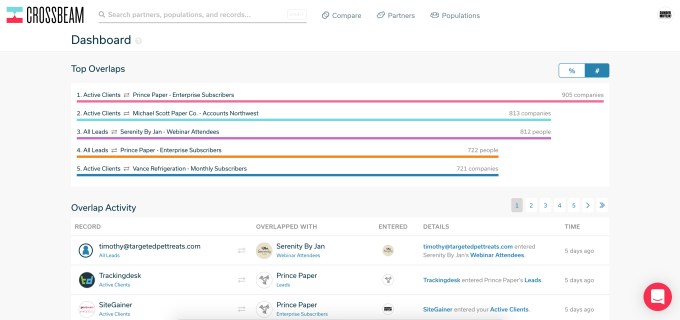
Summary Dashboard

Crossbeam Summary Dashboard. Screenshot: Crossbeam

He added that there is danger in the age of GDPR and the upcoming California Consumer Privacy Act (CCPA) in oversharing of data, but at the other extreme is not sharing at all. Moore said he created Crossbeam to deal with this. “It seemed like the solution would be to build something that could almost function as an escrow service for data, which could sit between companies that are partnering with each other, and allow them to combine their data sets and identify that when certain conditions are met — like an overlapping need, or an overlapping customer — to take very specific precise actions as a result of that overlap,” Moore explained.

The product works by sharing data from tools like Salesforce, Hubspot or even a .csv file and comparing that data inside of Crossbeam. Partners can see the overlap and where it makes sense for them to work together. Sometimes that may involve customer names, but other times it may be common sales reps across accounts. He says that many companies start with highly trusted partners to get comfortable with the product before branching out.

The company, which was founded in July 2018, has 15 employees and is based in Philadelphia. It previously received a $3.3 million seed round at the end of 2018.

21 Aug 2019

Only 3 days left: Get your 2-for-1 passes to Disrupt Berlin 2019

Holy sonderangebot, startup fans — yet another special offer you don’t want to miss! You’ve got just three days left to take advantage of our a 2-for-1 summer flash sale on passes to Disrupt Berlin 2019. Imagine scoring two Innovator, Founder or Investor passes for the price of one. That’s some mighty big ROI.

Don’t delay, because this deep 2-for-1 discount offer disappears August 23 at precisely 11:59 p.m. (CEST). Buy your 2-for-1 passes right here.

You’ll get the full Disrupt experience at half the price. Sweet! Come and hear some of the startup world’s most innovative thinkers, founders and investors. They’ll join TechCrunch editors on the Disrupt Main Stage and discuss crucial tech and investor topics affecting startups of every stripe.

Want to delve deeper into one topic or have the chance to ask follow-up questions in a smaller, more personal setting? Then be sure to attend the Q&A Sessions. These audience-interactive discussions — moderated by TC editors — feature subject-matter experts answering your burning questions related to Disrupt Berlin’s category tracks — Artificial Intelligence/Machine Learning, BioTech/HealthTech, Blockchain, FinTech, Gaming, Investor Topics, Media, Mobility, Privacy/Security, Retail/eCommerce, Robotics/IoT/Hardware, SaaS, Space and Social Impact & Education.

The only way to benefit is to be there in person because we don’t record or stream these sessions — or allow media to attend (except for the moderating TC editors). Show up early, because seating is limited.

Networking is a major event at any Disrupt, and we’re making it easier than ever for you to find the right people — you know, the ones who align with your goals and can help you move forward. CrunchMatch — our free business-matching platform — cuts through the noise to help you zero in on the connections that matter most to you and your business.

We’ll notify all pass holders when CrunchMatch goes live. Then simply create a profile listing your specific criteria, goals and interests. CrunchMatch (powered by Brella) works a bit of algorithmic magic to find like-minded startuppers and will suggest matches and, subject to your approval, propose meeting times and send meeting requests.

You’ll be fully prepped and ready to explore the hundreds of early-stage startups in Startup Alley with a tool that helps you connect with just the right opportunities.

That’s only a taste of what Disrupt Berlin 2019 has to offer, and now you can get it — and a whole lot more — for a whole lot less. This special offer disappears on August 23 at 11:59 p.m. (CEST). Buy your 2-for-1 passes today. Sonderangebot!

Is your company interested in sponsoring or exhibiting at Disrupt Berlin 2019? Contact our sponsorship sales team by filling out this form.

21 Aug 2019

Only 3 days left: Get your 2-for-1 passes to Disrupt Berlin 2019

Holy sonderangebot, startup fans — yet another special offer you don’t want to miss! You’ve got just three days left to take advantage of our a 2-for-1 summer flash sale on passes to Disrupt Berlin 2019. Imagine scoring two Innovator, Founder or Investor passes for the price of one. That’s some mighty big ROI.

Don’t delay, because this deep 2-for-1 discount offer disappears August 23 at precisely 11:59 p.m. (CEST). Buy your 2-for-1 passes right here.

You’ll get the full Disrupt experience at half the price. Sweet! Come and hear some of the startup world’s most innovative thinkers, founders and investors. They’ll join TechCrunch editors on the Disrupt Main Stage and discuss crucial tech and investor topics affecting startups of every stripe.

Want to delve deeper into one topic or have the chance to ask follow-up questions in a smaller, more personal setting? Then be sure to attend the Q&A Sessions. These audience-interactive discussions — moderated by TC editors — feature subject-matter experts answering your burning questions related to Disrupt Berlin’s category tracks — Artificial Intelligence/Machine Learning, BioTech/HealthTech, Blockchain, FinTech, Gaming, Investor Topics, Media, Mobility, Privacy/Security, Retail/eCommerce, Robotics/IoT/Hardware, SaaS, Space and Social Impact & Education.

The only way to benefit is to be there in person because we don’t record or stream these sessions — or allow media to attend (except for the moderating TC editors). Show up early, because seating is limited.

Networking is a major event at any Disrupt, and we’re making it easier than ever for you to find the right people — you know, the ones who align with your goals and can help you move forward. CrunchMatch — our free business-matching platform — cuts through the noise to help you zero in on the connections that matter most to you and your business.

We’ll notify all pass holders when CrunchMatch goes live. Then simply create a profile listing your specific criteria, goals and interests. CrunchMatch (powered by Brella) works a bit of algorithmic magic to find like-minded startuppers and will suggest matches and, subject to your approval, propose meeting times and send meeting requests.

You’ll be fully prepped and ready to explore the hundreds of early-stage startups in Startup Alley with a tool that helps you connect with just the right opportunities.

That’s only a taste of what Disrupt Berlin 2019 has to offer, and now you can get it — and a whole lot more — for a whole lot less. This special offer disappears on August 23 at 11:59 p.m. (CEST). Buy your 2-for-1 passes today. Sonderangebot!

Is your company interested in sponsoring or exhibiting at Disrupt Berlin 2019? Contact our sponsorship sales team by filling out this form.

21 Aug 2019

Volocopter reveals its first commercial aircraft, the VoloCity air taxi

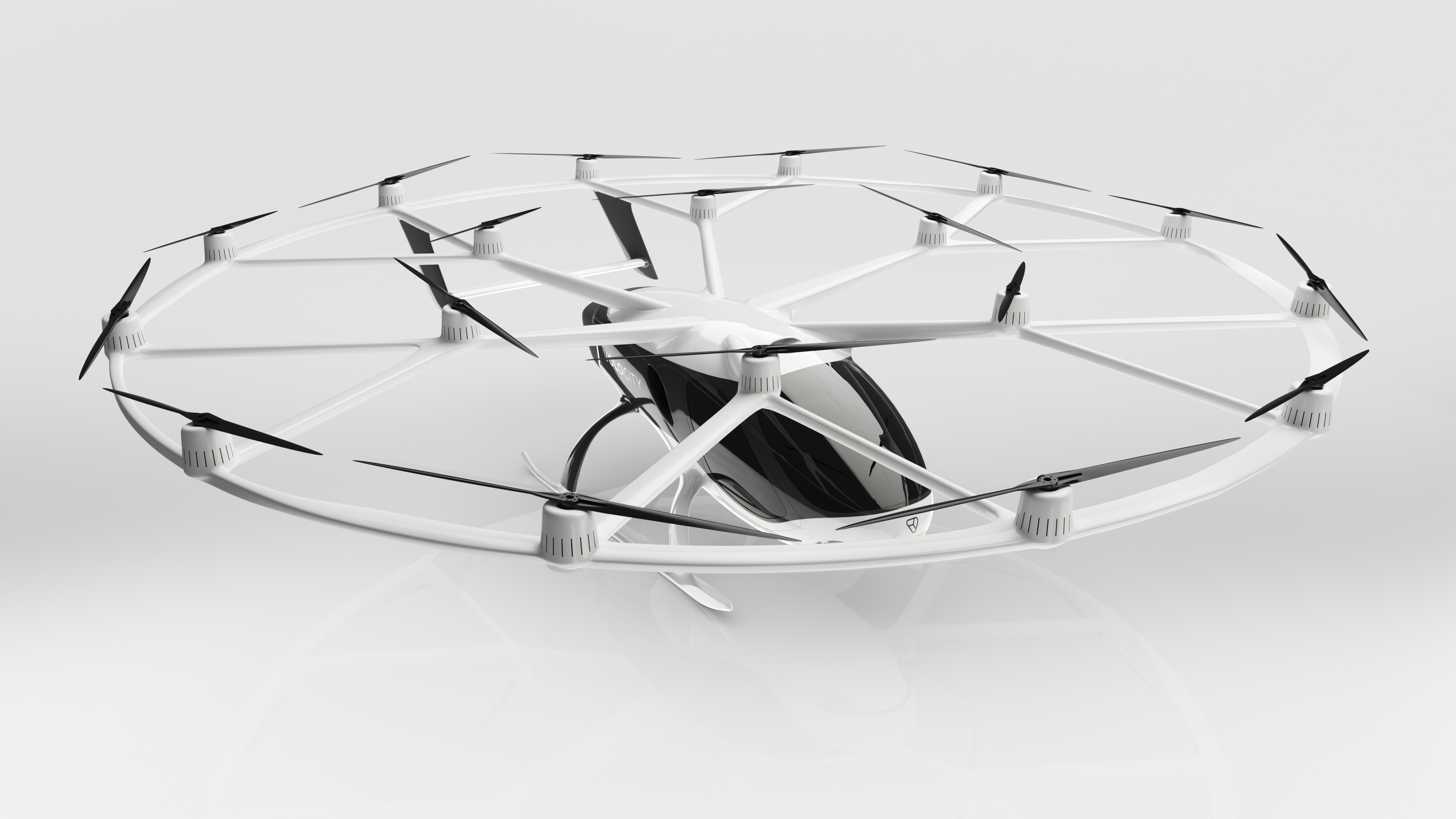
VoloCity takes off into nightIt’s a race to the skies in terms of which company actually deploys an on-demand air taxi service based around electric vertical take-off and landing aircraft – for its part, German startup Volocopter is taking another key step with the revelation of its first aircraft designed for actual commercial use, the VoloCity.

The VoloCity is the fourth-generation eVTOL vehicle that Volocopter has created, but the first three were created for testing and demonstration purposes, and have flown over 1,000 times in service of that goal. The VoloCity, an 18-rotor VTOL with a range of around 35 km (just under 22 miles) and a top speed of about 70 mph, is designed for transporting up to two people, including light luggage like backpacks, briefcases or purses.

VoloCity Top

Volocopter has paid close attention to safety and comfort with this design, meeting the safety standards set by the European Aviation Sfey Agency, and including a new stabilizer that hasn’t been a part of the test aircraft, in rod to provide more stability during flight.

Now, Voloctoper says it’s turning its attention to infrastructure and ecosystem development, which includes establishing its ‘VoloPorts’ for take-off and landing, as well as working with cities on air traffic control. The company says it’s meeting already with global operators that serve this purpose, including Fraport, which runs the Frankfurt International Airport.

As for when VoloCity moves from render to reality, Volocopter says that it’s targeting a first public test flight for Q4 of this year in Singapore, where it’ll also show off the prototype of first first VoloPort, pictured in concept images below.

[gallery ids="1871690,1871691"]

21 Aug 2019

Europe’s top data protection regulator, Giovanni Buttarelli, has died

Europe’s data protection supervisor, Giovanni Buttarelli, has died.

His passing yesterday, aged 62, was announced by his office today — which writes:

It is with the deepest regret that we announce the loss of Giovanni Buttarelli, the European Data Protection Supervisor. Giovanni passed away surrounded by his family in Italy, last night, 20 August 2019.

We are all profoundly saddened by this tragic loss of such a kind and brilliant individual. Throughout his life Giovanni dedicated himself completely to his family, to the service of the judiciary and the European Union and its values. His passion and intelligence will ensure an enduring and unique legacy for the institution of the EDPS and for all people whose lives were touched by him.

Ciao Giovanni

Buttarelli was appointed to the key oversight role monitoring the implementation of EU privacy rules for a five year term, starting in December 2014.

Among his achievements in the post was overseeing the transition to a new comprehensive data protection framework, the General Data Protection Regulation (GDPR), which came into force last year — a shift of gear towards enforcement that has shone a global spotlight on the bloc’s approach to privacy at a time when the implications of not putting meaningful checks on data-mining giants are writ large across Western democracies.

The jury is still out on how effectively Europe’s regulators will enforce the GDPR against powerful platform giants but a large number of open investigations are now pending.

Buttarelli also personally pressed the case for regulators to collectively grasp the nettle — to tackle what he described as “real cases like that of Facebook’s terms of service”.

At the same time as working for a consistent and comprehensive application of the GDPR, he believed further interventions would be needed to steer the application of powerful technologies in a fair and ethical direction.

This included advocating for greater joint working between privacy and competition regulators — calling for them to “adopt a position on the intersection of consumer protection, competition rules and data protection” and use “structural remedies to make the digital market fairer for people”.

He has also sought to accelerate innovation and debate around data ethics, which was the theme of a major privacy conference he hosted last year.

In an interview with TechCrunch last year he warned that laws alone won’t stop data being used to discriminate unfairly — while asserting that online discrimination “is not the kind of democracy we deserve”.

The sad news of Buttarelli’s passing has shocked the region’s data protection community which has responded with an outpouring of tributes on social media.

Prior to joining the European Commission, Buttarelli was secretary general of Italy’s data protection watchdog.

He also served for many years as a judge in his home country.

21 Aug 2019

Andrew Ng’s AI companies expand to Medellin, Colombia

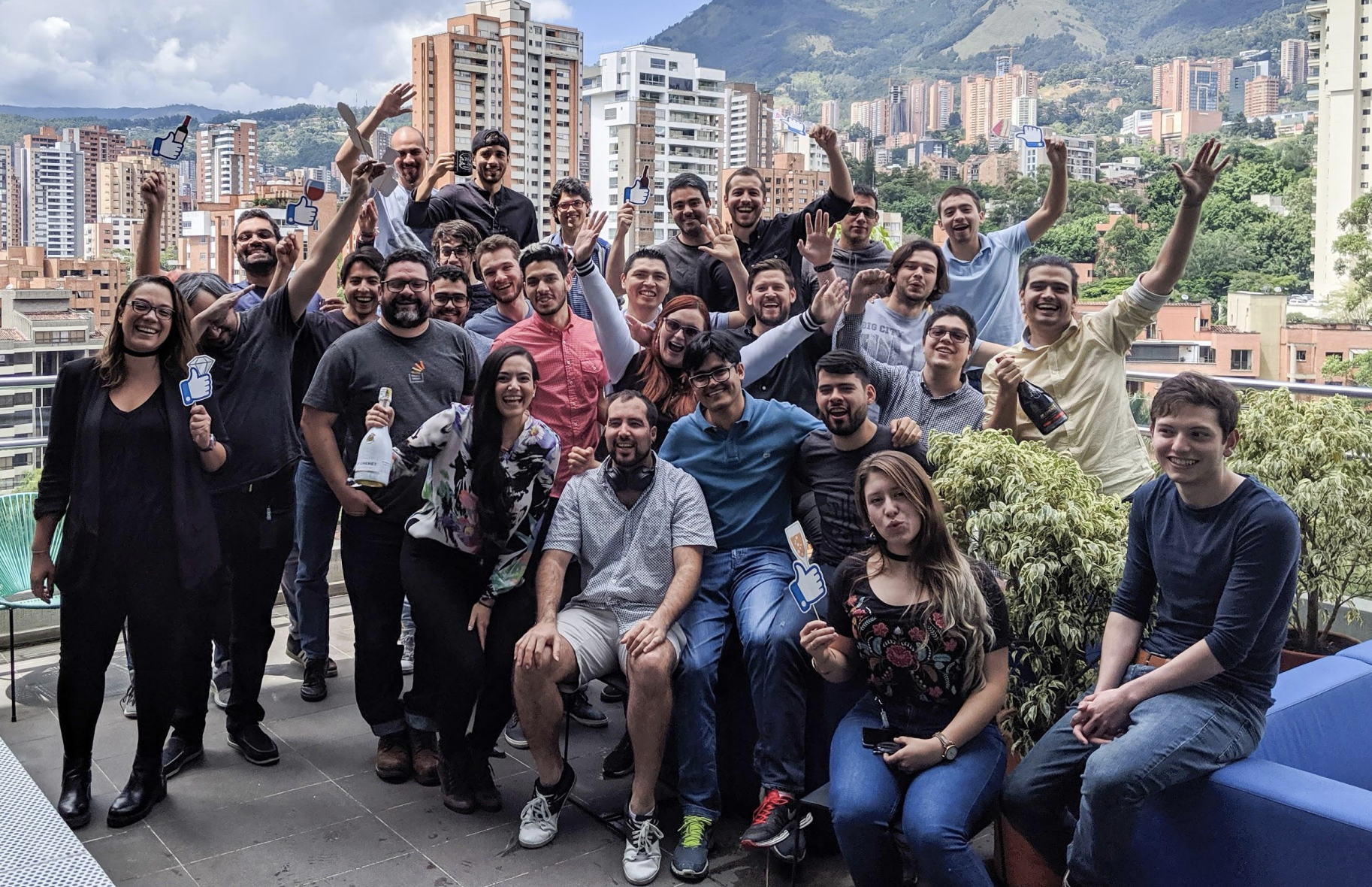
After his tenure as Chief Scientist at Baidu, Andrew Ng, the founder of the Google Brain project and former CEO of Coursera, set up a number of different proejcts that all focus on making AI more approachable. These include the education startup Deeplearning.ai, the AI Fund startup studio for building AI companies and Landing.ai, which helps enterprises (and especially manufacturing companies) use AI. Today, Ng announced that he has opened a second office for these projects in Medellin, Colombia.

At first, Medellin may seem like an odd choice. But today’s Medellin is very different from the one you may have seen on Narcos (and a lot safer). It’s home to a number of universities and over the course of the last few years, it’s a hub for Colombia’s startup scene thanks to incubators like Ruta N and others.

Ng told me that he chose Medellin after looking at a wide range of cities in Europe, Asia and Latin America. Medellin, he believes, offers a strong talent pool, educational system and business ecosystem. it also helps that the Colombia government has made tech a focus in recent years.

Screen Shot 2019 08 20 at 4.29.37 PM 1

“I see early signs of momentum for Colombia being a talent magnet both regionally and globally,” he told me. Indeed, the company was able to hire team members from Poland, Bangladesh, Egypt and Chile for its offices in Medellin, which now has just under 50 people. Over the course of the next two years, Ng plans to expand this team to between 150 and 200 employees.

It’s important, Ng argues, that we set up AI hubs outside of Silicon Valley and China, in part, because they’ll provide a different perspective. “We are able to share our AI ecosystem and Silicon Valley know-how with Medellín,” he writes in today’s announcement. “We’re equally thrilled for our Silicon Valley team to be learning from the Medellín community. Local knowledge and innovation shared with a global community is what will catapult the technology forward.”

The teams in Medellin will work on all of Ng’s projects, including four unannounced stealth portfolio companies that are looking into using AI in sectors like healthcare, education and customer support. In total, the teams in Medellin are working on about a dozen projects right now. And that’s very much Ng’s approach to AI — and for Landing.ai in particular: build lots of specialized components for various verticals that can then be generalized. “AI isn’t some piece of SaaS software that everybody can just swipe their credit card and use,” he said.


Andrew Ng will also join us for our first TechCrunch Sessions: Enterprise event in San Francisco on September 5 to talk about Landing.ai and the future of AI in general. You can find more information about the event (and buy tickets) here.

21 Aug 2019

Waymo releases a self-driving open data set for free use by the research community

Waymo is opening up its significant stores of autonomous driving data with a new ‘Open Data Set’ it’s making available for the purposes of research. The data set isn’t for commercial use, but its definition of ‘research’ is fairly broad, and includes researchers at other companies as well as academics.

The data set is “one of the largest, riches and most diverse self-driving datasets ever released for research,” according to Waymo Principal Scientist and Head of Research at Waymo Drago Anguelov, who was at both Zoox and Google prior to joining Waymo last year. Anguelov said in a briefing that the reason he initiated the push to make this data available is that Waymo, along with several other companies working in the field are “currently hampered by the lack of suitable data sets.”

“We decided to contribute our part to make, ultimately, researchers in academia ask the right questions – and for that, they need the right data,” Anguelov said in a briefing. “And I think this will help everyone in the field, it is not an admission in any way that we have problems solving these issues. But there is always room for improvement in terms of efficiency, scaleability, amount of labels to need. It’s a developing field. I’s mostly we’re trying to get others into thinking about our problems and working with us, as opposed to doing work that’s potentially not so impactful, given the current state of things.”

labels 2d

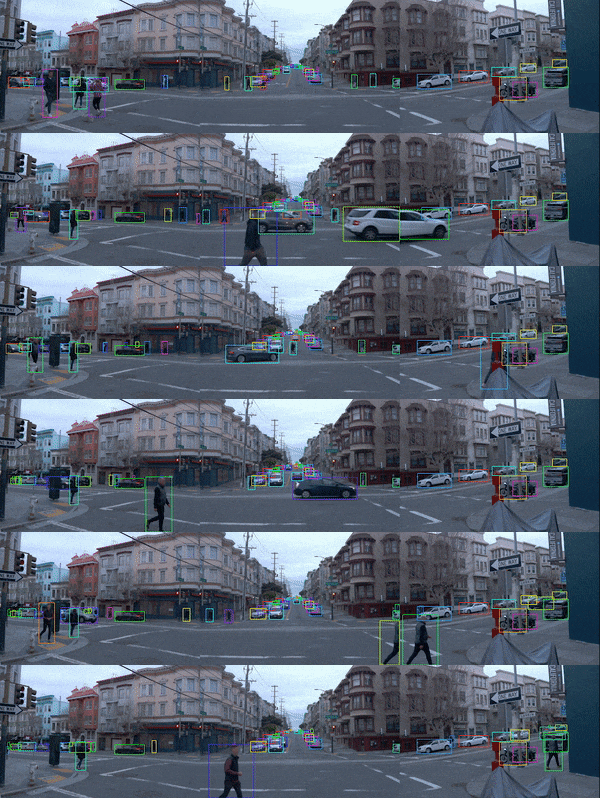
The Waymo Open Data set tries to fill in some of these gaps for their research peers by providing data collected from 1,000 driving segments done by its autonomous vehicles on roads, with each segment representing 20 seconds of continuous driving. It includes driving done in Phoenix, AZ; Kirkland, WA; Mountain View, CA; and San Francisco, CA, and offering a range of different driving conditions including at night, during rain, at dusk and more. The segments include data collected from five of Waymo’s own proprietary lidars, as well as five standard cameras that face front and to the sides, providing a 360-degree view captured in high resolution, as well as synchronization Waymo uses to fuse lidar and imaging data together. Objects, including vehicles, pedestrians, cyclists and signage is all labelled.

Waymo has traditionally been among the more closed companies when it comes to its collected data, and it’s also the player that often touts its own long experience as a key competitive advantage (Waymo began life as Google’s Self-Driving Car project, which officially began work out of Google’s X Lab in 2009). The company has also had a high-profile legal spat over intellectual property with autonomous driving technology rival Uber, following the hiring by Uber of a former member of its own team. Naturally, then, some might be skeptical about how ‘open’ it actually is about ways this data can be used.

pasted image 0 2

Vijaysai Patnaik, a Product Lead at Waymo, explained that ‘research’ use actually covers a lot of ground. There’s a specific licensing agreement with the data set, as you would expect, but Patnaik also gave a general explanation during the briefing about who they expect might make use of the data and for what purposes.

“That could include universities and PhD students are professors at various universities who are interested in this field, it could include independent research labs or robotics labs, for example.” Patnaik said. “There are a number of those in the Bay Area. And […] companies can use this data set as long as they comply with our license agreements, or it could also include folks like Drago [Anguelov] and his teams in other organizations.

Other companies working in autonomous driving have taken similar approaches, with Lyft and Argo AI as two recent examples. Waymo does indeed have a commanding lead on the rest of the field when it comes to actual time on the road and miles driven, however, so researchers in both autonomous driving, and related robotics fields, including computer vision, are probably eager to see what they’re releasing.

21 Aug 2019

Cosi raises €5M for its ‘full-stack’ hospitality alternative to boutique hotels

Cosi, a new Berlin-based startup operating in the hospitality space with an alternative to boutique hotels and managed short-stay apartments, has picked up €5 million in seed funding pre-launch.

Leading the round are venture capital firms Cherry Ventures and e.ventures, with participation from a number of travel, real estate and hospitality entrepreneurs and experts. They include Nils Regge (founder of HomeToGo and Dreamlines), Gleb Tritus (MD Lufthansa Innovation Hub), Manuel Stotz (founder of Kingsway Capital), Mato Peric (founder of Immo), Andreas Brehmke, Loric Ventures, and Lions Venture.

That’s quite a line up for a company that won’t launch for another few months, but is no doubt based in part on the track record of Cosi’s founders.

They are Christian Gaiser, the startup’s CEO, who preciously founded Bonial.com, the local shopping platform sold to Axel Springer in 2011; Dimitri Chandogin, who co-founded Doc+, a prominent digital healthcare provider in Russia; and CTO Gerhard Maringer, who has a background in fintech and previously built ForexFix, an FX hedging platform.

“More and more guests prefer to stay in a unique apartment versus a boring hotel, i.e. travelers tend to book their stay at a private host via Airbnb. [However], the experience can be frustrating though due to lack of quality and service: long check-in/check-out times, poor interior design, lack of cleanliness, not enough linen, no service hotline in case of questions, to name a few examples,” Gaiser tells TechCrunch.

“Many guests, therefore, decide not to stay in a unique home for quality reasons. Cosi solves this problem as a full-stack hospitality brand: We control the entire guest journey from end-to-end”.

To offer a “full-stack” hospitality service that hopes to compete with well-run boutique hotels or traditional local managed apartments, Gaiser says the company signs long term leases with property owners, and then furnishes those apartments itself to “control” the interior design experience. “On top of that, we offer a digital service along the entire guest journey from initial contact to loyalty. Finally, we rent out our apartments short-term as a hotel replacement,” he explains.

That requires technology to drive “the entire value chain,” and Gaiser points out that the tech guests experience directly is only the tip of the iceberg. “Running a hospitality business requires a lot of tools in the background for housekeeping, maintenance, yield management, to name a few, that will create an efficiency edge for us,” says the Cosi co-founder.

With regards to target customer, Cosi broadly covers travellers that want the quality assurance of a hotel but appreciate the unique design and “coziness” of a personal home. More specifically, the company has two main target groups in mind: tourists that spend a few days in Berlin to immerse themselves in the local culture and history (“live like a real Berliner”), and business travellers that need to stay several weeks or months and are fed up with the traditional hotel experience.

“Cosi creates a new category, but the closest direct competitors include smaller boutique hotels or traditional local serviced apartment operators for tourists,” says Gaiser. “In a broader sense, we also compete with the big hotel companies like Marriot or Hilton in business travel”.

There are potential U.S. competitors, too, with Sonder and Lyric operating a similar model. “They might also look into Europe,” concedes Gaiser, “[but] it will be challenging for them to comply with local regulations and to establish real estate relationships. It is a very local game”.

21 Aug 2019

Hear THX’s new Deep Note right here

The THX Deep Note is changing and it can be heard here first. The iconic audio track has long proceeded movies certified by THX and features the now familiar crescendo that showcases the movie’s audio capability. This time around THX built the intro to feature 4k video as much as audio as it will be available to theaters that are THX Certified Cinema partners.

To make the trailer immersive online, THX utilized its THX Spatial Audio post-production mixing tools that enables online users to experience the multidimensional sound using headphones. It’s special. Don some headphones and turn up your volume before pressing play. THX says in a press release it “applied advanced objects and ambisonics-based engineering, essentially spherical harmonics, for full-sphere audio.” I’m not sure what that means, but the trailer sounds great.

The original THX Deep Note debuted at the premiere of Return of the Jedi in Los Angeles.

“Our aim with this piece is to extend the legacy that inspired us as young people in the movie theater,” said Ben Rosenblatt in a released statement, the trailer’s executive producer and co-founder of American Meme. “As a kid, I was blown away by the THX Deep Note trailer and would go back to the movie theater again and again just to see it, which inspired me to pursue the career I have in Hollywood today. We hope we’ve taken this a step beyond the originals to open up young minds and inspire an entirely new generation.”