Year: 2019

21 Aug 2019

Daily Crunch: DoorDash acquires Scotty Labs

The Daily Crunch is TechCrunch’s roundup of our biggest and most important stories. If you’d like to get this delivered to your inbox every day at around 9am Pacific, you can subscribe here.

1. DoorDash acquires autonomous driving startup Scotty Labs

DoorDash seems to be very interested in self-driving technology — not only did it acquire Scotty Labs (a startup enabling people to remotely control self-driving cars), it also brought on the two co-founders of Lvl5, which was creating high-resolution maps for autonomous driving.

“We’ll share more updates in the near future but for now, we’re really excited to be part of the amazing DoorDash family and looking forward to building something magical together,” Scotty Labs co-founder Tobenna Arodiogbu wrote on in a blog post.

2. Apple, Google and Mozilla block Kazakhstan’s browser spying tactics

Apple, Google and Mozilla have taken the rare step of blocking an untrusted certificate issued by the Kazakhstan government, which critics say it forced its citizens to install as part of an effort to monitor their internet traffic.

3. The 11 best startups from Y Combinator’s S19 Demo Day 1

We already rounded up all the startups that presented at the accelerator’s Demo Day 1, but now the team has selected their favorites. (Extra Crunch membership required.)
4. MoviePass exposed thousands of unencrypted customer card numbers

An unprotected MoviePass database included both customer cards (those are the debit cards used to purchase movie tickets) and personal credit card numbers.

5. Waymo releases a self-driving open data set for free use by the research community

The data set isn’t for commercial use, but Waymo’s definition of “research” is fairly broad, and includes researchers at other companies as well as academics.

6. PayPal-backed money lender Tala raises $110M to enter India

Tala looks at behavioral data gathered through an Android app to build a customer’s credit profile. The new round values the company at $750 million.

7. Join The New Stack for Pancake & Podcast with Q&A at TC Sessions: Enterprise

Popular enterprise news and research site The New Stack is coming to TechCrunch Sessions: Enterprise on September 5 for a special Pancake & Podcast session with live Q&A. (And we’re dead serious about the pancakes.)

21 Aug 2019

Google denies reports of unannounced changes to Android app review process

Multiple reports this week claimed Google had quietly rolled out a more in-depth app review process to all developers — changes designed to keep the Play Store safer from spam, malware, and copycat apps. Those reports are inaccurate, Google tells TechCrunch. Instead, the company is giving itself more time to review apps from new, unestablished developers on the Play Store, as previously announced, but this hasn’t been extended to all developers.

Concerns about these so-called “unannounced changes” stemmed from a blog post by Choice of Games, which wrote that “all new apps” would be getting an additional review, slowing down app approvals. It claimed new apps would require at least three days for review, and this now included existing developers.

The post cited a conversation with Google Support as the source for its claims.

This led to a ton of confusion, as the development shop behind the post was well-established, having been on the Play Store since 2010 as would have been exempt from Google’s policy of increased reviews for new developers.

As it turns out, it appears there was miscommunication between Google Play Store developer support and the developer, according to the chat transcript that was published. The support person, “Liz,” was alerting the developer to the new policy Google announced in April, which detailed increased review times for Play Store newcomers. She didn’t appear to understand that she was speaking with a developer who had published on Google Play for nearly a decade.

Android Police also picked up the news, writing that it Google had “quietly instigated a more involved review process that impacts every app and update.”

Reddit and Hacker News also weighed in. In addition to the reported changes, developers were concerned there was now no way to schedule new app releases through the Timed Publishing feature. (That’s also not true — developers can publish to a closed testing track, then used Timed Publishing to go live to the public.)

A Google Developer Relations team member stepped in to clear things up on Reddit, and we’ve confirmed with Google that his responses were accurate.

Google’s updated app review process, first announced in April, hasn’t changed.

At the time, Google said:

“We will soon be taking more time (days, not weeks) to review apps by developers that don’t yet have a track record with us. This will allow us to do more thorough checks before approving apps to go live in the store and will help us make even fewer inaccurate decisions on developer accounts.”

Google began notifying developers directly in the Play Console in June that new apps by developers without a track record will take a couple of days longer to review. Google says that, since this change, it’s already seen a meaningful increase in the number of harmful apps blocked by Play even before they are published.

It’s not clear why the developer relations support person miscommunicated this information to the developer in question, but it points to a training issue on Google’s part.

It’s also unclear why the established developer’s app was held up in app review, beyond it just being a mistake on Google’s part.

Unfortunately for Google, Play Store developers have come to expect a speedy review process so any delays feel like unnecessary friction.

Unlike Apple, which employs a large team to carefully review app submissions and make hard calls on controversial apps, Google has more heavily relied on automation over the years. The company disclosed in the past how it uses software to pre-analyze apps for viruses, malware, and other content and copyright violations.

That process doesn’t always work, though. Only days ago, dozens of Android apps disguised as harmless photo editors and games were discovered to actually be adware. This follows similar news from January, where 85 apps were found to contain adware. And in May, where adware was discovered in some 200 apps totaling 150+ million installs. And, news from last November, where malware was found across over a dozen apps with half a million installs. And so on.

While it would make sense for Google to increase its review of all apps, given its inability to address this problem, that was not the case here.


21 Aug 2019

Bring your posse to Disrupt SF 2019 with group discounts

Disrupt San Francisco 2019, our flagship event on October 2-4, features three full days of programming, more than 10,000 attendees, over 1,200 exhibiting startups and sponsors — and that’s just for starters. That’s a lot of ground to cover. Here’s a hot tip: take advantage of group discounts, saddle up and bring your whole posse to the show and squeeze out every bit of information, inspiration and opportunity possible.

Spread your crew across Disrupt and get more done. Network till you drop in Startup Alley — using CrunchMatch, our free business match-making platform, to find and schedule meetings with only the best connections for your business. Bear witness to our epic pitch competition, Startup Battlefield — a great place to spot investment-worthy companies.

Attend the many Main Stage panel discussions and interviews with tech titans, up-and-coming founders and startup investors. Check out the conference agenda hereLooking for actionable tips and advice? Head for the Extra Crunch Stage. Yeah, you’ll learn a thing or two.

We offer group discounts for every pass level, to make your posse possible. Here’s what you need to know.

Group Innovator Pass: Buy five or more passes and get a 20 percent discount. Need 10 or more passes? Email us for a price quote at events@techcrunch.com. An Innovator Pass grants access to the Main Stage, ExtraCrunch Stage, Q&As, workshops, CrunchMatch, networking receptions and the TechCrunch Events App, which lets you communicate with other attendees.

Group Founder Pass: Buy two or more passes and you’ll get a 10 percent discount. Your Founder Pass gets you the same benefits as an Innovator Pass but at an already discounted rate — but you must be a (co)founder of a company (of any size).

Group Investor Pass: Purchase two or more passes to get a 10 percent discount. An Investor Pass provides the same benefits as an Innovator pass, PLUS access to the Investor Lounge, an invitation to investor-only reception and two hours of private meeting space.

Group Expo Only Pass: If you want to buy Expo Only passes in bulk (10 or more), email events@techcrunch.com for a price quote. An Expo Only Pass provides access to the Startup Alley expo floor, workshops and a lite version of the TechCrunch Events App.

Group Startup Alley Exhibitor Packages: If you’re interested in purchasing more than one Startup Alley Exhibitor Package, then email startupalley@techcrunch.com for more information. This package includes exhibit space for one day, use of the Startup Alley Lounge, access to the media list and two or three Founder Passes, depending on when you book.

Disrupt San Francisco 2019 takes place on October 2-4. Bring your posse and cover more ground, find more opportunity and discover more ways to grow your business. Get your group discounts today. If you’re riding solo, no problemo. Get an early bird ticket and, depending on the pass level you choose, you can save up to $1,300. Saddle up and ride!

Is your company interested in sponsoring or exhibiting at Disrupt San Francisco 2019? Contact our sponsorship sales team by filling out this form.

21 Aug 2019

How Dropbox, Nike, Salesforce, MailChimp, Google and Pepsi welcome their new hires

The first day of work at a new job can be very stressful. The unfamiliar surroundings and onslaught of new material can cause new hires some degree of discomfort. But sometimes the atmosphere at the new company can be welcoming and can help counteract the stress.

Different companies have their own traditions to help make this transition period more comfortable and memorable for new hires. Some of these traditions include:

  • Team-building day trips for new hires
  • Breakfast with the CEO
  • Tours of the best cafes, parks, and other spots in the neighborhood
  • Office “quests” (or some other gamification of onboarding)
  • Personalized onboarding programs or interactive company academies

Usually, only employees can experience these traditions. But there’s one new-hire tradition that has become extremely popular and often highly publicized: the “welcome kit”.

Welcome kits usually contain a hodgepodge of items that employees will need on the job (pens, notebooks, books, etc.) and things to make employees feel welcome (clothing, stickers, water bottles, or more unusual items — often with the company name or logo on them).

To get a sense of how different companies handle their kits, we talked to four successful startups about their welcome kits in the article below, followed by our look at a dozen more:

Table of Contents:

This article is based on the personal welcome kit collection of Vladimir Polo, founder of AcademyOcean. AcademyOcean is a tool for interactive onboarding and training (and Vladimir Polo is a fan of welcome kits).

Dropbox

21 Aug 2019

Apple exec Susan Prescott is coming TechCrunch Sessions: Enterprise

Susan Prescott, Apple’s vice president of markets, apps and services, has been at Apple since 2003. She worked with the company’s mythical co-founder Steve Jobs, and has witnessed such milestones as the launch of the iPhone and the iPad. Susan will be coming to TechCrunch Sessions: Enterprise in San Francisco on September 5 to discuss Apple’s enterprise strategy.

Prescott has been closely involved in that from the earliest days of the iPhone, and as she told TechCrunch in a 2018 article on Apple’s enterprise strategy, the company was thinking about the enterprise as a potential market from the start. “Early on we engaged with businesses and IT to understand their needs, and have added enterprise features with every major software release,” she said at the time.

When you think about it, it was in fact the iPhone and the iPad that led to the Consumerization of IT and Bring Your Own Device movements, two huge trends in enterprise IT that began in the 2011 timeframe. Later the company helped grow the business further by partnering with such enterprise stalwarts as IBM, SAP, Cisco, GE and most recently Salesforce along with systems integrators like Deloitte and Accenture. Today, the company offers a range of business tools including Apple Business Chat and Apple Business Manager, an IT management tool for managing Macs, iPhones and iPads and the apps that run on them.

All of that adds up to robust enterprise strategy, and Prescott will discuss all of that and more with TechCrunch editors. We’ll dive into Apple’s history in the enterprise and what it’s doing today to enhance that part of its business.

In all, Prescott has over 25 years of computing industry experience. Before joining Apple in 2003, she worked for Adobe where she had a range of engineering, marketing and management roles. Her last position before joining Apple in 2003 was Vice President of product management and marketing in Adobe’s Creative Professional Solutions group.

Grab your $349 tickets today to join the show and meet amazing enterprise leaders. Don’t wait! Ticket prices go up at the door! If you book 4+ tickets you’ll save 20% – book for your team here.

21 Aug 2019

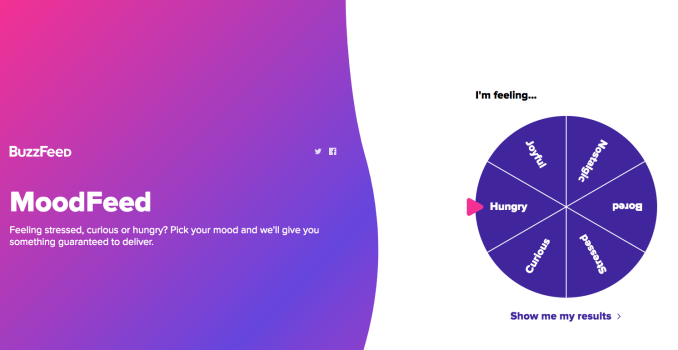
BuzzFeed’s new MoodFeed recommends content based on how you’re feeling

BuzzFeed is offering readers a new approach to finding content that fits the way they’re feeling right now.

It’s not the boring old approach of following a link on social media or search, or of typing BuzzFeed.com into your browser.  Instead, on MoodFeed, readers can identify their mood, then they’ll get a list of articles that match those feelings.

There are currently six options — curious, stressed, bored, nostalgic, joyful or hungry. If you select “curious,” you’ll see a list of BuzzFeed posts about strange facts, life hacks and the like. If, on the other hand, you go with “nostalgic,” you’ll get lots of headlines about pop culture history. And if you’re not sure, you can just give the mood wheel a spin and see what it lands on.

Talia Halperin, BuzzFeed’s vice president of brand management, described this as an experiment in “getting our audience engaged and excited in a non-traditional way.” The team apparently created these recommendations by first identifying the main mood options, then “reverse-engineering” which articles would be a good fit.

And while BuzzFeed’s never offered this kind of interface before, Halperin argued that the broader strategy is one that the organization uses “all the time, in a curated, audience-focused way” — when the team is sharing and promoting articles, it’s thinking about moods and associated identities.

MoodFeed

In fact, the BuzzFeed team has actually built AI tools to help with this process, automating the ability to identify which BuzzFeed stories should be posted on which BuzzFeed pages, when “evergreen” stories should be re-promoted and at what time headlines should be shared.

In the case of MoodFeed, Halperin made it sound like this is very much an experiment, with the company still figuring out things like “how often we should refresh it, what our strategy is around that.”

At the same time, she said there’s plenty of room for expansion.

“This could scale in a really interesting way,” she added. ” You may have noticed that there are only six moods, but of course, there are several different moods that come along with certain events [so we’re interested] in really being able expand to expand the moods at different times of the year.”

21 Aug 2019

Deadline extended one week: apply to Hardware Battlefield @ TC Shenzhen

Whether you’re a time-crunched procrastinator or a last-minute decision-maker we have great news for early-stage hardware startup founders! You get one more week to apply to compete in Hardware Battlefield at TC Shenzhen on November 11-12 in China.

Did we just hear a collective sigh of relief? Take advantage of the reprieve and grab this opportunity for all it’s worth — $25,000 in prize money for starters. What are you waiting for? Submit your application by the new deadline: August 28 at 11:59 p.m. (PT).

This Battlefield takes place as part of the larger TechCrunch Shenzhen show, produced in collaboration with our China partner TechNode, that runs November 9-12. Shenzhen, the heartland of hardware, earned its stellar reputation for supporting hardware startups through a combination of accelerators, rapid prototyping and world-class manufacturing.

We accept applications from early-stage hardware startup from any country. Participating in this pitch competition will place your startup in front of some of the most influential technologists, investors and media. Win or lose, that kind of world-class exposure can change the course of your business.

You’re qualified to apply if you can meet these minimum requirements:

  • Submit the TC Hardware Battlefield 2019 application before August 28 at 11:59 p.m. (PT)
  • You must have a minimally viable product to demo onstage
  • Your product has received little if any, press coverage to date
  • Your product must be a hardware device or component

Here’s how the Hardware Battlefield works. Applying and participating is free. TechCrunch editors will pour over all qualified applications and then select 10-15 of the best hardware startups to compete. If you make the cut, get ready for six weeks of intense prep as our Battlefield team coaches you (for free) on crafting the perfect pitch.

Each startup has just six minutes to pitch and demo their creation to the judges — all expert VCs, founders and technologists. After you pitch, you’ll face a tough Q&A with the judges. That free coaching will sure come in handy. If you make it through the first round, you’ll pitch all over again to a fresh set of judges.

Only one startup will be declared the winner, earn serious bragging rights and that $25,000 equity-free prize. But every team receives invaluable media and investor interest. That exposure goes way beyond the live audience. We record the Battlefield on video and publish it on TechCrunch to a global audience.

Hardware Battlefield at TC Shenzhen takes place on November 11-12. This is your chance to launch your hardware startup on a global stage. Take advantage of the extra week and apply to Hardware Battlefield at TC Shenzhen before August 28 at 11:59 p.m. (PT). Come and show us your hardware!

Is your company interested in sponsoring or exhibiting at Hardware Battlefield at TC Shenzhen? Contact our sponsorship sales team by filling out this form.

21 Aug 2019

Workspace provider Knotel secures $400M, putting it in WeWork’s rear-view mirror

While some analysts are calling WeWork’s IPO filing as a ‘masterpiece of obfuscation’ and the esteemed tech observer Professor Scott Galloway simply calls it “WeWTF

There is another company which is coming up fast in the “WeViewMirror” – if you will – and that’s Knotel. Also a ‘flexible workspace provider’ Knotel has reversed the WeWork model and instead of “We” branding everywhere, simply leases buildings, take s a small office for its staff and then kits out the building with modular furniture a company can just move straight into and call their own.

Knotel has now completed a $400 million financing, led by Wafra, an investment arm of the Sovereign Wealth Fund of Kuwait. Mori Trust (one of Japan’s leading real estate business operators), Itochu (one of Japan’s largest trading conglomerates) and Mercuria (a leading Japanese equity firm) also all participated in the financing. Returning and previous Knotel investors include Norwest Venture Partners, Newmark Knight Frank, Bloomberg Beta and Rocket Internet.

Knotel will use the financing to grow its footprint in existing markets, continue expanding into “the world’s 30 largest cities” and also, “deepen its engagement with global enterprise accounts.” Basically, that is code for going after the world’s biggest businesses who now require the flexibility of offices like they require AWS Cloud Service provision for their applications.

In a statement Amol Sarva, Co-Founder and CEO of Knotel, said: “Knotel is building the future of the workplace, and we are excited to welcome a group of investors who believe passionately in our product, vision and ability to execute. Wafra will help us continue our rapid global expansion and solidify our position as the leader in a fast-growing, trillion-dollar flexible office market.”

Unlike traditional coworking players, which provide shared spaces for freelancers and company satellite locations, Knotel focuses on providing private and fully-furnished workspaces to large enterprises. The whole idea is to make it very simple: flexible workspaces; cheaper capital expenditures; operational flexibility.

There is also a tech play here. It’s “Baya” product is a blockchain platform used internally to facilitate data-driven acquisition decisions and reduce company costs while “Geometry” is a subscription service to make furnishing your office far easier faster and cost flexible.

Speaking to TechCrunch, Sarva said : “This funding is timely because rotate that other IPO [referring to the WeWork IPOD] is in the works. People have been complaining about some of the aspects of that and some of the inefficiencies they have. But the core of this new investment for us is about making the business capitally efficient.” He said everything they do is geared towards this.

He said Knotel will do this in three ways: “We will go way deeper into cities. Many individual cities are getting bigger than whole competitor companies in revenue. NYC, Paris, London SF. So doing that is way more efficient and others don’t understand this.

“Secondly we are adding about a dozen more cities. Not 1200. No-one makes money in Cairo.”

“Thirdly, every time we announce a product or tech product it’s about the core business. A product like Geometry, or modular furniture etc. That is all about making us grow faster with less capital. Making real estate less painful, faster and with less friction.”

The company now has more than 4 million square feet across more than 200 locations in New York, San Francisco, London, Los Angeles, Washington, D.C., Paris, Berlin, Toronto, Boston, São Paulo and Rio de Janeiro. In less than 4 years, the company has raised a total of $560 million, is now valued at more than $1 billion. It’s London footprint now stands at 263,000 square feet across 63 locations. It’s now aiming to be London’s number one flexible office provider (by building count), having achieved this in New York earlier in the year, it says.

21 Aug 2019

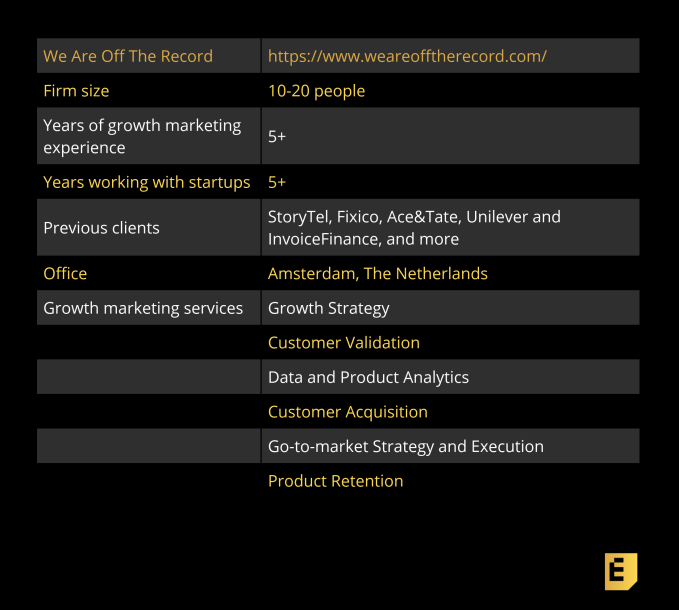
Verified Expert Growth Marketing Agency: We Are Off The Record

Unlike most agencies, We Are Off The Record’s (WAOTR) mission is to advise and train in-house growth teams to scale their business. CEO and founder Bas Prass prides his team’s “train and transfer method” because it has allowed them to work with tech startups and giant corporations from all around the world. WAOTR is based in the Netherlands, but learn more about their approach to growth, agency values, and more.

Logo Stacked Center Black 1

Image via We Are Off the Record

WAOTR’s unique approach to growth:

“As far as I know, we’re still the only growth bureau in Europe with our approach to growth — we help startups from within. We work with their in-house teams, which means we are literally in the same room as our clients. We want to lead by example. I don’t believe in any other approach anymore because growth has to come from within the business itself.”

“WAOTR walks the talk: they actually do growth instead of solely advising.” Rutger Planken, Rotterdam, The Netherlands, Director & Founder, FoodServicehub

WAOTR’s ideal client:

“Our ideal clients are the ones that understand that growth takes time and doesn’t happen overnight. They understand that we need to touch multiple domains within their business and that growth isn’t only in the marketing or product department but in the entire culture of the company. This is also the reason we insist to work with founders and/or want involvement from C-level positions.”

designer fast facts 32

Below, you’ll find the rest of the founder reviews, the full interview, and more details like pricing and fee structures. This profile is part of our ongoing series covering startup growth marketing agencies with whom founders love to work, based on this survey and our own research. The survey is open indefinitely, so please fill it out if you haven’t already. 

Q&A with We Are Off The Record Founder & CEO Bas Prass

Bas Prass TC

Yvonne Leow: How did you become a growth marketer and start working with tech startups? 

Bas Prass: I started designing websites and building websites at the age of twelve and quickly figured out how to survive in the digital jungle. I learned by doing and was pretty active within online communities.

21 Aug 2019

SiriusXM undercuts rivals with a $4 per month student subscription

SiriusXM is making its streaming service more affordable for younger consumers with the launch of a new subscription package for college students. While SiriusXM’s Premier package is $12.99 per month, the new streaming-only student offering will be just $4 per month — a 69% discount. This comes in a dollar less than competitors’ student plans, including the $4.99 per month packages from Apple Music, Spotify, Amazon Music Unlimited, YouTube Music, and even SiriusXM-owned Pandora.

The move represents a big grab for a growing user base who prefers to subscribe to streaming music services rather than make purchases on digital marketplaces, like iTunes or Amazon.

Though the SiriusXM brand has for a long time been associated with being an upgrade option for vehicles, the service has been working to establish itself as a viable option outside the car. In April, it launched a streaming-only subscription for listeners without cars.

Today, SiriusXM streams across phones and tablets, on the web, and at home on connected devices including Amazon Alexa, Fire TV, Chromecast, Roku, Apple TV, smart TVs, Sonos speakers, Xbox, and Sony PlayStation.

Like other student packages, SiriusXM’s student plan isn’t a watered-down subscription. It offers access to SiriusXM’s full lineup of music, including its over 200 commercial-free channels, which feature both music and talk radio-style programming as well as sports, entertainment, comedy, lifestyle, news and more.

This also includes some of SiriusXM’s more recent additions, following its $3.5 billion Pandora acquisition last year, which bring Pandora -powered content to its service. For example, the companies this spring launched Pandora NOW, a station that streams on both services that used Pandora listener data to pull in the most listened-to and the fastest-trending new tracks across Pop, Hip Hop, R&B, Dance and Latin.

Plus, students will have access to the over 100 SiriusXM Xtra channels which allow you to skip through songs, the company says.

The service does not include the ability to stream to cars, however — it’s a student version of SiriusXM’s streaming-only plan.

To join the service, students will have to verify their status as a registered student by providing their university or college name upon sign-up. The verification process is handled by SheerID, which also powers verification for others in the space, like YouTube, Spotify and more.

“Today’s college students grew up listening to SiriusXM in their parent’s car, and now we have a package built just for them,” said Matt Epstein, Vice President, SiriusXM Outside the Car, in a statement. “Our Student Premier Package enables students to have their own subscription and continue to enjoy the SiriusXM programming they love in their dorm room, at home or on the go,” he said.