Year: 2019

21 Aug 2019

After a breakout year, looking ahead to the future of podcasting

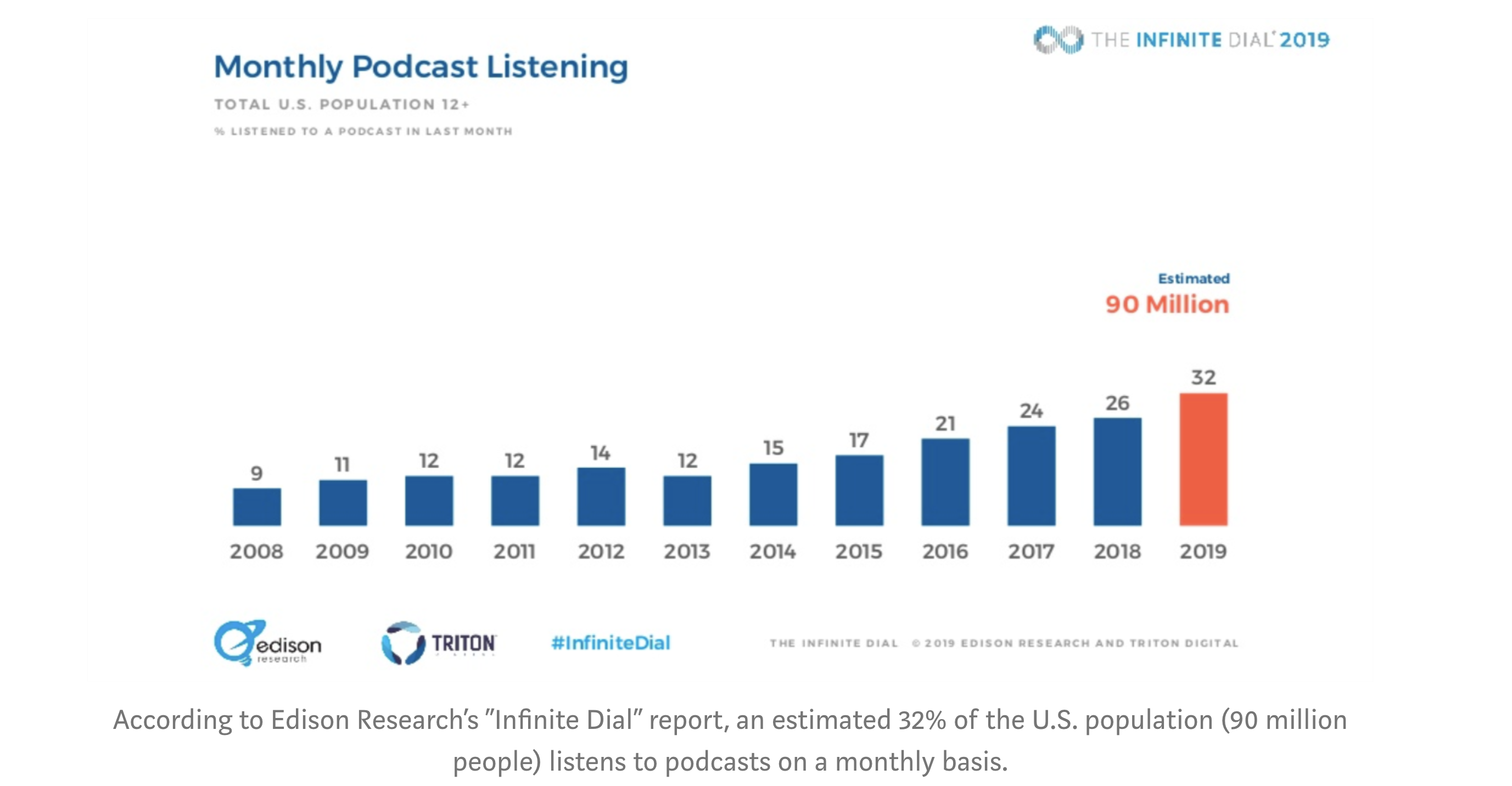
2019 has been a breakout year for podcasting. According to Edison Research’s Infinite Dial report, more than half of Americans have now listened to a podcast, and an estimated 32% listen monthly (up from 26% last year). This is the largest yearly increase since this data started being tracked in 2008. Podcast creation also continues to grow, with more than 700,000 podcasts and 29 million podcast episodes, up 27% from last year.
Screen Shot 2019 08 21 at 1.10.34 PM

Thanks to this growing listener base, big companies are finally starting to pay attention to the space — Spotify plans to spend $500M on acquisitions this year, and already acquired content studio Gimlet, tech platform Anchor, and true crime network Parcast for a combined $400M. In the past week, Google added playable podcasts to search results, Spotify released an analytics dashboard for podcasters, and Pandora launched a tool for podcasters to submit their shows.

We’ve been going to Podcast Movement, the largest annual industry conference, for three years, and have watched the conference grow along with the industry — reaching 3,000 attendees in 2019. Given the increased buzz around the space, we were expecting this year’s conference to have a new level of energy and professionalism, and we weren’t disappointed. We’ve summarized five top takeaways from the conference, from why podcast ads are hard to scale to why so many celebrities are launching their own shows.

Rise of celebrity podcasters boosts listenership

We’ve officially entered the age of celebrity podcasters. After early successes like WTF with Marc Maron (2009), Alec Baldwin’s Here’s The Thing (2011), and Anna Faris’ Unqualified (2015), top talent is flooding into the space. In 2017, 15% of Apple’s href=""https://www.allaccess.com/net-news/archive/story/172268/apple-podcasts-charts-top-20-most-downloaded-podca"> top 20 most-downloaded podcasts of the year were hosted by celebrities or influencers — this jumped to 32% of the top 25 in 2018. And of all the new shows that launched in 2018, 48% of the top 25 were celebrity-hosted.

Screen Shot 2019 08 21 at 1.21.50 PMThough podcasts are undermonetized compared to other forms of media, talent agents now consider them to be an important part of a well-rounded content strategy. Dan Ferris from CAA tells his clients to think of podcasting as a way of connecting with fans that is “much more intimate than social media.” Podcasts also help celebrities find a new audience. Ben Davis from WME said that while his client David Dobrik has a smaller audience on his podcast than on YouTube (1.5M downloads per episode versus 6M views per video), the podcast helps him reach a new group of listeners who stumble upon his show on the Apple Podcast charts.

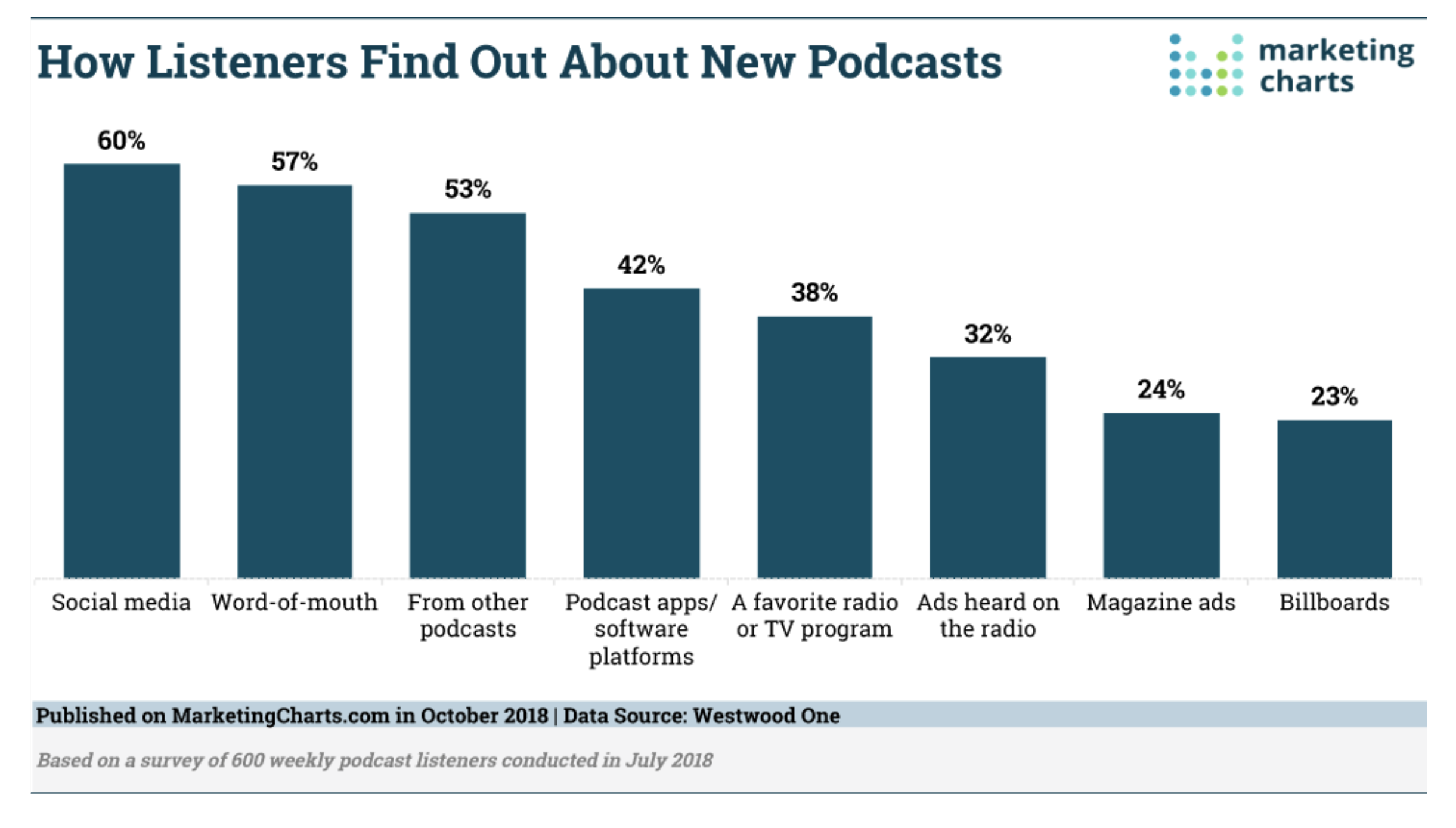
While some podcast veterans grumble about the rise of celebrity talk shows, famous podcasters are good for the industry as a whole. Advertisers are drawn to the space by the opportunity to get to access A-list talent at lower prices. One recent example is Endeavor Audio’s fiction show Blackout, which starred Rami Malek, who was fresh off an Oscar win. Endeavor’s head of sales Charlie Emerson said brands might have to sign a “seven or eight figure deal” to advertise alongside Malek’s content in other forms of media. Other podcasters also benefit from new listeners brought into the medium by their favorite stars — a Westwood One survey in fall 2018 found that 60% of podcast listeners report discovering shows via social media, where celebrities and influencers have huge existing audiences to push content to.
Screen Shot 2019 08 21 at 1.39.31 PM

Creator backlash against “walled garden” apps

Paid listening apps represent a fairly small percentage of podcast listenership, with production platform Anchor estimating that Apple Podcasts and Spotify control more than 70% of listenership. A venture-backed company called Luminary is trying to change this — it raised $100M to launch a “Netflix for podcasts” this spring. Consumers pay $7.99/month to access Luminary-exclusive shows alongside podcasts that are free on other apps. Because podcasts have RSS feeds, distributors like Luminary can easily grab free content and put it behind a paywall. The platform, not the creator, benefits from this monetization.

Within days of Luminary’s launch, prominent podcasters and media companies (The New York Times, Gimlet, and more) requested their shows be removed from the app. It’s interesting to note that YouTube has a similar premium plan — for $11.99/month, users can access and download ad-free videos. Unlike Luminary, however, YouTube, pays creators a cut of the revenue from these subscriptions based on how frequently their content is viewed.

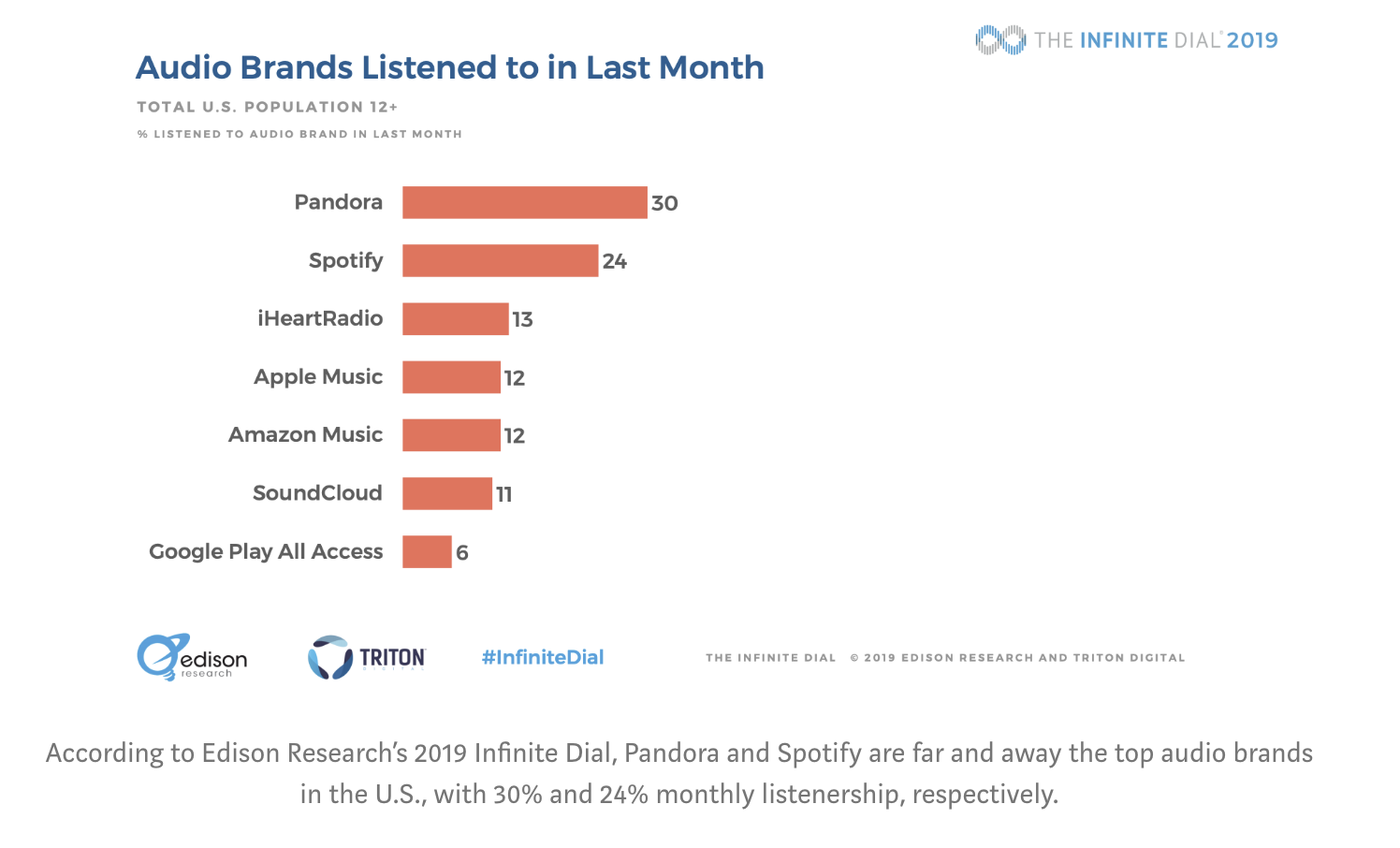
Unsurprisingly, creator sentiment is more positive toward platforms like Spotify and Pandora . Though these companies do make money from premium subscribers who listen to podcasts, creators can choose whether or not to submit their shows. And podcasters benefit from making their shows discoverable to the existing user base of these platforms, which already dominate “earshare.” Spotify alone has 232 million MAUs, which dwarfs the 90 million people in the U.S. who listen to a podcast monthly.
Screen Shot 2019 08 21 at 1.46.24 PM

Industry anxiety around maintaining quality at scale

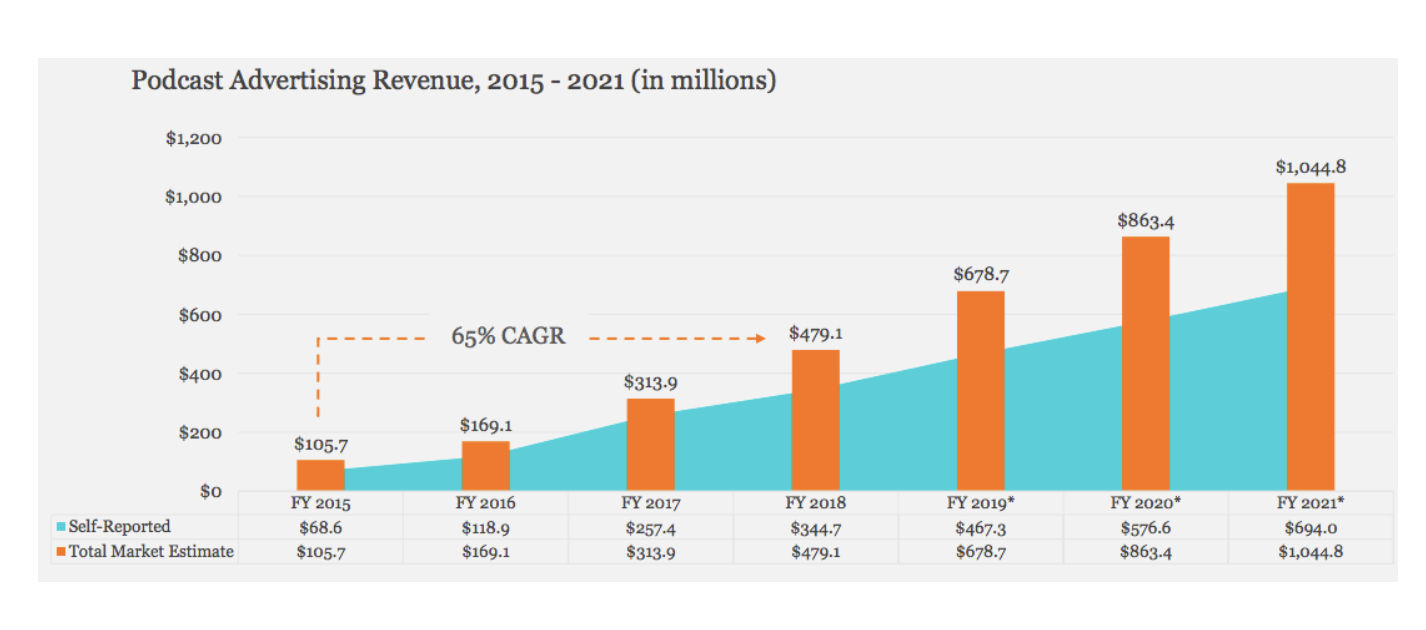
Podcast ad revenue has been scaling quickly, with $480M in spend last year and a projected $680M this year. Over the past four years, ad revenue has scaled at a 65% CAGR, and this growth is expected to continue. In its early days, the podcast ad market was largely been driven by D2C brands — you’ve probably heard hundreds of Casper, Blue Apron, and Madison Reed ads. However, bigger brands are also starting to enter podcasting (Geico, Capital One, and Progressive made the top 10 list for June 2019) due to the growing audience scale and increased precision around targeting and attribution.
Screen Shot 2019 08 21 at 1.48.00 PM

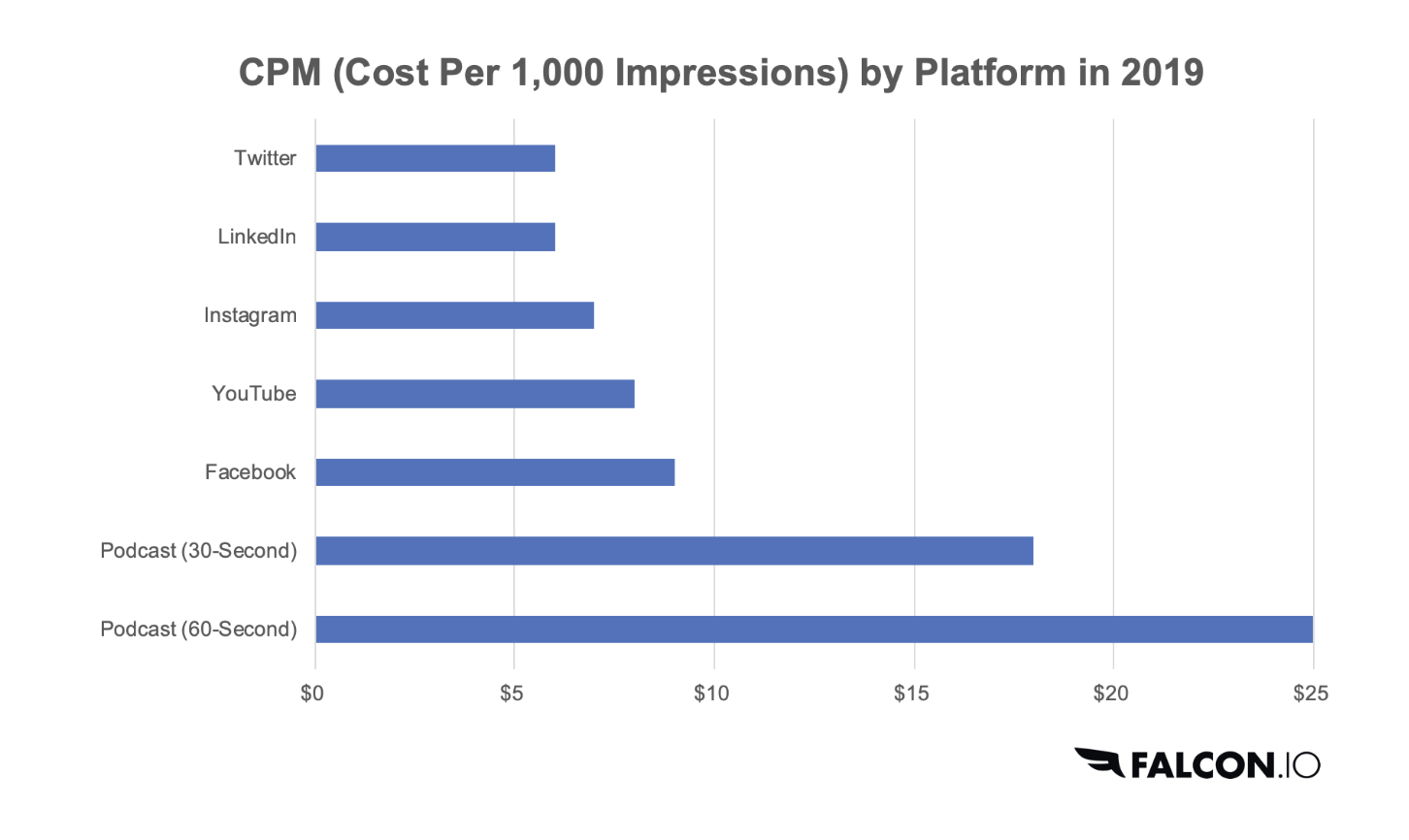
While many attendees were excited by the massive growth in ad revenue, others worried that it may kill what makes podcasting special. They’re particularly concerned that podcasts may go the way of online video, with annoying, generic, low CPM ads. Podcast hosts typically read their own ads, and are often true fans of the product — they share personal stories instead of reciting brand talking points. This results in premium CPMs compared to most digital media — AdvertiseCast’s 2019 survey found an average CPM of $18 for a 30-second podcast ad and $25 for a 60-second ad, more than 2x the average CPM on other digital platforms.
Screen Shot 2019 08 21 at 1.49.12 PM

While these ads are effective, they’re time-consuming and expensive to produce. Big brands interested in podcast ads often expect to reuse radio spots — they aren’t used to the process of crafting and approving a host-read ad that may only reach 10,000 listeners. Podcasters, meanwhile, value their trust with listeners and don’t want to spam them with loud, unoriginal radio ads. The tension between maintaining the quality of ads while scaling quantity was an underlying theme of most monetization discussions, and industry veterans disagree on how it will play out.

Podcasts are still undermonetized — but there is hope!

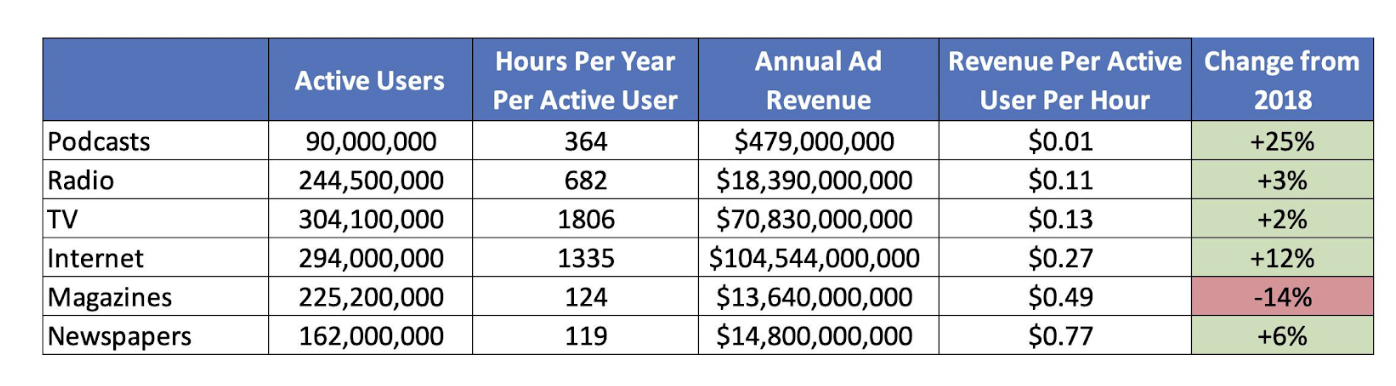
Despite the growth in ad revenue and relatively high CPMs, the industry is significantly undermonetized. Using data from Nielsen, IAB, and Edison, we calculated that podcasts monetize through advertisements at only $0.01 per listener hour — less than ten times the rate of radio. Podcast monetization per listener hour has increased over the past year, up 25% by our calculations, but still substantially lags all other forms of media.
Screen Shot 2019 08 21 at 2.01.56 PM

Why are podcasts so undermonetized? Unlike many other forms of media, the dominant distribution platform (Apple Podcasts) has no ad marketplace. Creators have historically had to approach brands themselves or sign with podcast networks to construct custom ad deals, and the “long tail” of podcasters were unable to monetize. This is finally changing. Anchor, which reported in January that it powers 40% of new podcasts, has an ad marketplace that has doubled the number of podcasts that are running ads. Other popular platforms like Radio Public have launched programs for small podcasters to opt-in to ad placements.

The second major hurdle in monetization is attribution. Podcasts have historically monetized through direct response campaigns — a podcaster provides a special URL or promo code for listeners to use when making a purchase. However, many people listen to podcasts when exercising or driving, and can’t write down the promo code or visit the URL immediately. These listeners might remember the product and make a purchase later, but the podcaster won’t get the attribution. Thomas Mancusi of Audioboom estimated that this happens in 50–60% of purchases driven by podcast ads.

Startups are trying to bring better adtech into podcasting to fix this issue.Chartable is one example — the company installs trackers to match a listener’s IP address with a purchaser’s IP address, allowing podcasters to claim attribution for listeners who don’t use their URL or promo code. Chartable currently runs on 10,000 shows, and the early results are so promising that ad agencies expect to see higher CPMs and significantly more spend in the space.

Podcast fans of the future ≠ podcast fans today

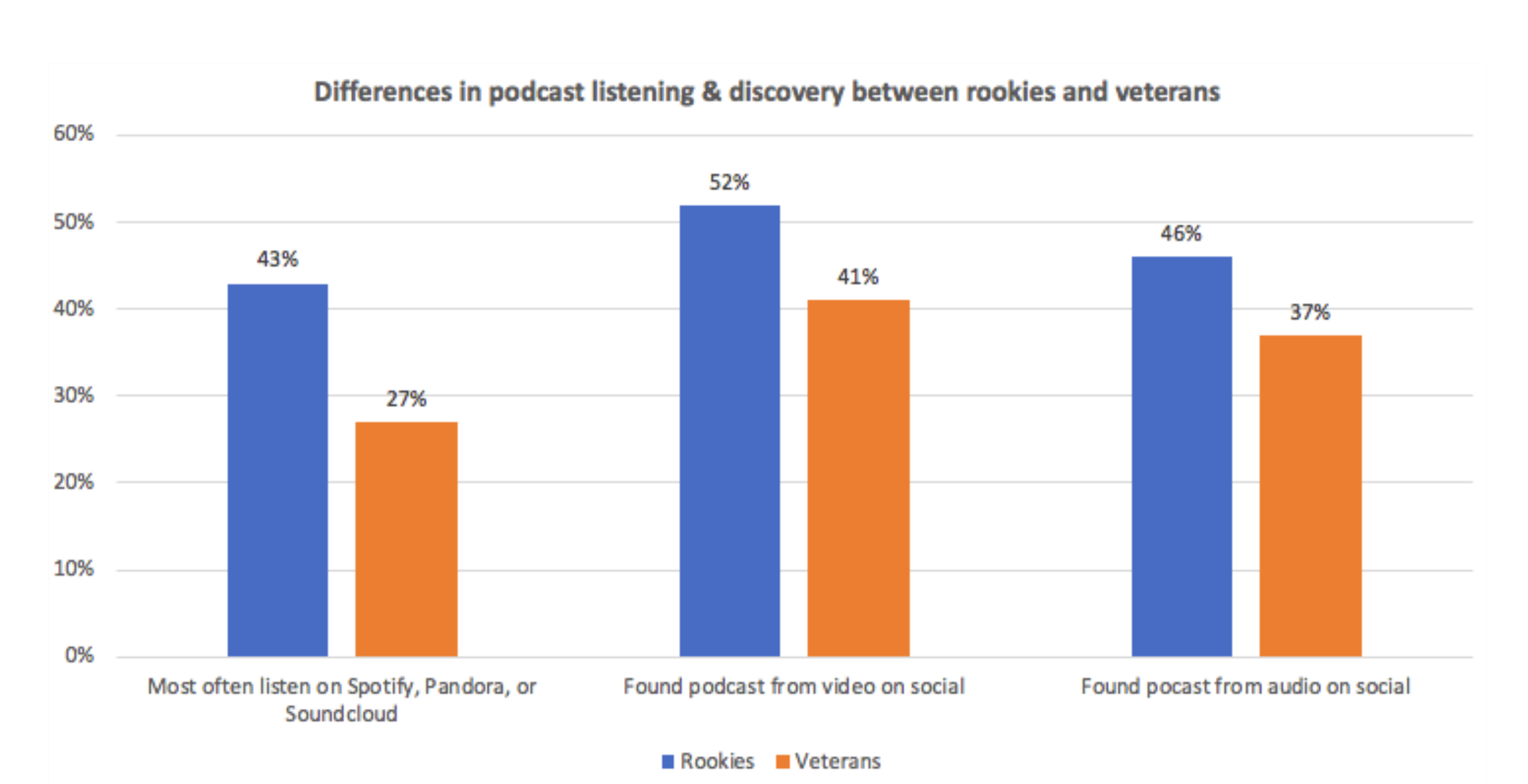
As podcasting grows, the listener base is diversifying. Edison Research looked into data on “rookie” listeners (listening for six months or less) and “veteran” listeners (listening for 3+ years), and found significant demographic differences. Only 37% of veterans are female, compared to 53% of rookies. While the plurality of veterans (43%) are age 35–54, 54% of rookies are age 12–34. Rookies are also 1.6x more likely to say they most often listen to podcasts on Spotify, Pandora, or SoundCloud (43% versus 27% of veterans). And social media is an important way that rookies discover podcasts — 52% have found a podcast from video and 46% from audio on social media, compared to 41% and 37% for veterans.
Screen Shot 2019 08 21 at 1.41.53 PM

These new listeners will have a profound impact on the future of podcasting, in both the type of content produced and the way it’s distributed. Industry experts are already noting significant new demand for female-hosted podcasts, as well as audio dramas that appeal to young people looking for a fast-paced, suspenseful story. They’re advising podcasters to share clips of their content on social media, and to leverage broader listening platforms like YouTube and Soundcloud for distribution.

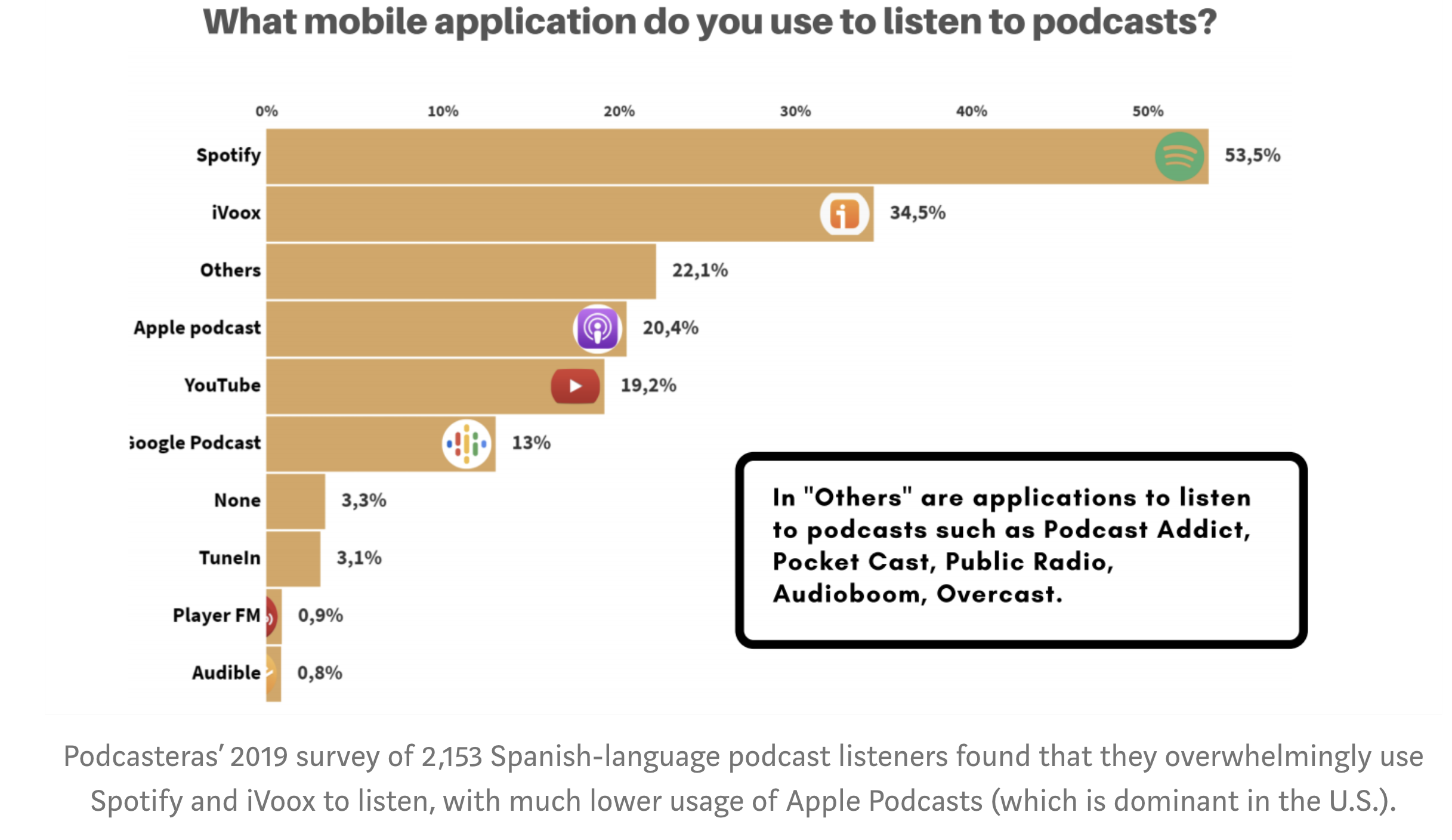
International markets also represent an enormous opportunity for growth. Most podcast listeners today live in the U.S. or China, but content producers are starting to see significant demand elsewhere. Castbox’s Valentina Kaledina said that many fans abroad have resorted to listening in their non-native language, with the top 100 shows in each country comprising a mix of English and local language. Adonde Media’s Martina Castro, who recently conducted the first listener survey on Spanish-language podcast fans, said that 53% of the survey’s 2100 respondents reported listening to podcasts in English — and only 20% of them use Apple Podcasts.
Screen Shot 2019 08 21 at 1.43.21 PM

Larger podcast producers are beginning to translate shows for non-English-speaking markets. Wondery CEO Hernan Lopez announced at the conference that the company’s hit show Dr. Death is now available in seven languages. Lopez noted that it was an expensive process, and he doesn’t expect the shows to generate profit in the near future. However, he believes that Wondery will eventually see a significant return from investing in the development of new podcast markets — and if they do, other podcast companies will likely follow in their footsteps.
21 Aug 2019

Splunk acquires cloud monitoring service SignalFx for $1.05B

Splunk, the publicly traded data processing and analytics company, today announced that it has acquired SignalFx for a total price of about $1.05 billion. Approximately 60 percent of this will be in cash and 40 percent in Splunk common stock.

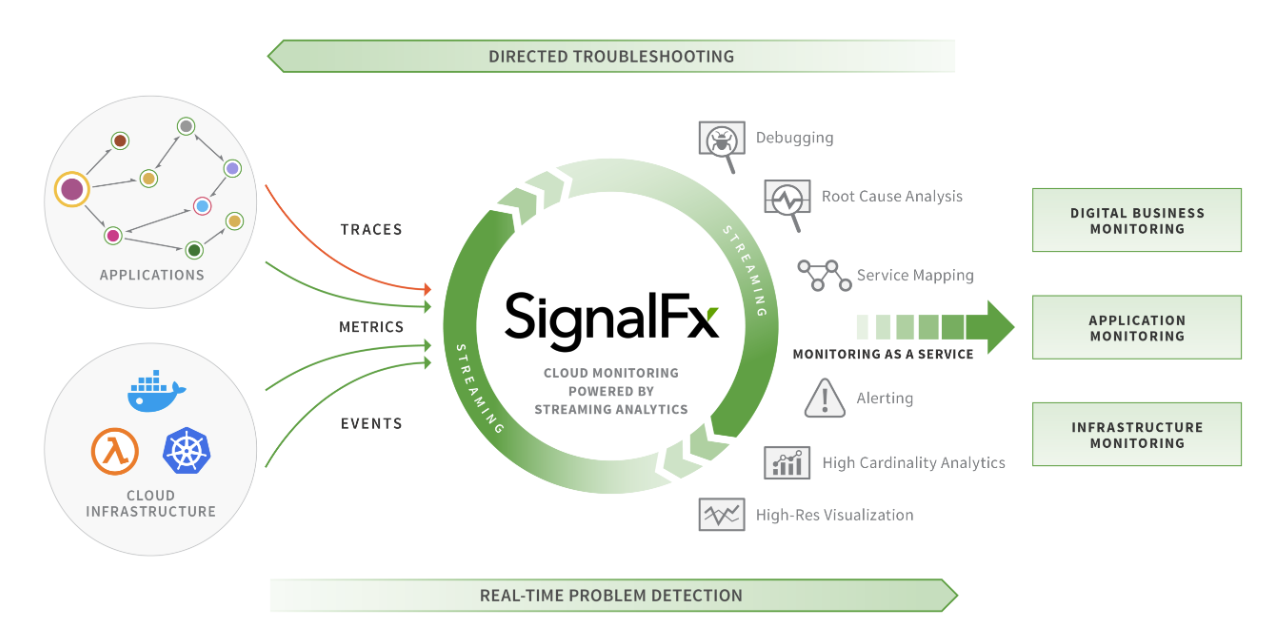
SignalFx, which emerged from stealth in 2015, provides real-time cloud monitoring solutions, predictive analytics and more. Upon close, Splunk argues, this acquisition will allow it to become a leader in “in observability and APM for organizations at every stage of their cloud journey, from cloud-native apps to homegrown on-premises applications.”

Indeed, the acquisition will likely make Splunk a far stronger player in the cloud space as it expands its support for cloud-native applications and the modern infrastructures and architectures those rely on.

2019 08 21 1332

Ahead of the acquisition, SignalFx had raised a total of $178.5 million, according to Crunchbase. Investors include General Catalyst, Tiger Global Management, Andreessen Horowitz and CRV. Its customers include the likes of AthenaHealth, Change.org, Kayak, NBCUniversal, and Yelp.

“Data fuels the modern business, and the acquisition of SignalFx squarely puts Splunk in position as a leader in monitoring and observability at massive scale,” said Doug Merritt, President and CEO, Splunk, in today’s announcement. “SignalFx will support our continued commitment to giving customers one platform that can monitor the entire enterprise application lifecycle. We are also incredibly impressed by the SignalFx team and leadership, whose expertise and professionalism are a strong addition to the Splunk family.”

21 Aug 2019

Porsche invests in ‘low visibility’ sensor startup TriEye

Porsche’s venture arm has acquired a minority stake in TriEye, an Israeli startup that’s working on a sensor technology to help vehicle driver-assistance and self-driving systems see better in poor weather conditions like dust, fog and rain.

The strategic investment is part of a Series A financing round that has been expanded to $19 million. The round was initially led by Intel Capital and Israeli venture fund Grove Ventures. Porsche has held shares in Grove Ventures since 2017.

TriEye has raised $22 million to date. Terms of Porsche’s investment were not disclosed.

The additional funding will be used for ongoing product development, operations and hiring talent, according to TriEye.

The advanced driver assistance systems found in most new vehicles today typically rely on a combination of cameras and radar to “see.” Autonomous vehicle systems, which are being developed and tested by dozens of companies such as Argo AI, Aptiv, Aurora, Cruise and Waymo, have a more robust suite of sensors that include light detection and ranging radar (lidar) along with cameras and ultrasonic sensors.

For either of these systems to function properly, they need to be able to see in all conditions. This pursuit of sensor technology has sparked a boom in startups hoping to tap into demand from automakers and companies working on self-driving car systems.

TriEye is one of them. The premise of TriEye is to solve the low visibility problem created by poor weather conditions. The startup’s co-founders argue that fusing existing sensors such as radar, lidar and standard cameras don’t solve this problem.

TriEye, which was founded in 2017, believes the answer is through short-wave infrared (SWIR) sensors. The startup said it has developed an HD SWIR camera that is a smaller size, higher resolution, and cheaper than other technologies. The camera is due to launch in 2020.

The technology is based on advanced nano-photonics research by Uriel Levy, a TriEye co-founder and CTO who is also a professor at the Hebrew University of Jerusalem.

The company says its secret sauce is its “unique” semiconductor design that will make it possible to manufacture SWIR HD cameras at the “fraction of their current cost.”

TriEye’s technology was apparently good enough to get Porsche’s attention.

Michael Steiner, a Porsche AG board member focused on R&D, said the technology was promising as well as team, which is compromised of people with expertise in deep learning, nano-photonics and semiconductor components.

“We see great potential in this sensor technology that paves the way for the next generation of driver assistance systems and autonomous driving functions,” Steiner said in a statement. “SWIR can be a key element: it offers enhanced safety at a competitive price.”

21 Aug 2019

Peak Design’s Travel Duffel 35L is as simple or as powerful as you need it to be

A good, solid duffel bag is a mainstay for many travelers – especially those who like packing up a car for a weekend away, or frequent flyers who disdain the thought of checking a bag. Peak Design introduced its own take on the duffel bag this year, with a couple different twists on the concept. The Peak Design Travel Duffel 35L is the most fundamental of the company’s options, and it delivers a lot of packing space and support for Peak’s packing tools if you want to get real serious about space optimization.

I’m an unabashed fan of Peak Design’s Everyday camera bags, its capture clips, and basically its entire ecosystem. This is a company that you can tell things deeply about the problems it’s aiming to solve for its customers – because they’re the problems shared by the company’s founders themselves. The Travel Duffel is actually probably a bit more mainstream and less specialized than most of their offerings, but that only makes it more appealing, not less.

Peak Travel Duffel 35 2

You’ll find the same weatherproof nylon coating this bag that Peak uses in its other packs, and it’s a very durable material that also looks great both up close and at a distance. If there’s a complaint here, it’s that the black color I prefer tends to pretty easily pick up dust, but it also wipes or washes off just as easily. The heavy-duty nylon canvas shell should also stand up to the elements well, and the zipper is the especially weather sealed kind, plus there’s a waterproof bottom liner in case you’re less than careful about where you drop your pack while en route.

[gallery ids="1872075,1872074"]

The Duffel includes both hand straps and a longer padded shoulder strap, and the unique connector hardware system means you can reposition the straps in a number of ways to suit your carrying preferences. The hand straps double as shoulder straps for wearing it like a backpack ad though this is a bit tight for my larger frame, it’s still a way to quickly alleviate shoulder or hand strain for longer treks with the bag in tow. The connectors here are also super smart – there’s no moving parts, they just snap on and off the sewn-in loops placed around the bag – which means added durability and ease of use.

[gallery ids="1872070,1872069,1872068"]

Plenty of pockets inside and out give you lots of divined storage options, and there’s also a security loop feature on the main zipper to make it much harder for someone to quickly yank the bag open and grab what’s inside if they’re targeting a quick theft opportunity. A dedicated ID card holder is a nice touch that tells you exactly who this is ideal for, too.

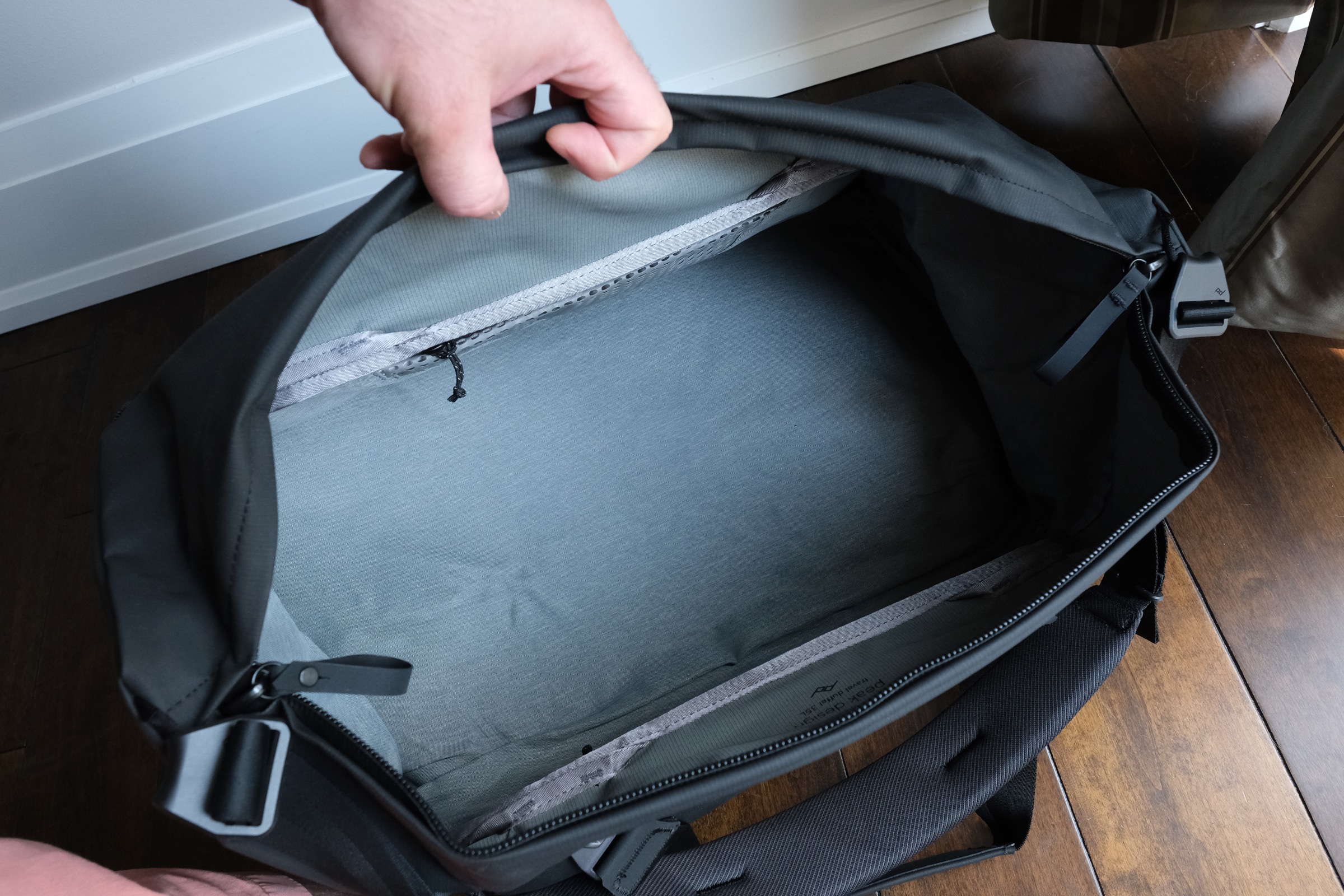
As I alluded to above, there’s also support for the rest of Peak’s packing tools. I’ve got their small camera cube in the bag width-wise in the photo below, and it should be able to fit up to three of these in this orientation easily. Peak also offers packing cubes, dop kits and more, and you can use the slide hooks provided with those with internal elastic attachment points if you want to ensure things won’t shift around. But the best part about this bag is that it has everything you need in a straightforward duffel out of the box – the rest of the packing tools are totally optional and don’t take away form its fundamental effectiveness at all.

Peak Travel Duffel 35 6

The 35L carrying capacity of this bag is just perfect for a weekend trip, or even a few days longer if you’re an economical packer. At $129.95, it’s actually very reasonable for a high-quality duffel bag, too, and definitely one of the better bargains in the Peak lineup when it comes to value for money.

21 Aug 2019

YC is doubling down on these investment theses in its most recent batch

Nearly 200 startups have just graduated from the prestigious San Francisco startup accelerator Y Combinator . The flock of companies are now free to proceed company-building with a fresh $150,000 check and three-months full of tips and tricks from industry experts.

As usual, we sent several reporters to YC’s latest demo day to take notes on each company and pick our favorites. But there were many updates to the YC structure this time around and new trends we spotted from the ground that we’ve yet to share.

CTO and HR demo days

21 Aug 2019

Second docking adapter for commercial crew vehicles installed on International Space Station

The International Space Station is now more than ready for crew-carrying spacecraft flown by commercial companies to pay it a visit: The second planned International Dock Adapter (IDA) was installed on the Space Station during a spacewalk by NASA astronauts Nick Hague and Andrew Morgan earlier today.

The dock adapter, actually IDA-3 since the first IDA was lost during the SpaceX launch failure of its CRS-7 mission on June 28, 2015. IDA-2, which was intended to be the second installed on ISS, instead became the first and was delivered in July 2016 during the SpaceX CRS-9 resupply mission.

IDA-2 has already proven effective, too: It received its first docking vehicle on March 3 of this year, when SpaceX’s Crew Dragon Demo-1 test vehicle used the automated docking procedure designed for this adapter to demonstrate how it will work eventually when crew are on board.

IDA-3 is the second working dock adapter that uses this automated procedure, which makes it so that vehicles arriving at the ISS don’t have to be caught and guided in manually by astronauts with the help of the station’s Canadarm2 robotic arm. The automated procedure is designed as an industry standard of sorts, and should mean that any commercial crew craft, from SpaceX’s Crew Dragon, to Boeing’s CST-100, and any other potential future craft, can easily and automatically dock with the ISS to transfer over passengers and cargo.

Boeing is the company that was contracted to design and build these docking adapters. Each weight about 1,150 lbs and, they’re about 42-inches hight and 63-inches wide, which means it’s a bit of a tight squeeze for crew to come through (these aren’t big step-through passageways like you sometimes see in movies).

Having both the IDAs installed on the Space Station is key milestone in the commercial crew program, but there are still plenty of hurdles left to clear – including the first test flights of commercial Crew vehicles with astronauts on board.

21 Aug 2019

Google updates to a cleaner, simpler Play Store design with no Music section

Google’s Play Store has gotten a big visual makeover, the company announced today, with changes that include a cleaner look-and-feel, new navigation, an easier way to to see app information, and more. Most notably, however, is that Google has taken a page from Apple’s playbook with the priority given to its two distinct sections for apps and games. It has also removed the “Music” tab, ahead of planned changes to Google Play Music and YouTube Music.

Though the redesign is in keeping with Google’s Material Design philosophy, it’s hard to miss Apple’s influence here — from the brighter, whiter and cleaner layout to the new navigation and updated app detail page layouts, among other things.

With Apple’s huge App Store revamp in 2017, the company made several changes to refocus user attention away from top charts and rankings to editorial content, stories and tips, recommendations, and curated collections. As a part of this redesign, it created two separate tabs for Apps and Games in the App Store app’s main navigation to better direct users to the type of app content they wanted to browse.

The Play Store had already broken out Apps and Games before today, but they had been part of a much larger navigational element at the top of the home page.

The new design now relocates the Play Store’s main navigation to the bottom of the screen, just like on the iOS App Store. It also distills down navigation to just four tabs: Games, Apps, Movies & TV, and Books. (Music is gone).

Google says its decision to create two main tabs for apps and games will help it to “better serve users the right kind of content.”

Within the Games and Apps sections, users can browse into other sections including Google’s personalized “For You” suggestions and Top Charts, and more. Here, you’ll find the same sections the Play Store had before (like “New,” “Events,” “Premium,” etc.) — they’ve just been relocated within the new tabs instead of existing as a second-level navigation bar on the Play Store homepage.

When the user finds an app or game they’re interested in, the updated store listing page layout will now surface richer app information at the top of the page and a bigger call-to-action button (e.g. “Install”).

This, too, is similar to iOS, where key details about the app or game — like its rating or age range — are at the top of this app detail page.

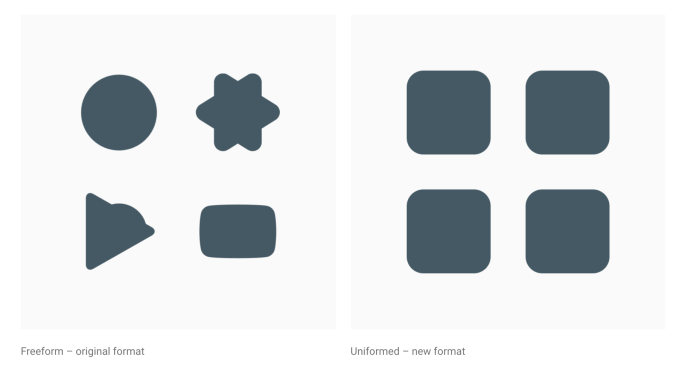
The store also features Google’s new icon system where apps have a uniform rounded square shape. Apple has always enforced standardized app icons.

Screen Shot 2019 08 21 at 2.25.18 PM

The Play Store makeover had already leaked earlier this year, thanks to enterprising developers who got their hands on Google’s tests and published screenshots.

As for the Music tab’s removal, Google already confirmed it was planning to replace Google Play Music with YouTube Music, and shut down Google Play’s artist hub this April in preparation for that. With the removal of the Music tab from the new Play Store, the completion of this merger appears to be imminent.

In Google’s announcement today about the redesign, it showed off the new look with a photo. (see top photo above).

It’s pretty odd that the app being showcased in Google’s photo, Alto’s Odyssey, is an Apple Design Winner that launched on iOS first — as did its precursor, Alto’s Adventure. When coming to Android, the game development company worked with Android publisher Noodlecake on its Android ports.

In other words, not only is this a non-exclusive game, it comes from an iOS-first shop. Sure, it’s a great game. But that’s also a pretty weird pick, on Google’s part.

The Google Play Store has over two billion monthly active users, Google said in its announcement. The new version of the Play Store is rolling out now.

21 Aug 2019

Our 12 favorite startups from Y Combinator’s S19 Demo Day 2

After two days of founders tirelessly pitching, we’ve reached the end of YC’s Summer 2019 Demo Days. TechCrunch witnessed more than 160 on-the-record startup pitches coming out of Y Combinator, spanning healthcare, B2B services, augmented reality and life-extending.

The full list is worth a gander, you can read about the 84 startups from Day 1 and the 82 companies from Day 2 in the linked posts. You can also check out our votes for the best of the best from day 1.

After conferring on the dozens of startups we saw yesterday, here are our favorites from the second day of Y Combinator pitches.

21 Aug 2019

Twitter picks up team from narrative app Lightwell in its latest effort to improve conversations

Twitter’s ongoing, long-term efforts to make conversations easier to follow and engage with on its platform is getting a boost with the company’s latest acquihire. The company has picked up the team behind Lightwell, a startup that had built a set of developer tools to build interactive, narrative apps, for an undisclosed sum. Lightwell’s founder and CEO, Suzanne Xie, is becoming a director of product leading Twitter’s Conversations initiative, with the rest of her small team joining her on the conversations project.

(Sidenote: Sara Haider, who had been leading the charge on rethinking the design of Conversations on Twitter, most recently through the release of twttr, Twitter’s newish prototyping app, announced that she would be moving on to a new project at the company after a short break. It’s not clear whether twttr will be moving on as well: I’m asking.)

The Lightwell/Twitter news was announced late yesterday both by Lightwell itself and Twitter’s VP of product Keith Coleman. A Twitter spokesperson also confirmed the deal to TechCrunch in a short statement today: “We are excited to welcome Suzanne and her team to Twitter to help drive forward the important work we are doing to serve the public conversation,” he said.

To be clear, this is more acqui-hire than hire: only the Lightwell team (of what looks like three people) is joining Twitter. The Lightwell product will no longer be developed, but it is not going away, either. Xie noted in a separate Medium post that apps that have already been built (or plan to be built) on the platform will continue to work. It will also now be free to use.

Lightwell originally started life in 2012 as Hullabalu, as one of the many companies producing original-content interactive children’s stories for smartphones and tablets. In a sea of children-focused storybook apps, Hullabalu’s stories stood out not just because of the distinctive cast of characters that the startup had created, but for how the narratives were presented: part book, part interactive game, the stories engaged children and moved narratives along by getting the users to touch and drag elements across the screen.

hullabalu lightwell

After some years, Hullabalu saw an opportunity to package its technology and make it available as a platform for all developers, to be used not just by other creators of children’s content, but advertisers and more. It seems the company shifted at that time to make Lightwell its main focus. In its startup life, it went through YCombinator, TechStars, and picked up some $6.5 million in funding (per Crunchbase), from investors that included Joanne Wilson, SV Angel, Vayner, Spark Labs, Great Oak, Scout Ventures and more.

If turning Hullabalu into Lightwell was a pivot, then the exit to Twitter can be considered yet another interesting shift in how talent and expertise optimised for one end can be repurposed to meet another.

One of Twitter’s biggest challenges over the years has been trying to create a way to make conversations (also narratives of a kind) easy to follow — both for those who are power users, and for those who are not and might otherwise easily be put off from using the product.

The crux of the problem has been that Twitter’s DNA is about real-time rivers of chatter that flow in one single feed, while conversations by their nature linger around a specific topic and become hard to follow when there are too many people talking. Trying to build a way to fit the two concepts together has foxed the company for a long time now.

At its best, bringing in a new team from the outside will potentially give Twitter a fresh perspective on how to approach conversations on the platform, and the fact that Lightwell has been thinking about creative ways to present narratives gives them some cred as a group that might come up completely new concepts for presenting conversations.

At a time when it seems that the conversation around Conversations had somewhat stagnated, it’s good to see a new chapter opening up.

21 Aug 2019

Classic Hangouts for G Suite will hang in there a bit longer

Earlier this year, Google said it would transition all Hangouts users on G Suite to Hangouts Chat and Meet by October 2019 and then retire the classic version of Hangouts. But a lot of G Suite users love their classic Hangouts, so Google has now revised Hangouts’ retirement date to “no sooner than June 2020.” That leaves the door open for a later date, too, and the company says it will provide a “more definitive date” at some point in the future.

It’s worth stressing that this is about Hangouts for paying G Suite users. What’s happening to Hangouts for consumers remains unclear, given that Google’s original consumer messaging strategy failed after the disappointment that was Allo.

Earlier this year, Google said that it wanted to transition consumers over to a free version of Hangouts Chat and Meet after the G Suite transition. A Google spokesperson told me that this plan remains in place and that it will start after the G Suite transition.

As for G Suite users, Google plans to make the transition for G Suite users easier as it looks to move them over to the new platform. Admins can already jump on an accelerated timeline and disable classic Hangouts right now (but they still need an invitation from Google to do so).