Year: 2019

20 Aug 2019

Independent report on Facebook bias catalogues mild complaints from conservatives

An independent investigator has issued a preliminary report on its work determining the existence and/or extent of bias against conservatives on Facebook . It’s refreshingly light reading — the complaints are less “Facebook is a den of liberals” and more “we need more transparency on ad policies.”

The report was undertaken in May of last year, when Facebook retained Covington and Burling, led by former Republican Senator Jon Kyl, to look into the allegations loudly being made at the time that there was some kind of anti-conservative bias on the social network.

“We know we need to take these concerns seriously,” wrote VP of global affairs and communications Nick Clegg. Of course, Facebook says it takes everything seriously, so it’s hard to be sure sometimes.

Covington and Burling’s approach was to interview more than a hundred individuals and organizations that fall under the broad umbrella of “conservative” about their concerns. These would be sorted, summarized, and presented to Facebook leadership.

By far the biggest concern wasn’t anything like “they’re censoring us” or “they’re pushing an agenda.” These views, which are often over-amplified, don’t seem to reflect what everyday folks and businesses are having trouble with on the platform.

Instead, the largest concern is transparency. The people interviewed were mainly concerned that the policies behind content moderation, ad approval, fact-checking, and so on were inadequately explained. In the absence of good explanations, these people understandably supplied their own, usually along the lines that they were being targeted inordinately in comparison with those left of them politically.

It’s worth noting here that no evidence that this was or wasn’t the case was sought or presented. The surveys were about concerns people had, and did not extend to anything like “provide the logs where you can see this happened,” or anything like that. What was gathered was strictly anecdotal.

In a way this feels irresponsible, in that anyone could voice their concern about a problem that may very well not exist, or that may not be universally agreed is a problem. For instance some groups complained that their anti-abortion ads featuring premature babies were being removed. Maybe Facebook feels that images of bloody, screaming children will not increase time on site.
hatespeech

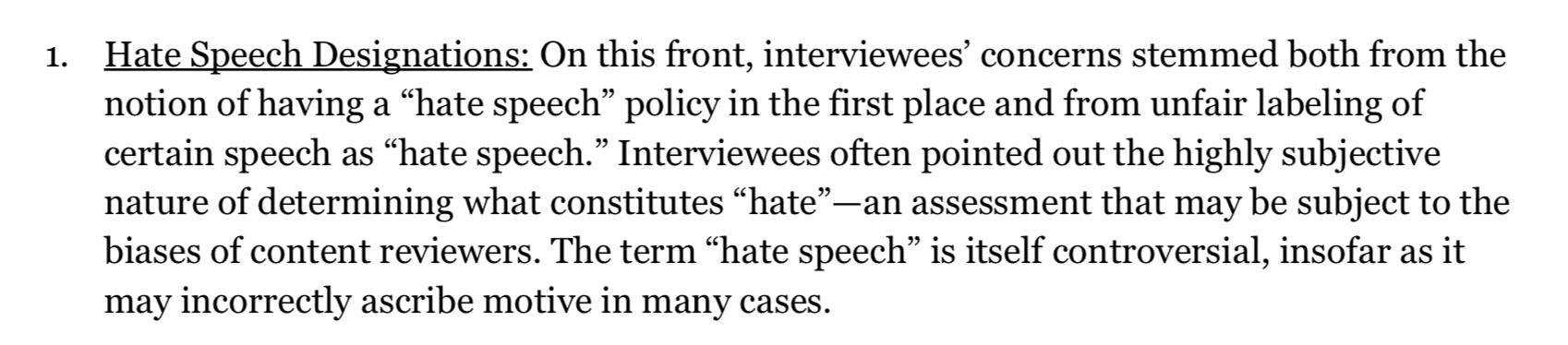
Unfortunately hate speech is real and here to stay. But it is valid to take issue with the subjectivity of how it may be determined as such.

But at the same time, the intent was not to quantify and solve bias, necessarily, but to understand how people perceived bias in day-to-day use of the site in the first place.

As you may have perceived, the concerns of conservatives in fact mirror the concerns of liberals: that Facebook is applying unknown and unknowable processes to the selection and display of content on the platform, and that our ability to question or challenge these processes is limited. These are nonpartisan issues.

Facebook’s response since the report was commissioned (in other words, over the last year and a half) has been to generally provide more information whenever it has stepped in to touch a post, ad, or other user data. It now tells people why certain posts are being shown, it has better documented news feed ranking (though not too well, lest someone take advantage), and it has created a better system for making content removal decisions, as well as a better appeal process.

So it says, anyway, but we can hardly take the company at its word that it has increased diversity, improved tools, and so forth. The investigation by Covington and Burling continues and these are but the preliminary results. Clegg writes that “This is the first stage of an ongoing process and Senator Kyl and his team will report again in a few months’ time.”

You can read the full interim report below:

Facebook – Covington Interim Report 1 by TechCrunch on Scribd

20 Aug 2019

NASA confirms mission to Jupiter’s moon Europa to explore its icy oceans

NASA has confirmed a mission to Europa, one of the Moons of Jupiter, will indeed happen. The mission was initially explored starting in 2017, with the space agency looking for reports on how it might proceed, and now NASA has said it will go ahead and move to the key stop of finalizing mission design, which will then lead to actually building the spacecraft that will make the trip, and the science payload it’ll carry on board.

The goal of the mission, which is codenamed ‘Europa Clipper,’ is to find out whether the icy natural satellite orbiting Jupiter could sustain life, and also explore whether it might be colonizable or habitable. Plus, we’ll definitely learn a lot more about Europa with an up-close-and-personal exploration.

Europa is the one of 79 known moons orbiting the gas giant, and is the six-largest in the entire solar system. It’s a bit smaller than our own, and has a crust that is composed primarily of water ice. Some scientists believe that it could have a water ocean just underneath that ice curst, however, and that if said ocean exists, it might be among the likelier places in our solar system to find life.

NASA’s goal for this mission is to launch it as early as 2023, though it’ll need its SLS launch system to be ready to make that happen. The extended timeline allows for a launch-ready state by 2025, which seems a bit more realistic given the current state of affairs.

20 Aug 2019

NASA confirms mission to Jupiter’s moon Europa to explore its icy oceans

NASA has confirmed a mission to Europa, one of the Moons of Jupiter, will indeed happen. The mission was initially explored starting in 2017, with the space agency looking for reports on how it might proceed, and now NASA has said it will go ahead and move to the key stop of finalizing mission design, which will then lead to actually building the spacecraft that will make the trip, and the science payload it’ll carry on board.

The goal of the mission, which is codenamed ‘Europa Clipper,’ is to find out whether the icy natural satellite orbiting Jupiter could sustain life, and also explore whether it might be colonizable or habitable. Plus, we’ll definitely learn a lot more about Europa with an up-close-and-personal exploration.

Europa is the one of 79 known moons orbiting the gas giant, and is the six-largest in the entire solar system. It’s a bit smaller than our own, and has a crust that is composed primarily of water ice. Some scientists believe that it could have a water ocean just underneath that ice curst, however, and that if said ocean exists, it might be among the likelier places in our solar system to find life.

NASA’s goal for this mission is to launch it as early as 2023, though it’ll need its SLS launch system to be ready to make that happen. The extended timeline allows for a launch-ready state by 2025, which seems a bit more realistic given the current state of affairs.

20 Aug 2019

Fitbit cofounders James Park and Eric Friedman are coming to Disrupt SF

Ten years ago, a hardware startup launched a fitness device on stage at TechCrunch 50. The $99 gadget combined a pedometer with a diet monitoring system, designed to help wearers meet their fitness goals.

Of course, a lot has changed for Fitbit in the intervening decade. The company has since become synonymous with fitness trackers in the U.S. In 2015, it filed for a $358 million IPO.

After several years of defining the wearables category, things have gotten a bit rockier, however, as the company contends with increased competition from the premium Apple Watch and low cost trackers from companies like Xiaomi.

Through acquisitions like Pebble and Vector, the company has improved its fortunes by building its own smartwatch line. Fitbit has also begun to transition into the healthcare industry through partnerships wit companies like Blue Cross Blue Shield.

Fitbit’s cofounders James Park and Eric Friedman will join us on stage to discuss their process for growing a hardware startup and navigating often fickle industry trends.

Disrupt SF runs October 2 to October 4 at the Moscone Center in San Francisco. Tickets are available here.

Did you know Extra Crunch annual members get 20% off all TechCrunch event tickets? Head over here to get your annual pass, and then email extracrunch@techcrunch.com to get your 20% off discount. Please note that it can take up to 24 hours to issue the discount code.

20 Aug 2019

Daily Crunch: Apple Card launches in the U.S.

The Daily Crunch is TechCrunch’s roundup of our biggest and most important stories. If you’d like to get this delivered to your inbox every day at around 9am Pacific, you can subscribe here.

1. Apple Card launches today for all US customers, adds 3% cash back for Uber and Uber Eats

Customers can apply for Apple Card through the Wallet app on their iPhones, then start using it via Apple Pay before the physical card arrives in the mail.

Why use the card? One benefit is the ability to track your purchases in an app. Plus, there’s cash back — 2% for Apple Pay purchases, 1% for non-Apple Pay purchases and 3% for purchases on Uber and Uber Eats.

2. Twitter blocks state-controlled media outlets from advertising on its social network

The new policy was announced just hours after the company identified hundreds of accounts linked to China as part of an effort to “sow political discord” around protests in Hong Kong.

3. All 84 startups from Y Combinator’s S19 Demo Day 1

There are 197 companies (!) in the summer YC batch, and TechCrunch wrote up all 84 of the ones that presented yesterday.

Starship Technologies delivery robots go to work for Postmates in Washington D.C.

4. Starship Technologies raises $40M, crosses 100K deliveries and plans to expand to 100 new universities

Starship Technologies invented the category of rolling autonomous sidewalk delivery robots.

5. Facebook unveils new tools to control how websites share your data for ad-targeting

Just to be clear: Facebook isn’t deleting the data that a third party might have collected about your behavior. Instead, it’s removing the connection between that data and your personal information on the social network.

6. Without evidence, Trump accuses Google of manipulating millions of votes

The president’s accusation appears to be based on little more than supposition in an old paper reheated by months-old congressional testimony.

7. Revenue-based investing: A new option for founders who care about control

There’s a new wave of investors who use creative deal structures with some of the upside of traditional VC, but some of the downside protection of debt. (Extra Crunch membership required.)

20 Aug 2019

The 11 best startups from Y Combinator’s S19 Demo Day 1

Y Combinator, the genesis for many of the companies that have shaped Silicon Valley including Airbnb, PagerDuty and Stripe, has minted another 200 some graduates. Half of those companies made their pitch to investors today during Day 1 of Y Combinator’s Summer 2019 Demo Day event and we’re here to tell you which startups are on the fast-track to the unicorn club.

Eighty-four startups presented (read the full run-through of every company plus some early analysis here) and after chatting with investors, batch founders and of course, debating amongst ourselves, we’ve nailed down the 11 most promising startups to present during Day 1. We’ll be back Tuesday with our second round of top picks.


20 Aug 2019

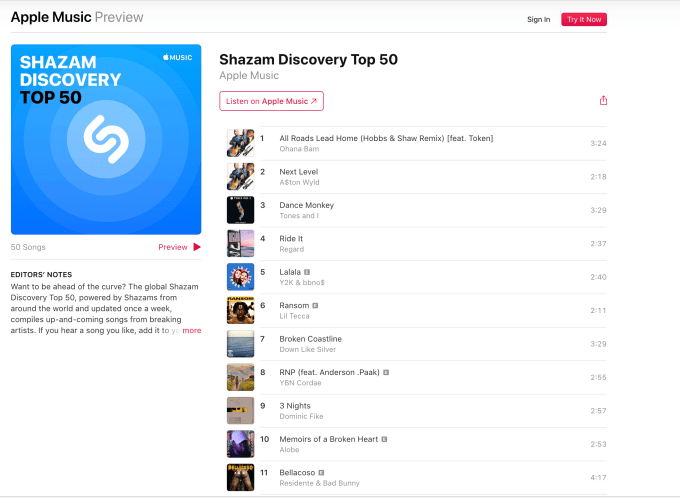
Shazam data is powering Apple Music’s newest chart, the Shazam Discovery Top 50

Apple continues to make use of Shazam, the music recognition app it acquired for $400 million in 2018. Earlier this month, Apple publicly launched its Music for Artists dashboard which included insights powered by Shazam data. Today, Apple announced that Shazam data will also now power a new Apple Music chart: the Shazam Discovery Top 50.

The chart will feature a weekly global ranking of the top 50 artists on the move and their trending track, based on Shazam data.

The Shazam app today has been downloaded a billion times and sees 20 million “Shazams” per day — that’s the number of times a user pushes the button to identify a song that’s playing. These Shazams will now be used to identify tracks that are poised for a breakout.

This is a different sort of metric than a traditional music chart would use, as it’s not a reference to how many downloads, purchases or streams a song has — instead, it lends itself more to insights about up-and-coming artists.

Screen Shot 2019 08 20 at 1.06.56 PM

That said, the chart may include a variety of songs at different points in their lifecycle. The majority may be emerging artists, but some songs may be experiencing a burst of momentum for other reasons. To rank on the chart, the song could be demonstrating a pattern of moving quickly through Shazam’s charts, rapid growth, steady growth, or it may be growing geographically, the company says. Of all of the above.

The new Apple Music chart will feature songs that are trending in the U.S. and over 10 other countries.

This isn’t Shazam’s first foray into music charts by any means. Today, you’ll find Shazam online offers a Top 200 chart for the U.S., various other countries, and as a global top chart, in addition to a 10-song “Discovery” chart for the U.S. and a smaller subset of other markets.

The Discovery Top 50 for Apple Music doesn’t currently match up with the online version of the Discovery chart, which may be related to the timing of its updates.

The launch of the new chart is another confirmation as to why Apple wanted to bring Shazam in-house — not for its nifty parlor trick of music recognition, but rather for the data it acquires on trending music. This gives Apple another means of competing with Spotify, whose own Artist dashboard launched exited beta back in 2017, giving it a big head start on serving artists and musicians with insights.

The new Shazam chart is being highlighted today in the Browse tab of the Apple Music app on iOS and Mac, and elsewhere in the app.


20 Aug 2019

IBM is moving OpenPower Foundation to The Linux Foundation

IBM makes the Power Series chips, and as part of that has open sourced some of the underlying technologies to encourage wider use of these chips. The open source pieces have been part of the OpenPower Foundation. Today, the company announced it was moving the foundation under The Linux Foundation, and while it was at it, announced it was open sourcing several other important bits.

Ken King, general manager for OpenPower at IBM, says that at this point in his organization’s evolution, they wanted to move it under the auspices of the Linux Foundation . “We are taking the OpenPower Foundation, and we are putting it as an entity or project underneath The Linux Foundation with the mindset that we are now bringing more of an open governance approach and open governance principles to the foundation,” King told TechCrunch.

But IBM didn’t stop there. It also announced that it was open sourcing some of the technical underpinnings of the Power Series chip to make it easier for developers and engineers to build on top of the technology. Perhaps most importantly, the company is open sourcing the Power Instruction Set Architecture (ISA). These are “the definitions developers use for ensuring hardware and software work together on Power,” the company explained.

King sees open sourcing this technology as an important step for a number of reasons around licensing and governance. “The first thing is that we are taking the ability to be able to implement what we’re licensing, the ISA instruction set architecture, for others to be able to implement on top of that instruction set royalty free with patent rights,” he explained.

The company is also putting this under an open governance workgroup at the OpenPower Foundation. This matters to open source community members because it provides a layer of transparency that might otherwise be lacking. What that means in practice is that any changes will be subject to a majority vote, so long as the changes meet compatibility requirements, King said.

Jim Zemlin, executive director at the Linux Foundation, says that making all of this part of the Linux Foundation open source community could drive more innovation. “Instead of a very, very long cycle of building an application and working separately with hardware and chip designers, because all of this is open, you’re able to quickly build your application, prototype it with hardware folks, and then work with a service provider or a company like IBM to take it to market. So there’s not tons of layers in between the actual innovation and value captured by industry in that cycle,” Zemlin explained.

In addition, IBM made several other announcements around open sourcing other Power Chip technologies designed to help developers and engineers customize and control their implementations of Power chip technology. “IBM will also contribute multiple other technologies including a softcore implementation of the Power ISA, as well as reference designs for the architecture-agnostic Open Coherent Accelerator Processor Interface (OpenCAPI) and the Open Memory Interface (OMI). The OpenCAPI and OMI technologies help maximize memory bandwidth between processors and attached devices, critical to overcoming performance bottlenecks for emerging workloads like AI,” the company said in a statement.

The softcore implementation of the Power ISA, in particular, should give developers more control and even enable them to build their own instruction sets, Hugh Blemings, executive director of the OpenPower Foundation explained. “They can now actually try crafting their own instruction sets, and try out new ways of the accelerated data processes and so forth at a lower level than previously possible,” he said.

The company is announcing all of this today at the The Linux Foundation Open Source Summit and OpenPower Summit in San Diego.

20 Aug 2019

‘This is Your Life in Silicon Valley’: The League founder and CEO Amanda Bradford on modern dating, and whether Bumble is a ‘real’ startup

Welcome to this week’s transcribed edition of This is Your Life in Silicon Valley. We’re running an experiment for Extra Crunch members that puts This is Your Life in Silicon Valley in words – so you can read from wherever you are.

This is your Life in Silicon Valley was originally started by Sunil Rajaraman and Jascha Kaykas-Wolff in 2018. Rajaraman is a serial entrepreneur and writer (Co-Founded Scripted.com, and is currently an EIR at Foundation Capital), Kaykas-Wolff is the current CMO at Mozilla and ran marketing at BitTorrent.

Rajaraman and Kaykas-Wolff started the podcast after a series of blog posts that Sunil wrote for The Bold Italic went viral. The goal of the podcast is to cover issues at the intersection of technology and culture – sharing a different perspective of life in the Bay Area. Their guests include entrepreneurs like Sam Lessin, journalists like Kara Swisher and Mike Isaac, politicians like Mayor Libby Schaaf and local business owners like David White of Flour + Water.

This week’s edition of This is Your Life in Silicon Valley features Amanda Bradford – Founder/CEO of The League. Amanda talks about modern dating, its limitations, its flaws, why ‘The League’ will win. Amanda provides her candid perspective on other dating startups in a can’t-miss portion of the podcast.

Amanda talks about her days at Salesforce and how it influenced her decision to build a dating tech product that focused on data, and funnels. Amanda walks through her own process of finding her current boyfriend on ‘The League’ and how it came down to meeting more people. And that the flaw with most online dating is that people do not meet enough people due to filter bubbles, and lack of open criteria.

Amanda goes in on all of the popular dating sites, including Bumble and others, providing her take on what’s wrong with them. She even dishes on Raya and Tinder – sharing what she believes are how they should be perceived by prospective daters. The fast-response portion of this podcast where we ask Amanda about the various dating sites really raised some eyebrows and got some attention.

We ask Amanda about the incentives of online dating sites, and how in a way they are created to keep members online as long as possible. Amanda provides her perspective on how she addresses this inherent conflict at The League, and how many marriages have been shared among League members to date.

We ask Amanda about AR/VR dating and what the future will look like. Will people actually meet in person in the future? Will it be more like online worlds where we wear headsets and don’t actually interact face to face anymore? The answers may surprise you. We learn how this influences The League’s product roadmap.

The podcast eventually goes into dating stories from audience members – including some pretty wild online dating stories from people who are not as they seem. We picked two audience members at random to talk about their entertaining online dating stories and where they led. The second story really raised eyebrows and got into the notion that people go at great lengths to hide their real identities.

Ultimately, we get at the heart of what online dating is, and what the future holds for it.   If you care about the future of relationships, online dating, data, and what it all means this episode is for you.

For access to the full transcription, become a member of Extra Crunch. Learn more and try it for free. 

Sunil Rajaraman: I just want to check, are we recording? Because that’s the most important question. We’re recording, so this is actually a podcast and not just three people talking randomly into microphones.

I’m Sunil Rajaraman, I’m co-host of this podcast, This is Your Life in Silicon Valley, and Jascha Kaykas-Wolff is my co-host, we’ve been doing this for about a year now, we’ve done 30 shows, and we’re pleased today to welcome a very special guest, Jascha.

Jascha Kaykas-Wolff: Amanda.

Amanda Bradford: Hello everyone.

GettyImages 981543806

Amanda Bradford. (Photo by Astrid Stawiarz/Getty Images)

Kaykas-Wolff: We’re just going to stare at you and make it uncomfortable.

Bradford: Like Madonna.

Kaykas-Wolff: Yeah, so the kind of backstory and what’s important for everybody that’s in the audience to know is that this podcast is not a pitch for a product, it’s not about a company, it’s about the Bay Area. And the Bay Area is kind of special, but it’s also a little bit fucked up. I think we all kind of understand that, being here.

So what we want to do in the podcast is talk to people who have a very special, unique relationship with the Bay Area, no matter creators that are company builders, that are awesome entrepreneurs, that are just really cool and interesting people, and today we are really, really lucky to have an absolutely amazing entrepreneur, and also pretty heavy hitter in the technology scene. In a very specific and very special category of technology that Sunil really, really likes. The world of dating.

Rajaraman: Yeah, so it’s funny, the backstory to this is, Jascha have both been married, what, long time-

Kaykas-Wolff: Long time.

Rajaraman: And we have this weird fascination with online dating because we see a lot of people going through it, and it’s a baffling world, and so I want to demystify it a bit with Amanda Bradford today, the founder CEO of The League.

Bradford: You guys are like all of the married people looking at the single people in the petri dishes.

Rajaraman: So, I’ve done the thing where we went through it with the single friends who have the app, swiping through on their behalf, so it’s sort of like a weird thing.

Bradford: I know, we’re like a different species, aren’t we?

20 Aug 2019

GitHub adds 21 new partners to its free Student Developer Pack

For a few years now, GitHub has been running a program that gives students around the world free access to GitHub Pro and various free and discounted services from other partners as part of its GitHub Education program. In total, over 1.5 million students have now signed up for the program, with about 750,000 being currently active, and with the new school year about to start, the company today announced that it is doubling the number of partners in the Student Developer Pack program by adding an additional 21 companies to the list.

The new partners cover a wide range of developer tools and services. They range from web design tools like Bootstrap Studio, which actually quietly joined the program over the summer, to the domain registrar .TECH, SSH client Terminus, ConfigCat for feature flag and configuration management, and Icons8 for making applications look better.

“Our philosophy what it comes to the pack is that it is about preparing students for all the premier tools they are going to encounter in the workplace,” said Scott Sanicki, the Senior Program Manager for the GitHub Student Developer Pack. That means that there can be partners with competing products, too, but as Sanicki noted, GitHub hasn’t seen any pushback from existing partners so far, including Microsoft.

Indeed, over the summer, GitHub’s new owner, Microsoft also added its Azure cloud computing services to the Student Pack. That’s no surprise, but it’s worth noting that AWS, DigitalOcean and Heroku were already part of the pack and offered students free and discounted cloud computing resources. They remain in the program and as Sanicki told me, it’s part of the company’s promise to remain open, even after having been acquired by Microsoft.

“[GitHub CEO Nat Friedman] was asked directly at the time of the acquisition whether we were going to sunset the student developer pack and he committed that we were continuing the pack and, in fact, make it stronger and that’s what we’ve we’ve attempted to continue to do,” Sanicki said. “We’ve seen support from Microsoft, from leadership, to give us the resources that we need to not only dream bigger with what we want to do with the pack and GitHub Education but to actually now attempt to accomplish it.”

Sanicki expects that the team will continue to add new partners over the course of the next few months. To sign up and see if you qualify for the program, head over here.

Below, you can find a list of all the new partners and what they are offering.

  • .TECH domains — A powerful domain extension to convey that you belong to the technology industry. One .TECH domain free for 1 year: https://get.tech/github-student-developer-pack
  • Better Code Hub — Better Code Hub provides a definition of done for code quality and actionable refactoring feedback for every push and pull request. A free upgrade to an Individual license to analyse your personal private repos: https://bettercodehub.com/github-student-developer-pack
  • Bootstrap Studio — Bootstrap Studio is a powerful desktop app for creating responsive websites using the Bootstrap framework. A free license for Bootstrap Studio while you are a student: https://bootstrapstudio.io/student-pack
  • ConfigCat — Feature flag service with unlimited team size, awesome SDK documentation and super easy integration with your application. 1000 feature flags, ∞ users for free: https://configcat.com/student
  • Cryptolens — License and sell your software securely. 10 licenses and any number of end-users for free for students: https://app.cryptolens.io/user/githubstudent
  • Frontend Masters — Advance your skills with in-depth JavaScript, Node.js & front-end engineering courses. Free 6-months access to all courses and workshops: https://frontendmasters.com/welcome/github-student-developers/
  • Gitpod — An online IDE for GitHub that provides a complete dev environment with a single click Free personal plan subscription for six months for students: https://www.gitpod.io/github-student-developer-pack/
  • Icons8 — Design resources: icons, UI illustrations, photos and software to class up your projects. 3-month All Access subscription with icons, photos, illustrations, and music: https://icons8.com/github-students
  • LogDNA — Log management platform that offers aggregation, monitoring, and analysis of server and application logs at any volume, from any source. $100 of credit every month for 1 year: www.logdna.com/github-students
  • Name.com — Domain names, web hosting, and websites. Unicorns and rainbows come standard with our customer support. One free domain name and free Advanced Security (SSL, privacy protection, and more): https://www.name.com/partner/github-students
  • Netwise — Turnkey data centre services for the hosting of critical IT infrastructure systems. Free single unit server colocation package free for 12 months: https://www.netwise.co.uk/students/
  • Next.tech — Learn tech skills and build software directly from your browser with real, online computing environments. 10,000 minutes of compute time for students: https://next.tech/github-students
  • Phrase — A cloud-based translation management system built to accelerate the development of multilingual digital products. Phrase Lite Plan free for up to 12 months for students: https://www.phraseapp.com/lp/github-student-package/
  • PomoDone — With PomoDone, hack and track your time and boost your productivity by applying Pomodoro technique to your workflow — eliminate distraction, sharpen focus and prevent burnout. PomoDone Lite plan free for 2-years: https://pomodoneapp.com/pomodoro-app-for-students.html
  • PushBots — The easiest way to engage your mobile & web app users via push notifications. Free Premium account for 6 months: https://pushbots.com/for/education
  • SQL Smash — Productivity plugin for SQL Server Management Studio for writing maintainable SQL scripts and faster navigation. Free standard license for students: https://student.sqlsmash.com
  • SymfonyCasts — Master Symfony and PHP with video tutorials and code challenges. Free 3-month subscription for students ($75 value): https://symfonycasts.com/github-student
  • Termius —SSH client that works on desktop and mobile. Termius securely syncs data across all your devices. Free access to the Premium plan (normally $99/year) while you’re a student: https://termius.com/education
  • Transloadit — A versatile uploading & encoding API to automate any file conversion. The Startup plan for free, including 10GB of encoding credit (valued at $49/month): https://transloadit.com/github-students/
  • Working Copy — Powerful Git client for iPhone & iPad. All Pro features for free while you are a student: https://workingcopy.app/education/