Year: 2019

19 Aug 2019

Baidu beats estimates on strong video streaming growth

Chinese search giant Baidu on Monday posted a revenue of 26.33 billion yuan ($3.73 billion) for the quarter that ended in June, beating analysts’ estimates of 25.77 billion yuan ($3.65 billion) as its video streaming service iQIYI continues to see strong growth. The 19-year-old firm’s shares were up over 9% in extended trading.

The company, which is often called Google of China, said revenue of its core businesses grew 12% from the same period last year “despite the weak macro environment, our self-directed healthcare initiative, industry-specific policy changes and large influx of ad inventory.”

Net income for the second quarter dropped to 2.41 billion yuan ($344 million).

“With Baidu traffic growing robustly and our mobile ecosystem continuing to expand, we are in a good position to focus on capitalizing monetization and ROI improvement opportunities to deliver shareholder value,” Herman Yu, CFO of Baidu, said in a statement.

Today’s results for Baidu, which has been struggling of late, should help calm investors’ worries. In recent years, as users move from desktop to mobile and rivals such as ByteDance win hundreds of millions of users through their mobile apps, many have cast doubt on Baidu’s ability to maintain its momentum and hold onto its advertising business. (On desktop, Baidu continues to command over three quarters of the Chinese market share.)

In the quarter that ended in March this year, Baidu posted its first quarterly loss since 2015, the year it went public.

Robin Li, Baidu co-founder and CEO, said Baidu app was being used by 188 million users everyday, up 27% from the same period last year. “In-app search queries grew over 20% year over year and smart mini program MAUs reached 270 million, up 49% sequentially,” said.

Baidu’s video streaming service iQIYI has now amassed over 100.5 million subscribers, up 50% year over year, the company said. Revenue from iQIYI stood at 7.11 billion yuan ($1.01 billion), up 15% since last year.

“On Baidu’s AI businesses, DuerOS voice assistant continues to experience strong momentum with installed base surpassing 400 million devices, up 4.5 fold year over year, and monthly voice queries surpassing 3.6 billion, up 7.5 fold year over year, in June. As mobile internet penetration in China slows, we are excited about the huge opportunity to provide content and service providers a cross-platform distribution channel beyond mobile, into smart homes and automobiles,” he added.

Revenue from online marketing services, which makes a significant contribution to overall sales, fell about 9% to 19.2 billion yuan ($2.72 billion).

19 Aug 2019

YC’s latest VR bet is a team building a cyberpunk anime MMO

There are niche startups and then there are VR companies going after fans of the “cyberpunk fantasy anime aesthetic.”

Ramen VR is one of only a few virtual reality startups that Y Combinator has bet on in the past few years and is only one of two in the company’s most recent batch of bets. It has a niche approach but it’s hoping to build an MMO that can leanly grow alongside the slow-but-steady virtual reality market. Like any content play that’s hoping for VC dollars, Ramen VR wants to eventually be a platform.

“Long-term, our goal isn’t just to create a game, but we’ve seen the issues of VR platforms that tried to be platforms before they had a meaningful use case. If you’re just trying to be a chat room or platform without any users, that doesn’t work,” CEO Andy Tsen tells TechCrunch.

The company’s first title is called Zenith, and it’s an anime-inspired fantasy title that plays with cyberpunk themes as well. The founders are really aiming to give VR geeks the game that they want, one that taps into the 80s futuristic aesthetic with gameplay that pays tribute to popular sci-fi books, movies and games of the era.

MMOs are attracting quite a bit of inbound interest in the venture-backed startup world, part of the reasoning has been because of people seeing the scope a title like Fortnite was able to achieve so quickly after going viral, the other part is the prevalence of developer tools that gaming startups are able to easily plug into their tech stacks. Ramen VR is using Improbable’s SpatialOS to bring persistent online gameplay to its users.

The company just rolled out a Kickstarter to gauge interest for Zenith, they launched a week ago and have raised $132k in the crowdfunding campaign thus far. Backers get access to a VR version of the title as well as a desktop PC copy. The startup plans to roll out across VR devices including PC systems, PlayStation VR and Oculus Quest.

“The whole point is that it’s not just on one device, it’s a world, it’s literally the Upside Down from Stranger Things layered on top of your entire world. At any point, no matter what screen you’re on, you can access that,” CTO Lauren Frazier tells us.

The startup still has a bit of development ahead of them, but the current plan is to launch an Alpha in six months, a beta in nine months and to go live broadly a year from now.

19 Aug 2019

ULA tapped to launch Astrobotic’s lunar lander to the Moon in 2021

The United Launch Alliance (ULA) has been chosen to launch the lunar lander of one of the companies chosen by NASA for its commercial lunar payload program. ULA will deliver Astrobotic’s Peregrine lander to the Moon in 2021, the companies announced today.

Peregrine will fly aboard ULA’s Vulcan Centaur rocket, taking off from Space Launch Complex-41 at Cape Canaveral, and this will act as one of two required certification flights that ULA must do in order to qualify for USAF missions with the Vulcan Centaur.

Vulcan is ULA’s next-generation heavy lift launch vehicle, which is currently in development. The launch vehicle will inherit some technology from the Atlas V and Delta IV rockets, but the booster will be powered by Blue Origin BE-4 engines, and it’ll be able to carry larger payloads than either Atlas V or Delta IV Heavy.

Astrobotic has been chosen by NASA as one of its commercial payload providers for its ambitious program to return to the Moon and eventually establish a colony. The company has already signed up 16 customers for delivery on its first Moon mission, it said in a press release, which it will log onto the Peregrine, which can support up to 90kg (nearly 200 lbs) for its first mission.

NASA recently opened up a call for more companies to join Astrobotic and the eight other providers it chose last November for its lunar commercial payload program. These will all need launch providers, which represents more potential business for ULA, SpaceX and others looking to develop and launch vehicles capable of getting payloads to the Moon.

19 Aug 2019

RYU’s line of backpacks offer style and function for exploring the city or weekends away

Yes, it’s Bag Week, where we celebrate all the best bags of the year here at TechCrunch. And there is little more satisfying than finding a basic black one that’s functional, stylish and unique. Luckily, Canadian urban athletic apparel maker RYU makes three such bags, and while each one has its own particular appeal depending on what you’re looking for in a backpack, they’re also all winners that elevate the basic black backpack to new heights.

Quick Pack Lux 18L ($185)

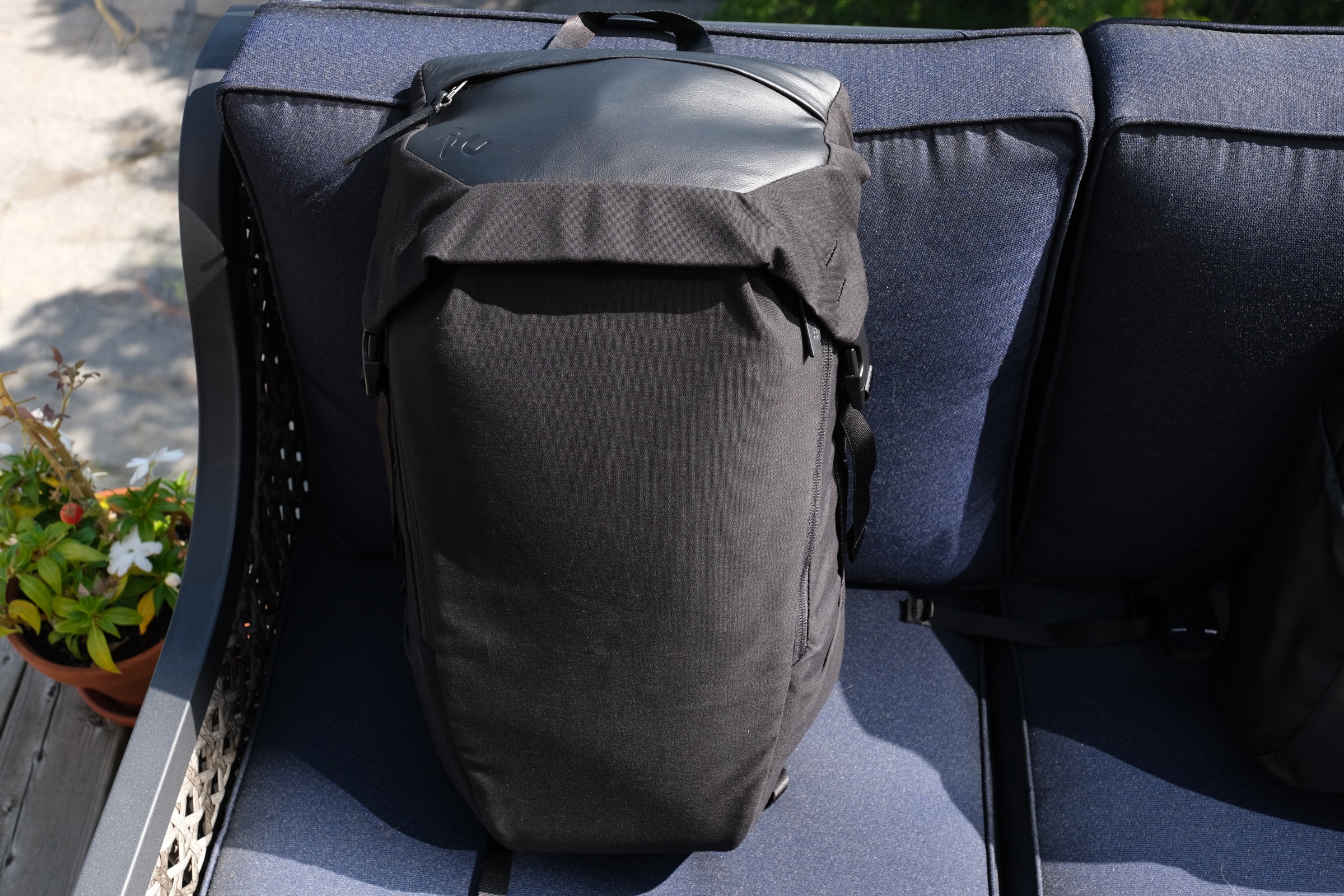
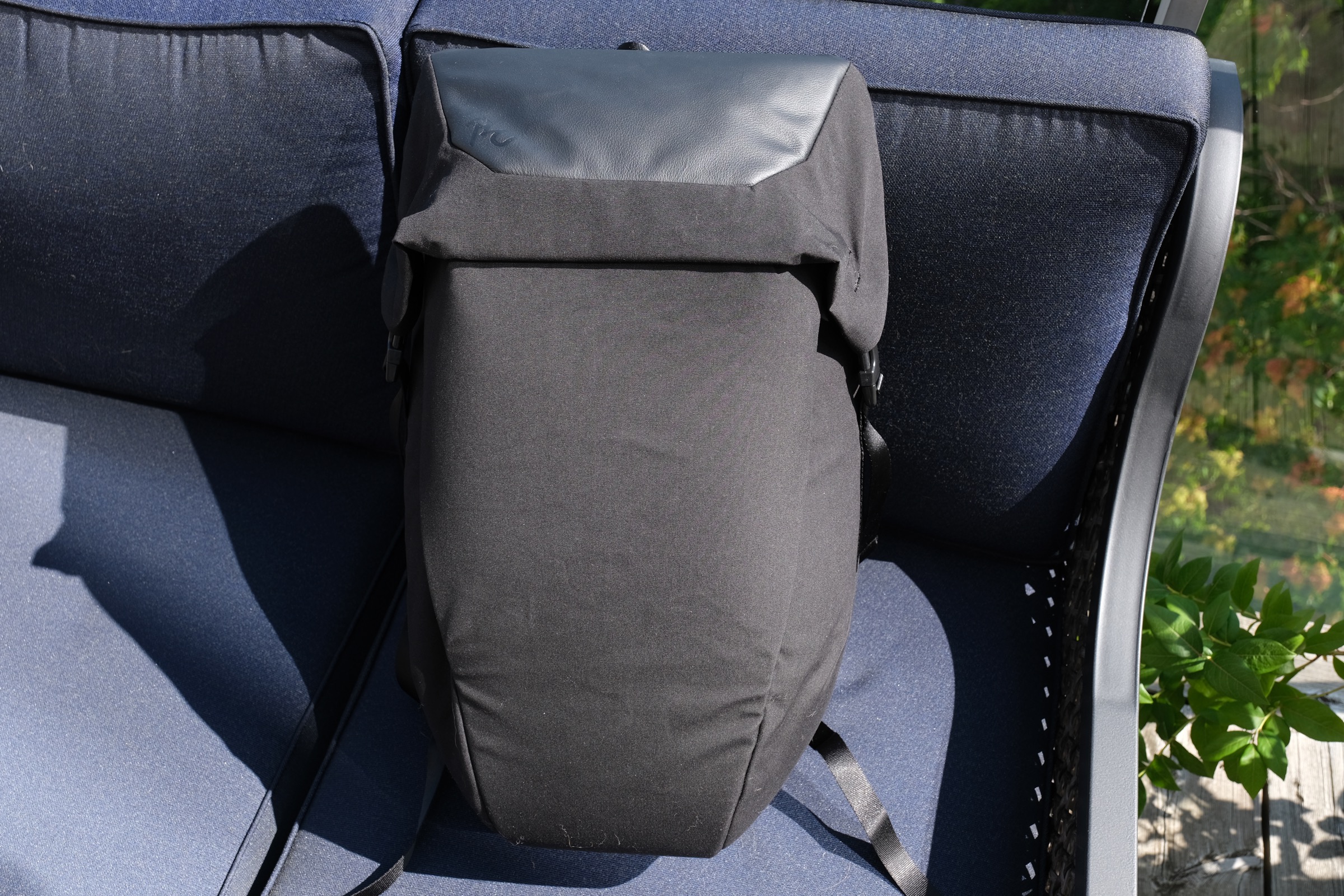
RYU bags 3 Locker Pack 18LRYU’s ‘just right’ offering for me is the Quick Pack Lux 18L capacity bag that’s pretty much perfect as a general use day pack in terms of cargo space, and that can also serve well for a one or two-night trip, depending on how lightly you pack.

The RYU’s signature feature, and what makes it my favorite daypack in terms of everyday use around the city, is its profile – a silhouette which is made all the better because RYU uses an internal molded shell to ensure that it never flattens down or loses its shape, regardless of how full or empty the bag actually is. This is actually a huge selling point for me, and one that makes the RYU Quick Pack 18L almost certain to become my go-to daily bag. Inside, there are a few pockets, including a laptop sleeve that can fit up to a 15-inch MacBook Pro – another rarity in a daypack this low-profile.

In addition to the integrated frame, the Quick Pack Lux is kitted out with premium materials, like the leather accent patch on the top flap, leather shoulder straps, and a outer layer of poly-cotton blend that covers a wax-treated canvas, and nylon interior for water resistance and durability. The materials definitely feel premium, though the outermost layer resembles kind of a yoga pant material, and in my house definitely attracts and picks up my dog’s easily shed white hairs with reckless abandon. I’m more than happy to get out the lint roller once and a while as a trade-off for just how good looking the bag is, however.

[gallery ids="1870659,1870660,1870661"]

It wears slightly long, but tight to the back (for reference when sizing up the photos above, I’m 6’2″ and quite a bit of that is torso). The removable chest strap helps keeps the profile pretty seamless, and there’s a handle on top for easy carrying when not on the back.

Another unique feature of the Quick Pack Lux is that opens from the front, with the flap at the top unbuckling to reveal two zippers that run the length of the bag. Undo these, and you get basically a duffle-style cargo loading method, which is great for arranging your stuff without having to layer or dig down as you would in a top loading pack.

Locker Pack Lux 24L ($215)

RYU bags 2 Locker Pack 24L 1The Locker Pack Lux is the more spacious version of the Quick Pack Lux, with 6L extra volume for packing your gear. It’s designed more for those overnights or two day trips, and yet it doesn’t really add that much in the way of bulk if you’re looking for something that can serve flexibly as both day pack and weekender.

The Locker Pack Lux has the same materials combination as the Quick Pack, but is a bit longer and so is probably better suited for taller people. It still offers a very slim profile, and has the same internal structural components that mean it’ll keep its shape, but it has a bit more leeway for expansion, too, letting you pack in a surprising amount of stuff via the front-loading, double zipper stowage and packing flap.

[gallery ids="1870681,1870682,1870683,1870674"]

Unlike the Quick Pack Lux, you also get external access to the laptop compartment in the Locker Pack, which gives you an easy way to get at up to a 15-inch notebook. The leather-accented top flap closes down over this compartment, too, to give you some protection against the elements in the case of light showers (RYU also sells a dedicated rain hood separately).

Express Pack 15L ($90)

RYU bags 4 Express Pack 15L

The Express Pack is the smallest of these RYU backpacks in terms of packing volume, but it’s also probably the best option when it comes to an all-around city daypack that will fit you regardless of height and frame. The extremely minimal aesthetic is great for the city, especially with the polyurethane outer coating that wraps a middle canvas layer for the bag’s body.

This is a very lightweight bag, but the internal pocket can actually fit a lot of stuff when needed, and there’s a single woven pocket on one side of the exterior for stowing a water bottle. This adds an asymmetrical look which is also pretty cool looking. Inside, there’s a zippered mesh block and a fully zippered front pocket for separating your sweaty gym gear, plus a laptop compartment that can fit a full, 15-inch MacBook Pro without issue.

[gallery ids="1870704,1870710,1870711,1870697"]

The bag is comfortable to wear, but doesn’t have the internal structure of the other two, so if it’s empty it’ll hug a lot closer to the body. If there’s one thing I’d change about it, it’s the RYU branding – but it does actually recede to being barely visible in less direct lighting, and is more subtle overall than it looks here.

Overall, RYU’s bag lineup is impressive, and offers something for everyone. The Vancouver-based company has done a great job of delivering highly functional designs that also offer great style with pretty much universal appeal. The company also offers non-Lux versions of both the Quick Pack and the Locker Pack, which drop the leather accents and embedded waxed canvas, but which also offer some decent discounts if the prices above strike you as too high.

19 Aug 2019

TikTok’s new ‘Hashtag Challenge Plus’ lets video viewers shop for products in the app

TikTok, the short-form video platform favored by young adults and teens, has launched a new feature that allows users to shop for products associated with a sponsored Hashtag Challenge, without leaving its app. These sponsored challenges are Gen Z-friendly marketing campaigns where users are prompted to post videos of them using a product — like showing off favorite outfits from Uniqlo or Guess, for example. Or they might participate in some sort of manufactured viral trend, like singing favorite Disney songs ahead of a Disney-themed episode of American Idol.

The new e-commerce feature, called Hashtag Challenge Plus, adds a shoppable component to the hashtag.

In addition to creating and viewing videos featuring the brand’s sponsored hashtag, a separate tab features an in-app experience where products from the campaign can be purchased within TikTok itself.

Last week, Kroger was the first brand to try out the new feature, according to a report from AdWeek.

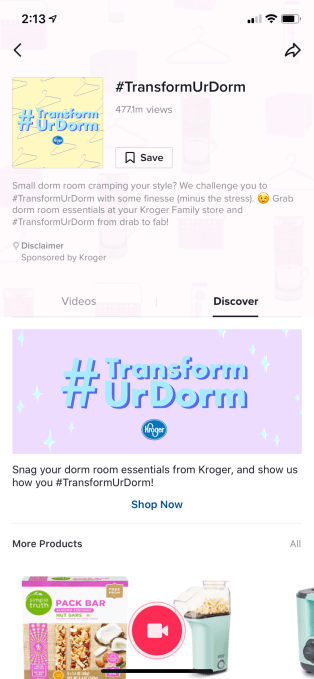
Image from iOS 2

While not exactly a company that exudes youth appeal, Kroger found a way to reach TikTok’s young adult audience through their hashtag campaign.

In partnership with four TikTok influencers — Joey Klaasen, Cosette Rinab, Mia Finney and Victoria Bachlet — Kroger prompted TikTok viewers to post videos of their dorm makeovers using the hashtag #TransformUrDorm. Digital agency i360 was involved in the videos’ creation.

What made Kroger’s challenge unique was that it also introduced a dedicated brand page where viewers could actually shop for products, too.

Image from iOS 1 1

Kroger paid for its sponsored hashtag to be given placement on TikTok’s Discover page for a week’s time. The tag can still be found via search, even though the campaign has wrapped.

Of course, many of its intended viewers found it by way of their favorite TikTok influencer’s profile, much like how Instagram ad campaigns work.

Since launch, the hashtag has since grown to around 477 million views across hundreds of videos — some labeled “Official,” if from the influencers. The rest is user-generated content from other TikTok users hoping to capitalize on the trend to gain a little TikTok fame for themselves.

On the hashtag’s landing page, there’s a separate tab also labeled “Discover,” but not to be confused with TikTok’s main Discover section. This directs viewers to the new shopping experience.

Here, Kroger shows off a scrollable row of featured products including things like a popcorn maker, a box of snack bars, a toaster, and other items.

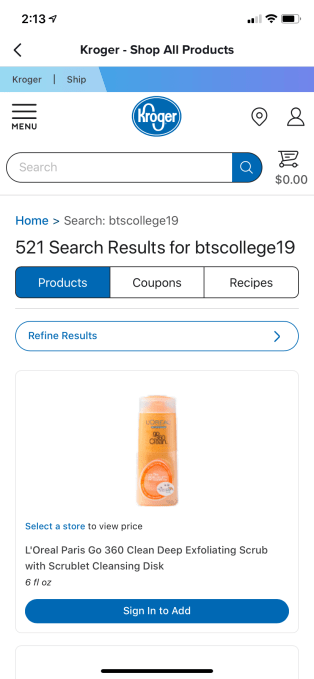
Tapping the “Shop Now” link then opens up Kroger’s website where users can add items to their cart and check out online.

Image from iOS 3

This shoppable experience is really just a mobile-optimized Kroger website pointing to a special search term (btscollege19). It isn’t a TikTok creation, nor built with TikTok’s help. On the mobile site, you can scroll down through a random list of items — from shampoos to coffee filters to toothpaste to hangers and more — or you can filter by category or enter a search term.

It’s unclear if such an offering will actually significantly impact e-commerce sales.

If anything, a hashtag campaign like this is better utilized to remind viewers that Kroger’s grocery store is also a place to shop for back-to-school needs, as an alternative to big-box stores like Target or Walmart or online retailers like Amazon.

TikTok confirmed to TechCrunch that Kroger was the first to put it into action last week. A spokesperson declined to say if other campaigns using the new product were in the works, adding that the company couldn’t talk about any plans ahead of their launch.

Sponsored Hashtag Challenges are only one way TikTok is experimenting with generating revenue from its some 500 million monthly users, the majority who are under 30. The company has also tried out full-screen ads at launch, in-feed ads, 3D/AR lenses, stickers and more.


19 Aug 2019

Join The New Stack for Pancake & Podcast with Q&A at TC Sessions: Enterprise

Popular enterprise news and research site, The New Stack, is coming to TechCrunch Sessions: Enterprise on September 5 for a special Pancake & Podcast session with live Q&A  featuring, you guessed it, delicious pancakes and awesome panelists!

Here’s the “short stack” of what’s going to happen:

  • Pancake buffet opens at 7:45 am on Thursday, Sept. 5 at TC Sessions: Enterprise
  • At 8:15 am the panel discussion/podcast kicks off, the topic, “The People and Technology You Need to Build a Modern Enterprise
  • After the discussion, the moderators will host a live audience Q&A session with the panelists
  • Once the Q&A is done, attendees will get the chance to win some amazing raffle prizes

You can only take part in this fun pancake-breakfast podcast if you register for a ticket to  TC Sessions: Enterprise. Use the code TNS30 to get 30% off the conference registration price!

Here’s the longer-versions of what’s going to happen:

At 8:15 a.m., The New Stack founder and Publisher Alex Williams takes the stage as the moderator and host of the panel discussion. Our topic for TC Sessions: Enterprise is The People and Technology You Need to Build a Modern Enterprise. We’ll start with intros of our panelists and then dive into the topic with Sid Sijbrandij, founder and CEO at GitLab, and Frederic Lardinois, enterprise reporter and editor at TechCrunch, as our initial panelists. More panelists to come!

Then it’s time for questions. Questions we could see getting asked (hint, hint): Who’s on your team? What makes a great technical team for the enterprise startup? What are the observations a journalist has about how the enterprise is changing? What about when the time comes for AI? Who will I need on my team?

And just before 9 a.m., we’ll pick a ticket out of the hat and announce our raffle winner. It’s the perfect way to start the day.

On a side note, the pancake breakfast discussion will be published as a podcast on The New Stack Analysts

But there’s only one way to get a prize and network with fellow attendees, and that’s by registering for TC Sessions: Enterprise and joining us for a short stack with The New Stack. Tickets are now $349, but you can save 30% with code TNS30.

19 Aug 2019

WP Standard’s Weekender leather duffle is built for life

Have you heard? It’s Bag Week! It’s the most wonderful week of the year at TechCrunch. Just in time for back to school, we’re bringing you reviews of bags of all varieties: from backpacks, to rollers to messengers to fanny packs.

WP Standard makes exceptional leather goods and the company’s new leather duffle is no different. It’s fantastic and my go-to travel bag. There are downsides — it’s heavy and the shoulder strap slips on my boney shoulders — but the good outweighs the bad.

I travel a lot. Airplanes, bikes, cars, and pretty much everything but trains — because I live in the midwest and not because I don’t like trains. A few years back I got a lovely, low-cost leather duffle from Amazon and started using it instead of a roller bag. It’s fun and forces me to pack smarter. Besides, the duffle always fits in overhead spaces, in taxi cabs and is easier to handle on a busy subway.

But you don’t care about my life. You’re here for this bag.

WP Standard built the Weekender duffle for people like me. It’s a great size and I have no issue packing away a bunch shirts, a few pairs of pants and an extra pair of shoes. This isn’t a bag built to hold suits, but rather a weekend’s worth of clothes — hence the name.

The full grain leather is thick and tough and has so far held up nicely to the riggers of travel. There are scratches and scuffs but those are souvenirs and badges of honor. It’s ridden in the back of my pickup in downpours and down dusty lanes. It’s survived several transatlantic flights and still looks like it has decades of life to give.

In the end this isn’t a Patagonia or The North Face duffle constructed out of space-age fabric designed to survive the tallest peaks or the deepest valleys. WP Standard doesn’t play that game. This company makes goods out of full grain leather that are naturally tough and will age gracefully.

The bag is constructed in a way to give the leather the best chance at survival. The hand straps wrap the bag to give it extra strength. The bottom is constructed out of two layers of stiff leather. The zipper is beefy. The shoulder strap is tough and hasn’t shown any sign of stretching.

A few years ago I reviewed WP Standard’s messenger bag. The Weekender duffle is just as lovely but these two bags share the same downside: The shoulder straps pad is too slippery. It doesn’t matter if I’m wearing a t-shirt, jacket or parka, the shoulder strap doesn’t stay in place. To compensate, I often forgo using the pad and use the strap itself, which is thinner and can be uncomfortable after several minutes. To me, this isn’t a deal killer, but you, dear reader, should know about this downside.

The WP Standard Weekender costs $375. It’s a great price considering the thickness of the leather and quality of construction. Similar bags can be had from Wills, Shinola or Saddleback but for nearly twice the price. Pad and Quill makes quality leather goods and sells a leather duffle that’s similar to the Weekend for $545; it’s also worth a consideration.

19 Aug 2019

Twitter blocks state-controlled media outlets from advertising on its social network

Twitter is now blocking state-run media outlets from advertising on its platform.

The new policy was announced just hours after the company identified an information operation involving hundreds of accounts linked to China as part of an effort to “sow political discord” around events in Hong Kong after weeks of protests in the region. Over the weekend over 1 million Hong Kong residents took to the streets to protest what they see as an encroachment by the mainland Chinese government over their rights.

State-funded media enterprises that do not rely on taxpayer dollars for their financing and don’t operate independently of the governments that finance them will no longer be allowed to advertise on the platform, Twitter said in a statement. That leaves a big exception for outlets like the Associated Press, the British Broadcasting Corp., Public Broadcasting Service, and National Public Radio, according to reporting from BBC reporter, Dave Lee.


The affected accounts will be able to use Twitter, but can’t access the company’s advertising products, Twitter said in a statement.

“We believe that there is a difference between engaging in conversation with accounts you choose to follow and the content you see from advertisers in your Twitter experience which may be from accounts you’re not currently following. We have policies for both but we have higher standards for our advertisers,” Twitter said in its statement.

The policy applies to news media outlets that are financially or editorially controlled by the state, Twitter said. The company said it will make its policy determinations on the basis of media freedom and independence including editorial control over articles and video, the financial ownership of the publication, the influence or interference governments may exert over editors, broadcasters and journalists, and political pressure or control over the production and distribution process.

Twitter said the advertising rules wouldn’t apply to entities that are focused on entertainment, sports, or travel, but if there’s news in the mix, the company will block advertising access.

Affected outlets have 30 days before they’re removed from Twitter and the company is halting all existing campaigns.

State media has long been a source of disinformation and was cited as part of the Russian campaign to influence the 2016 election. Indeed, Twitter has booted state-financed news organizations before. In October 2017, the company banned Russia Today and Sputnik from advertising on its platform (although a representative from RT claimed that Twitter encouraged it to advertise ahead of the election).


19 Aug 2019

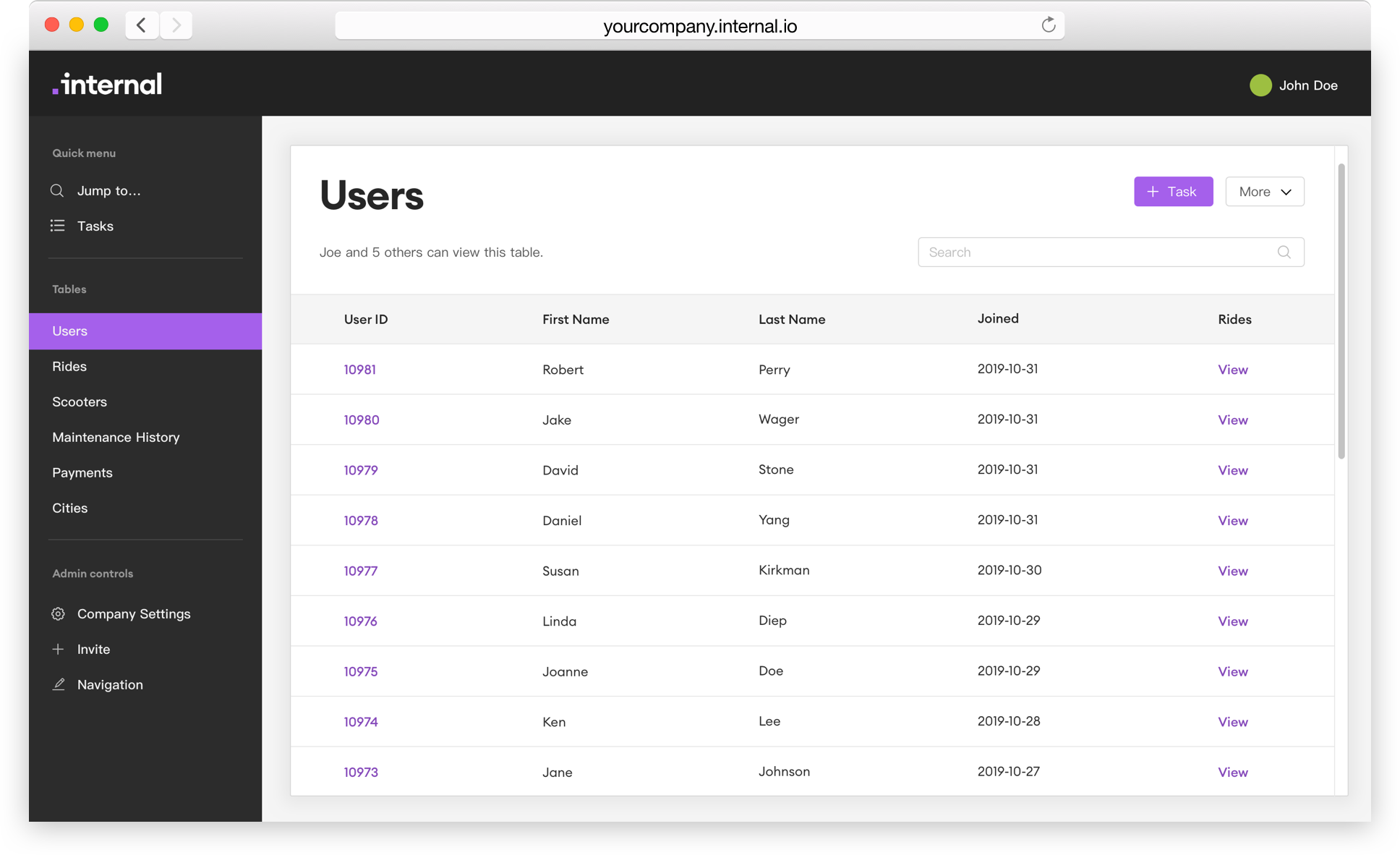
A newly funded startup, Internal, says it wants to help companies better manage their internal consoles

Uber and Facebook and countless other companies that know an awful lot about their customers have found themselves in hot water for providing broad internal access to sensitive customer information.

Now, a startup says its “out-of-the-box tools” can help protect customers’ privacy while also saving companies from themselves. How? With a software-as-a-service product that promises to help employees access the app data they need — and only the app data they need. Among the features the company, Internal, is offering, are search and filtering, auto-generated tasks and team queues, granular permissioning on every field, audit logs on every record, and redacted fields for sensitive information.

Whether the startup can win the trust of enterprises is the biggest question for the company, which was created by Arisa Amano and Bob Remeika, founders who last year launched the blockchain technology company Harbor. The two also worked together previously at two other companies: Zenefits and Yammer.

All of these endeavors have another person in common, and that’s David Sacks, whose venture firm, Craft Ventures, has just led a $5 million round in Internal. Sacks also invested last year in Harbor; he was an early investor in Zenefits and took over during troubled times as its CEO for less than a year; he also founded Yammer, which sold to Microsoft for $1.2 billion in cash in 2012.

All of the aforementioned have been focused, too, on making it easier for companies to get their work done, and Amano and Remeika have built the internal console at all three companies, which is how they arrived at their “aha” moment last year, says Amano. “So many companies build their consoles [which allow users advanced use of the computer system they’re attached to] in a half-hearted way; we realized there was an opportunity to build this as a service.” Adds Remeika, “Companies never dedicate enough engineers to [their internal consoles], so they’re often half broken and hard to use and they do a terrible job of limiting access to sensitive customer data. We eliminate the need to build these tools altogether, and takes just minutes to get set up.”

Internal Screens 1

Starting today, companies can decide for themselves whether they think Internal can help their employees interact with their customer app data in a more secure and compliant way. The eight-person company has just made the product available for a free trial.

Naturally, Amano and Remeika are full of assurances why companies can trust them. “We don’t store data,” says Amano. “That resides on the [customer’s] servers. It stays in their database.” Internal’s technology instead “understands the structure of the data and will read that structure,” offers Remeika, who says not to mistake Internal for an analytics tool. “Analytics tools commonly provide a high-level overview; Internal is giving users granular access to customer data and letting you debug problems.”

As for competitors, the duo say their most formidable opponent right now is developers who throw up a data model viewer that has complete access to everything in a database, which may be sloppy but happens routinely.

Internal isn’t disclosing its pricing publicly just yet, but it says its initial target is non-technical users, on operations and customer support teams, for example.

As for Harbor (we couldn’t help but wonder why they’re already starting a new company), they say it’s in good hands with CEO Josh Stein, who was previously general counsel and chief compliance officer at Zenefits (he was its first lawyer) and who joined Harbor in February of last year as its president. Stein was later named CEO.

In addition to Craft Ventures, Internal’s new seed round comes from Pathfinder, which is Founders Fund’s early-stage investment vehicle, and other, unnamed angel investors.

19 Aug 2019

Without evidence, Trump accuses Google of manipulating millions of votes

The President this morning lashed out at Google on Twitter, accusing the company of manipulating millions of votes in the 2016 election to sway it towards Hillary Clinton. The authority on which he bases this serious accusation, however, is little more than supposition in an old paper reheated by months-old congressional testimony.

Trump’s tweet this morning cited no paper at all, in fact, though he did tag conservative watchdog group Judicial Watch, perhaps asking them to investigate. It’s also unclear who he thinks should sue the company.

Coincidentally, Fox News had just mentioned the existence of such a report about five minutes earlier. Trump has also recently criticized Google and CEO Sundar Pichai over a variety of perceived slights.

In fact the report was not “just issued,” and does not say what the President suggests it did. What both Fox and Trump appear to be referring to is a paper published in 2017 that described what the authors say was a bias in Google and other search engines during the run-up to the 2016 election.

If you’re wondering why you haven’t heard about this particular study, I can tell you why — it’s a very bad study. The authors looked at search results for 95 people over the 25 days preceding the election and evaluated the first page for bias.

They claim to have found that based on “crowdsourced” determinations of bias, the process for which is not described, that most search results, especially on Google, tended to be biased in favor of Clinton. No data on these searches, such as a sample search and results and how they were determined to be biased, is provided. There’s no discussion of the fact, for example, that Google tailors search results based on a person’s previous searches, stated preferences, location, and so on.

In fact, the paper lacks all the qualifications of any ordinary research paper. There is no abstract or introduction, no methods section to show the statistics work and definitions of terms, no discussion, no references. Without this basic information the document is not only incapable of being reviewed by peers or experts, but is indistinguishable from completely invented suppositions. Nothing in this paper can be in any way verified.

Epstein freely references himself, however: a single 2015 paper in PNAS on how search results could be deliberately manipulated to affect a voter looking for information on candidates, and  the many, many opinion pieces he has written on the subject, frequently on far-right outlets the Epoch Times and Daily Caller, but also non-partisan ones like USA Today and Bloomberg Businessweek.

The numbers advanced in the study are completely without merit. Citing math he does not describe, Epstein says that “a pro-Clinton bias in Google’s search results would over time, shift at least 2.6 million votes to Clinton.” No mechanism or justification for this assertion is provided, except a highly theoretical one based on ideas and assumptions from his 2015 study, which had little in common with this one. The numbers are, essentially, made up.

In other words, this so-called report is nothing of the kind — a nonfactual document written with no scientific justification of its claims written by someone who publishes anti-Google editorials almost monthly. It was not published in a journal of any kind, simply put online at a private nonprofit research agency called the American Institute for Behavioral Research and Technology, where Epstein is on staff and which appears to exist almost solely to promote his work. (I’ve asked AIBRT for more information on its funding.)

If that were all, it would be more than enough. But Trump’s citation of this fraudulent paper doesn’t even get the facts right. His assertion was that “Google manipulated from 2.6 million to 16 million votes for Hillary Clinton in 2016 Election,” and the report doesn’t even state that.

The source for this false claim appears to be Epstein’s recent appearance in front of the Senate Judiciary Committee in July. Here he received star treatment from Sen. Ted Cruz (R-TX), who asked him to share his expert opinion on the possibility of tech manipulation of voting. Cruz’s previous expert for this purpose was conservative radio talk show host Dennis Prager.

Again citing no data, studies, or mechanisms whatsoever, Epstein described 2.6 million as a “rock bottom minimum” of votes that Google, Facebook, Twitter and others could have affected (he does not say did affected, or attempted to affect). He also says that in subsequent elections, specifically in 2020, “if all these companies are supporting the same candidate, there are 15 million votes on the line that can be shifted without people’s knowledge and without leaving a paper trail for authorities to trace.”

“the methods they are using are invisible, they’re subliminal, they’re more powerful than most any effects I’ve seen in the behavioral sciences,” Epstein said, but did not actually describe what the techniques are. Though he did suggest that Mark Zuckerberg could send out a “get out the vote” notification only to Democrats and no one would ever know — absurd.

In other words, the numbers are not only invented, but unrelated to the 2016 election, and inclusive of all tech companies, not just Google. Even if Epstein’s claims were anywhere near justifiable, Trump’s tweet mischaracterizes them and gets everything wrong. Nothing about any of this is anywhere close to correct.

Google issued a statement addressing the President’s accusation, saying “This researcher’s inaccurate claim has been debunked since it was made in 2016. As we stated then, we have never re-ranked or altered search results to manipulate political sentiment.”

You can read the full “report” below:

EPSTEIN & ROBERTSON 2017-A Method for Detecting Bias in Search Rankings-AIBRT by TechCrunch on Scribd