Year: 2019

19 Aug 2019

Mammoth Media introduces Choose Your Own Adventure-style storytelling to its chat fiction app Yarn

The chat fiction stories offered in Mammoth Media‘s mobile app Yarn are about to get more interactive.

The branching narrative mechanic should be familiar to anyone who read Choose Your Own Adventure books when they were kids — you read a story, and at certain key moments, you choose from different options that determine where the plot will go next.

More recently, the “Being Beyonce’s assistant for a day” thread on Twitter reminded everyone how fun and stressful this kind of storytelling can be. In fact, Mammoth says it’s hired the thread’s author Landon Rivera as one of the writers for this new initiative.

One thing you probably won’t recognize from your childhood reading is the fact that some of these choices aren’t free — to select them, you’ll need to spend money in the form of Yarn’s new virtual currency, gems.

Mammoth founder and CEO Benoit Vatere explained that in those cases, there might be two choices that you can select for free, plus a third that you need to pay for. Usually, it will be something that accelerates the story or sends it off in a new direction — in a horror story, you could get the option to stab someone, or in a romance story, your character could get the option to go home with someone.

Vatere added, “It’s not only being able to have a different branch in the story, but being able to play as a different character lead … Instead of being the male character, would they like to be the female character and really see a different perspective?”

He acknowledged that some of Yarn’s paying subscribers might be cranky about being asked to pay more, but he said the goal is that those subscribers can have “a full experience” without having to buy additional gems.

Yarn is launching interactive stories with titles including “Blue Ivy’s Nanny,” where it’s your first day on the job as Beyoncé’s nanny (I’m going to go ahead and guess that Rivera worked on this one); a romance story called “Playing the Field”; a horror story called “Haunted Camper” and a drama called “Trapped.” Vatere also said there are plans for branched narratives tying into existing Yarn franchises, and set in the world of Archie Comics.

Overall, Vatere said he’s hoping that this will lead to more engagement from Yarn readers, while also opening up new opportunities for monetization.

“Subscription is a great model, but subscription has a cap,” he said. That’s why Mammoth is experimenting with virtual currency, and why it plans to make these stories available to non-subscribers.

19 Aug 2019

These are the games coming to Google Stadia

Google’s game streaming service isn’t set to launch until November, but the company kept the hype train going through the mid-August doldrums with a Gamescom Stadia Connect livestream. As promised, the online press conference was “all about the games,” featuring what looks to be a nearly complete list of launch (and some post-launch) titles.

The games include some top names like Cyberpunk 2077, Final Fantasy XV, Assassin’s Creed Odyssey and Mortal Kombat 11. It also enlists a number of top publishers, including Bethesda, Square and Ubisoft. A number of key publishing partners have opted to keep their lists under wraps until closer to (or at) launch, however, including EA, Capcom and Rockstar.

As previously noted, the service will run $10 a month, including access to games and discounts on purchases. A base version of the service will also be available at some point next year. When it launches in November, the service will be available in 14 countries, including US, Canada, UK, Ireland, France, Germany, Italy, Spain, Netherlands and Finland. More will be added in 2020.

Google is currently offering up a “Founder’s Edition” pre-order for $130. That includes a controller, Chromecast Ultra and three months of the service for you and a friend.

Here’s the list of titles so far,

  • Bandai Namco – Dragon Ball Xenoverse 2
  • Bethesda – DOOM Eternal, DOOM 2016, Rage 2, The Elder Scrolls Online, Wolfenstein: Youngblood
  • Bungie – Destiny 2, Destiny 2: Shadowkeep Expansion
  • CD PROJEKT RED – Cyberpunk 2077
  • Chump Squad – KINE
  • Coatsink – Get Packed
  • Codemasters – GRID
  • Dotemu – Windjammers 2
  • Deep Silver – Metro Exodus
  • Drool – Thumper
  • Giants Software -Farming Simulator 19
  • Larian Studios – Baldur’s Gate 3
  • nWay Games – Power Rangers: Battle for the Grid
  • Omega Force – Attack on Titan 2: Final Battle
  • Pandemic Studios – Destroy All Humans!
  • Robot Entertainment – Orcs Must Die 3
  • Sega – Football Manager
  • SNK – Samurai Shodown
  • Square Enix – Final Fantasy XV – Tomb Raider Definitive Edition, Rise of the Tomb Raider, Shadow of the Tomb Raider, Marvel’s Avengers
  • SUPERHOT – SUPERHOT
  • 2K – NBA 2K, Borderlands 3
  • Tequila Works – Gylt
  • Warner Bros – Mortal Kombat 11
  • THQ – Darksiders Genesis
  • Ubisoft – Assassin’s Creed Odyssey, Just Dance , Tom Clancy’s Ghost Recon Breakpoint , Tom Clancy’s The Division 2 , Trials Rising, The Crew 2, Watch Dogs: Legion
19 Aug 2019

Twitter says accounts linked to China tried to ‘sow political discord’ in Hong Kong

Twitter says a significant state-backed information operation involving hundreds of accounts linked to China were part of an effort to deliberately “sow political discord” in Hong Kong after weeks of protests in the region.

In a blog post, the social networking site said the 936 accounts it found tried to undermine “the legitimacy and political positions of the protest movement on the ground.”

More than a million protesters took to the streets this weekend to demonstrate peacefully against the Chinese government, which took over rule from the British government in 1997. Protests erupted months ago following a bid by Hong Kong leader Carrie Lam to push through a highly controversial bill that would allow criminal suspects to be extradited to mainland China for trial. The bill was suspended, effectively killing it from reaching the law books, but protests have continued, pushing back at claims that China is trying to meddle in Hong Kong’s affairs.

Although Twitter is banned in China, the social media giant says the latest onslaught of fake accounts is likely “a coordinated state-backed operation.

“Specifically, we identified large clusters of accounts behaving in a coordinated manner to amplify messages related to the Hong Kong protests,” the statement said.

china tweets

Two of the tweets supplied by Twitter.

Twitter said many of the accounts are using virtual private networks — or VPNs — which can be used to tunnel through China’s vast domestic censorship system, known as the Great Firewall. The company added that the accounts its sharing represent the “most active” portions of a wider spam campaign of about 200,00 accounts.

“Covert, manipulative behaviors have no place on our service — they violate the fundamental principles on which our company is built,” said Twitter.

Facebook said in its own post it also took down five Facebook accounts, seven pages and three groups on its site “based on a tip shared by Twitter.” The accounts frequently posted about local political news and issues including topics like the ongoing protests in Hong Kong, said Nathaniel Gleicher, Facebook’s head of cybersecurity policy.

“Although the people behind this activity attempted to conceal their identities, our investigation found links to individuals associated with the Chinese government,” said Gleicher.

Some of the posts, Facebook said, referred Hong Kong residents are “cockroaches.”

Twitter said it’s adding the complete set the accounts’ tweets to its archive of information operations.

19 Aug 2019

After data incidents, Instagram expands its bug bounty

Facebook is expanding its data abuse bug bounty to Instagram.

The social media giant, which owns Instagram, first rolled out its data abuse bounty in the wake of the Cambridge Analytica scandal, which saw tens of millions of Facebook profiles scraped to help swing undecided voters in favor of the Trump campaign during the U.S. presidential election in 2016.

The idea was that security researchers and platform users alike could report instances of third-party apps or companies that were scraping, collecting and selling Facebook data for other purposes, such as to create voter profiles or build vast marketing lists.

Even following he high profile public relations disaster of Cambridge Analytica, Facebook still still had apps illicitly collecting data on its users.

Instagram wasn’t immune either. Just this month Instagram booted a “trusted” marketing partner off its platform after it was caught scraping millions of users’ stories, locations and other data points on millions of users, forcing Instagram to make product changes to prevent future scraping efforts. That came after two other incidents earlier this year where a security researcher found 14 million scraped Instagram profiles sitting on an exposed database — without a password — for anyone to access. Another incident saw another company platform scrape the profile data — including email addresses and phone numbers — of Instagram influencers.

Last year Instagram also choked developers’ access as the company tried to rebuild its privacy image in the aftermath of the Cambridge Analytica scandal.

Dan Gurfinkel, security engineering manager at Instagram, said its new and expanded data abuse bug bounty aims to “encourage” security researchers to report potential abuse.

Instagram said it’s also inviting a select group of trusted security researchers to find flaws in its Checkout service ahead of its international rollout, who will also be eligible for bounty payouts.

Read more:

19 Aug 2019

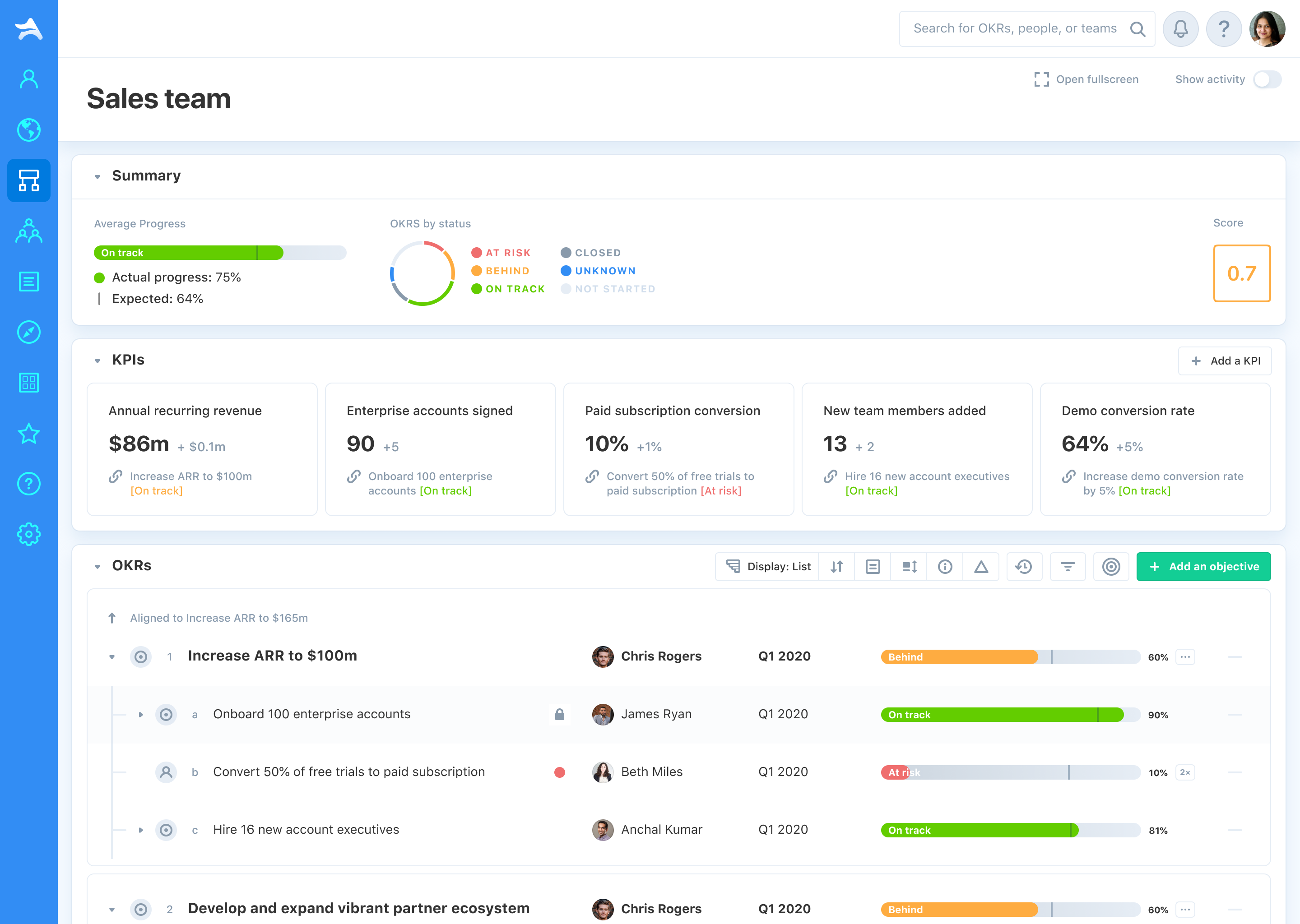
Ally raises $8M Series A for its OKR solution

OKRs, or Objectives and Key Results, are a popular planning method in Silicon Valley. Like most of those methods that make you fill in some form once every quarter, I’m pretty sure employees find them rather annoying and a waste of their time. Ally wants to change that and make the process more useful. The company today announced that it has raised an $8 million Series A round led by Accel Partners, with participation from Vulcan Capital, Founders Co-op and Lee Fixel. The company, which launched in 2018, previously raised a $3 million seed round.

Ally founder and CEO Vetri Vellore tells me that he learned his management lessons and the value of OKR at his last startup, Chronus. After years of managing large teams at enterprises like Microsoft, he found himself challenged to manage a small team at a startup. “I went and looked for new models of running a business execution. And OKRs were one of those things I stumbled upon. And it worked phenomenally well for us,” Vellore said. That’s where the idea of Ally was born, which Vellore pursued after selling his last startup.

Most companies that adopt this methodology, though, tend to work with spreadsheets and Google Docs. Over time, that simply doesn’t work, especially as companies get larger. Ally, then, is meant to replace these other tools. The service is currently in use at “hundreds” of companies in more than 70 countries, Vellore tells me.

One of its early adopters was Remitly . “We began by using shared documents to align around OKRs at Remitly. When it came time to roll out OKRs to everyone in the company, Ally was by far the best tool we evaluated. OKRs deployed using Ally have helped our teams align around the right goals and have ultimately driven growth,” said Josh Hug, COO of Remitly.

Desktop Team OKRs Screenshot

Vellore tells me that he has seen teams go from annual or bi-annual OKRs to more frequently updated goals, too, which is something that’s easier to do when you have a more accessible tool for it. Nobody wants to use yet another tool, though, so Ally features deep integrations into Slack, with other integrations in the works (something Ally will use this new funding for).

Since adopting OKRs isn’t always easy for companies that previously used other methodologies (or nothing at all), Ally also offers training and consulting services with online and on-site coaching.

Pricing for Ally starts at $7 per month per user for a basic plan, but the company also offers a flat $29 per month plan for teams with up to 10 users, as well as an enterprise plan, which includes some more advanced features and single sign-on integrations.

19 Aug 2019

Developers accuse Apple of anti-competitive behavior with its privacy changes in iOS 13

A group of app developers have penned a letter to Apple CEO Tim Cook, arguing that certain privacy-focused changes to Apple’s iOS 13 operating system will hurt their business. In a report by The Information, the developers were said to have accused Apple of anti-competitive behavior when it comes to how apps can access user location data.

With iOS 13, Apple aims to curtail apps’ abuse of its location-tracking features as part of its larger privacy focus as a company.

Today, many apps ask users upon first launch to give their app the “Always Allow” location-tracking permission. Users can confirm this with a tap, unwittingly giving apps far more access to their location data than is actually necessary, in many cases.

In iOS 13, however, Apple has tweaked the way apps can request location data.

There will now be a new option upon launch presented to users, “Allow Once,” which allows users to first explore the app to see if it fits their needs before granting the app developer the ability to continually access location data. This option will be presented alongside existing options, “Allow While Using App” and “Don’t Allow.”

The “Always” option is still available, but users will have to head to iOS Settings to manually enable it. (A periodic pop-up will also present the “Always” option, but not right away.)

The app developers argue that this change may confuse less technical users, who will assume the app isn’t functioning properly unless they figure out how to change their iOS Settings to ensure the app has the proper permissions.

The developers’ argument is a valid assessment of user behavior and how such a change could impact their apps. The added friction of having to go to Settings in order to toggle a switch so an app to function can cause users to abandon apps. It’s also, in part, why apps like Safari ad blockers and iOS replacement keyboards never really went mainstream, as they require extra steps involving the iOS Settings.

That said, the changes Apple is rolling out with iOS 13 don’t actually break these apps entirely. They just require the apps to refine their onboarding instructions to users. Instead of asking for the “Always Allow” permission, they will need to point users to the iOS Settings screen, or limit the apps’ functionality until it’s granted the “Always Allow” permission.

In addition, the developers’ letter pointed out that Apple’s own built-in apps (like Find My) aren’t treated like this, which raises anti-competitive concerns.

The letter also noted that Apple in iOS 13 would not allow developers to use PushKit for any other purpose beyond internet voice calls — again, due to the fact that some developers abused this toolkit to collect private user data.

“We understand that there were certain developers, specifically messaging apps, that were using this as a backdoor to collect user data,” the email said, according to the report. “While we agree loopholes like this should be closed, the current Apple plan to remove [access to the internet voice feature] will have unintended consequences: it will effectively shut down apps that have a valid need for real-time location.”

The letter was signed by Tile CEO CJ Prober; Arity (Allstate) President Gary Hallgren; CEO of Life360 Chris Hullsan; CEO of dating app Happn Didier Rappaport; CEO of Zenly (Snap), Antoine Martin; , CEO of Zendrive, Jonathan Matus which; and chief strategy officer of social networking app Twenty, Jared Allgood.

Apple responded to The Information by saying that any changes it makes to the operating system are “in service to the user” and to their privacy. It also noted that any apps it distributes from the App Store have to abide by the same procedures.

It’s another example of how erring on the side of increased user privacy can lead to complications and friction for end users. One possible solution could be allowing apps to present their own in-app Settings screen where users could toggle the app’s full set of permissions directly — including everything from location data to push notifications to the app’s use of cellular data or Bluetooth sharing.

The news comes at a time when the U.S. Dept. of Justice is considering investigating Apple for anti-competitive behavior. Apple told The Information it was working with some of the impacted developers using PushKit on alternate solutions.

19 Aug 2019

‘Breaking Into Startups’: Torch CEO and Well Clinic founder Cameron Yarbrough on mental health & coaching

There has long been a stigma associated with therapy and mental health coaching, a stigma that is even more pronounced in the business world, despite considerable evidence of the efficacy of these services. One of the organizations that has set out to change this negative association is Torch, a startup that combines the therapeutic benefits of executive coaching with data-driven analytics to track outcomes.

Yet, as Torch co-founder and CEO Cameron Yarbrough explains in this Breaking Into Startups episode, the startup wasn’t initially a tech-oriented enterprise. At first, Yarbrough drew on his years of experience as a marriage and family counselor as he made the transition into executive coaching, even referring to the early iterations of Torch as little more than “a matchmaking service between coaches and professionals.”

In time, Yarbrough identified a virtually untapped market for executive coaching — one that, by his estimate, could amount to a $15 billion industry. To demonstrate to investors the great potential of this growing market, he first built up a clientele that provided Torch with sufficient recurring revenue and low churn rate.

Only then was Yarbrough able to raise a $2.4 million seed round from Initialized Capital, Y Combinator, and other investors, convincing them that data analytics software could enhance the coaching process — as well as coach recruitment — enough to effectively “productize feedback,” as he puts it.

For Yarbrough and Torch, “productizing feedback” involves certain well-known business strategies that complement traditional coaching methods. For instance, Torch’s coaching procedure includes a “360 review,” a performance review system that incorporates feedback from all angles, including an employee’s manager, peers, and other people within an organization who have knowledge of the employee’s work.

The 360 review is coupled with an OKR platform, which provides HR departments and other interested parties with the metrics and analytics to track employee progress through the program. This combination is designed to promote the development of soft skills, which in turn drive leadership.

Torch has achieved considerable success, landing several influential clients in the tech sector through its B2B approach. But Yarbrough is clear that his goal with the company is to “democratize” access to professional coaching, in hopes of providing the same kind of mental health counseling and support to employees in all levels of an organization.

In this episode, Yarbrough discusses the history and trajectory of Torch, his experience scaling a company many considered unscalable, and the methods he uses to manage his own emotional and mental health as the CEO of an expanding startup. Yarbrough offers insights into the feelings of anxiety and dread common among entrepreneurs and provides a close look at how he has found business and personal success with Torch.


Breaking Into Startups: There’s a difference between a mentor and a coach. Today, I want to talk about that difference and in addition to the intersection between business and psychology, What Cameron Yarbrough, CEO of Torch and Founder of Well Clinic.

If you’re someone that is looking for a mentor or a coach as you break into tech, or if you just want to be surrounded by peers, make sure you download the Career Karma app by going to www.breakingintostartups.com/download.

On today’s episode, you’re going to understand the importance of therapy, mental health and coaches, as well as how historically, it has been inaccessible to people and how Cameron is using his background to democratize this for the world.

If this is your first time listening to the Breaking Startups Podcast, make sure you leave a review on iTunes and tell your friends. Listen to it on Soundcloud and talk about it on Spotify. If you have any feedback for us, positive or negative, please let us know. Without further ado, let’s break-in.

Cameron Yarbrough is the CEO of Torch. He’s one of the best executive coaches in the world. Not only are we going to be talking about coaching and mentoring for executives, but we’ll also be talking about coaching in general for everyone. We’re going to go into how he created his company.

19 Aug 2019

Shell’s first electric vehicle fast charger lands in Singapore

Royal Dutch Shell, the energy giant known for its fossil fuel production and hundreds of Shell gas stations, is creeping into the electric vehicle-power business.

The company’s first DC fast charger launched Monday at a Shell gas station in Singapore. Greenlots, an EV charging startup acquired by Shell in January, installed the charger. This is the first of 10 DC fast chargers that Greenlots plans to bring to Shell service stations in Singapore over the next several months.

The decision to target Singapore is part of Greenlots’ broader strategy to provide EV charging solutions across all applications throughout Asia and North America, the company said. Both Shell and Greenlots have a presence in Singapore. Greenlots, which based in Los Angeles, was founded in Singapore; and Shell is one of Singapore’s largest foreign investors.

Singapore has been promoting the use of electric vehicles, particularly for car-sharing and ride-hailing platforms. The island city-state has been building up its EV infrastructure to meet anticipated demand as ride-hailing drivers and commercial fleets switch to electric vehicles.

Greenlots was backed by Energy Impact Partners, a cleantech investment firm, before it was acquired by Shell. The company, which combines its management software with the EV charging hardware, has landed some significant customers in recent years, notably Volkswagen. Greenlots is the sole software provider to Electrify America, the the entity set up by Volkswagen as part of its settlement with U.S. regulators over its diesel emissions cheating scandal.

19 Aug 2019

The five great reasons to attend TechCrunch’s Enterprise show Sept. 5 in SF

The vast enterprise tech category is Silicon Valley’s richest, and today it’s poised to change faster than ever before. That’s probably the biggest reason to come to TechCrunch’s first-ever show focused entirely on enterprise. But here are five more reasons to commit to joining TechCrunch’s editors on September 5 at San Francisco’s Yerba Buena Center for an outstanding day (agenda here) addressing the tech tsunami sweeping through enterprise. 

#1 Artificial Intelligence.
At once the most consequential and most hyped technology, no one doubts that AI will change business software and increase productivity like few if any, technologies before it. To peek ahead  into that future, TechCrunch will interview Andrew Ng, arguably the world’s most experienced AI practitioner at huge companies (Baidu, Google) as well as at startups. AI will be a theme across every session, but we’ll address again it head-on in a panel with investor Jocelyn Goldfein (Zetta), founder Bindu Reddy (Reality Engines) and executive John Ball (Salesforce / Einstein). 

#2. Data, The Cloud and Kubernetes.
If AI is at the dawn of tomorrow, cloud transformation is the high noon of today.  90% of the world’s data was created in the past two years, and no enterprise can keep its data hoard on-prem forever. Azure’s CTO
Mark Russinovitch (CTO) will discuss Microsft’s vision for the cloud. Leaders in the open-source Kubernetes revolution, Joe Beda (VMWare) and Aparna Sinha (Google) and others will dig into what Kubernetes means to companies making the move to cloud. And last, there is the question of how to find signal in all the data – which will bring three visionary founders to the stage: Benoit Dageville (Snowflake), Ali Ghodsi (Databricks), Murli Thirumale (Portworx). 

#3 Everything else on the main stage!
Let’s start with a fireside chat with
SAP CEO Bill McDermott and Qualtrics Chief Experience Officer Julie Larson-Green.  We have top investors talking where they are making their bets, and security experts talking data and privacy. And then there is quantum,  the technology revolution waiting on the other side of AI: Jay Gambetta, the principal theoretical scientist behind IBM’s quantum computing effort,  Jim Clarke, the director of quantum hardware at Intel Labs, and Krysta Svore, style="font-weight: 400;"> who leads the Microsoft’s quantum effort.

All told, there are 21 programming sessions.

#4 Network and get your questions answered.
There will be two Q&A breakout sessions with top enterprise investors for founders (and anyone else) to query investors directly. Plus, TechCrunch’s unbeatable CrunchMatch app makes it really easy to set up meetings with the other attendees, an
incredible array of folks, plus the  20 early-stage startups exhibiting on the expo floor.

#5 SAP
Enterprise giant SAP is our sponsor for the show, and they are not only bringing a squad of top executives, they are producing four parallel track sessions featuring key SAP Chief Innovation Officer
Max Wessel,  SAP Chief Designer and Futurist  Martin Wezowski and SAP.IO’s managing director Ram Jambunathan (SAP.iO) in sessions including, how to scale-up an enterprise startup, how startups win large enterprise customers, and what the enterprise future looks like.

Check out the complete agenda. Don’t miss this show! This line-up is a view into the future like none other. 

Grab your $349 tickets today, and don’t wait till the day of to book because prices go up at the door!

We still have 2 Startup Demo Tables left. Each table comes with 4 tickets and a prime location to demo your startup on the expo floor. Book your demo table now before they’re all gone!

19 Aug 2019

MIT built a better way to deliver high-quality video streams to multiple devices at once

Image via Getty Images / aurielaki

Depending on your connection and the size of your household, video streaming can get downright post-apocalyptic – bandwidth is the key resource, and everyone is fighting to get the most and avoid a nasty, pixelated picture. But a new way to control how bandwidth is distributed across multiple, simultaneous streams could mean peace across the land – even when a ton of devices are sharing the same connection and all streaming video at the same time.

Researchers at MIT’s Computer Science and Artificial Intelligence Lab created a system they call ‘Minerva’ that minimizes stutters due to buffering, and pixelation due to downgraded stream, which it believes could have huge potential benefits for streaming services like Netflix and Hulu that increasingly serve multiple members of a household at once. The underlying technology could be applied to larger areas, too, extending beyond the houseful and into neighbourhoods or even whole regions to mitigate the effects of less than idea streaming conditions.

Minerva works by taking into account the varying needs of different delivery devices streaming on a network – so it doesn’t treat a 4K Apple TV the same as an older smartphone with a display that can’t even show full HD output, for instance. It also considers the nature of the content, , which is important because live action sports require a heck of a lot more bandwidth to display in high quality when compared to say, an animated children’s TV show.

Video is then served to viewers based on its actual needs, instead of just being allocated more or less evenly across devices, and the Minerva system continually optimizes delivery speeds in accordance with their changing needs as the stream continues.

In real-world testing, Minerva as able to provide a quality cup equivalent to going from 720p to 1080p as much as a third of the time, and eliminated the need for rebuffing by almost 50 percent, which is a massive improvement when it comes to actually being able to seamlessly stream video content continuously. Plus, it can do all this without requiring any fundamental changes to network infrastructure, meaning a streaming provider could roll it out without having to require any changes on the part of users.