Year: 2019

15 Aug 2019

Fitz Frames, with $2.5M in seed funding, wants your kid to have custom glasses

Fitz Frames is today launching out of beta to offer affordable, custom-made glasses for families, and in particular, for children.

The company, which has raised $2.5 million in seed funding, was founded by Heidi Hertel is led by her and co-CEO Gabriel Schlumberger. The company declined to disclose its investors, but shared that it was a mix of angel and institutional investors.

Hertel started the company after taking her children through the process of buying glasses with little to no success.

Hertel cites two main problems with buying glasses for children: 1) There isn’t much selection around style for kids, and 2) Glasses are made for kids and adults with little variation in size for kids who are in-between.

Here’s how it works:

With a Rx from a doctor or without, kids and parents hop on the Fitz Frames app to go through a virtual try-on. While the user is going through a virtual try-on to find the right pair of glasses, the Fitz Frames app is doing a full measurement of the face using thousands of data points, including ear-height, nose shape, etc. to make sure that the end-result is a comfortable, well-fitting pair of glasses.

From there, Fitz Frames sends the measurements to their manufacturing set-up in Youngstown, Ohio, where the frames are made from polyamide powder which is 3D-printed using selective laser sintering.

Not only does the polyamide allow for a more durable, flexible frame, but the manufacturing process as a whole allows Fitz to turn around frames quickly. The goal, according to Hertel, is to turn around a pair of glasses in a week or less.

Fitz Frames are also made with no-screw hinges, opting instead for arms that pop right out of the socket and pop back in. This means repairing a pair of Fitz Frames is far easier and doesn’t require sewing hands and tiny screwdrivers.

Kids can also have their name or favorite number or address etched into the arm of the glasses.

Fitz Frames cost $95, but the company is also offering a subscription plan for parents. The idea is that kids lose and break their glasses all the time, and that small children shouldn’t have to feel responsible for something worth hundreds of dollars.

“Glasses shouldn’t have to be so precious,” said Hertel.

The subscription, which costs $185/year, includes two pairs of glasses. From there, subscribers can get unlimited frames (but not lenses, or shipping) throughout the year. In other words, your kids can lose their glasses as often as they’d like as long as you’re cool paying for the third, fourth, and so on lenses.

Fitz Frames isn’t alone. A company called Pair Eyewear is also tackling kids glasses with an approach that focuses on easily changing the style through clip-on top-frames. Warby Parker also recently got into kids’ frames.

Not unlike Warby, Fitz is also working alongside non-profits to make glasses more accessible. The company has a partnership with Vision to Learn, which provides eye exams and glasses to kids in low-income communities, as well as a pilot program with Loving Eyes, an org that provides custom-fit eyeglasses for children with craniofacial anomalies who can’t wear conventional glasses.

Fitz Frames also has plans to launch a pop-up in the Hamptons this fall.
15 Aug 2019

The Google Assistant now lets you annoy your family members with assignable reminders

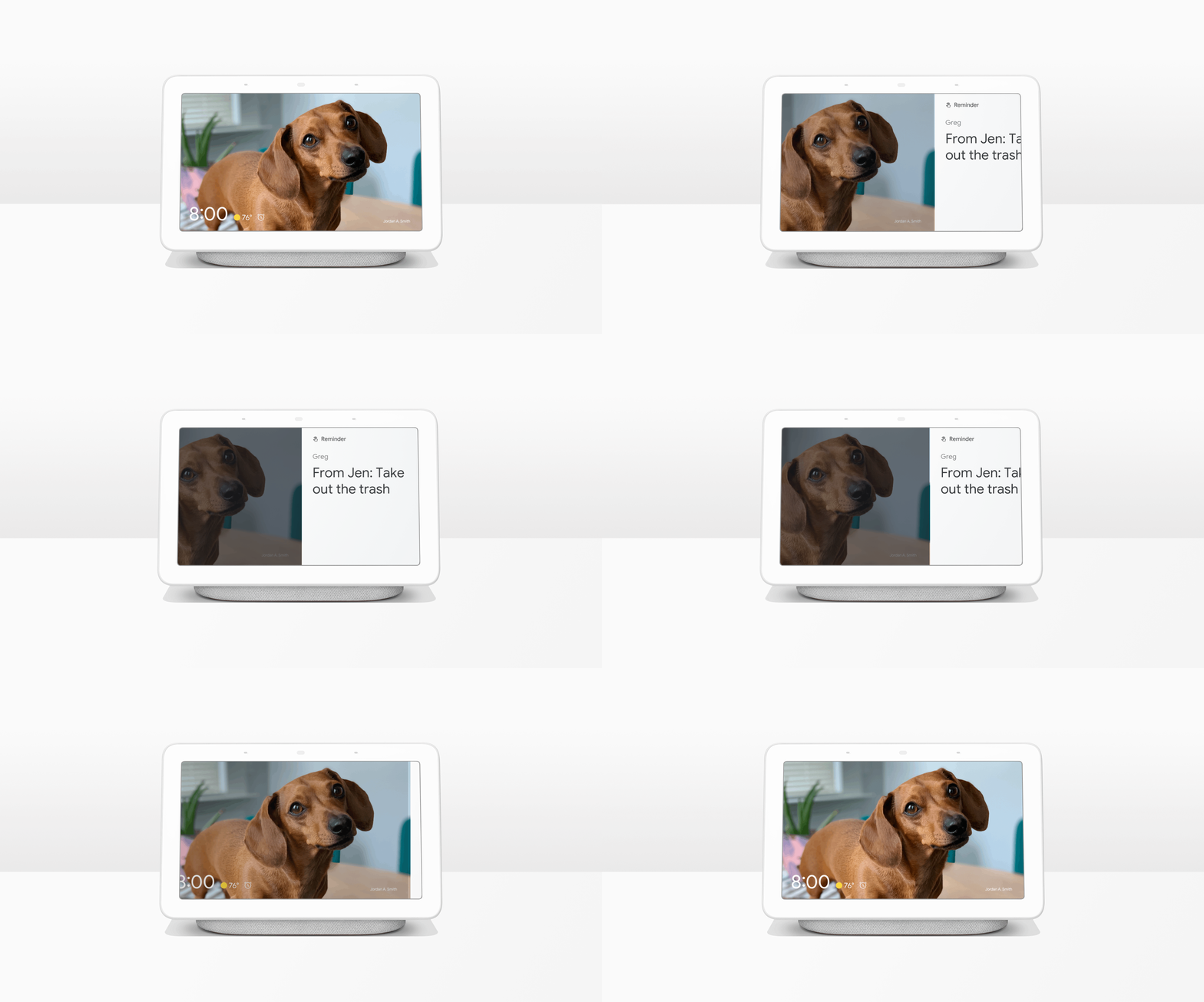
Do you sometimes have to nag your significant other to take out the trash on Monday night? Now, you can do so in a more passive-aggressive way by sending them a reminder through the Google Assistant instead of in person.

“Hey Google, remind Alex to take out the trash at 8pm,” is all it takes. Your family members (or roommates that you’ve added to your Google family group) will then get a notification on their phones and/or Assistant-powered Smart Displays.

“Assignable reminders on the Google Assistant help families and housemates better collaborate and stay organized while at home or on the go,” explains Google. “This means you can now create reminders for your partner or roommate to do things like pick up the groceries, pay a recurring bill, walk the dog—or send them a note of encouragement when they need it the most (‘Hey Google, remind Mary that she will do great on tomorrow’s exam.’)”

I’m pretty sure Mary would prefer a bit of human contact with that encouragement, but sometimes the Google Assistant is all you have.

AR Hub

Technically, for all of this to work, you need to have the person you are sending the reminder to in your contacts list and in your Google Family group. You also need to set up Voice Match for them for this to work on a smart display or speaker. Parents can set up accounts for children under 13 through Family Link.

This new feature will become available in English on phones, speakers and Smart Displays in the U.S., U.K. and Australia. Like with all Google reminders, you can set times and locations for your messages to pop up.

Mercifully, you can block people from sending you reminders, too, thanks to a new toggle in the Assistant Settings menu.

AR Mobile

15 Aug 2019

Spotify will reportedly test a price hike for its premium service in some markets

Spotify is set to test a price increase for its family plan, upping the cost by around 13 percent in some Scandinavian markets, Bloomberg reports. The price increase is designed as a limited test to figure out whether it might be able to roll out higher pricing for its service globally. The report notes that the higher prices might not be made permanent or roll out anywhere else, depending on the result of the limited test.

The music streaming company has good reason to give higher prices a shot: It’s consistently a money losing company, despite having the largest user base of any music streaming service around. That’s more important now that the company is a publicly listed entity, and as it seeks to move towards profitability as a result.

In video streaming, Netflix has managed to consistently increase prices and retain subscribers over the years as it shifted from seeking growth to driving more revenue. But Netflix’s offering is currently more or less unique in the market, and its costs to consumers still far undercut the alternative – a traditional cable or satellite TV subscription. Spotify is acting in a very different environment, with competitive services on offer with very similar value propositions from companies including Apple, Google and Amazon who all use these primarily as complements to other businesses, rather than as money-making enterprise in themselves.

15 Aug 2019

What security pros need to know from Black Hat & Def Con 2019

Black Hat and Def Con came and went as quickly as it ever does. The week-long pair of back-to-back conferences, referred to as “hacker summer camp,” draws in the security crowd from across the world onto Las Vegas, where startups tout their technologies as hackers and researchers reveal their findings.

This year we saw ordinary-looking charging cables that can hack your computer, we found out that cloud backups are easily exposed, robocall blocking apps aren’t as privacy-focused as you might think, and your corporate VPN and office printer are targets for hackers (and if they fail there they’ll just ship a hardware exploit to your mailroom.) Even students can easily hack their own school systems.

The obvious takeaways might be to never plug anything into your computer and that all your data is already ‘pwned’.

But what does that all mean to the average security professional, let alone the CISO at the top of the corporate chain? Between the villages and the many speaker tracks — not to mention the darting between hotels — it’s tough to know exactly what we should take away from the shows.

We spoke to four security experts who were there and asked them what their primary takeaways were for security decision-makers.

Internet of Things is a risk factor

15 Aug 2019

Flower delivery startup UrbanStems raises $12M to fund national expansion

UrbanStems is announcing that it has raised $12 million in Series B funding.

CEO Seth Goldman told me the startup has already been using the money to expand nationally. He explained that UrbanStems now has two delivery models — there are bike couriers who deliver plants and flowers within two hours in New York City and Washington, D.C. (where the company is headquartered), and then there’s a third-party shipping partner who offers next-day delivery to anywhere else in the United States.

The company started out with bike couriers, and Goldman said it’s not abandoning that strategy: “We will find areas where there’s enough demand to warrant jumping in, boots on the ground.”

At the same time, he said next-day shipping has allowed the company “grow a lot faster in the short term.” (Regardless of method, UrbanStems does not charge an extra delivery fee.)

Recent initiatives include a partnership with Vogue, with bouquets created by Vogue editors. In addition, the company has been expanding beyond flowers (where prices start at $35) and plants ($50) by offering curated gift boxes ($55). It sounds like Goldman has plans to do more in this area, too.

“The gifting market is far bigger than just the flower market,” he said. “We are providing more than a product … Gifting itself is a highly emotional, vulnerable experience. [You want to] make sure it gets there successfully, make sure it gets there on-time, make sure they love it, it’s packaged well, every little detail feels personal and special.”

The round was led by SWaN & Legend Venture Partners (who also led the startup’s $6.8 million Series A) and Motley Fool Ventures, with participation from Middleland Capital, NextGen Venture Partners and Sagamore Ventures.

“We are excited to continue to invest in the growth of UrbanStems,” said SWaN & Legend Managing Director David Strasser in a statement. “We continue to be impressed with the team led by Seth Goldman, as he builds on the strong foundation the cofounders laid out in building the pre-eminent gifting platform of the future.”

The funding came after a leadership change at the company, with Goldman (who joined as COO in 2017 after serving as CEO for HelloFresh USA) taking over the chief executive role from co-founder Ajay Kori in May of last year.

When asked about the transition, Goldman noted that Kori remains involved as chairman of the board, and he said, “We partnered a lot on this and kept our team from making it feel like it was a huge deal — which is a weird thing to say, even though it is a huge deal. But I was already managing more than half of the headcount of entire team across the company … so they knew what they were getting with me as a leader.”

15 Aug 2019

UPS takes minority stake in self-driving truck startup TuSimple

UPS said Thursday it has taken a minority stake in self-driving truck startup, TuSimple, just months after the two companies began testing the use of autonomous trucks in Arizona.

The size of minority investment, which was made by the company’s venture arm UPS Ventures, was not disclosed. The investment and the testing comes as UPS looks for new ways to remain competitive, cut costs and boost its bottom line.

TuSimple, which launched in 2015 and has operations in San Diego and Tucson, Arizona, believes it can deliver. The startup says it can cut average purchased transportation costs by 30%.

TuSimple, which is backed by Nvidia, ZP Capital and Sina Corp., is working on a “full-stack solution,” a wonky industry term that means developing and bringing together all of the technological pieces required for autonomous driving. TuSimple is developing a Level 4 system, a designation by the SAE that means the vehicle takes over all of the driving in certain conditions.

An important piece of TuSimple’s approach is its camera-centric perception solution. The system has a vision range of 1,000 meters, the company says.

The days of when highways will be filled with autonomous trucks are years away. But UPS believes it’s worth jumping in at an early stage to take advantage of some of the automated driving such as advanced braking technology that TuSimple can offer today.

“UPS is committed to developing and deploying technologies that enable us to operate our global logistics network more efficiently,” Scott Price, chief strategy officer at UPS said in a statement. “While fully autonomous, driverless vehicles still have development and regulatory work ahead, we are excited by the advances in braking and other technologies that companies like TuSimple are mastering. All of these technologies offer significant safety and other benefits that will be realized long before the full vision of autonomous vehicles is brought to fruition — and UPS will be there, as a leader implementing these new technologies in our fleet.”

UPS initially tapped TuSimple to help it better understand how Level 4 autonomous trucking might function within its network. That relationship expanded in May when the companies began using self-driving tractor trailers to carry freight on a freight route between Tucson and Phoenix to test if service and efficiency in the UPS network can be improved. This testing is ongoing. All of TuSimple’s self-driving trucks operating in the U.S. have a safety driver and an engineer in the cab.

TuSimple and UPS monitor all aspects of these trips, including safety data, transport time and the distance and time the trucks travel autonomously, the companies said Thursday.

UPS isn’t the only company that TuSimple is hauling freight for as part of its testing. TuSimple has said its hauling loads for for several customers in Arizona.  The startup has a post-money valuation of $1.095 billion (aka unicorn status).

15 Aug 2019

Instagram says growth hackers are behind spate of fake Stories views

If you use Instagram and have noticed a bunch of strangers watching your Stories in recent months — accounts that don’t follow you and seem to be Russian — well, you’re not alone.

Nor are you being primed for a Russian disinformation campaign. At least, probably not. But you’re right to smell a fake.

TechCrunch’s very own director of events, Leslie Hitchcock, flagged the issue to us — complaining of “eerie” views on her Instagram Stories in the last couple of months from random Russian accounts, some seemingly genuine (such as artists with several thousand followers) and others simply “weird” looking.

A thread on Reddit also poses the existential question: “Why do Russian Models (that don’t follow me) keep watching my Instagram stories?” (The answer to which is: Not for the reason you hope.)

Instagram told us it is aware of the issue and is working on a fix.

It also said this inauthentic activity is not related to misinformation campaigns but is rather a new growth hacking tactic — which involves accounts paying third parties to try to boost their profile via the medium of fake likes, followers and comments (in this case by generating inauthentic activity by watching the Instagram Stories of people they have no real interest in in the hopes that’ll help them pass off as real and net them more followers).

Eerie is spot on. Some of these growth hackers probably have banks of phones set up where Instagram Stories are ‘watched’ without being watched. (Which obviously isn’t going to please any advertisers paying to inject ads into Stories… )

A UK social media agency called Hydrogen also noticed the issue back in June — blogging then that: “Mass viewing of Instagram Stories is the new buying followers of 2019”, i.e. as a consequence of the Facebook-owned social network cracking down on bots and paid-for followers on the platform.

So, tl;dr, squashing fakes is a perpetual game of whack-a-mole. Let’s call it Zuckerberg’s bane.

“Our research has found that several small social media agencies are using this as a technique to seem like they are interacting with the public,” Hydrogen also wrote, before going on to offer sage advice that: “This is not a good way to build a community, and we believe that Instagram will begin cracking down on this soon.”

Instagram confirmed to us it is attempting to crack down — saying it’s working to try to get rid of this latest eyeball-faking flavor of inauthentic activity. (We paraphrase.)

It also said that, in the coming months, it will introduce new measures to reduce such activity — specifically from Stories — but without saying exactly what these will be.

We also asked about the Russian element but Instagram was unable to provide any intelligence on why a big proportion of the fake Stories views seem to be coming from Russia (without any love). So that remains a bit of a mystery.

What can you do right now to prevent your Instagram Stories from being repurposed as a virtue-less signalling machine for sucking up naive eyeballs?

Switching your profile to private is the only way to thwart the growth hackers, for now.

Albeit, that means you’re limiting who you can reach on the Instagram platform as well as who can reach you.

When we suggested to Hitchcock she switch her account to private she responded with a shrug, saying: “I like to engage with brands.”

15 Aug 2019

Amazon launches a new program to donate unsold products from third-party sellers to charity

Amazon will make it easier and more affordable for its third-party sellers to donate of their unwanted excess inventory and returns, rather than having the items sent back or destroyed. The company on Wednesday announced the launch of a new program, Fulfillment by Amazon (FBA) Donations, which will distribute excess and returned products to charitable organizations.

CNBC first reported the news, which was also confirmed by Amazon through a brief post on its corporate blog.

The program’s launch follows a series of news reports earlier this year, which found that Amazon warehouses routinely trashed millions of unsold items. One smaller facility in France was even found to have sent 293,000 items to a local dump during a 9-month period. A French TV documentary also claimed that Amazon destroyed over 3 million products last year.

The documentary had secretly filmed Amazon workers loading up brand-new toys, kitchen equipment, and flat-screen TVs for transport to the dump, a report said.

While it’s an unfortunately common retail practice to destroy excess or unwanted inventory or returned items — particularly in luxury apparel — at Amazon’s scale, the issue is compounded. In addition, the items being destroyed could make a real impact on people’s lives.

Amazon says it will begin donating products from sellers starting in September in the U.S. and U.K. with the help of charity partners. In the U.S., it’s working with Good360, an organization that partners with retailers and consumer goods companies to source and distribute highly needed products through a network of diverse nonprofits. In the U.K., Amazon is working with NewlifeSalvation Army, and Barnardo’s.

Sellers told CNBC the new program makes it cheaper to donate than to dispose or ask for items to be returned, where Amazon charges 50 cents and 15 cents, respectively. The program will also be the new default for sellers, though they can choose to opt-out, if desired.

“We know getting products into the hands of those who need them transforms lives and strengthens local communities,” said Alice Shobe, Director, Amazon in the Community, in a statement about the program’s launch. “We are delighted to extend this program to sellers who use our fulfillment services.”

The company also told CNBC that it’s working to bring the number of destroyed items to zero, and said the “vast majority” of returns were resold to other customers, liquidators, returned to suppliers, or donated to charities, depending on their condition.

15 Aug 2019

Kitty Hawk’s Flyer personal VTOL has now flown over 25,000 times

Flying cars, or at least their functional equivalent, edge closer to reality every day – and startup Kitty Hawk wants you to know it’s putting in the flying time to make it happen. The company, led by former Google self-driving car visionary Sebastian Thrun, has now flown its first aircraft, the one-person Flyer, over 25,000 times. That includes both its excursions as a prototype that resembled a flying motorcycle or ATV, and in its current, more refined, mostly enclosed cockpit design.

Flyer is now one of two aircraft that Kitty Hawk is working on bringing to market, alongside its Cora two-person, autonomous taxi built in collaboration with Boeing. Flyer is a one-person, human piloted aircraft designed primarily for recreational use, and Kitty Hawk has said it’s refined the vehicle to the point where someone with no experience can learn to fly it in 15 minutes. The company is currently looking for applications for potential partners who want to deploy it in their communities, and it does seem like the type of thing that might do well as an organized excursion activity at a travel destination or resort.

There’s no info on pricing or actual availability yet, but there was a limited Founder Series pre-order for individual purchasers with deep pockets. The aircraft features pontoons and is designed for use over water, and it can fly between three and 10 ft above the surface with vertical take-off and landing capabilities.

Personally, I’d probably opt for the flying jet-ski over paragliding if it was on offer at a vacation spot, so here’s hoping this actually finds a path to commercialization somewhat soon.

15 Aug 2019

Birth control delivery startup Nurx approaches $300M valuation

Nurx, citing 200,000 current patients and a monthly growth rate as high as 20%, has raised $32 million in Series C equity funding in a round co-led by existing investors Kleiner Perkins and Union Square Ventures. The company has also secured $20 million in debt, bringing total new capital to $52 million.

The San Francisco-based digital health startup, which seeks to make birth control more accessible and affordable by shipping it direct to consumer, has raised more than $90 million in debt and equity funding to date, with the latest infusion bringing its valuation to nearly $300 million, according to stock authorization filings uncovered by PitchBook. Nurx declined to comment on its valuation.

The goal, Nurx chief executive officer Varsha Rao explains, is to become a telehealth platform focused on all sensitive health needs.

“We see there is a need to help people that may have issues that often carry stigma and judgment by providing a streamlined platform,” Rao tells TechCrunch. “What the company is doing in terms of providing more accessibility form a physical and economic perspective to critical health services is very inspiring for me.”

The fresh bout of funding comes four months after a scathing New York Times report highlighted irresponsible practices at the company, including reshipping returned medications and attempting to revise medical policy on birth control for women over the age of 35.

Nurx’s Rao, who joined from Clover Health just one week before the article was published, says she feels good about how the company has scaled: “I want to make it clear, patient safety was never at risk even then; having said that, we are super committed to always investing in compliance and patient safety and all of the things that are important.”

The business plans to use the funding to double its engineering team and launch additional “sensitive” healthcare services of which Rao declined to further outline. In addition to shipping birth control D2C, including the pill, shot, ring and patch, Nurx provides emergency contraception, STI and HPV testing and screening kits, and PrEP medication, the once-daily pill that reduces the risk of getting HIV.

The company added STI testing kits to its line up last month and has since performed tests for 1,000 patients, Nurx says.

Nurx’s service is currently live in 26 states and Washington, D.C. The company plans to be accessible to 90% of the U.S. population by the end of the year, with additional launches, including the state of Nebraska, expected this month.

A graduate of Y Combinator, Nurx investors also include Reproductive Health Investors Alliance, Dreamers VC, Lowercase Capital and debt & equity provider Triple Point Capital.