Year: 2019

14 Aug 2019

Peer-to-peer boat rental marketplace Boatsetter raises $10M as it looks to grow globally

Obviously, not everyone owns their boat, and boat ownership is far more unique than car ownership – which makes it maybe an ideal category for peer-to-peer marketplace rentals. P2P boat rental startup Boatsetter recognized this opportunity, and is now announcing a $10 million Series A “extension” funding round to help it grow its business, with investment led by WestCap Group and Valor Equity.

Boatsetter counts itself the top peer-to-peer boat rental marketplace in the U.S., and offers insurance to boat renters, owners and captains alike through a just-announced strategic partnership with Geico. The Miami-based startup estimates he size of the peer-to-peer boat rental market at as much as $50 billion annually, and plans to use its investment to expand its offering, both from a product perspective and expanding its presence in key markets globally.

To date, Boatsetter has raised $31 million, including earlier portions of this Series A raised over the past two years. The company focuses on rentals for anywhere from two to more than a dozen passengers, and a range of boat options that can also include qualified captains for larger vessels. It’s a bit like an Airbnb crossed with an Uber, and there are rentals available in vacation hotspots around the world. AS part of this new funding, Boatsetter is also adding a new board member – Laurence Tosi, the former CFO of Blackstone and Airbnb, who is also a founder and partner at new investor WestCap.

The funding will help the startup invest in bringing in new talent focused on design, engineering and brand building, in addition to product work and market expansion.

14 Aug 2019

Self-driving truck startup Starsky launches Hutch, its API and nerve center

Starsky Robotics has been building its self-driving — and human-driven — truck business for three years now. And it’s finally ready to show off its first product.

It’s not, as one might presume, a self-driving truck. This product, called Hutch, offers what in Starsky’s view is far more valuable: automatic access to its trucking capacity, no phone calls or paper logs necessary.

The trucking industry is a giant and fragmented system of shippers, freight carriers, brokers and, of course, drivers. This system is almost always out of whack with more demand for capacity (and, in turn drivers) than is available.

Traditionally, large shippers partner with freight brokers like CH Robinson to manage capacity. Startups including Convoy, Loadsmart, Transfix and Uber Freight are aiming to disrupt the freight brokerage part of the trucking world by developing apps that match truckers with shippers.

Meanwhile, traditional trucking companies like Schneider have set up their own brokerages because — again — sales typically outpace capacity.

Starsky believes it can solve the capacity problem with its self-driving trucks. But instead of selling its self-driving trucks to trucking companies like Schneider or locking in contracts with major shippers, Starsky built the Hutch API to put its capacity out into the market.

Hutch is an API that gives freight brokers and major shippers access to Starsky’s trucking capacity without what co-founder and CEO Stefan Seltz-Axmacher describes as “back office intervention.” The API allows partner brokers and select shippers to integrate directly with Starsky’s operations. Using the Hutch API, a broker can bid for space in Starsky’s autonomous and human-driven trucks without calling the company.
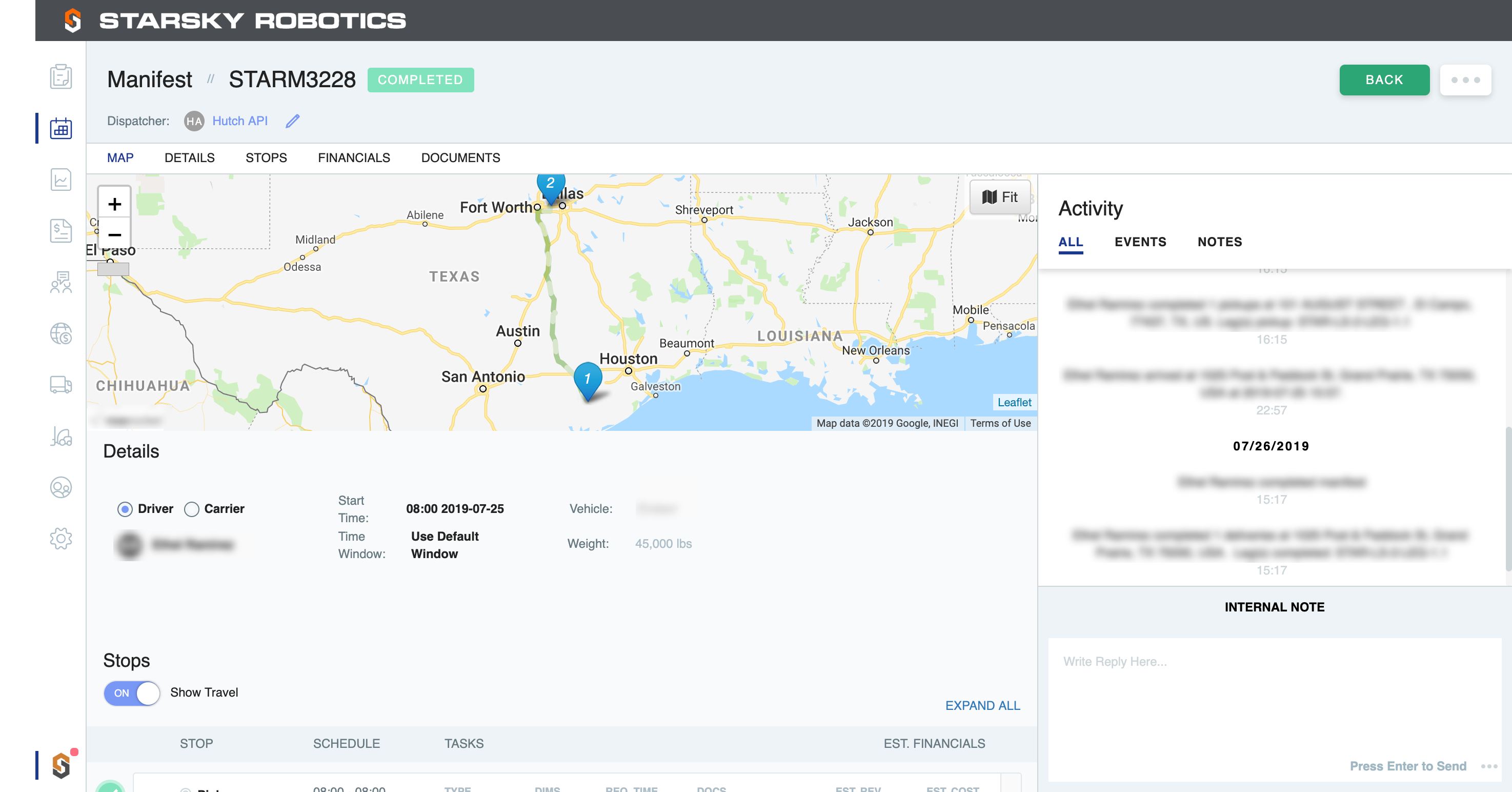
starsky autodispatch

“It’s simple, we are selling the capacity of our self-driving truck,” Seltz-Axmacher said, admitting that in most industries, an API like Hutch would be ubiquitous.

“If this was an API to find the nearest scooter, we wouldn’t be talking because I think 25 of those exist,” Seltz-Axmacher said. “In trucking, it’s been surprising to us how manual the industry is — all the technology that you would assume exists, doesn’t.”

Today, Starsky’s trucks, most of which are driven by humans, haul 40 loads a day. Starsky hauls most of that freight through brokers Schneider Logistics and CM Hamilton. The company wants the majority of its loads to be brokered through the API, and eventually have no loads that don’t go through Hutch.

Hutch is essential to Starsky’s growth as a company, Seltz-Axmacher contends. With Hutch, Starsky employees can focus on building a robot that can safely drive, and in turn, bring some relief to the capacity-constrained trucking market.

“I don’t want to sell that capacity with a whole bunch of phone calls to brokers, long negotiations and yada, yada, yada,” Seltz-Axmacher told TechCrunch. “I want to make that available to brokers via an API, where it’s all programmatic.”

More importantly, it gives Starsky control over where it hauls freight. Starsky has been operating a traditional trucking business that employs human drivers to haul loads for customers. It also has several autonomous trucks that are driven and supported by a handful of test drivers.

Starsky can limit the API to only the safest, easiest and legal routes for its self-driving trucks. That means Starsky will miss out on hundreds, even thousands, of routes across the country.

Even with those limitations, Starsky sees ample opportunity. “We believe that there is a $50-billion-plus freight market on routes that appear easy for our current system to drive in states where it is legal,” Seltz-Axmacher said. For now, that means routes in Alabama, Florida, Louisiana and Texas.

Hutch is already in action. The Hutch API integrated with Loadsmart’s Automated Dispatch API to dispatch an autonomous truck just a few weeks ago. The Hutch API is also used internally to more productively test its fleet of autonomous trucks.


14 Aug 2019

Corporate carpooling startup Scoop raises $60 million

Enterprise carpooling startup Scoop just closed a $60 million round led by Activate Capital with participation from Goldman Sachs, NGP Capital, Total Group, BNP Capital and others.to fuel its expansion and growth. This round brings Scoop’s total funding to $106 million.

Scoop, which launched back in 2015, is a corporate carpooling service that works with the likes of LinkedIn, Workday, T-Mobile and more than 50 other companies to help their employees get to and from work.

With Scoop, trips are pre-scheduled, so you can select from one or more times you’d be willing to leave in the morning and afternoon, and have up until 9pm the night before for morning trips and 3:30pm the day of for afternoon trips to schedule your ride. After the deadline, Scoop’s algorithms work to automatically create the most efficient carpools based on routes, detours, company preference, favorites and more.

Currently, Scoop operates in more than 2,000 cities across six major metro areas, including the San Francisco Bay Area, Seattle, Portland, Reno and Los Angeles. To date, Scoop has facilitated 7 million carpool trips.

Scoop is not the only, nor the first company to do carpooling. Lyft, for example, began as a carpooling service called Zimride, which is now owned by Enterprise. There’s also Carma, which partners with federal and state transportation agencies.

Late last year, Scoop partnered with Lyft to supplement its offerings to its customers. That partnership has continued into the present day.

“By partnering together, Scoop and Lyft are ensuring that commuters not only gain a stronger sense of community by carpooling to work with co-workers and neighbors, but that they also feel supported in the event of last-second schedule changes and know they have guaranteed transportation home,” Scoop co-founder and CEO Rob Sadow said in a statement to TechCrunch. “With this program, carpoolers are able to request a Lyft or view public transit options through the Scoop app.”

14 Aug 2019

Procore brings 3D construction models to iOS

Today, Procore, a construction software company, announced Procore BIM (Building Information Modeling), a new tool that takes advantage of Apple hardware advances to bring the 3D construction model to iOS.

Dave McCool, senior product manager at Procore, says that architects and engineers have been working with 3D models of complex buildings for years on desktop computers and laptops, but these models never made it into the hands of the tradespeople actually working on the building. This forced them to make trips to the job site office to see the big picture whenever they ran into issues, a process that was inefficient and costly.

What Procore has done is created a 3D model that corresponds to a virtual version of the 2D floor plan and runs on an iOS device. Touching a space on the floor plan, opens a corresponding spot in the 3D model. What’s more, Procore has created a video game-like experience, so that contractors can use a virtual joystick to move around a 3D representation of the building, or they can use gestures to move around the rendering.

black iphone in landscape position held by a construction worker with a yellow hat a12584

Procore BIM running on an iPhone. Photo: Procore

The app has been designed so that it can run on an iPhone 7, but for optimal performance, Procore recommends using an iPad Pro. The software takes advantage of Apple Metal, which gives developers “near direct” access to the GPU running on these devices. This ability to tap into GPU power, speeds up performance and allows this level of sophisticated rendering quickly on iOS devices.

McCool says that this enables trades people to find the particular area on the drawing where their part of the project needs to go much more easily and intuitively, whether it’s wiring, ductwork or plumbing. As he pointed out, it can get crowded in the space above a ceiling or inside a utility  room, and the various trades teams need to work together to make sure they are putting their parts in the correct spot. Working with this tool helps make that placement crystal clear.

It’s essentially been designed to gamify the experience in order to help tradespeople who aren’t necessarily technically savvy to operate the tool themselves and find their way around a drawing in 3D, while reducing the number of trips to the office to have a discussion with the architects or engineers to resolve issues.

This is the latest tool from a company that has been producing construction software since 2002. As a company spokesperson said, early on the company founder had to wire routers on the site to allow workers to use the earliest versions. Today, it offers a range of construction software to track financials, project, labor and safety management information.

Procore BIM will be available starting next month.

14 Aug 2019

A new app can detect Bluetooth credit card skimmers on gas pumps

A team of computer scientists has built a new app that can wirelessly detect credit card skimmers, often found discreetly placed on gas pumps and bank ATMs.

Gone are the days where entire card skimmers would take over the front facade of an entire cash machine. Credit card skimmers are tiny, almost invisible — and many contain Bluetooth wireless capabilities, meaning skimming operators can install their credit card data-stealing skimmers just once and never have to take apart a gas pump again. Instead, criminals can just pull up in their car and wirelessly download the stolen card data.

Skimmers are also often connected to the magnetic stripe reader or the keypad, not only to steal your credit card number but also your PIN and ZIP codes.

This new app, dubbed Bluetana, developed by researchers at the University of California, San Diego and the University of Illinois Urbana-Champaign, can detect Bluetooth-enabled skimmers without having to dismantle vulnerable gas pumps.

By detecting Bluetooth signatures, the app aims to find more skimmers without flagging false positives, like speed-limit signs and fleet tracking systems, said Nishant Bhaskar, a PhD student and one of the researchers. Many skimmers use the same components, which when detected can indicate the presence of a skimmer. The prefix of the Bluetooth device’s unique MAC address is then compared to a hit list of prefixes known to be used by skimmers recovered by law enforcement. The app also uses signal strength is a “reliable way” to determine if a Bluetooth skimmer device is located near a gas pump.

The app was developed after field testers obtained scans of 1,185 Bluetooth gas pump skimmers in six U.S. states.

It’s a new technique aimed at improving on existing efforts designed to detect these tiny, inconspicuously installed skimming devices. Bluetooth skimmers are popular among scammers and fraudsters, not least because they offer a high return on investment. A single device can cost $20 to develop and can be used to steal thousands of dollars in a single data, depending on where the skimmer is located.

So far, the Bluetana app has detected 64 Bluetooth-based skimmers that had evaded other, existing scans, according to the researchers, and cuts down detection time to just a few seconds rather than minutes.

But don’t expect the app to come to consumers any time soon. The app is currently in use by U.S. law enforcement. Currently the app is in use in several U.S. states, the researchers said.

14 Aug 2019

Oru’s new foldable kayak weighs under 20 lbs and assembles in just 2 minutes

California-based kayak maker Oru has built a great brand on the strength of its origami-inspired folding kayaks, and now it’s launching its lightest and most portable model yet with a new Kickstarter project. The Oru Inlet miraculously packs up to the size of a suitcase, weights less than 20 lbs, and can unfold and be on the water in as little as two minutes.

Even if you’re trying it for the first time, or just aren’t particularly handy, the kayak still sets up in 5 minutes, at most, according to Oru – which, speaking from personal experience, is a lot faster than its other models. Which isn’t to say that those aren’t also impressive, since they still allow you to carry around what amounts to luggage and have a durable, fun watercraft in around 10 minutes. But the Inlet takes this concept to a whole new level, and looks like the ideal casual kayak for dipping out for a quick paddle in and around the city.

243ee7c707b6a6115a6fb8dd838ce3ba originalThe kayak itself is 10 feet long, which is definitely on the shorter side, but a very common size for recreational boats. It features a wide, open cockpit design with an integrated floorboard, an adjustable footrest and backrest, and bulkheads to keep the ship sturdier on the water. Like all the Oru boats, it’s built of a corrugated plastic that’s incredibly durable (my own Oru kayak has easily withstood the rigors of multiple years of use) and yeah super lightweight.

6fa465f2f9aed2949d5e0baac5cd907c originalWhen packed up, the Inlet is still only 19-inches tall, 42-inches long and 10-inches wide. That makes it around the size of a rather long duffle, but it’s still plenty small enough to tuck into the trunk of a car, or hide away in a condo closet or storage locker. Assembly is a three-step process, and there are no tools required, so it really is optimized for the minimalist city adventurer. Oru’s 4-piece portable paddle can also pack inside the folded Inlet for super easy transportation.

f6dd22b65f1fdc80e17c83d5026d203b originalOverall, the Inlet looks like it has all the ingredients that have made Oru successful as a startup and indie boat maker thus far, with plenty of added convenience features that make it even better suited to weekend warriors and people who just want to be able to explore the waterways that surround them without a lot of fuss and preparation.

The crowdfunding campaign has already passed its goal, and Oru has proven itself able to deliver consistently, so you can be confident that it will ship these boats. It’s currently listing a May 2020 timeframe fro delivery, and $749 is the entry-level price for backers to pick up an Inlet, with varying levels for adding accessories or more kayaks.

14 Aug 2019

Business management startup vCita acquires email marketing tool WiseStamp

Just a couple of months after disclosing a $15 million round of funding, vCita, the business management SaaS for SMEs, has made an acquisition: It’s acquiring WiseStamp, a veteran of the Israeli startup scene that launched its email marketing tool a decade ago.

Unsurprisingly, terms of the deal remain undisclosed. However, I understand that vCita has acquired WiseStamp as a company, including all assets, employees, customer base, technology and other IP. In addition, WiseStamp’s two remaining founders will join vCita along with the rest of the 20 person team.

WiseStamp hadn’t taken much capital in its relatively long history, having raised around $400,000 from angel investors.

Founded in 2009 by Orly Izhaki, Tom Piamenta, Tzvika Avnery and Sasha Gimelshtein, WiseStamp offers a email signature solution for self-employed professionals. The company claims over 50,000 paying customers, who it says use the platform to increase social media engagement, expand business reach, and generate more sales.

Meanwhile, the much younger vCita says it has over 100,000 paying users worldwide who use its SaaS to manage their schedule, track invoices, collect payments, and organize client data via the vCita app.

““We’re thrilled to have WiseStamp join our team. Both companies share the same vision: Empowering small business owners to deliver their services at a level comparable to that of a large company, at a fraction of the cost,” says says vCita co-founder and CEO Itzik Levy in a statement.

Adds Orly Izhaki, WiseStamp’s CEO and co-founder: “Over the years, WiseStamp created advanced solutions that enable hundreds of thousands of small enterprises to grow their business online. We are excited about the merger, which will establish us as one of the most dominant players in the SMB market”.

14 Aug 2019

WeWork reveals IPO filing

WeWork, now known as The We Company, released its IPO prospectus Wednesday morning months after filing confidentially to go public.

Backed by billions by SoftBank and its monstrous Vision Fund, the exit is expected as soon as next month.

This story is updating


14 Aug 2019

Apply to Startup Battlefield at Disrupt Berlin 2019

Audacious. Bold. Innovative. If those adjectives describe your early-stage startup, if you’re champing at the bit to launch your company to the world — we want you! Apply to compete in Startup Battlefield at Disrupt Berlin 2019.

Our premier pitch competition takes place on 11-12 December, and a select cohort of startups will compete for bragging rights, the Disrupt Cup and a $50,000 equity-free prize. And they’ll all bask in a bright spotlight of attention from influential global investors and worldwide media outlets. Apply to Startup Battlefield today.

You have nothing to lose — applying and participating in Startup Battlefield is free, and TechCrunch does not charge any fees or take any equity. Since 2007, more than 857 companies have launched at Startup Battlefield to great success. Collectively they’ve raised more than $8.9 billion in funding, with 112 successful exits (IPOs or acquisitions). If you’re selected, you’ll join the ranks of this alumni community that includes Dropbox, GetAround, SirenCare, Fitbit, Mint.com, Vurb and more.

Here’s how it all works. Early-stage startups from any country — and any tech category — can apply as long as they have a minimally viable product to demo. TechCrunch editors with years of Battlefield experience and a keen eye for potential success will vet the applications and choose 15-20 startups.

Now the work begins. TechCrunch provides free pitch coaching to the participants. It’s rigorous and thorough, so you’ll be ready to present your best possible pitch and demo. Each team has six minutes to pitch to a world-class panel of judges — followed by a six-minute Q&A session.

If you make it through to the final round, it’s lather, rinse and repeat that experience in front of a fresh set of judges. The judges confer and declare one outstanding startup the Battlefield champion — winner of a $50,000 bottom-line boost.

It’s a wild ride that takes place in front of thousands of eager investors, journalists and startup fans. TechCrunch also live-streams the entire Battlefield to a global audience of millions. Win or lose, that kind of exposure benefits all the participants, and it can change a startup’s trajectory in the best way possible.

Participating in the Battlefield carries a lot of perks beyond the actual competition. We’re talking free exhibition space in Startup Alley for both days of Disrupt, invitations to private events, backstage access, CrunchMatch — our free business-matching platform — free subscriptions to Extra Crunch and a ticket to all future TechCrunch events. That’s some major value right there.

With nothing to lose and so much to gain, it’s the perfect time for every audacious, bold and innovative early-stage startup founder to take their shot. Stop champing at the bit and apply to Startup Battlefield today. We want to see you in Berlin!

If you’re not ready to compete in the Battlefield, why not apply for our TC Top Picks program? If you make the cut, you’ll receive a free Startup Alley Exhibitor Package along with VIP treatment and plenty of media and investor exposure.

Is your company interested in sponsoring or exhibiting at Disrupt Berlin 2019? Contact our sponsorship sales team by filling out this form.

14 Aug 2019

Facebook’s human-AI blend for audio transcription is now facing privacy scrutiny in Europe

Facebook’s lead privacy regulator in Europe is now asking the company for detailed information about the operation of a voice-to-text feature in Facebook’s Messenger app and how it complies with EU law.

Yesterday Bloomberg reported that Facebook uses human contractors to transcribe app users’ audio messages — yet its privacy policy makes no clear mention of the fact that actual people might listen to your recordings.

A page on Facebook’s help center also includes a “note” saying “Voice to Text uses machine learning” — but does not say the feature is also powered by people working for Facebook listening in.

A spokesperson for Irish Data Protection Commission told us: “Further to our ongoing engagement with Google, Apple and Microsoft in relation to the processing of personal data in the context of the manual transcription of audio recordings, we are now seeking detailed information from Facebook on the processing in question and how Facebook believes that such processing of data is compliant with their GDPR obligations.”

Bloomberg’s report follows similar revelations about AI assistant technologies offered by other tech giants, including Apple, Amazon, Google and Microsoft — which have also attracted attention from European privacy regulators in recent weeks.

What this tells us is that the hype around AI voice assistants is still glossing over a far less high tech backend. Even as lashings of machine learning marketing guff have been used to cloak the ‘mechanical turk’ components (i.e. humans) required for the tech to live up to the claims.

This is a very old story indeed. To wit: A full decade ago, a UK startup called Spinvox, which had claimed to have advanced voice recognition technology for converting voicemails to text messages, was reported to be leaning very heavily on call centers in South Africa and the Philippines… staffed by, yep, actual humans.

Returning to present day ‘cutting-edge’ tech, following Bloomberg’s report Facebook said it suspended human transcriptions earlier this month — joining Apple and Google in halting manual reviews of audio snippets for their respective voice AIs. (Amazon has since added an opt out to the Alexa app’s settings.)

We asked Facebook where in the Messenger app it had been informing users that human contractors might be used to transcribe their voice chats/audio messages; and how it collected Messenger users’ consent to this form of data processing — prior to suspending human reviews.

The company did not respond to our questions. Instead a spokesperson provided us with the following statement: “Much like Apple and Google, we paused human review of audio more than a week ago.”

Facebook also described the audio snippets that it sent to contractors as masked and de-identified; said they were only collected when users had opted in to transcription on Messenger; and were only used for improving the transcription performance of the AI.

It also reiterated a long-standing rebuttal by the company to user concerns about general eavesdropping by Facebook, saying it never listens to people’s microphones without device permission nor without explicit activation by users.

How Facebook gathers permission to process data is a key question, though.

The company has recently, for example, used a manipulative consent flow in order to nudge users in Europe to switch on facial recognition technology — rolling back its previous stance, adopted in response to earlier regulatory intervention, of switching the tech off across the bloc.

So a lot rests on how exactly Facebook has described the data processing at any point it is asking users to consent to their voice messages being reviewed by humans (assuming it’s relying on consent as its legal basis for processing this data).

Bundling consent into general T&Cs for using the product is also unlikely to be compliant under EU privacy law, given that the bloc’s General Data Protection Regulation requires consent to be purpose limited, as well as fully informed and freely given.

If Facebook is relying on legitimate interests to process Messenger users’ audio snippets in order to enhance its AI’s performance it would need to balance its own interests against any risk to people’s privacy.

Voice AIs are especially problematic in this respect because audio recordings may capture the personal data of non-users too — given that people in the vicinity of a device (or indeed a person on the other end of the phone line who’s leaving you a message) could have their personal data captured without ever having had the chance to consent to Facebook contractors getting to hear it.

Leaks of Google Assistant snippets to the Belgian press recently highlighted both the sensitive nature of recordings and the risk of reidentification posed by such recordings — with journalists able to identify some of the people in the recordings.

Multiple press reports have also suggested contractors employed by tech giants are routinely overhearing intimate details captured via a range of products that include the ability to record audio and stream this personal data to the cloud for processing.