
Year: 2019

14 Aug 2019

TestCard founder: Attending Disrupt Berlin is a ‘no-brainer’

We love Berlin’s electric, evolving, early-startup ecosystem. Let’s be perfectly blunt: Whether you’re a startup founder, investor, hacker or tech leader, you can’t afford to miss Disrupt Berlin 2019, which takes place on 11-12 December. Get your super early-bird passes here.

TechCrunch honors its Silicon Valley roots, and we pack that ethic in our carry-on bags to Berlin. Disrupt showcases the very best of now and future tech, and startups from more than 50 countries come to Berlin to learn, share insights and build the kind of relationships that transform businesses.

The two-day conference offers measurable benefits, and that’s not just our (totally biased) opinion. Your startup peers tell us they come away with long-term benefits. Here’s what Luke Heron, CEO of TestCard Diagnostics, said about his Disrupt Berlin experience.

Based in the United Kingdom and founded in 2017 by Heron and Dr. Andrew Botham, TestCard, an at-home urine test company, combines smartphone technology and traditional mail to deliver a medical test experience in the privacy of the home.

The company embeds a urine test kit into a postcard and mails it out in a security envelope. The recipient takes the test, uses TestCard’s mobile app and the camera on their smartphone — as a clinical-grade scanner — to immediately determine the results.

TestCard exhibited in Startup Alley at Disrupt SF ’17 and again at Disrupt Berlin ’18 — as one of the select TC Top Pick startups. More on that in a minute. In San Francisco, Heron set a goal to make connections and gain exposure for the company.

“We got fantastic coverage in Engadget,” said Heron. “Cash at the beginning of the startup journey is difficult to come by, and an article from a credible organization can help push things in the right direction.”

In addition to generating media interest, Heron sought access to capital. He scheduled seven meetings with VCs using CrunchMatch. The free business-matchmaking platform makes it easy for startup founders and investors to connect and schedule meetings at Disrupt based on shared goals and criteria.

The company’s success in San Francisco made the decision to attend Disrupt Berlin 2018 a simple one. This time, Heron submitted TestCard for consideration as a TC Top Pick. It’s a competitive program where TechCrunch editors select up to five outstanding startups to represent a range of tech categories like AI, Fintech and, in Heron’s case, Healthtech & Biotech.

TestCard earned a Top Pick designation and received a free Startup Alley Exhibitor Package and plenty of VIP treatment at Disrupt Berlin — including an interview with a TechCrunch editor on the Showcase stage.

“TechCrunch uses a curation process regarding the companies it accepts,” he said. “So being a Top Pick at Disrupt — among all these other fantastic startups — has a hugely positive impact when you’re fundraising.”

How big an impact? The company recently closed on $1.7 million in funding, and Heron credits the TechCrunch Disrupt experience for making it possible.

“If you’re a startup founder or an entrepreneur,” said Heron, “attending Disrupt is a no-brainer.”

Disrupt Berlin 2019 takes place on 11-12 December. Come to Berlin, make some startup magic and keep your business moving in the right direction. Buy your super early-bird pass today.

Is your company interested in sponsoring or exhibiting at Disrupt Berlin 2019? Contact our sponsorship sales team by filling out this form.

14 Aug 2019

Nigerian logistics startup Kobo360 raises $30M backed by Goldman Sachs

Nigerian freight logistics startup Kobo360 has raised a $20 million Series A round led by Goldman Sachs and $10 million in working capital financing from Nigerian commercial banks.

The company — with an Uber -like app that connects truckers and companies to delivery services — will use the funds to upgrade its platform and expand to 10 new countries beyond current operating markets of Nigeria, Togo, Ghana and Kenya.

Since its launch in Lagos in 2017, Kobo360 has continued to grow its product offerings, VC backing and  customer base. The startup claims a fleet of more than 10,000 drivers and trucks operating on its app. Top clients include Honeywell, Olam, Unilever, Dangote and DHL.

In addition to customer focus, founders Ife Oyodelo and Obi Azor have prioritized serving the startup’s drivers. They offer the company’s app in languages common to drivers, such as Hausa and Pidgin. 

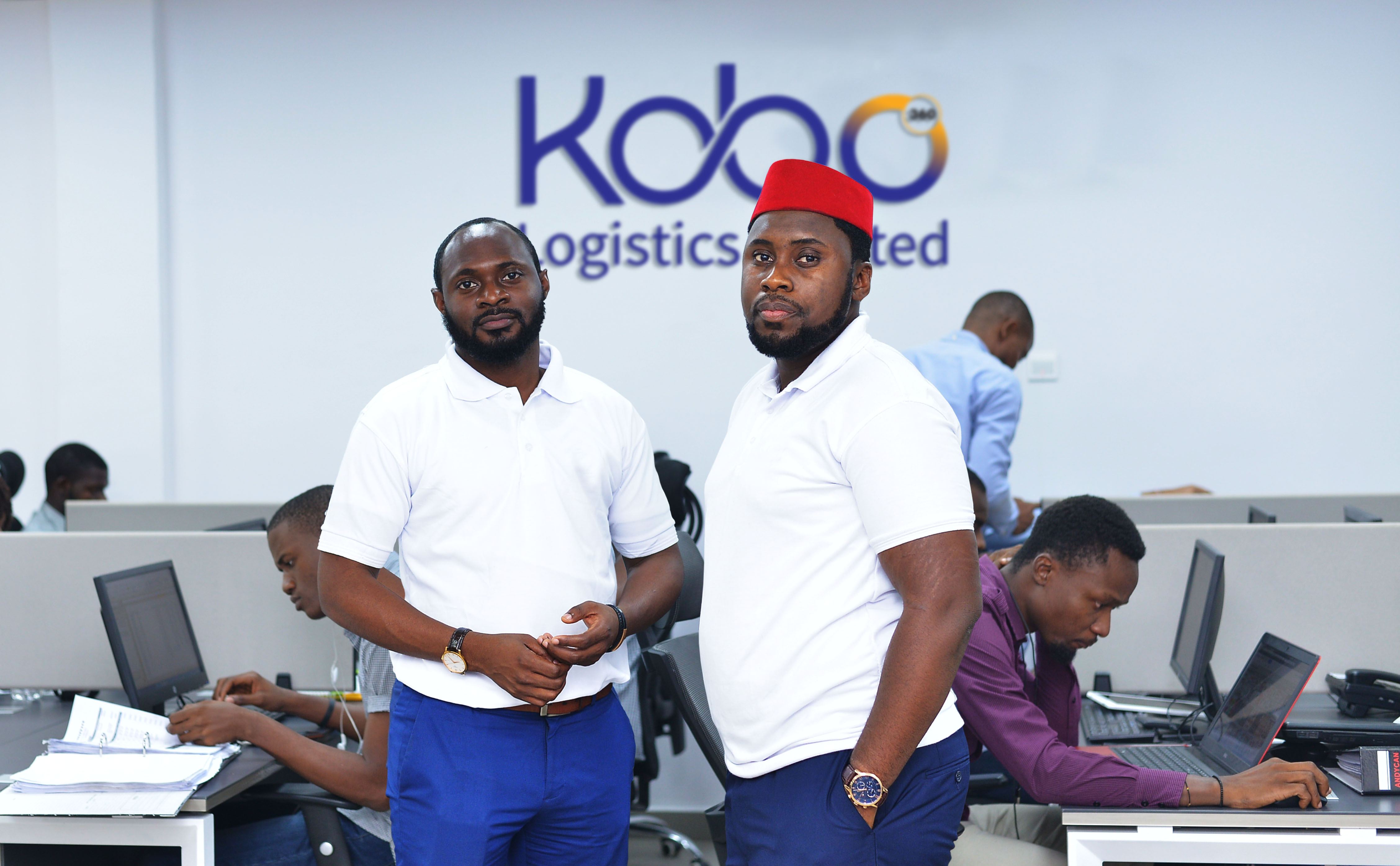
Obi Ozor Ife Oyedele II Kobo360 Co Founders Office Shot

Kobo360 also launched its own driver working capital finance program, KoPay, KoboSafe insurance product and KoboCare: a suite of driver services from HMO packages to family tuition assistance.

The startup is part of a growing e-logistics and transport space in Africa linking on-demand apps to mobile-based connectivity to move people and goods around the continent more effectively.

In the ride-hail space, global players such as Uber and Bolt are competing with each other and homegrown startups to digitize and capture revenues in the continent’s auto and motorcycle taxi markets.

In e-logistics freight delivery, two startups — Kobo360 and Lori Systems — have continued to compete tit for tat on investment, scale and expansion.

Kobo360 moved into Lori Systems’ HQ country Kenya last year. Lori Systems expanded into Nigeria in September of 2018.

Commercial research firm MarketLine estimated the value of Nigeria’s transportation sector in 2016 at $6 billion, with 99.4% comprising road freight.

Kobo360’s CEO Obi Azor told TechCrunch the startup would make final decisions on the 10 new  countries by first quarter 2020.

As a cross-border freight service, the company looks to benefit from Africa’s Continental Free Trade Area (AFCFTA), signed this year by all the continent’s 54 countries to reduce barriers and friction on Pan-African commercial activity.

In addition to lower costs for Kobo360’s country to country freight movement, the startup expects to have a voice in AFCTA’s final implementation.

“We’re going to do some policy work through the IFC so we can help shape AFCTA. The key to the deal is really logistics, so if the logistics component doesn’t work out the deal isn’t going to work,” Azor said.

Kobo360 will use part of its $30 million funding to build out its Global Logistics Operating System —  GLOS for short — a blockchain-enabled platform that will help the company transition to more supply-chain services.

Kobo360 Product Shot Accept Trips

By Digest Africa’s latest ranking, Kobo360’s $20 million Series A is the 5th largest investment in an African startup this year, after Egyptian ride-hail company Svwl’s $42 million raise in June. Kobo360’s existing investors IFC, TLCom Capital and Y Combinator joined the round.

Goldman Sachs confirmed to TechCrunch its lead on the Series A. Over the last several years the U.S. based finance firm’s Africa investments have included backing for e-commerce unicorn Jumia (which recently listed on the NYSE) and leading a $52 million investment in South African fintech startup Jumo in 2018.

Goldman Sachs’ Jules Frebault named Kobo360’s ability to scale quickly over a short period of time and use of tech to improve reliability and efficiency in Africa’s logistics ecosystem as a reason for leading the Series A.

“It’s also a business model that’s replicable across multiple geographies on the continent,” he told TechCrunch on a call.

Kobo360 has a mind toward international expansion but expects to remain focused on Nigeria and Africa for now. “We’re definitely thinking global, we just want to make sure we close out our home market first, then we’ll start looking outside,” Azor said.


14 Aug 2019

YC-backed startup Binks can ship custom-made clothing to Indian women in just three days

Binks is a custom clothing startup created after co-founder and CEO Aamna Khan realized how frustrating it is to find well-fitting women’s workwear in Indian cities. Currently participating in Y Combinator’s accelerator program, Binks solves the problem by using computer vision and machine learning to provide customers with clothing sewn to their measurements, shipped in just three days.

Khan says shopping online is often difficult because a standardized Indian sizing chart hasn’t been developed yet. Clothing companies use a mix of U.S. and European size charts, often resulting in inaccurate sizing (Khan tells TechCrunch that the return rate for apparel ordered online in India can be as high as 30% to 40%, mostly because of fit issues). In big cities like Bangalore, where the company is based, there are a lot of tailors, but getting clothing fitted and sewn is a time-consuming process.

“The tailoring market has not moved with the times, so the experience of getting something tailored is the same as it was 10 years ago. You have to buy fabric, give your measurements to the tailor, then there are usually a couple of fittings, and all of this means physically visiting the shop,” Khan says. “It’s very tedious for Indian women who are leading a busy life but still want well-fitting clothes.”

Many Indian customers buy readymade clothes and have them altered by a tailor or accept that if they order clothing online, a lot of it will need to be returned or exchanged. Companies that figure out a better way to sell clothing to women, however, stand to profit a lot. The women’s apparel market in India is worth $30 billion already and expected to grow quickly, becoming bigger than the men’s apparel market by 2025, according to research by Avendus Capital.

In a statement to TechCrunch, Adora Cheung, Binks’ Y Combinator partner, said “Indian fashion commerce looks very similar to the US today, with its high return rates and dead stock. Thanks to the inexpensive tailoring market in its backyard, India can look really different and we’re excited about that.”

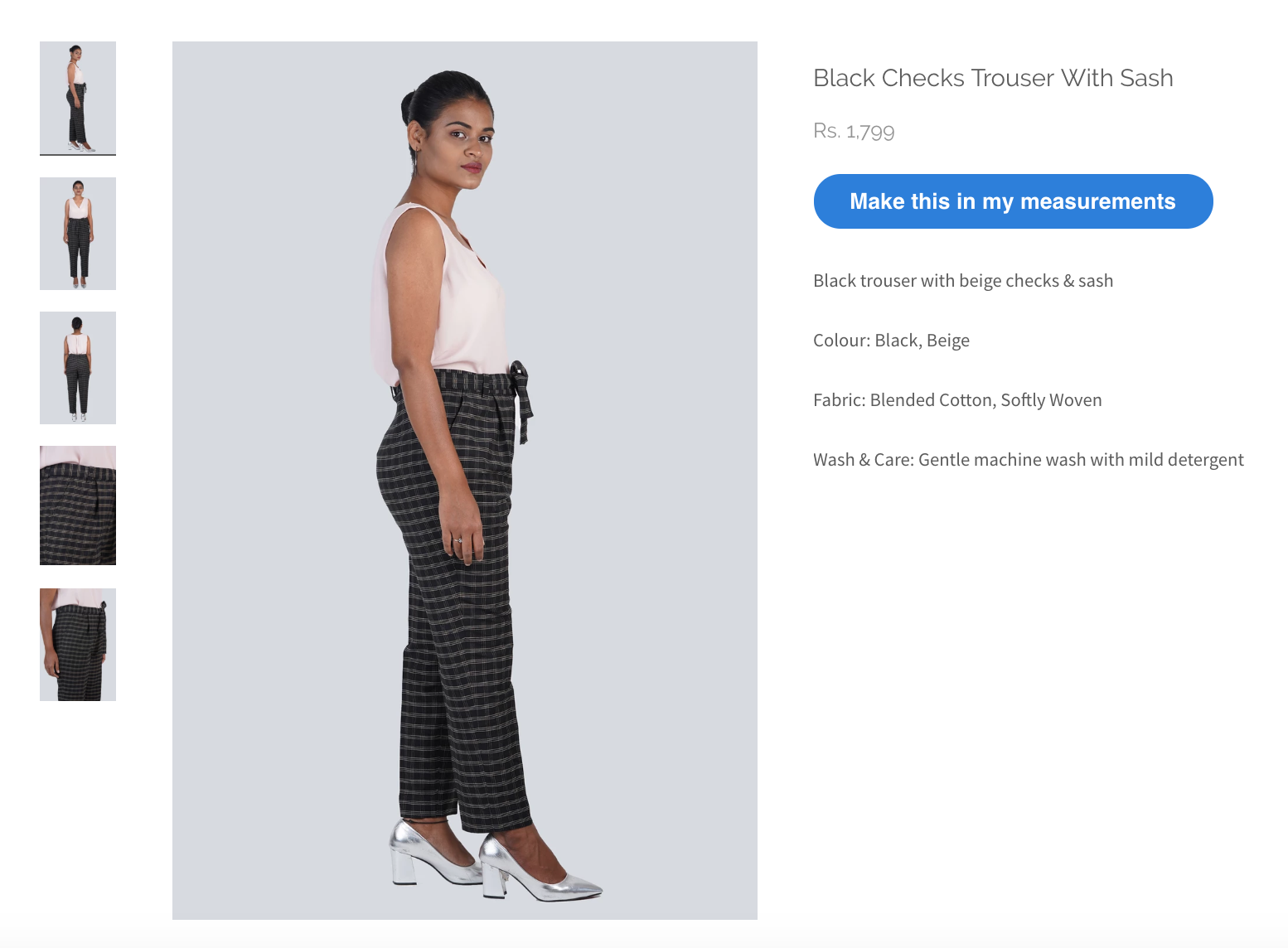
Binks' website

Binks’ website

To order custom clothes, customers pick a style on Binks’ site (the average price of a garment is about USD $30) and fill out a form that includes questions about their height and bra size, what brands of tops and pants fit them best and what sizes from those brands they usually wear. Customers are also prompted to upload a full-length photos of themselves taken from the front and side. Then a Binks consultant calls to discuss customizations before the order is finalized.

Binks uses computer vision to read body measurements, and combines them with the customer’s answers to customize clothing patterns. Orders are currently made by a single tailoring unit in Bangalore, but Binks’ plan is to automate patternmaking, since many tailors still draft patterns by hand, so the company can maintain a standardized process for sizing and quality control as it scales up.

Binks is run by Khan, an experienced product manager, and co-founder Raj Vardhan, a data scientist. The two spent three years working together at online payments company Simpl before leaving to found the startup. After hosting physical pop-up stores in Bangalore, the company started taking online orders in June and since then sales have doubled month over month, with 30% of customers placing a second order within the first month and a return rate of less than 1%, Khan says.

Binks takes a similar approach to RedThread, an American startup that also uses body scanning technology and algorithms to make customizing clothing more efficient. For the Indian market, Khan says Binks faces several specific challenges. For example, even though the National Institute of Fashion Technology is currently conducting a survey to create a standardized clothing chart for India, it won’t be ready for several years, so there isn’t an existing dataset of Indian women’s measurements to train Binks’ algorithms on. Brands use a mix of American and European standard sizing charts and many Indian women prefer looser clothing, making it even more difficult to accurately describe a garment’s fit online.

As more customers place order, that will help make Binks’ technology more accurate, Khan says. The next step is developing technology to streamline the tailoring process.

“We plan to make it super accurate and then at the next level scale it. We want to organize the dressmaking process in a way that has not been done using technology,” says Khan. “We want to automate it so that once a customer has selected a product, a pattern is produced and cutting is automated, so this reduces the turnaround time.”

14 Aug 2019

Only 24 hours left to apply to Hardware Battlefield at TC Shenzhen

Holy hardware, startup founders! You have only 24 hours left to apply to the Hardware Battlefield at TC Shenzhen on November 11-12. This hardware-only pitch competition, cousin to TechCrunch’s world-renown Startup Battlefield, is a real game-changer. Got hardware? Want to launch on a world stage? Do. Not. Delay. Apply to compete in TC Hardware Battlefield 2019 before 11:59pm on August 14th.

What’s in it for you? Excellent question. If you’re selected to compete, you’ll join a cadre of outstanding early-stage hardware startup to vie for a $25,000 prize along with global media and investor exposure. Come to Shenzhen, show the world your innovative hardware and take your startup to the next level.

We partnered with China’s TechNode, to produce this Hardware Battlefield during the larger TechCrunch Shenzhen show happening November 9-12. We’ll consider your startup if you meet these simple basic requirements.

  • Submit your application by on August 14
  • You must have a minimally viable product to demo onstage
  • Your product has received little if any, press coverage to date
  • Your product must be a hardware device or component

TechCrunch editors will closely vet qualified applications and select approximately 15 startups to compete. If you make the cut, get ready to roll up your sleeves and get to work. You’ll receive six weeks of free pitch coaching from our Battlefield editorial team. When it comes time to step onto the stage and deliver your pitch, you’ll be calm, cool and on point.

Every team gets six minutes to pitch in front of a panel of judges comprised of expert VCs, founders and technologists. They’ll hit you up with a tough Q&A and if you make the first cut, you’ll repeat the process all over again to a fresh set of judges.

Only one startup will be hailed the Hardware Battlefield champion, but the intense investor and media attention can change the lives of any or all competitors. Oh, and here’s another perk. All participants join the ranks of the Startup Battlefield elite. Our Battlefield alumni community currently numbers 857 companies that have accumulated $8.9 billion in funding and 110 exits. Just think of the potential networking opportunities.

Hardware Battlefield at TC Shenzhen takes place on November 11-12, but the application window closes at on August 14. Join us in China’s hardware heartland and launch your startup to the world. Apply to compete right now.

Is your company interested in sponsoring or exhibiting at Hardware Battlefield TC Shenzhen? Contact our sponsorship sales team by filling out this form.
14 Aug 2019

Tech companies get a reprieve thanks to a reversal from the President on tariffs

President Donald Trump and the Office of the U.S. Trade Representative have issued technology companies some temporary tariff relief.

Citing an unwillingness to hit consumers with higher prices on things like computers, mobile phones, laptops, video game consoles, computer monitors, clothes and shoes before the holidays, the President and his trade reps are holding off on slapping additional tariffs on those products coming from China.

The President could also have been motivated by growing concerns that the ongoing trade war could trigger a global recession and hurt his chances for re-election in 2020.

Whatever the reason, the news sparked a stock market rally on Tuesday with investors ignoring the rising prices that 10% tariffs on imports that don’t include consumer goods would cause.

The Dow Jones Industrial Average and S&P 500 indices were both up 1.4% on the day, while the Nasdaq rose 1.9% — thanks in large part to a surge of Apple stock. The company’s stock rose $8.49 or over 4.2% to close at $208.97.

At the beginning of the month, President Trump said he would slap a 10% tariff on $300 billion worth of Chinese goods, which sent markets tumbling. An ensuing slight devaluation of the Chinese currency further pushed markets into a tailspin before they began to recover.

The news on Tuesday all but erased those earlier losses.

These market whipsaws between fear and trembling and irrational exuberance won’t end until the U.S. and China come to some sort of agreement in the trade war.

Earlier in the day, Treasury Secretary Steven Mnuchin and Trade Representative Robert Lighthizer spoke with their Chinese counterparts Vice Premier Liu He and Commerce Minister Zhong Shan about the ongoing trade battle. The two Chinese officials issued a protest against the duties that were set to take effect in September. The two trade representatives have a called scheduled for another two weeks.

13 Aug 2019

Twitter exec says edit button isn’t ‘anywhere near the top of our priorities’

At a press event in San Francisco, Twitter Product Lead Kayvon Beykpour talked about a number of product changes coming to the company’s service, he also addressed the oft-memed user request for an edit button. Long story, short, you shouldn’t expect to see the button anytime soon.

“Honestly, it’s a feature that I think we should build at some point, but it’s not anywhere near the top of our priorities,” Beykpour said. “That’s the honest answer.”

The executive said that there were some obvious risk factors but that he felt the company would eventually be able to build a feature to address user needs like correcting a typo or clarifying what they meant to say.

Twitter announced earlier in the event that the company is testing the ability to let users follow topics the same way they would ordinarily follow accounts.

13 Aug 2019

Google details AI work behind Project Euphonia’s more inclusive speech recognition

As part of new efforts towards accessibility, Google announced Project Euphonia at I/O in May: An attempt to make speech recognition capable of understanding people with non-standard speaking voices or impediments. The company has just published a post and its paper explaining some of the AI work enabling the new capability.

The problem is simple to observe: The speaking voices of those with motor impairments, such as those produced by degenerative diseases like amyotrophic lateral sclerosis (ALS), simply are not understood by existing natural language processing systems.

You can see it in action in the following video of Google research scientist Dimitri Kanevsky, who himself has impaired speech, attempting to interact with one of the company’s own products (and eventually doing so with the help of related work Parrotron):

The research team describes it as following:

ASR [automatic speech recognition] systems are most often trained from ‘typical’ speech, which means that underrepresented groups, such as those with speech impairments or heavy accents, don’t experience the same degree of utility.

…Current state-of-the-art ASR models can yield high word error rates (WER) for speakers with only a moderate speech impairment from ALS, effectively barring access to ASR reliant technologies.

It’s notable that they at least partly blame the training set. That’s one of those implicit biases we find in AI models that can lead to high error rates in other places, like facial recognition or even noticing that a person is present. While failing to include major groups like people with dark skin isn’t a mistake comparable in scale to building a system not inclusive of those with impacted speech, they can both be addressed by more inclusive source data.

For Google’s researchers, that meant collecting dozens of hours of spoken audio from people with ALS. As you might expect, each person is affected differently by their condition, so accommodating the effects of the disease is not the same process as accommodating, say, a merely uncommon accent.

A standard voice-recognition model was used as a baseline, then tweaked in a few experimental ways, training it on the new audio. This alone reduced word error rates drastically, and did so with relatively little change to the original model, meaning there’s less need for heavy computation when adjusting to a new voice.

The researchers found that the model, when it is still confused by a given phoneme (that’s an individual speech sound like an e or f), has two kinds of errors. First, there’s the fact that it doesn’t recognize the phoneme for what was intended, and thus not recognizing the word. And second, the model has to guess at what phoneme the speaker did intend, and might choose the wrong one in cases where two or more words sound roughly similar.

The second error in particular is one that can be handled intelligently. Perhaps you say “I’m going back inside the house,” and the system fails to recognize the “b” in back and the “h” in house; it’s not equally likely that you intended to say “I’m going tack inside the mouse.” The AI system may be able to use what it knows of human language — and of your own voice or the contest in which you’re speaking — to fill in the gaps intelligently.

But that’s left to future research. For now you can read the team’s work so far in the paper “Personalizing ASR for Dysarthric and Accented Speech with Limited Data,” due to be presented at the Interspeech conference in Austria next month.

13 Aug 2019

Twitter is testing ways for you to follow and snooze topics

You may soon be able to organize Twitter’s web of hashtags and handles in a smarter way, that is if the company can pull off its ambitious new rethinking of the app’s timelines.

The company isn’t getting rid of the process of a following users but at a press event in SF, company execs announced that they are planning to push users to start following “topics” that bring in well-engaged tweets from a variety of accounts that the user might not necessarily follow. Twitter is currently testing the feature on Android with topics focused around sports “from MMA to Formula 1” to specific professional franchises.

The company plans to greatly expand the scope of these topics so that fans will be able to have timelines devoted to BTS and skincare routines.

The company is curating the overall topics manually, but Twitter will be relying on machine learning to intelligently populate the topics themselves so that the tweets can stay up to date. The company is also testing the ability to not only follow topics in your central timeline, but create your own secondary timelines that you can bring multiple topics, accounts and hashtags into.

A feature that Twitter says it is also starting to experiment with is the ability to temporarily unfollow a topic so you can keep certain tweets out of your timeline like tweets chronicling an ongoing finale of a TV show or a football game.

13 Aug 2019

Axios’ Dan Primack on ‘the most polarizing startup that exists’

Hello and welcome back to Equity, TechCrunch’s venture capital-focused podcast, where we unpack the numbers behind the headlines.

This week was a bit special. Instead of meeting up at the TechCrunch HQ to record the episode, Kate and Alex met up in muggy Boston at Drift’s office, where we linked up with Axios’s Dan Primack. And since we were feeling chatty, we went a bit long.

After checking in with Primack (he has a newsletter and a podcast), we first dealt with the latest from Tumblr. In short, Verizon Media is selling Tumblr to Automattic for a few dollars. How did Verizon wind up owning Tumblr? Ah. Well, Yahoo bought it. Later, after Verizon bought AOL, it bought Yahoo. Then it smushed them together and called it Oath. Then Verizon decided that it didn’t like that much and renamed the group Verizon Media. But Verizon doesn’t want to own media (besides TechCrunch, of course), so it sold Tumblr to Automattic, a venture-backed company best known for operating WordPress.

That’s a lot, I know. What matters is that Yahoo bought Tumblr for more than $1 billion. Verizon sold it for around $3 million. Now, Automattic now has a few hundred new employees and a shot at juicing its userbase before it goes public.

After that, we lamented that the WeWork S-1 had yet to appear. This was a tragedy, frankly. We had expected to spend half the show riffing on WeWork’s financials, alas…

So we turned to some normal material, like Ramp’s recent $7 million raise to take on Brex, and, SmartNews’s recent round, which gave it an eye-popping $1.1 billion valuation.

We ran a bit long because we were having fun, fitting in some conversation surrounding the notes from the SEC regarding the now-dead and then-fraudulent Rothenberg Ventures. More on that here if you want to get angry.

And finally, Vision Fund 2. It’s been a big source of interest for everyone on the show, and we expect whatever the second-act Vision Fund winds up becoming to be a big damn deal. The fund will invest in more than just consumer marketplaces, in fact, it’s eyeing more AI businesses and even biotech. That should be interesting.

All that and we have a lot more good stuff coming. Thanks for listening to the show, and we’ll be right back.

Equity drops every Friday at 6:00 am PT, so subscribe to us on Apple PodcastsOvercast, Pocket Casts, Downcast and all the casts.

13 Aug 2019

Would you rent out your living room for a few hours? This startup is counting on it

Recharge, a startup that tried convincing hotels to let its customers rent their rooms by the hour and even minute, has revamped and rebranded. Now Globe, the company is hoping to convince guests to sign up for short stays instead in people’s homes so that they can kick back between other commitments, and, if the host allows it, to shower and nap.

It’s at once crazy sounding and intriguing, which is perhaps why the popular accelerator program Y Combinator accepted the company into its most recent class of companies. (It shows off its newest batch of startups next week.) YC was famously early to spy the opportunity that Airbnb could chase, after all. The question is whether Globe, which likens itself to an Airbnb for day breaks, will have anywhere near the same appeal.

Its proposition is certainly similar. Home owner or renter wrings out some extra income by renting out all or part of their home, except that unlike with Airbnb, where the minimum stay is at least one night, with Globe, a host rents out his or her space for smaller increments of time.

In a world where the economic divide continues to grow between the haves and have-nots, it’s easy to see the logic in maximizing an underutilized asset — even one’s living room — in order to live more comfortably. It’s especially easy to see the logic in prohibitively expensive cities like San Francisco and New York.

At the same time, letting in a stranger — even a “businessperson” — for a shorter period of time is not going to be a no brainer for many people who might otherwise rent their home while away for a weekend. And on the other side of the marketplace, getting enough hosts with nice enough places to become hosts is a high hurdle for Globe to surmount. After all, if someone is looking for alternative to Starbucks for a few hours, and that individual has to take some form of transportation to get to a host’s couch that may or may not be as nice as pictured, that individual may well go the coffee shop route instead. (The company is also up against startups like Breather that offer hourly or daily “space as a service.”)

Founder Manny Bamfo appreciates the challenge he says. In fact, after running Recharge for a couple of years, he’s gotten well-acquainted with adversity.

Though he says that Recharge wound up seeing $4 million in revenue from its hotel partners, renting rooms to Recharge customers “wasn’t their number one priority, and that made it hard to provide a consistent experience for our customers,” he says. It was “particularly difficult for [hotels] to get their unionized cleaning labor to galvanize and get behind [the concept of cleaning rooms more frequently],” which is why the company decided to relaunch as a home-sharing service instead.

It’s not just a branding exercise. Along with the new name, Globe is starting from scratch with a new cap table, though Bamfo says Globe opened up a small round for previous investors that was “oversubscribed instantly.” Recharge had raised $10 million from investors. One of these backers was Binary Capital, which has since evolved into little more than a tangle of lawsuits. Another backer was the real-estate focused firm Fifth Wall Ventures, which maintains a small stake in the new company, says Bamfo.

In the meantime, Globe is looking to “do a proper seed round at [YC’s] Demo Day.” It’s also busy spreading the word in an effort to build up its burgeoning new marketplace of homes and apartments for rent, and advertising a rate of $50 per hour to people who host their entire home by the hour and $25 per hour to those who share less room. (Globe keeps 20 percent of the fee.)

Last but not least, Globe is also promising $1 million in general liability insurance and, for now, guests who have been verified and vetted by Bamfo himself.

It’s not a scalable solution, he acknowledges, but at the moment, he says, it’s all about building the right community and he sounds optimistic — of course — about its odds.

“People view it like selling a lamp on Craigslist. ‘If it’s not much work, and it’s another form of income, I’ll do it.'” There are a “lot of people with great jobs living in cities that are very expensive — people who are cops, who are teachers, who aren’t quite making six figures, and any extra income is a godsend.”

Asked then why Airbnb isn’t already chasing the same opportunity, Bamfo says it’s basic time management, and also a different market opportunity. “For any company to do this well, it has to be their number one priority.” Besides, he adds, Airbnb is “a travel company. we’re localized, with the ability to charge on a minute-by-minute basis. It’s a huge engineering undertaking and, for now, it’s part of our moat, too.”