Year: 2019

13 Aug 2019

Tech leaders condemn tech’s role in elevating white supremacy

A group of tech leaders has banned together to speak out against white supremacy and rampant hate speech on tech platforms. The group, Build Tech We Trust, refers to itself as a collective of tech CEOs, activists, changemakers and workers who are committed to countering hate and terrorism.

In a public letter published today, Project Include CEO Ellen Pao, Code 2040 CEO Karla Monterroso, ReadySet CEO Y-Vonne Hutchinson, Project Include Founding Member Erica Baker, Block Party CEO Tracy Chou and others make a call to hold tech platforms accountable and “build tech we trust.”

Despite platitudes by tech CEOs that their respective platforms are designed to bring the world together and foster connection, these platforms too often cause harm and “are radicalizing and fragmenting communities by providing an unprecedented ability to coordinate attacks and amplify hate,” the letter states.

That’s not to say that tech companies have done nothing to try to combat hate speech and white supremacy, but what they’ve done just hasn’t been enough. In June, former ACLU Washington Director Laura Murphy said Facebook’s white supremacy policy, despite some changes, was still too narrow. Meanwhile, stories have recently emerged regarding how people become radicalized on YouTube.

The letter comes shortly after the mass shootings in El Paso, Texas and Dayton, Ohio where many of the victims were either Latinx or black. Tech leaders in the letter also note other shootings where people were targeted because of their race, sexuality and/or religion, like Pulse Nightclub shooting and Charleston church massacre.

“White supremacist terrorism and violence, fueled by racism and misogyny, and empowered by technology, is on the rise,” they write. “They’ve moved beyond their white robes and hoods to social media and public rallies where they radicalize and fund their growing membership. Our government leaders at the highest levels encourage and spread it. Our industry leaders enable and profit from it. Four of the five worst gun massacres in modern history have taken place over the past two years. Evidence shows that many of these shooters are inspired by white supremacist ideology and targeting marginalized people.”

The aim of the letter is to serve as a call to action to encourage their fellow technologists to build ethical and responsible tech platforms.

“Whether it be a walkout, refusing to build or buy tech that accelerates hate, calling out unfair anti-abuse policies that silence marginalized voices, or continuing to demand answers from those in positions of power, the time to act is now,” the leaders write.

You can read the full letter over on Build Tech We Trust. I’ve reached out to Monterroso and will update this story when I hear back.

13 Aug 2019

Pete Buttigieg echoes Warren with $80B rural broadband plan

Democratic presidential hopeful Pete Buttigieg has unveiled his plan to address the broadband gap in this country: an $80 billion “Internet For All” initiative and set of related reforms. It echoes Senator Elizabeth Warren’s (D-MA) announcement last week, which is generally speaking a good thing.

It’s detailed in a document entitled “Investing in an American Asset: Unleashing the Potential of Rural America,” which feels like it may rub people the wrong way. It seems to imply that rural America is an “asset” to the rest of America, and that its potential has not yet been unleashed. But that’s just a tone thing.

There are a number of programs in there worth looking at if you’re interested in the economy of rural areas and how it might be spurred or revitalized (for instance paying teachers better), but the internet access portion is the most relevant for tech.

Buttigieg’s main promise is to “expand access to all currently unserved and underserved communities,” including a “public option” where private companies have failed to provide coverage.

That gets broken down into a few sub-goals. First is to revamp the way we measure and track broadband access, since the current system “is inaccurate and perpetuates inequity.” It’s important this isn’t overlooked in anyone’s plan, since this is how we officially make decisions like where to spend federal dollars on connectivity.

Like Warren, Buttigieg wants to remove the impediments to public and municipal broadband options that have been put in place over the years. This will allow “community-driven broadband networks, such as public-private partnerships, rural co-ops or municipally owned broadband networks” to move forward without legal challenges. A new Broadband Incubator Office will help roll these out, and the $80 billion will help bankroll them.

Net neutrality gets a bullet point as well — “Given the FCC’s volatility on this issue, Pete believes that legislation will ultimately be necessary,” the document reads. That’s frank, and while Warren and others have spoken out in favor of an FCC solution, it is likely that legislation will eventually come around and hopefully solve the issue once and for all.

Sen. Bernie Sanders (I-VT) was the first to make net neutrality a campaign promise, though most of the candidates have expressed support for the rule in the past.

The plan is a little less specific than Warren’s, but the truth is any plan involving this amount of money and complexity is going to necessarily be a bit vague at first. Demonstrating priorities and openness to ideas and methods is the important part, as well as throwing out a giant number like $80 billion. The specifics are unlikely to see much debate until one of these people is in the Oval Office.

“To ensure greater opportunity for all, we must make a massive investment in Internet access” summarizes the Buttigieg plan pretty well. You can read the full plan here or below.

Pete Buttigieg Rural Economy by TechCrunch on Scribd

13 Aug 2019

Confidence: The currency of acceleration

Imagine you’re a billionaire starting a new company. You’re happy to bet your entire fortune on it. As a result, capital is no constraint. How fast should you burn money?

You probably wouldn’t use the generic startup math of dividing your available capital by 18 months and burn $55.5 million a month — though it would be fun. So if capital is no longer the currency that determines how fast you go, what should?

It’s confidence, not capital, that should be the currency of acceleration at a startup — no matter if you have a million dollars or a billion dollars to burn.

Confidence is often misunderstood by those who feign it. It is not bluster or arrogance. It’s not “trusting your gut.” Competitors raising big rounds of funding shouldn’t change your level of confidence one way or the other unless they’re doing exactly what you are. Glowing press coverage helps team morale, but it shouldn’t color your assessment of readiness to scale up.

It’s also important to note that venture capital interest is a terrible proxy for founder confidence. VCs have different structural incentives than founders; in an easy money environment, placing a big bet in a hot category, backed by a good enough team, is a job well done for a VC. Remember that they have a portfolio of companies, you’ve just got the one.

So what should drive you to scale up spend? There’s no perfect answer, but if you consistently see strong customer response to your product, marketing delivering more qualified leads for less money, sales channels becoming better instrumented and more efficient, LTV expanding with product improvements and lower churn thanks to your customer success team, you’re probably in good position to accelerate investment.

Too many startups feel pressure to spend money based on hope, not confidence.

Compounding successes at all levels of the business should provide data points that give you the determination to plan out a more ambitious trajectory. The requirement for confidence shouldn’t be mistaken for conservatism. Startups need to take risks in order to thrive, but they should be calculated, not capricious. There is a limited speed any company should go based on what they’ve learned to date about their market and offering.

If you have a high degree of confidence that you can turn $1 into $2, or $10, you should invest immediately. If you don’t have that confidence, you should spend time, but limited capital, to build it. Unfortunately, too many startups feel pressure to spend money based on hope, not confidence.

Authentic growth

Startups appreciate in value through growth. This isn’t just another VC mantra: even bootstrapped startups or public companies become more valuable when they grow faster. Two $10 million companies where one is growing at 80% and the other 20% will be valued very differently. Even if the slower-growth company is generating some limited cash flow and the high-growth company is burning within reason, the high-growth company will usually be worth much more.

So given that growth drives value, why shouldn’t every startup grow as quickly as it possibly can? With capital in hand, why not spend to generate more growth and therefore more value?

Capital without confidence shouldn’t dictate a startup’s acceleration.

Shattered confidence kills startups

Companies that misuse capital as the driver of acceleration cause irreparable harm to confidence. When a company over-accelerates and misses, it takes a painful amount of time to observe the mistake, admit the mistake, correct the mistake and rebuild confidence with the team and investors that you won’t repeat the mistake. Eventually, the company must undertake the inevitable process of taking a huge step back to try to rebuild that faith. This requires going much slower than a similar company that has never faltered.

If you spend a small amount of money on a pilot and it fails, you’ve helped home in on what your product should be, and you’ve not burnt any credibility with your team or investors. Spend 10 times that amount and you’ll have no more confidence in what to do next, far less credibility and a diminished balance sheet. Worst yet, the next time you want to lean in on a major initiative, the lack of confidence of key stakeholders will likely overwhelm what may well be the right decision.

Three startup currencies: Confidence, credibility and capital

Companies create value by compounding learning and therefore compounding confidence in their future. As confidence grows, companies will earn credibility inside the management team and with investors. Once you have both, it usually gets easier and easier to find the right amount of capital needed to fuel that confidence. Confidence is the most important currency, followed closely by credibility, and only then, cash. By way of contrast, driving up revenue artificially by burning capital with low return on investment is not sustainable and does not create long-term value. This will ultimately damage confidence and credibility.

You can buy confidence with capital, but it’s rate-limited and there’s no benefit to scale

Arguably, there should be little difference between the acceleration of two competitive companies that have the same amount of confidence but radically different capitalizations. If both are early-stage startups and one company has $10 million in cash and the other has $1 billion, they should spend their money with the same principle in mind: what does it cost to build confidence that our most important experiments are working?

Authentic confidence is the only real winning weapon at a startup.

For a company with a million dollars, this may mean hiring a single inside sales rep to test out a direct channel based on some early successes with a specific type of customer. A company with a billion dollars will likely make the mistake to open global offices to meet international demand, without first validating that they can make that single inside sales rep successful. In both cases, the confidence of the management team and their ability to execute should be driving the decision, not the available capital.

Credibility is earned, not purchased

If you spend like you’re headed to $20 million ARR and only hit $10 million ARR, your business is in a very difficult position. Not only because you sustained large losses, but also because you’ve damaged confidence in execution — team members and investors won’t believe in the company’s ability to achieve the target the next time it wants to hit the gas pedal hard.

Conversely, If you confidently hit $10 million in sales and have sight lines to $20 million, you will not struggle to raise more money to achieve your goals. The more the management team meets its goals, the more confidence grows and the pace of acceleration can be increased. Compound confidence and acceleration is boundless.

One of the biggest mistakes of the startup community, fueled by an overcapitalized venture market and an overhyped argument about winner takes all market dynamics, is the belief that capital is a weapon that will win the startup wars.

Authentic confidence is the only real winning weapon at a startup. Capital can fuel that weapon, but when used without confidence, it usually becomes a weapon of self-destruction.


13 Aug 2019

Y Combinator bets on a startup building a weed breathalyzer for cops

Y Combinator has kept an eye on cannabis startups over the years, but it’s their latest investment that’s sure to attract the attention of both marijuana users and law enforcement.

SannTek Labs, which is launching with new funding out of Y Combinator’s latest jumbo class of startups, is building a new kind of breathalyzer that can detect blood-alcohol levels but can also determine how much cannabis a person has smoked or otherwise consumed in the past 3-4 hours.

CEO Noah Debrincat say that he wants the startup’s SannTek 315 breath testing device to help officers make stronger “evidence-based decisions” rather than only relying on unsophisticated roadside sobriety tests or blood tests which can potentially take months to get results for and can lead to false positives by detecting cannabis use that took place several days prior to the test.

The SannTek breathalyzer detects the cannabis molecules in your breath, and gives a police officer a readout that lets them know if you have the drug in your system.

“We are specifically detecting Delta-9 THC, which is the predominant psychoactive component of cannabis,” Debrincat tells TechCrunch. “We understand how that gets into your breath. We understand what it does to you and the impairing side effects. And we know that if people are driving with high concentrations of that in their system, their psycho-motor skills are seriously decreased.”

A young startup building a device that could lead to people being arrested is obviously a pretty high-stakes situation, but Debrincat says they are confident in the tech and there are certifications that they’ll need in order to get the device into law enforcement hands. “The only way that a police officer will buy this is if NHTSA, the National Highway Transportation Safety Association, puts its stamp of approval on it,” Debrincat says, noting that SannTek was already in talks with the agency.

FrontProfile

If it’s adopted, the startup’s device will be able to be used pre-arrest to give the officer a number indication of a driver’s impairment, or as SannTek further hones their device, the breathalyzer could be used for post-arrest evidentiary testing back at the precinct in a more controlled environment.

A Canadian startup building a device for U.S. law enforcement isn’t the most popular position given many of the conversations around systemic discriminatory practices that result in higher police presences in communities of color. But Debrincat hopes that the company’s device can be part of a positive shift due to the greater objectivity it promotes and its tighter window of detection.

“The state of affairs currently is that there’s a bunch of misdemeanor charges for small weed crimes that are happening across America and one way to address that is by federally decriminalizing the drug, sure,” Debrincat says. “But what gives police offers power now is the ability to make a call because there is no [breathalyzer] device.”

There are reasons to be concerned for law enforcement getting a tool that could be used discriminately, but Debrincat says there is also plenty of reason to be concerned for the other drivers that are on the road while cannabis users might be driving impaired. The CEO tells me that drivers are 2x as likely to get into an accident while operating vehicles under the influence of cannabis. Other studies reinforce the risks of driving while high. 

The company wants to keep the price of their device low enough that precincts across the U.S. can easily afford them, right now Debrincat says the startup is shooting for the $800-$1,000 range to stay competitive with other options out there.

13 Aug 2019

Xiaomi tops Indian smartphone market for eighth straight quarter

Xiaomi has now been the top smartphone maker in India for eight straight quarters, becoming a constant headache for Samsung in the key overseas market that continues to show strong appetite for handsets as their shipment slows, or drops pretty much everywhere else in the world.

The Chinese electronics giant shipped 10.4 million handsets in the quarter that ended in June this year and assumed 28.3% of the market, research firm IDC reported Tuesday. Its closest rival, Samsung, which once held the tentpole position in India, shipped 9.3 million handsets in the nation during the same period and settled with 25.3% market share.

Overall, 36.9 million handsets were shipped in India during the second quarter of this year, up 9.9% from the same period last year and up 14.8% since the quarter before, IDC reported. This was the highest volume of handsets that has ever shipped during the second quarter in India, the research firm said.

As smartphone shipments slow or decline in most of the world, India has emerged as an outlier that continues to show strong momentum as tens of millions of people purchase their first handset in the country each quarter.

Research firm Counterpoint told TechCrunch that there are about 450 million smartphone users in India, up from about 350 million late last year and 300 million in late 2017. This growth has made India, home to more than 1.3 billion people, the fastest and second largest smartphone market worldwide with unmatched room for further growth.

Globally, smartphone shipments declined by 2.3% year-over-year in Q2 2019, IDC said.

Chinese phone makers Vivo and Oppo, both of which spent lavishly in marketing during the recent local favorite cricket season in India, also expanded their base in the country. Vivo had 15.1% of the local market share, up from 12.6% in Q2 2018, while Oppo’s share grew from 7.6% to 9.7% during the same period. The market share of Realme, which has gained following after it started to replicate some of Xiaomi’s early model, also shot up, moving from 1.2% in Q2 2018 to 7.7% in Q2 2019.

GettyImages 1128860832

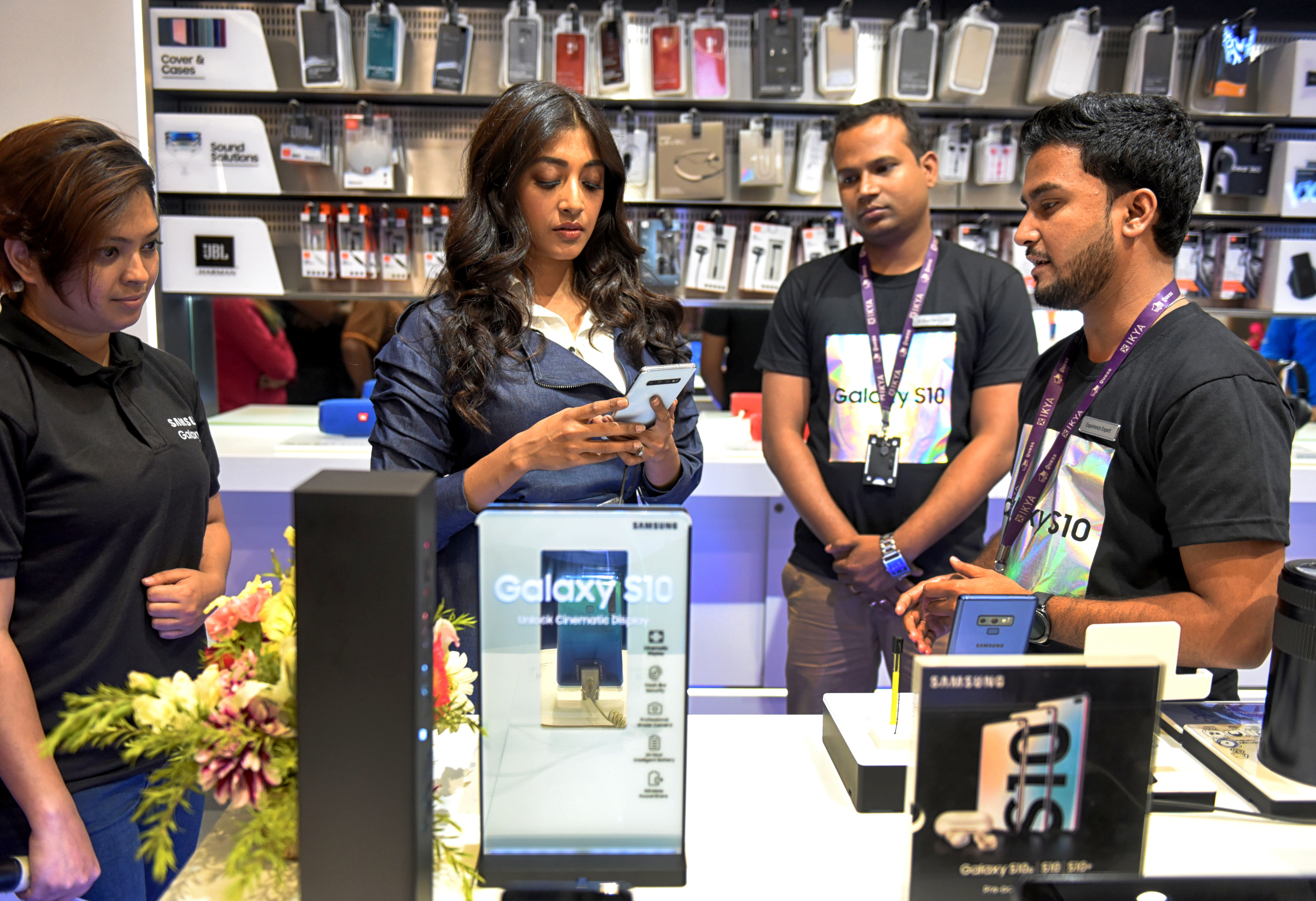
Samsung showroom demonstrator seen showing the features of new S10 Smartphone during the launching ceremony. (Photo by Avishek Das/SOPA Images/LightRocket via Getty Images)

The key to gaining market share in India has remained unchanged over the years: Increasingly bulk up the specs in handsets and sell them for low prices. The average selling price of a handset during the Q2 was $159 in the quarter that ended in June this year. 78% of the 36.9 million phones that shipped in India sported a sticker price below $200, IDC said.

That’s not to say that phones priced above $200 don’t have any takers in India. Per IDC, the fastest growing smartphone segment in the nation was priced between $200 to $300, witnessing a 105.2% growth over the same period last year.

Smartphones priced between $400 and $600 were the second-fastest growing segment in the country, witnessing a 16.1% growth since the same period last year. Chinese phone maker OnePlus assumed 63.6% of this premium segment, followed by Apple (which has less than 2% of the market share), and Samsung.

Feature phones that have maintained a crucial position in India’s handsets market continue to maintain their significant footprint, though their popularity is beginning to wane. 32.4 million feature phones shipped in India during Q2 this year, down 26.3% since the same period last year.

For Xiaomi, which shipped 32.3 million smartphones globally in Q2 2019, India has become its biggest market, the company said. Xiaomi entered the Indian market five years ago, and for the first two years, relied mostly on selling handsets online to cut overhead costs. But the company has since established and expanded its presence in the brick and mortar market, which continues to account for much of the sales in the country.

Earlier this month, the Chinese phone maker said it has set up its 2,000th Mi Home store in India. It is on track to have presence in 10,000 physical stores in the country by end of the year, and expects to see half of its sales come from the offline market by that time frame.

Samsung has stepped up its game in India in last two years, too. The company, which opened the world’s largest phone factory in the country last year, has ramped up productions of Galaxy A series of smartphones that are aimed at budget conscious customers and conceptualized a similar series that includes Galaxy M10, M20, and M30 smartphone models for the Indian market. The Galaxy A series handsets drove much of the growth for the company, IDC said.

Even as it lags behind Xiaomi, Samsung shipped more handsets in Q2 2019 compared to Q2 2018 (9.3 million vs 8 million) and its market share grew from 23.9% to 25.3% during the same period.

“The vendor was also offering attractive channel schemes to clear the stocks of Galaxy J series. Galaxy M series (exclusive online till the end of 2Q19) saw price reductions which helped retain the 13.5% market share in the online channel in 2Q19 for Samsung,” IDC said.

But the South Korean giant continues to have a tough time surpassing Xiaomi, which continues to abide by its 5% profit margin (Xiaomi says it only makes 5% profit on any hardware it sells). Xiaomi has also expanded its local production efforts in India and created more than 10,000 jobs in the country, more than 90% of whom have been granted to women.

13 Aug 2019

Facebook contractors said to have collected and transcribed users’ audio without permission

Reset the counter on “number of days since the last Facebook privacy scandal.”

Facebook has become the latest tech giant to face scrutiny over its handling of users’ data, following a report that said the social media giant collected audio data and recordings from its users and transcribed it using third-party contractors.

The report came from Bloomberg, citing the contractors who requested anonymity for fear of losing their jobs.

According to the report, it’s not known where the audio came from or why it was transcribed, but that Facebook users’ conversations were often matched against to see if they were properly interpreted by the company’s artificial intelligence.

There are several ways that Facebook collects voice and audio data, including from its mobile devices, its Messenger voice and video service, and through its smart speaker. But the social media giant’s privacy policy makes no clear mention of voice data. Bloomberg also noted that contractors felt their work was “unethical” because Facebook “hasn’t disclosed to users that third parties may review their audio.”

Facebook has since stopped the practice.

We’ve asked Facebook several questions, including how the audio was collected, for what reason it was transcribed, and why users weren’t explicitly told of the third-party transcription, but did not immediately hear back.

Facebook becomes the latest tech company to face questions about its use of third-party contractors and staff to review user audio.

Amazon saw the initial round of flak for allowing contractors to manually review Alexa recordings without express user permission, forcing the company to add an opt-out to its Echo devices. Google also faced the heat for allowing human review of audio data, along with Apple which used contractors to listen to seemingly private Siri recordings. Microsoft also listened to some Skype calls made through the company’s app translation feature.

It’s been over a year since Facebook last had a chief security officer in the wake of Alex Stamos’ departure.

Read more:

13 Aug 2019

Daily Crunch: Verizon is selling Tumblr

The Daily Crunch is TechCrunch’s roundup of our biggest and most important stories. If you’d like to get this delivered to your inbox every day at around 9am Pacific, you can subscribe here.

1. Verizon is selling Tumblr to WordPress.com parent, Automattic

It’s been six years since Yahoo acquired the popular blogging platform for more than $1 billion. Since then, Yahoo was acquired in turn by Verizon, and now Verizon is selling Tumblr for what’s been variously reported as a “nominal” price and “well below $20 million.”

While it may be simplistic to peg the service’s declining value to any single decision, last year’s move to ban pornography has certainly proved disastrous. At least on the surface, Automattic and WordPress seem like they might be a better fit.

2. Snap introduces Spectacles 3, with two HD cameras and 3D effects on Snapchat

Snap isn’t giving up on its Spectacles hardware yet.

3. Postmates to drop IPO filing next month

Despite previous reports indicating the on-demand delivery company is seeking an M&A exit, sources close to the matter say Postmates is on track to complete an initial public offering this year.

disrupt sf

4. Announcing the Disrupt SF 2019 agenda

We’ve got a little something for everyone: Space chats with Lockheed Martin’s Marillyn Hewson and Blue Origin’s Bob Smith, a word from Snap CEO Evan Spiegel, a fireside chat with two of 2019’s big VC winners, Ann Miura-Ko and Theresia Gouw, as well as a rare chance to sit down with GV’s David Krane.

5. MasterClass founder launches Outlier, offering online courses for college credit

The classes cost $400 each and feature content specifically shot for online consumption (rather than your standard classroom lectures), with dynamically generated problem sets. And they come with credit from the University of Pittsburgh.

6. Singularity 6 raises $16.5M from Andreessen Horowitz to create a ‘virtual society’

The startup’s ex-Riot Games co-founders claim they’re less focused on building a button-mashing competitive shooter and more on creating a “virtual society,” where users can develop relationships with in-game characters powered by “complex AI.”

7. How lawyers help bring your acquisition deal to fruition

Attorneys can act as project managers, working with company executives and boards of directors, guiding them through the lengthy transaction process — and of course, advising them on the legal side of the equation. (Extra Crunch membership required.)

13 Aug 2019

CBS and Viacom are merging into a combined company called ViacomCBS

In a widely-anticipated move, CBS and Viacom have agreed to reunite.

The two media giants split back in 2006, although the Redstone family maintained control through National Amusements, a privately-held holding company. Now they’re coming back together in an all-stock merger, creating a new entity with the straightforward-but-ungainly name ViacomCBS.

The move is, in some ways, a concession to a turbulent media environment driving large-scale M&A, with AT&T buying Time Warner and Disney acquiring most of Fox — both deals seen as consolidation in preparation for a streaming-centric future. Similarly, once this deal is done, ViacomCBS is expected to make more acquisitions of its own.

It’s also a victory for Shari Redstone, who’s been pushing for the merger over the opposition of some CBS executives — when CBS CEO Leslie Moonves’ resigned last year in a scandal over sexual harassment allegations, he also paved the way for this merger.

Viacom CEO Bob Bakish will become CEO of the combined organization, while Joe Ianniello will continue to serve as chief executive at CBS, and Redstone becomes chair of the combined company’s board of directors.

My father once said ‘content is king,’ and never has that been more true than today,” Redstone said in a statement. “Through CBS and Viacom’s shared passion for premium content and innovation, we will establish a world-class, multiplatform media organization that is well-positioned for growth in a rapidly transforming industry.”

Brands owned by ViacomCBS include CBS (obviously), Showtime, Nickelodeon, MTV, BET, Comedy Central and Paramount Network, as well as the film studio Paramount Pictures.

In their announcement, the companies note that the merger creates a joint content library that includes more than 140,000 TV episodes and 3,600 films, and “reunites fan-favorite franchises such as Star Trek and Mission: Impossible” (which were previously split between Paramount on the film side and CBS on the TV side). They also say that this will allow them to “accelerate” their direct-to-consumer strategy, which includes offerings like CBS All Access, Showtime and Pluto TV.

The deal is expected to close by the end of 2019.

13 Aug 2019

DirecTV Now’s rebranding to ‘AT&T TV NOW’ is officially rolling out

AT&T’s live TV streaming service, DirecTV Now, is getting a new name. The company in July announced that the service would soon be rebranded to AT&T TV NOW at some point later in the summer. The company today confirmed that change is officially rolling out.

The company teased the rebrand’s launch on its Twitter account this afternoon, but didn’t clarify what it meant by “whole new look.” Many assumed the tweet referred to the fact that DirecTV Now brand — which still remains across all app platforms and social accounts — will finally be removed.

A company spokesperson confirmed the tweet was related to AT&T’s prior announcement of the name change.

That being said, the AT&T DirecTV Now apps haven’t yet been updated in the app stores, so this is the first news that the name change is imminent. (The spokesperson could not speak to the exact timing of the rebrand’s arrival).

AT&T had previously explained that DirecTV Now customers would see the rebranding go live around the same time that the new AT&T TV service began its pilot testing.

The latter is the company’s new home TV service that doesn’t require a satellite. Instead, it offers live TV and on-demand titles over a broadband connection, plus a cloud DVR, and access to thousands of streaming apps like Netflix and Pandora, as well as a voice remote powered by Google Assistant.

Screen Shot 2019 08 13 at 2.29.47 PMBoth AT&T TV NOW and AT&T TV will utilize the same AT&T TV app on mobile devices and on their TV’s big screen. There will be no change for current DirecTV NOW subscribers beyond needing to re-accept the terms of service to continue streaming.


The DirecTV Now app will update automatically to become the AT&T NOW app when the changes go live, the company said.

DirecTV Now rebranding isn’t the only change to AT&T’s streaming plans in recent months.

The company also rolled out price hikes and new bundles for DirecTV Now customers, punted on its original plans for a multi-tiered WarnerMedia streaming service, and last month announced its new HBO Max service would instead launch in spring 2020 for slightly more than the HBO NOW subscription of $14.99/month.

The new name for AT&T’s live television streaming service comes at an opportune time, as the DirecTV Now brand has been in the headlines due to a nearly three-week-long blackout of CBS stations while the companies negotiated a new carriage agreement.

That deal had impacted 6.6 million people across DirecTV Now, Direct TV, and AT&T’s U-Verse in several major cities including New York, Chicago, and LA. A new agreement was reached last week, just ahead of the anticipated announcement of a CBS-Viacom merger. (Announced today!)


13 Aug 2019

The secret of content marketing: Avoid high bounce rates

Advice on content marketing always talks about getting people to your blog.

But, what about once they’re there — how do you get them to then buy from you?

That’s the conversion half of content marketing, and that’s what I’ll cover: converting your readers into paying customers.

First, they read. Then, they buy.

When visitors arrive on your blog, three things should happen:

  1. First, they must start reading — instead of bouncing.
  2. Next, keep should keep reading until at least halfway through.
  3. Finally, they should be enticed to read more or convert: sign up, subscribe, purchase, etc.

Demand Curve’s data shows that when readers complete this full chain of events — as opposed to skipping step #2 — they’re more likely to ultimately buy from you.

Why? People trust your brand more after they’ve consumed your content and deemed you to be high quality and authoritative.

We’ve optimized tens of millions of blog impressions, and we have three novel insights to share in this post. Each will hopefully help compel readers to stick around and buy.

Let’s conquer high bounce rates — the bane of content marketers.

Entice visitors to start reading

First, some obvious advice: Getting visitors to read begins with having a strong intro.

A good intro buys goodwill with readers so they keep reading — and tolerate your boring parts.

There are three components to a good intro:

  1. Have a hook. Read about hooks here.
  2. Skip self-evident fluff. Read about succinctness here.
  3. Tease your subtopics to reassure visitors they landed in the right place.

The web’s biggest blogs include tables of contents at the top of their posts to reassure readers. It not only benefits SEO, it also improves read-through rates.

GettyImages 913560720

Image via Getty Images / z_wei

Keep them reading once they’ve started

Once visitors begin reading, you have three tactics to retain them:

  1. Drop-off optimization.
  2. A/B testing.
  3. Exit rate analysis.

This is how we’ll improve our read-through and conversion rates.

Drop-off optimization

Sometimes, when I write a post on Julian.com, I find few people actually finish reading it. They get halfway through then bounce.

I discover this by looking at my scroll-depth maps using Hotjar.com. These show me how far down a page an average reader gets. Then I pair that data with the average time spent on the page, which I get from Google Analytics.

Whenever I notice poor read completion rates, I spend ten minutes optimizing my content:

  1. I refer to the heatmaps to see which sections caused people to stop reading.
  2. Then I rewrite those offending sections to be more enticing.

This routinely achieves 1.5-2x boosts in read-through rates, which can lead to a similar boost in conversion.

You see, I never just publish a blog post then move on.

I treat my posts the same way I treat every other marketing asset: I measure and iterate.

For some reason, even professional content marketers publish their posts then simply move on. That’s crazy. Not spending 10 minutes optimizing can be the difference between people devouring your post or not being able to get halfway through.

Specifically, here’s the process for rewriting a post’s drop-off points to get readers to continue reading.

How to perform drop-off optimization

Screenshot 2019 08 06 20.34.53

Image via Julian Shapiro / Julian.com

First, record a scroll heatmap of your blog post. Any heatmap tool will do. I use Hotjar.com.

Next, whenever you see, say, 80% of readers getting midway into your post but only a fraction then make it to the end, you know you have a problem in the back half of your post: it’s verbose, uninsightful, or off-topic.

Your job is to find these drop-off points then rewrite the offending content using four techniques:

  • Brevity: Make the section more concise: Cut the filler and switch to a bullet list like the one you’re reading now. Or, delete the section altogether if it’s not interesting.
  • Inject insights: Perhaps your content is self-evident and boring. Rewrite it with novel and surprising thoughts.
  • Make headlines enticing: Make the next section’s headline more enticing. Perhaps readers bounce because they see that the next section’s title is boring or irrelevant. For example, instead of titling your next section “Wrapping up,” re-write it into something more eyebrow-raising like, “What you still don’t know.”
  • Cliffhangers: End sections with a statement like “Everything I just told you is true, but there’s a big exception.” Then withhold the exception until the next section. Keep them reading.

Once you’ve ironed out drop-off points, perhaps 35% of your readers finish the post instead of 15%. This reliably works, and it’s the highest-leverage way to achieve conversion improvements on your posts.

This is so self-evident yet no one does it for some reason.

And we’re only just starting. There’s another, more effective technique for optimizing your content: A/B testing paragraphs. Whereas drop-off optimization irons out the kinks in your article, A/B testing is how you take your read-through rates to a new tier.

Before we begin, follow along

As we explore the tactics below, you’re welcome to visit two blogs that incorporate these techniques:

If you need a primer on SEO before continuing, see my other TechCrunch article on the topic here and this orientation here.

A/B testing content