Year: 2019

13 Aug 2019

The ClockworkPi GameShell is a super fun DIY spin on portable gaming

Portable consoles are hardly new, and thanks to the Switch, they’re basically the most popular gaming devices in the world. But ClockworkPi’s GameShell is something totally unique, and entirely refreshing when it comes to gaming on the go. This clever DIY console kit provides everything you need to assemble your own pocket gaming machine at home, running Linux-based open-source software and using an open-source hardware design that welcomes future customization.

The GameShell is the result of a successfully Kickstarter campaign, which began shipping to its backers last year and is now available to buy either direct from the company, or from Amazon. The $159.99 ($139.99 as of this writing on sale) includes everything you need to build the console, like the Clockwork Pi quad-core Cortex A7 motherboard with integrated Wi-Fi, Bluetooth, 1GB of DDR3 RAM, but it comes unassembled.
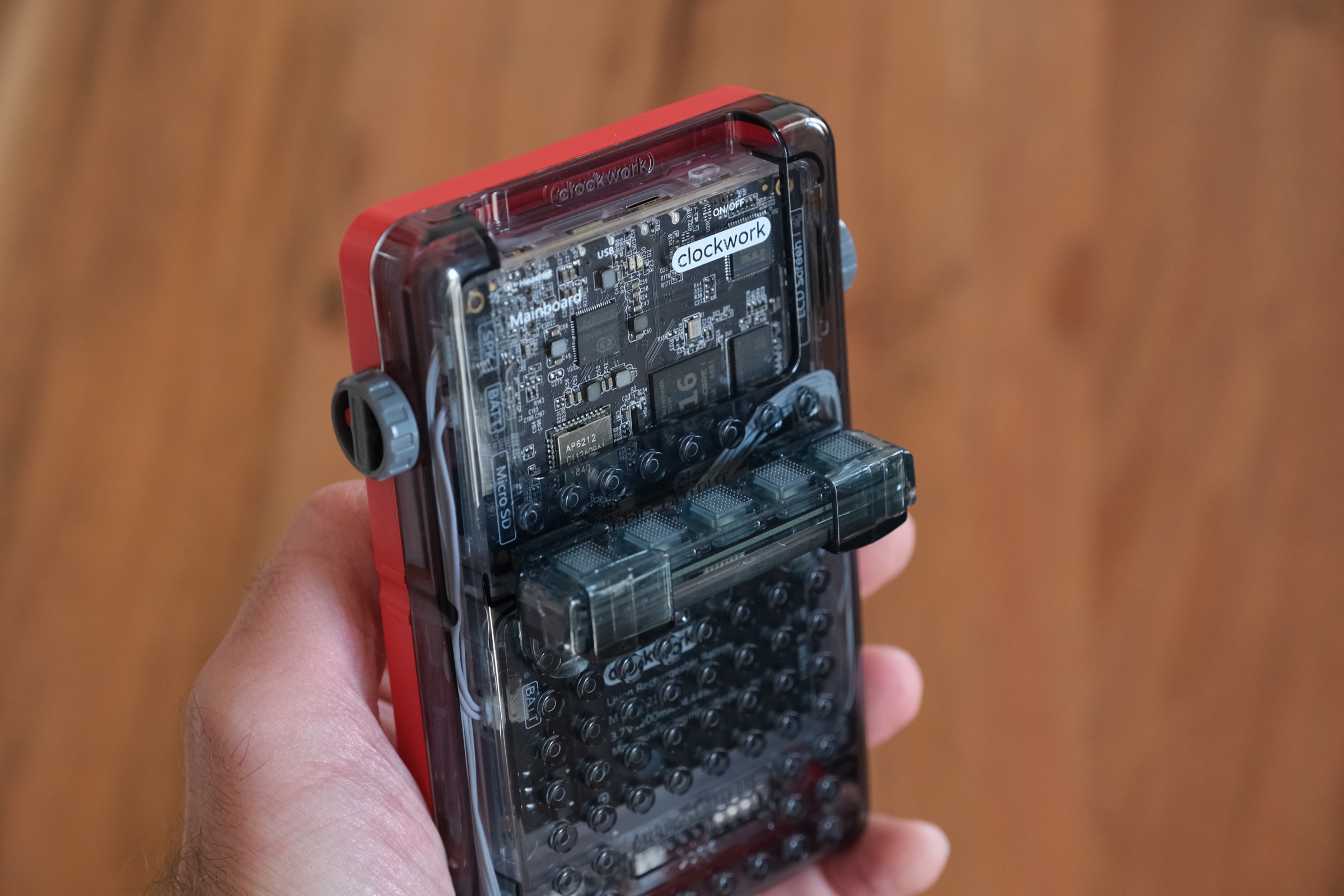
GameShell Clockwork Pi 3

You won’t have to get out the soldering iron – the circuit boards come with all components attached. But you will be assembling screen, keypad, CPU, battery and speaker modules, connecting them with included cables, and then installing them in the slick, GameBoy-esque plastic shell. This might seem like an intimidating task, depending on your level of technical expertise: I know I found myself a bit apprehensive when I opened the various boxes and laid out all the parts in front of me.

But the included instructions, which are just illustrations, like those provided by Lego or Ikea, are super easy to follow and break down the task into very manageable tasks for people of all skill levels. All told, I had mine put together in under an hour, and even though I did get in there with my teeth at one point (to remove a bit of plastic nubbin when assembling the optional Lightkey component, which adds extra function keys to the console), I never once felt overwhelmed or defeated. The time-lapse below chronicles my enter assembly process, start to finish.

What you get when you’re done is a fully functional portable gaming device, which runs Clockwork OS, a Linux-based open-source OS developed by the company. It includes Cave Storyone of the most celebrated indie games of the past couple of decades, and a number of built-in emulators (use of emulators is ethically and legally questionable, but it does provide an easy way to play some of those NES and SNES games you already own with more portability).

There’s a very active community around the GameShell that includes a number of indie games to play on the console, and tips and tricks for modifications and optimal use. It’s also designed to be a STEM educational resource, providing a great way for kids to see what’s actually happening behind the faceplate of the electronics they use everyday, and even getting started coding themselves to build software to run on the console. Loading software is easy, thanks to an included microSD storage card and the ability to easily connect via WiFi to move over software from Windows and Mac computers.

[gallery ids="1868132,1868139,1868138,1868137,1868136,1868135,1868133"]

Everything about the GameShell is programable, and it features micro HDMI out, a built-in music player and Bluetooth support for headphone connection. It’s at once instantly accessible for people with very limited tech chops, and infinitely expandable and hackable for those who do want to go deeper and dig around with what else it has to offer.

Swappable face and backplates, plus open 3D models of each hardware component, mean that community-developed hardware add-ons and modifications are totally possible, too. The modular nature of the device means it can probably get even more powerful in future too, with higher capacity battery modules and improved development boards.

I’ve definitely seen and used devices like the GameShell before, but few manage to be as accessible, powerful and customizable all at once. The GameShell is also fast, has great sound and an excellent display, and it seems to be very durable with decent battery life of around three hours or slightly ore of continuous use depending on things like whether you’re using WiFi and screen brightness.
13 Aug 2019

Aluminum packaging is coming for your water as Coca-Cola’s Dasani brand takes the plunge

Coca Cola’s Dasani brand is the latest company pitching bottled water to go the aluminum can route.

It’s part of a broader rejiggering of the water brand’s plans to use mostly recycled material for their water bottles by 2030.

The company is debuting a hybrid bottle that’s made from half renewable and recycled PET plastic in addition to new PET plastic. Consumers can expect those bottles to hit store shelves by mid-2020, according to the company.

Coca-Cola is also going to be rolling out more Dasani PureFill water dispensers (fancy water fountains) for its corporate installations as an expansion of its Coca-Cola Freestyle mix and match soda dispensing products, the company said.

Finally, and most interestingly (at least to this reporter), Coke is going to introduce aluminum cans across the northeastern U.S. in the fall. A national expansion and a rollout of new aluminum bottles is planned for 2020, according to the company.

“Designing our packages to reduce the amount of raw materials used and incorporating recycled and renewable content in our bottles to help drive a circular economy for our packaging is an important part of our commitment to doing business the right way,” said Sneha Shah, Group Director, Packaging Innovation, Coca-Cola North America. “We are working diligently to continually reduce our overall environmental footprint through smarter package design, procurement of recycled and renewable materials while continuing to deliver exceptional consumer experiences.”

Coke’s moves follow similar announcements from the competition.

Earlier this year, Pepsi’s Aquafina brand announced the introduction of aluminum cans for its own water distribution business.

All of these companies are responding to concerns about the profusion of plastics in the environment and increasing consumer concerns about what this proliferation of plastic waste may mean for human life and health.

Researchers recently discovered plastic microfibers in rainwater in the Rocky Mountains, and plastics are also showing up in the food supply (primarily in fish). It’s unclear what impact these plastics may have on people, but perhaps the best recourse is not to have to find out?

There’s another reason that both Coke and Pepsi are beginning to roll out aluminum packaging for their water. Competition.

The brains behind Vitacoco recently launched a new water brand called Ever and Ever, which the company claims is taking significant market share from Dasani and Aquafina in the places where it’s being sold.

And aluminum is better for the environment.  “Because the majority of aluminum is made from recycling… emissions on a recycled aluminum product are much lower than a PET,” says Michael Kirban, the chief executive of VitaCoco. 

The company launched its own foray into the aluminum-packaged water category after working with Lonely Whale, a non-profit that focuses on ocean environmental issues.

“We’re in mostly tetrapack and mostly in cans and in certain instances in plastic bottles,” said Kirban. “We brought them in last year to talk about how we could offset our own impact. The idea came about with them as they were launching a campaign against plastic water bottles.”

Then there’s Liquid Death, the company whose over $1 million financing from the venture investment studio Science launched a thousand sneers on Twitter before eventually being embraced.

If anything, the moves by Coke and Pepsi (along with Liquid Death, Ever and Ever and other brands) shows that corporations are finally taking at least some small steps to try to reduce the environmental impact of their packaging and logistics decisions.

It’s worth noting that there are other ways to ensure that potable water is available universally without having to pay for additional packaging — paying money to upgrade water infrastructure so everyone in the U.S. has access to clean, delicious drinking water. Tap water could be good enough, if cities and states were willing to adhere to already established laws around water quality.

13 Aug 2019

Facebook is losing its last Oculus co-founder

Facebook spent billions on Oculus in 2014, and in the years since the organization has been absorbed deeper into Facebook while the startup’s co-founders have stepped back in prominence. Today, the final Oculus co-founder remaining at Facebook, Nate Mitchell, announced he was leaving the company in an internal memo sent to employees.

The news was first reported by Alex Heath at The Information. Mitchell confirmed the news soon after on Twitter.

We’ve reached out to Facebook for comment.

In a note on Reddit, Mitchell said he was leaving the company and would be “taking time to travel, be with family, and recharge.”

Mitchell was Oculus’s head of product management for virtual reality.

Mitchell’s role has shifted several times in the past few years at the company as the VR organization underwent a number of leadership shakeups. Late last year, the company’s former CEO Brendan Iribe left the company following disagreements with the team on the future of Oculus’s high-end products. The company’s central co-founder Palmer Luckey had a much more high-profile departure from the company, following an odd, convoluted scandal that involved him paying for a billboard for an anti-Clinton political group aligned with Reddit’s r/The_Donald community.

13 Aug 2019

Domino’s launches e-bike delivery to compete with UberEats, DoorDash

Domino’s will start using custom electric bikes for pizza delivery through a partnership with Rad Power Bikes, as it aims to become more competitive with on-demand apps like DoorDash, GrubHub and UberEats.

Hundreds of e-bikes will be deployed across corporate-owned stores later this year in Baltimore, Houston, Miami and Salt Lake City, the company said Tuesday.

The e-bike announcement comes as Domino’s, which specializes in pizza, faces increasing competition from on-demand delivery apps like UberEats that offer customers far more choice. Domino’s could never offer enough menu options to compete with DoorDash or UberEats. But it can compete on service and delivery times.

The e-bikes are part of that plan. The company has also partnered with companies like Ford to test pizza delivery using autonomous vehicles. Earlier this summer, it launched a new pilot for self-driving pizza delivery in Houston in partnership with Nuro. Domino’s will use Nuro’s R2 vehicle, its second generation autonomous electric test car, which will go into service later this year.

The e-bikes supplied by Rad Power Bikes are equipped with small integrated motors to assist with pedaling and can run for 25 to 40 miles depending on the user, before needing a recharge, according to the company. The bikes are equipped with lights in the front and back, reflective materials for driver safety, and have a top assisted speed of 20 miles per hour.

Importantly, the e-bikes have been customized to hold pizza, drinks and sides. One e-bike can hold up to 12 large pizzas.

The company tested the e-bikes and discovered that service and delivery times improved, Tom Curtis, Domino’s executive vice president of corporate operations said in the announcement. The e-bikes also opened up the labor pool for the company, allowing it to tap into candidates who might not have a car or driver’s license.

Some franchisee owners were already using e-bikes and found they are essential in hilly urban areas.

“While delivery on a traditional bike solved many of our traffic and parking issues, the hills in Seattle were tough on even our best cyclists,” Greg Keller, Seattle Domino’s franchisee said a press release announcing the e-bike program. “E-bikes were a game-changer for us, and we’ve been delivering with them for three years now. We have been able to save money, provide better service, increase hiring and maintain a happy workforce.”

13 Aug 2019

Actijoy founder talks up the benefits of TechCrunch Disrupt

TechCrunch’s flagship tech conference — Disrupt San Francisco 2019 — takes place on October 2-4. Disrupt is the OG of tech startup conferences, and it rolls old school in keeping with the feisty, do-what-it-takes spirit of Silicon Valley. Disrupt is the intersection of now and future tech. It’s where startuppers of every stripe gather to learn, share expertise and make connections to transform their business.

If you haven’t been to Disrupt, why not? The benefits are real, and they can change the trajectory of your business. Of course, we’re a tad biased. But your discerning startup peers aren’t. We asked Jana Rosenfelder, co-founder and COO of Actijoy — a TC Top Pick at Disrupt San Francisco 2018 — to share her TechCrunch Disrupt experience.

Based in the Czech Republic and founded in 2016 by Jana Rosenfelder and Robert Hasek, Actijoy aims to help dog owners keep tabs on the health of their canine companions.

The system consists of three connected devices. An activity tracker (think FitBit for dogs) records activity, intensity levels and sleep quality. Smart Wi-Fi bowls look like standard pet dishes, but they contain scales that measure a dog’s food and water consumption in real-time. The third component — an app — logs the data from the tracker and the smart bowls and reports any abnormalities.

Rosenfelder and Hasek attended both Disrupt San Francisco and Disrupt New York in 2017. Actijoy exhibited in one of Startup Alley’s many country pavilions as part of a contingent sponsored by Czech Invest — a governmental agency that supports startups by defraying conference costs.

Their positive experiences made the decision to go to Disrupt San Francisco 2018 an easy one. For their third Disrupt, Actijoy applied to be a TC Top Pick, which involves a highly competitive curation process. Roughly 40 exceptional startups — including Actijoy — won the coveted designation.

In addition to exhibiting for free in Startup Alley, TC Top Picks spend the entire Disrupt conference on the receiving end of intense investor interest and media exposure — including a live video interview with a TechCrunch editor on the Showcase Stage in Startup Alley.

“It was a real door-opener because the media paid so much attention,” said Rosenfelder. “Being a TC Top Pick made a big impression with people who visited our booth. It gave us more credibility, and everyone listened to us.”

Exhibiting in Startup Alley is networking on steroids and a phenomenal opportunity to make those critical connections. Rosenfelder noted that most startups on the expo floor focus on software or mobile apps. Exhibiting a hardware product helped Actijoy stand out and drew a lot of traffic to its table.

“Startup Alley was a great experience because we talked to people non-stop and collected so many potential customer contacts,” said Rosenfelder.

Networking happens everywhere at Disrupt, and Rosenfelder made the most of that opportunity by using CrunchMatch — the free business-matching service that investors and founders with similar funding interests use to vet, meet and greet at Disrupt.

“CrunchMatch is a great tool. The application made it simple to organize a meeting. We arranged about 10 meetings — mainly with investors and potential partners.”

Rosenfelder scored one of her most valuable connections while attending Female Founder Office Hours, an “ask-me-anything” series of meetings sponsored by All Raise VC and founder mentors (be sure to apply to the All Raise AMA this year).

Rosenfelder had been trying to network to a specific contact for more than a year. Within five minutes of talking with an All Raise mentor, the woman offered to make the introduction.

Team Actijoy has traveled from the Czech Republic to the United States for three different Disrupt events, and they hope to compete in the Startup Battlefield at Disrupt SF 2019.

“TechCrunch Disrupt is one of the best startup conferences, and it’s worth the money. The media exposure is much better than at other events. It’s a great place for startups to network for leads, investors, industry contacts and partnerships.”

Disrupt San Francisco 2019 takes place on October 2-4 at the Moscone Center in San Francisco. Come see for yourself what Disrupt can do for your business. Get your early bird tickets to the show today.

13 Aug 2019

$600M Cray supercomputer will tower above the rest — to build better nukes

Cray has been commissioned by Lawrence Livermore National Laboratory to create a supercomputer head and shoulders above all the rest, with the contract valued at some $600 million. Disappointingly, El Capitan, as the system will be called, will be more or less solely dedicated to redesigning our nuclear armament.

El Capitan will be the third “exascale” computer being built by Cray for the U.S. government, the other two being Aurora for Argonne National Lab and Frontier for Oak Ridge. These computers are built on a whole new architecture called Shasta, in which Cray intends to combine the speed and scale of high performance computing with the easy administration of cloud-based enterprise tools.

Due for delivery in 2022, El Capitan will be operating on the order of 1.5 exaflops, or floating point operations per second, a measure of calculation often used to track supercomputer performance. Exa denotes a quintillion of something.

Right now the top dog is already at Oak Ridge: an IBM-built system called Sierra. At about 1.5 petaflops, it’s about 1/10th the power of Aurora — of course, the former is operational and the latter is theoretical right now, but you get the idea.

One wonders exactly what all this computing power is needed for. There are in fact countless domains of science that could be advanced by access to a system like El Capitan — simulations of atmospheric and geological processes, for instance, could be simulated in 3D at a larger scale and higher fidelity than ever before.

So it was a bit disheartening to learn that El Capitan will, once fully operational, be dedicated almost solely to classified nuclear weaponry design.

To be clear, that doesn’t just mean bigger and more lethal bombs. The contract is being carried out with the collaboration of the National Nuclear Security Administration, which of course oversees the nuclear stockpile alongside the Department of Energy and military. It’s a big operation, as you might expect.

We have an aging nuclear weapons stockpile that was essentially designed and engineered over a period of decades ending in the ’90s. We may not need to build new ones, but we do actually have to keep our old ones in good shape, not just in case of war but to prevent them failing in their advancing age and decrepitude.

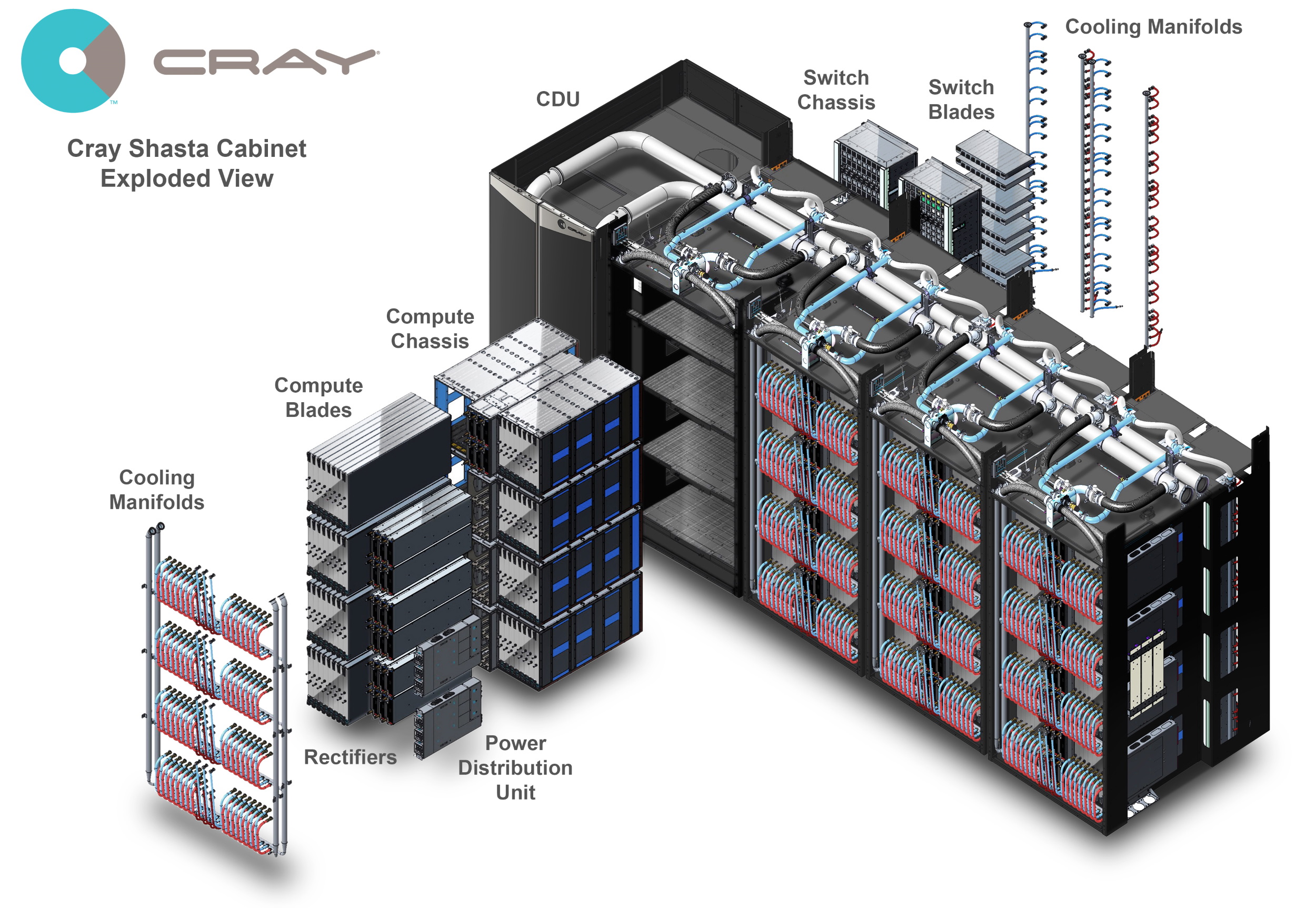
shasta

The components of Cray’s Shasta systems.

“We like to say that while the stockpile was designed in two dimensions, it’s actually aging in three,” said LLNL director Bill Goldstein in a teleconference call on Monday. “We’re currently redesigning both warhead and delivery system. This is the first time we’ve been doing done this for about 30 years now. This requires us to be able to simulate the interaction between the physics of the nuclear system and the engineering features of the delivery system. These are real engineering interactions and are truly 3D. This is an example of a new requirement that we have to meet, a new problem that we have to solve, and we simply can’t rely on two dimensional simulations to get at. And El Capitan is being delivered just in time to address this problem.”

Although in response to my question Goldstein declined to provide a concrete example of a 3D versus 2D research question or result, citing the classified nature of the work, it’s clear that his remarks are meant to be taken both literally and figuratively. The depth, so to speak, of factors affecting a nuclear weapons system may be said to have been much flatter in the ’90s, when we lacked the computing resources to do the complex physics simulations that might inform their design. So both conceptually and spatially the design process has expanded.

That said, let’s be clear: “warhead and delivery systems” means nukes, and that is what this $600 million supercomputer will be dedicated to.

There’s a silver lining there: Before being air-gapped and entering into its classified operations, El Capitan will have a “shakeout period” during which others will have access to it. So while for most of its life it will be hard at work on weapons systems, during its childhood it will be able to experience a wider breadth of scientific problems.

The exact period of time and who will have access to it is to be determined (this is still three years out), but it’s not an afterthought to quiet jealous researchers. The team needs to get used to the tools and work with Cray to refine the system before it moves on to the top secret stuff. And opening it up to a variety of research problems and methods is a great way to do it, while also providing a public good.

Yet Goldstein referred to the 3D simulations of nuclear weapons physics as the “killer app” of the new computer system. Perhaps not the phrase I would have chosen. But it’s hard to deny the importance of making sure the nuclear stockpile is functional and not leaking or falling apart — I just wish the most powerful computer ever planned had a bit more noble of a purpose.

13 Aug 2019

Google Docs, Sheets and Slides get a new font for faster reading

Google today announced that it is bringing a new font to Docs, Sheets and Slides that was explicitly designed to improve reading speeds. The new font, Lexend, was developed by Thomas Jockin, who is probably best known for his Quicksand font. While Google stresses how this will benefit students, most of us could probably benefit from a font that helps us read faster.

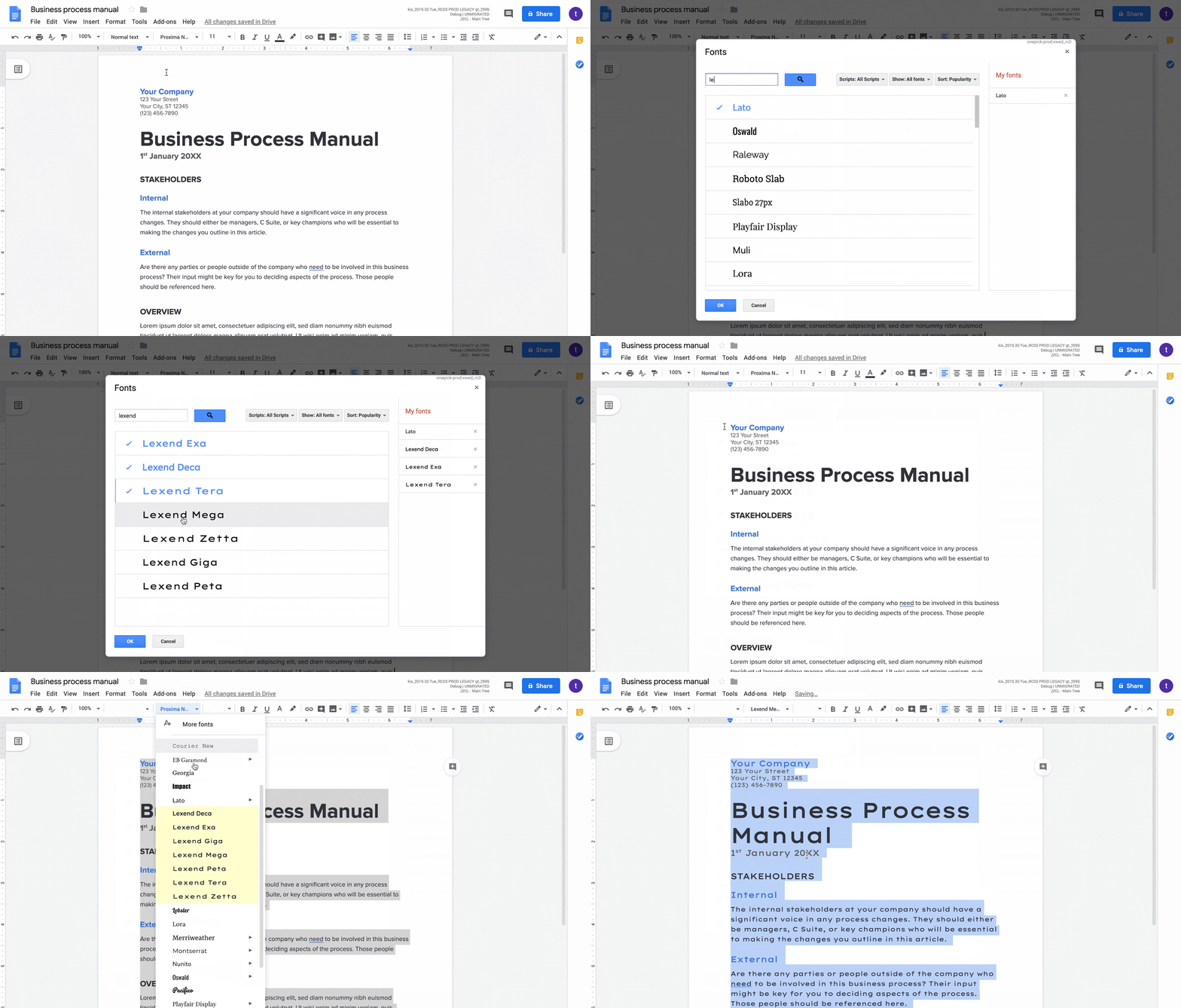
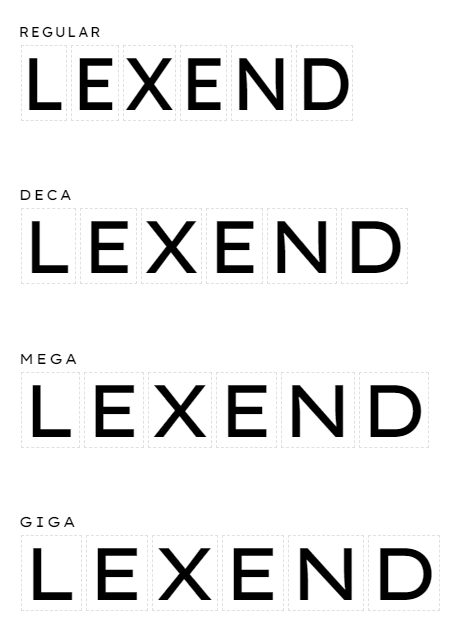
2019 08 13 0847To do this, the Lexend family, which comes in eight variations, doesn’t do anything fancy with the actual form of the letters. Indeed, it’s a pretty standard variable sans serif font. But Hockin applied data from a number of in-depth studies, which themselves were based on the research of Bonnie Shaver-Troup.

The fact that it’s sans serif already reduces noise, making it faster to scan the letters. In addition, using variable font technology, Lexend features expanded character spacing and font-outline shapes.

To try these new fonts, you first have to head to the Font menu in the toolbar and look for the ‘more fonts’ option. From there, you can search for Lexend and, once you’ve found it, add the new font to your list of saved fonts for use in Docs, Sheets and Slides.

lexend

13 Aug 2019

Allbirds is now selling socks

Allbirds is now selling socks.

The shoe brand that’s de rigueur for investors, entrepreneurs, and aspirants in Silicon Valley has been bitten by the sock bug.

But, because this is Allbirds (and Silicon Valley), the company didn’t just launch a new line of socks. They’re using a “brand new material” called Trino that uses a yarn which includes Allbirds’ tree and wool blend.

The company is claiming that its new socks are made with natural ingredients and a combination of recycled plastic bottles, plant fibers and are 100% carbon neutral.

The socks are priced at $16 for tube socks, $12 for “no-show’ socks, and $14 for quarter-length socks. There are six different colors, a blue, grey, black, brown, pink and green option and they’ll be available at stores in San Francisco, New York, Chicago, Boston, and Seattle.

Allbirds isn’t the only company to sell sustainable socks. Osom makes its socks from up-cycled clothing materials and sells at a similar price point. Repreve, Zkano, and Thought are also brands that use recycled materials to make their socks.

The shoe company has raised $77 million to date and is backed by investors including Lehrer Hippeau, Tiger Global Management, Fidelity Management, and T. Rowe Price.

13 Aug 2019

Oregon joins lawsuit opposing T-Mobile/Sprint merger

Oregon this week became the 15th state (plus the District of Columbia) to sign onto a lawsuit seeking to stop a T-Mobile/Sprint merger. The suit, co-signed by 16 attorneys general, argues that a merger between the country’s third and fourth largest carriers would greatly reduce competition in the wireless industry.

“It’s important that Oregon join other states in opposing the Sprint -T-Mobile merger,” said Oregon AG Ellen Rosenblum said in a statement. “If left unchallenged, the current plan will result in reduced access to affordable wireless service in Oregon — and higher prices. Neither is acceptable.”

Texas joined the suit earlier this month, marking one of only two Republican AGs who have signed onto the deal. Conservative voices have largely come out in favor of a merger, suggesting that by joining forces the new company (also named T-Mobile) would increase competition for AT&T and Verizon by getting a leg up in the race to implement 5G.

New York State AG Letitia James says the signee has added “momentum” to push again the merger, which was green lit by the U.S. Department of Justice in late July.

“Oregon’s addition to our lawsuit keeps our momentum going, and ensures that there isn’t a single region of this country that doesn’t oppose this anticompetitive megamerger,” said James. “We welcome Attorney General Rosenblum to our 16-member coalition that now includes states representing almost half of the U.S. population. We remain committed to blocking the merger of T-Mobile and Sprint because it would bad for consumers, bad for workers, and bad for innovation.”

13 Aug 2019

How even the best marketplace startups get paralyzed

Over the past 15 years, I’ve seen a pernicious disease infect a number of marketplace startups. I call it Marketplace Paralysis. The root cause of the disease is quite innocent and seemingly harmless. Smart people with good intentions fall victim to it all the time. It starts when a platform has sufficient scale — such that there is a good amount of data on things like performance, quality rankings, purchase rates, and fill ratios. What a platform implements as a result of that data, and how it’s received by their user base, is what can lead to marketplace paralysis.

In this post, I will detail what Marketplace Paralysis is and what startups can do to avoid it. Before I get into the nitty-gritty, here’s a snapshot of the lessons you’ll learn by reading this post:

  1. Segment and focus on high-value users
  2. Remember the silent majority
  3. Modify company goals to include quality components
  4. Empower small, autonomous teams

The easiest way to explain Marketplace Paralysis is with a hypothetical example. So allow me to introduce you to Labor Marketplace X (LMX).

Equipped with the aforementioned data, the well-intentioned product managers at LMX will think about policies or features to try and improve a KPI, like fill ratio or job success rate. They might craft a policy that would separate users into two tiers.

Tier 1 gets a shiny gold star next to their name, along with extra pay, bonuses, and preferred job access. Tier 2 gets standard pay and standard job access. They’ve done their homework and feel this will benefit the marketplace.

So, they build the feature. They launch it and make an announcement to their users. And then… a revolt!