Year: 2019

13 Aug 2019

Darren Bechtel (yes, of those Bechtels) has raised $97.5 million for his firm, Brick & Mortar Ventures

Brick & Mortar Ventures, a young, San Francisco-based venture firm that’s focused on startups innovating in or around architecture, engineering, construction, and facilities management, has closed with $97.2 million in capital commitments.

The fund is one in a sea or debut funds that have swung open their doors in recent years, though it’s also interesting for numerous, beginning with its founder, Darren Bechtel, who knows a thing or two about the building industry. He’s a scion of the family that built the 120-year-old, privately held company Bechtel into one of the largest construction and engineering firms in the world. In fact, his brother, Brendan, who was named CEO in 2016, represents the fifth generation of Bechtels to lead the company. (Their sister, Katherine, is a project controls manager with the powerhouse outfit.)

Brick & Mortar’s investors are just as notable. They aren’t the typical pension funds and university endowments that many VCs try hard to lock down. Instead, they comprise a long list of companies that are part of the “construction value chain” and so have an interest in the latest and greatest developments in their respective industries. Among the firm’s backers, for example, is the special materials maker Ardex; the software giant Autodesk; the building materials company CEMEX; Ferguson Ventures, which is the venture arm of a huge U.S distributor of plumbing supplies called Ferguson Enterprises; FMI, a management consulting company to the engineering and construction industry; Obayashi, a major Japanese construction company; Sidewalk Labs, which is Alphabet’s urban innovation organization; and United Rentals, one of the world’s largest equipment rental companies.

Brick & Mortar isn’t the first venture firm to focus on the so-called built world. Other firms that focus largely, if not exclusively, around the same themes include Fifth Wall Ventures, Navitas Capital, Corigin Ventures, Camber Creek, Metaprop, Starwood Capital, and Tamarisc Ventures.

In fact, Bechtel has ties to and is an individual investor in Fifth Wall, an L.A.-based firm that stormed onto the scene in 2017 with an equally impressive, and very different, roster of limited partners in the real estate industry from which it has already amassed more than $700 million in capital commitments across two funds.

As Bechtel told us on a call late last week, he was going to go into business with Fifth Wall’s founders initially, but they wanted to raise a lot of money, and Bechtel was thinking more conservatively — for a reason. “I’d done five deals on AngelList with [Fifth Wall cofounder] Brendan [Wallace] and we’d started putting together a pitch deck, and as we were thinking through ideal fund structure and size, Brendan said $500 million and I said $50 million,” says Bechtel.

Wallace was thinking big, says Bechtel, because “hospitality already had some massive players — Airbnb, WeWork. It was a far more mature landscape, and Brendan thought that if we were going to own a category, we needed the capital to secure a leadership position in the right deals.”

Bechtel thinks Wallace was right, too. He says he just came to realize that construction tech — which is what really interested him — was in its own league, and it was in its infancy. Though the construction software company PlanGrid took off like gangbusters — Bechtel wrote the largest check during the company’s seed round — it wasn’t so long ago that “there were great, billion-dollar ideas being formed but the rounds were small and the valuations were small,” says Bechtel. Because the “investment community didn’t understand what it was looking at, I had concerns about our ability to generate returns if we had too large a fund.”

In the end, the friends and former Stanford MBA classmates decided to split their respective focus on real estate and hospitality (Fifth Wall) and the actual construction of buildings (Brick & Mortar), and things seem to have gone well since. As Fifth Wall has gained traction, so too has Brick & Mortar, which is now a couple of years in the making. Indeed, though Bechtel is announcing the close of Brick & Mortar’s first fund today, he already works with two principals and two associates, and they’ve collectively sourced and funded 16 startups to date with capital they’ve been raising from investors along the way.

One of those checks went to Fieldwire, a maker of field management software for construction teams. They’ve also backed Serious Labs, which trains workers how to use heavy equipment and tools via virtual reality software, and Curbio, a real estate technology startup that orchestrates turnkey renovations for home sellers, then gets paid back once the home is sold.

Brick & Mortar even has an exit already, having helped fund the construction software platform BuildingConnected, which sold last December to Autodesk. (Bechtel’s earlier investment in PlanGrid, which also sold to Autodesk last year, was a personal investment, one of roughly 40 he made before setting out to create a traditional venture firm.)

As for whether Brick & Mortar ever hunts for companies that Bechtel — the firm founded by Darren’s great, great grandfather — might like to acquire or otherwise partner with, Darren is quick to note that the firm is not an investor in his venture fund or any or its portfolio companies, and he doesn’t have his finger on the pulse of what’s happening at the company.

” I don’t work at Bechtel or pretend to know what their intentions are, though my brother is CEO, so you could say I know a guy there.”

More, he notes, he doesn’t think it would make sense to fund a company that “a user would want to acquire. If one user buys [a startup’s tools] because they want exclusivity, they’re limiting the exit value of that company.” To underscore his point, he notes that “Bechtel does around $30 billion a year, but the construction market is an $11 trillion market.” In the end, he says, it’s “better to have a preferred relationship. Maybe you get the next year’s model released early; maybe you get custom colors.” But if you’ve developed a winning product, you want to make it accessible to everyone. “You benefit the most by having a technology adopted by the whole industry.”

Above, the Brick & Mortar Ventures team. From left to right: Austin Yount, senior associate; Alice Leung, associate; Curtis Rodgers, principal; Darren Bechtel, general partner; and Kaustubh Panda, principal.

13 Aug 2019

Facebook’s AR dev toolkit exits closed beta on Instagram

Not one to let Face App and Snapchat steal its spotlight, Facebook announced today that it’s opening its closed beta of Spark AR on Instagram, letting any developer build and share an augmented reality filter on the platform.

The company announced this change was coming at its F8 keynote earlier this year.

Phone-based AR isn’t the piping hot platform it was when Mark Zuckerberg devoted the top-half of his 2017 F8 keynote to highlighting the company’s AR Camera Effects platform, but two-and-a-half years later the company is ready to let more developers give it a whirl.

Effects published via the Spark AR app can pop up in a few ways. If a user is following someone that has shared effects on the platform, they may pop up in the user’s effects tray in the camera section of the app. The company is also introducing a new Effects Gallery where users can search for new filters. Instagram isn’t exactly throwing the Effect Gallery front-and-center, to find it users will have to reach the end of the effects tray in the Instagram camera and click on it there. Users will also be able to see the effect being used in Instagram Stories, which is probably the real ticket to Spark AR features finding any sort of viral hype.

13 Aug 2019

Apple brings contactless student IDs to a dozen more universities

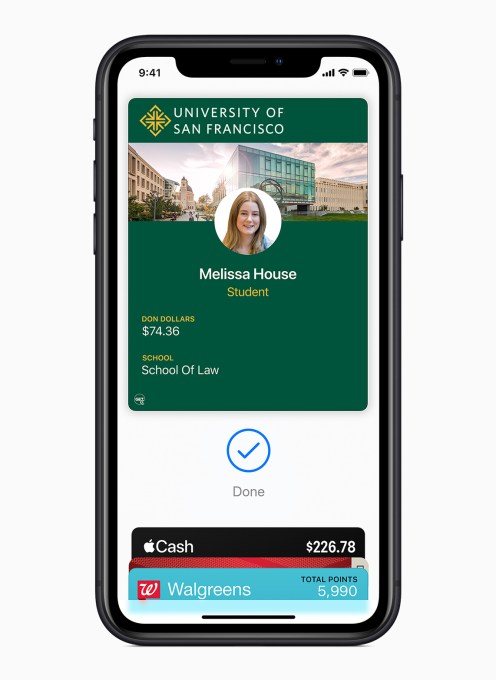
Ahead of the upcoming school year, Apple this morning announced it’s bringing contactless student IDs in Apple Wallet to several more U.S. universities. The expansion will allow over 100,000 college students to carry their student ID on their iPhone or Apple Watch, where it can be used for a variety of tasks including paying for their meals, snacks and for entry into buildings, like the student’s dorm and other campus facilities.

The expanded list of universities includes: Clemson University, Georgetown University, University of Tennessee, University of Kentucky, University of San Francisco, University of Vermont, Arkansas State University, South Dakota State University, Norfolk State University, Louisburg College, University of North Alabama and Chowan University.

These join the previously supported schools like Duke University, University of Oklahoma, University of Alabama, Temple University, Johns Hopkins University, Marshall University, and Mercer University.

Apple brings student IDs to iPhone and Apple Watch student ID on apple watch 081319

Apple had first announced its plans for contactless student IDs at WWDC 2018, then rolled out to its debut schools last October.

The contactless IDs not only serve as a means of student identification, but also work as a payment mechanism for on-campus transactions — like meals at the cafeteria or textbooks and supplies at the college’s bookstore, for example. Contactless entry into buildings is also now common on college campuses, and these digital IDs can work to open doors, too, as an alternative to swiping an entry card.

Apple brings student IDs to iPhone and Apple Watch university of san francisco student ID screen 081319

Support for college student IDs is only one way that Apple is trying to replace the physical wallet. The company also support the ability to add your debit and credit cards, transit and loyalty cards, tickets, and even paper money through Apple Pay Cash. And now it’s launching its own credit card, too, which rewards you with cashback for shopping Apple and using Apple Pay.

“We’re happy to add to the growing number of schools that are making getting around campus easier than ever with iPhone and Apple Watch,” said Jennifer Bailey, Apple’s vice president of Internet Services, in a statement about the expansion. “We know students love this feature. Our university partners tell us that since launch, students across the country have purchased 1.25 million meals and opened more than 4 million doors across campuses by just tapping their iPhone and Apple Watch.”

Related to this launch, Apple says it’s also adding support for CBORD, Allegion and HID — solution providers for campus credentials and mobile access. With these technologies on board, Apple will be able to reach other schools integrated with these systems in the future.

13 Aug 2019

Walmart tops U.S. online grocery market, with 62% more customers than next nearest rival

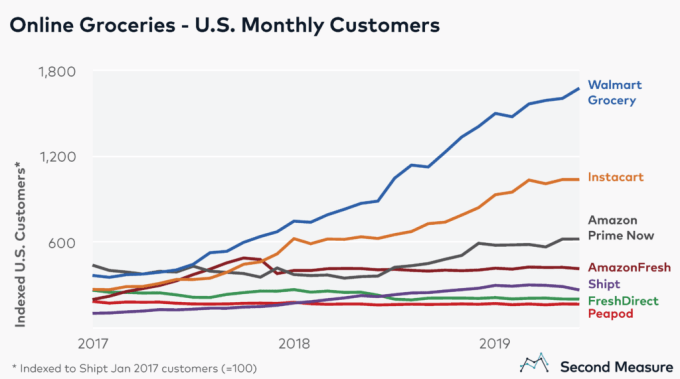
Walmart is dominating the U.S. online grocery market, according to new research out this week from the analysts at Second Measure. The nationwide retailer today offers grocery pickup and delivery in nearly every U.S. state, and had 62% more customers in June than its next nearest rival. And no, in this case, that rival is not Amazon — it’s Instacart.

Like Walmart, Instacart also operates across the U.S., offering both pickup and delivery services.

The same is true for Amazon Prime Now and Peapod, while other competitors are limited to delivery only — like Target-owned Shipt and FreshDirect. Meanwhile, AmazonFresh offers delivery, plus pickup in Seattle.

GroceryDelivery chart1 1024x571

While Walmart has been steadily capitalizing on its existing brick-and-mortar footprint and proximity to its customer base, Amazon’s strategy in the online grocery space appears to be one of confusion. The retailer is competing against itself by offering two services — Amazon Prime Now and AmazonFresh. The latter, an older service operated before Amazon’s Whole Foods acquisition, is actually one of the few online grocery businesses in decline, the report discovered. Founded over a decade ago, AmazonFresh has only grown to 15 U.S. cities and shut down in others.

This June, AmazonFresh sales were down by 19% year-over-year — the worst sales change in the new research report, the analysts noted.

Prime Now, on the other hand, is booming. Year-over-year sales nearly tripled in June. This is not only due to Whole Foods, whose assortment was added in February 2018, and is now a big driver for orders. Consumers also likely opt for Prime Now because it’s offered as part of their annual Amazon Prime subscription, while AmazonFresh is an additional $14.99 per month.

Prime Now has also been expanding to more U.S. markets, and is on track to reach even more as Amazon invests in building additional Whole Foods locations and possibly other non-Whole Foods stores. 

The new research also notes that Target’s Shipt could be doing better than its estimates indicate.

Since Shipt’s acquisition by Target in December 2017, Shipt’s customer base has grown by 69%. While a membership is required to shop the various grocers and stores offered in the app, Target deliveries don’t require a subscription.

In June, Target launched a dedicated online grocery shopping site on Target.com, powered by Shipt. Second Measure says it cannot distinguish any grocery orders that originate in the Target app or website, so Shipt’s customer counts may be higher than it’s able to determine.

Another question the report answers is to what extent Instacart has been impacted by the loss of Whole Foods.

Following its 2017 acquisition by Amazon, Whole Foods ended its relationship with its first and older delivery partner last year. The company recently claimed, however, that Whole Foods was only 5% of sales. Second Measure seems to back this up, finding that Instacart had 23% more customers in June than it had when the partnership ended in December 2018.  

GroceryDelivery chart2png 1024x631

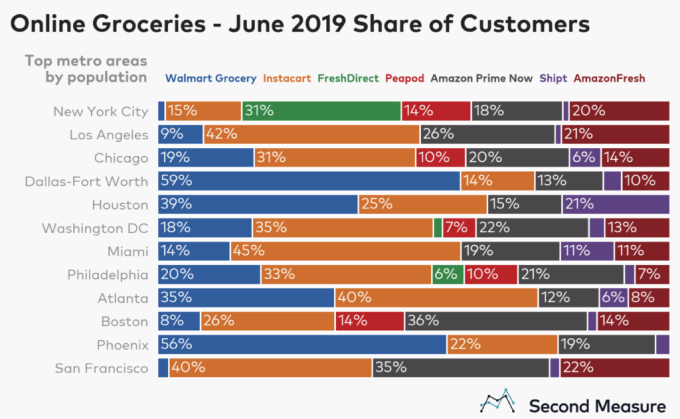
Meanwhile, one exception to Walmart’s dominance in online grocery is in the unique urban metro that is New York. Here, locally headquartered FreshDirect has 31% of the NYC customer base for online grocery. (Note that Second Measure counts customers at each company they use — so customers who shop from more than one are counted twice.) Walmart only has 2% of the NYC metro, by comparison.

It also has small percentages in several other big metros, including San Francisco (2%), Boston (8%) and Los Angeles (9%). Walmart is huge in both Dallas and Phoenix, on the other hand — but both have been early markets for online grocery.

GroceryDelivery chart3 v2

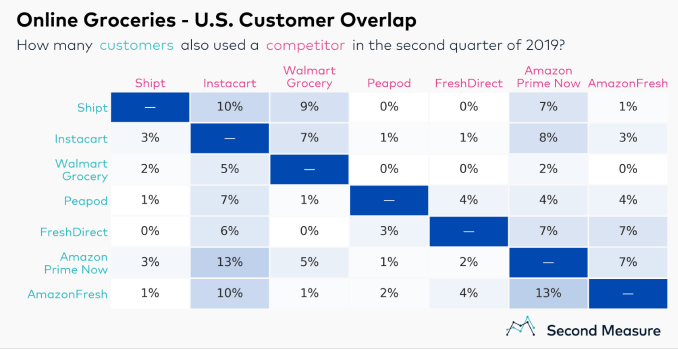
The report additionally found there’s strong loyalty among online grocery shoppers. Unlike with meal delivery services, no grocery delivery company shared more than 9% of another company’s customer base in the second quarter of 2019.

The market still has room to grow, as well. Only 12% of U.S. consumers have tried at least one of the grocery services the report analyzed, up from 9% in June 2018.

13 Aug 2019

Phones, laptops and game consoles get tariff reprieve until December

Electronics manufacturers are no doubt breathing a collective sigh of relief this morning at the news that the United States Trade Representative (USTR) has delayed tariffs on a number of categories.

A long list of exports, including livestock, foodstuff and clothing will have the additional 10 percent tariff imposed on September 1. Others, including “cell phones, laptop computers, video game consoles, certain toys, computer monitors, and certain items of footwear and clothing” have simply been delayed until December 15.

It seems the fees are an inevitability, but many might be able to scrape through just in time for the holidays.

“Certain products are being removed from the tariff list based on health, safety, national security and other factors and will not face additional tariffs of 10 percent,” the USTR writes. “Further, as part of USTR’s public comment and hearing process, it was determined that the tariff should be delayed to December 15 for certain articles.”

That list includes a wide range of electronics, from “telephones for cellular networks or for other wireless networks” to “telephone answering machines” and “cassette players (non‐recording) designed exclusively for motor‐vehicle installation.”

Stock prices for companies like Apple have already seen a positive bump following the news. The White House is expected to have additional trade talks with China next month in Washington, though Trump has since cast some doubt.

Asked by reporters whether he might cancel talks, the President answered, “Maybe. We’ll see what happens.”

13 Aug 2019

Spotify’s podcast dashboard comes out of beta

Over the last couple of years, Spotify has made a big push into podcasts. The tip of the spear has been major investments, including acquisitions of companies like Gimlet and Anchor. It’s all part of the company’s attempt harness a massively growing category and build an audience beyond music.

The other great thing about podcasts for a company like Spotify is the access to a tremendous amount of free content created by third-party producers. They record it, edit it and host it, and all Spotify has to do is index the stuff. Spotify for Podcasters is a new platform for the company designed to give creators more control — or at least insight — into how that content is served up.

The feature came out of beta today and is available for all users, showing key analytics like listening time, number of listeners and episode streams. “With so many podcasts out there, it’s more important than ever that you have the data you need to help you understand and grow your audience,” the company writes. “That’s exactly what your dashboard is designed to provide.”

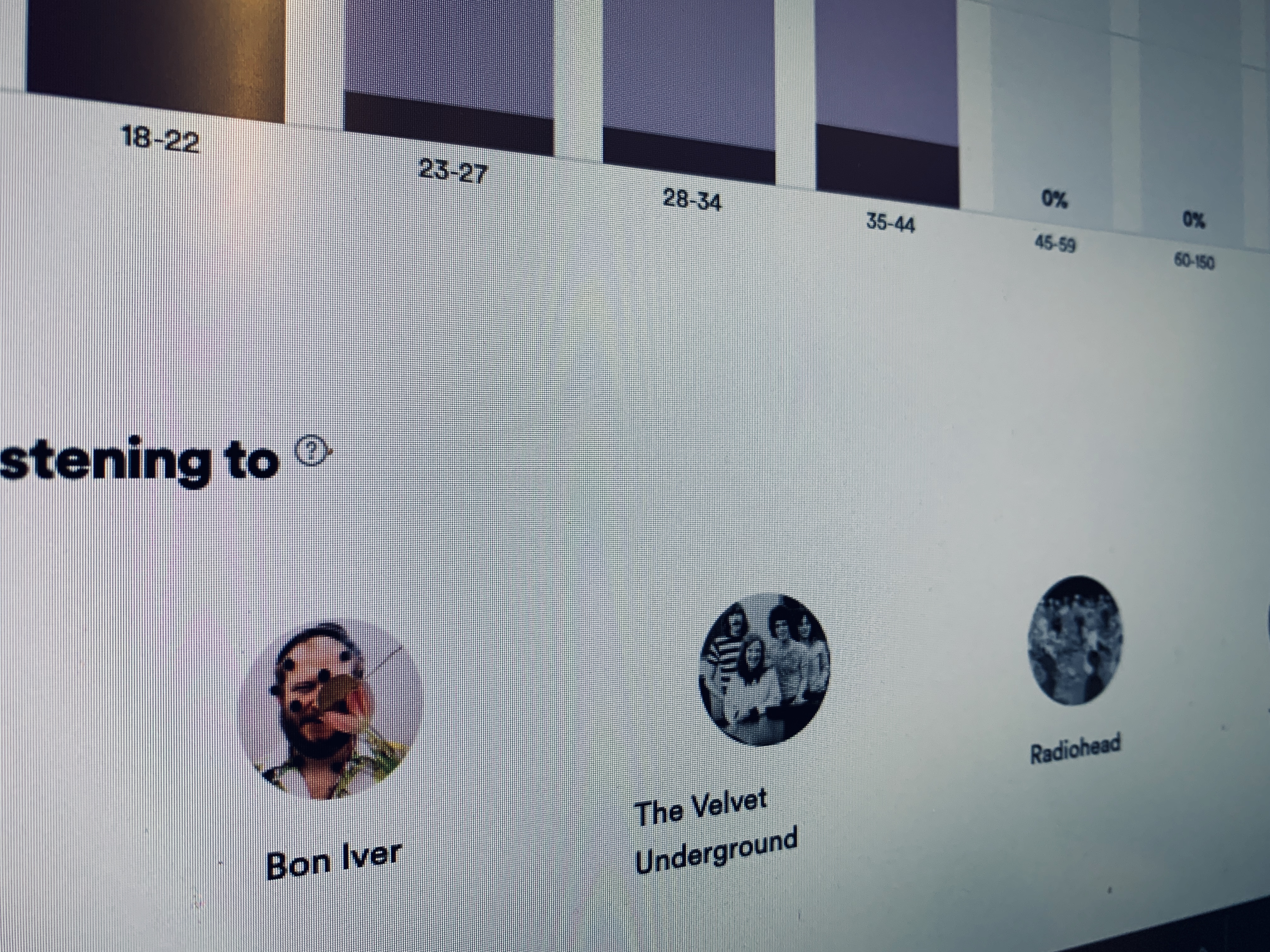
I’ve been playing around with the feature a bit this morning and am finding some interesting bits of demographic info based on the sample. My show RiYL is a mix of different interviews with subjects across a wide variety of different mediums.

No surprise, the ones with musical guests are doing far better than any other. I suspect many or most users are discovering episodes will searching for music on the service. That will likely be the case until Spotify becomes more known for podcast offerings.

IMG 4668

Seems the show’s listeners are mostly male (disappointing, but perhaps not surprising), aged 35-44, located in the United States. The also listen to a lot of Beatles, Bon Iver, Velvet Underground and Radiohead. Go figure.

The feature follows the similar Spotify for Artists offering and promises additional information/insight as it matures.

13 Aug 2019

Roku expands its free, live TV selection with 5 more channels, including fubo’s Sports Network

The Roku Channel continues to expand beyond ad-supported movies and premium subscriptions, with today’s announcement of the addition of several more live TV channels available to anyone with a Roku streaming device or Roku TV. The company says today it’s adding five free live TV channels to this offering, including most notably, fubo’s Sports Network.

The fubo Sports Network is streaming service fuboTV’s first-ever TV channel designed for distribution outside its own platform.

Soft-launched this June, fubo produces content for the channel, including original programming, event coverage, behind-the-scenes, and other exclusives. The network is already available to a few streaming platforms, including XUMO, Samsung TV Plus, and LG Channels (powered by XUMO.)

However, distribution to Roku’s popular entertainment hub is a big win for the new channel, given that Roku is now the top streaming device platform in the U.S., with a 39% share of streaming boxes and sticks and a 33% share of smart TV operating systems.

Other new networks arriving to The Roku Channel today include the ACC Digital Network, USA Today, Now This (news), and Comedy Dynamics.

In addition, The Roku Channel now offers the Sports Illustrated streaming service, SI TV, to any interested subscribers through its Premium Subscription lineup.

Roku has been rapidly expanding its Roku Channel hub since it first launched in September 2017 with a focus on free, ad-supported movies — similar to Vudu’s “Movies on Us” or Tubi, for example. But shortly after, the channel began to roll out more content like newssports, TV shows, and other entertainment offerings both from traditional studios and digital networks. This pushed the channel to become one of the most-watched on its platform.

And this year, Roku launched its own premium subscriptions alongside its free content, allowing The Roku Channel to become not just the place to find free entertainment, but where you tune in to your favorite shows as well. Today, its paid lineup includes top premium networks like HBO, Cinemax, Showtime, Starz, EPIX, and many others.

The decision to invest in its own content hub gives Roku a powerful selling point for its devices — and that appears to be paying off with consumers and in terms of the company’s bottom line.

Roku recently closed out its second quarter with 30.5 million active accounts, up by 1.4 million from the prior quarter, and average revenue per user up from $19.06 in Q1 to $21.06 in Q2. Revenue was also up 45% year-over-year to $252.5 million.


13 Aug 2019

Clumio raises $51M to bring enterprise backup into the 21st century

Creating backups for massive enterprise deployments may feel like a solved problem, but for the most part, we’re still talking about complex hardware and software setups. Clumio, which is coming out of stealth today, wants to modernize enterprise data protection by eliminating the on-premise hardware in favor of a flexible, SaaS-style cloud-based backup solution.

For the first time, Clumio also today announced that it has raised a total of $51 million in a Series A and B round since it was founded in 2017. The $11 million Series A round closed in October 2017 and the Series B round in November 2018, Clumio founder Poojan Kumar told me. Kumar’s previous company, storage startup PernixData, was acquired by Nutanix in 2016. It doesn’t look like the investors made their money back, though.

Clumio is backed by investors like Sutter Hill Ventures, which led the Series A, and Index Ventures, which drove the Series B together with Sutter Hill. Other individual investors include Mark Leslie, founder of Veritas Technologies, and John Thompson, chairman of the board at Microsoft .

2019 08 12 1904

“Enterprise workloads are being ‘SaaS-ified’ because IT can no longer afford the time, complexity and expense of building and managing heavy on-prem hardware and software solutions if they are to successfully deliver against their digital transformation initiatives,” said Poojan Kumar, Clumio founder and CEO. “Unlike legacy backup vendors, Clumio SaaS is born in the cloud. We have leveraged the most secure and innovative cloud services available, now and in the future, within our service to ensure that we can meet customer requirements for backup, regardless of where the data is.”

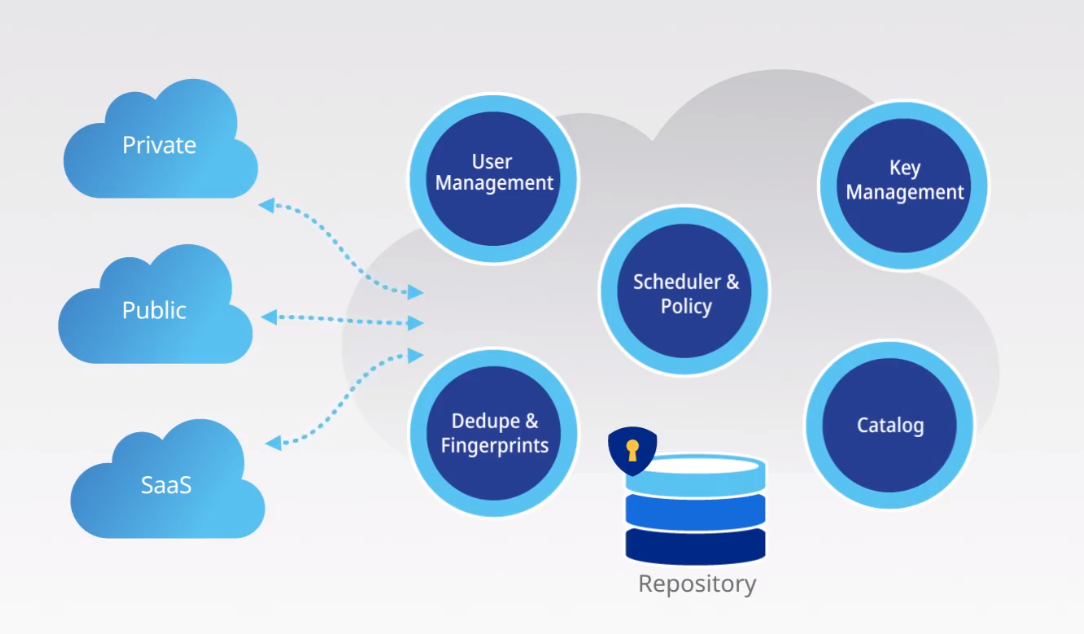
In its current iteration, Clumio can be used to secure data from on-premise, VMware Cloud for AWS and native AWS service workloads. Given this list, it doesn’t come as a surprise that Clumio’s backend, too, makes extensive use of public cloud services.

The company says that it already has several customers, though it didn’t disclose any in today’s announcement.

13 Aug 2019

MasterClass founder launches Outlier, offering online courses for college credit

Aaron Rasmussen, co-founder and former creative director of MasterClass, has a new startup called Outlier.org. Like MasterClass, Outlier is bringing education online, but with a key difference — these are college classes offering real college credit.

The startup is launching a pilot version of its first two courses, Calculus I and Introduction to Psychology, for the coming fall semester. Each course is available for $400. (That covers all costs, including textbooks.)

Despite the .org name and web address, Rasmussen said Outlier is very much a for-profit company, but he said, “We do want to make it clear that our goal is social impact. I believe in market solutions to problems. Coming up with a market solution to education, rather just relying on people’s charity, is far more durable.”

The problem in question is the cost of higher education. Rasmussen said that each year, 1 million students take a college-level Calculus I course in the United States, at an average cost of $2,500. And then 40% of them fail.

“That means we’re wasting $1 billion per year,” he said — and that’s just on a single class.

Outlier

Rasmussen is hardly the first to point out this problem, which is one of the main factors in the growing push for online learning. But he also argued that there’s not “a great online college” yet, due to four main factors.

First, there’s the issue of prestige, which he’s trying to solve by partnering with the University of Pittsburgh — students who pass Outlier’s classes will receive transferable credits from the university (though you’ll want to check whether a specific institution will accept those credits).

Next, there’s the actual content and learning environment. Rather than simply filming classroom lectures (“which can be pretty tedious to watch”) and posting PDFs of the homework and tests, Outlier is shooting classes specifically for online presentation, with instructors speaking directly to the camera, and it’s also offering dynamically generating the problem sets and one-on-one tutoring.

In addition, students can choose from different instructors (the teachers for Calculus I, for example, include Hannah Fry of University College London, Tim Chartier of Davidson College and John Urschel of MIT), or even switch between them mid-semester. And there are smaller touches, like the fact that the website was created in dark mode, so Rasmussen said it doesn’t feel like you’re “staring into a lightbulb” as you’re learning.

Third, there’s the element of social interaction, which is why Outlier will break classes up into smaller study groups of four to five students who can connect over video chat. When I suggested that this may be the hardest part of the college experience to replicate online, Rasmussen said the startup will be trying out different approaches (which he wasn’t ready to specify), but he added, “Part of our approach to this is trying to stay nimble.”

Lastly, there’s the cost. Again, Outlier is charging an introductory price of $400, and while it sounds like the exact number could change, Rasmussen is committed to keeping the price tag at around this level.

He also said that the company is “flipping the philosophy of education” by offering refunds to any student who doesn’t pass. That means Outlier has an incentive to ensure its student’s success — but does it also create an incentive to simply pass every student?

“The real stopgap there is that we are overseen by the accrediting partner university,” Rasmussen said. “They literally have checked our midterms and finals and things like that … That puts a bit of a failsafe there.”

While Outlier is only offering two pilot courses this fall, the obvious goal is to add more classes over time. Students might take these classes during their summer break, or as a supplement to their in-person classes, or as a way to get college credit when life circumstances make it difficult for them to attend residential university.

Still, even as it grows, Rasmussen suggested that Outlier will remain focused on “the first 25 college-level courses,” rather than recreating an entire college curriculum.

“As far as the next couple years of college after that, there’s just a lot of benefit to going to a residential college for those upper-level courses,” he said. “We’re really focused on these first couple years [where we can] hack down a bunch of the student debt.”

13 Aug 2019

Samsung’s Note 10 game streaming arrives in early September

GalaxyPlay Link got fleetingly little stage time at last week’s Unpacked event. It’s true that Samsung had a lot of information to jam into the hour-long press conference, but the offering was glazed over during a brief segment on mobile gaming — a surprising choice given how big of an industry the category has become.

We got a little more information from the company by way of a quick “hands-on” video served through Samsung’s Korean video channel, but that’s about all we’ve heard. Here’s what we know to date: GamePlay Live is a streaming service that makes it possible to stream PC games to the Note 10.

We can now add that the service will be available as a downloadable app (for Android and Windows 10) at some point during the first two weeks of September. The service is free and leverages technology created by Parsec, a New York-based cloud gaming startup that we covered way back in late 2017. The company’s technology is being used in the PlayGalaxy app, allowing users to stream titles from a Windows PC with limited latency.

“It’s humbling and exciting to us to be the chosen partner to provide the low latency streaming technology that powers the PlayGalaxy Link application,” Parsec’s CEO and co-founder Benjy Boxer says in a release. “This further demonstrates that our market leading technology can form the core of any game streaming product. Providing our ultra low latency high frame rate streaming software and our proprietary networking to other companies furthers our mission to democratize access to games.”

Parsec Artwork

The offering arrives as some of tech’s most prominent names are taking more active — although often distinct — interests in mobile gaming. Apple will be launching its arcade mobile gaming subscription service, while Google is offering full-on remote game streaming through Stadia. Microsoft, which recently announced a major partnership with Samsung, will provide similar console-to-mobile streaming with the Xbox.

Parsec, meanwhile, will be offering developer tools through a newly released SDK.