Year: 2019

13 Aug 2019

Nvidia breaks records in training and inference for real-time conversational AI

Nvidia’s GPU-powered platform for developing and running conversational AI that understands and responds to natural language requests has achieved some key milestones and broken some records that have big implications for anyone building on their tech – which includes companies large and small, since much of the code they’ve used to achieve these advancements is open source, written in PyTorch and easy to run.

The biggest achievements Nvidia announced today include its breaking the hour mark in training BERT, one of the world’s most advanced AI language models and a state-of-the-art model widely considered a good standard for natural language processing. Nvidia’s AI platform was able to train the model in under an hour, a record-breaking achievement at just 53 minutes, and the trained model could then successfully infer (ie, actually applying the learned capability achieved through training to achieve results) in under 2 milliseconds (10 milliseconds is considered a high-water mark in the industry), another record.

Nvidia’s breakthroughs aren’t just cause for bragging rights – these advances scale and provide real-world benefits for anyone working with their NLP conversational AI and GPU hardware. Nvidia achieved its record-setting times for training on one of its SuperPOD systems which is made up of 92 Nvidia DGX-2H systems runnings 1,472 V100 GPUs, and managed the inference on Nvidia T4 GPUs running Nvidia TensorRT – which beat the performance of event highly optimized CPUs by many orders of magnitude. But it’s making available the BERT training code, and TensorRT optimized BERT Sample via GitHub for all to leverage.

Alongside these milestones, Nvidia’s Research wing also build and trained the largest ever language model based on ‘Transformers,’ which is the tech that underlies BERT, too. This custom model includes a massive 8.3 billion parameters, making it 24 times the size of BERT-Large, the largest current core BERT model. Nvidia has cheekily titled this model ‘Megatron,’ and also offered up the PyTorch code it used to train this model so that others can also train their own similar, massive Transformer-based language models.

13 Aug 2019

DJI slims down and simplifies its smartphone gimbal

As we noted last month, DJI’s camera stabilizer line began life as an offshoot of the company’s drone offerings. Since then, however, it’s grown into a pretty massive portfolio in its own right, spanning from SLR to standalone pocket offerings.

For obvious reasons, the Osmo Mobile has been one of the more popular models. Designed for smartphone users, the product is among the most accessible DJI offerings, with out of the box operation for both iOS and Android users.

09

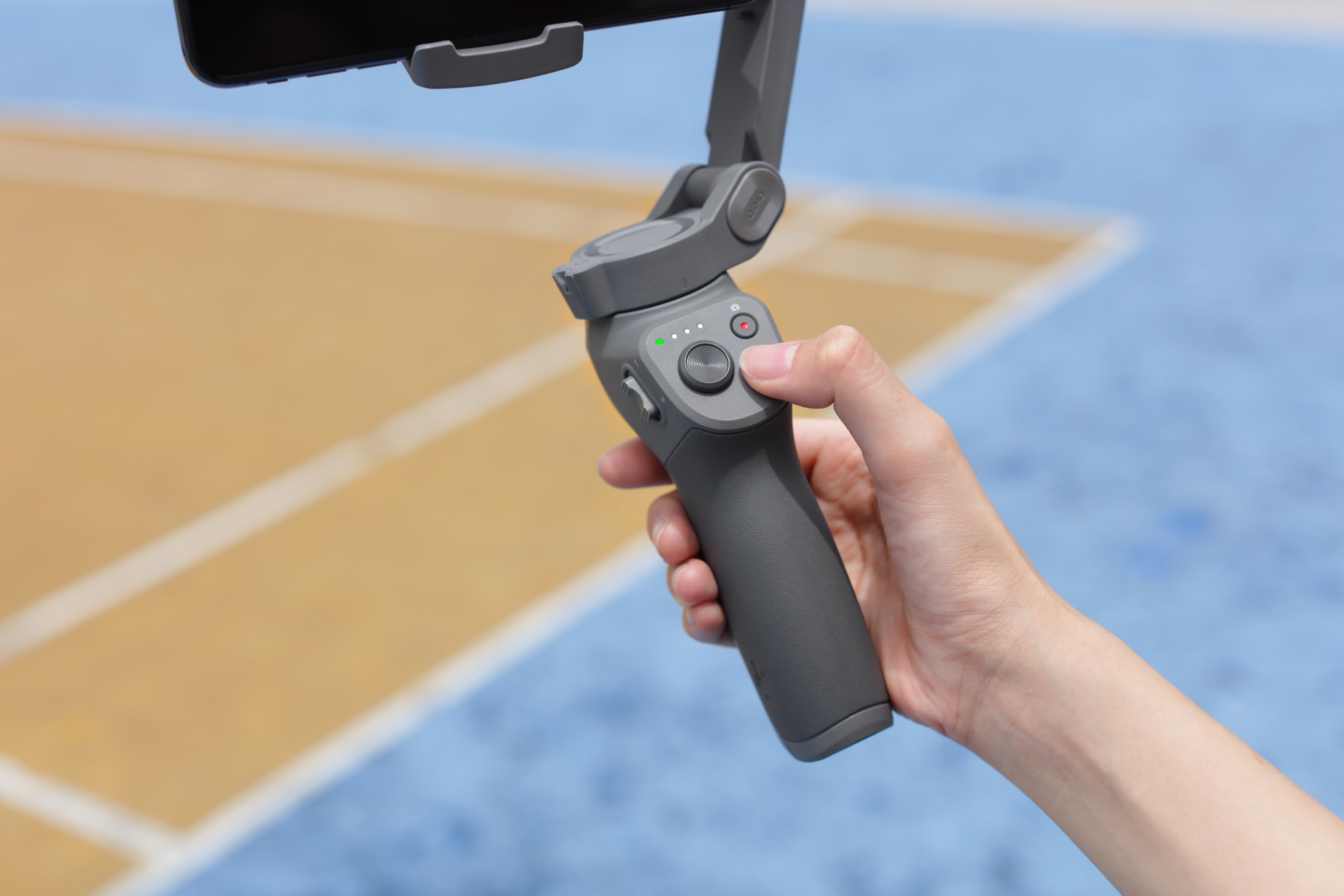
The company says it “went back to the drawing board” for the latest version of the handheld gimbal, but the Osmo Mobile 3 is really more of an evolution. The company took some customer feedback to heart and provided a handful of key changes. The new device is smaller and foldable, so users can much more easily toss it in a backpack. A DJI rep I spoke with suggested that it might fit in a pocket, but that’s a bit ambitious.

The other big piece of the puzzle is that DJI has made it a lot easier to operate the system with one hand. Most of the functions are executed using the back trigger or a combination of the front thumb buttons. There’s a new Quick Roll feature, which switches between landscape and portrait with the click of a button, while triple-clicking the trigger flips it into selfie mode. The trigger is also used to recenter the camera or lock into place.

018

There’s a bunch of software features borrowed from the company’s drones and the higher-end Ronin line, including Story Mode, Gesture Control, ActiveTrack, TimeLapse and HyperLapse. I didn’t really get much hands-on time with those, but we’ll be getting a review unit into the hands of our video team soon.

All in all, it looks like a nice little update. It’s also a bit cheaper, starting at $119 for the standard version and $139 for a bundle that includes a tripod. The Osmo Mobile 3 is available starting today.

13 Aug 2019

Rimeto lands $10M Series A to modernize the corporate directory

The notion of the corporate directory has been around for many years, but in a time of more frequent turnover and shifting responsibilities, the founders of Rimeto, a 3 year old San Francisco startup, wanted to update it to reflect those changes.

Today, the company announced a $10 million Series A investment from USVP, Bow Capital, Floodgate and Ray Dalio, founder of Bridgewater Associates.

Co-founder Ted Zagat says that the founders observed shifting workplace demographics and changes in the way people work. They believed it required a better to way to locate people inside large organizations, which typically used homegrown methods or relied on Outlook or other corporate email systems.

“On one hand, we have people being asked to work much more collaboratively and cross-functionally. On the other, is an increasingly fragmented workplace. Employees really need help to be able to understand each other and work together effectively. That’s a real challenge for them,” Zagat explained.

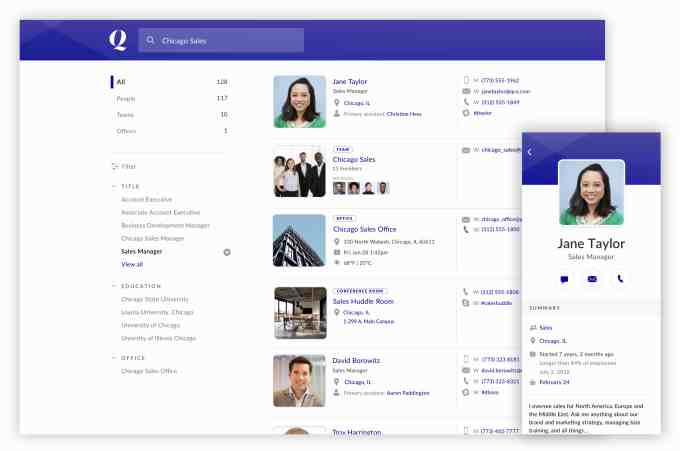
Rimeto has developed a richer directory by sitting between various corporate systems like HR, CRM and other tools that contain additional details about the employee. It of course includes a name, title, email and phone like the basic corporate system, but it goes beyond that to find areas of expertise, projects the person is working on and other details that can help you find the right person when you’re searching the directory.

Rimeto product version 1 1

Rimeto directory on mobile and web. Screenshot: Rimeto

Zagat says that by connecting to these various corporate systems and layering on a quality search tool with a variety of filters to narrow the search, it can help employees connect to others inside an organization more easily, something that is often difficult to do in large companies.

The tool can be accessed via web or mobile app, or incorporated into a company intranet. It could also be accessed from a tool like Slack or Microsoft Teams.

The three founders — Zagat, Neville Bowers and Maxwell Hayman — all previously worked at Facebook. Unlike a lot of early stage startups, the company has paying customers (although it won’t share exactly how many) and reports that it’s cash-flow positive. Up to this point, the three founders had boot-strapped the company, but they wanted to go out and raise some capital to begin to expand more rapidly.

13 Aug 2019

Snap introduces Spectacles 3, with two HD cameras and 3D effects on Snapchat

Snap has introduced a third generation of its Spectacles wearable sunglass cameras, and these include new 3D effects for use in Snapchat. You can capture 3D snaps, with a slight side-to-side depth effect thanks to dual angle cameras; 3D filters, which add AR graphics effects to captured video; 3D lenses, which add stickers and characters to your Snaps; and 3D viewing, which lets you use and included stereoscopic viewer to get the same perspective as someone who’s captured video using their Spectacles when viewing their Snaps.

[gallery ids="1867930,1867932,1867936"]

To achieve the 3D effects, this new hardware includes not one but two cameras, one at each outside top corner of the sunglass lenses. Both of these capture in HD, and record at 60 fps. Audio is captured using a four-microphone array, which Snap says helps improve the audio considerably on captured content. There’s a capture button to trigger photo or video shooting on either side.

The glasses themselves are constructed from a single sheet of stainless steel, and they’re designed to be lightweight for all-day wearing. They come in carbon black, and a “mineral” colorway that looks like a dusty rose. Each comes with a charging case for storage and powering up (which charges via includes USB C), and which folds completely flat when the glasses aren’t inside for easier carrying.

[gallery ids="1867924,1867923"]

Spectacles 3 are coming this fall, and going through the order flow for pre-orders reveals a shipping date of November. The new sunglasses retail for $380, which is more than their predecessors ($150 and $200 respectively for the original and Nico/Veronica Spectacles 2 variants) and they are not water resistant, unlike the gen 2 glasses. But that second camera definitely ups the game in terms of technical capabilities, so you can see where the additional cost comes from. Snap also says that these will indeed be a very limited edition production run, compared to previous generations.

The big changes here are clearly the 3D effects that are now possible in Snapchat, which should help tie these back more tightly to Snap’s software. Spectacles 2 offered better export formats for more general sharing, but it seems likely that the company is hoping to help showcase its AR filters and features with the unique capture capabilities of Spectacles 2. Point-of-view viewing is also unique to Snapchat, and should help Snap emphasize more Snapchat’s identify as the platform on which you feel most comfortable sharing with close friends.

13 Aug 2019

SNES controller for Switch shows up in FCC filing, hinting at SNES games for Nintendo Online

Nintendo looks set to release wireless SNES controllers for the Nintendo Switch, which likely means it’ll also be bringing classic SNES titles to its Nintendo Online virtual gaming library. The news comes via an FCC filing (hat tip to Eurogamer) , which includes a diagram of what looks very clearly to be the backside of a Super Nintendo-style wireless controller.

The diagram includes a model number that uses the ‘HAC’ code that Nintendo employs to designate Switch accessories, and past history suggests that the arrival of retro-inspired hardware for the Switch also means throwback games are on their way. Nintendo launched wireless NES controllers for the Nintendo Switch in September, and they arrived alongside NES games delivered via Nintendo Online as free perks for subscribers.

The FCC filing is more or less concrete proof that Nintendo intends to release something, but the rest is speculation (if very likely, informed speculation) at this point. Still, it seems inevitable that Nintendo bring its SNES library to the Switch, especially since it did so for the Wii Virtual Console before.

13 Aug 2019

Dostavista, the ‘crowdsourced’ same-day delivery service, raises $15M Series B

Dostavista, the “crowdsourced” same-day delivery service founded in Russia but operating in several countries, has raised a $15 million Series B. Leading the round is Vostok New Ventures, with participation from existing investors Flashpoint, and Addventure.

Founded in 2012 by Mike Alexandrovski, after he initially considered creating a game where players would be asked to deliver virtual items before pivoting to the real thing, Dostavista promises same-day delivery powered by its network of “trusted couriers”.

Via the Dostavista mobile app, a gig economy-styled courier can be booked to pick up and deliver the requested item in a claimed “less than 90 minutes”.

The company currently operates in 11 countries, including Brazil, India, Indonesia, Korea, Malaysia, Mexico, the Philippines, Russia, Thailand, Turkey and Vietnam. It employs almost 400 people and says it is on track to hit a $100 million GMV run rate.

Perhaps most noteworthy in the highly competitive and usually cash intensive market of delivery, Dostavista says it is already profitable.

“These days it’s possible to order food to your house in a half-hour, taxi in minutes, but unless you’re an Amazon Prime member, your options for affordable, same-day delivery of goods are very limited,” says Alexandrovski in a statement. “That’s a problem and one we intend to solve”.

Meanwhile, today’s injection of capital will be used to invest further in its product, try out new “bold” product experiments, and for more aggressive marketing and sales. This will include strengthening the global team through additional hires.

13 Aug 2019

Singularity 6 raises $16.5M from Andreessen Horowitz to create a ‘virtual society’

When Fortnite reached stratospheric popularity early last year, there were undoubtedly an awful lot of VCs on the sidelines looking enviously at the massive platform and wondering what opportunities could be gleaned from its rapid rise.

Epic Games went on to raise later that year at a nearly $15 billion valuation so some of those investors decided to invest directly in the Fortnite creator’s continued ascent, but others have been looking to get in on the ground floor of new operations that are aiming to rethink the line between video games and social networks.

Today, Andreessen Horowitz announced that it’s leading the $16.5 million Series A of a stealthy gaming startup called Singularity 6. The startup’s ex-Riot Games co-founders claim their venture is less focused on building a button-mashing competitive shooter than it is a “virtual society” where users can develop relationships with in-game characters powered by “complex AI”.

Singularity 6

Singularity 6 co-founders Anthony Leung (left)and Aidan Karabaich (right)

London Venture Partners (LVP) and FunPlus Ventures also participated in the Series A round. LVP led the company’s $2.5 million seed round last year.

“The near term focus is our first product, building a world that begins to tackle the community simulation space, and that’s really combining a strong virtual community with deep and compelling gameplay,” CEO Anthony Leung told TechCrunch in an interview.

He says that the company’s influences for its first title include “Animal Crossing, Stardew Valley and The Legend of Zelda: Breath of the Wild.”

While the co-founder did specify that Singularity 6 is a “game and tech company” he didn’t have too much to say about what that tech was. “We actually have to roll out a lot of custom tech, because there aren’t really any off-the-shelf solutions for the MMO aspects or the virtual community features,” Leung told us.

A16z has already invested in a company building the underlying tech for MMOs, Improbable, which has raised $600 million+ for its server-stitching SpatialOS platform. Investors like Andreessen Horowitz are largely ambitious that the gaming market will continue to grow as major players invest heavily in platforms that make the titles more accessible to new user bases.

“Interactive entertainment has become more mainstream and approachable than ever before, as technology use is no longer for fringe or techy groups – this new generation of ‘gamers’ is becoming more inclusive of everyone – as immersive, digital experiences will become as accessible and commonplace as the social forums we know and love today.” wrote a16z Partner Andrew Chen, who is taking a seat on Singularity 6’s board as part of this deal, in a blog post.

Singularity 6 isn’t sharing a release date for its “virtual society” quite yet, but Leung tells me the title is “still a ways out” from launch.

13 Aug 2019

Rocket Internet’s Caterwings acquires German business catering marketplace Lemoncat

Caterwings, the Rocket Internet-founded corporate catering marketplace that operates in 8 countries, has acquired German competitor Lemoncat.

Terms remain undisclosed, although I understand from a source close to the company that it was an “8-digit all stock” deal and sees investors, which include Lukasz Gadowski, Target Global, Point 9, and Northzone, pick up shares in Caterwings’ parent company B2B Food Group.

Noteworthy, Rocket Internet was also an investor in Lemoncat, despite founding Caterwings, as it is prone to do.

Meanwhile, the two combined companies are disclosing the completion of another financing round to bolster the newly rolled up venture. The sees a further €5 million invested into B2B Food Group, bringing total investment to €13 million in the last 9 months.

I’m told Lemoncat’s legacy investors participated, signalling that they remain bullish on the corporate catering market, essentially doubling down on their investment in the space rather than seeking an exit.

“The market in Europe is clearly there and the question is not whether it will be digitalized, but only when,” says Lemoncat founder and CEO Doreen Huber. “Hence I am thrilled to be part of the further expansion of the international market leadership of the B2B Food Group”.

The merger of the two companies also comes shortly after takeout food behemoth Just Eat acquired City Pantry, a rival to Caterwings in the U.K., for £16 million.

“It proves to us that also the big consumer food platforms see how great the B2B market is,” Huber tells me. “The baskets are much higher and therefore a business customer is more attractive”.

13 Aug 2019

Facebook denies making contradictory claims on Cambridge Analytica and other ‘sketchy’ apps

Facebook has denied contradicting itself in evidence to the UK parliament and a US public prosecutor.

Last month the Department for Digital, Culture, Media and Sport (DCMS) committee wrote to the company to raise what it said were discrepancies in evidence Facebook has given to international parliamentarians vs evidence submitted in response to the Washington, DC Attorney General — which is suing Facebook on its home turf, over the Cambridge Analytica data misuse scandal.

Yesterday Bloomberg obtained Facebook’s response to the committee.

In the letter Rebecca Stimson, the company’s head of U.K. public policy, denies any inconsistency in evidence submitted on both sides of the Atlantic, writing:

The evidence given to the Committees by Mike Schroepfer (Chief Technology Officer), Lord Allan (Vice President for Policy Solutions), and other Facebook representatives is entirely consistent with the allegations in the SEC 
Complaint filed 24 July 2019. In their evidence, Facebook representatives truthfully answered questions about when the company first learned of Aleksandr Kogan / GSR’s improper transfer of data to Cambridge Analytica, which was in 
December 2015 through The Guardian’s reporting. We are aware of no evidence to suggest that Facebook learned any earlier of that improper transfer.

 As we have told regulators, and many media stories have since reported, we heard speculation about data scraping by Cambridge Analytica in September 2015. We have also testified publicly that we first learned Kogan sold data to Cambridge Analytica in December 2015. These are two different things and this 
is not new information.

Stimson goes on to claim that Facebook merely heard “rumours in September 2015 that Cambridge Analytica was promoting its ability to scrape user data from public Facebook pages”. (In statements made earlier this year to the press on this same point Facebook has also used the word “speculation” to refer to the internal concerns raised by its staff, writing that “employees heard speculation that Cambridge Analytica was scraping data”.)

In the latest letter, Stimson repeats Facebook’s earlier line about data scraping being common for public pages (which may be true, but plenty of Facebook users’ pages aren’t public to anyone other than their hand-picked friends so… ), before claiming it’s not the same as the process by which Cambridge Analytica obtained Facebook data (i.e. by paying a developer on Facebook’s platform to build an app that harvested users’ and users friends’ data).

The scraping of data from public pages (which is unfortunately common for any internet service) is different from, and has no relationship to, the illicit transfer to third parties of data obtained by an app developer (which was the subject of the December 2015 Guardian article and of Facebook representatives’ evidence),” she writes, suggesting a ‘sketchy’ data modeling company with deep Facebook platform penetration looked like ‘business as usual’ for Facebook management back in 2015. 

As we’ve reported before, it has emerged this year — via submissions to other US legal proceedings against Facebook — that staff working for its political advertising division raised internal concerns about what Cambridge Analytica was up to in September 2015, months prior to The Guardian article which Facebook founder Mark Zuckerberg has claimed is the point when he personally learned what Cambridge Analytica was doing on his platform.

These Facebook staff described Cambridge Analytica as a “sketchy (to say the least) data modeling company that has penetrated our market deeply” — months before the newspaper published its scoop on the story, per an SEC complaint which netted Facebook a $100M fine, in addition to the FTC’s $5BN privacy penalty.

Nonetheless, Facebook is once claiming there’s nothing but ‘rumors’ to see here.

The DCMS committee also queried Facebook’s flat denial to the Washington, DC Attorney General that the company knew of any other apps misusing user data; failed to take proper measures to secure user data by failing to enforce its own platform policy; and failed to disclose to users when their data was misused — pointing out that Facebook reps told it on multiple occasions that Facebook knew of other apps violating its policies and had taken action against them.

Again, Facebook denies any contradiction whatsoever here.

“The particular allegation you cite asserts that Facebook knew of third party applications that violated its policies and failed to take reasonable measures to enforce against them,” writes Stimson. “As we have consistently stated to the Committee and elsewhere, we regularly take action against apps and developers who violate our policies. We therefore appropriately, and consistently with what we told the Committee, denied the allegation.”

So, turns out, Facebook was only flat denying some of the allegations in para 43 of the Washington, DC Attorney General’s complaint. But the company doesn’t see bundling responses to multiple allegations under one blanket denial as in any way misleading…

In a tweet responding to Facebook’s latest denial, DCMS committee chair Damian Collins dubbed the company’s response “typically disingenuous” — before pointing out: “They didn’t previously disclose to us concerns about Cambridge Analytica prior to Dec 2015, or say what they did about it & haven’t shared results of investigations into other Apps.”

On the app audit issue, Stimson’s letter justifies Facebook’s failure to provide the DCMS committee with the requested information on other ‘sketchy’ apps it’s investigating, writing this is because the investigation — which CEO Mark Zuckerberg announced in a Facebook blog post on March 21, 2018; saying then that it would “investigate all apps that had access to large amounts of information”; “conduct a full audit of any app with suspicious activity”; “ban any developer from our platform that does not agree to a thorough audit”; and ban any developers found to have misused user data; and “tell everyone affected by those apps” — is, er, “ongoing”.

More than a year ago Facebook did reveal that it had suspended around 200 suspicious apps out of “thousands” reviewed. However updates on Zuckerberg’s great app audit have been thin on the ground since then, to say the least.

“We will update the Committee as we publicly share additional information about that extensive effort,” says Stimson now.

13 Aug 2019

WeChat Pay and Alipay partner QFPay raises $20 million to develop new digital payment solutions

Digital payments startup QFPay announced today that it has raised $20 million in new funding led by returning investors Sequoia Capital China and Matrix Partners. MDI Ventures, the investment arm of state-owned Indonesian telecom Telkom Indonesia, Rakuten Capital and VentureSouq also participated as new strategic investors.

According to Crunchbase, this brings QFPay’s total raised so far to $36.5 million. The funding will be used to develop new digital payment products.

QFPay is the largest global partner of WeChat Pay and Alipay, enabling them to process payments to merchants around the world. Founded in 2012, QFPay first launched in China and is known for its QR code-based technology. Its products include end-to-end online and offline mobile payment solutions and add-on services like food ordering and customer loyalty programs. The company claims that it has served over 1.2 million merchants and processed over 1 billion transactions.

QFPay is currently present in 13 markets: Cambodia, China, Hong Kong, Indonesia, Japan, Korea, Laos, Malaysia, Myanmar, the Philippines, Singapore, Thailand and United Arab Emirates.

In a statement, co-founder and CEO Tim Lee said “We have built our track record, know-how and expertise in this industry since we launched in China, which is dubbed as the birthplace of digital payment. We are excited to leverage what we have learned in the past seven years to help lead the cashless movement in the rest of Asia as demand for digital payment, particularly QR-code payment method, heats up.”