Year: 2019

13 Aug 2019

China’s largest Q&A platform, Zhihu, raises $434 million from investors including Kuaishou, Baidu and Tencent

Zhihu, the largest question and answer platform in China, has raised a $434 million Series F. This is not only the company’s biggest round since it launched in 2011, but also one of the largest secured over the past two years by a Chinese Internet culture and entertainment company, said China Renaissance, which served as the funding’s financial advisor.

The Series F was led by Beijing Kuaishou, the video and live-streaming app, with participation from Baidu . Existing investors Tencent and CapitalToday also returned for the round, which Zhihu will use for technology and product development. Baidu told Bloomberg that it will add 100 million Zhihu posts to its main app.

While Zhihu has downplayed reports that it is planning an IPO, it embarked on plans to hire a CFO and restructure last year.

Zhihu users tend to be educated with relatively high incomes and the platform has developed a reputation for hosting experts and organizations that are knowledgeable in tech, marketing and professional services like education. Like Quora and other Q&A platforms, Zhihu lets users post and answer text-based questions. But it also has other features, including discussion forums, a publishing platform and live videos for brands and companies to answer questions in real-time. Instead of making its streaming video feature, called Zhihu Live, open to all users, it is available to only to experts and organizations, differentiating it from other streaming apps like Douyin, the domestic version of TikTok (ByteDance is an investor in Zhihu but did not participate in this round).

In a post about the round on his Zhihu page, founder and CEO Victor Zhou wrote the company plans to keep up with rapid changes in China’s media and Internet landscape. “Over the past 8 years, users have gone from expecting simple entertainment to using the Internet to deal with real-life and work problems. The focus of competition has also shifted from traffic to traffic + quality.”


13 Aug 2019

Porsche packs the power into its newest Cayenne plug-in hybrids

Porsche is upping its plug-in hybrid game with several new vehicles added to its lineup, including a power-packing 2020 Cayenne Turbo S E-Hybrid.

The plug-in version of this flagship SUV combines a 14.1-kilowatt-hour battery and 134-horsepower electric motor with a 4.0-liter twin turbocharged V8 engine found in the traditional gas-powered Cayenne Turbo. The electric motor is located between the V8 engine and its standard eight-speed transmission.

The upshot is a 670-horsepower plug-in beast that produces 663 pound-feet of torque and can travel from 0 to 60 miles per hour in 3.6 seconds. Not bad for an SUV.

But it’s not all about power. Porsche also increased the energy capacity of its battery, 30% more than the one used in previous generation plug-in hybrid Cayenne models. EPA fuel economy figures have not been released yet, but if it’s like other Porsche plug-in hybrids, the range will be somewhere around 20 or so miles.

The automaker has a number of nifty standard items in the Cayenne Turbo S E-Hybrid (and two new plug-in variants of the Cayenne Coupé), including a 7.2 kW onboard charger and 21-inch AeroDesign Wheels. The upgraded charger enables a complete recharge of the battery in as little as 2.4 hours when using a 240-volt connection with a 50-amp circuit, according to Porsche.

The plug-in versions of Cayenne Turbo and the Cayenne Turbo Coupé also comes standard with Porsche’s ceramic composite brakes, dynamic chassis control and other bonuses like 18-way adaptive sports seats.

All of this has a price, of course. The base price of the 2020 Porsche Cayenne Turbo S E-Hybrid is $161,900.

porsche cayenne plgu in

2020 Porsche Cayenne Turbo S E-Hybrid

Porsche also took the wraps off of two other plug-in variants of its new Cayenne Coupé, a smaller, flashier version of the Cayenne. Both Cayenne Coupé variants feature a fixed spoiler above the rear window with a new adaptive rear spoiler below it that’s designed to enhance aerodynamic stability.

The Cayenne Turbo S E-Hybrid Coupé has a base price of pricier $164,400, slightly more expensive than its Cayenne Turbo S E-Hybrid counterpart due to a few additional extras such as 20-inch alloy wheels and a glass panoramic roof.

But the two high-end vehicles share many of the same standard items and stats. Both vehicles can travel from 0 to 60 miles per hour in 3.6 seconds and reach a top speed of 183 miles per hour, which is electronically limited.

Porsche also unveiled a less powerful and cheaper 455-horsepower Cayenne E-Hybrid Coupé that has a V6 engine and a base price of $86,400. This coupé version, which has the same powertrain as the Cayenne E-Hybrid, has a top speed of 157 mph and can travel from 0 to 60 in 4.7 seconds.

12 Aug 2019

Automattic’s bargain-bin Tumblr deal plugs right into the WordPress business model

Tumblr has been an millstone around the neck of its owners, first Yahoo and later Oath and Verizon Media, pretty much since it was acquired in 2013. They never found an answer to the question that new owner Automattic is presumably about to take a crack at: how to make this unruly erstwhile porn factory turn a profit.

Amazingly, the secret technique that Tumblr may have been waiting for was good old-fashioned business sense: make something people want, then charge them a good price for it. Tumblr may fit into the WordPress model and do just this — quite a change from the indirect monetization attempts of the past decade.

The Yahoo acquisition under the stewardship of Marissa Mayer seems to have been made with the assumption, naive in retrospect but incredibly common in that era, that you could buy an audience, plunk some ads in the product, then sit back and let the money roll in.

But beyond doing that, Yahoo never really did anything with Tumblr apart from adding a few features and expanding ads. And for a while growth was good and the network flourished, even rivaling Instagram on some metrics.

But over time Tumblr, and “microblogging” in general, declined as more focused social experiences like Instagram took over, and it prospered in other, less savory ways. Porn grew to become a huge proportion of the content of the site, a large majority by some estimates — but to guess at the amount of porn on Tumblr is like trying to count the waves in the ocean.

After a run-in with Apple last year over allegations of child porn on the platform and its subsequent removal from the App Store, management somewhere in or above Tumblr — founder David Karp had long since left — decided at the end of 2018 to kill off all porn on the platform. The resulting exodus of users, and generally speaking the removal of the internet’s most popular form of content, must have practically decimated the site’s numbers. I don’t think it ever made a dime, but now it was losing money and users.

Hence, after following a long and rather boring path, Tumblr has arrived at the doorstep of WordPress wrapped in a bow. So what now? The answer lies in Tumblr’s original strengths and brand, which years of neglect have only partly tarnished.

Tumbling ideas

In the years since Tumblr was bought, its rivals have taken its best parts and run with them.

Tumblr was a community of communities — Pinterest and Reddit took this over with savvy partnerships and sticky user recruitment.

Tumblr was a simple, visual blog — Instagram completely took over a large part of this space, simplifying and streamlining, while hosts like Imgur appeared like remorae on the social networks, sucking up viral traffic.

Tumblr was a free, customizable home for artists — artists who later left for simple storefronts combined with one of the above platforms, or one more suited to them, like DeviantArt (!).

There are plenty of other ways that Tumblr helped nudge the internet economy forward, but it never evolved itself, an evolutionary dead end that found itself outcompeted in every niche.

Automattic, which reportedly bought the whole shebang for a few million dollars, is actually in a good position here. It is not saddled with a billion-dollar valuation it needs to justify and make back in five years. Automattic is a successful company and a few million bucks — plus all the recurring expenses — likely isn’t going to significantly impact their bottom line in the short run, especially what is likely to be a rather destructive redundancy check.

Leaving aside porn, Tumblr can still arguably be said to be known for its resilient and weird niche communities and a simple, easily created and customized “home on the web.”

WordPress is well known as being a step above these things, focusing on savvier users and businesses who not only don’t mind dealing with plugins and code upkeep, but who are willing to themselves actually pay for the services they use.

And old dog, but the tricks aged well

As a “baby’s first website” Tumblr is a great option, and unlike 7 or 8 years ago, one that WordPress knows how to monetize. Not only that, but people are leaving some of the communities that appeared in Tumblr’s wake as they begin to encroach on privacy and good practices. Etsy sellers, for instance, are being squeezed by the company’s insistence on free shipping. And while Instagram is a great place to advertise, it and Facebook still haven’t figured out the buying-stuff-on-it piece to anyone’s great satisfaction.

It’s not exactly a home run, since personal websites are also very ten years ago. But the migration to larger platforms has proven unsatisfactory: Your data is sucked up and sold, there’s cross-pollination with your personal stuff, the promised capabilities don’t appear, and so on. The pendulum is swinging away from companies like Facebook, Twitter, and Google, which have exhibited little interest in fostering user communities that don’t directly contribute to their primary business cases (where they exist).

Why shouldn’t Automattic snatch up a storied personal publishing website, recently swept of porn, with a good reputation for thriving, self-organized communities? Especially if it already has a business model that works and doesn’t require compromising the basic value proposition of the personal publishing website in question.

WordPress doesn’t make its money by displaying ads on the blogs it hosts, but through ordinary services and skimming a bit here and there from others using the platform to reach customers. Isn’t that a good match for Tumblr, or at least a good enough match to give it a shot? Yahoo’s unimaginative plan didn’t play to Tumblr’s strengths, and in fact may have resulted in exacerbating its weaknesses as engagement metrics were paramount, regardless of whether they were garbage clicks or not.

Tumblr is a relic of an older web, a younger and more naive one, in both good ways and bad. It was ill suited to the economy Yahoo attempted to shoehorn it into, and failed to become anything more than what it started as. But while it was a poor fit for web platforms that attempted to leverage their users as value to third parties, it may yet be a good fit for a company that just wants to charge money for goods and services and has found success doing so.

As a junior WordPress platform that combines personal website with small communities, blogging, and marketplaces, a new Tumblr could be a great match for an increasingly decentralized web economy. Whether Automattic will be able to make good on this particular venture is difficult to say. But one thing is for sure: They have a better chance of making back their purchase price than Yahoo did, and a lot less to lose if they don’t.


12 Aug 2019

How lawyers help bring your acquisition deal to fruition

Last week when Salesforce announced it was buying ClickSoftware for $1.35 billion you might not have realized it, but the law firm Shearman & Sterling was advising Salesforce throughout the deal. In fact, there are lawyers involved in every transaction of this sort from the initial call to the closing.

As you would expect, there are hundreds of tiny details involved in bringing a deal to fruition from checking the validity of the offer, checking the financial health of the target company, negotiating a price and terms and clearing it with the boards/stockholders. Even after the deal is signed and agreed upon by both companies, the lawyers often have to ease it through the regulatory process before it finally closes.

The attorneys act as project managers, work with company executives and boards of directors and guide them through the lengthy transaction process, advising them on the legal side of the equation, while working with the investment banks to make sure everything goes as smoothly as possible.

Looking for a target

A company like Salesforce doesn’t go out and buy ClickSoftware randomly. There is in fact a method to its M&A madness. As I wrote in an article describing the process in 2016:

12 Aug 2019

Blade raises $4.3M from Coinbase, SV Angel to reshape cryptocurrency derivatives trading

Exchanges like Coinbase have ballooned in size by taking the mechanics of equity markets and fitting them to cryptocurrency markets, but as the space expands in its scope and craftiness, new exchanges trading asset classes native to cryptocurrency are taking off and attracting the attention of top Silicon Valley VCs, oh, and Coinbase too.

Blade is a new cryptocurrency derivatives exchange launching in three weeks. Prior to starting the company, CEO Jeff Byun and his co-founder Henry Lee founded OrderAhead, a delivery startup platform which was eventually acquired in-part by Square in 2017. The pair’s newest company shares little in common with their previous venture, but they are bringing aboard some of the same investors to support them.

Blade is announcing that they’ve raised $4.3M in seed funding from a host of investors, including Coinbase, SV Angel, A.Capital, Slow Ventures, Justin Kan and Adam D’Angelo.

The exchange is tackling perpetual swap contracts.

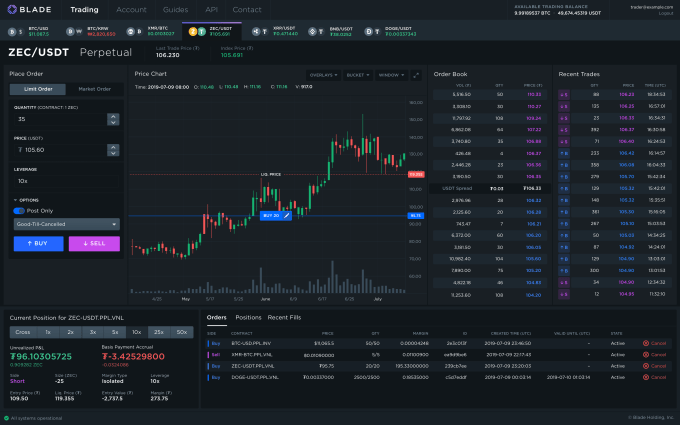
Perpetuals are a crypto-native trading instrument that Byun says are “arguably the fastest growing segment of cryptocurrency trading.” They allow traders to bet on the future values of cryptocurrencies in relation to another and the instruments have no expiration dates unlike fixed maturity futures. Traders can bet on how the price of Bitcoin can increase relative to USD but they can also make bets relative to other Altcoins like Monero, DogeCoin, Zcash, Ripple and Binance Coin. Here’s what’s on the Blade menu at the moment.

Blade’s noteworthy spins on perpetuals trading — compared to other exchanges — are that most of the contracts will be set up on simplified vanilla contracts, the perpetuals will also be margined/settled in USD Tether and the company is offering higher leverages (up to 150x on BTC-USD and BTC-KRW) on trades.

BLADE Image 1 for TC Trading Dashboard 1

Blade is raising funds from Silicon Valley’s VCs but US investors won’t be legally able to participate in the exchange. US government agencies have been a bit more stringent in regulating cryptocurrencies so there’s more trading activity taking place on exchanges outside the jurisdiction. Blade itself is an offshore entity with a US subsidiary; its primary market is East Asia.

“It’s kind of a bifurcated market,” CEO Jeff Byun tells TechCrunch. “Either you have exchanges like Coinbase or Gemini or Bitrex that cater to the US market that are highly regulated or the exchanges that cater to the non-US market that are much less regulated, but that’s where most of the volume is.”

While the company is still three weeks away from launch, the founders have bold ambitions.

“In the long-term, we want to be the CME (Chicago Mercantile Exchange) of crypto,” Byun tells me. “Coinbase and Binance are building this foundational structure for crypto, but I think we are too and in a sense that derivatives are at there core about risk transfer, we want to be building the foundational layer for risk transfer in the crypto markets.”

12 Aug 2019

Verizon is selling Tumblr to WordPress parent, Automattic

Six years after Yahoo purchased Tumblr for north of $1 billion, its parent corporation is selling the once dominant blogging platform. WordPress owner Automattic Inc. has agreed to take the service off of Verizon’s hands. Terms of the deal are undisclosed, but the number is “nominal,” compared to its original asking price, per an article in The Wall Street Journal.

Once the hottest game in town, the intervening half-decade has been tough on Tumblr, as sites like Facebook, Instagram, Reddit and the like have since left the platform in the dust. More recently, a decision to barn porn from the platform has had a marked negative impact on the service’s traffic.

The news certainly isn’t surprising. In May, it was reported that Verizon was looking for a new owner for the site it inherited through its acquisition of Yahoo. Tumblr was Yahoo’s largest acquisition at the time, as then-CEO Marissa Mayer “promise[d] not to screw it up” in a statement made at the time.

Tumblr proved not to be a great fit for Yahoo — and even less so Verizon, which rolled the platform into its short-lived Oath business and later the Verizon Media Group (also TechCrunch’s umbrella company).

Developing…

12 Aug 2019

This hacker’s iPhone charging cable can hijack your computer

Most people don’t think twice about picking up a phone charging cable and plugging it in. But one hacker’s project wants to change that and raise awareness at the dangers of potentially malicious charging cables.

A hacker who goes by the online handle MG took an innocent-looking Apple USB Lightning cable and rigged it with a small Wi-Fi enabled implant, which when plugged into a computer lets a nearby hacker run commands as if they were sitting in front of the screen.

Dubbed the O.MG cable, it looks and works almost indistinguishably from an iPhone charging cable. But all an attacker has to do is swap out the legitimate cable for the malicious cable and wait until a target plugs it into their computer. From a nearby device and within Wi-Fi range (or attached to a nearby Wi-Fi network), an attacker can wirelessly transmit malicious payloads on the computer, either from pre-set commands or an attacker’s own code.

Once plugged in, an attacker can remotely control the affected computer to send realistic-looking phishing pages to a victim’s screen, or remotely locking a computer screen to collect the user’s password when they log back in.

MG focused his first attempt on an Apple Lightning cable, but the implant can be used in almost any cable and against most target computers.

“This specific Lightning cable allows for cross platform attack payloads, and the implant I have created is easily adapted to other USB cable types,” MG said. “Apple just happens to be the most difficult to implant, so it was a good proof of capabilities.”

In his day job as a red teamer at Verizon Media (which owns TechCrunch), he develops innovative hacking methods and techniques to identify and fix security vulnerabilities before malicious attackers find them. Although a personal project, MG said his malicious cable can help red teamers think about defending against different kinds of threats.

“Suddenly we now have victim-deployed hardware that may not be noticed for much longer periods of time,” he explained. “This changes how you think about defense tactics. We have seen that the NSA has similar capabilities for over a decade, but it isn’t really in most people’s threat models because it isn’t seen as common enough.”

“Most people know not to plug in random flash drives these days, but they aren’t expecting a cable to be a threat,” he said. “So this helps drive home education that goes deeper.”

MG spent thousands of dollars of his own money and countless hours working on his project. Each cable took him about four hours each to assemble. He also worked with several other hackers to write some of the code and develop exploits, and gave away his supply of hand-built cables to Def Con attendees with a plan to sell them online in the near future, he said.

But the O.MG cable isn’t done yet. MG said he’s working with others to improve the cable’s functionality and expand its feature set.

“It really just comes down to time and resources at this point. I have a huge list in my head that needs to become reality,” he said.

(via Motherboard)

12 Aug 2019

Nio electric vehicles sales took a hit as it scrambled to handle battery recall

Nio delivered just 837 electric vehicles in July, a nearly 38% drop from the previous month that was largely caused by a voluntary recall of its high-performance ES8 SUV.

The Chines automotive startup issued a voluntary recall in June of nearly 5,000 ES8 SUVs after a series of battery fires in China and a subsequent investigation revealed a vulnerability in the design of the battery pack that could cause a short circuit. The recall affected a quarter of the ES8 vehicles sold since they went on sale in June 2018.

Nio was able to complete its recall for the 4,803 ES8s by prioritizing battery manufacturing capacity for this effort, which significantly affected our production and delivery results, NIO founder, chairman and CEO William Li said Monday in a statement.

“On the positive side, we completed the ES8 battery recall in approximately half the time compared to our original timeline,” Li said, adding that the customer confidence is returning. “Looking ahead, with battery capacity allocation back to normal, we will accelerate deliveries and make up for the delivery loss impacted by the recall.”

Nio expects August to be a “much stronger month” with a target to deliver between 2,000 and 2,500 vehicles, according to Li. That’s a considerable jump from what Nio has been able to achieve in the past several months, even without the added battery recall problem.

Nio delivered 1,340 vehicles in June, 1,089 in May and 1,124 in April. As of July 31, 2019, aggregate deliveries of the Company’s ES8 and ES6 reached 19,727 vehicles, of which 8,379 vehicles were delivered in 2019.

Deliveries of the ES8 initially surpassed expectations, but they have since slowed in 2019. Now, Nio will have to double deliveries in August to meet its target.

Other factors, and ones that might prove more chronic, also affected delivery numbers in July. Li noted that anticipated reductions in EV subsidies and macroeconomic conditions in China such as a decline in passenger vehicle sales and the U.S.-China trade conflict as other causes.

The souring economic picture in China has already prompted Nio to cut its workforce by 4.5%, shift its vehicle production plans and reduce R&D spending. Nio reported in May a loss of $390.9 million in the first quarter from a slowdown in sales that was primarily driven by the EV subsidy reduction in China and macroeconomic trends in the country that have been exacerbated by the U.S.-China trade war, Li said at the time.

12 Aug 2019

Daily Crunch: Twitter tests reply subscriptions

The Daily Crunch is TechCrunch’s roundup of our biggest and most important stories. If you’d like to get this delivered to your inbox every day at around 9am Pacific, you can subscribe here.

1. Twitter’s latest test lets users subscribe to a tweet’s replies

Many people already receive push notifications when selected accounts send out new tweets. Now you’ll be able to set up something similar for individual tweets, so you receive a notification every time there’s a reply.

And this is just one of a number of features that Twitter is testing to personalize conversation views.

2. ByteDance launches a new search portal that returns a mix of results from the Web and its own platforms

The Chinese company that owns social app TikTok and news aggregator Toutiao launched a new portal called Toutiao Search. This could set up ByteDance as a competitor to Baidu, while also driving traffic to various ByteDance properties.

3. Lucidworks raises $100M to expand in AI-powered search-as-a-service for organizations

Lucidworks has raised around $200 million in funding to date, and it says it’s been doubling revenues annually for the past three years.

bosch 3d display

4. Bosch is working on glasses-free 3D displays for in-car use

These 3D displays use passive 3D tech, which means you won’t need to wear glasses to see the effect. It also skips eye tracking, which is a key ingredient for most high-quality glasses-free 3D displays today.

5. How a Swedish saxophonist built Kobalt, the world’s next music unicorn

Combining a technology platform to better track ownership rights and royalties of songs with a new approach to representing musicians in their careers, Kobalt has risen from the ashes of the 2000 dot-com bubble to become a major player in the streaming music era. (Extra Crunch membership required.)

6. Adobe’s Amit Ahuja will be talking customer experience at TechCrunch Sessions: Enterprise

Customer experience is a term we’re hearing a lot of these days, and we’ll be discussing that very topic with Amit Ahuja, Adobe’s vice president of ecosystem development, at our big enterprise event in September.

7. Startups seek sperm … and venture capital backing

That headline is not a joke: This week’s Equity is about male reproductive health startups. Meanwhile, Original Content reviews the new Netflix series “Another life.”

12 Aug 2019

PopBase launches its platform for social media stars to share and monetize their work

It’s been almost a year since PopBase first launched on the Battlefield Stage at TechCrunch Disrupt SF 2018.

In the ensuing months the company has been working hard to sign up influencers and get its platform for social media stars ready for prime time. The company is launching its early access release today… enabling social media stars of all stripes to use PopBase as a new tool for exclusive distribution and monetization.

The company has already signed up an impressive roster of talent. The list includes YouTube entertainers like Snarled, Caleb Hyles and Mr. Creepy Pasta, who collectively have around 4.3 million followers, and emerging TikTok stars like Leanne Bailey and Mihaiu Dania, who have 6.5 million followers between them.

Snarled

Logo for Snarled

Social media entertainers today have very few channels available to them to monetize their following. YouTube doesn’t pay that well, they say, and other, newer platforms like TikTok are still ironing out the kinks of how to monetize their incredible reach.

As we reported at the time of its launch, PopBase is designed to take the relationship between a social media celebrity and their audience beyond videos and encourage a more interactive experience.

As we reported at the time of the company’s launch, that means interactive quizzes and exclusive video clips, but the company plans to enable games, augmented reality experiences, collectibles and more.

For Binary Bubbles, the Los Angeles-based company behind PopBase, it’s a chance to help creative users of social media monetize their work.

Creators take a 60% cut of all revenue with the remainder going to Binary Bubbles. But creators who really succeed in generating revenue through the channel could see their share of the proceeds rise to 70%, according to chief executive Lisa Wong.

“PopBase is all about brand expansion,” said Wong, in a statement. “The platform was built to allow creators to expand their brand into new mediums. Our tools were built by creators, for creators. We believe that creators today are special, building their brands on personality, responsiveness, and playfulness. And we’re designing our tools and tech to leverage that.”

[gallery ids="1704425,1704424,1704423,1704422"]

Wong, who spent over 25 years working in the video game industry for companies like Sony PlayStation and Activision, started Binary Bubbles in January 2017 alongside CTO Richard Weeks and CBDO Amit Tishler. Wong reconnected with Weeks — a programmer whose past employers include Lucas Art — when they both worked on an AR project, and the addition of Tishler, who is an artist/animator, rounded out the founding team.