Year: 2019

08 Aug 2019

ULA successfully launches fifth U.S. Air Force protected communications satellite

The United Launch Alliance (ULA), a joint-effort commercial launch service provider set up by Boing and Lockheed Martin, succeeded in launching a U.S. Air Force communications satellite to orbit today, the fifth in a series of launches to form a constellation. The satellite, code-named AEHF-5 (for the fifth ‘Advanced Extremely High Frequency” spacecraft) is already communicating with USAF on the ground, indicating full mission success.

For ULA, this is another win in an unbroken streak – it’s the 90th Atlas V launch to date, with 100% success across all those launches. The launch took off from Cape Canaveral Air Force Station in Florida at 6:13 AM ET this morning, marking the second successful launch from the Cape this week after SpaceX launched the AMOS-17 satellite earlier this week.

The Atlas V for this mission was flying in what ULA terms “551” configuration, which means that it’s equipped with five solid rocket boosters surrounding its liquid-fuelled center core booster. This is the configuration that provides Atlas V with the most lift and payload capacity, which was necessary in this case because of the weight of the AEHF-5 satellite at nearly 14,000 lbs, combined with its target orbit.

Lockheed Martin built the AEHF-5 for the Air Force, and confirmed via email this afternoon that it not only achieved geostationary transfer obit but is responding as planned to the USAF’s 4th Space Operations Squadron. The company has built all five current active AEHF satellites in operation, and is currently working on the sixth, which should launch sometime next year if all goes to plan.

08 Aug 2019

Auto supplier Continental shifts gears — and its capital — to an electric future

Continental AG, a global auto-parts supplier, will no longer invest in parts used in internal combustion engines, the latest sign that the automotive industry is being forced to respond to increasingly strict emissions laws.

Instead, the company said it will put more focus and capital on the electric powertrain, which it believes is the “future of mobility.”

“Our customers are increasingly and consistently turning to the electrification of combustion engines through hybrid drives as well as to pure battery-powered vehicles,” said Andreas Wolf, head of Continental’s Powertrain division, which in the future will operate under the name Vitesco Technologies with Wolf as CEO.

This shift toward electrification is being driven by tighter regulations around the world. Cities are clamping down on the use of diesel- and gas-powered cars, trucks and SUVs in urban centers and states like California are tightening rules to meet air quality and emissions targets to combat climate change. China has placed restrictions on gas-powered vehicles and provides incentives to electric ones. France wants to end the sale of fossil fuel-powered cars by 2040.

And automakers are following. Volvo, VW and others have announced plans over the past two years to increase sales of electric vehicles and move toward more electrification throughout their portfolios of existing vehicles. Electrification can mean hybrid, plug-in or all-electric vehicles.

There has been plenty of speculation and attempts to predict exactly when — not so much if — a tectonic shift to electric powertrains would occur. Suppliers have grappled with the “when” part. Putting too much capital too soon toward developing automotive parts can saddle a supplier with inventory and mounting costs.

What’s happening at Continental is starting to play out within the rest of the industry. If companies like Continental want to survive and keep up with the demands of automakers, they have to act. But not wildly. Development costs for powertrains are, after all, no small matter.

Continental is making specific choices on what exactly it pursues. The company, for instance, will not consider producing solid-state battery cells in the future. Apparently the company was open to making an investment in battery cell production. But now the company believes the market no longer offers any attractive economic prospects for battery cell production for Continental, Wolf said.

What Continental is going to do is reduce investment in its hydraulic components business, which includes parts like injectors and pumps for gasoline and diesel engines.

“Investments in research and development and in production capacity for innovations are becoming less profitable,” says Wolf, explaining the reasoning behind this decision.

Continental will fulfill existing orders. New orders will “play an increasingly marginal role.”

This shift within Continental will likely extend over a number of years, as combustion engines essentially serve as the basic drivers for hybrid solutions, Wolf said. The company will also review its business in components for exhaust-gas after treatment and fuel delivery.

All of this translates into big changes within the company, including the technologies it decides to invest in, jobs and even locations of some of its operations. Continental said it will also consider partnerships.

08 Aug 2019

Voxel51 raises $2 million for its video-native identification of people, cars and more

Many companies and municipalities are saddled with hundreds or thousands of hours of video and limited ways to turn it into usable data. Voxel51 offers a machine learning-based option that chews through video and labels it, not just with simple image recognition but with an understanding of motions and objects over time.

Annotating video is an important task for a lot of industries, the most well known of which is certainly autonomous driving. But it’s also important in robotics, the service and retail industries, for police encounters (now that body cams are becoming commonplace), and so on.

It’s done in a variety of ways, from humans literally drawing boxes around objects every frame and writing what’s in it to more advanced approaches that automate much of the process, even running in real time. But the general rule with these is that they’re done frame by frame.

A single frame is great if you want to tell how many cars are in an image, or whether there’s a stop sign, or what a license plate reads. But what if you need to tell whether someone is walking or stepping out of the way? What about whether someone is waving or throwing a rock? Are people in a crowd going to the right or left, generally? This kind of thing is difficult to infer from a single frame, but looking at just two or three in succession makes it clear.

That fact is what startup Voxel51 is leveraging to take on the established competition in this space. Video-native algorithms can do some things that single-frame ones can’t, and where they do overlap, the former often does it better.

Voxel51 emerged from computer vision work done by its co-founders, CEO Jason Corso and CTO Brian Moore, at the University of Michigan. The latter took the former’s computer vision class and eventually the two found they shared a desire to take ideas out of the lab.

“I started the company because I had this vast swath of research,” Corso said, “and the vast majority of services that were available were focused on image-based understanding rather than video-based understanding. And in almost all instances we’ve seen, when we use a video based model we see accuracy improvements.”

While any old off-the-shelf algorithm can recognize a car or person in an image, it takes much more savvy to make something that can, for example, identify merging behaviors at an intersection, or tell whether someone has slipped between cars to jaywalk. In each of those situations the context is important and multiple frames of video are needed to characterize the action.

“When we process data we look at the spacio-temporal volume as a whole,” said Corso. “Five, ten, thirty frames… our models figure out how far behind and forward it should look to find a robust inference.”

In other, more normal words, the AI model isn’t just looking at an image, but at relationships between many images over time. If it’s not quite sure whether a person in a given frame is crouching or landing from a jump, it knows that it can scrub a little forwards or backwards to find the information that will make that clear.

And even for more ordinary inference tasks like counting the cars in the street, that data can be double-checked or updated by looking back or skipping ahead. If you can only see five cars because one’s big and blocks a sixth, that doesn’t change the fact that there are six cars. Even if every frame doesn’t show every car, it still matters for, say, a traffic monitoring system.

The natural objection to this is that processing 10 frames to find out what a person is doing is more expensive, computationally speaking, than processing a single frame. That’s certainly true if you are treating it like a series of still images, but that’s not how Voxel51 does it.
scoop voxel51

“We get away with it by processing fewer pixels per frame,” Corso explained. “The total amount of pixels we process might be the same or less as a single frame, depending on what we want it to do.”

For example, on video that needs to be closely examined but speed isn’t a concern (like a backlog of traffic cam data), it can expend all the time it needs on each frame. But for a case where the turnaround needs to be quicker, it can do a fast, real-time pass to identify major objects and motions, then go back through and focus on the parts that are the most important — not the unmoving sky or parked cars, but people and other known objects.

The platform is highly parameterized and naturally doesn’t share the limitations of human-driven annotation (though the latter is still the main option for highly novel applications where you’d have to build a model from scratch).

“You don’t have to worry about, is it annotator A or annotator B, and our platform is a compute platform, so it scales on demand,” said Corso.

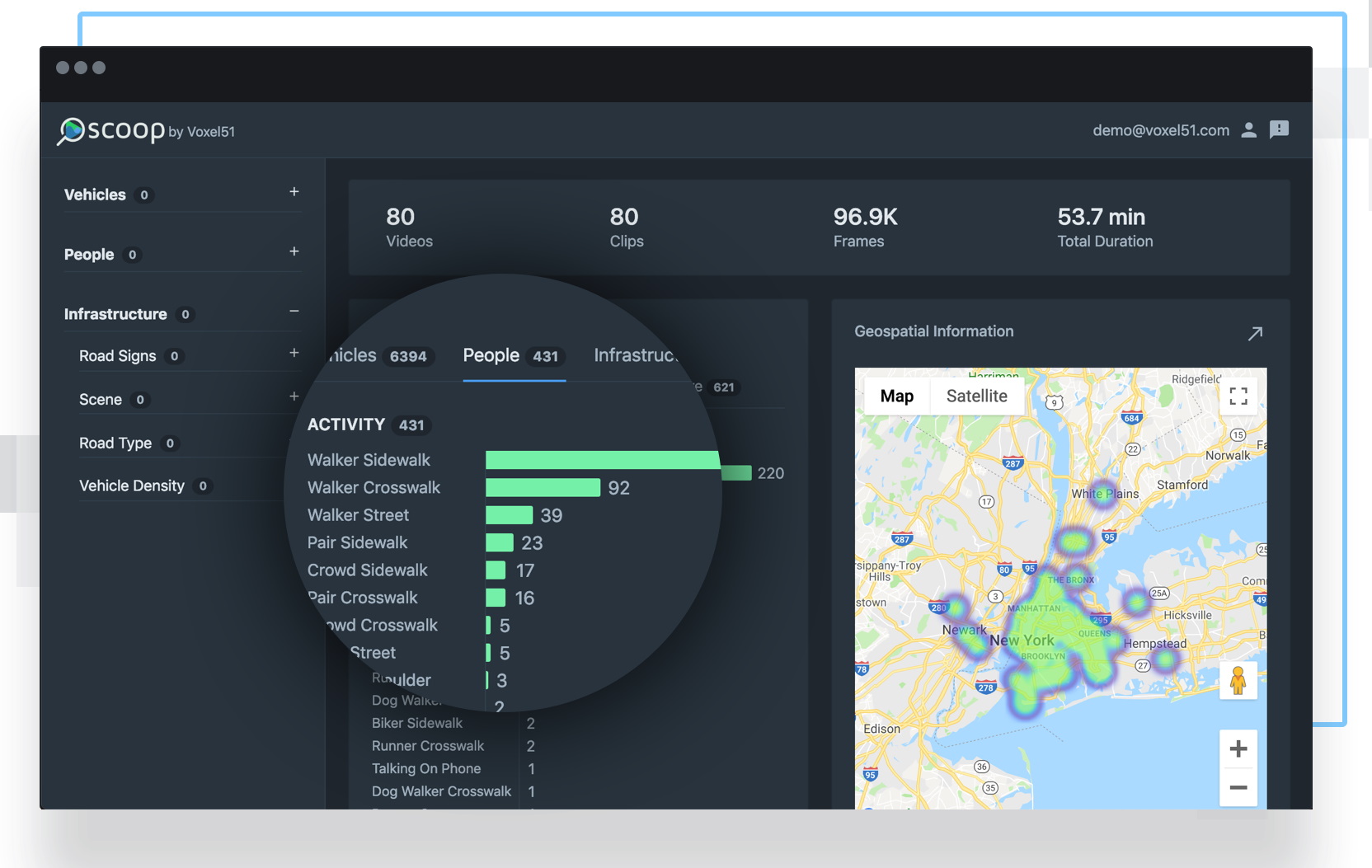
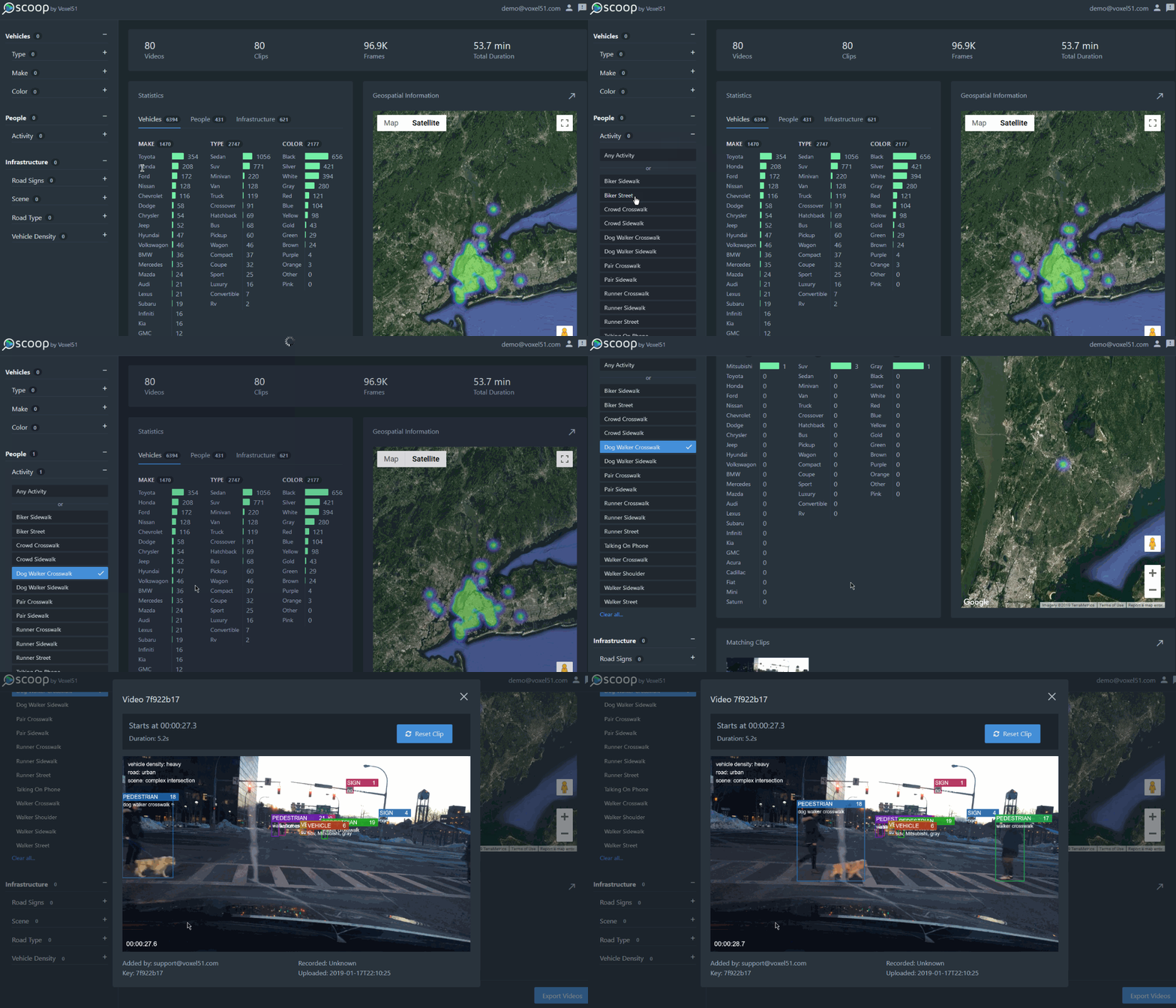
They’ve packed everything into a drag-and-drop interface they call Scoop. You drop in your data — videos, GPS, things like that — and let the system power through it. Then you have a browsable map that lets you enumerate or track any number of things: types of signs, blue BMWs, red Toyotas, right turn only lanes, people walking on the sidewalk, people bunching up at a crosswalk, etc. And you can combine categories, in case you’re looking for scenes where that blue BMW was in a right turn only lane.
dogwalk2

Each sighting is attached to the source video, with bounding boxes laid over it indicating the locations of what you’re looking for. You can then export the related videos, with or without annotations. There’s a demo site that shows how it all works.

It’s not a little like Nexar’s recently announced Live Maps, though obviously also quite different. That two companies can pursue AI-powered processing of massive amounts of street-level video data and still be distinct business propositions indicates how large the potential market for this type of service is.

Despite its street-feature smarts, Voxel51 isn’t going after self-driving cars to start. Companies in that space, like Waymo and Toyota, are pursuing fairly narrow, vertically-oriented systems that are highly focused on identifying objects and behaviors specific to autonomous navigation. The priorities and needs are different from, say, a security firm or police force that monitors hundreds of cameras at once — and that’s where the company is headed right now. That’s consistent with the company’s pre-seed funding, which came from a NIST grant in the public safety sector.
map1

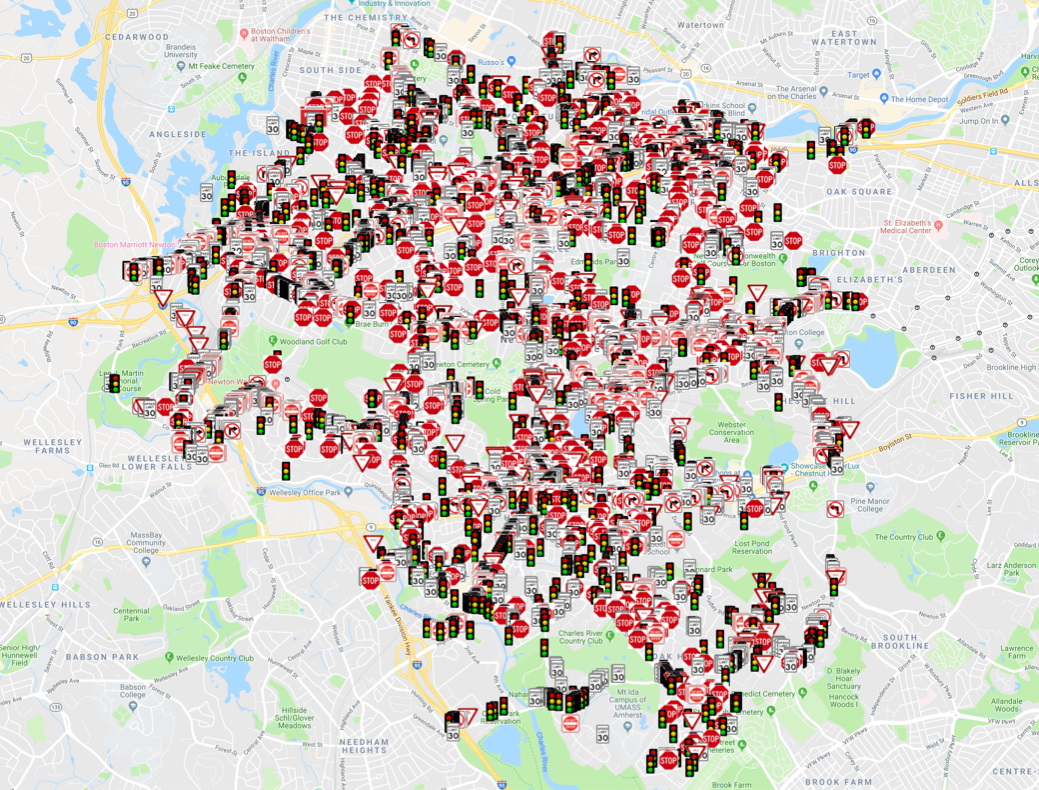
Built with no human intervention from 250 hours of video, a sign/signal map like this would be helpful to many a municipality.

“The first phase of go to market is focusing on smart cities and public safety,” Corso said. “We’re working with police departments that are focused on citizen safety. So the officers want to know, is there a fire breaking out, or is a crowd gathering where it shouldn’t be gathering?”

“Right now it’s experimental pilot — our system runs alongside Baltimore’s Citiwatch,” he continued, referring to a crime-monitoring surveillance system in the city. “They have 800 cameras, and five or six retired cops that sit in a basement watching those — so we help them watch the right feed at the right time. Feedback has been exciting: When [Citiwatch overseer Major Hood] saw the output of our model, not just the person but the behavior, arguing or fighting, his eyes lit up.”

Now, let’s be honest — it sounds a bit dystopian, doesn’t it? But Corso was careful to note that they are not in the business of tracking individuals.

“We’re primarily privacy-preserving video analytics; We have no ability or interest in running face identification. We don’t focus on any kind of identity,” he said.

It’s good that the priority isn’t on identity, but it’s still a bit of a scary capability to be making available. And yet, as anyone can see, the capability is there — it’s just a matter of making it useful and helpful rather than simply creepy. While one can imagine unethical uses like cracking down on protestors, it’s also easy to imagine how useful this could be in an Amber or Silver alert situation. Bad guy in a beige Lexus? Boom, last seen here.

At any rate the platform is impressive and the computer vision work that went into it even more so. It’s no surprise that the company has raised a bit of cash to move forward. The $2 million seed round was led by eLab Ventures, a Palo Alto and Ann Arbor-based VC firm, and the company earlier attracted the $1.25 million grant from NIST mentioned earlier.

The money will be used for the expected purposes, establishing the product, building out support and the non-technical side of the company, and so on. The flexible pricing and near-instant (in video processing terms) results seem like something that will drive adoption fairly quick given the huge volumes of untapped video out there. Expect to see more companies like Corso and Moore’s as the value of that video becomes clear.


08 Aug 2019

Daily Crunch: Samsung unveils the Galaxy Note 10

The Daily Crunch is TechCrunch’s roundup of our biggest and most important stories. If you’d like to get this delivered to your inbox every day at around 9am Pacific, you can subscribe here.

1. This is Samsung’s Galaxy Note 10 and 10+

The landscape has changed dramatically since the Galaxy Note was first unveiled in 2011, with Samsung pulling the rest of the industry into a world of bigger screens.

Now, the question is how to make the latest updates compelling. With the Note 10 and 10+ (available August 23 at a starting price of $950), Samsung is splitting the line into two distinct devices, and it’s getting rid of the headphone jack.

2. Google launches ‘Live View’ AR walking directions for Google Maps

The Live View feature isn’t designed with the idea that you’ll hold up your phone continually as you walk. Instead, in provides quick, easy and super-useful orientation by showing you arrows and big, readable street markers overlaid on the real scene in front of you.

3. Lyft’s stock is a roller coaster after its Q2 earnings release

Despite big losses, what made Wall Street happy was Lyft’s optimism for Q3, as well as the full-year 2019.

Netflix app icon iOS

Photo: TechCrunch

4. Netflix signs multi-year deal with ‘Game of Thrones’ showrunners

According to The Hollywood Reporter, the deal is worth $200 million. This follows expensive Netflix pacts with other high-profile showrunners, including Ryan Murphy ($300 million) and Shonda Rhimes ($100 million).

5. Instagram ad partner secretly sucked up and tracked millions of users’ locations and stories

Hyp3r, an apparently trusted marketing partner of Facebook and Instagram, has been secretly collecting and storing location and other data on millions of users, violating the policies of the social networks, according to Business Insider.

6. Sperm storage startups are raising millions

Both Dadi and Legacy recently raised funding, hoping to leverage venture capital dollars to become the dominant men’s fertility brand.

7. How to fundraise in August

Danny Crichton argues that although August is generally considered a black hole for VC, using it effectively for fundraising is perhaps the single most important factor for success in the coming season. (Extra Crunch membership required.)

08 Aug 2019

‘The Operators’: Experts from Airbnb and Carta on building and managing your company’s customer support

Welcome to this transcribed edition of The Operators. TechCrunch is beginning to publish podcasts from industry experts, with transcriptions available for Extra Crunch members so you can read the conversation wherever you are.

The Operators features insiders from companies like Airbnb, Brex, Docsend, Facebook, Google, Lyft, Carta, Slack, Uber, and WeWork sharing their stories and tips on how to break into fields like marketing and product management. They also share best practices for entrepreneurs on how to hire and manage experts from domains outside their own.

This week’s edition features Airbnb’s Global Product Director of Customer and Community Support Platform Products, Andy Yasutake, and Carta’s Head of Enterprise Relationship Management, Jared Thomas.

Airbnb, one of the most valuable private tech companies in the world, has millions of hosts who trust strangers (guests) to come into their homes and hundreds of millions of guests who trust strangers (hosts) to provide a roof over their head. Carta, a $1 Billion+ company formerly known as eShares, is the leading provider of cap table management and valuation software, with thousands of customers and almost a million individual shareholders as users. Customers and users entrust Carta to manage their investments, a very serious responsibility requiring trust and security.

In this episode, Andy and Jared share with Neil how companies like Airbnb, Carta, and LinkedIn think about customer service, how to get into and succeed in the field and tech generally, and how founders should think about hiring and managing the customer support. With their experiences at two of tech’s trusted companies, Airbnb and Carta, this episode is packed with broad perspectives and deep insights.

image1 2

Neil Devani and Tim Hsia created The Operators after seeing and hearing too many heady, philosophical podcasts about the future of tech, and not enough attention on the practical day-to-day work that makes it all happen.

Tim is the CEO & Founder of Media Mobilize, a media company and ad network, and a Venture Partner at Digital Garage. Tim is an early-stage investor in Workflow (acquired by Apple), Lime, FabFitFun, Oh My Green, Morning Brew, Girls Night In, The Hustle, Bright Cellars, and others.

Neil is an early-stage investor based in San Francisco with a focus on companies building stuff people need, solutions to very hard problems. Companies he’s invested in include Andela, Clearbit, Kudi, Recursion Pharmaceuticals, Solugen, and Vicarious Surgical.

If you’re interested in starting or accelerating your marketing career, or how to hire and manage this function, you can’t miss this episode!

The show:

The Operators brings experts with experience at companies like Airbnb, Brex, Docsend, Facebook, Google, Lyft, Carta, Slack, Uber, WeWork, etc. to share insider tips on how to break into fields like marketing and product management. They also share best practices for entrepreneurs on how to hire and manage experts from domains outside their own.

In this episode:

In Episode 5, we’re talking about customer service. Neil interviews Andy Yasutake, Airbnb’s Global Product Director of Customer and Community Support Platform Products, and Jared Thomas, Carta’s Head of Enterprise Relationship Management.


Neil Devani: Hello and welcome to the Operators, where we talk to entrepreneurs and executives from leading technology companies like Google, Facebook, Airbnb, and Carta about how to break into a new field, how to build a successful career, and how to hire and manage talent beyond your own expertise. We skip over the lofty prognostications from venture capitalists and storytime with founders to dig into the nuts and bolts of how it all works here from the people doing the real day to day work, the people who make it all happen, the people who know what it really takes. The Operators.

Today we are talking to two experts in customer service, one with hundreds of millions of individual paying customers and the other being the industry standard for managing equity investments. I’m your host, Neil Devani, and we’re coming to you today from Digital Garage in downtown San Francisco.

Joining me is Jared Thomas, head of Enterprise Relationship Management at Carta, a $1 billion-plus company after a recent round of financing led by Andreessen Horowitz. Carta, formerly known as eShares, is the leading provider of cap table management and valuation software with thousands of customers and almost a million individual shareholders as users. Customers and users trust Carta to manage their investments, a very serious responsibility requiring trust and security.

Also joining us is Andy Yasutake, the Global Product Director of Customer and Community Support Platform Products at Airbnb, one of the most valuable private tech startups today. Airbnb has millions of hosts who are trusting strangers to come into their homes and hundreds of millions of guests who are trusting someone to provide a roof over their head. The number of cases and types of cases that Andy and his team have to think about and manage boggle the mind. Jared and Andy, thank you for joining us.

Andy Yasutake: Thank you for having us.

Jared Thomas: Thank you so much.

Devani: To start, Andy, can you share your background and how you got to where you are today?

Yasutake: Sure. I’m originally from southern California. I was born and raised in LA. I went to USC for undergrad, University of Southern California, and I actually studied psychology and information systems.

Late-90s, the dot com was going on, I’d always been kind of interested in tech, went into management consulting at interstate consulting that became Accenture, and was in consulting for over 10 years and always worked on large systems of implementation of technology projects around customers. So customer service, sales transformation, anything around CRM, as kind of a foundation, but it was always very technical, but really loved the psychology part of it, the people side.

And so I was always on multiple consulting projects and one of the consulting projects with actually here in the Bay Area. I eventually moved up here 10 years ago and joined eBay, and at eBay I was the director of product for the customer services organization as well. And was there for five years.

I left for Linkedin, so another rocket ship that was growing and was the senior director of technology solutions and operations where I had all the kind of business enabling functions as well as the technology, and now have been at Airbnb for about four months. So I’m back to kind of my, my biggest passion around products and in the customer support and community experience and customer service world.

08 Aug 2019

GitHub gets a CI/CD service

Microsoft’s GitHub today launched the beta of a new version of GitHub Actions with full continuous integration and delivery (CI/CD) capabilities built right into the service. General availability is planned for November 13.

The company also today announced that it now has more than 40 million developers on its platform.

Ten months ago, GitHub launched Actions, its workflow automation platform. Developers could already take actions to trigger all kinds of events and use that to build custom CI/CD pipelines. At launch, the GitHub team stressed that Actions allowed for building these pipelines, but that it was a lot more than that. Still, developers were obviously quite interested in using Actions for CI/CD.

“Since we introduced GitHub Actions last year, the response has been phenomenal, and developers have created thousands of inspired workflows,” writes GitHub CEO Nat Friedman in today’s announcement. “But we’ve also heard clear feedback from almost everyone: you want CI/CD! And that’s what we’re announcing today.”

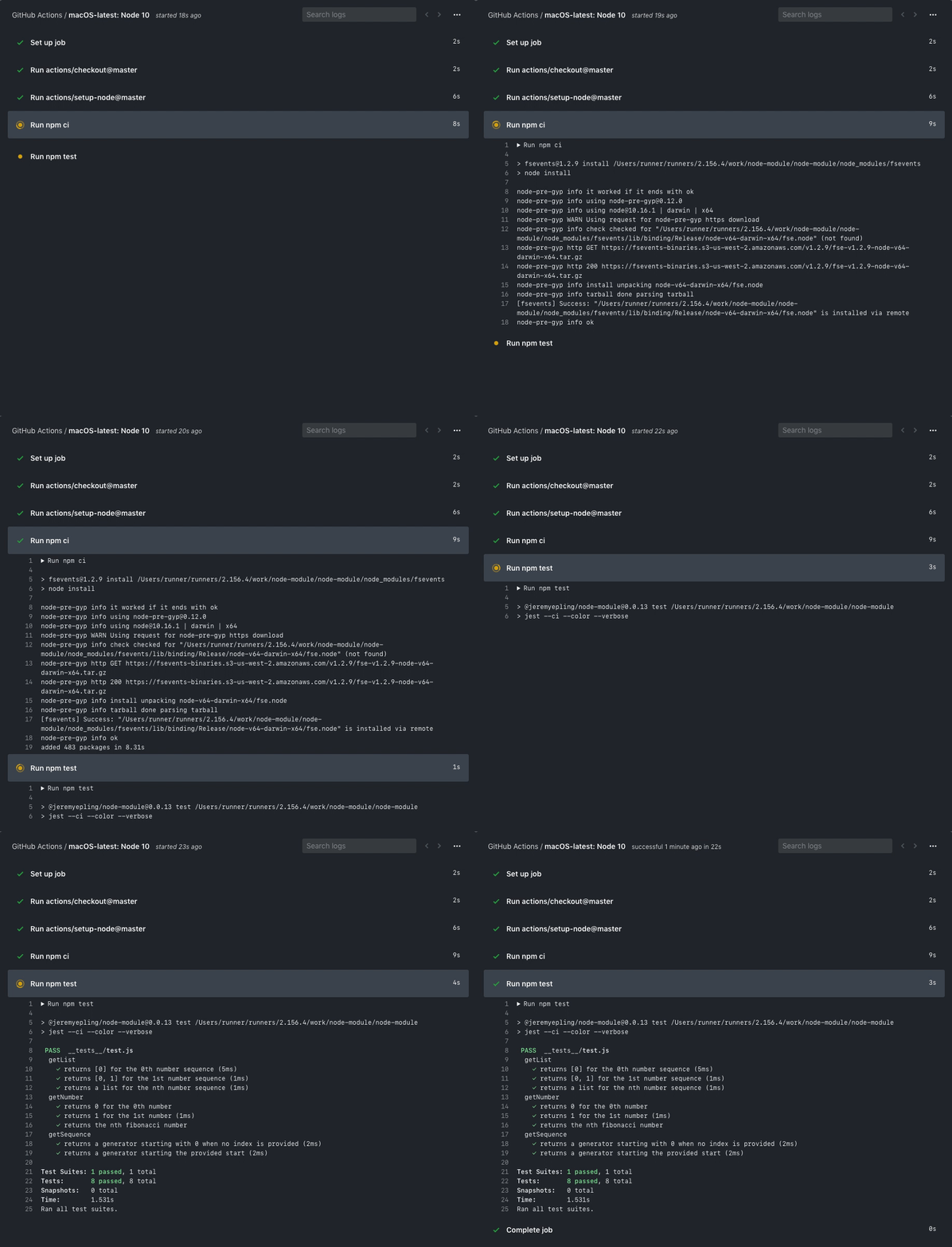
With this updated version of Actions, developers can now build, test and deploy their code on any platform and run their workflows in containers or virtual machines. Developers also can test multiple versions of their applications in parallel thanks to a new feature called “matrix builds,” which lets you, for example, test three different versions of Node.js on Linux, Windows and MacOS at the same time. Because GitHub Actions are defined in a basic YAML file, making those changes is only a matter of adding a few lines to the file.

Supported languages and frameworks include Node.js, Python, Java, PHP, Ruby, C/C++, .NET, Android and iOS. Actions is also integrated with the GitHub Package Registry.

As the application is built, you also get live logs streamed to the Action console, and it’s easy to link to any line in a log file to discuss issues with the rest of your team.

These new features are available for free during the beta and will remain free for all public repositories.

Actions for GitHub Enterprise Server will launch next year and will include a hybrid option that will allow you to keep the code in a private data center and still use GitHub to orchestrate the workflows.

“GitHub Actions is the democratization of CI/CD and software automation. Developers can write workflows reacting to any GitHub platform event and reference open-source GitHub Actions — reusable pieces of code — to supercharge their software lifecycle the same way they are used to writing application code,” said Max Schoening, GitHUb’s senior director of Product Design. “It truly is community-powered CI/CD with a pricing model that works for everyone.”

image002

With this launch, GitHub is now also competing more directly with some of the CI/CD startups that have built businesses on top of the platform. That’s likely to create a bit of friction.

“GitHub has made a commitment to keeping their platform open to all partners, but only time will tell,” CircleCI CEO Jim Rose said in a statement. “Ultimately, developers are smart and will choose the best, most powerful tools available on the market, and we’re confident that that’s where CircleCI will continue to be. […] With more than nine years of data and experience on how teams move from idea to delivery, CircleCI is the leader in CI/CD and we are confident we have the best solution for developers.”

I expect that Rose’s comment will echo that of other CI/CD players, though it’s also worth noting, as Rose did, that Actions can be integrated with other continuous integration services to allow developers to trigger builds on their platforms. These providers can also make their own Actions available on GitHub.

“We see GitHub actions as complementary to what Codefresh does. It’s an additional way that users can leverage Codefresh to build robust pipelines in a scalable way. One interesting thing is that GitHub followed our lead in how they architected Actions. You can actually use GitHub actions as steps inside a Codefresh pipeline. So you see, we’re actually very aligned,” said Dan Garfield, the chief technology evangelist at CI/CD platform Codefresh. “Developers can find the Codefresh action right on GitHub!”

When I asked GitHub about this, Schoening provided the following statement: “GitHub and our community believe in choice and an open ecosystem. That is something we take seriously and build into everything we do. GitHub Actions lets developers integrate with all their existing tooling, mix and match new developer products, and hook into all parts of the software lifecycle, including existing CI/CD partners.”

08 Aug 2019

Apple Music for Artists comes out of beta with an iOS app and Shazam data

Apple Music launched its data dashboard for musicians more than a year ago. Today, the company is taking that product — Apple Music for Artists — out of beta, and adding some new features in the process.

For one thing, it’s no longer a web-only product, because Apple is releasing an iPhone app. On both web and iOS, Apple Music for Artists allows musicians and their teams to see how often a song has been played, how many listeners it’s reaching and how many times it’s been purchased.

There’s also an “insights” section designed to highlight noteworthy data at any given moment, like how the first week of a new song compares to the first weeks of previous songs, or when the popularity of a song is spiking, or if they’ve hit a big milestone like 1 million plays.

Apple is also introducing data from Shazam, the music-recognition app it acquired last year. The idea is to capture listener behavior that’s very different from seeking out an artist or a specific song — it’s more about a moment of spontaneous connection, when you hear a song and think, “Whoa, what’s this?” (This also provides a window to behavior beyond Apple Music listeners.)

Apple Music for Artists

One of the goals is to give musicians the data they need to actually guide their decisions. For example, they might see that a song that’s not many plays compared to their big singles, but it’s doing surprisingly well on Shazam — so maybe it’s time to shift promotion.

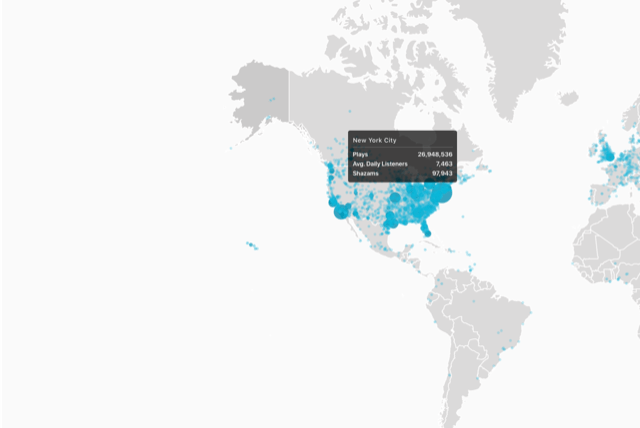
And the data is also browsable by city, on a map. So if someone’s planning a tour, they can use this to data to choose which cities or visit, or to find the correct venue size in a given market.

Apple says all the data (including Shazam data) goes back to the launch of Apple Music in 2015. Any artist can claim their account for free.

08 Aug 2019

Only 24 hours left to save $100 on TC Sessions: Enterprise 2019

Heads up all you enterprising enterprise software startuppers. You have only 24 hours before the price goes up on tickets to TC Sessions: Enterprise 2019. Save $100 and join us in San Francisco on September 5 — along with some of the industry’s top founders, CEOs, investors and technologists. Buy your early-bird ticket before 11:59 p.m. (PT) on August 9.

Enterprise is, without doubt, Silicon Valley’s 800-pound gorilla. No other startup category is as large, rich or competitive. In this day-long conference, we tackle the big topics and separate hype from reality. Artificial intelligence? Check. Cloud, Kubernetes, security and privacy, marketing automation, quantum? Yes. Investors, founders, and acquisition-hungry big enterprise companies? Tons of opportunity to network efficiently via CrunchMatch? Yeah, all that and more in 20 main-stage sessions — plus separate speaker Q&As and breakout sessions. Check out the day’s agenda.

Here’s a quick example of the type of programming you can expect.

Does the recent Capital One data breach have you up nights worried about the cost and consequences of cyberattacks? Don’t miss TechCrunch editor Zack Whittaker’s interview with Martin Casado (Andreessen Horowitz), Emily Heath (United Airlines) and Wendy Nather (Duo Security) in a session called, Keeping the Enterprise Secure.

Enterprises face a litany of threats from both inside and outside the firewall. Now more than ever, companies — especially startups — have to put security first. From preventing data from leaking to keeping bad actors out of your network, enterprises have it tough. How can you secure the enterprise without slowing growth? We’ll discuss the role of a modern CISO and how to move fast… without breaking things.

Looking for more ways to save or boost your ROI? Look no further. Buy four or more tickets at once and save 20% with the group discount. And, with every ticket you buy to TC Sessions: Enterprise, you’ll score a free Expo Only pass to TechCrunch Disrupt SF on October 2-4.

TC Sessions: Enterprise takes place on September 5, and if you want to save $100, you have just 24 hours left to act. The $249 early-bird ticket price remains in play until 11:59 p.m. (PT) on August 9. Buy your ticket now and save.

Is your company interested in sponsoring or exhibiting at TC Sessions: Enterprise 2019? Contact our sponsorship sales team by filling out this form.

08 Aug 2019

Lockheed Martin CEO Marillyn Hewson joins Disrupt SF to talk about U.S. crewed spaceflight

The space race is back on, but this time it’s closer to home: A number of U.S. companies are vying to become the first to return Americans to crewed launches, after an eight year hiatus marked by the end of the Space Shuttle program in 2011. Lockheed Martin is one of that very small group, through its partnership with Boeing on the United Launch Alliance, and through its development of the Orion crew capsule, which ticked off an important checkbox in July when it was confirmed complete and ready for mission prep.

Lockheed Martin is at the center of it all, no matter which way you slice it, and that’s why it’s great news that CEO Marillyn Hewson will join us at TechCrunch Disrupt SF 2019 in San Francisco to talk all about her company’s work with NASA, their progress on bringing back America’s crewed launch capabilities, and their designs on the Moon and beyond.

Even after Orion flies with astronauts aboard for the first time, which is currently set to happen sometime next year, Lockheed Martin has yet more ambitious plans – including developing an “early Gateway” to precede the full-scale Lunar Orbital Platform-Gateway that NASA aims to install orbiting the Moon to provide a more permanent base of operations for long-term lunar operations.

Lockheed Martin has been in the space business since the 1950s, but private and commercial interest in space has changed a lot in the ensuing fifty years. We’ll talk about what the growing commercial interesting low-Earth orbit and beyond, and the increasing number of launch and service providers, means for Lockheed and its evolution.

Disrupt SF runs October 2 to October 4 at the Moscone Center in San Francisco. Tickets are available at an early-bird rate here.

08 Aug 2019

Keith Rabois, BoxGroup back New York-based Brex competitor

Considering its unparalleled success, it was only a matter of time before a Brex copycat emerged.

Ramp Financial, a new startup led by Capital One-acquired Paribus founders Eric Glyman and Karim Atiyeh (pictured), has raised $7 million, TechCrunch has learned. The capital came from Keith Rabois of Founders Fund, BoxGroup’s Adam Rothenberg and Coatue Management, a hedge fund that recently launched a $700 million early-stage investment vehicle.

Ramp Financial, Founders Fund, BoxGroup and Coatue Management declined to comment.

Ramp Financial is in the very early stages of product development, though we’re told, “It’s the same as Brex .” Other details available on the new startup, which raised on a pre-money valuation of $25 million, according to sources, are slim. Even its name may be subject to change.

Brex, founded in 2017 by a pair of now 23-year-olds, created a corporate charge card tailored for startups. The Y Combinator graduate doesn’t require cardholders to submit Social Security numbers or credit scores, granting entrepreneurs a new avenue to credit and method of protecting their credit scores. Brex’s software also expedites the time-consuming expense management, and accounting and budgeting processes for employees. Quickly, it has become essential to the company-building process in Silicon Valley.

It helps that VCs are wild for Brex. The startup has raised more than $300 million in VC funding in only two years. Most recently, it closed a $100 million round led by Kleiner Perkins at a valuation of $2.6 billion.

Given Brex’s rapid growth and the uptick in venture capital investment in challenger banks, or new financial services competing with incumbent financiers, we’re guessing Ramp Financial didn’t have a tough time pitching VCs. Plus, its founders Glyman and Atiyeh have a clear track record of success.

The duo previously built Paribus, a startup acquired by Capital One roughly one year after launching onstage at TechCrunch Disrupt New York 2015. Paribus, which raised just over $2 million from Slow Ventures, General Catalyst, Greylock and others before the M&A transaction, helps online shoppers get money back when prices drop on items they’ve purchased. Terms of Capital One’s acquisition were not disclosed.

Paribus is also a graduate of Y Combinator, completing the startup accelerator in the summer of 2015.

Aside from both completing Y Combinator, the founders of Brex and Ramp Financial share connections to the PayPal mafia. Rabois, a general partner at Founders Fund, was an executive at the business in the early 2000s. PayPal co-founders Peter Thiel and Max Levchin are Brex investors.