Year: 2019

08 Aug 2019

Apple is under formal antitrust probe in Russia

Make way for another antitrust investigation into big tech. Step forward Russia’s Federal Antimonopoly Service (FAS), which has opened an official probe of Apple — following a complaint lodged in March by security company Kaspersky Labs.

Kaspersky’s complaint to FAS followed a change in Apple’s policy towards a parental control app it offers, called Kaspersky Safe Kids. Discussing the complaint in a blog post the security firm says Apple contacted it in 2017 to inform it that the use of configuration profiles is against App Store policy, even though the app had been on Apple’s store for nearly three years without it raising any objections. 

Apple told Kaspersky to remove configuration profiles from the app — which it says would require it to remove two key features that makes it useful to parents: Namely, app control and Safari browser blocking.

It also points out that the timing of Apple’s objection followed Apple announcing its Screen Time feature, in iOS 12 — which allows iOS users to monitor the amount of time they spend using certain apps or on certain websites and set time restrictions. Kaspersky argues Screen Time is “essentially Apple’s own app for parental control” — hence raising concerns about the potential for Apple to exert unfair market power over the store it also operates by restricting competition.

We’ve reached out to Apple for comment on the FAS investigation. The company referred Reuters to a statement it made in April about its policy towards parental control apps, following other complaints.

In the statement Apple says it removed several such apps from the App Store because they “put users’ privacy and security at risk” — calling out the use of what it described as “a highly invasive technology called Mobile Device Management” (MDM).

But Kaspersky claims its app does not, and never did, use MDM.

Following complaints and some press attention to Apple’s parental control apps crackdown), the company appears to have softened its stance on MDM for this specific use-case — updating the App Store Review Guidelines’ to allow using MDM for parental controls in limited cases.

Kaspersky also says that the Apple Developer Enterprise Program License Agreement “clarifies that the use of MDM-profiles and configuration profiles in applications for home users is only possible with the explicit written consent of Apple”.

However it argues that Apple’s updated rules and restrictions still “do not provide clear criteria allowing the usage of these profiles, as well as information on meeting the criteria, which is needed for obtaining written consent from Apple to use them”. Hence it’s not willing to drop its complaint yet.

It says it’s also continuing to prepare to file an antitrust complaint over the same issue in Europe — where a separate competition-related complaint was recently filed against Apple by the music service Spotify.

Kaspersky says now that only official written confirmation from Apple — of “the applicability of the new p.5.5. “App Store Review Guidelines” for Kaspersky Safe Kids for iOS” — will stay its complaint.

Russia’s FAS has shown itself to be relatively alacritous at handling big tech antitrust complaints — most notably slapping Google with an order against bundling its services with Android back in 2015, a few months after local search giant Yandex had filed a complaint.

It took the European Union’s competition regulator several more years before arriving at a similar conclusion vis-a-vis Google’s competition-blocking Android bundling.

08 Aug 2019

The Navy taps YouTube creators for its latest recruiting campaign

The US Navy is turning to YouTube creators for help in finding technical recruits.

Captain Matt Boren, the chief marketing officer at US Navy Recruiting Command, told me that in that while past recruiting efforts have focused on TV and other traditional media, that’s no longer the best route to reach the post-millennial generation.

“For our audience now, if they want to find something, they’re using the search engine on YouTube,” Boren said. “We had to be where our audience was.”

So the Navy worked with its agencies MLY&R and Wavemake, along with Google, to identify YouTube creators with a focus on science, technology and math, then invited those creators to highlight different technical roles and environments. Specifically, Kevin Leiber (a.k.a. Vsauce2) filmed aboard a nuclear submarine, Jake Koehler (a.k.a. Dallmyd) worked with an explosives specialist and William Osman talked to a cybersecurity team.

“We gave the creators a great deal of free rein,” Boren added. “We didn’t want to come off as the Navy trying to buy their loyalty … We wanted to give them the opportunity to spend time in a work environment so they can understand and relate to them and really [convey] that to their audience.”

While the “Sailor Vs.” series (launching today) only involves three YouTube creators, Boren said he’s open to experimenting with more influencer marketing campaigns in the future, especially since those broader media-consumption trends aren’t going away.

And that’s all happening as the Navy is facing significant recruiting challenges — Boren estimated that it needs to fill 50,000 roles this year (though highly technical roles only make up a small percentage of that total).

08 Aug 2019

Statespace picks up $2.5M to help gamers train

Gaming continues to grow in popularity, with esports revenue growing 23 percent from last year to top $1 billion in 2019.

But the metrics by which talent is evaluated in gaming, and the methods by which gamers can train to better hone their craft, are varied and at times non-existent. That’s where StateSpace, and specifically the company’s gaming arm Klutch, come into play.

In 2017, Statespace launched out of stealth with their first product, Aim Lab. Aim Lab is meant to mimic the physical rules of a game to give gamers a practice space where they can improve their skills. Moreover, Aim Lab identifies weaknesses in a player’s gameplay — one person might struggle with their visual acuity in the top left quadrant of the screen, while another might have trouble spotting or aiming at targets on the bottom right side of the screen — and allows gamers to focus in on their weaknesses to get better.

Today, the company has announced a $2.5 million seed funding round led by FirstMark Capital, with participation from Expa, Lux Capital and WndrCo. This brings the company’s total funding to $4 million.

Alongside growing Aim Lab, which is on track to soon reach 1 million users, one of the company’s main goals is to create a standardized metric by which gamers’ skills can be measured. In football, college athletes and NFL coaches have the Scouting Combine to make decisions around recruiting. This doesn’t necessarily take into account stats like yardage or touchdowns, but rather the raw skills of a player such as 40-yard sprint speed.

In fact, Statespace has partnered with the Pro Football Hall of Fame for ‘The Cognitive Combine’, becoming the official integrative medicine program cognitive assessment partner of the organization. Statespace wants to create a similar ‘combine’ for gaming.

The hope is that the company can offer this metric to publishers, colleges and esports orgs, giving them the ability to not only evaluate talent, but to better serve casual users through improved matchmaking and cheat detection.

“We want to go a level beyond your kill:death ratio,” said cofounder and CEO Dr. Wayne Mackey. Those metrics greatly depend on factors like who you’re playing with. You won’t always be matched against players who are on an even keel with you. So we want to look at fundamental skills like hand eye coordination, visual acuity, spatial processing skills, and working memory capacity.”

[gallery ids="1866281,1866282,1866283"]

Klutch has partnered with the National Championship Series as the official FPS training partner for 2019. NCS has majors for both CS:Go and Overwatch, two of the biggest competitive FPS games in the world. The company is also partnering with top Twitch streamers and Masterclass to create The Academy.

Academy users will be able to get advanced tutorials from streamers like KingGeorge (Rainbox Six Siege), SypherPK (Fortnite), Valkia (Overwatch), Drift0r (CoD), and Launders (CS:GO).

Obviously, gaming is a major part of Statespace’s business model. But the skeleton of the technology has a number of different applications, particularly in medicine. Statespace is currently in the research phase of rolling out an Aim Lab product that is specifically focused on helping people who have had strokes recover and rehabilitate.

Statespace wants to use the funding to build out the team and expand the Klutch Aim Lab platform beyond Steam to mobile and eventually console, with Xbox prioritized over PlayStation, as well as launching the Academy.

08 Aug 2019

Netflix signs multi-year deal with ‘Game of Thrones’ showrunners

David Benioff and D.B. Weiss, the creators and showrunners of HBO’s adaptation of “Game of Thrones,” have found a new home.

Netflix has signed a multi-year film and TV pact with the writer-producers; according to The Hollywood Reporter, the deal is worth $200 million. This follows expensive Netflix deals with other high-profile showrunners, including Ryan Murphy ($300 million) and Shonda Rhimes ($100 million).

Benioff and Weiss are a bit different, in that their reputation rests on a single show. But then, the Obamas didn’t have much of a TV résumé either — and of course, “Game of Thrones” is the hit show of the past decade, with record ratings for HBO and a record number of Emmy nominations for the final season. (Basically, no one in Hollywood is interested in your finale complaints.)

It will likely be several years before this deal actually leads to new content on Netflix, with Benioff and Weiss tied up writing and producing a trilogy of Star Wars movies for Disney. (The first is scheduled for release in 2022.)

On the other hand, this deal means we won’t be seeing the pair’s controversial HBO series about an alternate American history where slavery continues.

08 Aug 2019

Opsani helps optimize cloud applications with AI

Opsani, a Redwood City, California startup, wants to go beyond performance monitoring to continually optimizing cloud applications, using artificial intelligence to help the software learn what is the optimal state.

“We have come up with a machine learning technique centered around reinforcement learning to tune the performance of applications in the cloud,” company co-founder and CEO Ross Schibler told TechCrunch.

Schibler says each company has its own unique metrics and that’s what they try to optimize around. “We’re modifying these parameters around the resource, and we’re looking at the performance of the application. So in real time, what is the key business metric that the application is producing as a service? So it might be the number of transactions or it might be latency, but if it’s important to the business, then we use that,” he explained.

He claims that what separates Opsani from a monitoring tool like New Relic or AppDynamics is that they watch performance and then provide feedback for admins, but Opsani actually changes the parameters to improve the application performance in real time, based on what it knows about the application and what the developers want to optimize for.

It is also somewhat similar to a company like Spotinst, which optimizes for the cheapest cloud resources, but instead of simply trying to find the best price, Opsani is actually tuning the application.

The company recently announced a $10 million Series A investment led by Redpoint Ventures. Previous investors Zetta Ventures and Bain Capital also participated.

For now, it’s still early days for the startup. It has a dozen employees and a handful of customers, according to Schibler. With the recent $10 million round of funding, it should be able to hire more employees and continue refining the product.

08 Aug 2019

Google adds playable podcast episodes to search results

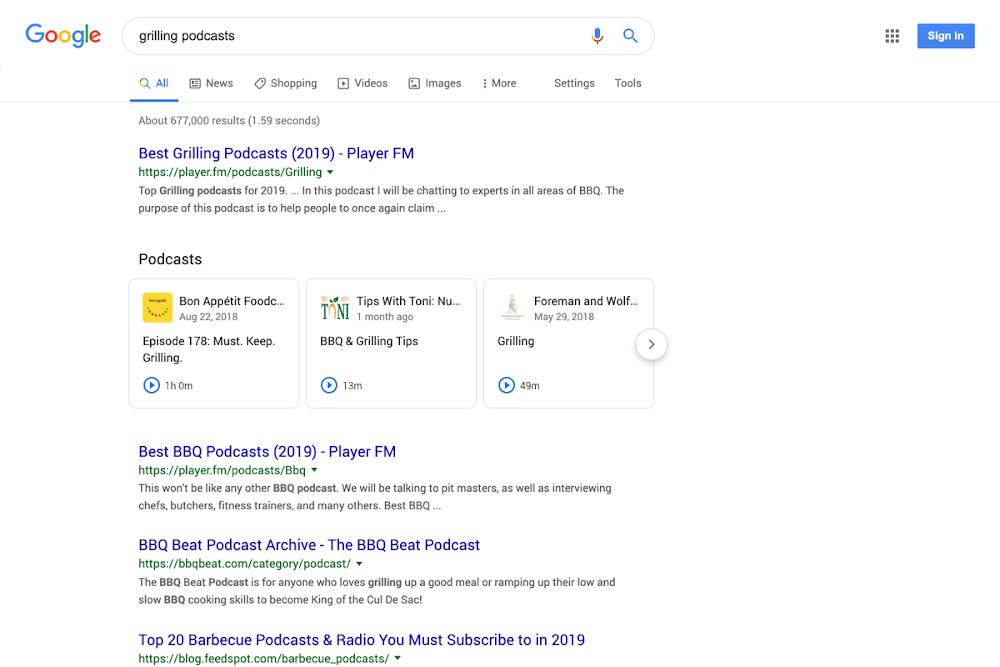
Google is making it easier to find and listen to audio content specific to your search interests, with playable episodes surfaced in results that start rolling out today.

Playable podcasts will show up in results when you use “podcasts” as a keyword in your search, in combination with other terms. It’s intended to deliver you relevant results freed from the confines of a dedicated podcast player, and Google also intends to extend this search feature to queries that don’t even specify “podcast” in future as it refines its algorithms.

Google is also going to be rolling out this inline playable results feature for the search function in Google Podcasts on the web, and for Google Assistant. If you’re logged in, it’ll also sync your results so that you can pick up from wherever you left off in the dedicated Google Podcasts app.

This should be good for discoverability, since it means that a much broader potential audience can stumble across your podcasts then would be possible with existing tools, and sample them on the spot. But Google still plans to roll out finer controls for publishers, that mean you can specify where people can listen to them, and presumably where they can’t.

Podcasts grilling desktop.max 1000x1000

It’s yet another sign that podcasts are slowly and surely becoming more prevalent and mainstream than ever, and that Google is very interested in making sure that it doesn’t fall behind on ensuring this content is part of its overall search index and not the exclusive domain of other, more closed ecosystems that exist outside its sphere of influence.

Google is going to be rolling this out gradually beginning today, with initial availability open to U.S. users searching in English.

08 Aug 2019

Flawed office printers are a silent but serious target for hackers

You probably don’t think too much about your humble office printer. But they’re a prime target for hackers, if any of the dozens of vulnerabilities found by security researchers are anything to go by.

The latest research by the NCC Group just revealed at the Def Con security conference shows just how easy of a target office printers can be.

Think about it: office printers at some of the largest organizations in finance, government and tech all print corporate secrets — and classified material — and often keep a recorded copy in their memory. Printers are also complicated devices — more so than most people realize — with multiple internet-connected components, networking protocols, printer languages and fonts, and connected apps and devices, all of which have vulnerabilities.

No wonder they’re a target; office printers are a treasure trove of sensitive data. And because they often come with a web-based interface or an internet connection, they have a huge attack surface, making them easy to hack.

In the course of three months’ work, researchers Daniel Romero and Mario Rivas found and reported 45 separate vulnerabilities from six of the largest printer makers — HP, Lexmark, Brother, Xerox, Ricoh, and Kyocera — which could have allowed attackers to, among other things, siphon off copies of print jobs to an attacker controlled server.

They also showed they could hijacked and enlist vulnerable printers into botnets — used to overload websites with junk internet traffic. Or, with little effort, they could brick the printers completely, potentially causing havoc for business operations.

“Suppose a criminal developed a work that sought to compromise and permanently corrupt every vulnerable printer; this would severely impact the world’s ability to print, and could be catastrophic for affected sectors that rely heavily on printed documents, such as healthcare, legal and financial services,” said Romero and Rivas.

Not only that, printers can also be used as a way to gain a “method of persistence on a network,” the researchers said, allowing them to gain deeper access into a corporate network from an easy point of entry.

Because in most cases printers aren’t protected by anti-malware services like desktops and laptops, a malicious attacker could gain a permanent backdoor on the devices, giving them long-term access to a target corporate network.

When the researchers reported the bugs, they received mixed responses from the companies. Although every printer maker has since fixed the bugs they found, the researchers said some printer makers didn’t have a way to disclose the vulnerabilities they found, leaving them stranded and unable to make contact with some companies for more than two months.

Lexmark, which fixed nine vulnerabilities and issued its own security advisories, received a special mention for its “mature” vulnerability disclosure effort.

HP also issued a security advisory noting the five bugs it received and later fixed.

But the researchers said there are “probably more” bugs ready to be found. “We stopped searching after a few vulnerabilities,” they said. What makes matters worse is that most printer makers share code from one device to another, likely vastly expanding the number of devices affected by a single vulnerability.

Maybe next time, think before you print.

08 Aug 2019

Beynd gets $2M seed to improve customer experience with better onboarding

Customer experience is a term that gets bandied about quite a bit these days. If you can improve the customer experience, you can win more customers. Beynd, a Utah startup, wants to help by providing a better, more automated onboarding workflow. Today, it announced a $2 million seed round.

The round was led by Peak Ventures with participation from Prelude Ventures. The investors seem to be making a good bet. CEO and founder Peter Ord says the company has had a product for just 10 months, but already boasts 121 paying customers with 6800 users on the platform.

Ord says the company’s genesis began, like so many startup ideas, out of frustration he experienced at his previous job. Getting people started on the company’s software was too hard. He thought there had to be a better way, so he built it, and Beynd (pronounced Beyond) was born.

“They say the best companies start with the founders biggest frustration. One of my biggest frustrations at my previous job was that in my everyday life, I could order a pizza and know exactly when that pizza was ready. But when our customers bought our software, we had no thoughtful or meaningful way to help our customers understand when we were going to deliver that,” Ord told TechCrunch.

The customer starts by creating an onboarding workflow template. Each client has its own unique requirements. The first interactions are by email (or communication channel of choice) giving instructions on how to proceed. If the customer gets stuck, there is a button to email the project manager that there is a problem.

The solution includes tools for projected launch dates, so that customers can understand when a product will be ready (or service completed). It also includes an analytics tool, so that customers can understand which processes are most likely to stall.

The company actually uses its own software to onboard its customers. “We drink our own champagne, We use our own products. And so we’re extremely efficient in the way we onboard our customers because they get an immediate sense of how they use the tool through us using our tool to onboard them,” Ord explained.

The company had bootstrapped the business to this point. He says that his goal is to continue to run it as a real business, but the funding will help him expand his vision and improve the experience. He just doesn’t want to get too caught up in the funding culture. “There’s an interesting culture in the VC space where it’s all about raise as much as you can, as fast as you can, and I actually have kind of the opposite opinion, he said.

For now, he has $2 million to try and scale the business further, and he’ll get more only if he feels he needs it. “Let’s continue to prove out the model with this money, then let’s raise more if we have to,” he said.

08 Aug 2019

The UK’s National Health Service is launching an AI lab

The UK government has announced it’s rerouting £250M (~$300M) in public funds for the country’s National Health Service (NHS) to set up an artificial intelligence lab that will work to expand the use of AI technologies within the service.

The Lab, which will sit within a new NHS unit tasked with overseeing the digitisation of the health and care system (aka: NHSX), will act as an interface for academic and industry experts, including potentially startups, encouraging research and collaboration with NHS entities (and data) — to drive health-related AI innovation and the uptake of AI-driven healthcare within the NHS. 

Last fall the then new in post health secretary, Matt Hancock, set out a tech-first vision of future healthcare provision — saying he wanted to transform NHS IT so it can accommodate “healthtech” to support “preventative, predictive and personalised care”.

In a press release announcing the AI lab, the Department of Health and Social Care suggested it would seek to tackle “some of the biggest challenges in health and care, including earlier cancer detection, new dementia treatments and more personalised care”.

Other suggested areas of focus include:

  • improving cancer screening by speeding up the results of tests, including mammograms, brain scans, eye scans and heart monitoring
  • using predictive models to better estimate future needs of beds, drugs, devices or surgeries
  • identifying which patients could be more easily treated in the community, reducing the pressure on the NHS and helping patients receive treatment closer to home
  • identifying patients most at risk of diseases such as heart disease or dementia, allowing for earlier diagnosis and cheaper, more focused, personalised prevention
  • building systems to detect people at risk of post-operative complications, infections or requiring follow-up from clinicians, improving patient safety and reducing readmission rates
  • upskilling the NHS workforce so they can use AI systems for day-to-day tasks
  • inspecting algorithms already used by the NHS to increase the standards of AI safety, making systems fairer, more robust and ensuring patient confidentiality is protected
  • automating routine admin tasks to free up clinicians so more time can be spent with patients

Google-owned UK AI specialist DeepMind has been an early mover in some of these areas — inking a partnership with a London-based NHS trust in 2015 to develop a clinical task management app called Streams that’s been rolled out to a number of NHS hospitals.

UK startup, Babylon Health, is another early mover in AI and app-based healthcare, developing a chatbot-style app for triaging primary care which it sells to the NHS. (Hancock himself is a user.)

In the case of DeepMind, the company also hoped to use the same cache of NHS data it obtained for Streams to develop an AI algorithm for earlier detection of a condition called acute kidney injury (AKI).

However the data-sharing partnership ran into trouble when concerns were raised about the legal basis for reusing patient data to develop AI. And in 2017 the UK’s data watchdog found DeepMind’s partner NHS trust had failed to obtain proper consents for the use of patients’ data.

DeepMind subsequently announced its own AI model for predicting AKI — trained on heavily skewed US patient data. It has also inked some AI research partnerships involving NHS patient data — such as this one with Moorfields Eye Hospital, aiming to build AIs to speed up predictions of degenerative eye conditions.

But an independent panel of reviewers engaged to interrogate DeepMind’s health app business raised early concerns about monopoly risks attached to NHS contracts that lock trusts to using its infrastructure for delivering digital healthcare.

Where healthcare AIs are concerned, representative clinical data is the real goldmine — and it’s the NHS that owns that.

So, provided NHSX properly manages the delivery infrastructure for future digital healthcare — to ensure systems adhere to open standards, and no single platform giant is allowed to lock others out — Hancock’s plan to open up NHS IT to the next wave of health-tech could deliver a transformative and healthy market for AI innovative that benefits startups and patients alike.

Commenting on the launch of NHSX in a statement, Hancock said: “We are on the cusp of a huge health tech revolution that could transform patient experience by making the NHS a truly predictive, preventive and personalised health and care service.

“I am determined to bring the benefits of technology to patients and staff, so the impact of our NHS Long Term Plan and this immediate, multimillion pound cash injection are felt by all. It’s part of our mission to make the NHS the best it can be.

“The experts tell us that because of our NHS and our tech talent, the UK could be the world leader in these advances in healthcare, so I’m determined to give the NHS the chance to be the world leader in saving lives through artificial intelligence and genomics.”

Simon Stevens, CEO of NHS England, added: “Carefully targeted AI is now ready for practical application in health services, and the investment announced today is another step in the right direction to help the NHS become a world leader in using these important technologies.

“In the first instance it should help personalise NHS screening and treatments for cancer, eye disease and a range of other conditions, as well as freeing up staff time, and our new NHS AI Lab will ensure the benefits of NHS data and innovation are fully harnessed for patients in this country.”

08 Aug 2019

Google Travel adds flight price notifications and a limited time flight price guarantee

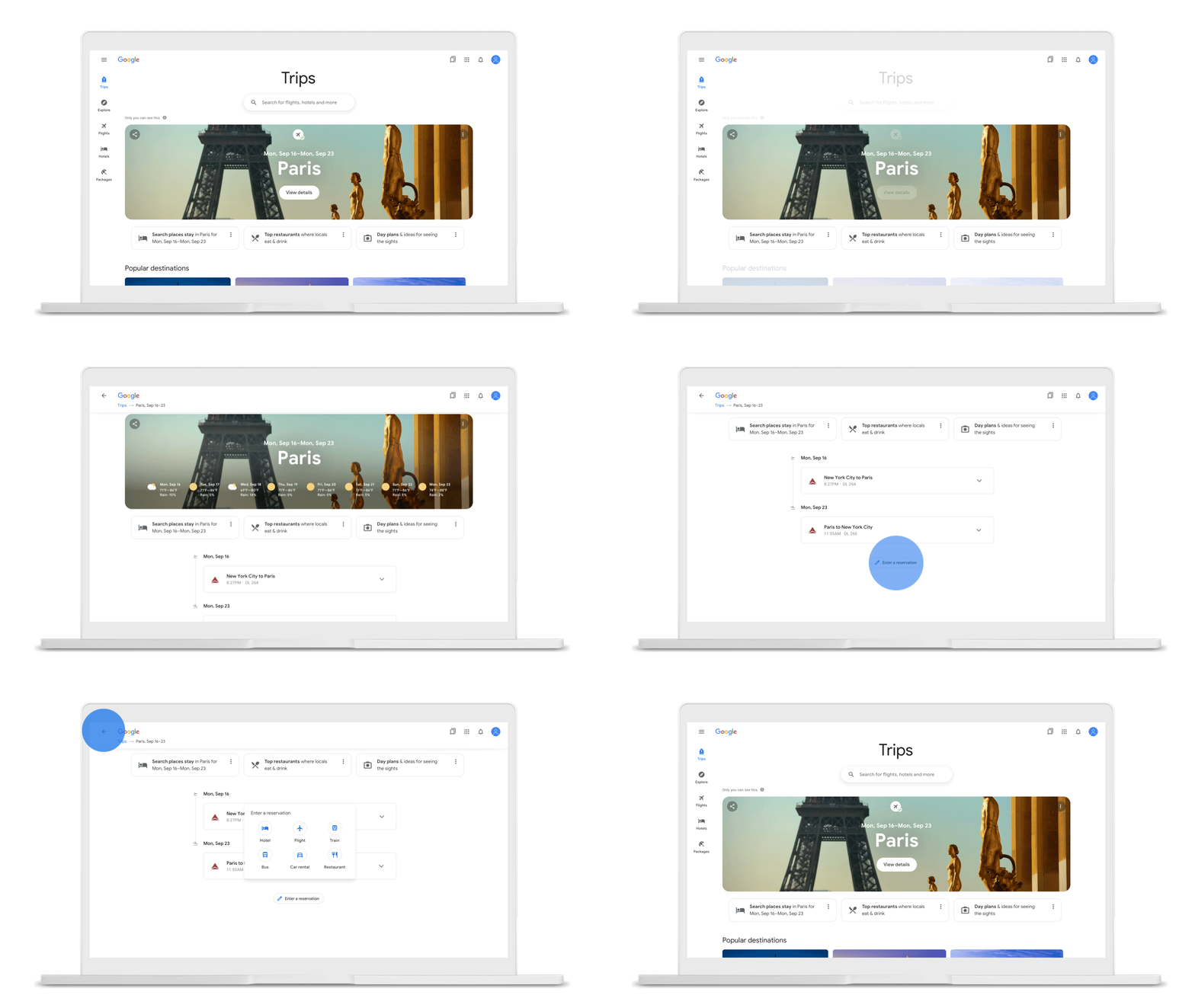
tp animation full no zoom alpha 1Google is building out its travel product with more features to convince you to use it to book flights and plan trips directly, instead of having to go anywhere else. The company is adding more sophisticated pricing features, including historical price comparison for specific itineraries – and notifications about when a price is likely to spike or when it’s at the absolute lowest. It’s also offering a pricing guarantee for bookings made in the next couple of weeks, so you’ll get be refunded the difference if Google says a flight price won’t drop and it subsequently does.

For any flights booked through Google that originate in the U.S. (regardless of destination) between August 13 and September 2, for which Google sends you an alert notifying you that the price is predicted to be at its lowest, the company will alert you if it does drop and then send you a refund on the price difference between what it predicted (ie., what you paid) and the lowest actual fare.

It’s an attractive deal, and the limited time offer is probably only even available because this is new and Google wants to make sure people feel absolutely comfortable trusting their predictions. The company likely has the most readily available, cross-airline information about flight availability, route popularity and price in the world, however, backed by some of the most sophisticated machine learning on the planet, so it sounds like it’s probably a pretty safe bet for them to make.

Google Travel is also adding a number of features once you actually book you trip – it’ll suggest next steps for planning your trip, and then help you find the best neighbourhoods, hotels, restaurants and stuff to do. Plus, reservations and other trip details will automatically carry over to the Google Maps app on your iOS or Android.

Overall, it’s clear that Google is making an aggressive play to own your overall travel and trip planning – and it has the advantage of having more data, better engineering, and a whole lot more in the way of design skills when compared to just about every dedicated travel booking company out there.