Year: 2019

08 Aug 2019

Google launches ‘Live View’ AR walking directions for Google Maps

Google is launching a beta of its augmented reality walking directions feature for Google Maps, with a broader launch that will be available to all iOS and Android devices that have system-level support for AR. On iOS, that means ARKit-compatible devices, and on Android, that means any smartphones that support Google’s ARcore, so long as ‘Street View’ is also available where you are.

Originally revealed earlier this year, Google Maps’ augmented reality feature has been available in an early alpha mode to both Google Pixel users and to Google Maps Local Guides, but starting today it’ll be rolling out to everyone (this might take a couple weeks depending on when you actually get pushed the update). We took a look at some of the features available with the early version in March, and it sounds like the version today should be pretty similar, including the ability to just tap on any location nearby in Maps, tap the ‘Directions’ button and then navigating to ‘Walking,’ then tapping ‘Live View’ which should appear newer the bottom of the screen.

Live View
The Live View feature isn’t designed with the idea that you’ll hold up your phone continually as you walk – instead, in provides quick, easy and super useful orientation, by showing you arrows and big, readable street markers overlaid on the real scene in front of you. That makes it much, much easier to orient yourself in unfamiliar settings, which is hugely beneficial when traveling in unfamiliar territory.

Google Maps is also getting a number of other upgrades, including a one-stop ‘Reservations’ tab in Maps for all your stored flights, hotel stays and more – plus it’s backed up offline. This, and a new redesigned Timeline which is airing on Android devices only for now, should also be rolling out to everyone over the next few weeks.

08 Aug 2019

FlixMobility extends Series F at $2B+ valuation as it gears up to add cars to its bus and train network

Back in July it emerged that FlixMobility — the company behind the network of ubiquitous green FlixBus coaches that crisscross Europe and parts of the US — had raised about €500 million in the largest-ever round of funding for a German tech company. That turned out not to be the full story. Today, the company is announcing that the round has now been extended substantially, according to founder and CEO Jochen Engert, with contributions from a new set of investors: Baillie Gifford, Luxor Capital Group, Odyssey 44 and additional investment provided through funds managed by BlackRock.

Engert said FlixMobility will be using the money to “move on from a business perspective” (I don’t think he meant it as a pun, but it’s a good one), and that means growth in a number of ways. They include expanding into new markets in South America and Asia and further into the US; bringing trains onto its network by way of FlixTrain; launching a new group-focused service, FlixBus Charter; and by next year, startup up a long-distance ride-sharing brand, FlixCar. It’s also been working on a smaller “pilot” project, Flix2Fly, to consider how to bring some air routes into the mix as well.

The aim, he said in an interview, is to build a wider “transportation marketplace for customers looking for affordable mobility.”

Engert would not specify the exact size of the round, but he confirmed that it was at the same valuation as the first close of the Series F (which was just over $2 billion), and that the extra funding was “not double” the earlier amount, “but substantial.” (The company has always kept quiet about the exact amount it has raised, and from whom, in part to focus on the business, but also in part to keep competition guessing. We’re still trying to find out the actual number.)

Considering the investors in the round, it means it’s likely it’s added hundreds of millions more to the mix alongside the €500 million from TCV, Permira and HV Holtzbrinck Ventures. Previous investors in the company have included Silver Lake and General Atlantic.

The company, similar to other on-demand transportation giants like Uber or RedBus in India, does not own a large fleet of vehicles, but works with individuals and companies that own these that want to tap into its logistics platform, which helps build efficient long-distance (intercity) routes — its shortest connection is 50km, most are beyond 100km, and the “sweet spot” Engert said is 200km — and source passengers who collectively want to travel on them.

Typically, Engert said these companies do not go all-in on the Flix platform, but they contribute a proportion of their fleets, which in turn get rebranded with Flix’s distinctive green logo. The idea — similar to a key building block for intracity car services — is to give the operators of those vehicles a steady, predicable stream of usage and business, which offsets the fact that those operators may make smaller margins on those routes because they are not operating them directly. It’s also acquired other companies operating on a similar business model to grow its network.

In 2018, some 45 million people using FlixBus and FlixTrain, along 350,000 daily connections to over 2,000 destinations, the company says. Its network currently spans 29 countries and 300 independent bus and train partners, and it attributes some 10,000 jobs in the industry to its business.

In doing so, FlixBus (and latterly FlixMobility) have tapped into an interesting segment of the world of transportation. While there has been a lot of focus on the next generation of transportation machines — whether that is scooters, or self-driving cars, or electric vehicles, or planes that do not burn as much fuel — Flix is instead working on ways of applying technology to bring some of the dinosaurs of the current (old) generation of vehicles into the 21st century. That has given it an interesting status of working in markets that have typically had less competition, or at least attention, leaving open water for companies like Flix.

That may not be the case longer term. Today companies like Uber are focusing on the urban mobility question, although as it grows to cover all modes of urban transport, there is a clear opportunity for it to extend to the next leg of the journey, too.

08 Aug 2019

Sperm storage startups are raising millions

A number of startups are bringing technology and innovation to the fertility industry, with a growing few focused specifically on male fertility.

“Society at large doesn’t understand the subject of fertility,” Tom Smith, the co-founder and chief executive officer of men’s sperm storage startup Dadi tells TechCrunch. “People see it as a female issue.”

Dadi has raised a $5 million seed extension led by The Chernin Group, a private equity fund that typically invests in media, with existing investors including London seed-fund Firstminute Capital and New York’s Third Kind Venture Capital also participating. The company, which sends at-home fertility tests and sperm storage kits, closed a $2 million seed round earlier this year.

Dadi’s funding event comes shortly after another men’s fertility business, Legacy, raised a $1.5 million round for its sperm testing and freezing service. Both companies hope to leverage venture capital funding to become the dominant men’s fertility brand.

Bain Capital Ventures -backed Legacy, which won TechCrunch’s Startup Battlefield competition at Disrupt Berlin 2018, allows men to get their sperm tested and frozen without visiting a clinic or meeting with a doctor. Founder and chief executive officer Khaled Kteily said the company, which is based out of the Harvard Innovation Labs in Boston, planned to use the capital to expand its sperm analysis and cryogenic storage services.

040319 AG WaPo Legacy Sperm Freezing 0016

Sarah Steinle, head of marketing, Khaled Kteily, founder and CEO, and Daniel Madero, head of clinic partnerships at Legacy .

Like many startups today, Dadi and Legacy are capitalizing on the direct-to-consumer business model to educate men about their fertility. Customers of both Dadi and Legacy simply order a DIY sperm collection kit online, collect a sperm sample and send it back to the company for a full fertility report. Both companies offer sperm storage services too. Dadi charges a total of $199.98 for its sperm testing kit and one year of sperm storage, while Legacy asks for $350 for clinical fertility analysis and lifestyle recommendations. To store your sperm in Legacy’s cryogenic storage facilities, it’s an additional $20 per month.

One in six couples struggles to get pregnant after one year of trying. According to the U.S. Department of Health & Human Services, one-third of the infertility cases amongst those couples are caused by fertility problems in men, another one-third of issues are connected to women and the remaining cases are a result of a combination of male and female fertility issues. By making sperm storage more accessible, startups hope to encourage a conversation around family planning and fertility among young men.

“Men also have a biological clock,” Smith said. “From your late 20s and onward, your overall sperm count absolutely declines and, more importantly, the number of mutations that can be passed on to that potential child grows.”

Dadi, a New York-based company, plans to use its latest bout of funding to continue developing a number of yet-to-be-announced products, as well as offer new support services to customers who’ve taken Dadi’s fertility tests: “If we are going to live up to our overall objective of being this encompassing business helping men through the fertility stack, the next step for us is investing in next-step support,” Smith explains.

Dadi’s founding team lacks experience in the healthcare sector, which is likely to pose problems as the company expands and forges partnerships in the greater healthcare field. Smith previously led a custom emoji business, Imoji, which was acquired by Giphy in 2017. Dadi co-founder Mackey Saturday, for his part, was previously a graphic designer responsible for creating Instagram’s logo.

Aiming to make up for its lack of expertise, Dadi has formed a Science and Technology Advisory Board with participation from Dr. Michael Eisenberg, associate professor of urology at Stanford’s Medical Center, and Dr. Jacques Cohen, the laboratory director at ART Institute of Washington at Walter Reed National Military Medical Center.

Legacy’s Kteily previously worked as a consultant focused on health & life sciences before serving as a senior manager at the World Economic Forum. Daniel Madero and Sarah Steinle, also Legacy co-founders, previously worked at Medifertil, a Colombian fertility clinic, and Extend Fertility, respectively.

In addition to Dadi and Legacy, other companies close to the space have recently secured notable investments including Hims, the provider of direct-to-consumer erectile dysfunction (ED) and hair loss medication, which raised a $100 million this year. Another seller of ED meds, Ro, has raised a total of $91 million. And Manual, an educational portal and treatment platform for men’s issues, raised a £5 million seed round in January from Felix Capital, Cherry Ventures and Cassius Capital.

08 Aug 2019

Japan’s mobile payments app PayPay reaches 10 million users

Paytm, India’s biggest mobile payments firm, now has 10 million customers in Japan, the company said as it pushes to expand its reach in international markets.
Paytm entered Japan last October after forming a joint venture with SoftBank and Yahoo Japan called PayPay.

In addition to 10 million users, PayPay is now supported by 1 million local stores in Japan, Vijay Shekhar Sharma, founder and CEO of Paytm said Thursday. The mobile payment services has clocked 100 million transactions to date, he claimed. In June, PayPay had 8 million users.

“Thank you India ?? for your inspiration and giving us chance to build world class tech…,” he posted in a tweet.

Like in India, cash also dominates much of the daily transactions in Japan. Large medical clinics and supermarkets often refuse to accept plastic cards and instead ask for cash. This encouraged Paytm, which also has presence in Canada, to explore the Japanese market.

And it has the experience, capital, and tech chops to achieve it. The mobile payments app has amassed more than 250 million registered users in India. Most of these customers signed up after the Indian government invalidated much of the cash in the nation in late 2016.

More to follow…

08 Aug 2019

Japan’s mobile payments app PayPay reaches 10 million users

Paytm, India’s biggest mobile payments firm, now has 10 million customers in Japan, the company said as it pushes to expand its reach in international markets.
Paytm entered Japan last October after forming a joint venture with SoftBank and Yahoo Japan called PayPay.

In addition to 10 million users, PayPay is now supported by 1 million local stores in Japan, Vijay Shekhar Sharma, founder and CEO of Paytm said Thursday. The mobile payment services has clocked 100 million transactions to date, he claimed. In June, PayPay had 8 million users.

“Thank you India ?? for your inspiration and giving us chance to build world class tech…,” he posted in a tweet.

Like in India, cash also dominates much of the daily transactions in Japan. Large medical clinics and supermarkets often refuse to accept plastic cards and instead ask for cash. This encouraged Paytm, which also has presence in Canada, to explore the Japanese market.

And it has the experience, capital, and tech chops to achieve it. The mobile payments app has amassed more than 250 million registered users in India. Most of these customers signed up after the Indian government invalidated much of the cash in the nation in late 2016.

More to follow…

08 Aug 2019

Group dating app 3fun exposed sensitive data on 1.5 million users

More than 1.5 million users of a group dating service had their personal data exposed — including their real-time location — because of a vulnerability in the app.

The app, 3fun, bills itself as a “private space” where you can meet “local kinky, open-minded people.” But the data wasn’t private at all. Ken Munro, founder of Pen Test Partners, which published the research Thursday and shared its findings with TechCrunch, said it was “probably the worst security for any dating app we’ve ever seen.”

Pen Test Partners researchers found the app was leaking the precise location, photos and other personal details of any nearby user.

Worse, because the app wasn’t properly secured, the researchers found they could plug in any coordinates they wanted to spoof their location, revealing sensitive information on anyone within any location of their choosing, including government buildings, military bases, and even intelligence agencies.

TechCrunch ran the same tests as Pen Test Partners and confirmed its findings. We were able to modify our current geolocation to any set of coordinates we wanted — including the White House and the CIA.

Using a man-in-the-middle tool like Burp Suite, we could capture our real location, manipulate it in transit on the way to the server, and receive a batch of data for that location.

Screen Shot 2019 08 06 at 1.19.56 PM

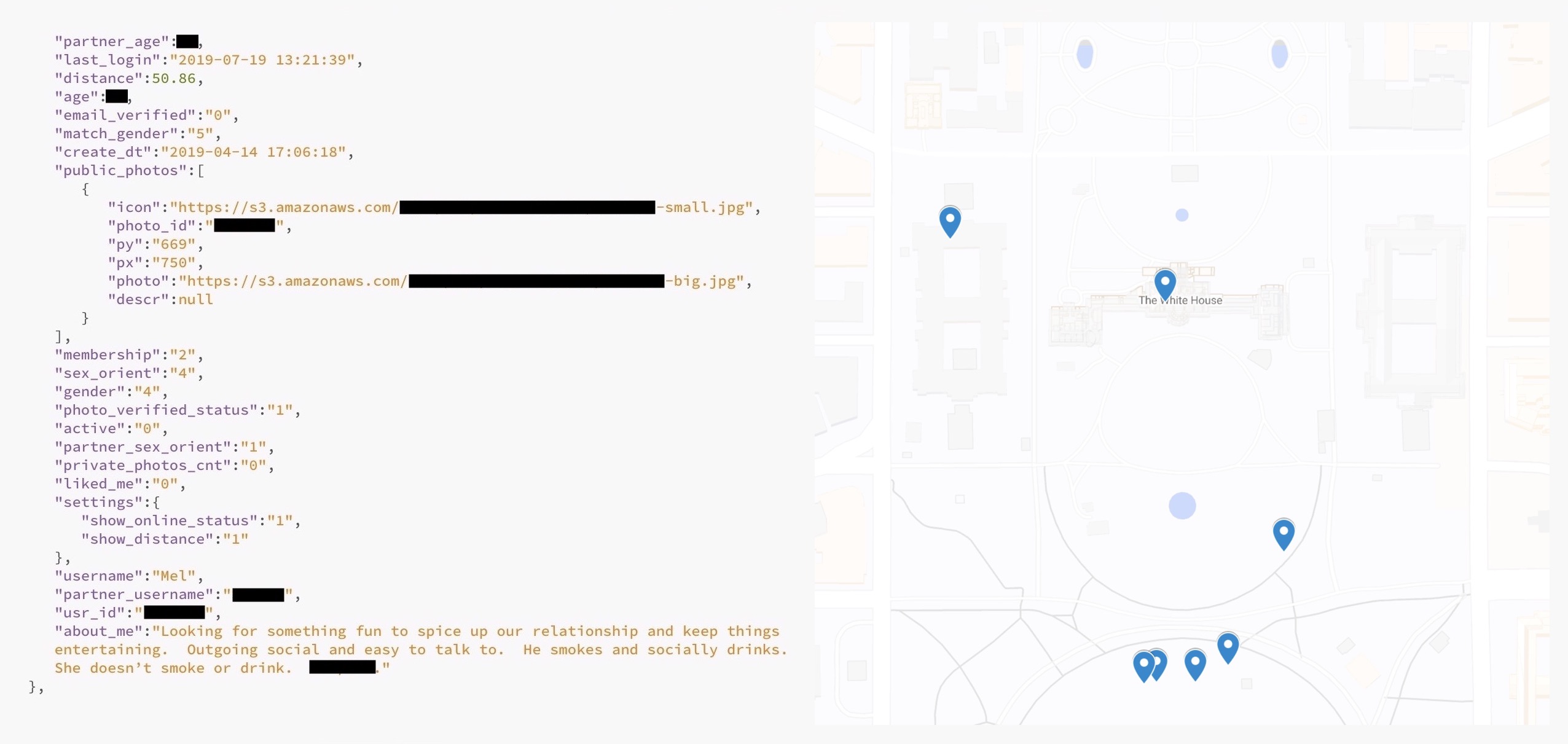
One of the exposed user records (left) and an approximate representation of several users (right).

We found profiles of users at both locations, including their sexual preferences — including sexual orientation and their preferred matches; their age; username and their partner’s username; their bio — many of which included expansive, specific and personal information on the user; and their full-resolution profile picture. In some cases, dates of birth were also exposed.

None of the data was encrypted. The researchers called the app a “privacy train wreck.”

The researchers contacted 3fun on July 1 to report the bugs. Munro said the app maker took weeks to fix the issues.

We emailed 3fun with several questions, but spokesperson Jennifer White did not respond to a request for comment.

It’s the latest app to fall foul of proper security standards in recent months. Jewish dating app JCrush left 200,000 user records exposed in June following a security lapse. Last year on its launch day, conservative dating app Donald Daters exposed its entire user base — at the time some 1,600 users — after leaving a set of hardcoded keys in its app, which was quickly found after a security researcher decompiled the app.

Another dating app, Coffee Meets Bagel, was breached on Valentine’s Day, no less.

Well, that’s one way to a person’s heart — hacking their dating profile.

08 Aug 2019

Group dating app 3fun exposed sensitive data on 1.5 million users

More than 1.5 million users of a group dating service had their personal data exposed — including their real-time location — because of a vulnerability in the app.

The app, 3fun, bills itself as a “private space” where you can meet “local kinky, open-minded people.” But the data wasn’t private at all. Ken Munro, founder of Pen Test Partners, which published the research Thursday and shared its findings with TechCrunch, said it was “probably the worst security for any dating app we’ve ever seen.”

Pen Test Partners researchers found the app was leaking the precise location, photos and other personal details of any nearby user.

Worse, because the app wasn’t properly secured, the researchers found they could plug in any coordinates they wanted to spoof their location, revealing sensitive information on anyone within any location of their choosing, including government buildings, military bases, and even intelligence agencies.

TechCrunch ran the same tests as Pen Test Partners and confirmed its findings. We were able to modify our current geolocation to any set of coordinates we wanted — including the White House and the CIA.

Using a man-in-the-middle tool like Burp Suite, we could capture our real location, manipulate it in transit on the way to the server, and receive a batch of data for that location.

Screen Shot 2019 08 06 at 1.19.56 PM

One of the exposed user records (left) and an approximate representation of several users (right).

We found profiles of users at both locations, including their sexual preferences — including sexual orientation and their preferred matches; their age; username and their partner’s username; their bio — many of which included expansive, specific and personal information on the user; and their full-resolution profile picture. In some cases, dates of birth were also exposed.

None of the data was encrypted. The researchers called the app a “privacy train wreck.”

The researchers contacted 3fun on July 1 to report the bugs. Munro said the app maker took weeks to fix the issues.

We emailed 3fun with several questions, but spokesperson Jennifer White did not respond to a request for comment.

It’s the latest app to fall foul of proper security standards in recent months. Jewish dating app JCrush left 200,000 user records exposed in June following a security lapse. Last year on its launch day, conservative dating app Donald Daters exposed its entire user base — at the time some 1,600 users — after leaving a set of hardcoded keys in its app, which was quickly found after a security researcher decompiled the app.

Another dating app, Coffee Meets Bagel, was breached on Valentine’s Day, no less.

Well, that’s one way to a person’s heart — hacking their dating profile.

08 Aug 2019

Mubi founder Efe Cakarel is coming to Disrupt Berlin

Most entrepreneurs who have tried to compete with Netflix have failed. But Efe Cakarel isn’t one of them. As the founder and CEO of Mubi, he has created a beloved movie streaming service. That’s why I’m excited to announce that Mubi founder Efe Cakarel is joining us at TechCrunch Disrupt Berlin.

Mubi has been around for more than a decade. Back then, Netflix was just launching its on-demand streaming service. It was still mostly a DVD rental company.

Instead of focusing on quantity and mainstream content, Mubi went the opposite direction with a subscription tailored for cinephiles. Every day, Mubi adds a new movie to its catalog. It remains available for 30 days before it disappears from the service.

With this rolling window of 30 movies, there’s always something new, something interesting. The limited selection has become an asset as you can take time to read about each movie and watch things you would have never considered watching on a service with thousands of titles.

More recently, the company started purchasing exclusive distribution rights and even producing its own original content. The service is available in most countries around the world.

But it hasn’t always been an easy ride. A few years ago, Mubi had plans to form a joint venture with a Chinese partner in order to launch a service in China. The company had to cancel the project.

And yet, Mubi is still around after all those years. I’m personally impressed by Cakarel’s resilience and I can’t wait to see what’s next for the company.

Buy your ticket to Disrupt Berlin to listen to this discussion and many others. The conference will take place on December 11-12.

In addition to panels and fireside chats, like this one, new startups will participate in the Startup Battlefield to compete for the highly coveted Battlefield Cup.

08 Aug 2019

Stock trading app Robinhood gets UK broker license

Robinhood, the Silicon Valley-based stock trading app that was recently valued by investors at $7.6 billion, has received regulatory approval in the U.K., breaking cover on its plans to set up shop in London (as reported exclusively by TechCrunch 7 months ago).

Specifically, Robinhood International Ltd., a Robinhood subsidiary, has been authorised to operate as a broker (with some restrictions) in the U.K. by the Financial Conduct Authority, which regulates U.K. financial services. This gears Robinhood up for a U.K. launch, although the company is staying tightlipped on when exactly that will be.

In addition, Robinhood is disclosing that it has appointed Wander Rutgers as President of Robinhood International. He joins from London fintech Plum, where he headed up the startup’s investing and savings product, and prior to that is said to have led product, compliance and operations teams at TransferWise.

At Robinhood, Rutgers will lead the U.K. business and oversee the company’s new London office, which has already begun staffing up. Sources told me in April that Robinhood was busy hiring for multiple U.K. positions, including recruitment, operations, marketing/PR, customer support, compliance and product.

The company tells me it is also building out a London-based user research team so it can better find product-market fit here. Crudely building a localised version of Robinhood obviously won’t cut it.

Meanwhile, news that Robinhood is ramping its planned U.K. launch is interesting in the context of local fintech startups that have launched their own fee-free trading offerings.

First out of the gate was London-based Freetrade, which chose very early on to build a bona-fide “challenger broker,” including obtaining the required license from the FCA, rather than simply partnering with an established broker. The app lets you invest in stocks and ETFs. Trades are “fee-free” if you are happy for your buy or sell trades to execute at the close of business each day. If you want to execute immediately, the startup charges a low £1 per trade.

And just last week, Revolut finally launched its fee-free stock trading feature, albeit tentatively. For now, the feature is limited to some Revolut customers with a premium Metal card (which itself entails a monthly subscription fee) and covers 300 U.S.-listed stocks. The company says that it plans to expand to U.K. and European stocks as well as Exchange Traded Funds in the future. Noteworthy, my understanding is that Revolut doesn’t have its own broker license but is partnering with US broker DriveWealth for part of its tech and the required regulatory authorisation (it also explains why, for now, Revolut is offering access to U.S. stocks only).

In contrast, Freetrade has long argued that to innovate within trading, you need to build and own the full brokerage stack. It was the first mover in this regard amongst the new crop of “fee-free” trading apps in the U.K., though others, including Netherlands-based Bux and now Robinhood, have since taken the same path. Only time will tell if Revolut will be forced to do the same.

Another tidbit is that Revolut and Robinhood share investors, namely Index and DST. That makes for an interesting subplot as the two unicorns encroach on each other’s lawn. No conflict, no interest.

08 Aug 2019

Google and Twitter are using AMD’s new EPYC Rome processors in their datacenters

AMD announced that Google and Twitter are among the companies now using EPYC Rome processors during a launch event for the 7nm chips today. The release of EPYC Rome marks a major step in AMD’s processor war with Intel, which said last month that its own 7nm chips, Ice Lake, won’t be available until 2021 (though it is expected to release its 10nm node this year).

Intel is still the biggest datacenter processor maker by far, however, and also counts Google and Twitter among its customers. But AMD’s latest releases and its strategy of undercutting competitors with lower pricing have quickly transformed it into a formidable rival.

Google has used other AMD chips before, including in its “Millionth Server,” built in 2008, and says it is now the first company to use second-generation EPYC chips in its datacenters. Later this year, Google will also make virtual machines that run on the chips available to Google Cloud customers.

In a press statement, Bart Sano, Google vice president of engineering, said “AMD 2nd Gen Epyc processors will help us continue to do what we do best in our datacenters: innovate. Its scalable compute, memory and I/O performance will expand out ability to drive innovation forward in our infrastructure and will give Google Cloud customers the flexibility to choose the best VM for their workloads.”

Twitter plans to begin using EPYC Rome in its datacenter infrastructure later this year. Its senior director of engineering, Jennifer Fraser, said the chips will reduce the energy consumption of its datacenters. “Using the AMD EPYC 7702 processor, we can scale out our compute clusters with more cores in less space using less power, which translates to 25% lower [total cost of ownership] for Twitter.”

In a comparison test between 2-socket Intel Xeon 6242 and AMD EPYC 7702P processors, AMD claimed that its chips were able to reduce total cost of ownership by up to 50% across “numerous workloads.” AMD EPYC Rome’s flagship is the 64-core, 128-thread 7742 chip, with a 2.25 base frequency, 225 default TDP and 256MB of total cache, starts at $6,950.