
Year: 2019

06 Aug 2019

Apple subsidiary FileMaker Inc. changes its name (back) to Claris

Remember Claris, the 1987 Apple spin-off that made applications like MacWrite, MacPaint and FileMaker? In 1998, Apple brought all of those products in-house again, with the exception of the low-code application platform FileMaker . With that move, Claris changed its name to FileMaker Inc. Today, however, the Claris name rises from the dead, as FileMaker Inc. is changing its name to Claris International. The name of the FileMaker product itself, though, remains the same.

As FileMaker Claris CEO Brad Freitag, who recently took over this role from Dominique Goupil, told me, the reason for this move is because the company is starting to look beyond its core FileMaker product. “We’re accelerating our vision and our strategy,” he said. “We’ve described our vision for a long time as making powerful technology accessible to everyone. And with the leadership change, we are really asserting a more aggressive posture in bringing that product roadmap to life.”

Brad

Claris CEO Brad Freitag

To put a point on this and clarify its strategy, Claris is also using today’s announcement to launch Claris Connect, a tool for integrating various cloud services and automating workflows between them. With this, Claris also confirmed the previously reported acquisition of Stamplay, a small Italian startup that makes tools for connecting the APIs of various enterprise tools. Claris Connect is going to be the second product in Claris’ lineup, with FileMaker remaining its flagship product.

FileMaker, the product, currently serves more than a million end users who work at about 50,000 different companies. The company has great brand recognition and has been profitable for more than 80 consecutive quarters, Freitag said, but with its foray into workflow and business process automation, it was time to look for a different brand name.

Although low-code/no-code has been a growing buzzword in the industry for a few years now, FileMaker didn’t really make any waves. That, too, is going to change a bit, it seems, as Freitag actually hopes to expand the business significantly. “As we look out five years, we see multiplying the user community by at least 3x and there’s a pretty clear path to getting there,” he said. “If you look at our business, we’re over 50% outside of the U.S. The market opportunities for us exist in the Americas, as well as Europe and Asia.”

Claris logo rgb blk

Freitag admits that FileMaker was “relatively modest” in its go-to-market posture, so it will expand its brand and category awareness efforts. Chances are then, you’ll hear the Claris and FileMaker names a bit more often going forward (and Freitag stressed that the company remains “100% committed to the FileMaker platform”).

Claris also expects to expand its product offerings going forward — and that may include additional acquisitions. “We are investing heavily in organic innovation as we expand the product lines — and we are open to additional acquisitions,” he said.

FileMaker Inc./Claris is making this move while the overall market for products like FileMaker continues to grow. That’s something Freitag hopes to capitalize on as the company looks ahead. What exactly that will look like remains to be seen, but Freitag noted that the kind of next-generation platform will go beyond the kind of database-driven applications FileMaker itself is known for today and focus on services that support workflow applications. He also believes there is an opportunity for IoT solutions under the Claris brand and maybe, in the long run, augmented reality applications.

06 Aug 2019

Democratic senate campaign group exposed 6.2 million Americans’ emails

A political campaign group working to elect Democratic senators left a spreadsheet containing the email addresses of 6.2 million Americans’ on an exposed server.

Data breach researchers at security firm UpGuard found the data in late July, and traced the storage bucket back to a former staffer at the Democratic Senatorial Campaign Committee, an organization that seeks grassroots donations and contributions to help elect Democratic candidates to the U.S. Senate.

Following the discovery, UpGuard researchers reached out to the DSCC and the storage bucket was secured within a few hours. The researchers published shared their findings exclusively with TechCrunch and published their findings.

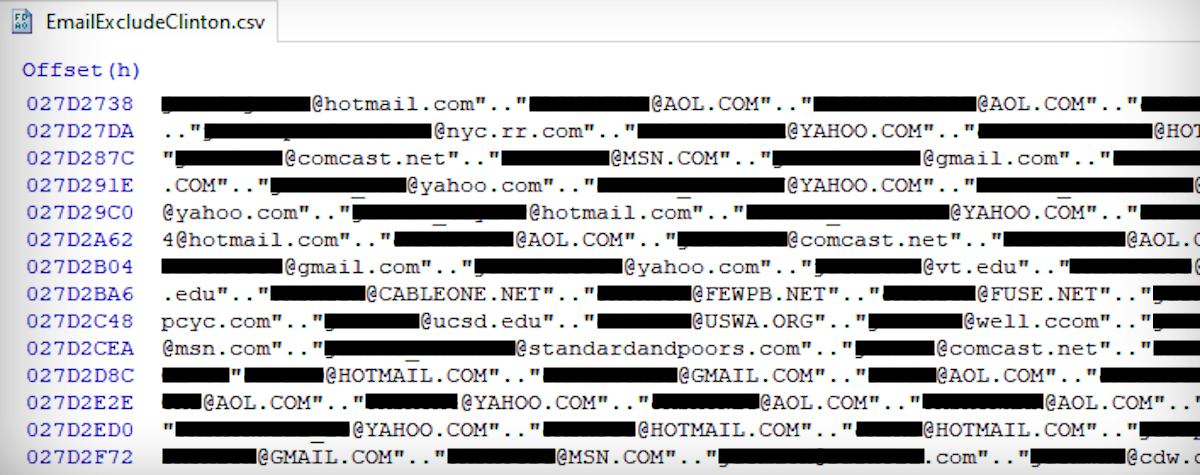
The spreadsheet was titled “EmailExcludeClinton.csv” and was found in a similarly named unprotected Amazon S3 bucket without a password. The file was uploaded in 2010 — a year after former Democratic senator and presidential candidate Hillary Clinton, whom the data is believed to be named after, became secretary of state.

UpGuard said the data may be people “who had opted out or should otherwise be excluded” from the committee’s marketing.

screenshot

A redacted portion of the email spreadsheet. (Image: UpGuard/supplied)

Stewart Boss, a spokesperson for the DSCC, denied the data came from the Sen. Hillary Clinton’s campaign and claimed the data had been created using the committee’s own information.

“A spreadsheet from nearly a decade ago that was created for fundraising purposes was removed in compliance with the stringent protocols we now have in place,” he told TechCrunch in an email.

Despite several follow-ups, the spokesperson declined to say say how the email addresses were collected, where the information came from, what the email addresses were used for, how long the bucket was exposed, or if the committee knew if anyone else accessed or obtained the data.

We also contacted the former DSCC staffer who owned the storage bucket and allegedly created the database, but did not hear back.

Most of the email addresses were from consumer providers, like AOL, Yahoo, Hotmail and Gmail, but the researchers found over 7,700 U.S. government email addresses and 3,400 U.S. military email addresses, said the UpGuard researchers.

The DSCC security lapse is the latest in a string of data exposures in recent years — some of which were also discovered by UpGuard. Two incidents in 2015 and 2017 exposed 191 million and 198 million Americans’ voter data respectively, including voter profiles and political persuasions. Last year, 14 million voter records on Texas residents were also found on an exposed server.

Although the DSCC’s data exposure contains less damaging information than similar exposed sets of voter data, it represents another embarrassing lapse around political campaign data security.

“This list contained only email addresses, but other political data sets contain far more information on individuals, down to psychographic information such as their habits, behaviors, and likely beliefs,” said UpGuard. “The same things that make this data valuable to political campaigns makes it valuable to malicious actors — intel on individuals that can be used to contact and influence them.”

“If political data can be exposed for ten years, the risk created by that data has an unknown half-life,” the researchers said.

06 Aug 2019

Klarna raises $460 million, looks to expand its payments presence in the U.S.

Swedish payments provider Klarna has announced a new round of equity funding, adding $60 million at a post-money valuation of $5.5 billion, which makes it one of the most highly-valued private fintech companies in the world. The new funding will be used to help Klarna continue to grow its presence in the U.S. payments market, the company said in a press release.

Klarna’s European presence is strong, based on the back of its credit card-alternative payment method which allows customers to pay over time, with the purchase price broken up over four equal instalments, but directly from their bank accounts and without incurring any interest. The company also offers pay now options to provide both retailers and their customers so people can pay more traditionally, too.

In Europe, the mode has been a tremendous success because it’s more in line with how customers in many European markets prefer to pay anyway – avoiding credit and opting for cash and debit. Klarna is also riding the rise of pay later options that are increasingly popular in U.S. commerce, including offerings like purchase financing from Affirm.

Once reserved for big ticket items, interest-free, instalment based payment programs are increasingly common, and popular, for lower-cost purchase. Affirm, for instance saw total loan volume cross $2 billion in 2018. Klarna, meanwhile, is currently growing in the U.S. at a rate of around 6 million new customers annually, and it counts over 3,000 U.S. merchants as customers. Per order value is also growing among customers using Klarna’s 4-payment instalment option, the company says: Average order value is 68% higher when using this option, with a 44% higher conversion rate (ie. customers actually following through with the purchase) vs. traditional credit card payments.

The new funding for Klarna is led by Dragoneer Investment Group, and includes participation by Commonwealth Bank of Australia, HMI Capital LLC, Merian Chrysalis Investment Company Limited, and more.

06 Aug 2019

OnePlus’ first 5G handset is headed for Sprint

Sprint href="https://newsroom.sprint.com/sprint-to-launch-5g-smartphone-from-oneplus.htm"> this morning announced that it will be the first network to get its hands on OnePlus’s long-promised 5G handset [not pictured]. The Shenzhen-based manufacturer announced late last year that it was targeting 2019 for the device, bucking the trend of being slightly behind the curve on the latest smartphone technologies.

Sprint’s not offering much in the way of actual information here — no pricing or availability. Not even specs or a device name were made available via the press release. Rather, the carrier notes that this is its first 5G smartphone, joining three other non-phone 5G devices for the nascent network.

Last year OnePlus made a device available for the first time through a U.S. carrier, partnering with T-Mobile for the 6T. It’s made the jump to Sprint this time out, though given merger plans, that distinction may soon be moot regardless.

06 Aug 2019

6 steps to reduce churn for high volume subscription companies

Your customers don’t really want to cancel. At least, not all of them. Between 15 and 30 percent of customers leave for reasons that are within your control. Tapping into these customers at the right moment for the right reason, and giving them a path to stay is the key to reducing churn for subscription companies. 

These six steps outline how to intercept customers who show intent to cancel, and use their feedback to take action, build better experiences and ultimately retain subscribers:

  1. Survey every customer at the point of cancel
  2. Define a reason-based classification system for churn
  3. Connect churn data to a central source of truth
  4. Segment customers by actionability
  5. Deliver personalized, reason-based offers
  6. Test and evolve using saved revenue as your KPI

Step 1. Survey every customer at the point of cancel 

The subscription industry has many ways of collecting customer feedback. Net Promoter Scores (NPS) and in-product surveys are table stakes for most companies. You need a regular pulse on customer sentiment, but polling customers while they’re still customers isn’t enough.

Cancellation is a critical moment in the customer lifecycle rivaled only by the moment of purchase, and yet it remains a blind spot for most companies.

When customers cancel, they’re sending a message with their wallets—to effectively reduce churn, you need to know why. Surveying customers at the point of cancel is an untapped opportunity because:

06 Aug 2019

Optimus Ride’s Brooklyn self-driving shuttles begin picking up passengers this week

Self-driving startup Optimus Ride will become the first to operate a commercial self-driving service in the state of New York – in Brooklyn. But don’t expect these things to be contending with pedestrians, bike riders, taxis and cars on New York’s busiest roads; instead, they’ll be offering shuttle services within Brooklyn Navy Yards, a 300-acre private commercial development.

The Optimus Ride autonomous vehicles, which have six seats across three rows for passengers, and which also always have both a safety driver and another Optimus staff observer on board, at least for now, will offer service seven days a week, for free, running a service loop that will cover the entire complex. It includes a stop at a new ferry landing on-site, which means a lot of commuters should be able to pretty easily grab a seat in one for their last-mile needs.

Optimus Ride’s shuttles have been in operation in a number of different sites across the U.S., including in Boston, Virginia, California and Massachusetts.

The Brooklyn Navy Yards is a perfect environment for the service, since it plays host to some 10,000 workers, but also includes entirely private roads – which means Optimus Ride doesn’t need to worry about public road rules and regulations in deploying a commercial self-driving service.

May Mobility, an Ann Arbor-based startup also focused on low-speed autonomous shuttles, has deployed in partnership with some smaller cities and on defined bus route paths. The approach of both companies is similar, using relatively simple vehicle designs and serving low-volume ridership in areas where traffic and pedestrian patterns are relatively easy to anticipate.

Commercially viable, fully autonomous robotaxi service for dense urban areas is still a long, long way off – and definitely out of reach for startup and smaller companies in the near-term. Tackling commercial service in controlled environments on a smaller scale is a great way to build the business while bringing in revenue and offering actual value to paying customers at the same time.

06 Aug 2019

DeepCode gets $4M to feed its AI-powered code review tool

DeepCode, a Swiss startup that’s using machine learning to automate code reviews, has closed a $4M seed round, led by European VC firm Earlybird, with participation from 3VC and existing investor btov Partners.

The founders described the platform as a sort of ‘Grammarly for coders’ when we chatted to them early last year. At the they were bootstapping. Now they’ve bagged their first venture capital to dial their efforts up.

DeepCode, which is spun-out of Swiss technical university ETH Zurich, says its code review AI is different because it doesn’t just pick up syntax mistakes but is able to determine the intent of the code because it processes millions of commits — giving it an overview that allows it to identify many more critical bugs and vulnerabilities than other tools.

“All of the static analysis and lint tools out there (there are hundreds of those) are providing similar code analysis services but without the deeper understanding of code, and mostly focusing on one language or specific languages,” says CEO and co-founder, Boris Paskalev, going on to name-check the likes of CA Technologies, Micro Focus (Fortify), Cast Software, and SonarSource as the main competitors DeepCode is targeting.

Its bot is free for enterprise teams of up to 30 developers, for open source software, and for educational use.

To use it developers connect DeepCode with their GitHub or Bitbucket accounts, with no configuration required. The bot will then immediately start reviewing each commit — picking up issues “in seconds”.  (You can see a demo of the code review tool here.)

“We do not disclose developer information but the number of Open Source Repositories that are using DeepCode have hundreds of thousands of total contributors,” Paskalev tells us when asked how many developers are using the tool now.

“We do not count rules per se as our AI Platform combines thousands of programming concepts, which if combined in individual rules will result in millions of separate rules,” he adds.

The seed funding will go on supporting additional integrations and more programming languages than the three currently supported (namely: Java, JavaScript, and Python); on improving the scope of code recommendations, and on expanding the team internationally.

Commenting in a statement, Christian Nagel, partner and co-founder of Earlybird, said: “For all industries and almost every business model, the performance and quality of coding has become key. DeepCode provides a platform that enhances the development capabilities of programmers. The team has a deep scientific understanding of code optimization and uses artificial intelligence to deliver the next breakthrough in software development.”

06 Aug 2019

Ticket marketplace TickPick raises $40M in its first institutional funding

TickPick was founded back in 2011, but it never raised any institutional funding — until now, with the announcement of a $40 million investment from PWP Growth Equity.

Brett Goldberg and Chris O’Brien (who were college roommates before founding TickPick together and serving as co-CEOs) said they created the site as a marketplace where users could bid for tickets. However, O’Brien admitted that this functionality — while still supported — has “fallen by the wayside quite a bit,” and that the core of TickPick’s identity is now the elimination all hidden fees.

To be clear, the service still makes its money from fees, but those fees are all incorporated into the price you see up front, rather than appearing as an unpleasant surprise right before you make your purchase.

Goldberg said that while other ticket marketplaces have tried to do something similar, they inevitably go back to the old model, largely because they’re trying to compete on price and “everyone’s assuming there will be fees tacked on at the end.” In his view, TickPick has been able to hold out because “it’s just so core to our brand and messaging” – and when the company has strayed from that vision (like when it included a $5 e-delivery fee), customers were quick to complain.

TickPick started out as a secondary marketplace for ticket resellers, but it’s started to sell tickets directly from partners like Firefly Music Festival and Riot Fest, the Big South and Western Athletic Conferences, Florida International, Georgia State and Santa Clara Universities, Ric Flair, Sports Illustrated Saturday Night Lights, Shaq’s Fun House and the Maxim Pregame Experience.

TickPick game view

The company says it’s on-track to facilitate $200 million worth of transactions in 2019, up 60% year-over-year.

Asked why TickPick didn’t raise outside funding before this, Goldberg said it didn’t have the traction to win over investors, unless the team was willing to “sell a large stake in the business for not that much money.”

O’Brien added, “We always seem to find ourselves in a weird position in the broader ecosystem of startups, because of our focus on profitability — it’s not the same story as a lot of other startups.”

Now, however, Goldberg suggested that “the bootstrap model” might finally be holding the company back from reaching the next level. tTe pair plans to use the new funding to make some key hires like a chief financial officer and a chief marketing officer, and to build a data team that can help TickPick use artificial intelligence and machine learning to improve the customer experience.

“We seek to partner with passionate and committed management teams with differentiated business models looking to further unlock their growth potential – and we found that in abundance in TickPick,” said PWP Managing Partner John McKee in a statement. “Since its founding, TickPick has been disrupting the secondary event ticketing industry with its unique value proposition and established an incredibly loyal, passionate customer base.”

06 Aug 2019

Cockroach Labs announces $55M Series C to battle industry giants

Cockroach Labs, makers of CockroachDB, sits in a tough position in the database market. On one side, it has traditional database vendors like Oracle, and on the other there’s AWS and its family of databases. It takes some good technology and serious dollars to compete with those companies. Cockroach took care of the latter with a $55 million Series C round today.

The round was led by Altimeter Capital and Tiger Global along with existing investor GV. Other existing investors including Benchmark, Index Ventures, Redpoint Ventures, FirstMark Capital and Work-Bench also participated. Today’s investment brings the total raised to over $110 million, according to the company.

Spencer Kimball, co-founder and CEO, says the company is building a modern database to compete with these industry giants. “CockroachDB is architected from the ground up as a cloud native database. Fundamentally, what that means is that it’s distributed, not just across nodes in a single data center, which is really table stakes as the database gets bigger, but also across data centers to be resilient. It’s also distributed potentially across the planet in order to give a global customer base what feels like a local experience to keep the data near them,” Kimball explained.

At the same time, even while it has a cloud product hosted on AWS, it also competes with several AWS database products including Amazon Aurora, Redshift and DynamoDB. Much like MongoDB, which changed its open source licensing structure last year, Cockroach did as well, for many of the same reasons. They both believed bigger players were taking advantage of the open source nature of their products to undermine their markets.

“If you’re trying to build a business around an open source product, you have to be careful that a much bigger player doesn’t come along and extract too much of the value out of the open source product that you’ve been building and maintaining,” Kimball explained.

As the company deals with all of these competitive pressures, it takes a fair bit of money to continue building a piece of technology to beat the competition, while going up against much deeper-pocketed rivals. So far the company has been doing well with Q1 revenue this year doubling all of last year. Kimball indicated that Q2 could double Q1, but he wants to keep that going, and that takes money.

“We need to accelerate that sales momentum and that’s usually what the Series C is about. Fundamentally, we have, I think, the most advanced capabilities in the market right now. Certainly we do if you look at the differentiator around just global capability. We nevertheless are competing with Oracle on one side, and Amazon on the other side. So a lot of this money is going towards product development too,” he said.

Cockroach Labs was founded in 2015, and is based in New York City.

06 Aug 2019

Walmart-owned Flipkart bets on free video streaming service and Hindi support to win next 200 million internet users in India

India’s e-commerce giant Flipkart said on Tuesday that it is revamping its shopping app to add support for Hindi language, a video streaming service, and an audio-visual assistant, the latest in a series of recent efforts to expand its reach in the country.

The Walmart-owned company, which leads the local market, told TechCrunch that it has started to rollout the features on its shopping app and will push it to all its existing users in within next 20 days.

Only 10% of India’s 1.3 billion people speak English. Flipkart said it has been working to customize its entire platform for several months to add support for Hindi. As part of the revamp, the company is also introducing an “audio visual guided navigation” feature, also built in Hindi, that is aimed at first time internet users — and existing online users not comfortable with making transactions online — to make it easier for them to navigate the site and place orders.

As part of the accessibility push, Flipkart is also introducing an in-app video streaming feature dubbed ‘Flipkart Videos,’ that will syndicate movies, shows, and other long-form and short form content from a number of production houses and movie studios, the company said.

Its rival Amazon India added support for Hindi last year, though the feature is limited to basic text translation.

The inclusion of video streaming feature comes as Indians’ appetite for consuming media content on the internet has ballooned in the recent years. Hotstar, a Disney-owned video streaming service, has amassed more than 300 million monthly active users in the country.

Flipkart said the video streaming feature will enable it to invite a new segment of users to its platform who are online but don’t currently shop on the internet. Even as more than 500 million users are connected to the web in India, only tens of millions of them currently shop there. The streaming feature will be accessible to all users at no charge without any loyalty program, a company spokesperson said, refuting a recent media report that claimed the feature will be limited to loyalty customers.

“In the past 10 years our vision and ethos have been to solve for ‘Real India,’ create India specific tech solutions, here in India. What we are rolling out when it comes to addressing the needs of the next 200 million users in our country, is taking forward those founding principles of access and affordability,” said Kalyan Krishnamurthy, Group CEO of Flipkart, in a statement.

“We strongly believe that the next phase of our growth is rooted in loyalty , democratizing e-commerce and the country will continue seeing more innovations that stem from our deep understanding of Indian consumers, especially middle India.”

Flipkart said it is also attempting to make it easier for users to discover items on its app. So it is introducing a feed called ‘Flipkart Ideas’ that will populate short form videos, animated images, polls and quizzes.

For instance, a user may see a short form video that shows a sportsperson wearing a pair of sneakers, a t-shirt, a pair of jeans, and a cap. If they tap on the video, they will see the exact items the person in the video is wearing and other similar items. One more tap, and the user would be able to purchase any of those items.

The company said it is working with more than 400 influencers and 30 brands to create content that will appear on the feed.

All of these features, as well as a gaming section that Flipkart introduced last year, will now appear at the bottom of the screen for easier navigation, the company said. More than half a million users in India play mini-games on Flipkart everyday. The company said it will introduce more games to boost engagement levels and offer loyalty points as incentive to customers.