Year: 2019

06 Aug 2019

Snap looks to raise $1 billion in private debt offering

Snap, the parent company of Snapchat, is looking to add some cash to its coffers via a new proposed private offering of $1 billion in convertible senior notes, with a due date for maturation of August 1, 2026. The debt offering will be used to cover the cost of general operating expenditures involved in running the business, Snap says, but also potentially to “acquire complementary businesses, products, services or technologies,” as well as possibly for future stock repurchase plans, though no such plans exist currently.

Raising debt to fund operations and acquisitions is not unusual for a publicly traded company – Netflix does this regularly to pick up more money to fund its increasingly expensive production budget for content, for instance. So far, the market seems to be reacting negatively to the news of Snap’s decision to seek this chunk of debt funding, however, as it’s down in pre-market trading.

Snap has generally been on a positive path in terms of its relationship with stockholders, however – its stock price rose on the back of a strong quarterly earnings report at the end of July, closing above its IPO price for the first time. It’s now dipped south of that mark again, but it’s still much-improved on a year-to-date timeline measure.

06 Aug 2019

Watch SpaceX launch a huge satellite using a twice-flown Falcon 9 live

SpaceX is launching a Falcon 9 rocket with a huge communications satellite as payload, with launch window opening at 6:53 PM EDT (3:53 PM PDT) today. The window extends to 8:21 PM EDT, so there’s a possibility of a launch anytime in between there, should weather conditions or anything impact the ability to launch. The livestream above should begin around 15 minutes prior to the opening of the launch window.

The launch will use a twice-flown Falcon 9 first stage booster, which previously flew in missions in July and November of last year. This will be the last mission for the rocket, however, since the launch is configured in ‘expendable’ mode, which means that there’s no attempt to return it to Earth for a soft landing.

That’s because Amos-17, the satellite SpaceX is launching on behalf of Israeli company Spacecomm for this mission, weighs over 14,000 lbs – meaning it needs all the fuel on board the Falcon 9 to achieve its target orbit, leaving none remaining for an attempted controlled decent.

The launch will, however, include an attempted recovery of the nose cone fairing that protects the satellite during the ascent phase. SpaceX has managed to catch the fairing once before during a launch, using a ship at sea called ‘Ms. Tree’ which was fitted with an extra large net. Recovering the fairing is a big cost savings for SpaceX, as is recovering the Falcon 9 booster, all of which contributes to SpaceX’s goal of achieving 100 percent reusable launch capabilities.

06 Aug 2019

Squad, the ‘anti-bro startup,’ is creating a safe space for teenage girls online

When we go online to communicate, hang out or play, we’re typically logging on to platforms conceived of and built by men.

Mark Zuckerberg famously created Facebook in his Harvard dorm room. Evan Spiegel and his frat brother Bobby Murphy devised a plan for the ephemeral messaging app Snapchat while the pair were still students at Stanford. Working out of a co-working space, Kevin Systrom and Mike Krieger built Instagram and yes, they also went to Stanford.

Seldom have social tools created by women climbed the latter to mainstream success. Instead, women and girls have battled the lion’s share of digital harassment on popular social platforms — most of which failed early-on to incorporate security features tailored to minority user’s needs — and struggled to find a protected corner of the internet.

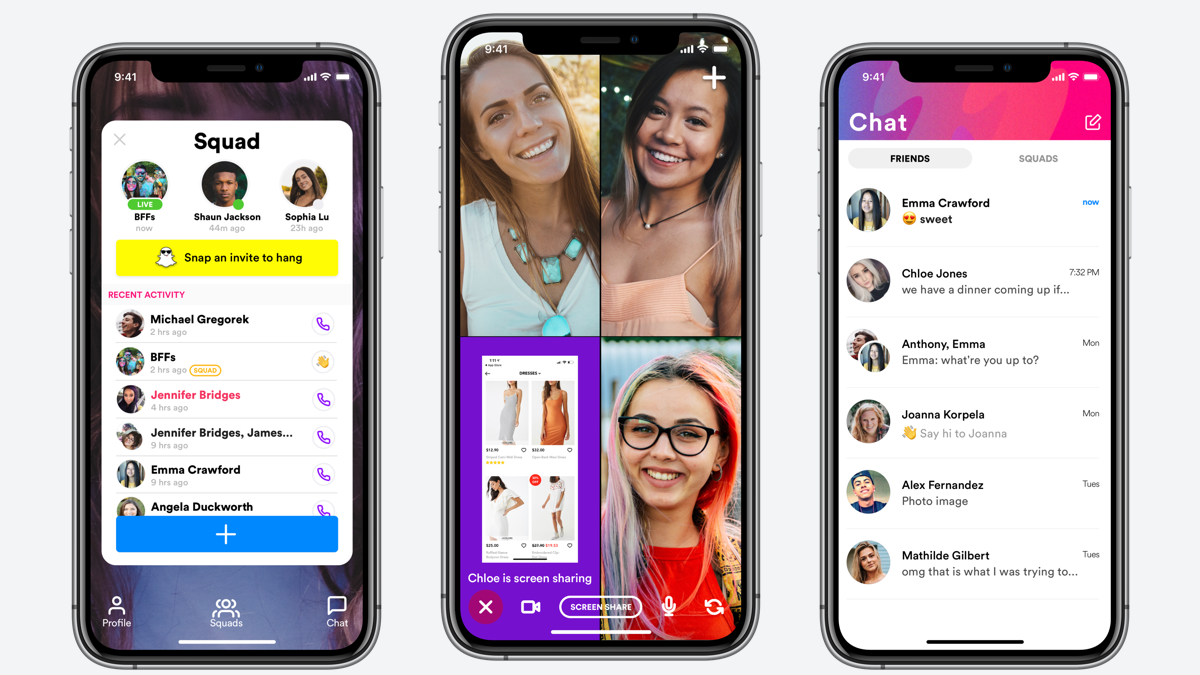
Squad, an app that allows you to video chat and share your phone screen with a friend in real-time, has tapped into a demographic clamoring for a safe space to gather online. Without any marketing, the startup has collected 450,000 registered users in eight months, 70% of which are teenage girls. So far this year, users have clocked in 1 million hours inside Squad calls.

“Completely accidentally we’ve developed this global audience of users and it’s girls all over the world,” Squad co-founder and chief executive officer Esther Crawford tells TechCrunch. “In India, it’s girls. In Saudia Arabia, it’s girls. In the U.S., it’s girls. Even without us localizing it, girls all over the world are finding it.”
Squad screens

Squad, the social screen sharing and group video chat app, has pulled together a $5 million investment led by First Round Capital.

Learn from the best but get rid of the shit

A remote team of six people led by Crawford, who’s a graduate of Oregon State University, Squad’s compelling founding story and organic growth helped them close a $5 million seed round led by First Round Capital general partner Hayley Barna, the only female partner at the historically all-male early-stage investment fund known for being the first institutional check in Uber.

Betaworks, Alpha Bridge Ventures, Day One Ventures, Jane VC, Mighty Networks CEO Gina Bianchini, early Snapchat employee Sebastian Gil and Y Combinator, the startup accelerator program Squad completed in the winter of 2018, have also participated in the funding round.

“We want to be a place where girls can come and hang out,” -Squad co-founder and CEO Esther Crawford.

Crawford describes Squad, which she’s built alongside her co-founder and chief technology officer Ethan Sutin, as the “anti-bro startup.” Not only because it’s led by a woman and boasts a cap table that’s 30% women and 30% people of color, but because she’s completely rewriting the consumer social startup playbook.

“We are trying to learn from the best in what they did but get rid of the shit,” Crawford said, referring to Snap, WhatsApp, Twitch and others. Twitch, a live-streaming platform for gamers, has become a social gathering place for Gen Z, she explains, but like many other communities on the internet, it’s failed its female users.

“Girls have been completely pushed off of Twitch,” she said. “The Twitch community didn’t want them there and they weren’t friendly to them. For boys, there are places you can go to consume content with other people, like Fortnite, but for girls there hasn’t been a place that’s really broken out. We want to be a place where girls can come and hang out.”

What Crawford and the small team at Squad have realized is that you don’t have to sacrifice growth for user safety and comfort. From the beginning, Squad has made sure users could easily block and report inappropriate behaviors and users, a feature that was an afterthought on many other social tools. They also made users unsearchable unless another user knows their exact username. By prioritizing the security of its primarily female audience, Squad is betting girls will continue coming back to the app and telling their friends about it.

“It’s possible to make girls feel safe and still have growth as a consumer product,” she said. “If people don’t feel safe on your app, they won’t stick around long-term.”

A new playbook

Squad quietly launched in January after pivoting away from building an information-sharing tool called Molly, which was backed with $1.5 million from BBG, Betaworks, CrunchFund and Halogen Ventures. Crawford’s now 14-year-old daughter unintentionally inspired the transition, when she proposed her mom create an app where she could peer into her best friend’s phones from afar.

IMG 2588

This reporter and Squad CEO Esther Crawford discuss the startup’s growth via Squad video chat.

Using Squad, people can browse memes, pore through DMs, plan a trip on Airbnb, peruse Tinder or a photo album with a friend via its video chat and screen share features. As Crawford describes it, it’s all the stuff you don’t want to post to Snap or Instagram but want to show your best friends. An app that may seem frivolous or non-essential seems to have quickly become a space online where girls can are opting to spend hours intimately engaged with their friends — without fear of stumbling into a troll.

“People can use this digital tech to hang out together instead of it being so performative,” Crawford said.

The downside of Squad’s screen sharing capabilities is a user can view another user’s Facebook friend’s profile, even if, say, they themselves were blocked from viewing that content. Most apps are available for viewing through screen share aside from premium video streaming apps like Netflix or Amazon Prime Video, so its entirely possible someone could use Squad solely for the purpose of viewing social content they are otherwise barred from seeing. In response to this possibility, Crawford says they are considering alerting users when their Squad chat’s been screen-shotted. To avoid additional privacy issues, Squad users can’t record or save anything from their calls or replay what happened on Squad.

Like many early-stage startups, the company isn’t making any money yet because the app is free and without ads. As soon as next year, however, Squad plans to monetize the product with in-app purchasing, scraping another rule from the consumer social playbook that has long encouraged companies to expand their user base first before trying to profit off users at all. (See: The Snapchat Monetization Problem).

Techno-optimism

Crawford, a product marketing veteran, grew up in a cult in Oregon where girls were barred from wearing makeup and from watching television or listening to music. But because the internet was so early, the dangers of it were yet to be discovered and miraculously, she was allowed to go online. Quickly, she made connections with people all over the world thanks to everyone’s favorite messaging tool at the time, AOL Instant Messenger.

The experience planted in her a deep love for the internet and a desire to share her life online. After developing a community through AIM, Crawford became one of the very first original content creators on YouTube and garnered millions of views on her videos. Without trying, she became an influencer, long before the term entered the zeitgeist.

Squad Screensharing1

She used her newfound digital prowess to launch one of the first social marketing agencies, where her clients included Weight Watchers and K-Mart, legacy brands that had no idea how to tap into her native digital communities. Ultimately, Crawford landed in the tech startup world, hopping from Series A startup to Series A startup, offering up her product marketing skills before her daughter’s idea prompted her to go into business on her own again.

“I’m a techno-optimist and yet, so many of these tech companies we thought were going to connect people turned out to have accidentally made people more lonely,” she said. “With a different lense and approach, I thought there could be an app that built bridges.”

Now with a new bout of funding, Squad can implement strategic marketing campaigns, continue adding integrations with complementary platforms (the startup has just announced a new integration with YouTube) and hire product designers. The next few years will be critical to Squad’s success as it looks to young people to give them a permanent spot on their home screen.

For Crawford, what’s most important, aside from growing group of teenagers using Squad, is to make sure only good people see a big payday thanks to her great idea: “I am ready to do everything I can to make Squad successful and make sure our success has a positive downstream effect so that we have great people on our team that get rich off our success.”


06 Aug 2019

Apple rolls out Apple Card Preview to select users

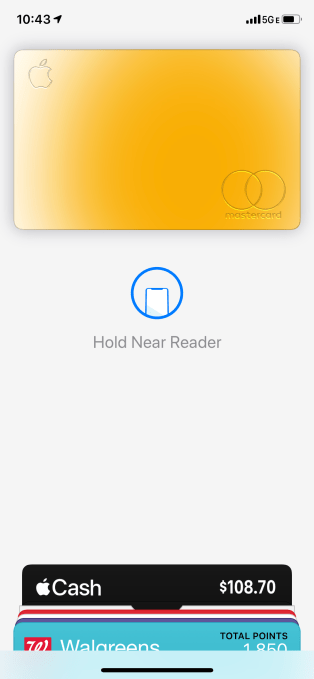
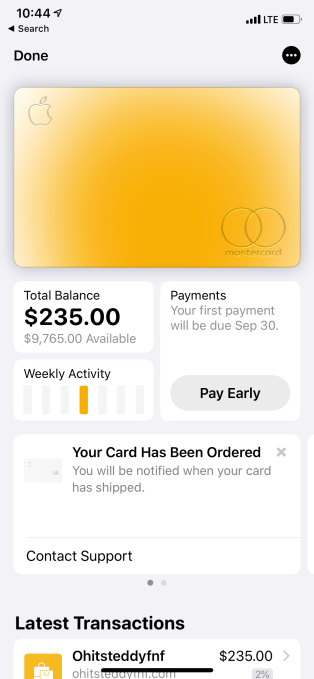
Apple Card is getting its first group of public test users today. A limited amount of customers that signed up to be notified about the release of Apple Card are getting the ability to apply for the card in their Wallet app today — as well as the option to order their physical Apple Card.

I’ve been using the card for a few days on my own device, making purchases and payments and playing around with features like Apple Cash rewards and transaction categorization.

A full rollout of Apple Card will come later in August. It requires iOS 12.4 and up to operate.

The application process was simple for me. Portions of the information you need are pre-filled from your existing AppleID account, making for less manual entry. I had an answer in under a minute and was ready to make my first purchase instantly. I used it both online and in person with contactless terminals.

It…works.

The card on the screen has a clever mechanism that gives you a sort of live heat map of your spending categories. The color of the card will shift and blend according to the kinds of things you buy. Spend a lot at restaurants and the card will take on an orange hue. Shop for entertainment related items and the card shifts into a mix of orange and pink. It’s a clever take on the chart based spending category features many other credit cards have built into their websites.

IMG 0676

As many have pointed out, if you’re the kind of person that maximizes your points on current cards towards super specific rewards, like travel miles, the rewards system of Apple Card will not feel all that impressive. This is by design. Apple’s aim on this initial offering was to provide the most representational and easy to understand reward metric, rather than to provide top of category points returns.

But it also means that this may not be the card for you if you’re a big travel points maximizer.

I am a points person, and I carry several cards with differing rewards returns and point values depending on what I’m trying to accomplish. Leveraging these cards has allowed me to secure upgrades to higher classes, first class flights for family members and more due to how much I travel. Getting to this point, though, required a crash course in points values, programs and a tight grip on what cards to use when. Shout out to TPG.

IMG 0677

You will not be able to leverage Apple’s card in this way as a frequent traveler. Instead, Apple decided on a (by comparison) transparent rewards methodology: cash back based on a percentage of your purchases in 3 categories.

Those categories are 3% on all purchases from Apple Stores, the App Store and Apple subscriptions, 2% daily cash on any Apple Pay purchase and 1% with the physical card either online or offline.

The cash rewards are delivered daily, and made available to you very quickly on your Apple Cash card balance. Usually in less than a day. You can then do an instant transfer to your bank for a maximum $10 fee or a 1-3 day transfer for free. This cashout is faster than just about any other cash back program out there and certainly way faster cash reward tallying than anyone else. And Apple makes no effort to funnel you into a pure statement credit version of cash back, like many other cards do. The cash becomes cash pretty instantly.

I could easily see the bar Apple sets here — daily rewards tallies and instant cashouts — becoming industry standard.

The card interface itself is multiples better to use than most card apps, with the new Amex apps probably coming the closest. But even those aren’t system level, requiring no additional usernames and passwords. Apple Card has a distinct advantage there, one that Apple I’m sure hopes to use to the fullest. This is highlighted by the fact that the Apple Card application option is present on the screen any time you add a new credit card or debit card to Apple Pay now. Top of mind.

The spending categories and clear transaction names (with logos in many cases) are a very welcome addition to a credit card interface. The vast majority of time with even the best credit card dashboards you are presented with super crappy list of junk that includes a transaction identifier and a mangled vendor ID that could or could not map directly to the name of the actual merchant you purchased from. It makes deciphering what a specific transaction was for way harder then it should be. Apple Card parses these by vendor name, website name and then whatever it can parse on its own before it defaults back to the raw identifier. Way easier.

IMG 0681

A note, during the setup process the card will ask you if you want it to be your payment default for everything Apple and will automatically attach to your Apple stuff like App Store and subscription payments. So keep an eye out for that and make a call. You will get 3% cash back on any apps you buy, of course, even if they’re third party.

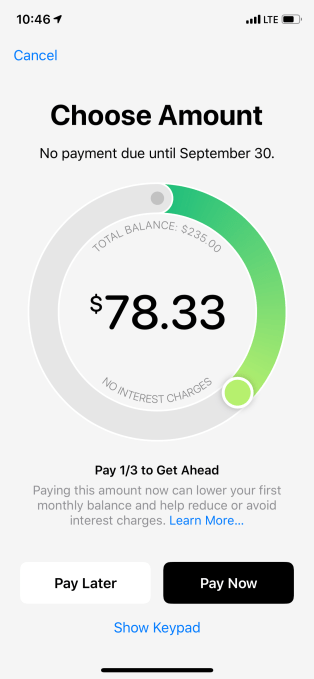
The payments interface is also unique in that Apple is pushing very hard to help you not pay interest. It makes recommendations on how to pay chunks of your balance over time before you incur interest. It places 1-3 markers on the circle-shaped interface that show you how much you need to pay off minimum, minimum with no interest and in full. These markers are personalized a bit and can vary depending on balance, due date and payment history.

I really dug hard on how Apple Card data was being handled the last time I wrote about the service, so you should read that for more info. Goldman Sachs is the partner for the card but it absolutely cannot use the data it gathers on transactions via Apple Card for market maps, as chunks of anonymized data it can offer partners about spending habits or any of the typical marketing uses credit card processors get up to. Mastercard and Goldman Sachs can only use the data for operations uses. Credit reporting, remittance, etc.

And Apple itself neither collects nor views anything about where you shopped, what you bought or how much you paid.

And, as advertised, there are no fees with Apple Card.

One thing I do hope that Apple Card adds is an ability to see and filter out recurring payments and subscriptions. This fits with the fiscal responsibility theme it’s shooting for with the payments interface and it’s sorely lacking in most first party apps.

Some nice design touches beyond the transaction maps, the color grading that mirrors purchases and the far more readable interface is a pleasant metallic sheen that is activated on device tilt.

My physical card isn’t here yet so I can’t really evaluate that part of it. But it is relatively unique in that it is nearly featureless, with no printed number, expiration, signature or security codes on its surface.

The titanium Apple Card comes in a package with an NFC chip that allows you to simply tap your phone to the envelope to begin the process of activating your card. No phone numbers to call and, heavens forbid, no 1-800 stickers on the surface of the card.

I can say that this is probably the first experience most people will ever have with a virtual credit card number. The physical card has a ‘hard coded’ number that cannot be changed. You never need to know it because it’s only used in in-person transactions. If it ever gets compromised, you can request a new card and freeze the old one in the app.

For online purchases that do not support Apple Pay, you have a virtual card number in the Wallet app. You enter that number just as you would any other card number and it’s automatically added to your Safari auto-fill settings when you sign up for Apple Card.

The advantage to this, of course, is that if it’s ever compromised, you can hit a button to request an entirely new number right from within the app. Notably, this is not a ‘per transaction’ number — it’s a semi-permanent virtual number. You keep it around until you have an issue. But when you do have a problem, you’ve got a new number instantly, which is far superior to having to wait for a new physical card just to continue making online purchases.

Some banks like Bank of America and Citibank already offer virtual options for online purchases, and third party services like Privacy.com also exist. But this is the beginning of the mainstreaming of VCCs. And it’s a good thing.

06 Aug 2019

Facebook still full of groups trading fake reviews, says consumer group

Facebook has failed to clean up the brisk trade in fake product reviews taking place on its platform, an investigation by the consumer association Which? has found.

In June both Facebook and eBay were warned by the UK’s Competition and Markets Authority (CMA) they needed to do more to tackle the sale of fake product reviews. On eBay sellers were offering batches of five-star product reviews in exchange for cash, while Facebook’s platform was found hosting multiple groups were members solicited writers of fake reviews in exchange for free products or cash (or both).

A follow-up look at the two platforms by Which? has found a “significant improvement” in the number of eBay listings selling five-star reviews — with the group saying it found just one listing selling five-star reviews after the CMA’s intervention.

But little appears to have been done to prevent Facebook groups trading in fake reviews — with Which? finding dozens of Facebook groups that it said “continue to encourage incentivised reviews on a huge scale”.

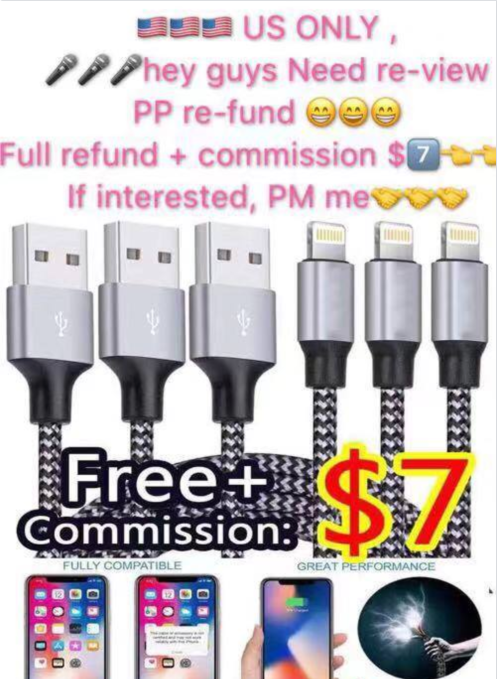
Here’s a sample ad we found doing a ten-second search of Facebook groups… (one of a few we saw that specify they’re after US reviewers)

Screenshot 2019 08 06 at 09.53.19

Which? says it found more than 55,000 new posts across just nine Facebook groups trading fake reviews in July, which it said were generating hundreds “or even thousands” of posts per day.

It points out the true figure is likely to be higher because Facebook caps the number of posts it quantifies at 10,000 (and three of the ten groups had hit that ceiling).

Which? also found Facebook groups trading fake reviews that had sharply increased their membership over a 30-day period, adding that it was “disconcertingly easy to find dozens of suspicious-looking groups in minutes”.

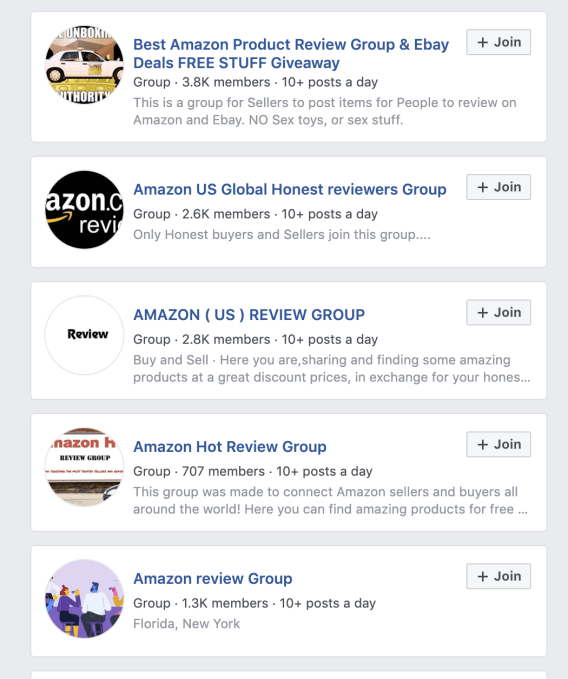
We also found a quick search of Facebook’s platform instantly serves a selection of groups soliciting product reviews…

Screenshot 2019 08 06 at 09.51.09

Which? says looked in detail at ten groups (it doesn’t name the groups), all of which contained the word ‘Amazon’ in their group name, finding that all of them had seen their membership rise over a 30-day period — with some seeing big spikes in members.

“One Facebook group tripled its membership over a 30-day period, while another (which was first started in April 2018) saw member numbers double to more than 5,000,” it writes. “One group had more than 10,000 members after 4,300 people joined it in a month — a 75% increase, despite the group existing since April 2017.”

Which? speculates that the surge in Facebook group members could be a direct result of eBay cracking down on fake reviews sellers on its own platform.

“In total, the 10 [Facebook] groups had a staggering 105,669 members on 1 August, compared with a membership of 85,647 just 30 days prior to that — representing an increase of nearly 19%,” it adds.

Across the ten groups it says there were more than 3,500 new posts promoting inventivised reviews in a single day. Which? also notes that Facebook’s algorithm regularly recommended similar groups to those that appeared to be trading in fake reviews — on the ‘suggested for you’ page.

It also says it found admins of groups it joined listing alternative groups to join in case the original is shut down.

Commenting in a statement, Natalie Hitchins, Which?’s head of products and services, said: ‘Our latest findings demonstrate that Facebook has systematically failed to take action while its platform continues to be plagued with fake review groups generating thousands of posts a day.

“It is deeply concerning that the company continues to leave customers exposed to poor-quality or unsafe products boosted by misleading and disingenuous reviews. Facebook must immediately take steps to not only address the groups that are reported to it, but also proactively identify and shut down other groups, and put measures in place to prevent more from appearing in the future.”

“The CMA must now consider enforcement action to ensure that more is being done to protect people from being misled online. Which? will be monitoring the situation closely and piling on the pressure to banish these fake review groups,” she added.

Responding to Which?‘s findings in a statement, CMA senior director George Lusty said: “It is unacceptable that Facebook groups promoting fake reviews seem to be reappearing. Facebook must take effective steps to deal with this problem by quickly removing the material and stop it from resurfacing.”

“This is just the start – we’ll be doing more to tackle fake and misleading online reviews,” he added. “Lots of us rely on reviews when shopping online to decide what to buy. It is important that people are able to trust they are genuine, rather than something someone has been paid to write.”

In a statement Facebook claimed it has removed 9 out of ten of the groups Which? reported to it and claimed to be “investigating the remaining group”.

“We don’t allow people to use Facebook to facilitate or encourage false reviews,” it added. “We continue to improve our tools to proactively prevent this kind of abuse, including investing in technology and increasing the size of our safety and security team to 30,000.”

06 Aug 2019

Apply to be a TC Top Pick at Disrupt Berlin 2019

It’s official — applications are now open for TC Top Picks at Disrupt Berlin 2019, which takes place on 11-12 December. This pre-conference competition is your chance to experience Disrupt Berlin VIP-style and exhibit your early-stage startup to some of the world’s most influential tech leaders, investors and media outlets across Europe, Asia and beyond — for free. Das ist gut, ja?

Apply here to be a TC Top Pick.

Here’s how it all works. TechCrunch editors — a picky bunch with an eye for exceptional startups — will closely review every qualified application. Then they’ll select up to five startups in each of these categories: AI/Machine Learning, Biotech/Healthtech, Blockchain, Fintech, Mobility, Privacy/Security, Retail/E-commerce, Robotics/IoT/Hardware, CRM/Enterprise and Education.

What sort of startups catch our eye? Great question. Take a look at the TC Top Picks Disrupt Berlin 2018.

If you’re one of the chosen few, you’ll win a free Startup Alley Exhibitor Package. In addition to one exhibit day, the package includes three Founder passes, access to the full conference and all programming across four stages, including Startup Battlefield, our epic pitch competition with a $50,000 prize. You’ll also receive invitations to VIP events, like the investor reception. We’re talking top-tier investors and global press.

Top Picks enjoy a prime location in Startup Alley, and you’ll be well-positioned for the thousands of attendees looking for investments, collaborators, providers or the next big thing. Plus, each Top Pick founder will be interviewed by a TechCrunch editor on the Showcase Stage, and we’ll edit and promote that video interview across our social media platforms. That’s a marketing gift that keeps on giving.

Here’s yet another perk. All companies exhibiting in Startup Alley — including Top Picks — become eligible for a Wild Card spot in the Startup Battlefield. Who knows, it might be you.

Disrupt Berlin 2019 takes place on 11-12 December, and it draws participants from more than 50 countries. There’s no better place to introduce your pre-Series A startup to the international startup community. And there’s no easier, or more affordable, way to do it than as a TC Top Pick. Apply today. Das ist gut, ja?

Is your company interested in sponsoring or exhibiting at Disrupt Berlin 2019? Contact our sponsorship sales team by filling out this form.

06 Aug 2019

Spaceflow, the ‘tenant experience platform’, scores $1.8M investment

Spaceflow, a startup founded out of Prague that offers a “tenant experience platform” to help landlords provide a better service, has raised $1.8 million in funding.

Leading the round is Credo Ventures, with participation from Day One Capital, and UP21. The company, which also has an office in Sillicon Valley, says it will use the new capital to hire additional members of its product development team, and to meet its U.S. and U.K. growth goals.

Describing itself as a “plug & play” tenant experience and community engagement platform sold to landlords and operators of co-living spaces, the Spaceflow mobile app connects space users to amenities, services, and “community life”.

The claimed upside is that by enabling landlords and building operators to offer a “space-as-a-service” to tenants and guests, the startup helps improve tenant satisfaction and, in turn, attract and retain good tenants in order to increase profits.

“Once you download the Spaceflow app as an occupant, you can locate your building via QR code/GPS (in most cases the profile is not public so there is also an access code),” explains Spaceflow co-founder and CEO Lukas Balik. “Once you reach the building profile, most of the content is tailored specifically to the building”.

Balik says the Spaceflow app is akin to a “remote control” for your building so that you have access to bookings and reservations for common spaces, bikes, and parking etc. There’s also a “digital concierge” aspect for things like dry cleaning, room cleaning, food delivery, or local yoga classes.

In addition, the news feed provides the latest updates from the property owner. The app houses a reporting tool for maintenance and other issues too, and an online community for the building.

“Every landlord gets an access to the admin console where they can set up their whole portfolio,” adds Balik. “Also every client gets an on-boarding session with one of our community managers and our subscription plans offer three different plans based on the level of ongoing support”.

Since being founded in 2016, Spaceflow says it currently operates in 9 country markets, with a footprint on both sides of the pond.

06 Aug 2019

Penta, the German business banking startup, raises €8M additional funding

Penta, the business banking provider for small and medium sized enterprises (SMEs) that was recently acquired by fintech company builder Finleap, has raised “over” €8 million in new funding.

The round is led by HV Holtzbrinck Ventures. Also participating is Finleap, alongside Fabrick, the Italian platform for open banking and fintech services, which is another of Penta’s existing shareholders. The startup raised a €7 million Series A round in late 2018, and is thought to have had over €18 million investment since being founded in 2016.

Meanwhile, today’s new injection of capital comes shortly after Penta was acquired by Finleap, the German company builder that co-founded and also owns a stake in banking platform solarisBank, of which Penta is a customer. Shortly after the deal went through, it was confirmed that Marko Wenthin, who previously co-founded solarisBank, had become Penta’s new CEO, replacing outgoing CEO and Penta co-founder Lav Odorović.

With a team of over 50, Penta now operates from three offices located in Berlin, Belgrade, and Milan. The latter follows a recent merger with Beesy, the Italian micro-business banking startup. Penta CEO Wenthin says internationalisation will be one of the focuses following HV Holtzbrinck Ventures’ backing.

“Penta has shown an incredible amount of passion for the market, the customers, and the product: it is amazing to see what the team has built since their inception,” he says in a statement. “This funding will allow us to further invest into our product and partnerships to become the financial platform of choice for small and medium sized companies. Additionally, we will push the internationalisation of Penta, starting with Italy this year”.

06 Aug 2019

The Federal Reserve announces plans for a real-time payments system that will be available to all banks

The Federal Reserve Bank announced today that it is developing a new service called FedNow that will allow all banks in the United States to offer 24/7 real-time payment services every day of the week. FedNow is expected to be available by 2023 or 2024 and will initially support transfers of up to $25,000.

FedNow will make managing budgets easier for many people and small businesses, but it also puts the Fed at loggerheads with big banks since a federal real-time payments system would compete with the one being developed by the Clearing House, which is owned by some of the world’s largest banks, including Capital One, Citibank, Wells Fargo, Bank of America, JP Morgan Chase and Deutsche Bank.

The Federal Reserve’s board of governors voted 4-1 to approve the proposal for FedNow on August 2, with its of vice chair for supervision, Randal Quarles, casting the dissenting vote.

While Venmo, Zelle and other apps already allow users to transfer money instantly to one another, the Federal Reserve Bank described services like those as a “closed loop” because both parties need to be on the same platform in order to transfer money and they can only be linked to accounts from certain banks. On the other hand, FedNow will be a universal infrastructure, enabling all banks, including smaller ones, to provide real-time payments.

Furthermore, the traditional retail payment methods used for transferring funds not only creates frustrating delays, but can “result in a build-up of financial obligations between banks which, as faster payment usage grows, could present risks to the financial system, especially in times of stress,” the Federal Reserve Board said.

In a FAQ, the Federal Reserve Board explained that “there is a broad consensus within the U.S. payment community and among other stakeholders” that real-time payment services can have a “significant and positive impact on individuals and businesses throughout the country and on the broader U.S. economy.”

For example, real-time payments mean people living on tight budgets will have to rely less on costly check-cashing services and high-interest loans and will incur less overdraft and late fees. Small businesses will also benefit because they can avoid short-term loans with high-interest rates.

The proposal has gained the support of Democratic lawmakers including U.S. Senators Elizabeth Warren and Chris Van Hollen and Representatives Ayanna Pressley and Jesús García.

In a statement, Warren, who is campaigning for the Democratic presidential nomination, said “I’m glad the Fed has finally taken action to ensure that people living paycheck-to-paycheck don’t have to wait up to five days for a check to clear so that they can pay their rent, cover child care, or pick up groceries.  Today’s Fed action will also help small businesses by making payments from customers available more quickly. I look forward to working with the Fed to ensure a swift and smooth implementation of this system.”

Comments about FedNow will be accepted for 90 days after the proposal is published in the Federal Register.

06 Aug 2019

Cybereason raises $200 million for its enterprise security platform

Cybereason, which uses machine learning to increase the number of endpoints a single analyst can manage across a network of distributed resources, has raised $200 million in new financing from SoftBank Group and its affiliates. 

It’s a sign of the belief that SoftBank has in the technology, since the Japanese investment firm is basically doubling down on commitments it made to the Boston-based company four years ago.

The company first came to our attention five years ago when it raised a $25 million financing from investors including CRV, Spark Capital and Lockheed Martin.

Cybereason’s technology processes and analyzes data in real-time across an organization’s daily operations and relationships. It looks for anomalies in behavior across nodes on networks and uses those anomalies to flag suspicious activity.

The company also provides reporting tools to inform customers of the root cause, the timeline, the person involved in the breach or breaches, what tools they use and what information was being disseminated within and outside of the organization.

For founder Lior Div, Cybereason’s work is the continuation of the six years of training and service he spent working with the Israeli army’s 8200 Unit, the military incubator for half of the security startups pitching their wares today. After his time in the military, Div worked for the Israei government as a private contractor reverse engineering hacking operations.

Over the last two years, Cybereason has expanded the scope of its service to a network that spans 6 million endpoints tracked by 500 employees with offices in Boston, Tel Aviv, Tokyo and London.

“Cybereason’s big data analytics approach to mitigating cyber risk has fueled explosive expansion at the leading edge of the EDR domain, disrupting the EPP market. We are leading the wave, becoming the world’s most reliable and effective endpoint prevention and detection solution because of our technology, our people and our partners,” said Div, in a statement. “We help all security teams prevent more attacks, sooner, in ways that enable understanding and taking decisive action faster.”

The company said it will use the new funding to accelerate its sales and marketing efforts across all geographies and push further ahead with research and development to make more of its security operations autonomous.

“Today, there is a shortage of more than three million level 1-3 analysts,” said Yonatan Striem-Amit, chief technology officer and Co-founder, Cybereason, in a statement. “The new autonomous SOC enables SOC teams of the future to harness technology where manual work is being relied on today and it will elevate  L1 analysts to spend time on higher value tasks and accelerate the advanced analysis L3 analysts do.”

Most recently the company was behind the discovery of Operation SoftCell, the largest nation-state cyber espionage attack on telecommunications companies. 

That attack, which was either conducted by Chinese-backed actors or made to look like it was conducted by Chinese-backed actors, according to Cybereason targeted a select group of users in an effort to acquire cell phone records.

As we wrote at the time:

… hackers have systematically broken in to more than 10 cell networks around the world to date over the past seven years to obtain massive amounts of call records — including times and dates of calls, and their cell-based locations — on at least 20 individuals.

Researchers at Boston-based Cybereason, who discovered the operationand shared their findings with TechCrunch, said the hackers could track the physical location of any customer of the hacked telcos — including spies and politicians — using the call records.

Lior Div, Cybereason’s co-founder and chief executive, told TechCrunch it’s “massive-scale” espionage.

Call detail records — or CDRs — are the crown jewels of any intelligence agency’s collection efforts. These call records are highly detailed metadata logs generated by a phone provider to connect calls and messages from one person to another. Although they don’t include the recordings of calls or the contents of messages, they can offer detailed insight into a person’s life. The National Security Agency  has for years controversially collected the call records of Americans from cell providers like AT&T and Verizon (which owns TechCrunch), despite the questionable legality.

It’s not the first time that Cybereason has uncovered major security threats.

Back when it had just raised capital from CRV and Spark, Cybereason’s chief executive was touting its work with a defense contractor who’d been hacked. Again, the suspected culprit was the Chinese government.

As we reported, during one of the early product demos for a private defense contractor, Cybereason identified a full-blown attack by the Chinese — ten thousand usernames and passwords were leaked, and the attackers had access to nearly half of the organization on a daily basis.

The security breach was too sensitive to be shared with the press, but Div says that the FBI was involved and that the company had no indication that they were being hacked until Cybereason detected it.