Year: 2019

03 Aug 2019

StockX was hacked, exposing millions of customers’ data

It wasn’t “system updates” as it claimed. StockX was mopping up after a data breach, TechCrunch can confirm.

The fashion and sneaker trading platform pushed out a password reset email to its users on Thursday citing “system updates,” but left users confused and scrambling for answers. StockX told users that the email was legitimate and not a phishing email as some had suspected, but did not say what caused the alleged system update or why there was no prior warning.

A spokesperson eventually told TechCrunch that the company was “alerted to suspicious activity” on its site but declined to comment further.

But that wasn’t the whole truth.

An unnamed data breached seller contacted TechCrunch claiming more than 6.8 million records were stolen from the site in May by a hacker. The seller declined to say how they obtained the data, but promised to soon put the stolen records for sale on the dark web.

The seller provided TechCrunch a sample of 1,000 records. We contacted customers and provided them information only they would know from their stolen records, such as their real name and username combination and shoe size. Every person who responded confirmed their data as accurate.

The stolen data contained names, email addresses, hashed passwords, and other profile information — such as shoe size and trading currency. The data also included the user’s device type, such as Android or iPhone, and the software version. Several other internal flags were found in each record, such as whether or not the user was banned or if European users had accepted the company’s GDPR message.

Under those GDPR rules, a company can be fined up to four percent of its global annual revenue for violations.

When reached prior to publication, neither spokesperson Katy Cockrel nor StockX founder Josh Luber responded to a request for comment.

StockX was last month valued at over $1 billion after a $110 million fundraise.

03 Aug 2019

E3’s organizer apologizes after revealing information for thousands of journalists

The Entertainment Software Association issued an apology of sorts after making available the contact information for more than 2,000 journalists and analysts who attended this year’s E3.

“ESA was made aware of a website vulnerability that led to the contact list of registered journalists attending E3 being made public,” the organization said via statement. “Once notified, we immediately took steps to protect that data and shut down the site, which is no longer available. We regret this this occurrence and have put measures in place to ensure it will not occur again.”

It’s not clear whether the organization attempted to reach out to those impacted by the breach.

In a kind of bungle that utterly boggles the mind in 2019, the ESA had made available on its site a full spreadsheet of contact information for thousands of attendees, including email addresses, phone numbers and physical addresses. While many or most of the addresses appear to be businesses, journalists often work remotely, and the availability of a home address online can present a real safety concern.

After all, many gaming journalists are routinely targets of harassments and threats of physical violence for the simple act of writing about video games on the internet. That’s the reality of the world we currently live in. And while the information leaked could have been worse, there’s a real potential human consequence here.

That, in turn, presents a pretty compelling case that the ESA is going to have a pretty big headache on its hands under GDPR. Per the rules,

In the case of a personal data breach, the controller shall without undue delay and, where feasible, not later than 72 hours after having become aware of it, notify the personal data breach to the supervisory authority competent in accordance with Article 55, unless the personal data breach is unlikely to result in a risk to the rights and freedoms of natural persons. Where the notification to the supervisory authority is not made within 72 hours, it shall be accompanied by reasons for the delay.

There is, indeed, a pretty strong argument to made that said breach could “result in a risk to the rights and freedoms of natural persons.” Failure to notify individuals in the allotted time period could, in turn, result in some hefty fines.

It’s hard to say how long the ESA knew about the information, though YouTuber Sophia Narwitz, who first brought this information to light publicly, may have also been the first to alert the organization. The ESA appears to have been reasonably responsive in pulling the spreadsheet down, but the internet is always faster, and that information is still floating around online and fairy easily found.

VentureBeat notes rightfully that spreadsheets like these are incredibly valuable to convention organizations, representing contact information some of the top journalists in any given industry. Many will no doubt think twice before sharing this kind of information again, of course.

Notably (and, yes, ironically), the Black Hat security conference experienced a similar breach this time last year. It chalked the issue up to a “legacy system.”

Natasha Lomas contributed to this report

03 Aug 2019

Amazon quietly adds ‘no human review’ option to Alexa as voice AIs face privacy scrutiny

Amazon has tweaked the settings for its Alexa voice AI to allow users to opt out of their voice recordings being manually reviewed by the company’s human workers.

The policy shift took effect Friday, according to Bloomberg, which reports that Alexa users will now find an option in the settings menu of the Alexa smartphone app to disable human review of their clips.

The Alexa T&C did not previously inform users of the possibility that audio recordings captured by the service might be manually reviewed by actual humans. (Amazon still doesn’t appear to provide this disclosure on its main website either.)

But the Alexa app now includes a disclaimer in the settings menu that flags the fact human ears may in fact be listening, per the report.

This disclosure appears only to surface if users go digging into the settings menu.

Bloomberg says users must tap ‘Settings’ > ‘Alexa Privacy’ > ‘Manage How Your Data Improves Alexa’ before they see the following text: “With this setting on, your voice recordings may be used to develop new features and manually reviewed to help improve our services. Only an extremely small fraction of voice recordings are manually reviewed.”

The policy tweak comes as regulators are dialling up attention on the privacy risks posed by voice AI technologies.

This week it emerged that Google was ordered by a German data protection watchdog to halt manual reviews of audio snippets generated by its voice AI, after thousands of recordings were leaked to the Belgian media last month which was able to identify some of the people in the clips.

Google has suspended reviews across the whole of Europe while it liaises with EU privacy regulators.

In a statement on its website the Hamburg privacy watchdog raised concerns about other operators of voice AIs, urging EU regulators to make checks on providers such as Amazon and Apple — and “implement appropriate measures”.

Coincidentally (or not) Apple also suspended human reviews of Siri snippets this week — globally, in its case — following privacy concerns raised by a recent UK media report. The Guardian newspaper quoted a whistleblower claiming contractors regularly hearing confidential personal data captured by Siri.

While Google and Apple have entirely suspended human reviews of audio snippets (at least temporarily), Amazon has not gone so far.

Nor does it automatically opt users out. The policy change just lets users disable reviews — which requires consumers to both understand the risk and act to safeguard their privacy.

Amazon’s disclosure of the existence of human reviews is also currently buried deep in the settings, rather than being actively conveyed to users.

It’s not clear whether any of this will wash with regulators in Europe. 

Bloomberg reports that Amazon declined to comment on whether it had been contacted by regulators about the Alexa recordings review program, saying only: “We take customer privacy seriously and continuously review our practices and procedures We’ll also be updating information we provide to customers to make our practices more clear.”

We reached out to Amazon with questions but at the time of writing a spokesperson was not available.

03 Aug 2019

Startups Weekly: DoorDash gets a taste of Caviar

Hello and welcome back to Startups Weekly, a weekend newsletter that dives into the week’s noteworthy startups and venture capital news. Before I jump into today’s topic, let’s catch up a bit. Last week, I wrote about SoftBank’s second Vision Fund. Before that, I noted some challenges plaguing mental health tech startups.

Remember, you can send me tips, suggestions and feedback to kate.clark@techcrunch.com or on Twitter @KateClarkTweets. If you don’t subscribe to Startups Weekly yet, you can do that here.

What’s new?

This week DoorDash announced an agreement to acquire Caviar, an on-demand delivery business, from Square. DoorDash says it will pay $410 million for the company in a combination of cash and stock. If you’re thinking that seems like a lot of money, you are very much correct.

It’s so much money that all of us over here at TechCrunch were scratching our heads trying to understand why DoorDash would shell out that kind of cash. After all, Square paid only $90 million in stock for Caviar when it acquired the company back in 2014. However, DoorDash is VC cash-rich. The business, still privately-owned, has raised an astronomical sum of venture capital. This year alone it’s raised $1 billion, including a Series G funding of $600 million that valued it at $12.6 billion.

When a company raises that many huge rounds so close together, you can only assume it’s burning through a lot of cash. When it comes time for DoorDash to begin pitching Wall Street for an IPO — we’re thinking late next year — established subsidiaries like Caviar will at least help bolster its IPO-ready narrative.

With monster companies like DoorDash, Grubhub and UberEats owning the food delivery space, we will no doubt see more big M&A deals and more startups die. (Remeber the insane fall of Munchery, anyone?) But will any of these efforts ever become profitable? Or will DoorDash burn through cash until there’s just no more cash left to burn?

#Equitypod

tc equity podcast ios 2 1

If you enjoy this newsletter, be sure to check out TechCrunch’s venture-focused podcast, Equity. In this week’s episode, available here, Equity co-host Alex Wilhelm and I attempt to make sense of DoorDash’s acquisition of Caviar. Equity drops every Friday at 6:00 am PT, so subscribe to us on Apple PodcastsOvercast and Spotify.

Big Deals

Male Female with Platform

Little Deals

computer heart

M&A

78E0AF45 F6D8 48F5 8A12 FF1BFFCCD06C

Venture Fundraising

GettyImages 816919766

Extra Crunch

Here’s your weekly reminder that for a low price — a complete bargain really — you can learn more about the startups and venture capital ecosystem with a subscription to Extra Crunch. We offer exclusive deep dives, Q&As, newsletters, resources and recommendations, and fundamental startup how-to guides to our subscribers. Here are some of the best EC posts of the week:

03 Aug 2019

Elon Musk says The Boring Company will launch in China this month

Elon Musk wants to drill holes in China. The Tesla founder has tweeted to reveal that his tunnelling and transportation startup, The Boring Company, will be launch in China later this month.

Musk is due to speak at an AI conference, called the World Artificial Intelligence Conference, taking place in Shanghai on August 29-31. Replying to a tweet about the event he announced: “Will also be launching The Boring Company China on this trip.”

Another Twitter user chipped into the conversation to ask whether the company would also do underwater tunnels — to which Musk replied simply “yes“.

A securities filing last month revealed that the The Boring Company had raised its first outside investment via the sale of $120M in stock. So the company has some extra cash sloshing around to plough into new ventures.

It also recently landed its first commercial contract: $48.7M to build and operate an underground “people mover” in Las Vegas, focused on the Las Vegas Convention Center.

This underground ‘people mover’ is not, as you might imagine, a tried and tested metro train system. The plan apparently involves building two tunnels: One for vehicles (Musk does also sell electrics cars) and a second tunnel for pedestrians who will be carried in (modified) Tesla cars. The latter fully autonomous, under the plan.

Current generation Teslas are not capable of driving themselves, merely offering driving assistance features to humans. But autonomous driving inside a tunnel is about as much of a controlled environment you could hope for — without, y’know, sticking cars together on rails and making a driverless train (like the one that’s been serving London’s Docklands area since 1987).

The Las Vegas contract specifies three months of safety testing before Musk’s modified Teslas will be allowed to whisk people through the tunnel.

Another design that The Boring Company has proposed — for an ambitious Loop system from Washington, D.C. to Baltimore — is still on the drawing board, having attracted major safety concerns by failing to meet several key national safety standards, including lacking sufficient emergency exits and not taking note of the latest engineering practices.

So perhaps, in looking to expand The Boring Company by taking his spade to the Far East, Musk is hoping for a more accommodating set of building standards to drive an electric truck through.

03 Aug 2019

Facebook to admit ownership of Instagram, WhatsApp in hard-to-read small-print

For the first time in more than half a decade, Facebook wants to inform you that it owns Instagram, the hyper-popular rival social networking app it acquired for a $1BN steal back in 2012.

Ditto messaging platform WhatsApp — which Mark Zuckerberg splurged $19BN on a couple of years later to keep feeding eyeballs into his growth engine.

Facebook is adding its own brand name alongside the other two — in the following format: ‘Instagram from Facebook’; ‘WhatsApp from Facebook.’

The cheap perfume style rebranding was first reported by The Information which cites three people familiar with the matter who told it employees for the two apps were recently notified internally of the plan to rebrand.

“The move to add Facebook’s name to the apps has been met with surprise and confusion internally, reflecting the autonomy that the units have operated under,” it said. Although it also reported that CEO Mark Zuckerberg has also been frustrated that Facebook doesn’t get more credit for the growth of Instagram and WhatsApp.

So it sounds like Facebook may be hoping for a little reverse osmosis brand-washing — aka leveraging the popularity of its cleaner social apps to detoxify the scandal-hit mothership.

Not that Facebook is saying anything like that publicly, of course.

In a statement to The Information confirming the rebranding it explained it thus: “We want to be clearer about the products and services that are part of Facebook.”

The rebranding also comes at a time when Facebook is facing at least two antitrust investigations on its home turf — where calls for Facebook and other big tech giants to be broken up are now a regular feature of the campaign trail…

We can only surmise the legal advice Facebook must be receiving vis-a-vis what it should do to try to close down break up arguments that could deprive it of its pair of golden growth geese.

Arguments such as the fact most Instagram (and WhatsApp) users don’t even know they’re using a Facebook-owned app. Hence, as things stand, it would be pretty difficult for Facebook’s lawyers to successfully argue Instagram and WhatsApp users would be harmed if the apps were cut free by a break-up order.

But now — with the clumsy ‘from Facebook’ construction — Facebook can at least try to make a case that users are in a knowing relationship with Facebook in which they willingly, even if not lovingly, place their eyeballs in Zuckerberg’s bucket.

In which case Facebook is not telling you the Instagram user that it owns Instagram for your benefit. Not even slightly.

Note, for example, the use of the comparative adjective “clearer” in Facebook’s statement to explain its intent for the rebranding — rather than a simple statement: ‘we want to be clear’.

It’s definitely not saying it’s going to individually broadcast its ownership of Instagram and WhatsApp to each and every user on those networks. More like it’s going to try to creep the Facebook brand in. Which is far more in corporate character.

At the time of writing a five day old update of of Instagram’s iOS app already features the new construction — although it looks far more dark pattern than splashy rebrand, with just the faintest whisker of grey text at the base of the screen to disclose that you’re about to be sucked into the Facebook empire (vs a giant big blue ‘Create new account’ button winking to be tapped up top… )

Here’s the landing screen — with the new branding. Blink and you’ll miss it…

image2

So not full disclosure then. More like just an easily overlooked dab of the legal stuff — to try to manage antitrust risk vs the risk of Facebook brand toxicity poisoning the (cleaner) wells of Instagram and WhatsApp.

There are signs the company is experimenting in some extremely dilute cross-brand-washing too.

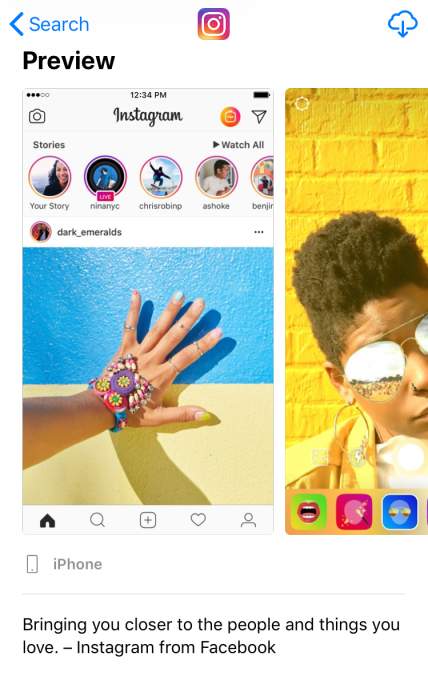
The iOS app description for Instagram includes the new branding — tagged to an ad style slogan that gushes: “Bringing you closer to the people and things you love.”  But, frankly, who reads app descriptions?

image1

Up until pretty recently, both Instagram and WhatsApp had a degree of independence from their rapacious corporate parent — granted brand and operational independence under the original acquisition terms and leadership of their original founders.

Not any more, though. Instagram’s founders cleared out last year. While WhatsApp’s jumped ship between 2017 and 2018.

Zuckerberg lieutenants and/or long time Facebookers are now running both app businesses. The takeover is complete.

Facebook is also busy working on entangling the backends of its three networks — under a claimed ‘pivot to privacy‘ which it announced earlier this year.

This also appears intended to try to put regulators off by making breaking up Facebook much harder than it would be if you could just split it along existing app lines. Theories of user harm potentially get more complicated if you can demonstrate cross-platform chatter.

The accompanying 3,000+ word screed from Zuckerberg introduced the singular notion of “the Facebook network”; aka one pool for users to splash in, three differently colored slides to funnel you in there.

“In a few years, I expect future versions of Messenger and WhatsApp to become the main ways people communicate on the Facebook network,” he wrote. “If this evolution is successful, interacting with your friends and family across the Facebook network will become a fundamentally more private experience.”

The ‘from Facebook’ rebranding thus looks like just a little light covering fire for the really grand dodge Facebook is hoping to pull off as the break-up bullet speeds down the pipe: Aka Entangling its core businesses at the infrastructure level.

From three networks to one massive Facebook-owned user data pool. 

One network to rule them all, one network to find them,
One network to bring them all, and in the regulatory darkness bind them

02 Aug 2019

MaC Ventures, the brainchild of Adrian Fenty and Marlon Nichols, is quietly making its first investments

MaC Ventures, the new Los Angeles-based investment firm formed from the merger of Cross Culture Ventures and M Ventures, has quietly started deploying capital from its fund.

One of the firm’s first disclosed investments is Edge Delta, which announced a $3 million seed round earlier this week.

The Seattle-based company, which has a tool to predict and identify faulty code and potential security issues in software designed for mobile environments, reflects the new continuing focus on companies that reflect the changing cultural environments throughout the commercial, cultural, and technological worlds.

And if anyone knows anything about downtime and application failures it would be the two co-founders who have held positions at Microsoft, Twitter, and Sumo Logic. That’s the background Ozan Unlu, a Microsoft and Sumo Logic alum, and Fatih Yildiz, who spent years at Twitter and Microsoft, will leverage as they pitch their services. 

“We have reached the inflection point for centralized security analytics, SIEM products like Splunk are struggling to scale and a lack of mature SaaS offerings mean that if customers want to keep up with growth in their environments, innovation is required,” said Will Peteroy, founder and chief executive of ICEBRG (acquired in 2018) and Chief Technology Officer for Security at Gigamon, in a statement.

That innovation is something that M Ventures and Cross Culture have tried to identify according to previous statements from both founders. And the merger between both firms was likely about growth and scale. Both firms have co-invested on a number of deals and both share the same emphasis on cultural shifts that create new opportunities.

Shared portfolio companies between the two firms include Blavity, BlocPower, and Mayvenn, and each reflect a different aspect of the firms’ commitment to the transformations impacting culture and community in the twenty-first century.

BlocPower is focused on urban resiliency and health in the face of new challenges to the power grid; Blavity has become the online community for black creativity and news; and Mayvenn is leveraging the economics of community to create new entrepreneurs and enable new businesses.

For Adrian Fenty and Marlon Nichols —  the two managing general partners of the new fund — and general partners and partners Charles King, Michael Palank, and Alyson DeNardo; MaC Ventures is a logical next step in their progression in the venture business.

Fenty, the former mayor of Washington, and an early special advisor to Andreessen Horowitz seven years ago, has long been interested in the intersection of technology and governance and said that politics was a great introduction to the venture world in an interview with TechCrunch when he joined Andreessen.

“As a mayor you have a lot of districts you work with, and every day is different,” Fenty said, noting that the same could be said for VCs who work with different startups. However, the pace will likely be a bit quicker in this space than it is in the political realm. “I believe that change should happen fast and in big ways, and that’s the tech industry,” he said. “Some of these entrepreneurs and CEOs, their energy and ability to come up with new ideas is infectious.”

As for Nichols, the introduction to venture capital came through work at Intel Capital before striking out with Troy Carter, a limited partner in the MaC Ventures fund, to form Cross Culture.

As the new firm finds its legs, it’s likely that some of the guiding principles that Nichols expressed when talking about Cross Culture will carry over to the new vehicle.

“This is the time to be here,” Nichols said in an interview earlier this year. “If you are going to invest in the companies of tomorrow you have to go where the world is moving to — and that’s black and brown, honestly.”

02 Aug 2019

The SEC wants disgraced VC Mike Rothenberg to cough up more than $30 million

Nearly three year ago to the day, TechCrunch reported on suspected fraud committed by Mike Rothenberg, a self-described “millennial venture capitalist” who’d made a name for himself not only by eponymously branding his venture firm but for spending lavishly to woo startup founders, including on Napa Valley wine tours, at luxury boxes at Golden State Warriors games and most famously, hosting an annual “founder field day” at the San Francisco Giants’s baseball stadium that later inspired a scene in the HBO show “Silicon Valley.”

The Securities & Exchange Commission had initially reached out to Rothenberg in June of 2016 and by last August, Rothenberg had been formally charged for misappropriating up to $7 million on his investors’ capital. He settled with the agency without making an admission of guilt, and, as part of the settlement, he stepped down from what was left of the firm and agreed to be barred from the brokerage and investment advisory business with a right to reapply after five years.

Now, comes the money part. Following a forensic audit conducted in partnership with the accounting firm Deloitte, the SEC is seeking $18.8 million in disgorgement penalties from Rothenberg, and an additional $9 million civil penalty. The SEC is also asking that Rothenberg be forced to pay pre-judgment interest of $3,663,323.47

According to a new lawsuit filed on Wednesday, the SEC argues that Rothenberg raised a net amount of approximately $45.9 million across six venture funds from at least 200 investors, yet that he took “fees” on their capital that far exceeded what his firm was entitled to during the life of those funds, covering up these “misdeeds” by “modifying accounting entries to make his misappropriation look like investments, entering into undisclosed transactions to paper over diverted money, and shuffling investments from one [f]und to another to conceal prior diversions.”

Ultimately, it says, Deloitte’s examination demonstrated that Rothenberg misappropriated $18.8 million that rightfully belong to Rothenberg Ventures, $3.8 million of which was transferred to Rothenberg personally; $8.8 million of which was used to fund other entities under his control (including a car racing team and a virtual reality studio); and $5.7 of which was used to pay the firm’s expenses “over and above” the management and administrative fees it was entitled to per its management agreements.

We reached out to Rothenberg this morning. He has not yet responded to our request to discuss the development.

It sounds from the filing like he doesn’t have wiggle room to fight it, in any case. According to the SEC’s suit, the “Rothenberg Judgment” agreed upon last summer left monetary relief to be decided by a court’s judgment, one that “provides that Rothenberg accepts the facts alleged in the complaint as true, and does not contest his liability for the violations alleged, for the purposes of this motion and at any hearing on this motion.”

In the meantime, the lawsuit contains interesting nuggets, including an alleged maneuver in which Rothenberg raised $1.3 million to invest in the game engine company Unity but never actually bought shares in the company, instead diverting the capital to other entities. (He eventually paid back $1 million to one investor who repeatedly asked for the money back, but not the other $300,000.)

Rothenberg also sold a stake in the stock-trading firm Robinhood for $5.4 million, says the SEC, but rather than funnel any proceeds to investors, he again directed the money elsewhere, including, apparently, to pay for a luxury suite during Golden State Warriors games for which he shelled out $136,000.

In a move that one Rothenberg investor finds particularly galling, the SEC claims that Rothenberg then turned around and rented that box through an online marketplace that enables people to buy and sell suites at various sports and entertainment venues, receiving at least $56,000 from the practice.

Ostensibly to keep up appearances, Rothenberg also gave $30,000 to the Stanford University Athletics Department (he attended Stanford as an undergrad) and spent thousands of dollars on ballet tickets last year and early this year, says the SEC’s filing.

Regardless of what happens next, one small victor in the SEC’s detailed findings is Silicon Valley Bank, a sprawling enterprise that has aggressively courted the tech industry since its 1983 founding. Last year, at the same time that Rothenberg was agreeing to be barred from the industry, he made a continued show of his innocence by filing suit against SVB to “vindicate the interests of its funds and investors,” the firm said in a statement at the time.

The implication was that SVB was at fault for some of Rothenberg’s woes because it had not properly wired money to the correct accounts, but the SEC says that SVB was defrauded, providing Rothenberg a $4 million line of credit after being presented with fabricated documents.

A loser — other than Rothenberg and the many people who now feel cheated by him — is Harvard Business School. The reason: it used Rothenberg Ventures as a case study for students after Rothenberg graduated from the program. As we’ve reported previously, that case study — funded by HBS before any hint of trouble at the firm had surfaced  — was co-authored by two professors who had a “significant financial interest in Rothenberg Ventures,” as stated prominently in a curriculum footnote.

Presumably, those ties gave confidence to at least some of the investors in Silicon Valley and elsewhere who later provided Rothenberg with money to invest on their behalf.

You can read the SEC’s 20-page motion for disgorgement and penalties below, along with the 48-page report assembled by Deloitte’s forensic accounting partner Gerry Fujimoto.

SEC vs. Mike Rothenberg by TechCrunch on Scribd

Forensic report re Mike Rothenberg/Rothenberg Ventures by TechCrunch on Scribd

Additional reporting by TechCrunch’s Sarah Perez.

Above: Rothenberg Ventures during better days.

02 Aug 2019

United Airlines CISO Emily Heath joins Sessions: Enterprise this September

In an era of massive data breaches, most recently the Capital One fiasco, the risk of a cyberattack and the costly consequences are the top existential threat to corporations big and small. At TechCrunch’s first-ever enterprise-focused event (p.s. early bird sales end August 9), that topic will be front and center throughout the day.

That’s why we’re delighted to announce United’s chief information security officer Emily Heath will join TC Sessions: Enterprise in San Francisco on September 5, where we will discuss and learn how one of the world’s largest airlines keeps its networks safe.

Joining her to talk enterprise security will be a16z partner Martin Casado and DUO / Cisco’s head of advisory CISO s Wendy Nather, among others still to be announced.

At United, Heath oversees the airline’s cybersecurity program and its IT regulatory, governance and risk management.

The U.S.-based airline has more than 90,000 employees serving 4,500 flights a day to 338 airports, including New York, San Francisco, Los Angeles and Washington D.C.

A native of Manchester, U.K., Heath served as a former police detective in the U.K. Financial Crimes Unit where she led investigations into international investment fraud, money laundering, and large scale cases of identity theft — and running join investigations with the FBI, SEC, and London’s Serious Fraud Office.

Heath and her teams have been the recipients of CSO Magazine’s CSO50 Awards for their work in cybersecurity and risk.

At TC Sessions: Enterprise, Heath will join an expert panel of cybersecurity experts to discuss security on enterprise networks large and small — from preventing data from leaking to keeping bad actors out of their network — where we’ll lear how a modern CSO moves fast without breaking things.

Join hundreds of today’s leading enterprise experts for this single-day event when you purchase a ticket to the show. $249 Early Bird sale ends Friday, August 9. Make sure to grab your tickets today and save $100 before prices go up.

02 Aug 2019

Nyca Partners raises $210M to invest in fintech startups

Nyca Partners, a firm with investments in financial technology businesses including PayRange, Trellis, Affirm and Acorns, has collected another $210 million for its third venture capital fund.

Located in New York, Nyca’s debut fund closed on $31 million in 2014. Its second fund, a similarly focused fintech effort, raised $125 million in 2017.

Venture capital investment in fintech is poised to reach new heights in 2019, according to PitchBook. So far this year, investors have bet $8.6 billion on U.S.-based fintech upstarts. Last year, investment in the space reached an all-time high of more than $12 billion, with Robinhood, Coinbase and Plaid all raising multi-hundred-million-dollar rounds.

Nyca managing partner Hans Morris has a long history in the financial space. Most recently, he was managing director at General Atlantic; before that, he served as president of Visa and spent nearly three decades at Citigroup in roles including chief financial officer and head of finance.

The firm is also led by Ravi Mohan, partner and chief operating officer, who spent 25 years at Citigroup and JP Morgan Chase .

As part of the new fundraise, Nyca has promoted David Sica to partner. Prior to joining Nyca, Sica was a director at Visa.

Nyca announces its new fund just days after Oak HC/FT, another fintech-focused fund, raised $800 million to invest in the space.