Year: 2019

02 Aug 2019

Northrup Grumman is among the companies tapped to make the U.S. Army’s drone killing lasers

Northrop Grumman is going to be working on the U.S. Army’s long-planned drone killing lasers.

The Army wants to mount 50 kilowatt laser systems on top of its General Dynamics designed Stryker vehicle as part of its U.S. Army Maneuver Short Range Air Defense (M-SHORAD) directed energy prototyping initiative.

Basically, the army wants to use these lasers to protect frontline combat troops against drone attacks.

The initiative includes integrating a directed energy weapon system on a Stryker vehicle as a pathfinding effort toward the U.S. Army M-SHORAD objective to provide more comprehensive protection of frontline combat units.

“Northrop Grumman is eager to leverage its portfolio of innovative, proven technologies and integration expertise to accelerate delivery of next-generation protection to our maneuver forces,” said Dan Verwiel, vice president and general manager, missile defense and protective systems, Northrop Grumman, in a statement.

The drone, helicopter, rocket, artillery and mortar defense system that the Army is looking to mount on a group of Stryker all-terrain vehicles could come from either Northrop Grumman or Raytheon, which was also tapped to develop tech for the project.

“The time is now to get directed energy weapons to the battlefield,” said Lt. Gen. L. Neil Thurgood, director of hypersonics, directed energy, space and rapid acquisition, in a statement. “The Army recognizes the need for directed energy lasers as part of the Army’s modernization plan. This is no longer a research effort or a demonstration effort. It is a strategic combat capability, and we are on the right path to get it in soldiers’ hands.”

For the Army, lasers extend the promise of reducing supply chain hurdles that are associated with conventional kinetic weapons. In May, the Army decided gave the green light to a strategy for accelerated prototyping and field use of a wide array of lasers for infantry, vehicles, and air support.

While Raytheon and Northrop Grumman have both been tapped by the Army, the military will also entertain pitches from other vendors who want to carry out their own research, according to the Army.

It’s a potential $490 million contract for whoever wins the demonstration, and the Army expects to have the vehicles equipped in Fiscal Year 2022.

“Both the Army and commercial industry have made substantial improvements in the efficiency of high energy lasers — to the point where we can get militarily significant laser power onto a tactically relevant platform,” said Dr. Craig Robin, RCCTO Senior Research Scientist for Directed Energy Applications, in a statement. “Now, we are in position to quickly prototype, compete for the best solution, and deliver to a combat unit.”


02 Aug 2019

Daily Crunch: Apple responds to Siri privacy concerns

The Daily Crunch is TechCrunch’s roundup of our biggest and most important stories. If you’d like to get this delivered to your inbox every day at around 9am Pacific, you can subscribe here.

1. Apple suspends Siri response grading after privacy concerns

After The Guardian ran a story last week about how Siri recordings are used for quality control, Apple says it’s suspending the program worldwide while it reviews the process.

The practice, known as grading, involves sharing audio snippets with contractors, who determine whether Siri is hearing the requests accurately. Apple says that in the future, users will be able to choose whether or not they participate in the grading.

2. DoorDash is buying Caviar from Square in a deal worth $410 million

Square bought Caviar about five years ago in a deal worth about $90 million. Now, Caviar has found a new home with DoorDash.

3. President throws latest wrench in $10B JEDI cloud contract selection process

Throughout the months-long selection process, the Pentagon repeatedly denied accusations that the contract was somehow written to make Amazon a favored vendor, but The Washington Post reports President Trump has asked his newly appointed defense secretary to examine the process.

LAS VEGAS, NV – APRIL 21: Twitch streamer and professional gamer Tyler “Ninja” Blevins streams during Ninja Vegas ’18 at Esports Arena Las Vegas at Luxor Hotel and Casino on April 21, 2018 in Las Vegas, Nevada.  (Photo by Ethan Miller/Getty Images)

4. Following Ninja’s news, Mixer pops to top of the App Store’s free charts

Yesterday, Tyler “Ninja” Blevins announced that he’s leaving Twitch, moving his streaming career over to Microsoft’s Mixer platform. This morning, Mixer shot to the top of the App Store’s free app charts.

5. Google ordered to halt human review of voice AI recordings over privacy risks

Apple isn’t the only company to face scrutiny over its handling of user audio recordings.

6. UrbanClap, India’s largest home services startup, raises $75M

Through its platform, UrbanClap matches service people such as cleaners, repair staff and beauticians with customers across 10 cities in India, as well as Dubai and Abu Dhabi.

7. Why AWS gains big storage efficiencies with E8 acquisition

The team at Amazon Web Services is always looking to find an edge and reduce the costs of operations in its data centers. (Extra Crunch membership required.)

02 Aug 2019

Early bird pricing ends next week for TC Sessions: Enterprise 2019

Here are five words you’ll never hear spring from the mouth of an early stage startupper. “I don’t mind paying more.” We feel you, and that’s why we’re letting you know that the price of admission to TC Sessions Enterprise 2019, which takes place on September 5, goes up next week.

Our $249 early-bird ticket price remains in play until 11:59 p.m. (PT) on August 9. Buy your ticket now and save $100.

Now that you’ve scored the best possible price, get ready to experience a full day focused on what’s around the corner for enterprise — the biggest and richest startup category in Silicon Valley. More than 1,000 attendees, including many of the industry’s top founders, CEOs, investors, and technologists will join TechCrunch’s editors on stage for interviews covering all the big enterprise topics – AI, the cloud, Kubernetes, data and security, marketing automation, event quantum computing, to name a few.

This conference features more than 20 sessions on the main stage plus separate Q&As with the speakers and breakout sessions. Check out the agenda here.

Just to peek at one session, TechCrunch’s Connie Loizos will interview three top VCs –  Jason Green (Emergence Capital), Maha Ibrahim (Canaan Partners) and Rebecca Lynn (Canvas Ventures) – in a session entitled Investing with an Eye to the Future: In an ever-changing technological landscape, it’s not easy for VCs to know what’s coming next and how to place their bets. Yet, it’s the job of investors to peer around the corner and find the next big thing, whether that’s in AI, serverless, blockchain, edge computing or other emerging technologies. Our panel will look at the challenges of enterprise investing, what they look for in enterprise startups and how they decide where to put their money.

Want to boost your ROI? Take advantage of our group discount — save 20 percent when you buy four or more tickets at once. And remember, for every ticket you buy to TC Sessions: Enterprise, we’ll register you for a free Expo Only pass to TechCrunch Disrupt SF on October 2-4.

TC Sessions: Enterprise takes place on September 5, but your chance to save $100 ends next week. No one enjoys paying more, so buy an early bird ticket today, cross it off your to-do list and enjoy your savings.

Is your company interested in sponsoring or exhibiting at TC Sessions: Enterprise 2019? Contact our sponsorship sales team by filling out this form.

02 Aug 2019

Don’t miss this epic Twitter fight between the IAB’s CEO and actual publishers

Grab popcorn. As Internet fights go this one deserves your full attention — because the fight is over your attention. Your eyeballs and the creepy ads that trade data on you to try to swivel ’em.

A Clockwork Orange Eyes GIF - Find & Share on GIPHY

In the blue corner, the Internet Advertising Association’s CEO, Randall Rothenberg, who has been taking to Twitter increasingly loudly in recent days to savage Europe’s privacy framework, the GDPR, and bleat dire warnings about California’s Consumer Privacy Act (CCPA) — including amplifying studies he claims show “the negative impact” on publishers.

Exhibit A, tweeted August 1:

NB: The IAB is a mixed membership industry organization which combines advertisers, brands, publishers, data brokers* and adtech platform tech giants — including the dominant adtech duopoly, Google and Facebook, who take home ~60% of digital ad spend. The only entity capable of putting a dent in the duopoly, Amazon, is also in the club. Its membership reflects the sprawling interests attached to the online ad industry, and, well, the personal data that currently feeds it (your eyeballs again!), although some members clearly have pots more money to spend on lobbying against digital privacy regs than others.

In a what now looks to have been deleted tweet last month Rothenberg publicly professed himself proud to have Facebook as a member of his ‘publisher defence’ club. Though, admittedly, per the above tweet, he’s also worried about brands and retailers getting “killed”. He doesn’t need to worry about Google and Facebook’s demise because that would just be ridiculous.

Now, in the — I wish I could call it ‘red top’ corner, except these newspaper guys are anything but tabloid — we find premium publishers biting back at Rothenberg’s attempts to trash-talk online privacy legislation.

Here’s the New York Times‘ data governance & privacy guy, Robin Berjon, demolishing Rothenberg via the exquisite medium of quote-tweet

I’m going to quote Berjon in full because every single tweet packs a beautifully articulated punch:

  • One of the primary reasons we need the #GDPR and #CCPA (and more) today is because the @iab, under @r2rothenberg’s leadership, has been given 20 years to self-regulate and has used the time to do [checks notes] nothing whatsoever.
  • I have spent much of my adult life working in self-regulatory environments. They are never perfect, but when they work they really deliver.
  • #Adtech had a chance to self-reg when the FTC asked them to — from which we got the joke known as AdChoices.
  • They got a second major chance with DNT. But the notion of a level playing field between #adtech and consumers didn’t work for them so they did everything to prevent it from existing.
  • At some point it became evident that the @iab lacked the vision and leadership to shepherd the industry towards healthy, sustainable behaviour. That’s when regulation became unavoidable. No one has done as much as the @iab has to bring about strong privacy regulation.
  • And to make things funnier the article that @r2rothenberg was citing as supporting his view is… calling for stronger enforcement of the #GDPR.
  • If that’s not a metaphor for where the @iab’s at, I don’t know what is.

Next time Facebook talks about how it can self-regulate its access to data I suggest you cc that entire thread.

Also chipping in on Twitter to champion Berjon’s view about the IAB’s leadership vacuum in cleaning up the creepy online ad complex, is Aram Zucker-Scharff, aka the ad engineering director at — checks notes — The Washington Post.

His punch is more of a jab — but one that’s no less painful for the IAB’s current leadership.

“I say this rarely, but this is a must read,” he writes, in a quote tweet pointing to Berjon’s entire thread.

Another top tier publisher’s commercial chief also told us in confidence that they “totally agree with Robin” — although they didn’t want to go on the record today.

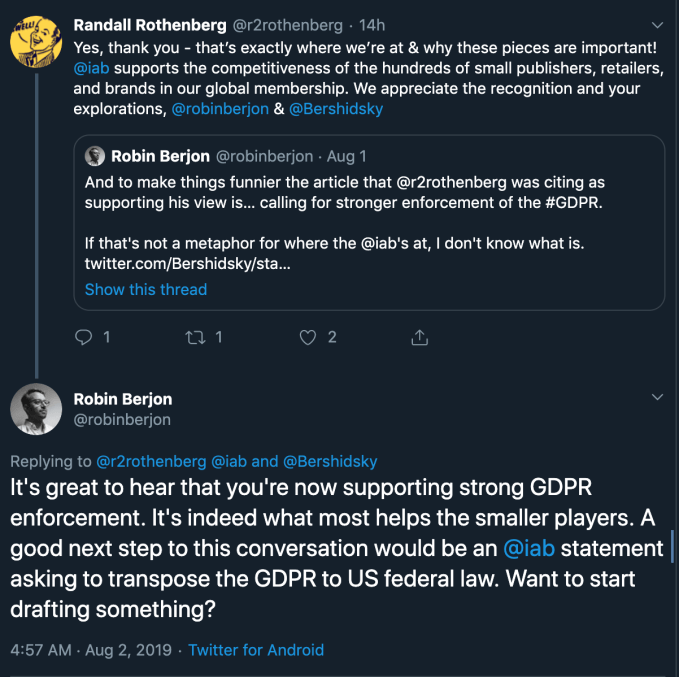
In an interesting twist to this ‘mixed member online ad industry association vs people who work with ads and data at actual publishers’ slugfest, Rothenberg replied to Berjon’s thread, literally thanking him for the absolute battering.

Yes, thank you – that’s exactly where we’re at & why these pieces are important!” he tweeted, presumably still dazed and confused from all the body blows he’d just taken. “@iab supports the competitiveness of the hundreds of small publishers, retailers, and brands in our global membership. We appreciate the recognition and your explorations,@robinberjon.”

Rothenberg also took the time to thank Bloomberg columnist, Leonid Bershidsky, who’d chipped into the thread to point out that the article Rothenberg had furiously retweeted actually says the GDPR “should be enforced more rigorously against big companies, not that the GDPR itself is bad or wrong”.

Who is Bershidsky? Er, just the author of the article Rothenberg tried to nega-spin. So… uh… owned.

But there’s more! Berjon tweeted a response to Rothenberg’s thanks for what the latter tortuously referred to as “your explorations” — I mean, the mind just boggles as to what he was thinking to come up with that euphemism — thanking him for reversing his position on GDPR, and for reversing his prior leadership vacuum on supporting robustly enforced online privacy laws. 

It’s great to hear that you’re now supporting strong GDPR enforcement,” he writes. “It’s indeed what most helps the smaller players. A good next step to this conversation would be an @iab statement asking to transpose the GDPR to US federal law. Want to start drafting something?”

We’ve asked the IAB if, in light of Rothenberg’s tweet, it now wishes to share a public statement in support of transposing the GDPR into US law. We’ll be sure to update this post if it says anything at all.

We’ve also screengrabbed the vinegar strokes of this epic fight — as an insurance policy against any further instances of the IAB hitting the tweet delete button. (Plus, I mean, you might want to print it out and get it framed.)
Screenshot 2019 08 02 at 18.48.08

Some light related reading can be found here:

02 Aug 2019

The evolving airspace ecosystem

Imagine a world where drones deliver emergency medical supplies to people in need. Or shuttle commuters from place to place avoiding ground traffic and breaking down the geographical divide between cities and suburbs.

Autonomous drones could spray pesticides on crops, monitor construction sites, or film adventure seekers skiing down mountains.

Potential drone applications are limited only by our imaginations… and our ability to operate them safely.

Right now the FAA is working together with the tech industry to build new rules of engagement to ensure that these unmanned aerial vehicles avoid a collision without the eyes of human pilots.

These regulatory hurdles are the last obstacle to letting the market for autonomous drones soar.

The current airspace ecosystem

Aircraft, from Cessna 152s to Airbus 380s, are the most common vehicles that populate and cruise the airspace. And they all require a pilot’s eyes to operate.

In the case of commercial aircraft, they also require a Mode C Transponder, which determines the aircraft’s altitude. All commercial and most private aircraft also have to communicate with Air Traffic Control (ATC), people on the ground who logistically coordinate which aircraft taxi, take off, and land at airports.

This is a system with three layers of protection and vigilance to avoid horrific and often fatal crashes: ATC, Mode C, and the pilot’s eyes. With unmanned aircraft, this universally accepted system for keeping the National Airspace System safe will have to change.

pasted image 0

Digitizing the airspace for drones flown by artificial intelligence

Objects that don’t have humans on board can’t use eyes to avoid collision, or communicate and listen to ATC. As a substitute for humans and eyes, these vehicles must rely on several new systems, largely using artificial intelligence. And these systems will require that the current ecosystem operate digitally in real time.

In the very near future, Unmanned Traffic Management (UTM) hopes to seamlessly integrate with today’s version of ATC. 

GettyImages 649629414

Image courtesy of Getty Images

UTM strives for the digital sharing of each user’s planned flight details with the goal for each user (e.g. “pilot”) to have the same situational awareness of the airspace. That way, as drones navigate the skies they will know whether or not they’re impeding any other traffic in the sky. Companies like Airmap and Unifly are working on such systems. While UTM is a great idea, it’s hard to standardize such a system because it will be nearly impossible to convince or require 100 percent of manned pilots to use it. There will always be non-cooperative aircraft, just like there will always be automobile drivers who do not wear their seat belts even though the benefits of doing so are obvious and compelling.

Therefore, we will need to aggregate other layers of safety on top of UTM to ensure our airspace is safe. Specifically, the Mode C Transponder will be updated to an Automatic Dependent Surveillance-Broadcast (ADS-B) sensor. This enhanced sensor transmits aircraft-to-aircraft and provides significant additional real-time precision to help both pilots and controllers achieve shared situational awareness.

As the last critical layer of safety and redundancy, if for whatever reason a manned aircraft pilot doesn’t enter her flight path in the UTM system or the aircraft doesn’t have a working ADS-B sensor, both common scenarios, the drone needs to have an equivalent to the pilot’s eyes to avoid another flying object.

Bessemer portfolio company, Iris Automation has developed a system that provides drones with eyes in the sky. The system uses a small module with a camera that feeds into a real-time, onboard computer vision and deep learning algorithm to detect, track, classify, and if needed, avoid, other objects in the airspace to keep the drone safe throughout its flight.

At present, Iris is the only company with an FAA beyond visual line-of-sight (BVLOS) waiver and is the only certified detect and avoid (DAA) system in the market. The BVLOS system doesn’t require a visual observer on the ground and the entire system fits into the palm of your hand, weighing only 350 grams.

The wild blue yonder of drone ubiquity

One day drones will ubiquitously operate in our airspace preventing disasters and making our lives safer, easier, and better. They’ll put out fires, deliver late night take out, and inspect our infrastructures such as bridges, railways, and pipelines.

In order for all this to happen, it will be necessary for pilots, drone users, manufacturers, and the FAA to embrace and use this new digital technology and ecosystem. When they do, the virtually endless possibilities associated with drone technology can be realized in a way that will make the skies even safer.

02 Aug 2019

What to expect from Samsung’s Galaxy Note event

Samsung’s never been particularly good at keeping things under wraps. That’s no doubt, at least in part, by design. The company loves priming the rumor pump ahead of product announcements, and like clockwork, we’ve already seen plenty of what we expect is planned for next Wednesday’s Unpacked event in Brooklyn.

Earlier this week, Samsung announced the Galaxy Tab S6, its latest shot against the iPad Pro. Doing low-key product announcements ahead of events has become a bit of a thing of late. Apple and Google both did it earlier this year. Among other things, it’s a way of letting the world know that you’ve got more stuff to announce than a single event could possibly hold.

It seems like Samsung’s got a fair amount lined up for Wednesday, but the big show at Barclays is really about one thing:

The Galaxy Note 10

Screen Shot 2019 08 02 at 1.05.42 PM

Duh, right?

If there’s one thing Samsung likes more than devices, it’s a lot of devices. Following on the heels of a bunch of new Galaxy S devices, the company is expected to release between two and three new models.

The big news here is the expected addition of a Plus or Pro model. For whatever percentage of the population that’s been holding off on buying a Note over concerns that the screen just isn’t large enough, the new model is a expected to support a 6.8-inch display compared to the standard Note’s 6.3 (both AMOLED). That’s definite tablet territory, but Samsung’s made great strides on the body-to-screen ratio front, so it may not be the size and weight of a manhole cover.

A third model, which is more wishful thinking than full-on rumor for now, has the company releasing a 5G model. It makes sense from a strategy standpoint. Samsung released an everything-and-the-kitchen-sink version of the S10 with 5G last month, and the company clearly prides itself at being one of the first to bring the tech to market — even though carriers haven’t really caught up.

Rumors point to a triple-lens camera this time out, including a 16-megapixel ultra-wide on board, while the Pro/Plus is getting a depth-sensing time of flight sensor. Internally, we expect the addition of the Snapdragon 855 Plus. The Note would be among the first to sport the newly souped-up chip announced by Qualcomm a couple of weeks back.

Charging is expected to be sped up to support the beefy 3,600mAh/4,300mAh batteries, and 8/12GB of RAM are expected on the standard and Plus models, along with 25GB of storage.

Oh yeah, and then there’s that dongle.

Galaxy Watch Active 2

Screen Shot 2019 08 02 at 1.07.25 PM

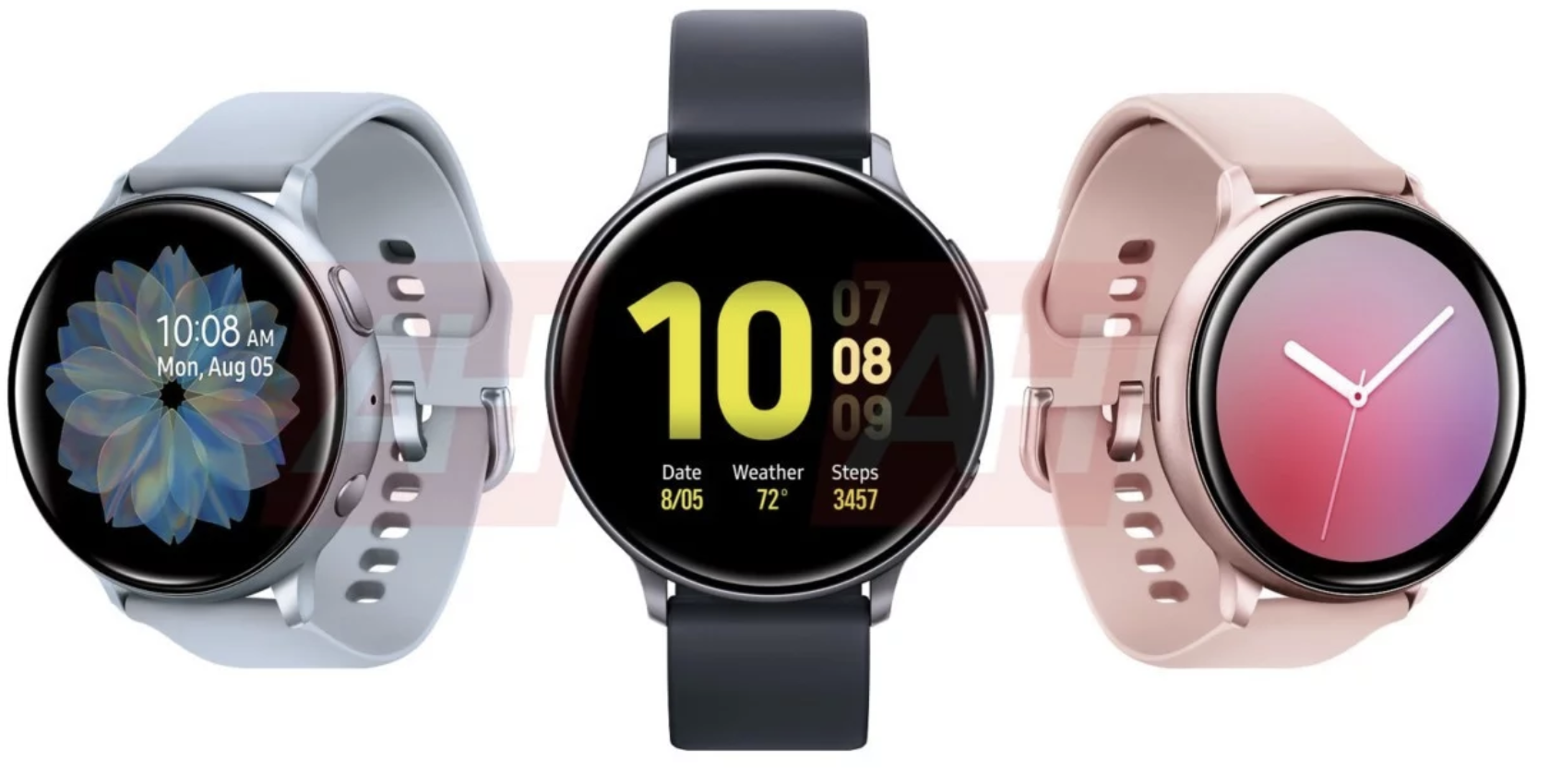
It’s been less than half a year since Samsung showed off the original Galaxy Watch Active, but the company is rumored to already be ready for part two. Available in both 40 and 44mm versions, the watches are said to bring ECG detection and fall monitoring, following recent additions for the Apple Watch. Rumors also point to the removal of the spinning physical bezel in favor of a touch version.

Etc.

DSCF5301 1

More information on the Galaxy Fold seems like a no-brainer. We got a rough time frame of September a couple of weeks back. I’d anticipate something more specific on the long-awaited and much-delayed foldable, along with some more information on those fixes.

Similarly MIA is the Galaxy Home, which was announced this time last year. We still don’t have a specific date on the company’s HomePod competitor, in spite of rumors that the company was already working on a cheaper version. Or maybe Samsung would rather sweep the Bixby delivery device under the carpet altogether?

All will be revealed on Wednesday, August 7, starting at 1PM ET/11AM PT.

02 Aug 2019

Journalist behind Cambridge Analytica story launches crowd-funder after libel threat

There have been millions of words written about the story of how Cambridge Analytica (CA) was employed by the Trump campaign to affect the 2016 US election and the UK’s Brexit referendum via the use of millions of Facebook profiles it had illegally bought, not least our recent review and analysis of the recent Netflix documentary about that saga. The controversy became so big that Facebook’s CEO, Mark Zuckerberg, was dragged before Congress and multiple legal investigations are still ongoing.

A major player in that movie and the ongoing story was, and still is, Pulitzer-nominated Carole Cadwalladr, the freelance Guardian newspaper journalist who was the first to tease apart the mess of threads liking CA, Trump and Brexit.

Cadwalladr recently made a highly regarded TED Talk which went viral on the subject, and which repeated evidence published by the UK’s Parliament about a series of “covert meetings” businessman Aaron Banks, a major Brexit campaigner and funder, had with the Russian government. The talk, “Facebook’s role in Brexit and its threat to democracy,” has been viewed more than two million times.

Cadwalladr’s reporting on the funding of the Brexit campaign and alleged links between Nigel Farage, Donald Trump’s 2016 presidential campaign, and Russian influence on the 2016 US election led to Banks – an ally of Donald Trump – becoming the subject of a serious criminal investigation by the National Crime Agency (the UK equivalent of the FBI).

Banks has now launched defamation proceedings against Cadwalladr over the allegations about his financial and political links, but, in particular, for that one remark about meetings with Russians, quoted in the Netflix documentary. Moreover, he is lodging a personal case against her, rather than suing the outlets that published her work, or TED, which hosted a speech at the heart of his case, and which would normally have the resources to fight a legal battle.

In order to support her journalism while she fights this libel case, and to increase resources for her investigation, Cadwalladr has now launched a GoFundMe campaign as she faces the possibility of a million-pound libel bill.

While her legal team are confident that the case is “entirely without merit”, Cadwalladr (a freelance, not staff, reporter) could be bankrupted by Banks’ legal costs, which are expected to rise into seven figures.

The result could mean that she is tied up in litigation for months in a move that press freedom organizations have called an “abuse of law” to “silence a journalist” .

“Arron Banks is not suing TED or the Guardian and Observer, though it is the extensive investigations that we have published and that have helped trigger several serious criminal investigations that has prompted this lawsuit,” she said in a statement.

“Instead, he has chosen to go after me as an individual in a clear attempt to intimidate and harass me. It’s extremely concerning that a millionaire can use the law in this way. This isn’t just an attack on me, it’s an attack on journalism.”

Fellow journalists and press freedom campaigners have spoken out in support of Cadwalladr in an open letter to the former Foreign Secretary, Jeremy Hunt. The letter identifies Banks’s claim as an example of “strategic litigation against public participation” (“SLAPP”) lawsuits, “a means of intimidating and silencing journalists working in the public interest”.

Banks’ spokesman, Leave.EU communications director Andy Wigmore, has said Banks’ lawsuit was about preventing Cadwalladr from continuing “to make assertions which are factually far-fetched and just not true”.

02 Aug 2019

A closer look at China’s smartphone market

In February 2013, China surpassed the United States to become the world’s largest smartphone market. More than half a decade on, it still proves an elusive target for international sellers. A glance at reports from the past several shows reveals the top spots dominated by homegrown names: Huawei, Vivo, Oppo, Xiaomi.

Combined, the big four made up roughly 84 percent of the nearly 100 million smartphones shipped last quarter, per new numbers from Canalys. Even international giants like Apple and Samsung have trouble cracking double-digit market share. Of the two, Apple has generally done better, with around six percent of the market — around six times Samsung’s share.

But Apple’s struggles have been very visible nonetheless, as the company has invested a good deal of its own future success into the China market. At the beginning of the year, the company took the rare action of lowering its guidance for Q1, citing China as the primary driver.

“While we anticipated some challenges in key emerging markets, we did not foresee the magnitude of the economic deceleration, particularly in Greater China,” Tim Cook said in a letter to shareholders at the time. “In fact, most of our revenue shortfall to our guidance, and over 100 percent of our year-over-year worldwide revenue decline, occurred in Greater China across iPhone, Mac and iPad.”

When it came time to report, things were disappointing as expected. The company’s revenue in the area dropped nearly $5 billion, year over year. On the tail of two rough quarters, things picked up a bit for Apple in the country. This week, Tim Cook noted “great improvement” in Greater China.

02 Aug 2019

A closer look at China’s smartphone market

In February 2013, China surpassed the United States to become the world’s largest smartphone market. More than half a decade on, it still proves an elusive target for international sellers. A glance at reports from the past several shows reveals the top spots dominated by homegrown names: Huawei, Vivo, Oppo, Xiaomi.

Combined, the big four made up roughly 84 percent of the nearly 100 million smartphones shipped last quarter, per new numbers from Canalys. Even international giants like Apple and Samsung have trouble cracking double-digit market share. Of the two, Apple has generally done better, with around six percent of the market — around six times Samsung’s share.

But Apple’s struggles have been very visible nonetheless, as the company has invested a good deal of its own future success into the China market. At the beginning of the year, the company took the rare action of lowering its guidance for Q1, citing China as the primary driver.

“While we anticipated some challenges in key emerging markets, we did not foresee the magnitude of the economic deceleration, particularly in Greater China,” Tim Cook said in a letter to shareholders at the time. “In fact, most of our revenue shortfall to our guidance, and over 100 percent of our year-over-year worldwide revenue decline, occurred in Greater China across iPhone, Mac and iPad.”

When it came time to report, things were disappointing as expected. The company’s revenue in the area dropped nearly $5 billion, year over year. On the tail of two rough quarters, things picked up a bit for Apple in the country. This week, Tim Cook noted “great improvement” in Greater China.

02 Aug 2019

Digitizing construction sites with Scaled Robotics

Approximately 20% of construction costs are wrapped up in fixing errors. Barcelona-based Scaled Robotics wants to minimize the rework by automating progress monitoring with autonomous mobile robots. 

Leveraging lidar and autonomous vehicle technology (similar to what’s used by Google cars to map the world), Scaled Robotics built a WALL-E doppelgänger to navigate and build maps of construction sites by fusing images, video and data captured by its robots.

[gallery type="slideshow" columns="1" ids="1863476,1863475,1863474,1863473"]

The company was born out of frustration, “of not having the tools to build what we designed in the office,” says co-founder Stuart Maggs, whose background is in construction and architecture. “You spend a lot of time in the office, creating this vision of what you wanted, that you thought was right, but ultimately, it came down to a guy in the field with just a tape measure and a piece of chalk that will put things pretty much however he felt on that day.” 

Their robots have been deployed in various construction sites around the world, including Dura Vermeer in the Netherlands and Kia in the U.K. Maggs says he found it surprisingly easy to convince the construction industry of the robot’s value — arguing there’s a real need for what it delivers: High-resolution comparison of the digital model to the on-the-ground build site that helps build managers keep close track of progress and spot problems before they can scale into costly expenses. The bot is a multifaceted tool for efficiency, he adds. 

In the beginning, workers on site were a bit hesitant, but after numerous jokes and picture-taking, Maggs, said in closing, “they just accept it as another tool on the construction site.”