Year: 2019

02 Aug 2019

Digitizing construction sites with Scaled Robotics

Approximately 20% of construction costs are wrapped up in fixing errors. Barcelona-based Scaled Robotics wants to minimize the rework by automating progress monitoring with autonomous mobile robots. 

Leveraging lidar and autonomous vehicle technology (similar to what’s used by Google cars to map the world), Scaled Robotics built a WALL-E doppelgänger to navigate and build maps of construction sites by fusing images, video and data captured by its robots.

[gallery type="slideshow" columns="1" ids="1863476,1863475,1863474,1863473"]

The company was born out of frustration, “of not having the tools to build what we designed in the office,” says co-founder Stuart Maggs, whose background is in construction and architecture. “You spend a lot of time in the office, creating this vision of what you wanted, that you thought was right, but ultimately, it came down to a guy in the field with just a tape measure and a piece of chalk that will put things pretty much however he felt on that day.” 

Their robots have been deployed in various construction sites around the world, including Dura Vermeer in the Netherlands and Kia in the U.K. Maggs says he found it surprisingly easy to convince the construction industry of the robot’s value — arguing there’s a real need for what it delivers: High-resolution comparison of the digital model to the on-the-ground build site that helps build managers keep close track of progress and spot problems before they can scale into costly expenses. The bot is a multifaceted tool for efficiency, he adds. 

In the beginning, workers on site were a bit hesitant, but after numerous jokes and picture-taking, Maggs, said in closing, “they just accept it as another tool on the construction site.”

02 Aug 2019

Google to auction slots on Android default search ‘choice screen’ in Europe next year, rivals cry ‘pay-to-play’ foul

Starting early next year Google will present Android users in Europe with a search engine choice screen when handsets bundle its own search service by default.

In a blog post announcing the latest change to flow from the European Union’s record-breaking $5B antitrust enforcement against Android last year, when the Commission found Google had imposed illegal restrictions on OEMs and carriers using its dominant smartphone platform, it says new Android phones will be shown the choice screen once during set-up (or again after any factory reset).

The screen will display a selection of three rival search engines alongside its own.

OEMs will still be able to offer Android devices in Europe that bundle a non-Google search engine by default (though per Google’s reworked licensing terms they have to pay it to do so). In those instances Google said the choice screen will not be displayed.

Google says rival search engines will be selected for display on the default choice screen, per market, via a fixed-price sealed bid annual auction — with any winners (and/or eligible search providers) being displayed in a random order alongside its own.

Search engines that win the auction will secure one of three open slots on the choice screen, with Google’s own search engine always occupying one of the four total slots.

“In each country auction, search providers will state the price that they are willing to pay each time a user selects them from the choice screen in the given country,” it writes. “Each country will have a minimum bid threshold. The three highest bidders that meet or exceed the bid threshold for a given country will appear in the choice screen for that country.”
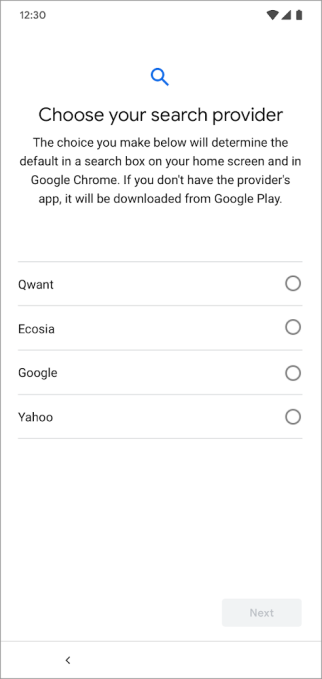
android choice screen

If there aren’t enough bids to surface three winners per auction then Google says it will randomly select from a pool of eligible search providers which it is also inviting to apply to participate in the choice screen. (Eligibility criteria can be found here.)

“Next year, we’ll introduce a new way for Android users to select a search provider to power a search box on their home screen and as the default in Chrome (if installed),” it writes. “Search providers can apply to be part of the new choice screen, which will appear when someone is setting up a new Android smartphone or tablet in Europe.”

“As always, people can continue to customize and personalize their devices at any time after set up. This includes selecting which apps to download, changing how apps are arranged on the screen, and switching the default search provider in apps like Google Chrome,” it adds.

Google’s blog post makes no mention of whether the choice screen will be pushed to the installed base of Android devices. But a spokeswoman told us the implementation requires technical changes that means it can only be supported on new devices.

Default selections on dominant platform are of course hugely important for gaining or sustaining marketshare. And it’s only since competition authorities dialled up their scrutiny that the company has started to make some shifts in how it bundles its own services in dominant products such as Android and Chrome.

Earlier this year Google quietly added rival pro-privacy search engine DuckDuckGo as one of the default choices offered by its Chrome browser, for example.

In April it also began rolling out choice screens to both new and existing Android users in Europe — offering a prompt to download additional search apps and browsers.

In the latter case, each screen shows five apps in total, including whatever search and browser is already installed. Apps not already installed are included based on their market popularity and shown in a random order.
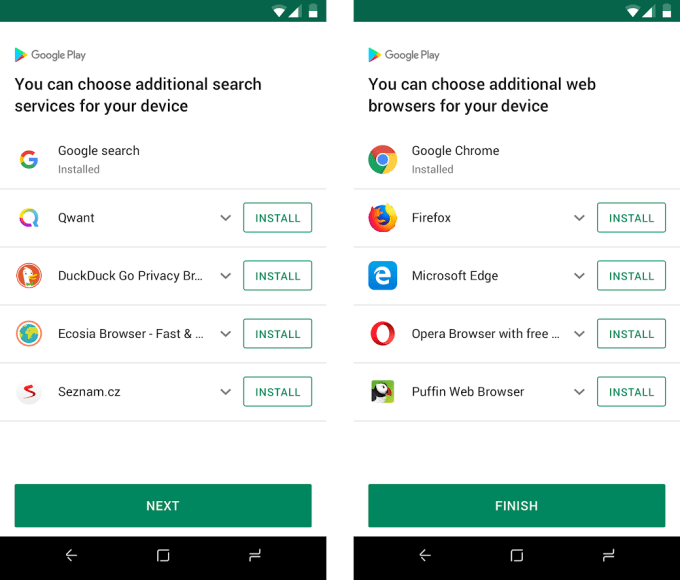
android choice app screen.max 1000x1000

French pro-privacy search engine, Qwant, told us that since the rollout of the app service choice screen to Android devices the share of Qwant users using its search engine on mobile has leapt up from around 2% to more than a quarter (26%) of its total userbase.

Qwant co-founder and CEO Eric Léandri said the app choice screen shows that competing against Google on search is possible — but only “thanks to the European Commission” stepping in and forcing the unbundling.

However he raised serious concerns about the sealed bid auction structure that Google has announced for the default search choice — pointing out that many of the bidders for the slots will also be using Google advertising and technology; while the sealed structure of the auction means no-one outside Google will know what prices are being submitted as bids, making it impossible for rivals to know whether the selections Google makes are fair.

Even Google’s own FAQ swings abruptly from claims of the auction it has devised being “a fair and objective method” for determining which search providers get slots, to a flat “no” and “no” on any transparency on bid amounts or the number of providers it deems eligible per market…
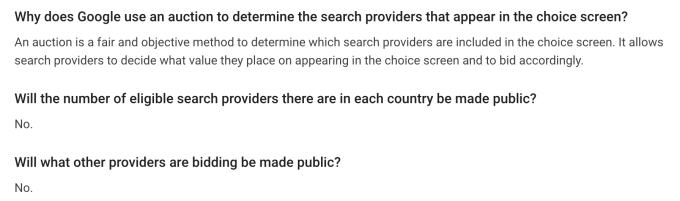
Screenshot 2019 08 02 at 16.51.50

“Even if Google is Google some people can choose something else if they have the choice. But now that Google knows it, it wants to stop the process,” Léandri told TechCrunch.

“It is not up to Google to now charge its competitors for its faulty behavior and the amount of the fine, through an auction system that will benefit neither European consumers nor free competition, which should not be distorted by such process,” Qwant added in an emailed press statement. “The proposed bidding process would be open to so-called search engines that derive their results and revenues from Google, thereby creating an unacceptable distortion and a high risk of manipulation, inequity or disloyalty of the auction.”

“The decision of the European Commission must benefit European consumers by ensuring the conditions of a freedom of choice based on the intrinsic merits of each engine and the expectations of citizens, especially regarding the protection of their personal data, and not on their ability to fund Google or to be financed by it,” it also said.

In a further complaint, Léandri said Google is requiring bidders in the choice screen auction to sign an NDA in order to participate — which Qwant argues would throw a legal obstacle in the way of it being able to participate, considering it is a complainant in the EU’s antitrust case (ongoing because Google is appealing).

“Qwant cannot accept that the auction process is subject to a non-disclosure agreement as imposed by Google while its complaint is still pending,” it writes. “Such a confidentiality agreement has no other possible justification than the desire to silence its competitors on the anomalies they would see. This, again, is an unacceptable abuse of its dominant position.”

We’ve reached out to the Commission with questions about Google’s choice screen auction.

DuckDuckGo founder, Gabriel Weinberg, has also been quick to point to flaws in the auction structure — writing on Twitter: “A ‘ballot box’ screen could be an excellent way to increase meaningful consumer choice if designed properly. Unfortunately, Google’s announcement today will not meaningfully deliver consumer choice.

“A pay-to-play auction with only 4 slots means consumers won’t get all the choices they deserve, and Google will profit at the expense of the competition. We encourage regulators to work with directly with Google, us, and others to ensure the best system for consumers.”


02 Aug 2019

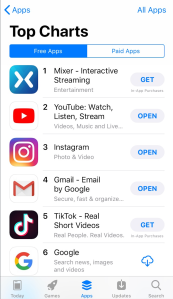
Following Ninja’s news, Mixer pops to top of the App Store’s free charts

Yesterday, Tyler “Ninja” Blevins announced that he’s leaving Twitch, moving his streaming career over to Microsoft’s Mixer platform. This morning, Mixer has shot to the top of the App Store’s free app charts.

Microsoft acquired Mixer in 2016, back when it was called Beam, and has been trying to grow the platform since. However, Mixer has had a tough go of it with competition from the industry leader, Twitch, as well as other tech giants like Google (YouTube) and Facebook.

In fact, Mixer represented just three percent of game streaming viewership hours in the last quarter, according to StreamElements.

Microsoft had this to say about Ninja’s move:

We’re thrilled to welcome Ninja and his community to Mixer. Mixer is a place that was formed around being positive and welcoming from day one, and we look forward to the energy Ninja and his community will bring.

mixerNinja announced the news with a video, which didn’t offer much by way of reasons for the move. It’s highly likely that Microsoft paid a pretty penny for it, though that hasn’t been officially confirmed.

In less than 24 hours, his new Mixer channel has picked up more than 250K followers, and Mixer has risen to the top of the App Store charts.

It’s early days for the switch, but it’s still a long way to go to get back to the 14 million followers Ninja enjoyed on Twitch.

02 Aug 2019

Texas joins growing list of AGs looking to block T-Mobile/Sprint merger

Late last week, the DOJ green lit T-Mobile and Sprint’s $26 billion deal to become nation’s number three carrier. The deal isn’t officially official just yet, with some prominent opposition facing the merger. A growing list of attorneys general have sued to block the merger, and other big name just came on board.

With the addition of Texas Attorney General Ken Paxton, the number moves to 15, including the District of Columbia. California, Colorado, Connecticut, the District of Columbia, Maryland, Michigan, Mississippi, New York, Virginia and Wisconsin filed the initial suit in June and were soon joined by Hawaii, Massachusetts, Minnesota and Nevada.

Notably, Paxton is one of only two Republicans on the list — probably not surprising as many conservative lawmakers have suggested that a merger of the third and forth largest carriers might actually promote competition. Trump appointed DOJ antitrust chief Makan Delrahim agreed with carrier suggestions that a merger would help a larger T-Mobile accelerate 5G growth.

Paxton disagreed with the sentiments.

“After careful evaluation of the proposed merger and the settlement, we do not anticipate that the proposed new entrant will replace the competitive role of Sprint anytime soon,” Paxton said in a statement provided to TechCrunch. “It is the Attorney General’s responsibility to preserve free market competition, which has proven to result in lower prices and better quality for consumers. The bargain struck by the U.S. Department of Justice is not in the best interest of working Texans, who need affordable mobile wireless telecommunication services that are fit to match the speed and technological innovation demands of Texas’ growing economy.”

T-Mobile has also come under scrutiny for intense lobbying, including $195,000 spent at Trump’s D.C. hotel since last April.

02 Aug 2019

SpaceX details launch and landing plans for Starship and Super Heavy in new document

SpaceX has prepared a draft environmental assessment around its plans for the new Starship and Super Heavy spacecraft launches it intends to begin, in a test capacity, very soon. Preparing and finalizing this environmental assessment is a key ingredient in actually launching both Super Heavy, the first stage for SpaceX’s forthcoming fully reusable, high-capacity launch system, and Starship, the second stage spacecraft component of said system.

Already, SpaceX is working towards getting a prototype of Starship in the air, with planned launches coming in just “2 to 3 months,” if SpaceX CEO Elon Musk manages to meet his optimistic timeline. It completed an untethered ‘hop’ low-altitude test flight of StarHopper, a sub-scale demonstration version of the Starship design meant to help it test that craft’s Raptor engine. But SpaceX must also show that it has fully considered the potential consequences that its planned launch operations will have on the surrounding environment.

Starship and Super Heavy will launch from Florida, with the current plan to build a second launch mount at its current LC-39A launch pad at Kennedy Space Center, which it leases from NASA and currently uses for Falcon 9 and Falcon Heavy launches. After launching from LC-39A, the current plan is to have Starship return back to Landing Zone 1 (LZ-1), which is SpaceX’s current landing area for Falcon first-stage boosters at nearby Cape Canaveral Air Force Station. Super Heavy would land downrange, aboard a drone barge ship, like the twin ‘Of Course I Still Love You’ and ‘Just Read The Instructions’ ships that SpaceX uses now depending on mission conditions on both its East and West coast launches.

Eventually, SpaceX hopes to also be able to build a landing zone within the existing confines of its LC-39A launch pad area, with the intent of landing Starship back much closer to where it launches – this will require more study to determine its viability and impact, however, so SpaceX has left that consideration for future investigation for now.

SpaceX says in the draft assessment that it also considered potentially launching and landing Starship and Super Heavy from its SLC-40 and SLC-4 launch sites, which are at Cape Canaveral Air Force Station and Vandenberg Air Force Base respectively, but these would not offer enough space in the case of SLC-40, or would require too long a trip back to the launch site in the case of SLC-4 (which would be an overland cross-country U.S. road trip for a huge rocket).

Finally, SpaceX also notes that it may, in future, “develop and launch the Starship/Super Heavy from its facility in Cameron County, TX.” A Texas-based launch site would have benefits in terms of proximity to one of SpaceX’s key rocket/engine development facilities, and if it’s successful in making its reusable launch and landing system extremely consistent in performance, the downsides of not being near a large body of water could be mitigated. These plans, however, will also merit separate consideration, so don’t expect full-scale launches for Starship from Texas in the near future.

02 Aug 2019

Unpacking DoorDash’s $410M Caviar acquisition

Hello and welcome back to Equity, TechCrunch’s venture capital-focused podcast, where we unpack the numbers behind the headlines.

This week Kate and Alex were back to dig through a surprising number of fresh rounds and new funds along with a little breaking news. The traditional VC summer is nowhere to be seen in 2019, so expect the show to stay packed for the foreseeable future.

DoorDash’s decision to buy Caviar from Square upended our agenda. The decacorn’s decision to drop $410 million in cash and stock on an asset that Square had spent around $90 million on was nearly confusing. Square couldn’t offload the damn thing for $100 million back in 2016; Jack’s second company has now shed an unprofitable arm that looked less and less core to its operations as time has gone along. And DoorDash turned cash and stock into a bit of growth.

Next on the docket was Clearbanc. The company, which wants to disrupt venture capital by popularizing the revenue-based financing model, raised a $50 million round and announced a $250 million fund. We’re keeping a close eye on this company, as its fast-growth is relatively unmatched. Plus, Kate’s interviewing Clearbanc co-founder Michele Romanow at TechCrunch Disrupt San Francisco, our annual conference that brings together the leaders of tech today. So that’s fun.

In this week’s edition of SaaS Watch, Monday.com raised $150 million at a $1.9 billion valuation. The corporate task management and productivity company is another firm selling software to help teams work together more efficiently. Slack, Asana, Notion and others are working in related areas.

Our second to last topic was Compass. There wasn’t enough time to go too deep but here’s the TL;DR: Compass raised a whopping $370 million on a valuation of $6.4 billion.

And finally, PowerPlant ventures raised a second, larger fund. The new $165 million vehicle will follow the first (a $42 million capital pool, as TechCrunch reported), investing in plant-based food companies. With the epic rise of Beyond Meat on the public markets, plant-based foods are hot and investors want a bite of the results. Also, we dig niche, focused funds.

Reminder, you can connect with us via email at equitypod@techcrunch.com. We’re open to feedback, suggestions and even compliments!

Equity drops every Friday at 6:00 am PT, so subscribe to us on Apple PodcastsOvercastSpotify, Pocket Casts, Downcast and all the casts.

02 Aug 2019

Scottish spaceport closer to launch after land lease signed

Plans to open a new spaceport in Sutherland in Scotland have moved closer to final approval: The real estate companies working on the deal have signed a 75-year lease for the land to be used for Space Hub Sutherland, which will look to launch small satellites via private launch services from companies including startup Orbex, a micro-launch startup founded in 2015, and Lockheed Martin.

The land lease is still dependent on final approval being given for the spaceport to be built, which is in process as the groups behind its development, including the UK Space Agency, are in process of working out the designs, funding and environmental impact studies. All of this will contribute to an overall planning application, which the partners are hoping will pave the way for construction to begin in 2020.

Sutherland isn’t the only spaceport the UK is looking to open in an effort to open up its commercial launch capabilities: There are also plans in the works to open one in Cornwall, with support and funding from both the UKSA and Richard Branson’s Virgin Orbit.

02 Aug 2019

Google ordered to halt human review of voice AI recordings over privacy risks

A German privacy watchdog has ordered Google to cease manual reviews of audio snippets generated by its voice AI. 

This follows a leak last month of scores of audio snippets from the Google Assistant service. A contractor working as a Dutch language reviewer handed more than 1,000 recordings to the Belgian news site VRT which was then able to identify some of the people in the clips. It reported being able to hear people’s addresses, discussion of medical conditions, and recordings of a woman in distress.

The Hamburg data protection authority used Article 66 powers of the General Data Protection Regulation (GDPR) to make the order — which allows a DPA to order data processing to stop if it believes there is “an urgent need to act in order to protect the rights and freedoms of data subjects”.

The Article 66 order to Google appears to be the first use of the power since GDPR came into force across the bloc in May last year.

Google says it received the order on July 26 — which requires it to stop manually reviewing audio snippets in Germany for a period of three months. Although the company had already taken the decision to manually suspend audio reviews of Google Assistant across the whole of Europe — doing so on July 10, after learning of the data leak.

Last month it also informed its lead privacy regulator in Europe, the Irish Data Protection Commission (DPC), of the breach — which also told us it is now “examining” the issue that’s been highlighted by Hamburg’s order.

The Irish DPC’s head of communications, Graham Doyle, said Google Ireland filed an Article 33 breach notification for the Google Assistant data “a couple of weeks ago”, adding: “We note that as of 10 July Google Ireland ceased the processing in question and that they have committed to the continued suspension of processing for a period of at least three months starting today (1 August). In the meantime we are currently examining the matter.”

It’s not clear whether Google will be able to reinstate manual reviews in Europe in a way that’s compliant with the bloc’s privacy rules. The Hamburg DPA writes in a statement [in German] on its website that it has “significant doubts” about whether Google Assistant complies with EU data-protection law.

“We are in touch with the Hamburg data protection authority and are assessing how we conduct audio reviews and help our users understand how data is used,” Google’s spokesperson also told us.

In a blog post published last month after the leak, Google product manager for search, David Monsees, claimed manual reviews of Google Assistant queries are “a critical part of the process of building speech technology”, couching them as “necessary” to creating such products.

“These reviews help make voice recognition systems more inclusive of different accents and dialects across languages. We don’t associate audio clips with user accounts during the review process, and only perform reviews for around 0.2% of all clips,” Google’s spokesperson added now.

But it’s far from clear whether human review of audio recordings captured by any of the myriad always-on voice AI products and services now on the market will be able to be compatible with European’s fundamental privacy rights.

These AIs typically have trigger words for activating the recording function which streams audio data to the cloud. But the technology can easily be accidentally triggered — and leaks have shown they are able to hoover up sensitive and intimate personal data not just of their owner but anyone in their vicinity (which of course includes people who never got within sniffing distance of any T&Cs).

In its website the Hamburg DPA says the order against Google is intended to protect the privacy rights of affected users in the immediate term, noting that GDPR allows for concerned authorities in EU Member States to issue orders of up to three months.

In a statement Johannes Caspar, the Hamburg commissioner for data protection, added: “The use of language assistance systems in the EU must comply with the data protection requirements of the GDPR. In the case of the Google Assistant, there are currently significant doubts. The use of language assistance systems must be done in a transparent way, so that an informed consent of the users is possible. In particular, this involves providing sufficient information and transparently informing those concerned about the processing of voice commands, but also about the frequency and risks of mal-activation. Finally, due regard must be given to the need to protect third parties affected by the recordings. First of all, further questions about the functioning of the speech analysis system have to be clarified. The data protection authorities will then have to decide on definitive measures that are necessary for a privacy-compliant operation. ”

The DPA also urges other regional privacy watchdogs to prioritize checks on other providers of language assistance systems — and “implement appropriate measures” — name-checking rival providers of voice AIs, Apple and Amazon .

This suggests there could be wider ramifications for other tech giants operating voice AIs in Europe flowing from this single Article 66 order.

The real enforcement punch packed by GDPR is not the headline-grabbing fines, which can scale as high as 4% of a company’s global annual turnover — it’s the power that Europe’s DPAs now have in their regulatory toolbox to order that data stops flowing.

“This is just the beginning,” one expert on European data protection legislation told us, speaking on condition of anonymity. “The Article 66 chest is open and it has a lot on offer.”

In a sign of the potential scale of the looming privacy problems for voice AIs Apple also said earlier today that it’s suspending a similar human review ‘quality control program’ for its Siri voice assistant.

The move, which does not appear to be linked to any regulatory order, follows a Guardian report last week detailing claims by a whistleblower that contractors working for Apple ‘regularly hear confidential details’ on Siri recordings, such as audio of people having sex and identifiable financial details, regardless of the processes Apple uses to anonymize the records.

Apple’s suspension of manual reviews of Siri snippets applies worldwide.

02 Aug 2019

Biome Makers closes $4M to assess the quality of the ‘gut bacteria’ of a farm’s soil

The agriculture industry faces huge problems of sustainability. The world’s population is increasing, leading to higher food demand, but this then threatens increasing deforestation, pesticide use, and some fertilizers that are responsible for greenhouse emissions. Farming can also be a source of carbon sequestration, but how to preserve that? Plus, land quality is being decreased due to over-framing. All this while agriculture has been an underserved industry in terms of technology development compared to others.

So it’s the right time to look at the importance of the “microbiome” in agriculture processes to understand what’s really happening in our crops. The microbiome comprises all of the genetic material within a microbiota (the entire collection of microorganisms in a specific niche, such as in farming ). It’s like looking at your gut bacteria, but for a farm.

Soil contains millions of microbes that all play a crucial role in the health of the crop, and this is why microbes in the soil are an important “biomarker”. Thus, understanding the microbes in the soil can lead to important actionable data.

Today Biome Makers, a technology company that uses advanced data analytics and artificial intelligence to analyze a soil’s ecosystem and provide actionable data-driven insights to farmers, has closed a $4M financing round led by Seaya Ventures and JME Ventures, with participation by London VC LocalGlobe. The financing will be used to keep expanding the company’s footprint across different geographies (U.S., Europe, Latam) and crop types, as well as an assessment system for agricultural products.

The company was founded by Adrián Ferrero (CEO) and Alberto Acedo (CSO), who have previously co-founded a successful startup in digital healthcare and have a strong scientific background. This is the second financing round for the company as it has previously raised $2M from a group of international investors, including Illumina, the global leading manufacturer of DNA sequencing instruments, through the Illumina Accelerator, Viking Global Investors, a leading US-based investment management firm.

Although other companies as Indigo Ag, Concentric, Pivot Bio or Marrone BioInnovations use similar techniques for biome identification, they claim to be the only company providing an open digital service and portal aimed at farmers, in order to democratize the microbiological information that will help them make informed decisions about their agricultural practices.

Biome Makers takes a different approach and looks below the surface. Currently, there are many companies that carry out physical-chemical analysis of the soil, but until now the microbiome dimension has not been taken into account. They say it is a new way of looking at the soil that provides information that had not been taken into account when making decisions in the field.

02 Aug 2019

Bring your team to Disrupt Berlin 2019 and save big

Early-stage startuppers around the world are getting ready for Disrupt Berlin 2019, which takes place on 11-12 December. Our premier tech conference attracts an international startup community from more than 50 countries. It’s the intersection of current and future tech and an incomparable networking opportunity.

You reap big savings with our super early-bird pricing (up to €600), but you can save even more when you buy in bulk. We want to make Disrupt Berlin a team-friendly event, because nobody wants to play rock, paper, scissors, lizard, Spock to see who stays home. Take advantage of our group discounts and bring your whole squad to Berlin.

  • Buy five or more Innovator passes at once and enjoy a 20% discount
  • Buy two or more Founder or Investor passes at once and enjoy a 10% savings

Bring the team and multiply your ROI. Split up and experience more of what Disrupt Berlin offers in two short days — world-class speakers, workshops, fireside chats, Q&A Sessions, the Extra Crunch stage and Startup Alley for starters. Let’s look a little closer, shall we?

You’ll hear advice and insight from leading founders and investors, like PicsArt founder and CEO Hovhannes Avoyan, UiPath founder and CEO Daniel Dines and SoftBank Vision Fund partner David Thevenon — to name just a few. We’re still adding speakers, and if you have someone you’d like to nominate, let us know.

Don’t miss out on Startup Battlefield. Our legendary pitch competition features the best early-stage startups launching their companies on a global stage in a bid for glory, the Disrupt Cup, investor love, media coverage and $50,000 cash. Keep your eyes peeled for the chance to enter this epic competition — sign up to get the latest Disrupt Berlin news.

We expect more than 3,000 attendees, and just about all of them will head to Startup Alley to explore our exhibition floor. They’ll find hundreds of creative early-stage startups displaying their latest innovations across the tech spectrum. It’s a networking opportunity like no other. Turn your team loose and let the startup magic begin.

Startup Alley is also home to the TC Top Picks. That’s our curated cadre of startups representing the very best in their tech categories. Check out our TC Top Picks from 2018. Think your startup can make the cut? You’ll have the opportunity to apply soon — another great reason to keep tabs on Disrupt Berlin news.

Join us at Disrupt Berlin 2019 on 11-12 December. So many excellent reasons to go and a limited amount of time to experience it all. Take advantage of our super early-bird group discounts and bring your whole team to amplify your presence and your ROI. We’ll see you in Berlin!

Is your company interested in sponsoring or exhibiting at Disrupt Berlin 2019? Contact our sponsorship sales team by filling out this form.