Year: 2019

31 Jul 2019

DeepMind touts predictive healthcare AI ‘breakthrough’ trained on heavily skewed data

DeepMind, the Google-owned UK AI research firm, has published a research letter in the journal Nature in which it discusses the performance of a deep learning model for continuously predicting the future likelihood of a patient developing a life-threatening condition called acute kidney injury (AKI). 

The company says its model is able to accurately predict that a patient will develop AKI “within a clinically actionable window” up to 48 hours in advance. 

In a blog post trumpeting the research, DeepMind couches it as a breakthrough — saying the paper demonstrates artificial intelligence can predict “one of the leading causes of avoidable patient harm” up to two days before it happens.

“This is our team’s biggest healthcare research breakthrough to date,” it adds, “demonstrating the ability to not only spot deterioration more effectively, but actually predict it before it happens.”

Even a surface read of the paper raises some major caveats, though.

Not least that the data used to train the model skews overwhelmingly male: 93.6%. This is because DeepMind’s AI was trained using patient data provided by the US Department of Veteran Affairs (VA).

The research paper states that females comprised just 6.38% of patients in the training dataset. “Model performance was lower for this demographic,” it notes, without saying how much lower.  

A summary of dataset statistics also included in the paper indicates that 18.9% of patients were black, although there is no breakout for the proportion of black women in the training dataset. (Logic suggests it’s likely to be less than 6.38%.) No other ethnicities are broken out.

Asked about the model’s performance capabilities across genders and different ethnicities, a DeepMind spokeswoman told us: “In women, it predicted 44.8% of all AKI early, in men 56%, for those patients where gender was known. The model performance was higher on African American patients — 60.4% of AKIs detected early compared to 54.1% for all other ethnicities in aggregate.”

“This research is just the first step,” she confirmed. “For the model to be applicable to a general population, future research is needed, using a more representative sample of the general population in the data that the model is derived from.

“The data set is representative of the VA population, and we acknowledge that this sample is not representative of the US population.  As with all deep learning models it would need further, representative data from other sources before being used more widely.

“Our next step would be to work closely with [the VA] to safely validate the model through retrospective and prospective observational studies, before hopefully exploring how we might conduct a prospective interventional study to understand how the prediction might impact care outcomes in a clinical setting.”

“To do this kind of work, we need the right kind of data,” she added. “The VA uses the same EHR [electronic health records] system (widely recognized as one of the most comprehensive EHRs) in all its hospitals and sites, which means the dataset is also very comprehensive, clean, and well-structured.”

So what DeepMind’s ‘breakthrough’ research paper neatly underlines is the reflective relationship between AI outputs and training inputs.

In a healthcare setting, where instructive outputs could be the difference between life and death, it’s not the technology that’s king; it’s access to representative datasets that’s key — that’s where the real value lies.

This suggests there’s huge opportunity for countries with taxpayer-funded public healthcare systems to structure and unlock the value contained in medical data they hold on their populations to develop their own publicly owned healthcare AIs.

Indeed, that was one of the recommendations of a 2017 industrial strategy review of the UK’s life sciences sector.

Oxford University’s Sir John Bell, who led the review, summed it up in comments to the Guardian newspaper, when he said: “Most of the value is the data. The worst thing we could do is give it away for free.”

Streams app evaluation

DeepMind has also been working with healthcare data in the UK.

Reducing the time it takes for clinicians to identify when a patient develops AKI has been the focus of an app development project it’s been involved with since 2015 — co-developing an alert and clinical task management app with doctors working for the country’s National Health Service (NHS).

That app, called Streams, which makes use of an NHS algorithm for detecting AKI, has been deployed in several NHS hospitals. And, also today, DeepMind and its app development partner NHS trust are releasing an evaluation of Streams’ performance, led by University College London.

The results of the evaluation have been published in two papers, in the Nature Digital Medicine and the Journal of Medical Internet Research.

In its blog DeepMind claims the evaluations show the​ ​app​ “​improved​ ​the​ ​quality​ ​of​ ​care​ ​for​ ​ patients​ ​by​ ​speeding​ ​up​ ​detection​ ​and​ ​preventing​ ​missed​ ​cases”, further claiming ​clinicians​ ​”were​ ​able​ ​to​ ​respond​ ​to​ ​urgent​ ​AKI​ ​cases​ ​in​ ​14​ ​minutes​ ​or​ ​less” — and suggesting that ​using​ ​existing​ ​systems​ “​might​ ​otherwise​ ​have​ ​taken​ ​many​ ​hours”.​ ​

It also claims a reduction in the cost of care to the NHS — ​from​ ​£11,772​ ​to​ ​£9,761​ ​for​ ​a hospital​ ​admission​ ​for​ ​a​ ​patient​ ​with​ ​AKI.​ ​

Though it’s worth emphasizing that under its current contracts with NHS trusts DeepMind provides the Streams service for free. So any cost reduction claims also come with some major caveats.

Simply put: We don’t know the future costs of data-driven, digitally delivered healthcare services — because the business models haven’t been defined yet. (Although DeepMind has previously suggested pricing could be based on clinical outcomes.)

“A​ccording​ ​to​ ​the​ ​evaluation,​ ​the​ ​app​ ​has​ ​improved​ ​the​ ​experience​ ​of​ ​clinicians​ ​responsible​ ​for​ ​ treating​ ​AKI,​ ​saving​ ​them​ ​time​ ​which​ ​would​ ​previously​ ​have​ ​been​ ​spent​ ​​trawling​ ​through​ ​paper,​ ​ pager​ ​alerts​ ​and​ ​multiple​ ​desktop​ ​systems,” DeepMind also writes now of Streams.

However, again, the discussion contained in the evaluation papers contains rather more caveats than DeepMind’s PR does — flagging a large list of counter considerations, such as training costs and the risks of information overload (and over-alerting) making it more difficult to triage and manage care needs, as well as concluding that more studies are needed to determine wider clinical impacts of the app’s use.

Here’s the conclusion to one of the papers, entitled A Qualitative Evaluation of User Experiences of a Digitally Enabled Care Pathway in Secondary Care:

Digital technologies allow early detection of adverse events and of patients at risk of deterioration, with the potential to improve outcomes. They may also increase the efficiency of health care professionals’ working practices. However, when planning and implementing digital information innovations in health care, the following factors should also be considered: the provision of clinical training to effectively manage early detection, resources to cope with additional workload, support to manage perceived information overload, and the optimization of algorithms to minimize unnecessary alerts.

A second paper, looking at Streams’ impact on clinical outcomes and associated healthcare costs, concludes that “digitally enabled clinical intervention to detect and treat AKI in hospitalized patients reduced health care costs and possibly reduced cardiac arrest rates”.

“Its impact on other clinical outcomes and identification of the active components of the pathway requires clarification through evaluation across multiple sites,” it adds.

To be clear, the current Streams app for managing AKI alerts does not include AI as a predictive tool. The evaluations being published today are of clinicians using the app as a vehicle for task management and push notification-style alerts powered by an NHS algorithm.

But the Streams app is a vehicle that DeepMind and its parent company Google want to use to drive AI-powered diagnosis and prediction onto hospital wards.

Hence DeepMind also working with US datasets to try to develop a predictive AI model for AKI. (It backed away from an early attempt to use Streams patient data to train AI, after realizing it would need to gain additional clearances from UK regulators.)

Every doctor now carries a smartphone. So an app is clearly the path of least resistance for transforming a service that’s been run on paper on pagers for longer than Google’s existed.

The wider intent behind DeepMind’s app collaboration with London’s Royal Free NHS Trust was stated early on — to build “powerful general-purpose learning algorithms”, an ambition expressed in a Memorandum of Understanding between the pair that has since been cancelled following a major data governance scandal.

The background to the scandal — which we covered extensively in 2016 and 2017 — is that the medical records of around 1.6 million Royal Free NHS Trust patients were quietly passed to DeepMind during the development phase of Streams. Without, as it subsequently turned out, a valid legal basis for the data-sharing.

Patients had not been asked for their consent to their sensitive medical data being shared with the Google-owned company. The regulator concluded they would not have had a reasonable expectation of their medical data ending up there.

The trust was ordered to audit the project — though not the original data-sharing arrangement that had caused the controversy in the first place. It was not ordered to remove DeepMind’s access to the data.

Nor were NHS patients whose data passed through Streams during the app evaluation phase asked for their consent to participate in the UCL/DeepMind/Royal Free study; a note on ‘ethical approval’ in the evaluation papers says UCL judged it fell under the remit of a service evaluation (rather than research) — hence “no participant consent was required”.

It’s an unfortunate echo of the foundational consent failure attached to Streams, to say the very least.

Despite all this, the Royal Free and DeepMind have continue to press on with their data-sharing app collaboration. Indeed, DeepMind is pressing on the accelerator — with its push to go beyond the NHS’ AKI algorithm.

Commenting in a statement included in DeepMind’s PR, Dr​ ​Chris​ ​Streather,​ ​Royal​ ​Free​ ​London​’s ​chief​ ​medical​ ​officer​ ​and​ ​deputy​ ​chief​ ​executive,​ ​enthuses: “The​ ​ findings​ ​of​ ​the​ ​Streams​ ​evaluation​ ​are​ ​incredibly​ ​encouraging​ ​and​ ​we​ ​are​ ​delighted​ ​that​ ​our​ ​partnership​ ​with​ ​DeepMind​ ​Health​ ​has​ ​improved​ ​the​ ​outcomes​ ​for​ ​patients.​ ​

“Digital​ ​technology​ ​is​ ​the​ ​way​ ​forward​ ​for​ ​the​ ​NHS.​ ​In​ ​the​ ​same​ ​way​ ​as​ ​we​ ​can​ ​receive​ ​transport​ ​ and​ ​weather​ ​alerts​ ​on​ ​our​ ​mobile​ ​devices,​ ​doctors​ ​and​ ​nurses​ ​should​ ​benefit​ ​from​ ​tools​ ​which​ ​put​ ​ potentially​ ​life-saving​ ​information​ ​directly​ ​into​ ​their​ ​hands.​

“In​ ​the​ ​coming​ ​months,​ ​we​ ​will​ ​be​ ​introducing​ ​the​ ​app​ ​to​ ​clinicians​ ​at​ ​Barnet​ ​Hospital​ ​as​ ​well​ ​as​ ​ exploring​ ​the​ ​potential​ ​to​ ​develop​ ​solutions​ ​for​ ​other​ ​life-threatening​ ​conditions​ ​like​ ​sepsis.”​

Scramble for NHS data

The next phase of Google-DeepMind’s plan for Streams may hit more of a blocker, though.

Last year DeepMind announced the app would be handed off to its parent — to form part of Google’s own digital health push. Thereby contradicting DeepMind’s own claims, during the unfolding scandal when it had said Google would not have access to people’s medical records.

More like: ‘No access until Google owns all the data and IP’, then…

As we said at the time, it was quite the trust shock.

Since then the Streams app hand-off from DeepMind to Google appears to have been on pause.

Last year the Royal Free Trust said it could not happen without its approval.

Asked now whether it will be signing new contracts for Streams with Google a spokesperson told us: “At present, the Royal Free London’s contract with DeepMind remains unchanged. As with all contractual agreements with suppliers, any changes or future contracts will follow information governance and data protection regulations. The trust will continue to be the data controller at all times, which means it is responsible for all patient information.”

The trust declined to answer additional questions — including whether it intends to deploy a version of Streams that includes predictive AI model at NHS hospitals; and whether or not patients will be given an opt out for their data being shared with Google.

It’s not clear what its plans are. Although DeepMind’s and Google’s is clearly for Streams to be the conduit for predictive AIs to be pushed onto NHS wards. Its blog aggressively pushes the case for adding AI to Streams.

To the point of talking down the latter in order to hype the former. The DeepMind Health sales pitch is evolving from ‘you need this app’ to ‘you need this AI’… With the follow on push to ‘give us your data’.

“Critically, these early findings from the Royal Free suggest that, in order to improve patient outcomes even further, clinicians need to be able to intervene before AKI can be detected by the current NHS algorithm — which is why our research on AKI is so promising,” it writes. “These results comprise the building blocks for our long-term vision of preventative healthcare, helping doctors to intervene in a proactive, rather than reactive, manner.

“Streams doesn’t use artificial intelligence at the moment, but the team now intends to find ways to safely integrate predictive AI models into Streams in order to provide clinicians with intelligent insights into patient deterioration.”

In its blog DeepMind also makes a point of reiterating that Streams will be folded into Google — writing: “As we announced in November 2018, the Streams team, and colleagues working on translational research in healthcare, will be joining Google in order to make a positive impact on a global scale.”

“The combined experience, infrastructure and expertise of DeepMind Health teams alongside Google’s will help us continue to develop mobile tools that can support more clinicians, address critical patient safety issues and could, we hope, save thousands of lives globally,” it adds, ending with its customary ‘hope’ that its technology will save lives — yet still without any hard data to prove all the big claims it makes for AI-powered predictive healthcare’s potential. 

As we’ve said before, for its predictive AI to deliver anything of value Google really needs access to data the NHS holds. Hence the big PR push. And the consent-overriding scramble for NHS data.

Responding to DeepMind’s news, Sam Smith, coordinator at health data privacy advocacy group  medConfidential told us: “The history of opportunists using doctors to take advantage of patients to further their own interests is as long as it is sordid. Some sagas drag on for years. Google has used their international reach to use data on the US military what they said they’d do in the UK, before it became clear they misled UK regulators and broken UK law.”

In a blog post the group added: “In recent weeks, Google & YouTube, Facebook & Instagram, and other tech companies have come under increasing pressure to accept they have a duty of care to their users. Can Google DeepMind say how its project with the Royal Free respects the Duty of Confidence that every NHS body has to its patients? How does the VA patient data they did use correspond to the characteristics of patients the RFH sees?

“Google DeepMind received the RFH data -– up to 10 years’ of hospital treatments -– of 1.6 million patients. We expect its press release to confirm how many of those 1.6 million people actually had their data displayed in the app, and whether they were used for testing alongside the US military data.”
31 Jul 2019

Direct-to-consumer lingerie brand Lively acquired for $85M

Lively, a lingerie business founded and led by former Victoria’s Secret executive Michelle Cordeiro Grant, has sold to intimate apparel brand Wacoal for $85 million.

The deal includes up to an additional $55 million in performance-based payouts.

Lively, headquartered in New York, had raised $15 million in venture capital funding, including a $6.5 million Series A investment from GGV Capital, NF Ventures and former Nautica CEO Harvey Sanders announced late last year. The Series valued the startup at $101 million, according to PitchBook.

The deal brings Wacoal’s parent company, Wacoal International Corporation, a team of highly-skilled e-commerce marketers, who’ve successfully managed to tap into the millennial customer sect.

Lively, founded in 2016, sells bras and intimates online and in two brick-and-mortar locations in Chicago and New York. It competes with a number of other direct-to-consumer lingerie and activewear upstarts, including ThirdLove, AdoreMe, TomboyX and Outdoor Voices .

“We built Lively to inspire women to live life passionately, purposefully, and confidently,” Grant wrote in a statement. “We invest in our community and customers to empower them to celebrate their individuality and enable them with products to look and feel their best. Wacoal’s core values have a beautiful synergy with Lively’s, enabling us to come together, not just to take market share, but to also create market share.”

31 Jul 2019

Consumer internet companies are easy to understand, but hard to create

Atari founder Nolan Bushnell once said that the best video games are easy to learn and nearly impossible to master.

I believe that a related concept holds for building foundational consumer internet companies. Two characteristics that I always look for in startups are the founder’s ability to describe what they do in less than five seconds, and a product or service that’s exceptionally hard to build well. Those two characteristics may sound as though they’re in opposition, but it turns out that the best companies can be simultaneously very easy to understand and very hard to do.

A successful consumer internet company must be easy to understand

“In a world of abundance, the only scarcity is human attention.” —Kevin Kelly, The Inevitable

Humans have short attention spans, and the competition for mindshare has never been greater. Today, the most successful products in consumer internet tend to be those that achieve high degrees of virality. Word of mouth, in particular, is an especially important driver of distribution for world-class products. Only products that are extremely simple to understand—such as DoorDashNiantic, or Coinbase—can thrive in the telephone-chain word-of-mouth distribution channel.

Here’s an example: imagine talking with a friend about something like Doppler Labs’ Here One earbuds. Though this hardware product had standout features and was unlike other earbuds on the market, it was difficult to explain what made them special. A conversation might sound something like, “They’re kind of like headphones, but really, they’re augmented reality for audio. You can phase in and out background noise. No, it’s not the same as adjusting volume or noise-canceling… but yes, you can use them to listen to music.” It’s not hard to predict that a message like this might not easily catch on.

Compare this to a product like Robinhood. You might say something such as, “It’s an app to buy and sell stocks on your phone without paying commission.” The succinct description instantly showcases the company’s value for consumers, and it’s memorable. Most people can understand how the product works, which makes it clear why Robinhood’s message sticks and can generate strong word-of-mouth distribution.

The less obvious insight is that this phenomenon can also work in startups’ benefit to attract capital. Founders who can quickly articulate their product and business model have the advantage of appealing to a large amount of investors.

Even more, a product or startup must be hard to do

Being able to concisely describe what a company does is just one part of the blueprint for success. While having a message and value proposition that are easy to understand and talk about are critical to growth, to become extremely valuable a startup must also build a product that’s hard to do.

Some verticals, like direct-to-consumer brands, can have a large number of companies that offer a similar product even after some have reached a moderate scale. While it’s never been easier to get to market with a new product in this vertical (good), it’s also a lot less likely for a single, super valuable company to capture the entire market (bad, at least from the perspective of a venture capitalist).

In contrast, when a business builds something that is hard to do well, they effectively construct a moat, or a sustainable competitive advantage. Nearly all startup pitches include a conversation around moats and the barrier to entry, and rightfully so. Building a moat allows a company to become a compounding franchise and accrue outsized profits over the long run.

The blueprint for consumer success

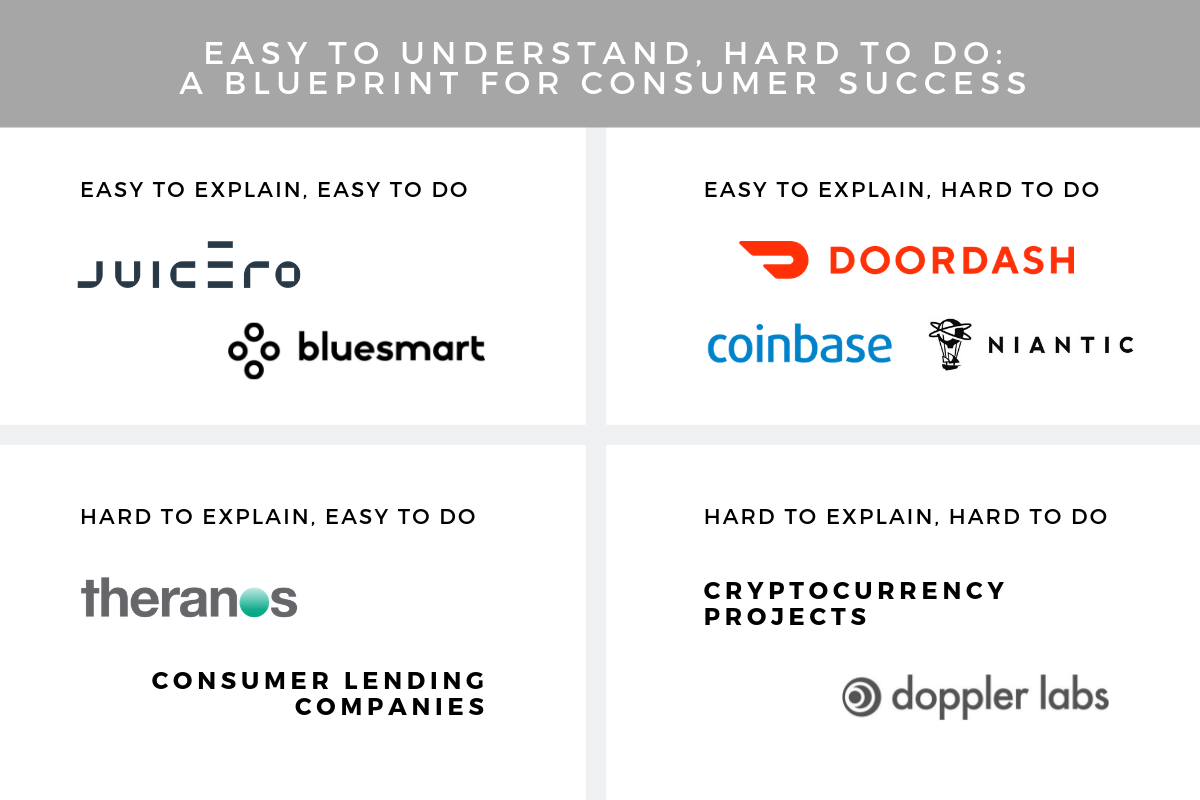
Using this framework, companies can be classified into one of four quadrants when we evaluate whether or not they follow the blueprint for consumer success.

Matt H 2

Easy to understand, hard to do

As described, this is the magic quadrant for consumer internet companies. Companies in this quadrant have a simple message that can be explained in five seconds or less, along with a component that’s hard to do. This may be an engineering build, regulatory approvals, cracking a network effect at scale, or building a brand that resonates.

  • Coinbase: Crypto is a notoriously complex vertical to understand, but the magic of Coinbase is that it doesn’t require a person to have any specific knowledge to use the product. By abstracting away the complexities of safely buying and storing crypto, Coinbase brought crypto to the mass market. Despite the simplicity of Coinbase’s product, the infrastructure that makes it possible is one of the most sophisticated engineering builds I’ve ever seen. For instance, keeping 98%+ of crypto deposits in cold storage while enabling instantaneous transaction ability is not a straightforward feat or something that people think about, but it’s critical to the ultimate product experience. Even more, the security infrastructure is a moving target that requires Coinbase to constantly innovate. Coinbase also remains one of the few scaled crypto exchanges/brokerages that have never been hacked .
  • Niantic: Niantic is a mobile game producer and the maker of Pokemon GO and Harry Potter: Wizards Unite. Niantic lands in the ‘easy to understand, hard to do’ category because the best games need little explanation; players simply open the app and start playing. Yet, there are few other companies that could successfully replicate the infrastructure that supports 100 million simultaneous instances in a single shared world geospatial game.
  • DoorDash: While DoorDash offers a drop-dead simple value proposition of better food delivery, the company has actually built a highly sophisticated software and operations stack that is really a next-generation last-mile logistics backbone. Much like Fedex or UPS, which were really software companies with trucks and drivers on the front end, DoorDash software controls every step of the process, from order batching, timing of food preparation, traffic analysis, and driver availability. DoorDash has largely out-executed competition because they recognized that better software and operations unlock a better product and a better business. For example, they solved reserved parking for dashers, and partnered with national chains to expand to non-urban markets. DoorDash also had to crack sufficient density in a geo-specific three-sided marketplace (restaurants, dashers, consumers), which is no small task.

Easy to understand, easy to do

Companies that are easy to understand may be able to get widespread, frictionless distribution, but those that are easy to do fall usually short when it comes to building a moat, or genuine competitive advantage. Brilliant marketing is not enough to prevent duplication, and business models that can be copied with something as simple as contract manufacturing may soon find themselves sidelined by competitors.

  • Juicero: No example comes to mind more quickly than Juicero. The Juicero Press was an expensive Wi-Fi connected device that utilized single-serving, pre-juiced fruit and vegetable packets sold via an exclusive subscription model. Juicero was easy to explain, but its technology wasn’t truly hard to do. Customers caught on to the fact that they didn’t actually need their device or Wi-Fi to make juice with the packets—they could do it with their hands by squeezing the packs. And there were significant alternatives in the market. The company shut down after 16 months in business.
  • BlueSmart: BlueSmart, a smart luggage company, serves as another good example of a company that was easy to understand and had a clear use case. Unfortunately, there was little about the product that was hard to do—it faced stiff competition from other smart suitcase companies as well as incumbents. Away, for example, came to market at a similar time and was able to out-execute on brand. The final blow came when airlines began banning lithium batteries, which the company decided they wouldn’t be able to sufficiently differentiate without.

Hard to understand, hard to do

Companies that are hard to do—perhaps they offer multiple products or elaborate models—can be difficult to articulate, which often causes the message to become distorted. As a result, these companies often have low virality. They can experience the same fate when it comes to attracting capital, as only a narrow set of investors will feel comfortable understanding the scope of what they do.

  • Doppler Labs: As mentioned, Doppler Labs headphones were hard to explain. They were different than any other headphones on the market and needed to be distinguished as such, but people failed to understand what set them apart and why they were valuable. While the technology to build the product may have been hard to do, that alone was insufficient to create a valuable company.
  • Cryptocurrency projects: “Crypto projects” are those where the core of the product (and often the investment security) requires at least some understanding of the cryptographic math and token economics to grasp what’s special about what they’re doing. Crypto projects are naturally harder to do because the nuts and bolts of crypto are complicated. That said, some of the most articulate founders in crypto can communicate their projects as easily as one can communicate a consumer marketplace.

Hard to understand, easy to do

Companies that are hard to understand and easy to do are the least appealing to investors, as they have a message that’s hard for consumers to grasp and low virality. They will struggle to build a moat. Put simply, they lack a real competitive advantage and are difficult to grow.

  • Consumer lending companies: Undifferentiated consumer lending companies often have models, investment criteria, or loan requirements that are hard for investors to understand. Though there may be moving parts, many lending companies rely on a simple funding and underwriting model that does the same thing: Checks a borrower’s credit score and/or bank account, connects to sources of capital, and then originates the loan. Without anything special to differentiate it, a lending company may be easily forgotten in a crowded space.
  • Theranos: Theranos marketed itself as a new kind of healthcare company that could run lab tests with smaller amounts of blood in a shorter period of time; a paradigm shift healthcare diagnostics. The various testing devices and panels made it difficult to understand exactly what the company did—and it turned out that they were doing something that was actually quite easy. Despite claims that it had created disruptive technology, the company was running standard blood tests (and doing so poorly) that lacked innovation. While it may have been fraud that brought down the company, the reality is that even if Theranos had told the truth about what they were actually doing, it’s unlikely they would have attracted significant capital to begin with.

Consumer internet companies can set themselves up for success early on by ensuring they can clearly speak to what they do, making it easy for people to understand and share the product and its value. A thoughtful approach to building something that’s difficult to do will go a long way when establishing a competitive advantage. This will also set a startup apart, attract investors and customers, and help the company thrive in a crowded space for the long run.

Special thanks to Steve Mullaney, the CEO of our portfolio company Aviatrix, for sparking this topic. He recently brought up this great concept (easy to understand, hard to do) when we talked about enterprise, and it inspired me to explore how the idea applies to consumer internet.

31 Jul 2019

Clearbanc co-founder and president Michele Romanow is coming to Disrupt SF

Raising venture capital isn’t easy; for some, it’s impossible.

Clearbanc offers startups a fundraising alternative and in just a few short years, it’s become a household name in Silicon Valley circles. The company disrupts the startup funding process by providing companies cash to buy ads in exchange for a revenue share so those companies aren’t forced to give up equity to venture capitalists. 

2019 has been Clearbanc’s year. It was only natural to invite Romanow to join us on stage at Disrupt SF. Romanow will discuss the funding landscape for startups, Clearbanc’s plans to deploy billions of dollars, as well as a breakdown of when to raise equity cash vs. non-dilutive capital. Alongside Brex CEO Henrique Dubugras, Romanow will also talk through serving startups as customers.

This year alone, the company, under Romanow’s lead, launched a campaign to back 2,000 businesses with $1 billion in non-dilutive capital by the end of 2019, raised $120 million across three different equity rounds and just this week, announced a $250 million fund to continue backing startups through its rev-share model.

Romanow’s career took off as an angel investor on the Canadian version of Shark Tank, Dragons’ Den. Together with co-founder Andrew D’Souza, she started Clearbanc in 2015 with a goal of helping more founders maintain control of their company through larger equity stakes. In conversation with TechCrunch earlier this year, she and D’Souza explained that some 40% of VC dollars end up going to Facebook and Google for digital ad campaigns. That capital, they said, should be put into hiring and other scaling efforts. 

“We are essentially a non-dilutive co-investor,” Romanow said. “VC takes time; it’s a lot of nos and you’re really giving up equity that you can never get back.”

“A lot of founders in the early days don’t calculate what their equity could be worth,” she added. “Like the first $250,000 in Uber is worth $1 billion now.”

Clearbanc, founded less than four years ago, has already put hundreds of millions of dollars in its pockets and like Brex, it has ambitions to support each and every startup out there. Brex and Clearbanc’s leaders will undoubtedly provide a conversation on the state of startups & fintech that can’t be missed.

Disrupt SF runs October 2 – October 4 at the Moscone Center in San Francisco. Tickets are available here.

31 Jul 2019

Investors bet another $50M on Clearbanc’s revenue share model

That company disrupting venture capital just raised more venture capital.

Clearbanc has attracted $300 million, including a $50 million equity investment led by Highland Capital with participation from Arcadia, iNovia and Emergence Capital, and another $250 million from limited partners for its third fund. Clearbanc declined to disclose its valuation, but noted the company was not “forced to raise” and therefore “raised on terms that [they] liked.”

The Canadian business, headquartered in Toronto, offers startups an alternative to VC in the form of non-dilutive revenue-share agreements. Coupling data and machine learning technology, Clearbanc is quick to make decisions about potential investments, driven by a lofty goal of backing 2,000 companies by 2020.

Through its latest campaign, the “20-Min Term Sheet,” Clearbanc invests between $10,000 to $10 million in e-commerce upstarts with positive ad spend and positive unit economics. Charging 6% on its capital, Clearbanc collects a portion of a company’s revenue until they’ve paid back 106% of the original investment.

Clearbanc has invested in 791 online brands so far this year, including Le Tote, UNTUCKit, Leesa Sleep and Public Goods. The company says its investments have generated an average of $121 million in monthly revenue.

“The 20-minute term sheet was our take on showing the market how fast we could get startups access to capital,” Clearbanc co-founder and president Michele Romanow tells TechCrunch. Their method, she explained, saves both VCs and founders a lot of time.

“[Founders] don’t need to go and pitch their life story,” Clearbanc co-founder and chief executive officer Andrew D’Souza tells TechCrunch. “They don’t need to spend hours and hours on due diligence and they don’t need to get on a flight and meet VCs in person, we’ve automated all of that.”

The $50 million investment will be used to expand into new verticals beyond e-commerce and to launch a venture partner program, which will give its portfolio of founders access to experienced investors and operators, a resource a traditional venture capital fund typically provides its entrepreneurs.

Clearbanc has signed up Jack Abraham, the founder and managing partner of Atomic, Hubble co-founder Jesse Horwitz, Product Hunt founder Ryan Hoover and more to support the new venture partner network.

D’Souza and Romanow say Clearbanc’s revenue-share model could become a larger asset class than equity in the long term. Bullish about their prospects, D’Souza compares Clearbanc to SoftBank, the Japanese telecom giant behind The Vision Fund.

“I have no doubt we will raise billions and billions for funds in the coming years and I think we can be bigger than SoftBank,” he said. “If we aren’t aiming to do that, then we aren’t aiming to solve the problems that exist for entrepreneurs globally.”

Clearbanc’s third fund, a $250 million effort, is five times larger than its second fund. The company wouldn’t disclose the size of its debut fund.

Clearbanc has raised $120 million in equity funding to date.

31 Jul 2019

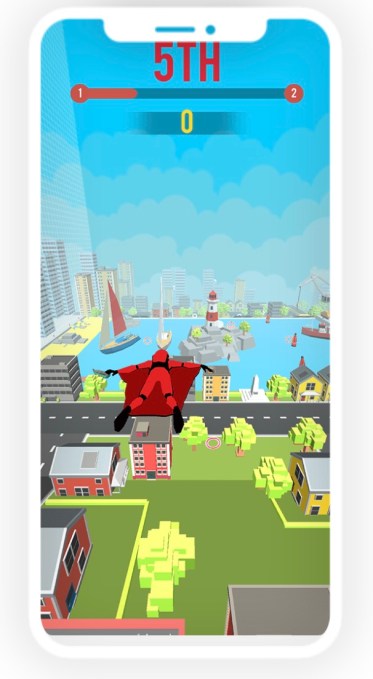
Luna Labs creates playable ads, directly from Unity

It seems obvious that the best way to advertise a game is to let people play the game itself — and we’ve covered other startups tackling this problem, such as AppOnboard and mNectar.

But Luna Labs co-founder and CEO Steven Chard said that for most developers, the creation of these ads involves outsourcing: “It might take weeks to make an ad, and the quality of the content at the end could be limited.”

The problem, Chard said, is that most games are built on the Unity engine, while the ads need to be in HTML5, which means that developers often have to build playable ads from scratch — hence the outsourcing.

“There’s this huge demand for playables, but the tech hasn’t caught up with it,” he said. “Our view — and I think why it’s really resonating with developers — we’re saying to developers: Use that same [Unity] editor to create a playable ad. You’re going to give the user a playable ad which genuinely feels like the game.”

In fact, while Luna is officially launching its service to developers this week, it’s already been working with a few partners like Kwalee and Voodoo. Luna says that in Kwalee’s case, the results were good enough that the company spent 60% more than they did on other playable ads, and the Luna playables drove more than 250,000 installs per day.

“Luna is solving a real pain point for our studio, and the initial results have been tremendous,” said Kwalee CRO Jason Falcus in a statement. “Integrating the Luna service has allowed us to significantly scale our campaigns by a comfortable margin, to the best results so far.”

Luna Labs screenshot

Luna’s investors include Ben Holmes (formerly of Index Ventures, backer of King and Playfish) and Chris Lee (who also invested in Space Ape and Hello Games).

Chard said the startup is currently focused on providing tools to developers, rather than getting involved in the ad-buying process. More generally, he said the company has been focused on the technology rather than the business model.

“We’re an early company with a very, very complex piece of technology — it’s taken a lot of time to get where we are,” he said. “We’re not doing it for free, but the focus isn’t on short-term profitability. It is, in the longer term, on creating a scalable product which can be used by developers.”

Chard added that eventually, he’s hoping Luna can become more involved in “at the content creation level.” For example, he suggested that developers could use the technology to test out playable concepts and see what resonates, before building a full game.

You can test it out for yourself on the Luna Labs website.

31 Jul 2019

Why AWS is building tiny AI race cars to teach machine learning

The AWS DeepRacer is an almost toylike 1/18th scale race car. It comes with all of the sensors and software tools to help developers build machine learning models to drive the car around a course — or really do anything else they want it to do. The $399 DeepRacer launched at AWS’s massive re:Invent show in late 2018.

At the time, it seemed like a bit of a gimmick, but AWS has put a lot of its weight behind it and is currently running a DeepRacer league at its various events around the world. At these events, developers can pit their models against each other and learn more about building a specific kind of machine learning model in the process.

Why bother, though? It’s not like DeepRacer cars are likely to add to AWS’s bottom line anytime soon. DeepRacer, however, is part of a line of hardware products from AWS that started with DeepLens, a smart camera for developers.

“It really comes from the same place,” AWS general manager for Artificial Intelligence and Machine Learning marketing Ryan Gavin told me. “When you think about the stimulus for something like DeepLens, it was really about how do we put machine learning into the hands of every developer and data scientist. That’s our mission and we’re very consistent about that.”

31 Jul 2019

Verizon adds Washington DC, Atlanta, Detroit and Indianapolis to list of 5G cities

This morning Verizon (TechCrunch’s parent company) flipped the 5G switch on four additional cities. Washington DC, Atlanta, Detroit and Indianapolis join Chicago, Denver, Minneapolis/St. Paul and Providence in getting coverage for the carrier’s growing next-generation network.

All of the usual caveats apply here. While the list of cities continues to grow, coverage varies from city to city to such a point where Verizon currently includes specific neighborhoods in these announcements. Here’s the break down,

In Washington DC, consumers, businesses and government agencies can initially access Verizon’s 5G Ultra Wideband service in areas of Foggy Bottom, Dupont Circle, Cardozo / U Street, Adams Morgan, Columbia Heights, Le Droit Park, Georgetown Waterfront, Judiciary Square, Shaw, Eckington, NOMA, National Mall and the Smithsonian, Gallery Place / Chinatown, Mt. Vernon Square, Downtown, Penn Quarter, Brentwood, Southwest Waterfront, Navy Yard, and nearby Crystal City, VA, as well as around landmarks such as the Ronald Reagan National Airport, United States Botanical Gardens, Hart Senate Building, National Gallery of Art, Lafayette Square, The White House, Freedom Plaza, Farragut Square, George Washington University, Capital One Arena, Union Station, Howard University Hospital, George Washington University Hospital, and Georgetown Waterfront Park.

In Atlanta, 5G Ultra Wideband service will initially be concentrated in parts of the following neighborhoods: Downtown, Midtown, Tech Square, and around such landmarks as The Fox Theater, Emory University Hospital Midtown, Mercedes Benz Stadium, Home Depot Backyard, Centennial Olympic Park, Georgia Aquarium, World of Coca Cola, and parts of Renaissance Park.

In Detroit, 5G Ultra Wideband service will initially be concentrated in parts of the following areas: Dearborn, Livonia, and Troy, including areas around the Oakland-Troy Airport.

In Indianapolis, 5G Ultra Wideband service is initially available in parts of the following neighborhoods, Arsenal Heights, Bates Hendricks, Castleton, Crown Hill, Fountain Square, Grace Tuxedo Park, Hawthorne, Historic Meridian Park, Lockerbie Square, Ransom Place, Renaissance Place, St. Joseph Historic Neighborhood, Upper Canal and Woodruff Place and around such landmarks and public spaces as Garfield Park, and Indiana University School of Medicine.

The carrier adds that service will be expanded within the above cities “in the months to come.” But hey, the White House is covered, which means even more rapid tweet storms. Verizon is adding a bunch more cities by the end of the year, including Boston, Charlotte, Cincinnati, Cleveland, Columbus, Dallas, Des Moines, Houston, Kansas City, Little Rock, Memphis, Phoenix, San Diego and Salt Lake City.

That will bring the total up to 30 for 2019.

The device selection is still limited, too for the moment. Verizon currently offers the LG V50 ThinQ 5G, Samsung Galaxy S10 5G and the Moto Z, which has an option 5G mod. There’s a 5G MiFi from Inseego available, as well.

31 Jul 2019

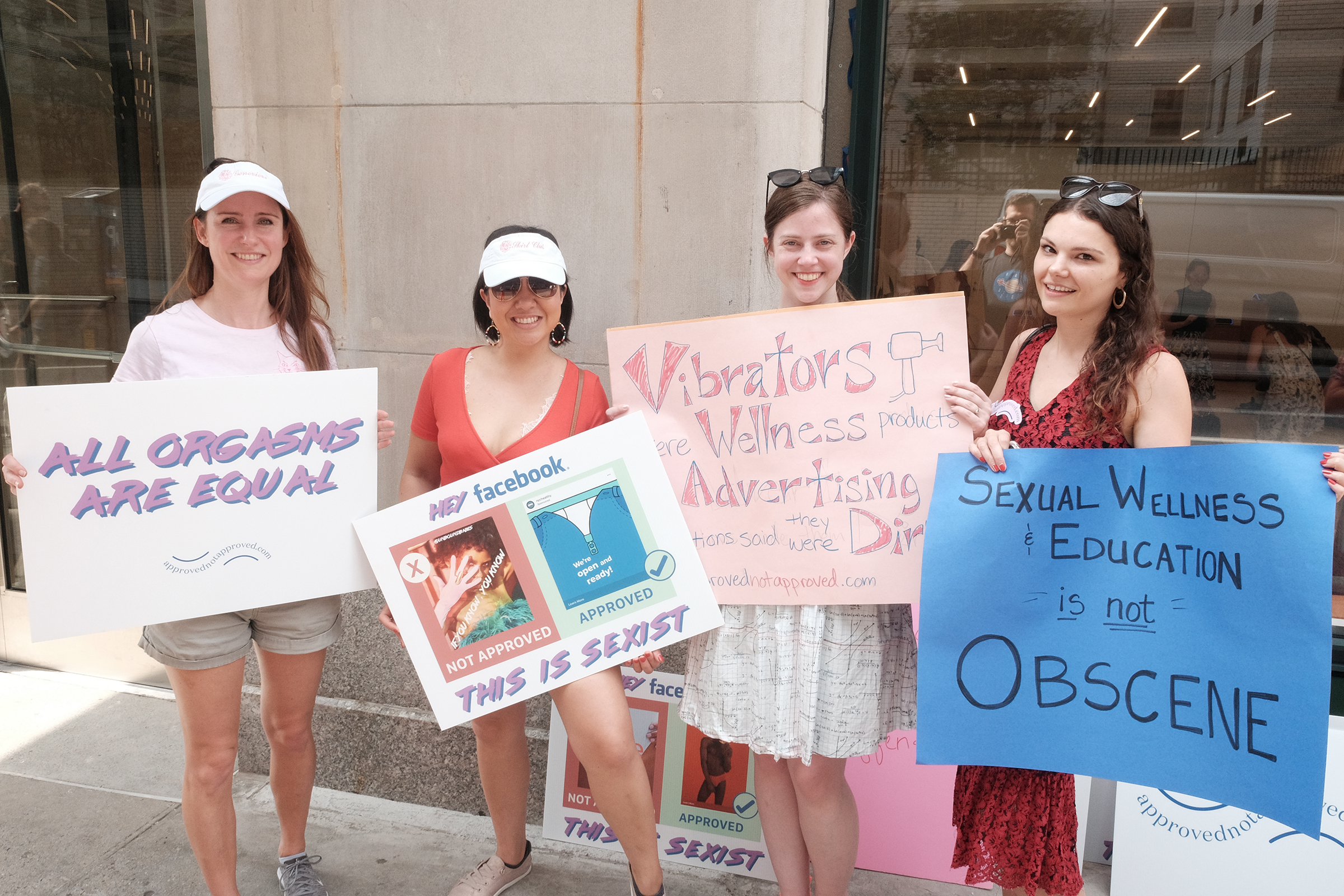
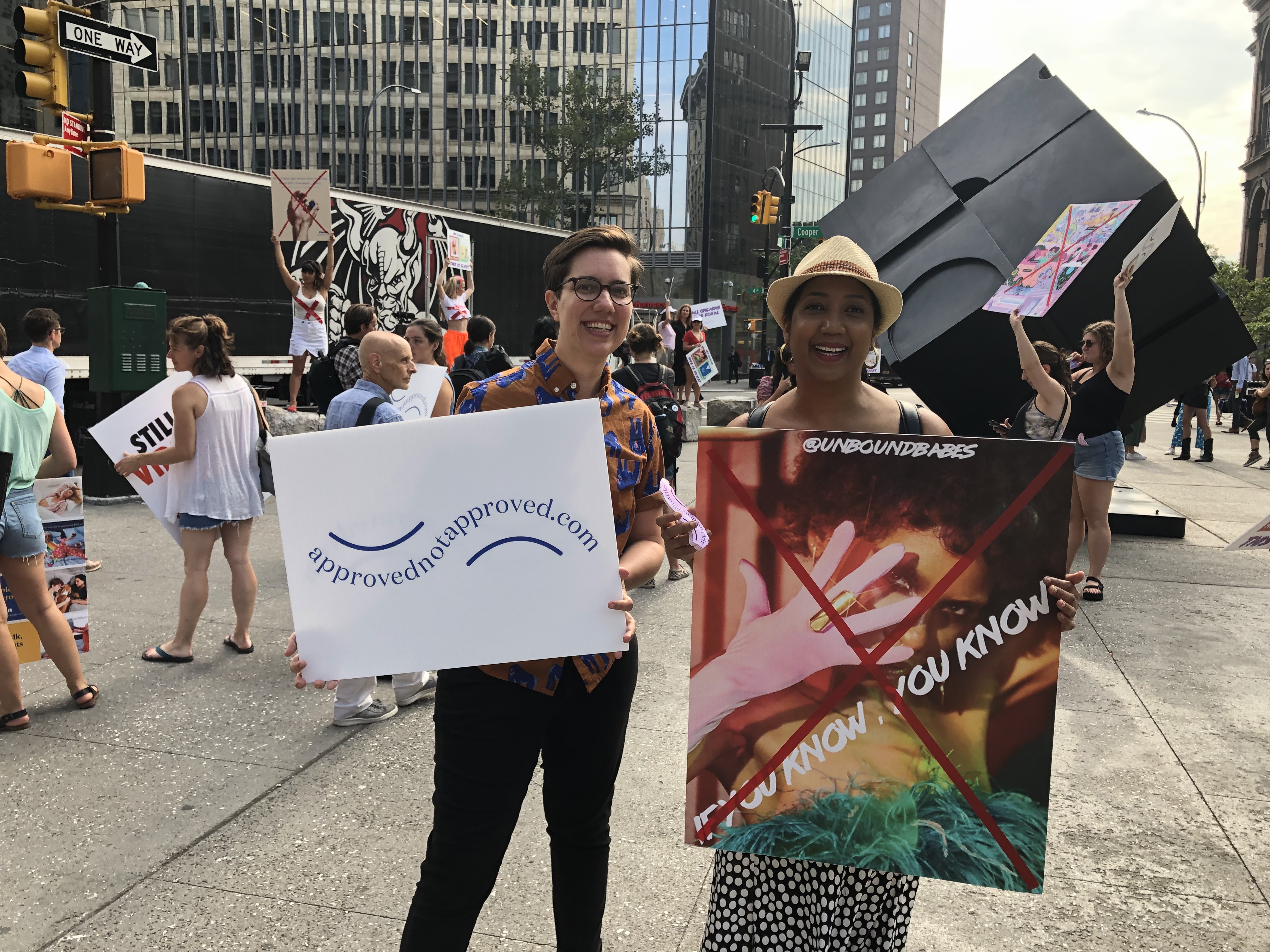
Sex tech companies and advocates protest unfair ad standards outside Facebook’s NY HQ

A group of sex tech startup founders, employees and supporters gathered outside of Facebook’s NY office in Manhattan to protest its advertising policies with respect to what it classifies as sexual content. The protest, and a companion website detailing their position we reported on Tuesday, are the work of ‘Approved, Not Approved,’ a coalition of sex health companies co-founded by Dame Products and Unbound Babes.

These policies are applied have fallen out of step with “the average person’s views of what should or shouldn’t be approved of ads,” according to Janet Lieberman, co-founder and CTO of Dame Products.

“If you look at the history of the sex toy industry, for example, vibrators were sexual health products, until advertising restrictions were put on them in the 1920s and 1930s – and then they became dirty, and that’s how the industry got shady, and that’s why we have negative thoughts towards them,” she told me in an interview at the protest. “They’re moving back towards wellness in people’s minds, but not in advertising policies. There’s a double standard for what is seen as obscene, talking about men’s sexual health versus women’s sexual health and talking about products that aren’t sexual, and using sex to sell them, versus taking sexual products and having completely non-sexual ads for them.”

facebook ad protest nyc

Credit: TechCrunch

It’s a problem that extends beyond just Facebook and Instagram, Lieberman says. In fact, her company is also suing NYC’s MTA for discrimination for its own ad standards after it refused to run ads for women’s sex toys in their out-of-home advertising inventory. But it also has ramifications beyond just advertising, since in many ways what we see in ads helps define what we see as acceptable in terms of our everyday lives and conversations.

“Some of this stems from society’s inability to separate sexual products from feeling sexual, and that’s a real problem that we see that hurts women more than men, but hurts both genders, in not knowing how to help our sexual health,” Lieberman said. “We can’t talk about it without being sexual, and that we can’t bring things up, without it seeming like we’re bringing up something that is dirty.”

IMG 9739

Credit: Unbound / Dame Products

“A lot of the people you see here today have Instagrams that have been shut down, or ads that have been not approved on Facebook,” said Bryony Cole, CEO at Future of Sex in an interview. “Myself, I run Future of Sex, which is a sex tech hackathon, and a podcast focused on sex tech, and my Instagram’s been shut down twice with no warning. It’s often for things that Facebook will say they consider phallic imagery, but they’re not […] and yet if you look at images for something like HIMS [an erectile dysfunction medication startup, examples of their ads here], you’ll see those phallic practice images. So there’s this gross discrepancy, and it’s very frustrating, especially for these companies where a lot of the revenue in their business is around community that are online which is true for sex toys.”

Online ads aren’t just a luxury for many of these startup brands and companies – they’re a necessary ingredient to continued success. Google and Facebook together account for the majority of digital advertising spend in the U.S., according to eMarketer, and it’s hard to grow a business that caters to primarily online customers without fair access to their platforms, Cole argues.

“You see a lot of sex tech or sexual wellness brands having to move off Instagram and find other ways to reach their communities,” she said. “But the majority of people, that’s where they are. And if they’re buying these products, they’re still overcoming a stigma about buying the product, so it’s great to be able to purchase these online. A lot of these companies started either crowdfunding, like Dame Products, or just through ecommerce sites. So the majority of their business is online. It’s not in a store.”

IMG 9753

Credit: Unbound / Dame Products

Earlier this year, sex tech company Lora DiCarlo netted a win in getting the Consumer Technology Association to restore its CES award after community outcry. Double standards in advertising is a far more systemic and distributed problem, but these protests will hopefully help open up the conversation and prompt more change.

31 Jul 2019

Netflix’s ‘The Irishman’ gets its first trailer starring a digitally de-aged De Niro

There’s plenty of reason to be excited for The Irishman. The Netflix-backed film teams Martin Scorsese with Robert De Niro, Al Pacino and Joe Pesci for a biopic based on the lives of organized crime-linked union figures Frank Sheeran and Jimmy Hoffa. But it’s the effects that have everyone talking.

Granted, that’s not the kind of phrase you generally hear in the lead up to a Scorsese film (particularly one that unites him with both De Niro and Pacino for the first time), but the involvement of Industrial Light & Magic has piqued the internet’s interest.

Lucasfilm’s special effects wing was tasked with de-aging the leads — in particular De Niro — as the septuagenarian actors play their characters at a range of different ages. The first trailer for the film, which hit this morning, features a notably younger De Niro in the role of Sheeran, the film’s titular Irishman.

The two minute trailer looks to be classic Scorsese: a stylized period piece with high tension and plenty of organized violence. There’s no release date yet for the film, which also stars  Harvey Keitel, Bobby Cannavale, Anna Paquin and Ray Romano, but it’s expected to appear in select theaters along with the streaming service — similar to Netflix’s award-focused approach with last year’s Oscar-winning Roma.