Year: 2019

31 Jul 2019

Hello Heart raises $12 million for at-home monitoring and behavioral treatment for hypertension

Leveraging new remote sensing and monitoring technologies and the willingness of corporate insurance programs to provide more preventative treatment to reduce longterm costs, Hello Heart has raised $12 million in new financing to further develop its business.

The money came from Khosla Ventures and previous backer Blue Run Ventures. The company said it will use the financing to expand its business.

Hello Heart tackles high blood pressure and heart disease with early monitoring coming from an at-home sensing system to track blood pressure and an integrated smart phone application providing prompts on behaviors to reduce high blood pressure.

According to a retrospective study paid for by Hello Heart and conducted by researchers at UCLA and Harvard Medical School, 70% of Hello Heart users managed to reduce their blood pressure an average of 22mmHg.

“Delivering clinical outcomes at the scale of population health requires strong patient engagement across a variety of patient types.  Hello Heart’s ability to drive engagement is what led to these unprecedented results,” said Dr. Eyal Zimlichman a Harvard medical school faculty researcher, and the chief medical and innovation officer of Sheba medical center.

The company collects all the data on its patients in a randomized and anonymized fashion in order to provide information on population health, according to a statement. In an interview, Maayan Cohen, the chief executive officer of the company said that Hello Heart did not sell any data to third parties.

“Our mission is to empower patients to understand and improve their health, and we’re very proud to be able to help them do it so effectively in heart health — [the number one] cause of death in the world.”

31 Jul 2019

Snapchat launches ‘instant’ tool for creating vertical ads

Snapchat is hoping to attract new advertisers (and make advertising easier for the ones already on the platform) with the launch of a new tool called Instant Create.

Some of these potential advertisers may not be used to creating ads in the smartphone-friendly vertical format that Snapchat has popularized, so Instant Create is to designed to make the process as simple as possible.

Executives at parent organization Snap discussed the tool during last week’s earnings call (in which the company reported that its daily active users increased to 203 million).

“Just this month we started testing our new Instant Create on-boarding flow, which generates ads for businesses in three simple steps from their existing assets, be it their app or their ecommerce storefront,” said CEO Evan Spiegel.

Now the product is moving from testing to availability for all advertisers using Snapchat’s self-serve Ads Manager.

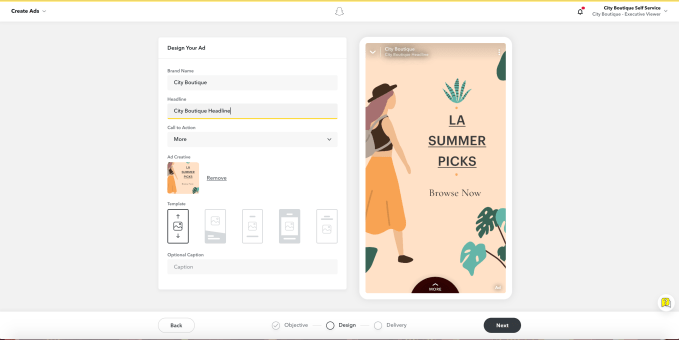
Snapchat Instant Create

Those three steps that Spiegel mentioned involve identifying the objective of a campaign (website visits, app installs or app visits), entering you website address and finalizing you audience targeting.

You can upload your creative assets if you want, but that’s not required since Instant Create will also import images from your website. And Snap notes that you won’t need to do any real design work, because there’s “a streamlined ad creation flow that leverages our most popular templates and simplified ad detail options, enabling you to publish engaging creative without additional design resources.”

The goal is to make Snapchat advertisers accessible to smaller advertisers who may not have the time or resources to try to understand new ad formats. After all, on that same earnings call, Chief Business Officer Jeremi Gorman said, “We believe the single biggest driver for our revenue in the short to medium term will be increasing the number of active advertisers using Snapchat.”

Instant Create is currently focused Snapchat’s main ad format, Snap Ads. You can read more in the company’s blog post.

31 Jul 2019

DJI aims for the best first-person drone experience with new googles, controller and more

New gear from DJI will equip you with everything you need to become the best first-person drone racer that’s ever graced the Earth – you’ll be the Anakin Skywalker of FPV drone races. The company is launching a new suite of products specifically to make the most of Digital First Person Viewing (FPV) when operating drones, with a wide range of compatibility.

The DJI Digital FPV Ecosystem includes a set of FPV goggles, a transmission unit that you attach to your drone of choice, a camera that also attaches to the transmitter unit and the drone body, and an FPV controller. Together, they provide the “first low latency HD video transmission signal” according to DJI, with total end-to-end latency of just 28 milliseconds per the specs, and the ability to transmit 720p footage at 120fps with that low lag transmission.

There are a few key ingredients here that are tuned specifically to the needs of drone racers here: low-latency is important because you want the video feed to be as real-time as possible when you’re racing high-speed drones around courses with tight turns and a field of airborne competitors you can potentially run into. And high-quality speed, with a high refresh rate for the video, is important for similar reasons – you need to ‘see’ accurately from the perspective of the drone in order to race it effectively.

The system can also transmit at a distance of up to 2.5 miles, and there are eight channels of 5.8GHz wireless frequency supported by the Air Unit so that you can fly as many as eight drones at the same time connected to a single system. Users can even change feeds on the fly when multiple units are in use, letting them take a look at the competition or just watch the race rom an FPV perspective if they don’t actually have a drone in the running.

As for the camera, it offers a 150-degree field of view, and while the feed is optimized for action at 720p 120fps as mentioned, you can export video at either 1080p 60 or 720p 120 depending on your editing needs. The live video transmission also optimizes by first pixellating around the edges and keeping the center clear when it needs to increase broadcast efficiency under heavy load and in sub-optimal connection conditions, so that the important part of the action remains in focus for racers.

DJI will be selling these in two packages, including a ‘Fly More Combo’ that retails for $929 and an ‘Experience Combo’ that will be $819, with the main difference being that you get the Remote controller in the mix with the ‘Fly More’ version.

31 Jul 2019

Samsung targets iPad Pro with the Galaxy Tab S6

Once again, the rumors proved to be true, with Samsung going straight from the S4 to S6 for its premium tier. Vaguely confusing naming conventions aside (there’s also the lower cost S5E), the company’s got another solid entry on its hands, going after the same slice of creatives targeted by the iPad Pro and various Surface devices.

The company buried the lede a bit here. The top level feature is almost certainly the addition of the latest Qualcomm Snapdragon processor. The 855 marks a nice bump the S4’s 835 (and even more so the S5E’s 670) — good news as the company is no doubt hoping the product will do double duty, inhabiting that increasingly blurry space between tablet and laptop. The 7,040mAh battery, meanwhile, promises up to 15 hours of life on a charge.
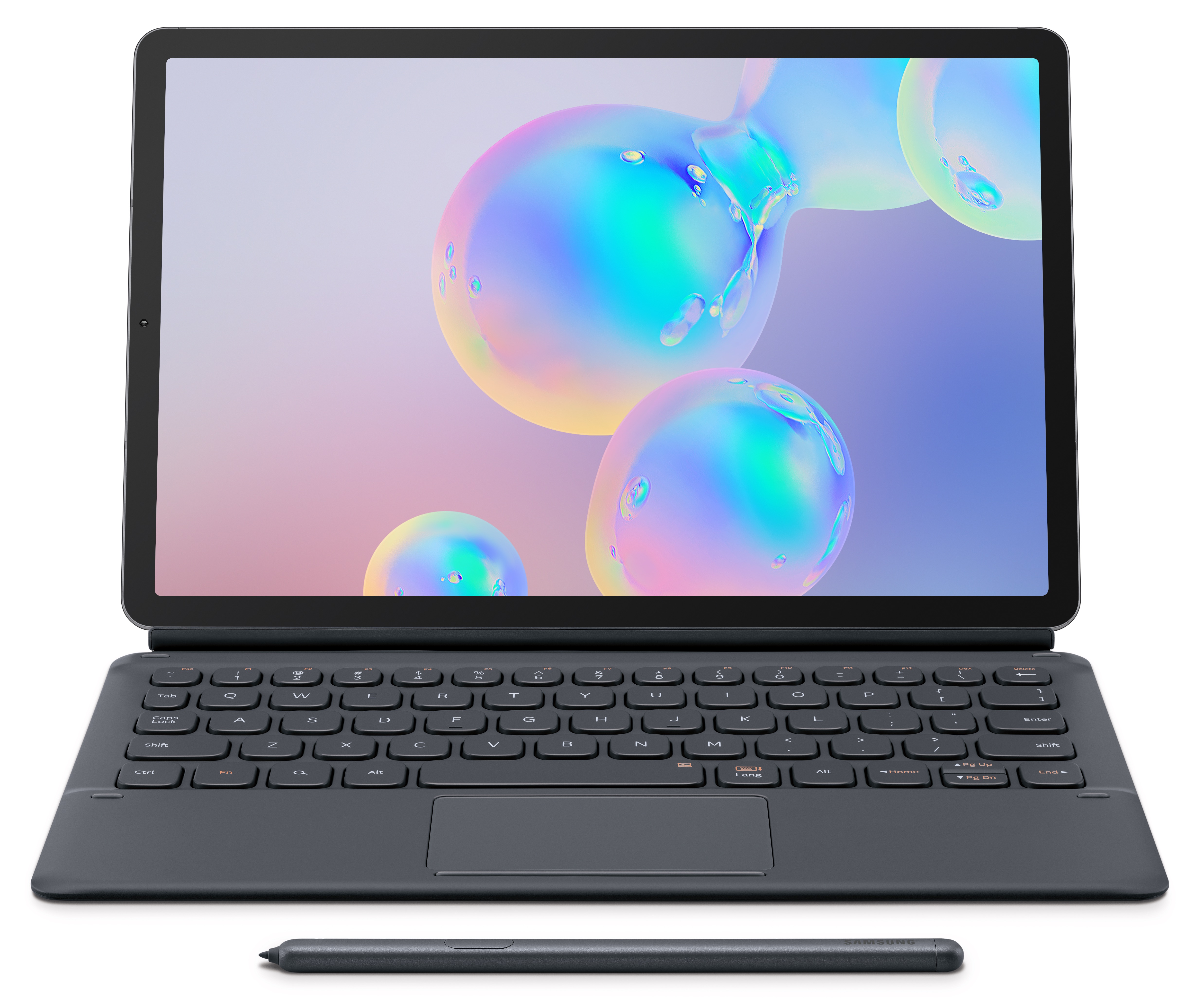
wifi sm t860 tab s 6 bk keyboard open s pen rgb

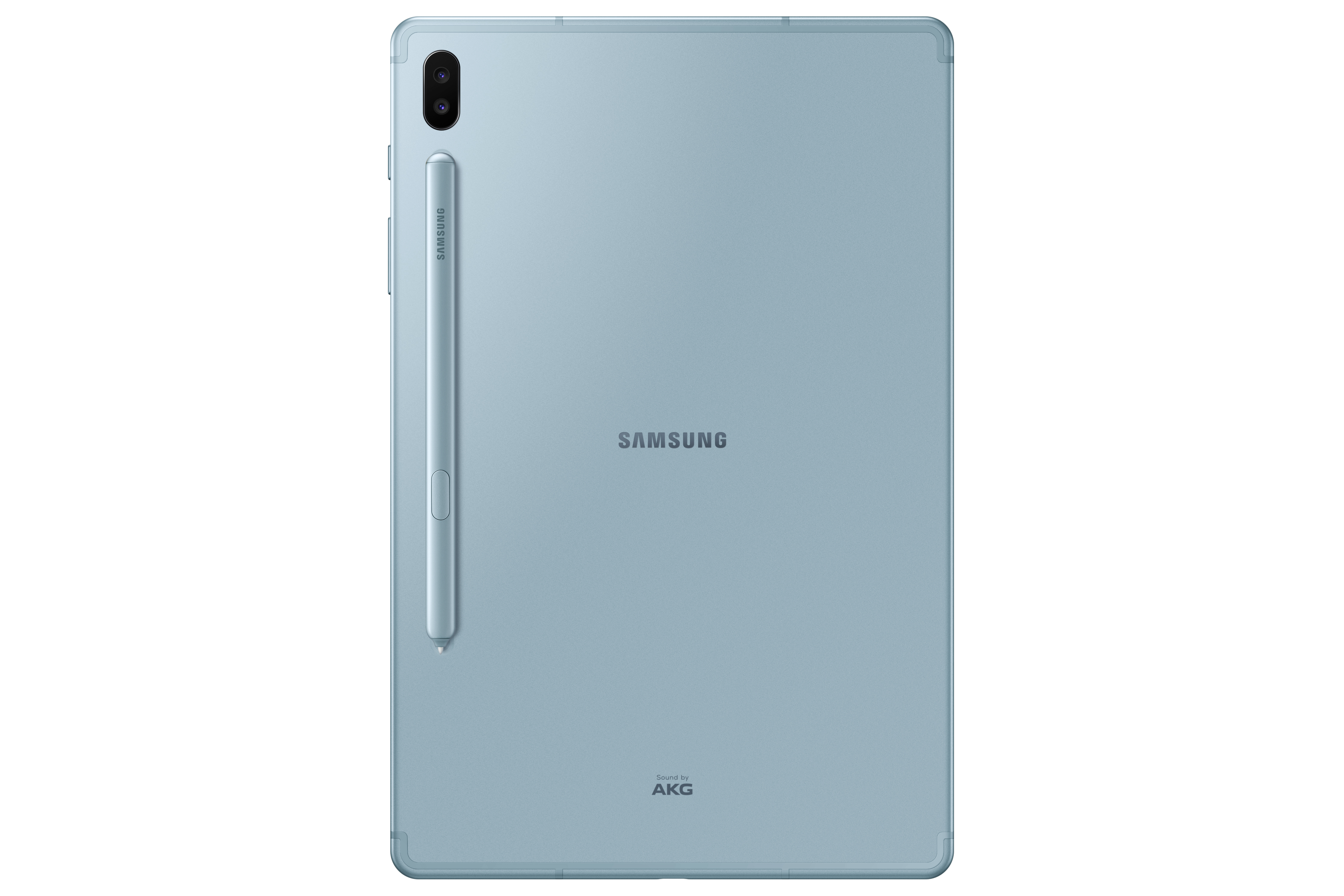
The S Pen comes standard — a nice touch, especially for the $649 price point. Mind you, that’s already a few hundred bucks cheaper than the entry level iPad Pro. The stylus charges wireless, attaching magnetically to the rear of the device, so you’re less likely to misplace it. And, more importantly, won’t accidentally break the whole thing by sticking it in backwards — truly the most humiliating of defeats.

The magnetic connection is pretty weak, compared to the iPad Pro’s sides. Though the new case has a clever concave slot for the S Pen, helping it stay in place while on. I also didn’t love the feel of the S4’s keyboard, so I’m happy to see what’s new there.

The S Pen does your standard array of stylus things, and as with the Note line, Samsung is working to make it more of a kitchen sink productivity accessory. That includes the ability to use it as a kind of bluetooth remote for advancing slide presentations and snapping videos and taking selfies. According to Samsung, people taking photos with tablets is very much a thing, and you might as well get used to it.

In fact, the rear camera actually gets an overhaul here. Samsung’s gone dual camera with a wide lens — noting that the S6 is its first tablet to offer that functionality. The wide angle lens offers a 123 degree angle — roughly the equivalent of what the human eye offers. As with other mobile devices from the company, AI is doing a lot of the heavy lifting to ensure you get better shots, offering scene optimization with the built-in Neural Processing Unit.

One thing the S6 offers that the iPad Pro (and for that matter, the iPhone) doesn’t is an on-screen fingerprint reader. It’s an optical scanner, however, instead of the ultrasonic offered on the Galaxy S10 (and, one assumes, the forthcoming Note 10). Samsung says the less advanced scanner was a matter of space issues — an odd concern, given the much larger real estate we’re dealing with here.
Product Image Galaxy Tab S6 4

Speaking of real estate, that’s a 10.5 inch Super AMOLED display and a fairly slim 5.7 millimeter body — thinner and lighter than the S4. The multimedia offering is filled out with a quartet of Dolby Atmos speakers tuned by Samsung’s own AKG.

Samsung continues to push DeX as a key part of its workflow. In fact, there’s now a DeX function key right on the case’s keyboard. DeX offers a more desktop like software experience on the table for improved multitasking. Now you can do stuff like opening multiple windows from the same app — bringing it more inline with what Apple is trying to do with iPadOS.

The company’s also partnered with Discord for an exclusive desktop Game Launcher — not doubt in a bid to offer something inline with Apple’s forthcoming Arcade. The Discord dealie is coming to Samsung tablets next month.

Preorders on the WiFi unit start August 23, starting at $649 for a unit with 6GB of RAM and 128GB of storage. Another $80 will get you a version with 8GB of RAM and double the storage. Early preorders will get the keyboard cover for half off when bundled with the tablet. There’s also an LTE model coming later this year.


31 Jul 2019

Security lapse exposed weak points on Honda’s internal network

An exposed database at automotive giant Honda allowed anyone to see which systems on its network were vulnerable to unpatched security flaws, potentially giving hackers insider knowledge of the company’s weak points.

The server contained 134 million rows of employee systems data from the company’s endpoint security service, containing technical details of each computer and device connected to the internal network.

There was no password on the database, allowing anyone to access and read the data.

The data included which operating system a user was running, its unique network identifiers and IP address, the status of the endpoint protection, and which patches were installed. That could allow an attacker to figure out which systems are at risk of certain vulnerabilities, or tailor attacks towards machines of interest using exploits known to target vulnerable devices. (We’re not naming the endpoint provider as it could prove useful for an attacker.)

In some cases the database would reveal the endpoint security status — including if a device was unprotected.

Security researcher Justin Paine found the exposed database earlier this month. He wrote up his findings and shared them exclusively with TechCrunch. The database was shut down hours after he made contact with the company.

“I thought this was a likely to be just a single Honda dealership,” Paine told TechCrunch. “The odds of that seemed far more likely than a database containing information related to all of Honda’s global network of employee machines.”

The database contained records on multiple Honda offices around the world, including Mexico, the U.K. and the U.S., said Paine.

He also found the chief executive’s computer in the logs, including which operating system he uses, the patches installed, and more. The records also included his email address and the last time he logged on.

“What makes this data particularly dangerous in the hands of an attacker is that it shows you exactly where the soft spots are,” said Paine. “This data contained enough identifiable information to make it extremely simple to locate specific high value employees and in the hands of an attacker this leaked data could be used to silently monitor for ways to launch very targeted attacks on those executives,” he said.

When reached prior to publication, Honda spokesperson Marcos Frommer did not comment.

It’s the latest find by Paine in recent months. Earlier this year he found a huge database of call logs and SMS messages exposed on the internet, and also the viewing habits of a library and university streaming service.

Read more:

31 Jul 2019

Porsche Digital expands U.S. presence beyond Silicon Valley with new Atlanta office

Porsche Digital, the subsidiary of carmaker Porsche, is opening its second U.S. location, after launching its first in 2017 in Silicon Valley. The second North American office for this software and digital product-focused wing of Porsche will open in Atlanta, which is also the seat of Porsche’s North American cars business. Porsche Digital cited proximity to their auto business headquarters as one reason why they picked Atlanta, but also pointed to Atlanta’s “local tech talent” and “robust and constantly growing startup and tech sector” as key factors in its selection.

The need for a second office is specifically about serving the U.S. market, Porsche Digital notes and the company expects to have 45 employees total in the U.S. across both offices within the next year. The subsidiary overall has 120 employees worldwide, with offices in Berlin, Shanghai, and Tel Aviv as well as the U.S.

Porsche Digital does focus on creating software and digital products for the automaker’s customers, but it’s actually probably more valuable to its parent company as a sort of distributed tech talent scouting and business development arm of the company. Its offices definitely occupy global hotspots when it comes to startup tech companies, and having a permanent presence in this locations has got to come in handy when looking to attract engineering talent and potential acquisitions of complimentary early-stage companies.

31 Jul 2019

Jamf acquires Digita Security to gain native Mac security

Jamf has been widely known as an enterprise Mac deployment and management tool company, but it has been looking for ways to expand beyond those core capabilities. One thing it heard from customers was that there was a dearth of native Mac security tools. It checked that box today, announcing it has acquired Digita Security, a startup with a native Mac security suite. The two companies did not reveal the purchase price.

Digita, a two-year old startup, was founded by a team of security experts led by Patrick Wardle, whose background includes a decade as a Mac security researcher, seeking out vulnerabilities on the Mac, and time at the NSA where he honed his security research skills.

Wardle says that because of the relatively low Mac marketshare, many traditional security vendors haven’t paid close attention, which can lead to trouble. “Mac marketshare is somewhat limited, maybe around 10%. So the average company is not going to spend a lot of time and resources developing Mac-specific capabilities,” he said.

“From the hacker’s point of view, this is great news, because their backdoor implants are generally not going to be detected by traditional tools. What I’ve been working on the last few years, and then most recently at Digita Security, is creating a system that is Mac specific, that leverages Mac-specific and Apple-specific frameworks and technologies,” he added.

The Digita Suite consists of three main tools. It takes advantage of and enhances XProtect, the Mac’s built-in malware detection system with a tool called UXProtect, that provides a valuable missing front end to the tool. It also offers a Mac laptop security tool called Do Not Disturb that sends you message if someone tries to access your laptop without permission, and finally it offers a tool called Gameplan, a heuristic-based malware detection system.

Jamf plans to continue to market the Digita toolset as a set of stand-alone package for the time being, while taking advantage of the Jamf policy engine when it makes sense, according to company CEO Dean Hagar. “With Digita, we’re going to be able to bring a whole solution to our customers, In addition to leaving Digita as a solution that can be offered on its own, we will be able to complete that journey for our customers by being able to monitor and hunt for threats and apply security policy,” Hagar told TechCrunch.

The deal has closed and the five Digita Security employees are now part of the Jamf security team. Having a security tool like this in the fold could help make companies more comfortable deploying Macs by giving security teams the tools they need to monitor and defend them, which could in turn expand Mac usage in the enterprise.

31 Jul 2019

Vizio rolls out its Apple AirPlay and HomeKit integrations to its SmartCast TV platform

Ahead of Apple launching its big video streaming initiative Apple TV+ this autumn, a integration is going live today that brings Apple closer to working with third-party TV makers and making its services available on a wider array of devices. Today Vizio said it would start to roll out support for AirPlay2 and HomeKit to its SmartCast TV sets, making it possible to stream video and other media from Apple devices to its TVs and control the sets using Apple’s Home app and through its Siri voice assistant.

The support is coming by way of an over-the-air update to SmartCast 3.0, the system that underpins Vizio’s smart TVs. Notably, using the Apple services will not necessarily mean buying new Vizio TVs: the service is backwards compatible to TVs dating back to 2016. New sets range in prices from $259.99 to $3,499.99.

“SmartCast 3.0 is full of added value for VIZIO customers. With both AirPlay 2 and HomeKit support, users can now share movies, TV shows, music and more from their favorite apps, including the Apple TV app, directly to SmartCast TVs, and enable TV controls through the Home app and Siri,” said Bill Baxter, Chief Technology Officer, VIZIO. “We are thrilled to offer an even more compelling value proposition to our users with a smart TV experience that supports all three major voice assistants. This broad range of compatibility enables VIZIO SmartCast to seamlessly integrate into any household with Siri, Google Assistant or Alexa – giving users more ways to sit back and enjoy the entertainment they love.” Vizio still appears to be the only smart TV maker that’s offering support on its sets for all of the major voice assistants.

Vizio’s integration for Apple’s media services was first announced in January at CES, when Vizio said it would be getting actually rolled out later in the year.

The news was notable at the time for a couple of reasons. First, it underscored how Vizio was stepping up its growth efforts after a tough couple of years involving lawsuits, regulatory investigations and a failed M&A attempt.

Second, it was part of a bigger theme of Apple branching out into a wider consumer electronics ecosystem for its push into the world of TV and video. The latter still stands in stark contrast to Apple’s approach around smartphones, computers and watches, where it has spent years building hardware, operating systems and walled gardens.

That’s a story that is still playing out. The timing of the Vizio news is notable given that it’s just one day after Apple’s quarterly earnings report, where the company revealed a solid quarter that beat analyst expectations but also continued to show slowing growth, largely on the back of an ongoing decline in unit sales for the iPhone (amid a similar, bigger market trend for smarphones overall). To offset that story, Apple has been working hard to build new product categories in newer hardware areas like wearables (the Apple Watch) and smart home hubs (HomePod), and Services, which includes Apple’s efforts in areas like video and music (

Services came in at $11.455 billion — missing analysts expections but still growing 13% on a year ago. The promise — or perhaps more accurately, the hope — is that adding TV and gaming into the mix later in the year will boost that even more. This is where integrations such as the one getting announced today with Vizio will fit in: they will help expand the number of people who might be using the services, and of course the number of screens where the content can be consumed.

Vizio does not specify how many sets it currently has in the market — last number it gave me earlier in the year was “millions” — but it generally is behind Samsung, which currently leads in the smart TV category.

It notes that the service will work by way of tapping an AirPlay icon within SmartCast to be able to stream 4K and Dolby VisionTM HDR movies and TV shows from Apple TV, along with other AirPlay-compatible video apps. Mirroring (which you can also do with non-smart TVs) will also be supported. AirPlay 2 also lets users play content across multiple rooms (provided you have the sets, HomePods or other AirPlay 2 speakers installed).

31 Jul 2019

Spotify hits 108M paying users and 232M overall, but its average revenue per user declines

Spotify added 8 million subscribers in the quarter that ended in June, slightly below the estimated 8.5 million figure, the streaming giant reported today.

The top music streamer said it had amassed 232 million monthly active users and 108 million paying subscribers at the end of June, up from 217 million users and 100 million subscribers in the quarter that ended in March. Monthly active users include paying subscribers and non-paying users.

“We missed on subs… That’s on us,” the company said.

Paying subscribers count includes users who are enjoying the 30-day trial Spotify offers. Additionally, Spotify recently kickstarted a biannual campaign, which offered customers access to the premium service for $1. This, among other factors, pushed its average revenue per user to €4.86 ($5.42) — down 1% since last quarter — the company said, adding that it expects the decline to continue in the low single digits for the rest of the year.

In comparison, Apple Music had 60 million paying subscribers as of June this year. (This also includes users who are part of Apple Music’s three-month free trial.)

On the business side, Spotify said its quarterly revenue rose 31% (from the same period last year) to $1.86 billion, while operating expenses increased 4%. Its operating loss narrowed to $3.34 million, the company said — better than estimations of analysts who expected Spotify to lose about $62 million on sales of $1.83 billion.

Additionally, Spotify revealed that it has reached an agreement with two of the four major record labels for licenses and is in active talks with the other two. It did not identify the labels.

Spotify’s future profits will depend on how its existing margins change with the music labels. Bulk of the revenue Spotify generates, it has to pay them to music labels. Every few years, the company has to renew its agreements with them.

The music streaming service, which has ramped up its podcast offerings with the acquisition of Gimlet Media, Anchor and Parcast, said its podcast audience is up 50% since the last quarter. Barry McCarthy, CFO of Spotify, said the company is still open to acquiring more podcasting businesses.

31 Jul 2019

Spotify hits 108M paying users and 232M overall, but its average revenue per user declines

Spotify added 8 million subscribers in the quarter that ended in June, slightly below the estimated 8.5 million figure, the streaming giant reported today.

The top music streamer said it had amassed 232 million monthly active users and 108 million paying subscribers at the end of June, up from 217 million users and 100 million subscribers in the quarter that ended in March. Monthly active users include paying subscribers and non-paying users.

“We missed on subs… That’s on us,” the company said.

Paying subscribers count includes users who are enjoying the 30-day trial Spotify offers. Additionally, Spotify recently kickstarted a biannual campaign, which offered customers access to the premium service for $1. This, among other factors, pushed its average revenue per user to €4.86 ($5.42) — down 1% since last quarter — the company said, adding that it expects the decline to continue in the low single digits for the rest of the year.

In comparison, Apple Music had 60 million paying subscribers as of June this year. (This also includes users who are part of Apple Music’s three-month free trial.)

On the business side, Spotify said its quarterly revenue rose 31% (from the same period last year) to $1.86 billion, while operating expenses increased 4%. Its operating loss narrowed to $3.34 million, the company said — better than estimations of analysts who expected Spotify to lose about $62 million on sales of $1.83 billion.

Additionally, Spotify revealed that it has reached an agreement with two of the four major record labels for licenses and is in active talks with the other two. It did not identify the labels.

Spotify’s future profits will depend on how its existing margins change with the music labels. Bulk of the revenue Spotify generates, it has to pay them to music labels. Every few years, the company has to renew its agreements with them.

The music streaming service, which has ramped up its podcast offerings with the acquisition of Gimlet Media, Anchor and Parcast, said its podcast audience is up 50% since the last quarter. Barry McCarthy, CFO of Spotify, said the company is still open to acquiring more podcasting businesses.