Year: 2019

30 Jul 2019

Inside the history of Silicon Valley labor, with Louis Hyman

As I wrote for TechCrunch recently, immigration is not an issue always associated with tech — not even when thinking about the ethics of technology, as I do here.

So when I was moved to tears a few weeks ago, on seeing footage of groups of 18 Jewish protestors link arms to block the entrances to ICE detention facilities, bearing banners reading “Never Again” in reference to the Holocaust — these mostly young women risking their physical freedom and safety to try to help the children this country’s immigration service is placing in concentration camps today, one of my first thoughts was: I can’t cover that for my TechCrunch column. It’s about ethics of course, but not about tech.

It turns out that wasn’t correct. Immigration is a tech issue. In fact, companies such as Wayfair (furniture), Amazon (web services), and Palantir (the software used to track undocumented immigrants) have borne heavy criticism for their support of and partnership with ICE’s efforts under the current administration.

And as I discussed earlier this month with Jaclyn Friedman, a leading sex ethics expert and one of the ICE protestors arrested in a major demonstration in Boston, social media technology has been instrumental in building and amplifying those protests.

But there’s more. IBM, for example, has an unfortunate and dark history of support for Nazi extermination efforts, and many recent commentators have drawn parallels between what IBM did during the Holocaust and what companies like Palantir are beginning to do now.

Dozens of protestors huddle in the rain outside Palantir HQ.

I say “companies,” plural, with intention: immigrant advocacy organization Mijente recently released news that Anduril, the company founded by Palmer Luckey and composed of Palantir veterans, now has a $13.5 million contract with the Marine corps for their autonomous surveillance “Lattice” towers at four different USMC bases, including one border base. Documents procured via the Freedom of Information Act show the Marines mention “the intrusion dilemma” in their justification for choosing Anduril.

So now it seems the kinds of surveillance tech we know are badly biased at best — facial recognition? Panopticon-style observation? Algorithms of various other kinds — will be put to work by the most powerful fighting force ever designed, for expanded intervention into our immigration system.

Will the Silicon Valley elite say “no”? To what extent will new protests emerge, where the sorts of people likely to be reading this writing might draw a line and make work more difficult for their peers at places like Anduril?

Maybe the problem, however, is that most of us think of immigration ethics as an issue that might touch on a small handful of particularly libertarian-leaning tech companies, but surely it doesn’t go beyond that, right? Can’t the average techie in San Francisco or elsewhere safely and accurately say these problems don’t actually implicate them?

Turns out that’s not right either.

Which is why I had to speak this week with Cornell University historian Louis Hyman. Hyman is a Professor at Cornell’s School of Industrial and Labor Relations, and Director of the ILR’s Institute for Workplace Studies, in New York. In our conversation, Hyman and I dig into Silicon Valley’s history with labor rights, startup work structures and the role of immigration in the US tech ecosystem. Beyond that,  I’ll let him introduce himself and his extraordinary work, below.

image1 4

Louis Hyman. (Image by Jesse Winter)

Greg Epstein: I discovered your work via a piece you wrote in the Washington Post, which drew from your 2018 book, Temp: How American Work, American Business, and the American Dream Became Temporary. In it, you wrote, “Undocumented workers have been foundational to the rise of our most vaunted hub of innovative capitalism: Silicon Valley.”

And in the book itself, you write at one point, “To understand the electronics industry is simple: every time someone says “robot,” simply picture a woman of color. Instead of self-aware robots, workers—all women, mostly immigrants, sometimes undocumented—hunched over tables with magnifying glasses assembling parts, sometimes on a factory line and sometimes on a kitchen table. Though it paid a lot of lip service to automation, Silicon Valley truly relied upon a transient workforce of workers outside of traditional labor relations.”

Can you just give us a brief introduction to the historical context behind these kinds of comments?

Louis Hyman: Sure. One of the key questions all of us ask is why is there only one Silicon Valley. There are different answers for that.

30 Jul 2019

Apple, Microsoft and Google to test new standard for patient access to digital health data

A newly released data model and draft implementation guide for providing digital access to historical health insurance claims data directly to patients could mean you have better access to this info from the devices you use everyday. Called the CARIN Blue Button API, it’s a new model developed by private sector partners including consumer organizations, insurance providers, digital health app developers and more, this new draft implementation will be in testing beginning this year, with participating companies including a number of different state-specific BlueCross/BlueShield providers, the State of Washington – and Apple, Google and Microsoft.

The news was announced today at the White House Blue Button Developers Conference in Washington D.C., and builds on the work done last year by the Centers for Medicare and Medicaid Services to launch Blue Button 2.0, a new standard aimed at providing Medicare beneficiaries in the U.S. access to all of their historical claims information in one place from whatever application they choose to use.

All of the organizations participating in the draft testing process will perform “real-world testing” of the CARIN model developed by the multi-disciplinary working group, with the aim of preparing for a broad, product launch of the data standard in 2020.

Seeing Apple, Google and Microsoft on that list along with a significant number of health care providers is a good sign, since it should mean more data portability and choice when it comes to how you access your own patient information, rather than it being decided on a platform-by-platform basis.

Apple already built a Health Records section into its own native Health app in iOS at the beginning of last year, and while it works with standards sometimes adopted by health care providers, it’s far from a universal, truly interoperable health care history feature on its own. Apple has been building partnerships with agencies and providers including Veterans’ Affairs and Aetna to flesh out its personal health data offering for users, and Microsoft has its own health records offering called HealthVault.

30 Jul 2019

Ford acquires software company Journey Holding

Ford has agreed to acquire Journey Holding Corporation, a company that has developed vehicle tracking software and app-based technology designed for public transportation, as the automaker seeks to scale up its new mobility business.

Journey Holding will be housed under Ford Smart Mobility, a Ford subsidiary that invests in and builds the automaker’s transportation services. Terms of the deal were not disclosed. In a separate announcement, Ford said Tuesday it acquired Quantum Signal, a small robotics company and defense contractor known for mobile robotics and real-time simulation.

The acquisition of Journey is part of broader vision laid out by CEO Jim Hackett more than a year ago to create an ecosystem of transportation-related services that people and cities need now and in the future. The Journey acquisition follows Ford’s purchase of Autonomic and Transloc in 2018.

Today, those services might include using an app to find a Ford-owned Spin scooter or schedule a bus or on-demand shuttle. In the future, it might include finding and hailing an autonomous vehicle.

Eventually, Journey will integrate into Transloc, a transit technology business that Ford bought in 2018. Transloc develops software that helps cities manage transit services including on-demand shuttles.

The name of the combined organization will be announced at a later date, Ford said.

Journey Holding Corporation was founded in 2018 through the merger of two companies, Indianapolis -based DoubleMap and Salt Lake City-based Ride Systems. Journey offers software to municipalities, universities and corporations to help manage their fleets. It also has developed apps that lets users schedule or track rides on shuttles, buses and other public transit.

Transloc CEO Doug Kaufman will leave the new company on Aug. 16. Journey Holding CEO Justin Rees, who founded Ride Systems in 2007 with Kelly Rees and Ben Haynie, will lead the new company.

Together, this newly formed company of about 200 people will serve nearly 1,200 cities, universities, corporate campuses and other enterprises with software solutions for fixed route transportation, microtransit on-demand transportation and other related areas.

“The combination of these transit technology companies will accelerate our efforts to help cities deliver more seamless, productive, and accessible transportation solutions to their citizens and visitors,” Brett Wheatley, vice president of Ford Mobility’s marketing and growth division, said in a statement. “It also will be key to connecting customers with the other mobility solutions in our portfolio, such as Spin e-scooters and our GoRide Health service.”

These services should eventually be part the Transportation Mobility Cloud, an open cloud-based platform that Ford developed for cities to use to orchestrate and manage all the disparate transportation modes happening at any given time.

30 Jul 2019

Apple is hosting augmented reality art walking tours in major cities

Apple is combining two of long-standing major efforts in a new push, making AR more consumer-friendly and helping portray Apple Stores as civic centers where communities can come together.

The project is called [AR]T Walk and it’s a walking tour through various city centers around the globe aiming to help the digital art works of artists come alive in physical spaces. The tours are taking place in Hong Kong, London, New York, Paris, San Francisco and Tokyo through mid-August.

Showcasing digital art in geo-specific locations isn’t a new concept. In 2017, Snapchat debuted a partnership with Jeff Koons in Central Park, though the company had some issues with ensuring the tech worked reliably.

People looking to take part in the AR walking tours can sign up on Apple’s site. The tours seem to last a couple hours and involve a 1.5 mile walk. The artists behind the work are Nick Cave, Nathalie Djurberg and Hans Berg, Cao Fei, John Giorno, Carsten Höller and Pipilotti Rist.

30 Jul 2019

How the new ‘Lion King’ came to life

When I was told that I’d be visiting the production of Disney’s new version of the “Lion King,” I had a hazy idea of what to expect — sets recreating the iconic landscapes of the animated film, maybe some actors in costumes or motion capture suits.

Instead, if you’ve seen the movie (which came out on July 19) you probably aren’t surprised to hear that there wasn’t a single set or costume in sight. After all, even though the film looks like a live action remake of “The Lion King,” every shot except for the first was created on a computer.

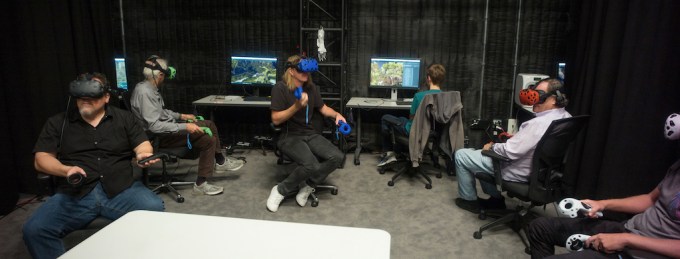
So what I visited in 2017 was a nondescript Los Angeles warehouse filled with computers. In the main room, almost everything was black — black padding on the walls, black VR headsets, black dolly tracks for the camera.

Director Jon Favreau explained to visiting journalists that the plan was to create a virtual Serengeti in the Unity game engine, and then apply live action filmmaking techniques to create the film, the “Lion King” team described this as a “virtual production process.”

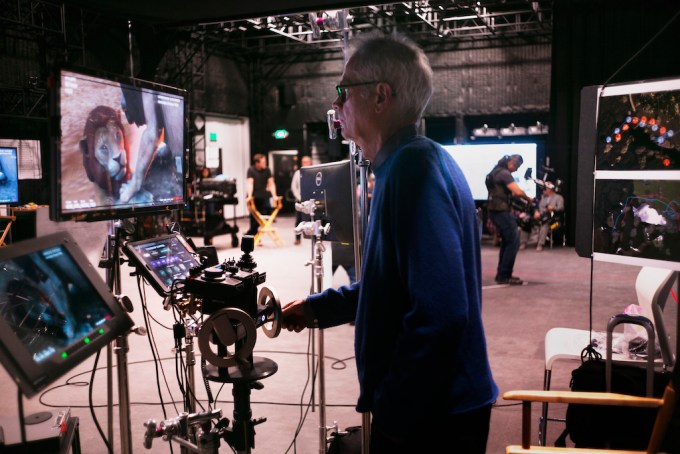
It started with a research trip to Kenya, with copious reference photos taken of the landscape and animals. Then the art department got to work creating sets — the aforementioned virtual Serengeti — which can be “filmed” by moving a real camera around the space (and the need for real-world camera equipment like dolly tracks). Those shots are then edited together and handed over to the effects team at MPC to create the images you see in the final film.

TLK Caleb OnTheWheels StdyCamInBG L1002485

THE LION KING – (Pictured) Caleb Deschanel. Photo by: Michael Legato.
© Disney Enterprises, Inc. All Rights Reserved.

“If you go back to ‘Avatar,’ ‘Avatar’ solved the problem of how do you film a movie that usually gets created with computer graphics, so we put computer graphics into the cinematographer’s monitor so that they could use more traditional equipment to see the movie” said virtual production supervisor Ben Grossman. “Fast forward to ‘Lion King’ and what we’re doing is we’re putting the filmmakers inside the monitor. So now, they can put on a VR Headset and be in Africa or on the Empire State Building or on the surface of the Moon, so that they can walk around and see and feel the filmmaking process … as though they were there.”

That doesn’t just involve VR and computer animation, Grossman added. There’s also significant use of artificial intelligence in the virtual sets and characters. For example, the filmmakers could create a 3D model of a lion, and then teach the AI so that the lion can act hungry, or cold, or as if it’s looking for food: “We start telling the computer things like that and then it starts to associate behaviors with motivations and intents.”

Ultimately, Grossman suggested that this could lead to a situation where filmmaking is less about traditional “filmmaking or storytelling,” and more about “world-building”: “You create a world where characters have personalities and they have motivations to do different things and then essentially, you can throw them all out there like a simulation and then you can put real people in there and see what happens.”

And while the technology side sounds quite sophisticated, everyone emphasized that the goal was to give the filmmakers the tools they needed to feel like they were making a live action film.

The Lion King

In fact, director of photography Caleb Deschanel (whose career has been focused on live action, with credits like “The Passion of the Christ” and “The Right Stuff”) described himself as “the Luddite in this group,” whose goal was to “try to make it feel as film-y as possible.”

“I remember reading about Brad Bird … who had directed a lot of animation, obviously, and then when he was directing live action, he got very frustrated ’cause he couldn’t do all these sort of crazy things,” Deschanel said. “And we’re going in the opposite direction and taking the tools of normal filmmaking and bringing them into our world, and using that as a method to create a reality.”

He acknowledged that working with the technology has been a learning process — so much so that he spoke wistfully about starting over again once they’d finished the movie, so that he could apply all the lessons he’d learned.

“I mean, when we did the canyon chase with the wildebeests early on, and we were filming and I was struggling with getting light where I wanted it,” he said. “And then, weeks later, I discovered: Well, if you don’t like the light there, we can take these mountains, we can just drop them down and get the sun coming through where you want it.”

All of this speaks to the extraordinary amount of thought and technology that went into making a movie in a new way. But it also dances around the most basic question: Why remake “The Lion King” at all?

TLK Leg 0735 CR

THE LION KING – (L-R) Jon Favreau, Caleb Deschanel, James Chinlund, Robert Legato and Andy Jones. Photo by: Michael Legato.
© Disney Enterprises, Inc. All Rights Reserved.

Favreau’s answer was that he wanted to take the story and themes that were so powerful in the original film (and in the subsequent Broadway musical), and then “create something that feels like a completely different medium than either of those two.”

The box office receipts offer another answer, with “The Lion King” on-track to become perhaps the highest grossing movie of the summer and one of the biggest hits of the year.

Critics haven’t been quite as impressed, complaining that the “realistic” approach hampers the emotional expressiveness of the animals (not to mention the imagination and energy of the musical numbers). It seems that many of them found themselves asking: Why go to all the effort to take such a fantastical story and then to tell it in a photo-real way?

Back during the set visit, VFX Rob Legato said studio heads were asking something similar, namely: “Why would you go through the great expense to have everything under your control and then take your control away on purpose?”

The point, Legato argued, is to be true to “the artist’s idea” of creating a movie that “looks like a film” but could never be shot in real life. And his hope is that when audiences watch the new “Lion King,” they don’t see visual effects — similar to how most people don’t watch “The Godfather” and think “great sets, great costumes, interesting light.” Instead, “You just watch the film. You don’t really pick apart one of the disciplines, you just enjoy it.”

He added, “My viewpoint is, it’s not a visual effect anymore, if it’s just moviemaking.”

30 Jul 2019

LG’s smartphone sales dropped another 21%

Let’s start with the good news. LG actually had a pretty good quarter (on the strength of appliance sales). The LG Home Appliance & Air Solution division made $5.23 billion for Q2. Anyone who’s been following the company for the past several years can guess where the bad news comes.

Smartphone sales dipped 21.3% year over year for the South Korean company. The culprits are as you’d expect: an overall slowing of the smartphone market, coupled with aggressive undercutting from Chinese manufacturers. Huawei seems to lead the pack on that front, with a big increase in sales, in spite of a confluence of external factors.

The smartphone unit saw an operating loss of $268.4 million, in spite of a 6.8% increase in sales from the quarter prior. LG chalks up the loss to higher marketing on new models and April’s move from Seoul to Vietnam for smartphone production for longer-term cost cutting.

In spite of this, the company says it’s still bullish about smartphone sales for Q3. “The introduction of competitive mass-tier smartphones and growing demand for 5G products are expected to contribute to improved performance in the third quarter,” it writes in an earnings release.

LG is, of course, among the first companies to release a 5G handset, with the V50 ThinQ. The next-gen wireless technology is expected to increase stagnating global smartphone sales, though much of that will depend on the speed with which carriers are able to roll it out. It seems unlikely that 5G in and of itself will be a quick or even longer-term fix for a struggling category.

30 Jul 2019

Ford acquires mobile robotics company Quantum Signal to help with self-driving

Ford has acquired a small robotics company based in Michigan called Quantum Signal, which has produced mobile robots for a number of clients, including the U.S. military. The company’s speciality has been building remote control software for robotic vehicles, specifically, and its also responsible for a very highly-regarded simulated testing and development environment for autonomous and remotely-controlled robotic systems.

All of the above is useful not only when developing military robots, but also when setting out to build and deploy self-driving cars – hence Ford’s interest in acquiring Quantum Signal. Ford said in a blog post that while others might’ve been sleeping on Quantum Signal and the work its done, it has been following the company closely, and will employ its experience in developing real-time simulation and algorithms related to autonomous vehicle control systems to help build out Ford’s self-driving vehicles, transportation-as-a-service platform, and both hardware and software related to both.

Reading between the lines here, it sounds like Ford’s main interest was in picking up some experienced talent working on autonomy, and very specific challenges that are needed to develop road-worth self-driving vehicles, including perception systems and virtual testing environments. Ford does however explicitly lay out a desire to “preserve” Quantum’s own “unique culture” as it brings the company on board, pointing out that that’s the course it took with similar acquisition SAIPS (an Israeli computer vision and machine learning company) when it brought that team onboard in 2016.

SAIPS has now more than doubled its team to 30 people, and relocated to a new headquarters in Tel Aviv, with a specific focus among its latest higher on bringing in specialists in reinforcement learning. Ford has also invested in Argo AI, taking a majority stake in the startup initially in 2017 and then re-upping with a joint investment with Volkswagen in July of this year in a deal that makes both major equal shareholders. It’s Ford is happy to both acquire and partner in its pursuit of self-driving tech development, and this probably won’t be the last similar deal we see made en route to actually deploying autonomous vehicles on roads for any major automaker.

30 Jul 2019

DigitalOcean gets a new CEO and CFO

DigitalOcean, the cloud infrastructure service that made a name for itself by focusing on low-cost hosting options in its early days, today announced that it has appointed former SendGrid COO and CFO Yancey Spruill as its new CEO and former EnerNOC CFO Bill Sorenson as its new CFO. Spruill will replace Mark Templeton, who only joined the company a little more than a year ago and who had announced his decision to step down for personal reasons in May of this year.

DigitalOcean is a brand I’ve followed and admired for a while — the leadership team has done a tremendous job building out the products, services and, most importantly, a community, that puts developer needs first,” said Spruill in today’s announcement. “We have a multi-billion dollar revenue opportunity in front of us and I’m looking forward to working closely with our strong leadership team to build upon the current strategy to drive DigitalOcean to the company’s full potential.”

Spruill das have a lot of experience, given that he was in CxO positions at SendGrid through both its IPO in 2017 and its sales to Twilio in 2019. He also previously held the CFO role at DigitalGlobe, which he also guided to an IPO.

In his announcement, Spruill notes that he expects DigitalOcean to focus on its core business, which currently has about 500,000 users (though it’s unclear how many of those are active, paying users). “My aspiration is for us to continue to provide everything you love about DO now, but to also enhance our offerings in a way that is meaningful, strategic and most helpful for you over time,” he writes.

Spruill’s history as CFO includes its fair share of IPOs and sales, but so does Sorenson’s. As CFO at EnerNOC, he guided that company to a sale to investor Enel Group. Before that, he led business intelligence firm Qlikto an IPO.

It’s not unusual for incoming CEOs and CFO’s to have this kind of experience, but it does make you wonder what DigitalOcean’s future holds in store. The company isn’t as hyped as it once was and while it still offers one of the best user experiences for developers, it remains a relatively small player in the overall cloud game. That’s a growing market, but the large companies — the ones that bring in the majority of revenue — are looking to Amazon, Microsoft and Google for their cloud infrastructure. Even a small piece of the overall cloud pie can be quite lucrative, but I think DigitalOcean’s ambitions go beyond that.

30 Jul 2019

DigitalOcean gets a new CEO and CFO

DigitalOcean, the cloud infrastructure service that made a name for itself by focusing on low-cost hosting options in its early days, today announced that it has appointed former SendGrid COO and CFO Yancey Spruill as its new CEO and former EnerNOC CFO Bill Sorenson as its new CFO. Spruill will replace Mark Templeton, who only joined the company a little more than a year ago and who had announced his decision to step down for personal reasons in May of this year.

DigitalOcean is a brand I’ve followed and admired for a while — the leadership team has done a tremendous job building out the products, services and, most importantly, a community, that puts developer needs first,” said Spruill in today’s announcement. “We have a multi-billion dollar revenue opportunity in front of us and I’m looking forward to working closely with our strong leadership team to build upon the current strategy to drive DigitalOcean to the company’s full potential.”

Spruill das have a lot of experience, given that he was in CxO positions at SendGrid through both its IPO in 2017 and its sales to Twilio in 2019. He also previously held the CFO role at DigitalGlobe, which he also guided to an IPO.

In his announcement, Spruill notes that he expects DigitalOcean to focus on its core business, which currently has about 500,000 users (though it’s unclear how many of those are active, paying users). “My aspiration is for us to continue to provide everything you love about DO now, but to also enhance our offerings in a way that is meaningful, strategic and most helpful for you over time,” he writes.

Spruill’s history as CFO includes its fair share of IPOs and sales, but so does Sorenson’s. As CFO at EnerNOC, he guided that company to a sale to investor Enel Group. Before that, he led business intelligence firm Qlikto an IPO.

It’s not unusual for incoming CEOs and CFO’s to have this kind of experience, but it does make you wonder what DigitalOcean’s future holds in store. The company isn’t as hyped as it once was and while it still offers one of the best user experiences for developers, it remains a relatively small player in the overall cloud game. That’s a growing market, but the large companies — the ones that bring in the majority of revenue — are looking to Amazon, Microsoft and Google for their cloud infrastructure. Even a small piece of the overall cloud pie can be quite lucrative, but I think DigitalOcean’s ambitions go beyond that.

30 Jul 2019

Special offer: discounted hotels and flights for Disrupt SF 2019

Disrupt San Francisco 2019 takes place on October 2-4, and we’re working every angle to make it financially accessible to as many people as possible. It starts with early-bird pricing on four types of passes for different needs and budgets. Plus, we offer discounts for students, nonprofit organizations, government employees and military personnel.

But did you know you can score discounted rates on flights and hotels for your Disrupt adventure? Yup. United Airlines offers Disrupt SF attendees discounted fares on flights to San Francisco International Airport or San Jose International Airport. Head on over to United.com and book your flight under “Advanced Search” using offer code ZFWZ101320. It’s an easy way to save.

Whether it’s just you or your entire team, you can reserve discounted hotel rooms through room blocks TechCrunch has secured at multiple hotels throughout the City by the Bay. Many of the hotels also offer special perks, including free Wi-Fi and gym access, when you book through this website. Your extras may vary depending on which hotel you choose. The supply of rooms is limited, so get booking!

Once you have your Disrupt pass and your travel reservations well in hand, you can start strategizing to make the most of your time at Disrupt SF — three short days packed with early-startup programming across four stages.

Whether on the Main stage, the Extra Crunch stage, on a panel or during a fireside chat, Disrupt speakers represent an impressive range of expertise. We’re talking up-and-coming boundary-pushers to the top players in the startup world — iconic technologists, investors and founders.

Witness the glory that is Startup Battlefield, TechCrunch’s epic pitch competition. Watch as the world’s most innovative startups launch and compete for the Disrupt Cup, investor and media love and, of course, $100,000.

Explore and network your way through Startup Alley, where you’ll find more than 1,200 startups and sponsors displaying products, platforms and services spanning the tech spectrum. While you’re there, be sure to visit the TC Top Picks, our hand-picked cadre of outstanding startups.

Want a tool that cuts through the crowds to help you meet the people who can help move your business forward? Then use CrunchMatch, the free business match-making service. It makes networking easier than ever.

Grab your discounts, people, and join us at Disrupt San Francisco 2019 on October 2-4. Buy your early-bird passes today, and then book your discounted flights and hotel rooms before they all disappear.

Is your company interested in sponsoring or exhibiting at Disrupt San Francisco 2019? Contact our sponsorship sales team by filling out this form.