Year: 2019

23 Jul 2019

Huawei cuts 600 jobs from its US research wing after being blacklisted

Huawei this week cut 600 positions from its Futurewei Technologies U.S. research arm, which operates out of Silicon Valley, Chicago, Washington State and Dallas. The move, which represents 70 percent of the division’s 850 roles, follows the hardware giant’s blacklisting by the U.S. government.

Reuters initially reported the news via a source from the company who noted that work has been more or less nonexistent for the branch for more than two months. “On the 17th of May, Huawei asked everyone at Futurewei to upload everything to the Huawei cloud, right before the ban took effect,” the source told the agency. “After that basically Futurewei has stopped doing any work — almost stopped everything.”

Huawei has since acknowledged the move, writing, “Futurewei Technologies announces a reduction in force, directly impacting over 600 US positions.”

The research wing has played a keyl role in filing thousands of patents for Huawei, including ones relating to 5G. That network technology has been at the center of recent concerns in the U.S., as red flags have been raised around Huawei’s networking equipment and potential ties to the Chinese government.

Huawei’s addition to the U.S. Commerce Department’s “entity list” has already had wide ranging impacts on the company that could ultimately prove hugely detrimental, banning access to essential technologies from American companies like Google and international component makers like ARM.

Earlier this week, another report surface tying Huawei to North Korea’s 3G network, a move that could potentially be in violation of U.S. sanctions against the country.

23 Jul 2019

Google updates its speech tech for contact centers

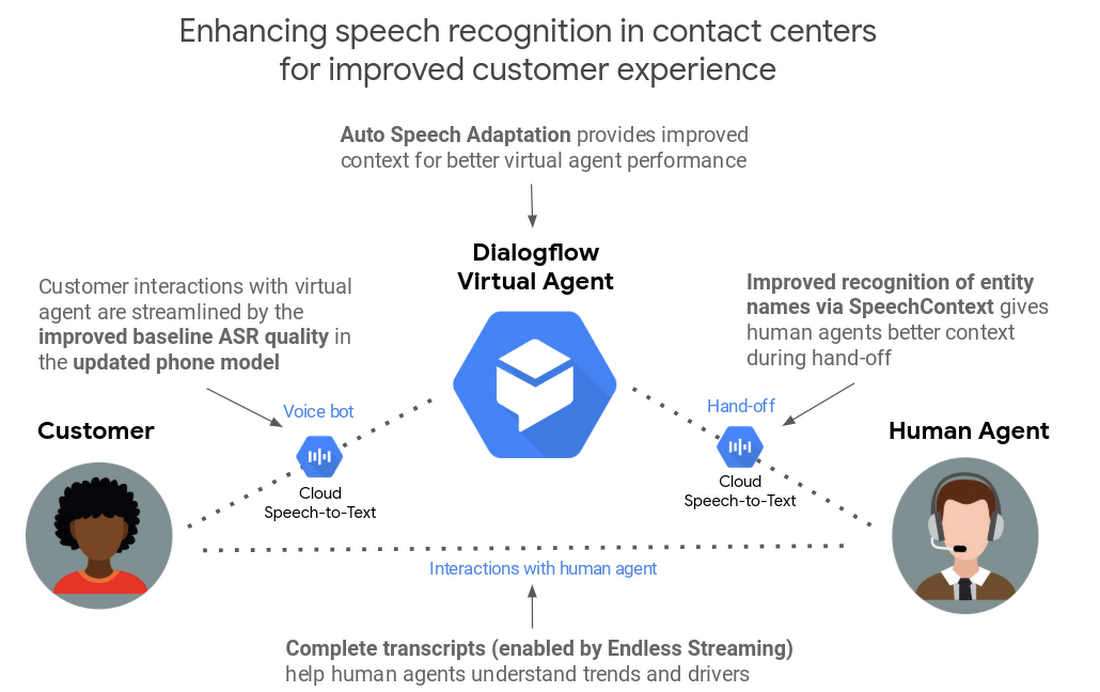
Last July, Google announced its Contact Center AI product for helping businesses get more value out of their contact centers. Contact Center AI uses a mix of Google’s machine learning-powered tools to help build virtual agents and help human agents as they do their job. Today, the company is launching several updates to this product that will, among other things, bring improved speech recognition features to the product.

As Google notes, its automated speech recognition service gets to very high accuracy rates, even on the kind of noisy phone lines that many customers use to complain about their latest unplanned online purchase. To improve these numbers, Google is now launching a feature called ‘Auto Speech Adaptation in Dialogflow,” (with Dialogflow being Google tool for building conversational experiences). With this, the speech recognition tools are able to take the context of the conversation into account and hence improve their accuracy by about 40 percent, according to Google.

Speech Recognition Accuracy

In addition, Google is also launching a new model phone model for understanding short utterances, which is now about 15 percent more accurate for U.S. English, as well as a number of other updates that improve transcription accuracy, make the training process easier and allow for endless audio streaming to the Cloud Speech-to-Text API, which previously had a 5-minute limit.

If you want to, you can also now natively download MP3s of the audio (and then burn them to CDs, I guess).

dialogflow virtual agent.max 1100x1100

23 Jul 2019

Lyft opens autonomous driving dataset from its Level 5 self-driving fleet to the public

Lyft is offering a set of autonomous driving data to to the public that it calls the “largest public dataset of its kind,” containing over 55,000 3D frames of captured footage, hand-labeled by human reviewers, data collected by 7 cameras and as many as 3 lidars depending on the car used, plus a drivable surface map and HD spatial semantic data that corresponds to the captured info to provide context to researchers.

The data set is the work of Lyft Level 5, the division fo the ride-hailing company that is responsible for its research and development of self-driving vehicle technology (hence the name, which is borrowed from SAE’s levels of autonomy for cars, with Level 5 being the highest). In a blog post detailing the move, Lyft notes that this part of the company has been working on its hardware and self-driving software for two years and wanted to make some of the data its collected in that time public in order to “help level the playing field for all researchers interested in autonomous technology.”

Lyft Level 5 EVP of Autonomous Technology Luc Vincent notes in the post that the company is “committed to democratizing access to this tech,” and plans to continue to “release additional data” going forward. Lyft will also host a competition to inspire use of the data, with $25,000 in cash prizes and a presentation plus job interview opportunity at the NeurIPS conference this December.

That job interview opp is key to understanding why Lyft would want to make public this data its collecting. Other autonomous driving companies have done similar things, including Aptiv for example, and there is indeed obviously some interest in sharing with other researchers in the field, since many of the people working at these companies come from a collaborative academic background. But it’s also a self-interested move, because it definitely helps these companies recruit talent, in a hiring market that is competitive with few qualified individuals to go around.

Still, regardless of motivation, it’s definitely a net benefit to have datasets like this available to the public. Meanwhile, Lyft is currently working on its third generation of self-driving car, which includes a new sensor array with its own, proprietary camera with ultra-HDR capabilities.

23 Jul 2019

CircleCI closes $56M Series D investment as market for continuous delivery expands

CircleCI launched way back in 2011 when the notion of continuous delivery was just a twinkle in most developer’s eyes, but over the years with the rise of agile, containerization and DevOps, we’ve seen the idea of continuous integration and continuous delivery (CI/CD) really begin to mainstream with developers. Today, CircleCI was rewarded with a $56 million Series D investment.

The round was led by Owl Rock Capital Partners and Next Equity. Existing investors Scale Venture Partners, Top Tier Capital, Threshold Ventures (formerly DFJ), Baseline Ventures, Industry Ventures, Heavybit and Harrison Metal Capital also participated in the round. CircleCI’s most recent funding prior to this round was $31 million Series C last January. Today’s investment brings the total raised to $115.5 million, according to the company.

CircleCI CEO Jim Rose sees a market that’s increasingly ready for the product his company is offering. “As we’re putting more money to work, there are just more folks that are now moving away from aspiring about doing continuous delivery and really leaning into the idea of, ‘We’re a software company, we need to know how to do this well, and we need to be able to automate all the steps between the time our developers are making changes to the code until that application gets in front of the customer,'” Rose told TechCrunch.

Rose sees a market that’s getting ready to explode and he wants to use the runway this money provides his company to take advantage of that growth. “Now, what we’re finding is that FinTech companies, insurance companies, retailers — all of the more traditional brands — are now realizing they’re in a software business as well. And they’re really trying to build out the tool sets and the expertise to be effective at that. And so the real growth in our market is still right in front of us,” he said.

As CircleCI matures and the market follows suit, a natural question following a Series D investment is when the company might go public, but Rose was not ready to commit to anything yet. “We come at it from the perspective of keeping our heads down trying to build the best business and doing right by our customers. I’m sure at some point along the journey, our investors will be itching for liquidity, but as it stands right now, everyone is really [focussed]. I think what we have found is that the bulk of the market is just starting to arrive,” he said.

23 Jul 2019

LG says smart TVs will gain AirPlay 2 and HomeKit support next week

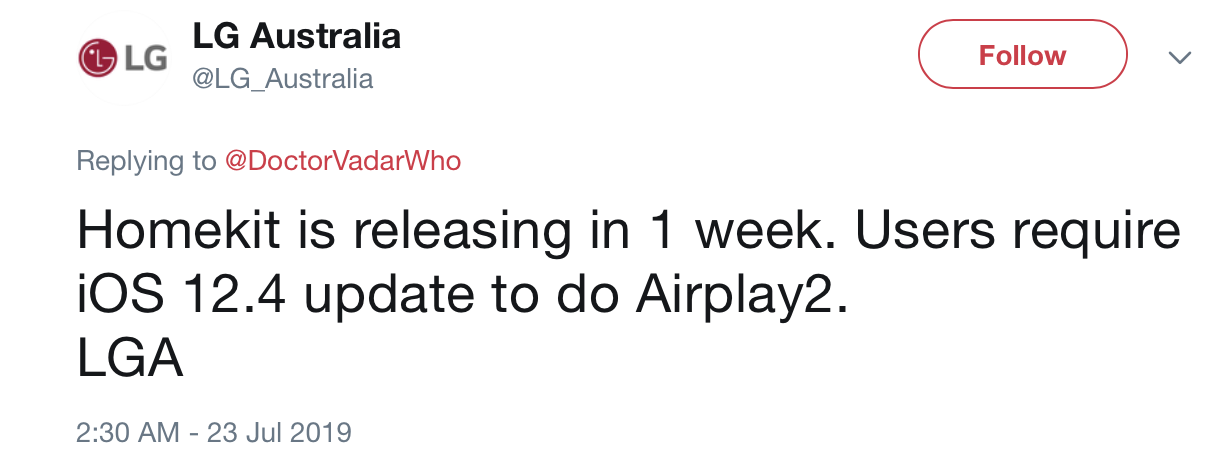
In addition to Samsung and Vizio, LG announced earlier this year that it would be adding support for Apple’s ecosystem to its TV operating system. According to a tweet from LG’s Australian account, the webOS update that adds support for HomeKit and AirPlay 2 will be released next week.

If you have an iPhone, iPad or Mac, you’ll be able to send video content to your TV using the AirPlay icon in your favorite video app. Unfortunately, some apps restrict AirPlay usage. So you’ll be able to beam YouTube or Amazon Prime Video content, but not Netflix shows for instance.

AirPlay is also useful if you want to show some photos on the big screen. And you can mirror your screen to a TV in case you want to use an LG TV for your PowerPoint presentation in your office.

LG TVs should also support AirPlay audio, which means that you can send audio to multiple AirPlay 2 devices at once (including your LG TV) and manage your multi-speaker setup from your iOS device.

When it comes to HomeKit support, you’ll be able to add your TV to the Home app and turn it on and off from there. Of course, it means that you can create automation in order to turn off the TV when you leave your home, or turn on the TV when you open the Hulu app on your iPad.

Thanks to HomeKit support, you can also create custom actions. For instance, you could say “Hey Siri, turn on the TV” and have Siri turn on the TV and dim your Philips Hue lights. You can also control the HDMI input from your Apple devices.

Unfortunately, LG said that AirPlay 2 and HomeKit support would only be added to 2019 smart TVs. Let’s see if that limit still stands when the company rolls out its software update.

Screen Shot 2019 07 23 at 3.38.42 PM

23 Jul 2019

Inventables raises $11.5M for its desktop milling technology

Inventables announced this morning that it has raised an $11.5 million Series C. The round, led by Cue Ball, alongside True Ventures, Greycroft, Pipeline Capital and Draper Associates, brings the Chicago-based startup’s total funding cup to 21 million, per Crunchbase.

The company specializes in desktop 3D carving — or subtractive manufacturing (not to be confused with the additive variety you get with 3D printers). While Inventables has produced its own proprietary machines, including the X Carve and the no longer available Carvey, this round is all about its software offerings.

Inventables says most of the funding this round will go into Easel, the company’s web-based design platform. Among other things, the company is working to make the technology compatible with more third-party machines.

“We are excited to see thousands of American businesses using our products for production,” founder and CEO Zach Kaplan said in a release tied to the news. This investment enables Inventables to enhance the functionality and compatibility of our Easel software, helping our business customers produce products faster and more profitably.”

The move is also clearly an attempt to transform the platform into a serious business product — though Inventables has apparently had little trouble attracting users. The company says it’s currently on track for four million carving projects this year using its services.

23 Jul 2019

TwelveSouth’s StayGo is the last USB-C dock you’ll ever need

The TwelveSouth StayGo is a new USB-C dock from a company that makes a ton of great and unique Mac and iOS device accessories. True to the company’s track record, it offers a slightly different take on a popular accessory category – and ends up excelling as a result.

The StayGo’s unique twist is an short USB-C to USB-C cable that slots right into a dedicated compartment on the dock, offering portable connectivity without any awkward stubby permanently attached cord. It also avoid the problem that direct USB-C dock connectors have, where they stick out and can potentially get damaged in your bag or scratch other stuff. There’s a second, 3-foot long cable included in the box, too, which you can conveniently just plug into your Mac at home if you switch between a desktop and a MacBook, or a Mac and an iPad.

It seems like a pretty simple thing, but having these two cables instead of just one, and the stowable short cable, make this far more convenient for anyone who travels or who does any out-of-home work at all. I’ve used a ton of these things, and StayGo is my clear favorite after having used it on a couple of trips over a month or so of testing.

I haven’t even talked about the ports yet – TwelveSouth nailed the right mix there, too, with three high-speed USB 3.0 ports, an Ethernet port, a USB-C connector (with pass-through charging at up to 85W), a 4K 30Hz HDMI port and both SD and microSD slots (which support UHS-I transfer speeds, and which can both operate simultaneously). That’s just about everything a traveler or working photographer today needs, and nothing they don’t – all in a space-saving design that never makes you choose between it and other gear when you’re packing even the smallest bag.

[gallery ids="1858916,1858915,1858914,1858913,1858912,1858911,1858910"]

In terms of performance, so far it’s been rock solid. There’s nothing worse than random unmounting of memory cards when you’re trying to transfer photos from a shoot, and the StayGo is definitely able to deliver solid, uninterrupted performance there. If I had any complaints, it’s that video output isn’t 60Hz, but that’s not really a necessary requirement for something that I’ll be using primarily to supplement my external monitor needs when I’m on the road instead of a dedicated video connection for a video editing setup, for instance.

The StayGo can get a bit warm when operating, but it’s never been actually hot, and the aluminum case construction helps ensure it can shed excess temp quickly.

At $79.99, it may be a bit more expensive than some of the hubs you can pick up on Amazon, but in terms of reliability, specs, port load out and its interesting approach to blending portability and at-home convenience, TwelveSouth is more than justified in setting that price point for the StayGo.

23 Jul 2019

Fetch Robotics raises $46 million to expand warehouse automation internationally

Placed against our sci-fi expectations, robotics have large fallen short — with one notable exception. In 2019, automation is a mainstay in  factories and warehouses. There the technology has been proven out in the field, and VCs are happy to invest millions.

This morning Fetch Robotics announced a $46 million Series C raise. The round, led by Fort Ross Ventures, brings the San Jose-based warehouse automation company’s total funding up to $94 million. New investors CEAS Investments, Redwood Technologies, TransLink Capital and Zebra Ventures joined the round, along with existing investors O’Reilly AlphaTech Ventures, Shasta Ventures, Softbank Capital and Sway Ventures.

Fetch says the money will be used to help expand operations globally for the largely U.S.-based operation. It will also be using funds to increase production for consumer demand and, naturally, additional research and development.

“Customers have responded enthusiastically to our unique Cloud Robotics solution, and we’re responding by securing the funds we need to continue growing and enhancing our offerings,” CEO Melonee Wise said in a release tied to the news. “The competitive pressures for excellence in logistics have never been greater. Our Autonomous Mobile Robots and cloud platform enables our customers to meet their customers’ demands while meeting their own financial objectives.”

The warehouse automation space has been booming in the past several years, and Fetch has been at the forefront. Founded in 2014 by Wise, an alumnus of Bay Area robotics pioneer Willow Garage, the company specializes in autonomous modular robotics designed to automate tedious warehouse tasks. We visited the company’s South Bay offices last year to get a fuller picture of what it has been working on.

These days the company is one of the primarily alternatives to in-house automation plays like Amazon Robotics.

23 Jul 2019

Mixhalo raises $10.7M to bring better sound quality to live events

Mixhalo — the startup co-founded by Incubus guitarist Mike Einziger and his wife, violinist Ann Marie Simpson-Einziger — has raised $10.7 million in Series A funding.

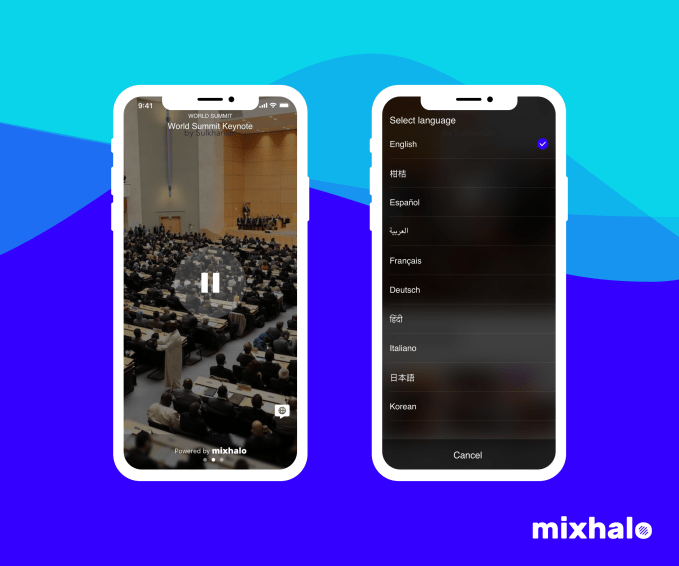
The company’s initial goal was to bring better sound quality to concerts. Instead of hearing music blasted out of speakers, users can connect their smartphone to a network (the startup creates its own wireless channel that doesn’t rely on the venue’s potentially overloaded WiFi or cell networks). Then, through their earbuds, they’ll hear the same sound mix that the musicians receive through their in-ear monitors.

Mixhalo launched two years ago at our Disrupt NY conference, where Incubus and investor Pharrell Williams took the stage to play a couple songs. The sound arrived loud and clear through my iPhone earbuds, and the experience didn’t feel too different form a normal concert.

Since then, Mixhalo has also been used at Y Combinator Demo Day and deployed on tours by Charlie Puth, Incubus and Metallica, as well as Aerosmith’s current Las Vegas residency.

And at the beginning of this year, Marc Ruxin joined as CEO. Ruxin formerly led the music discovery startup TastemakerX (which was acquired by Rdio), so this is clearly an area that interests him, but he told me that he actually wasn’t eager to return into the music business. However, he was wowed by Mixhalo’s sound quality, and as he talked to Einziger (who serves as the startup’s chief creative officer), he became convinced that the technology could be used at a wide range of events and venues — conferences, sports, museums, megachurches and more.

Plus, unlike other music startups, Ruxin said the business model here seemed appealingly straightforward: “We sell enterprise software to event organizers.”
mixhalo press 2up dark interpretation

When I’ve described the idea to friends, there’s usually some skepticism about whether concertgoers really care that much about sound, and concern about whether putting headphones on diminishes the social experience at these events.

However, Ruxin said Mixhalo offers a number of benefits beyond sound quality — there’s the ability for each listener to control their own volume, and an opportunity to create unique experiences, like offering multiple mixes for a single concert, or watching one band at a festival (or one presenter at Demo Day) while listening to another via Mixhalo.

He also argued that people don’t realize how bad most concert audio is, until Mixhalo gives the chance to experience something better.

“We’re definitely solving a problem in music that people don’t realize they have,” he said, comparing it to watching an old TV and thinking it was fine, until you had the chance to watch in HD: “Now, sports that’s not in HD looks crappy.”

As for the effect on the social experience, Ruxin said the idea isn’t to turn the whole event into a silent disco. Instead, Mixhalo aims to to allow the audience members to choose the experience they want. And that can change from song to song — he recalled seeing some fans listen to Mixhalo for most of a concert, then take their headphones off to sing along with the hits. Others did the opposite, wanting to get the best sound quality on their favorite songs.

Ruxin said he’s primarily focused on music and sports for now, but he’s also open to working with partners outside those areas, because the technology can be installed in, say, a Broadway musical with “no technical tweaks.”

The funding was led by Foundry Group, with participation from Sapphire Sport, Founders Fund, Defy Partners, Cowboy Ventures, Red Light Management, Another Planet Entertainment, Rick Farman and Rich Goodstone of Superfly and Charlie Walker of C3. Mixhalo has now raised a total of $15 million.


23 Jul 2019

AG Barr says consumers should accept security risks of encryption backdoors

U.S. attorney general William Barr has said consumers should accept the risks that encryption backdoors pose to their personal cybersecurity to ensure law enforcement can access encrypted communications.

In a speech Tuesday in New York, the U.S. attorney general parroted much of the same rhetoric from his predecessors and other senior staff at the Justice Department, calling on tech companies to do more to assist federal authorities gain access to devices with a lawful order.

Encrypted messaging has taken off in recent years, making its way to Apple products, Facebook, Instagram, and WhatsApp, a response from Silicon Valley in response to the abuse of access by the intelligence services in the wake of the Edward Snowden revelations in 2013. But law enforcement says encryption thwarts their access to communications they claim they need to prosecute criminals.

The government calls this “going dark” because they cannot see into encrypted communications, remains a key talking point by the authorities. Security experts have long said there is no secure way to create “backdoor” access to encrypted communications for law enforcement without potentially allowing malicious hackers to also gain access to people’s private communications.

In remarks, Barr said the “significance of the risk should be assessed based on its practical effect on consumer cybersecurity, as well as its relation to the net risks that offering the product poses for society.”

He suggested that the “residual risk of vulnerability resulting from incorporating a lawful access mechanism is materially greater than those already in the unmodified product.”

“Some argue that, to achieve at best a slight incremental improvement in security, it is worth imposing a massive cost on society in the form of degraded safety,” he said.

The risk, he said, was acceptable because “we are talking about consumer products and services such as messaging, smart phones, e-mail, and voice and data applications,” and “not talking about protecting the nation’s nuclear launch codes.”

The attorney general said it was “untenable” that devices offer uncrackable encryption while offering zero access to law enforcement.

Barr is the latest in a stream of attorney generals to decry an inability by law enforcement to access encrypted communications, despite pushback from the tech companies.

The U.S. is far from alone in calling on tech companies to give law enforcement access.

Earlier this year U.K. authorities proposed a new backdoor mechanism, the so-called “ghost protocol,” which would give law enforcement access to encrypted communications as though they were part of a private conversation. Apple, Google, Microsoft and WhatsApp rejected the proposal.

The FBI inadvertently undermined its “going dark” argument last year when it admitted the number of encrypted device it claimed it couldn’t gain access to was overestimated by thousands.

FBI director Christopher Wray said the number of devices it couldn’t gain access to was less than a quarter of the claimed 7,800 phones and tablets.

Barr did not rule out pushing legislation to force tech companies to build backdoors.