
Year: 2019

23 Jul 2019

Agolo attracts Microsoft and Google funding with AI-powered summarization tools

As the ways we consume content multiply and change, media creators are hard pressed to adapt their methods to take advantage. Short-form audio and video news is one growing but labor-intensive niche — and Agolo aims to help automate the process, pulling in the AP as a client and Microsoft, Google, and Tensility as investors.

Agolo is an AI startup focused on natural language processing, and specifically how to take a long article, like this one, and boil it down to its most important parts (assuming there are any). Summarization is the name of the process, as it is when you or I do it, and other bots and services do it as well. Agolo’s claim is to be able to summarize quickly and accurately, producing something of a quality worthy of broadcast or official documentation. Its deal with the AP provides an interesting example of how this works, and why it isn’t as simple as picking a few representative sentences.
AgoloThe AP is, of course, a huge news organization and a fast-moving one. But its stories, while spare as a rule, are rarely concise enough to be read aloud by a virtual assistant when its user asks “what’s the big news this morning?” As a result, AP editors and writers manually put together scores or hundreds of short versions of stories every day specifically for audio consumption and other short-form contexts.

Since this isn’t a situation where creative input is necessarily required, and it must be done quickly and systematically, it’s a good fit for an AI agent trained in natural language. Even so it isn’t as easy as it sounds, explained Agolo co-founder and CEO Sage Wohns.

“The way that we have things read to us is different from the way we read them. So the algorithm understanding that and reproducing it is important,” he said. And that’s without reckoning with the AP’s famous style guide.

“This is one of the most important points that we worked on with them,” Wohns said. “The AP has their style bible, and it’s a brick. We have a hybrid model that has algorithms pointed at each of those rules. We never want to change the language, but we can shorten the sentence.”
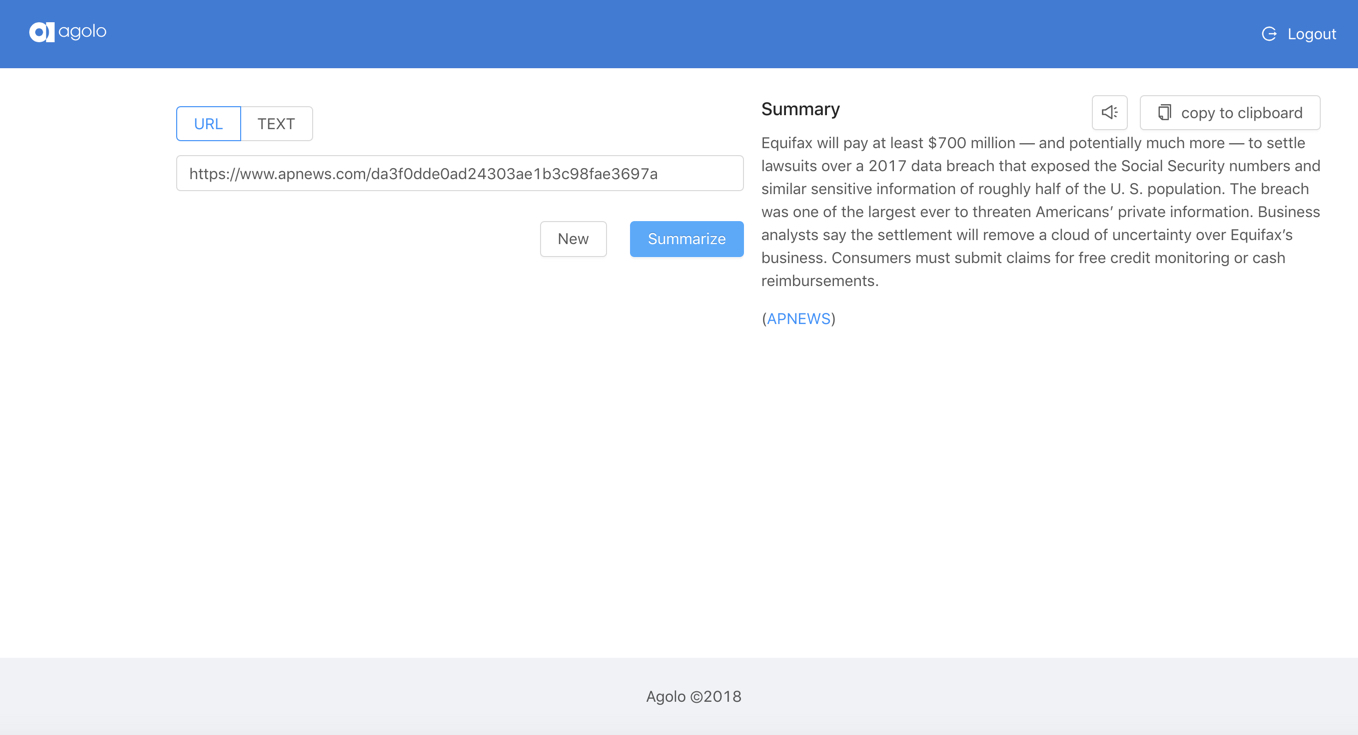
Agolo Listenable 1

That’s a risk with algorithmic summarizing, of course: that in “summarizing” a sentence you change its meaning. That’s incredibly important in the news, where the difference between a simple statement of fact and an egregious error can easily be in a single word or phrase. So the system is careful to preserve meaning if not necessarily the exact wording.

While the AP may not be given, as I am, to circumlocutions, it may still be beneficial to shift things a bit, though. Agolo worked closely with the news organization to figure out what’s acceptable and what’s not. A simple example would be changing something like “Statement,” said the source to The source said “Statement.” That doesn’t save any space, but you get the idea: essentially lossless compression of language.

If the AP team can trust the algorithm to produce a well-worded summary that follows their rules and only takes a quick polish by an editor, they could serve and even grow the demand for short-form content. “The goal is to enable them to create more content than was humanly possible before,” said Wohns.

The investment from and collaboration with Google falls along these lines as well, though not as laser-focused on turning news stories into sound bites.

“What we’re working on with them is making the web listenable,” said Wohns. “Right now you can ask Google a question but it often doesn’t have an answer it can read back to you.”

It’s primarily a bid to extend the company’s Assistant product as it continues its combat with Alexa and Siri, but may also have the extremely desirable side effect of making the data Google indexes more accessible to blind users.

The scope of Google’s data (Agolo is probably now getting the full firehose of Google News, among other things) means that the AI model being used has to be lightweight and quick. Even if it takes only ten seconds to summarize every article, that gets multiplied thousands of times in the complex workings of sorting and displaying news all over the world. So Agolo has been very focused on improving the performance of its models until they are able to turn things around very quickly and enable an essentially real-time summary service.
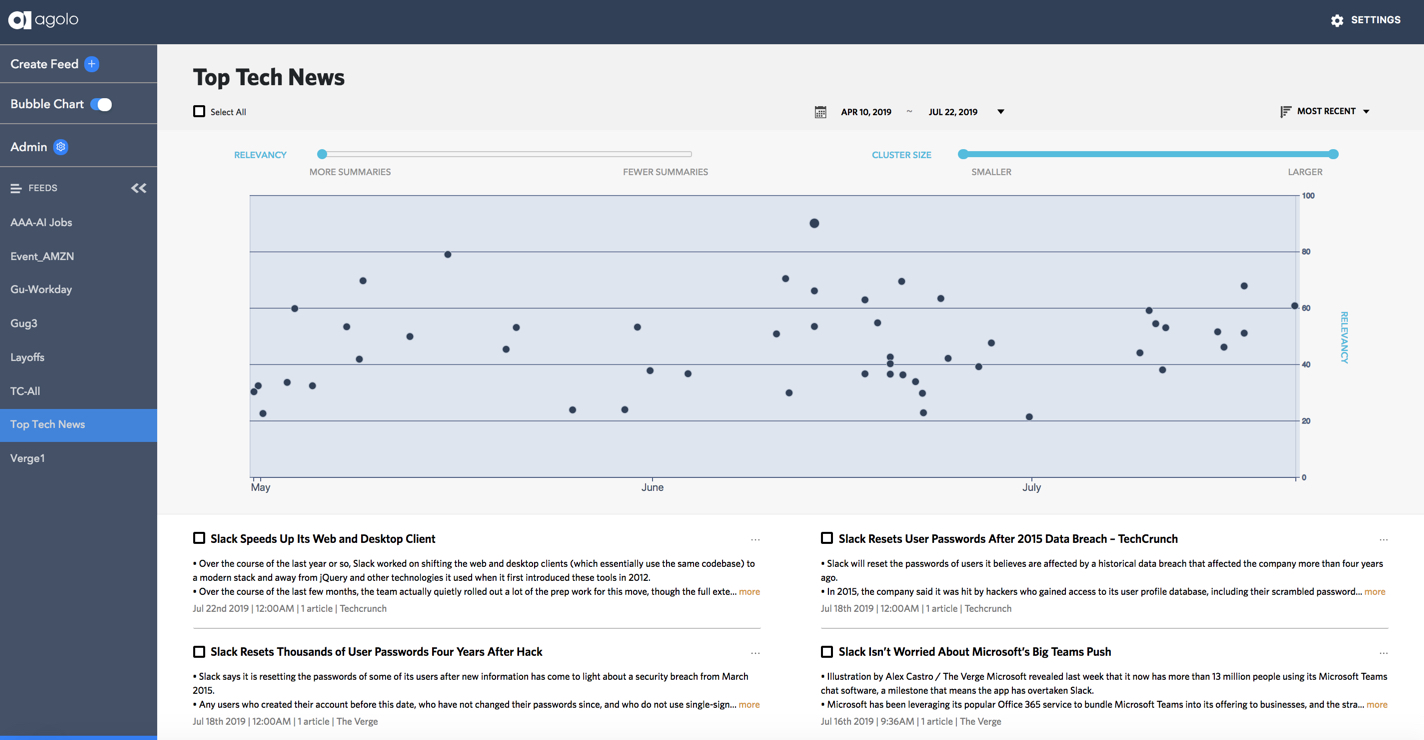
Agolo Research Application

This has a secondary application in large enterprises and companies with large backlogs of data like documentation and analysis. Microsoft is a good example of this: After decades of running an immense software and services empire, the number of support docs, studies, how-tos, and so on are likely choking its intranet and search may or may not be effective on such a corpus.

NLP-based agents are useful for summarizing, but part of that process is, in a way, understanding the content. So the agent should be able to produce a shorter version of something, but also tell you that it’s by this person (useful for attribution); it’s about this topic; it’s from this date range; it applies to these version numbers; its main findings are these; and so on and so forth.

Not all this information is useful in all cases, of course, but it sure is if you want to digest 30 years of internal documentation and be able to search and sort it efficiently. This is what Microsoft is using it for internally, and no doubt what it intends to apply it to as part of future product offerings or partnerships. (Semantic Scholar has applied a similar approach to journals and academic papers.)

It would also be helpful for, say, an investment bank analyst or other researcher, who can use Agolo’s timeline to assemble all the relevant documents in order, grouped by author or topic, with the salient information surfaced and glanceable. One pictures this as useful for Google News as well in browsing coverage of a specific event or developing story.

The new (undisclosed amount of) funding has Microsoft (M12 specifically) returning, with Google (Assistant Investment Group specifically) and Tensility Venture Partners joining for the first time. The cash will be used in the expected fashion of a growing startup: chasing sales and a few key hires.

“It’s about building out the go-to-market side, and the core NLP abilities of the team, specifically in New York and Cairo,” said Wohns. “Right now we’re about a 90 percent technical team, so we need to build out the sales side.”

Agolo’s service seems like a useful tool for many an application — anywhere you have to reduce a large amount of written content to a smaller amount. Certainly that’s common enough — but Agolo will need to prove that it can do so as non-destructively and accurately as it claims with a wide variety of datasets, and that this process contributes to the bottom line more than the time-tested method of hiring another intern or grad student to perform the drudgery.


23 Jul 2019

Alphabet’s Loon balloons developed clever strategies to pass 1M hours flying in Earth’s stratosphere

Alphabet’s Loon subsidiary, which aims to blanket the Earth in high-speed broadband Internet connectivity, has passed the 1 million hour mark in terms of total time spent in Earth’s stratosphere across all its flights. The balloons occupy the upper-edge of Earth’s atmosphere, in an altitude band between 50,000 and 70,000 feet, riding wind currents and using automated navigation systems to intelligently fly in specific areas defined by Loon’s engineers.

Loon’s balloons have accumulated almost 40 million km (nearly 25 million miles) or enough to make the trip to the Moon and back over 50 times. The result of all that time spent flying is that the automated navigation software has come up with some unexpected methods for ensuring the balloons stay in their designated flight target zones while dealing with those high-altitude winds.

The balloons make use of zig-zag patterns, similar to tacking tactics used by sailing vessels, for instance – but in doing so they employ strategies that are counterintuitive to even an experienced human navigator. They also waited out or “loitered” in some areas rather than continuing on an expected path, because they can take in wind forecast data and anticipate how to hitch a ride to get where they need to be rather than having to loop back around.

figure8 Loon

Balloons also adopted figure 8 patterns instead of simple circles to stay in a specific area over longer periods of time, which indeed proved the more effective way to deliver a reliable and consistent LTE connection over time. This was again not what human researchers would’ve attempted as a first choice, proving that logging the hours and letting the automated system figure out what works best based on mission parameters was the wisest course.

Loon CTO Salvatore Candido notes in this blog post that he’s actually unsure of whether or not to qualify this decision-making as basic AI or not – a refreshing admission in an era when most companies try their best to classify everything that can possible fit the definition of AI even loosely as AI. But regardless of what you call it, the software’s ability to adapt to its operating conditions and goals is impressive, and a great sign for Loon’s long-term mission of delivering affordable broadband connections to underserved areas.

23 Jul 2019

From liberal arts PhD to pre-IPO startup CEO with Shift’s Toby Russell

Transitioning between different types of professional roles can be challenging — new expectations arise, and fresh ways of seeing the world are required to be successful. A few weeks ago, I interviewed Anjul Bhambhri of Adobe about how she transitioned from engineering into product, where she now leads the company’s customer experience cloud.

This week, I chatted with Toby Russell, the co-CEO of online used car marketplace Shift, which generated $135 million in revenue last year and has raised $293 million in venture capital according to Crunchbase. The company is targeting an IPO in 2021.

While we have written a lot about Shift, we have written far less about Russell, whose career spans a model he calls “learn, earn, and serve.” He received a PhD in international relations at Oxford, switched to founding a startup, then served in the Obama Energy Department, before heading over to Capital One to lead digital and eventually rejoining his friend George Arison and Shift’s co-founder as co-CEO.

Across these roles, Russell has had to adapt to very different environments, and we chatted about those transitions, his lessons learned, and his approach to leadership.

23 Jul 2019

Watch crowdfunded spacecraft LightSail 2 unfurl its solar sail live

The Planetary Society’s pioneering spacecraft LightSail 2 is getting ready for its big moment – deploying the solar sail it carries on board, which should be able to propel the spacecraft using only the force of photons from the Sun striking its surface, if all goes to plan. You can watch live as it undergoes the unfurling process, starting at around 11:40 AM PT (2:40 PM ET) today.

LightSail 2, a spacecraft funded in part thanks to crowdfunding by a community of space enthusiasts, already made history when it launched aboard SpaceX’s Falcon Heavy on June 25. Since then, it’s been orbiting the Earth and undergoing tests to ensure its readiness for its main mission – deploying the sail and studying the results.

The benefits of solar sail propulsion is that it’s very low-cost and could potentially operate for a very long time, allowing us to study the far reaches of space and deliver a variety of payloads on research missions. It’s very low-thrust, however, and takes a long time to get to speed. And to date, much of what we know about solar sails is still theoretical – one craft called IKAROS was launched in 2010 by the Japan Aerospace Exploration Agency, but there’s lots left to learn and LightSail 2 could provide crucial experimental data that it intends to make available to the scientific community to study.

23 Jul 2019

The road ahead for Waymo, AV engineering and mobility, with Waymo CTO Dmitri Dolgov

Earlier this month, TechCrunch held its annual Mobility Sessions event down in San Jose, where leading mobility-focused auto companies, startups, executives and thought leaders joined us to discuss all things autonomous vehicle technology, micromobility and electric vehicles.

Extra Crunch is offering members access to full transcripts key panels and conversations from the event, including a mainstage conversation between Waymo CTO Dmitri Dolgov and TechCrunch mobility axe Kirsten Korosec. Dmitri and Kirsten dove into Waymo’s full product evolution, and dissect the path ahead for the company and the AV industry as a whole.

Dmitri Dolgov: So essentially, what makes this problem interesting in my mind is that it’s not one or two things where you say “there’s only this one challenge that remains and then you solve everything.” It’s really across a whole number of different areas — a whole number of different disciplines from hardware, to more advanced sensors, more powerful sensors, sensors you can manufacture at scale, cheaper sensors, more powerful compute, cheaper compute software.

You mentioned sensor fusion — this is actually where the software plays very nicely with the hardware and that connection is very deep. And our approach at Waymo is interesting in that we build our own software and hardware in house.

So this is where we have access to very powerful sensors, and not just having the increased range and increased resolution, but also having access to the raw sensor data, like the raw measurements that you get from lidars from cameras from radars, and doing sensor fusion at a later stage, where you can really bring to bear modern, deep learning algorithms to have models that learn to pick out the best signal from those different sensing modalities. That’s a very active area of improvement.

Dmitri also goes into more depth on the specific technical areas of improvements for AV technology and the importance of simulation miles when building a polished mobility product. Dmitri and Kirsten also talk through the regulatory road map and the impact it will play on AV rollouts, AV product quality, as well as on cities and society as a whole.

For access to the full transcription below and for the opportunity to read through additional event transcripts and recaps, become a member of Extra Crunch. Learn more and try it for free. 

Kirsten Korosec: Thanks, everyone for coming out. And we’re all here to talk to the CTO [Dmitri Dolgov] of Waymo. So I’m going to just let you roll with it. I’m wondering if you showed up in a self-driving car today, How’d you get here?

Dmitri Dolgov: I took a self-driving car to work today. Then I met with some folks there. And we took another car to here.

Korosec: So manually driven car from Mountain View. But My understanding is that you actually use Waymo self-driving cars quite a bit. You’re one of the most prolific users of the vehicle, correct?

Dolgov: Yeah. Nowadays, this is my default mode of transportation around town, I take our cars to work pretty much every day. I take them to get around town to run some errands. And actually, recently, there was a change that happened in California – we got the permit from the CPUC, the California Public Utilities Commission, that allowed us to take passengers in cars that are not employees of Waymo.

So now I can take my family and I have to go to the grocery store and I actually did that recently. I had to go with my son and instead of me doing the silly old thing of me driving around in my own car, we hopped into a Waymo. And that was cool.

23 Jul 2019

Microsoft makes 3 data sharing agreements available to the community

Microsoft today published three data sharing agreements that it hopes can function as a basis for other organizations who want to create similar documents.

In today’s announcement, Erich Anderson, Corporate Vice President and Chief IP Counsel at Microsoft, argues that while there are plenty of organizations that want to work together on shared datasets, the logistics of creating these agreements — with months of time spent on negotiating and talking to lawyers — often stall or stop these projects.

“We want to help make it easier for individuals and organizations that want to share data to do so,” Anderson writes. “Often, agreements for broad data sharing scenarios are unnecessarily long and complex. We also think there is an important role for agreements that limit rights to computational use for AI. Further, we think the state of the art on data sharing for proprietary and private data sets is changing rapidly and the terms available publicly could be improved and better explained.”

The three agreements focus on slight different use cases. One is the “Computational Use of Data Agreement” for sharing data from publicly available sources for computational purposes that don’t include any personal data, for example. The “Data Use Agreement for Open AI Model Development,” on the other hand, is all about training AI models with data that could include personal data, while the “Open Use of Data Agreement” focuses, as the name implies, on making data publicly available.

Anderson stresses that Microsoft is making these licenses available for community review and input. “Going forward, our aim is to work with interested stakeholders to improve these agreements and to offer additional ones that cover a wide range of data sharing scenarios,” he notes.


23 Jul 2019

Known for its electric scooters, Gogoro moves toward its future as a mobility platform

Since the launch of its first electric scooter in 2015, Gogoro co-founder and CEO Horace Luke has frequently been asked when the startup is going to expand beyond Taiwan. In its home country, Gogoro’s two-wheel vehicles, with their distinctive swappable battery system, are now the top-selling electric scooters.

But Luke says the company has always seen itself as a platform company, with the ultimate goal of providing a turnkey solution for energy-efficient vehicles. Now with the launch of GoShare*, its new vehicle-sharing platform, and partnerships with manufacturers such as Yamaha, Gogoro is ready to go global.

Founded by Luke, HTC’s former chief innovation officer, and chief technology officer Matt Taylor in 2011, Gogoro develops most of its technology in-house, including scooter motors, telematics units, backend servers and software. GoShare’s pilot program will launch next month in Taoyuan City, where Gogoro’s research and development center is located, with the goal of expanding with partners into cities around the world over the next year, starting in Europe, Australia and Southeast Asia.

“Gogoro has always been out with a thesis that we will be a platform enabler,” Luke told Extra Crunch during an interview in the company’s Taipei City headquarters. “Now you’ve seen the transformation of the company. Doing something this big, like what Gogoro is doing, takes time.”

Since the release of Gogoro’s first Smartscooter in 2015, the company says it has become the best-selling brand of electric two-wheel vehicles in Taiwan, holding a 17 percent share of the country’s vehicle market, including gas vehicles.

Last year, the company began licensing its technology to manufacturers Yamaha, Aeon and PGO to produce scooters that run on Gogoro’s batteries and charging infrastructure. It also has a partnership with Coup, the European electric-scooter sharing startup that plans to increase its fleet to more than 5,000 scooters on the streets of Paris, Berlin, Madrid and Tübingen this year, and is seeking similar deals with other vehicle-sharing services, as well as local governments that want to reduce traffic and pollution (the GoShare pilot program is being launched in collaboration with Taoyuan City’s government).

GoShare’s platform is meant to be a “very robust and cost-effective, very worry-free solution for municipalities and entrepreneurs,” Luke says. Parts of the system can be licensed separately or packaged as a turnkey solution that can be deployed in as little as two weeks.

The company describes GoShare as a “mobility solution.” When asked if this means the platform can be used for other electric vehicles, including cars, Luke says “just think of us as batteries and a motor.”

“It’s just like computers and processing ram,” he adds. “It can be any form factor. It just happens to be that the two-wheel form factor is the one we’re working on and focusing on at the moment.”

23 Jul 2019

Fintech firm Zeta’s valuation climbs to $300M in its first external funding round

Startups looking to expand the reach of financial services continue to receive a nod from investors. Zeta, a fintech firm that runs a full stack neo-banking platform and offers enterprise payments solutions, said today its valuation reached $300 million in its maiden outside funding.

Sodexo BRS funded Zeta’s Series C round to take a minority stake in the company. Zeta executives declined to reveal the size of the funding, but a person familiar with the matter told TechCrunch the amount was under $60 million.

This is the first time Zeta — or its CEO and co-founder Bhavin Turakhia — has raised money from an outside party, he told TechCrunch in an interview.

Turakhia, 39, has co-founded a number of companies over the years including ad-tech firm Media.net, which was sold for $900 million, and team collaboration and productivity app Flock. Flock too has not raised any outside capital to date.

Zeta operates in Asia and Latin America and counts companies and banks looking to bring retail and corporate fintech products as its potential clients. Its full stack cloud-native neo-banking platform supports issuance of credit, debit and prepaid products. Its enterprise solutions features support for TnE cards, P-cards, expense management, salary disbursement, and corporate gifting.

The firm has already amassed over 2 million users, three different banks and financial institutions including Sodexo that use Zeta’s platform and over 14,000 corporate clients including Amazon . Multiple banks in India are using Zeta’s corporate gifting service.

The new capital will be used to expand the company’s business in the United States, United Kingdom, Europe, and Southeast Asia, Turakhia and Ramki Gaddipati, the startup’s CTO and cofounder, told TechCrunch in an interview. It has already signed contracts with many partners to facilitate the expansion in the next six months.

The firm, which today employs about 450 people, also plans to grow its team and set up offices in many more places across the globe.

“There hasn’t been many zero to one innovations in the banking ecosystem in the last 20 years,” said Turakhia. “If you look at the banking space, it has been dominated by licensed software from legacy organizations. Many of these companies still provide most of the stacks that run most of the payment systems around the world for banks and non-banks.”

So like a growing number of companies, Zeta is betting that it is a pivotal time to disrupt this. “That was the genesis of starting Zeta, building new and innovative technology stack that enables interesting use cases for banks and other bank-line financial institutions that want to issue credit, debit, or prepaid products and provide their customers with enhanced functionalities,” he said.

And that opportunity is what led Turakhia to seek outside capital, he said. “In the next five to seven years, I want to make Zeta 20 to 30 times bigger than any exit I have ever had,” he said.

Additionally, Zeta also saw value that Sodexo, which operates globally, could bring to its platform.

In a statement, Aurelien Sonet, CEO, BRS at Sodexo, said, “Sodexo has been a strategic partner of Zeta since 2017. This investment will enable the Sodexo group to benefit from Zeta’s comprehensive suite of solutions and offer a seamless payment experience to our consumers. Zeta and Sodexo are already working together on deploying Zeta’s platform across several Sodexo subsidiaries across different regions.”

23 Jul 2019

Almost sold out! Buy a ticket to the 14th Annual TechCrunch Summer Party

Last call, startuppers! TechCrunch’s Silicon Valley summer soiree — a.k.a. the 14th Annual TechCrunch Summer Party — is nearly sold out. If you want to join the brightest members of the startup community on July 25 and celebrate your intrepid entrepreneurial spirit, you’d best buy a ticket while you can. It’s now o’clock, people!

This annual event is a true startup tradition. It’s a chance to enjoy the company of your peers and make new connections in a beautiful setting. It’s tough to beat an evening at San Francisco’s Park Chalet. Relax and enjoy the ocean views, craft beer, imaginative cocktails and tasty appetizers.

In between the drinks, the food and the fun you might find that startup magic happens at TechCrunch parties. Who knows, you could meet future co-founders, collaborators or investors — it can and does happen.

How often do you have the chance to build connections with top investors over a cold beer? You do at this shindig. Along with our lead VC partner, Merus Capital, August Capital, Battery Ventures, Cowboy Ventures, Data Collective, General Catalyst and Uncork Capital will be in the house.

We’ll also have a group of exciting early-stage startups displaying their tech and talent, so be sure to check ’em out.

Here are the essential Summer Party details:

  • When: July 25 from 5:30 p.m. – 9:00 p.m.
  • Where: Park Chalet in San Francisco
  • How much: $95

As always, we’ll mix things up with games and great door prizes. You could win TechCrunch swag, Amazon Echos and tickets to Disrupt San Francisco 2019.

The 14th Annual TechCrunch Summer Party takes place on July 25. So much fun, so much opportunity, so few tickets left. Don’t end up on the wrong side of “sold out.” Buy one of the last remaining tickets right now.

23 Jul 2019

Thumbtack raises $150 million for its local services marketplace

Thumbtack just closed a new funding round of $150 million. Sequoia is leading the round, and the company is now valued at $1.7 billion. TechCrunch’s Kate Clark previously reported that the startup was raising again, but that it was a tough process.

In a candid blog post, co-founder and CEO Marco Zappacosta admits that the company faced multiple challenges. Thumbtack started as a simple marketplace for local professionals.

Clients could post a message saying that they were looking for carpenters, wedding planners or house cleaning services. Professionals then scrolled through listings and sent quotes. Customers eventually picked a professional.

While it was a huge hit, it didn’t scale well and created a ton of issues. “We took a business that was growing more than 80% year over year and we pressed pause,” Zappacosta wrote.

The startup rewrote the back end, created a new front end, pivoted to a new business model and essentially created a new product.

Thumbtack now automatically generates quotes based on your needs and your location. Given that you can get quotes in a few minutes, it didn’t make sense to charge professionals every time they send a quote. Now, professionals pay Thumbtack a small fee when customers contact them after a quote.

“Now growth has reaccelerated dramatically, and we have the runway to make Thumbtack the only platform they need to find the right customers,” Zappacosta wrote.

So it sounds like Thumbtack has seen the light at the end of the tunnel. With today’s new funding round, the company can now focus on attracting service providers again. According to the Wall Street Journal, this could be the last funding round before Thumbtack files to go public.