Year: 2019

23 Jul 2019

How Axis went from concept to shipping its Gear smart blinds hardware

Axis is selling its first product, the Axis Gear, on Amazon and direct from its own website, but that’s a relatively recent development for the four-year old company. The idea for Gear, which is a $249.00 ($179.00 as of this writing thanks to a sale) aftermarket conversion gadget to turn almost any cord-pull blinds into automated smart blinds, actually came to co-founder and CEO Trung Pham in 2014, but development didn’t begin until early next year, and the maxim that ‘hardware is hard’ once again proved more than valid.

Pham, whose background is actually in business but who always had a penchant for tech and gadgets, originally set out to scratch his own itch and arrived upon the idea for his company as a result. He was actually in the market for smart blades when he moved into his first condo in Toronto, but after all the budget got eaten up on essentials like a couch, a bed and a TV, there wasn’t much left in the bank for luxuries like smart shades – especially after he actually found out how much they cost.

“Even though I was a techie, and I wanted automated shades, I couldn’t afford it,” Pham told me in an interview. “I went to the designer and got quoted for some really nice Hunter Douglas. And they quoted me just over $1,000 bucks a window with the motorization option. So I opted just for manual shades. A couple of months later, when it’s really hot and sunny, I’m just really noticing the heat so I go back to the designer and ask him ‘Hey can I actually get my shades motorized now, I have a little bit more money, I just want to do my living room.’ And that’s when I learned that once you have your shades installed, you actually can’t motorize them, you have to replace them with brand new shades.”

With his finance background, Pham saw an opportunity in the market that was ignored by the big legacy players, and potentially relatively easy to address with tech that wasn’t all that difficult to develop, including a relatively simple motor and the kind of wireless connectivity that’s much more readily available thanks to the smartphone component supply chain. And the market demand was there, Pham says – especially with younger homeowners spending more on their property purchases (or just renting) and having less to spare on expensive upgrades like motorized shades.

AXIS Gear 1The Axis solution is relatively affordable (though its regular asking price of $249 per unit can add up depending on how many windows you’re looking to retrofit) and also doesn’t require you to replace your entire existing shades or blinds, so long as you have the type that the Gear is compatible with (which includes quite a lot of commonly available shades). There are a couple of power options, including an AC adapter for a regular outlet, or a solar bar with back-up from AA batteries in case there’s no outlet handy.

Pham explained how in early investor meetings, he would cite Dyson as an inspiration, because that company took something that was standard and considered central to their very staid industry and just removed it altogether – specifically referring to their bagless design. He sees Axis as taking a similar approach in the smart blind market, which has too much to gain from maintaining its status quo to tackle Axis’ approach to the market. Plus, Pham notes, Axis has six patents filed and three granted for its specific technical approach.

“We want to own the idea of smart shades to the end consumer,” he told me. “And that’s where the focus really is. It’s a big opportunity, because you’re not just buying one doorbell or one thermostat – you’re buying multiple units. We have customers that buy one or two right away, come back and buy more, and we have customers that buy 20 right away. So our ability to sell volume to each household is very beneficial for us as a business.”

Which isn’t to say Axis isn’t interested in larger-scale commercial deployment – Pham says that there are “a lot of [commercial] players and hotels testing it,” and notes that they also “did a project in the U.S. with one of the largest developers in the country.” So far, however, the company is laser-focused on its consumer product and looking at commercial opportunities as they come inbound, with plans in future to tackle the harder work of building a proper commercial sales team. But it could afford Axis a lot of future opportunity, especially because their product can help building managers get compliant with measures like the Americans with Disabilities Act to outfit properties with the requisite amount of unites featuring motorized shades.

To date, Axis has been funded entirely via angel investors, along with family and friends, and through a crowdfunding project on Indiegogo which secured its first orders. Pham says revenue and sales, along with year-over-year growth, have all been strong so far, and that they’ve managed to ship “quite a few units so far” though he declined to share specifics. The startup is about to close a small bridge round and then will be looking to pin down its Series A funding after that, as it looks to expand its product line – with a focus on greater window coverings style compatibility as top priority.


 

23 Jul 2019

Using Spotify and Netflix payments to build your credit score? Grow Credit has a service for that.

Can subscriptions and everyday payments be used to help build or rebuild a credit score? The Los Angeles-based Grow Credit thinks so.

The service, which launched earlier this month, is one of the slew of new ideas coming from businesses that are angling to help build up credit scores for folks who can’t (or won’t) get a credit card, or who are rebuilding their credit.

The company is the latest evolution of a credit-based approach to financial services from the LA-based serial entrepreneur, Joe Bayen.

Bayen’s last startup was Lenny, a credit monitoring and lending service that was aimed at helping people better manage their payments to avoid damaging their credit scores.

Bayen scrapped the Lenny business model after realizing that he’d have a hard time finding a debt financing partner. So Bayen resolved to be more of a sourcing partner for new customers rather than developing a credit and lending business hmimself.

Hatch Bank, the new business arm for FirstTrust Bank, is acting as the lender of record for Grow Credit’s secured Mastercard credit business.

Bayen has always been focused on helping the under-banked make better decisions and in-between Grow Credit and Lenny there was still another business model that Bayen wanted to try.

it would have been a platform called LennyBike, which would have been a subscription service for customers to get access to a bicycle for $30 a month and those payments would then count toward building credit.

However, it’s a much simpler proposition to get people to use their existing subscription services as a credit building device than trying to get folks to pay for something new… thus, Grow Credit was born. (It also didn’t help that Bird raised $300 million and Line another $250 million around the time that Lenny Bike was trying to get to market.)

The company uses a virtual Mastercard that allows for consumers to pay for online subscriptions only. “We have been able to transform a healthy, positive, habit, which is making subscription payments, and we have turned that into a credit building opportunity,” says Bayen.

It’s a pretty elegant way to solve a problem that’s a real barrier to entry for a large number of financial services. Credit scores can impact mortgages, the ability to receive small business loans and a host of other services that are ways to boost economic opportunity.

The company has even brought on board experienced executives like Nick Roberts, the former chief marketing officer of Acorns to help get their messaging out.

There are two main competitors to a service like Grow Credit in the market for providing opportunities to build up a credit score, Roberts says. One is forced savings programs, the other is using fixed limit credit cards with massive fees. A host of new services that would use reporting utility, rental, mobile phone payments and other monthly expenditures toward credit scoring have yet to gain traction.

Grow Credit offers 0% APR financing for its service but has two tiers. A free tier for an unlimited $25 revolving credit line and a subscription service which charges $4.99 for a 12-month service offering periodic credit limit increases of up to $300. Both the free and subscription versions offer free FICO scores and automatic subscription detection.

The company makes money by giving subscription services the chance to upsell customers using the credit lines. ClassPass has already signed on as a partner, according to Bayen.

“This is establishing a small dollar loan and a line of credit,” says Roberts. “People on debit cards and stored value cards that are out there… they’re  using debit cards so the money is immediately debited from their account. What we’re doing is paying the bill and establishing the line of credit and getting paid back at the end of the month.”

The idea of using more data sources and alternative data to how credit bureaus determine credit scores is one that’s already resonating with a few Democratic contenders for the Presidential nomination.

Senator Kamala Harris has called for amending the Fair Credit Reporting Act to require credit agencies to include rent payments, cellphone bills and things like utility payments in their credit score calculations.

Roughly 26 million people are invisible to credit ratings and another 19 million have files that are unscorable, according to the Consumer Financial Protection Bureau . These are people who lack enough bank or credit-uninon accounts to have a credit score — and they’re a group that’s more likely to include African American and Latinx consumers.

Roughly 15% of African American and Latinx consumers are unable to receive a credit rating, according to data from the Consumer Financial Protection Bureau, as cited by MarketWatch.

“Expanding the calculation of credit scores to include payments made on rent, phone bills, and other utilities will increase access to credit for those with a limited or ‘invisible’ credit history or poor credit scores,” according to the Harris website.


23 Jul 2019

Starbucks will soon expand its delivery service via Uber Eats

Starbucks is gearing up to bring its on-demand delivery service, in partnership with Uber Eats, throughout the nation early next year. Starbucks first partnered with Uber Eats in 2018 with a pilot in Miami and expanded to cover 11 markets.

“We are driven to create new and unique digital experiences that are meaningful, valuable and convenient for our customers,” Starbucks Group President and COO Roz Brewer said in a statement. “Partnering with Uber Eats helps us take another step towards bringing Starbucks to
customers wherever they are.”

Currently, Starbucks delivers via Uber Eats in Miami, Seattle, Boston, Chicago, New York, Washington, D.C., San Francisco, Los Angeles, Orange County, Houston and Dallas. The partnership enables customers to place orders via the Uber Eats app, and track those orders in real-time.

“Our customers are huge Starbucks fans and love being able to get their favorite items delivered with Uber Eats speed,” UberEverything VP Jason Droege said in a statement. “We’re excited to expand our partnership across the United States to make ordering their favorite coffee and breakfast sandwich as easy as requesting a ride.”

Before its partnership with Uber Eats, Starbucks partnered with Posmates to tackle the same task back in 2015. However, that relatively small test in Seattle did not turn into a long-term partnership. Just yesterday, Uber announced that it’s testing a new monthly subscription that includes unlimited free deliveries via Eats, further creeping into Postmates’ territory.

23 Jul 2019

Buy a demo table at TC Sessions: Enterprise 2019

Early-stage enterprise startup founders listen up. That sound you hear is opportunity knocking. Answer the call, open the door and join us for TC Sessions: Enterprise on September 5 in San Francisco. Our day-long conference not only explores the promises and challenges of this $500 billion market, it also provides an opportunity for unparalleled exposure.

How’s that? Buy a Startup Demo Package and showcase your genius to more than 1,000 of the most influential enterprise founders, investors, movers and shakers. This event features the enterprise software world’s heaviest hitters. People like SAP CEO Bill McDermott; Aaron Levie, Box co-founder, chairman and CEO; and George Brady, executive VP in charge of technology operations at Capital One.

Demo tables are reserved for startups with less than $3 million, cost $2,000 and include four tickets to the event. We have a limited number of demo tables available, so don’t wait to introduce your startup to this very targeted audience.

The entire day is a full-on deep dive into the big challenges, hot topics and potential promise facing enterprise companies today. Forget the hype. TechCrunch editors will interview founders and leaders — established and emerging — on topics ranging from intelligent marketing automation and the cloud to machine learning and AI. You’ll hear from VCs about where they’re directing their enterprise investments.

Speaking of investors and hot topics, Jocelyn Goldfein, a managing director at Zetta Venture Partners, will join TechCrunch editors and other panelists for a discussion about the growing role of AI in enterprise software.

Check out our growing (and amazing, if we do say so ourselves) roster of speakers.

Our early-bird pricing is still in play, which means tickets cost $249 and students pay only $75. Plus, for every TC Sessions: Enterprise ticket you buy, we’ll register you for a complimentary Expo Only pass to TechCrunch Disrupt SF on October 2-4.

TC Sessions: Enterprise takes place September 5 at San Francisco’s Yerba Buena Center for the Arts. Buy a Startup Demo Package, open the door to opportunity and place your early-stage enterprise startup directly in the path of influential enterprise software founders, investors and technologists.

Looking for sponsorship opportunities? Contact our TechCrunch team to learn about the benefits associated with sponsoring TC Sessions: Enterprise 2019.

23 Jul 2019

Embedded finance, or why fintech mega VC rounds have become so common

Another day, another monster fintech venture round.

This morning, it was personalized banking app MoneyLion, which raised $100 million at a near unicorn valuation. Last week, it was N26, which raised another $170 million on top of its $300 million round earlier this year. Brex raised another $100 million last month on top of its $125 million Series C from late last year. Meanwhile, companies like payments platform Stripe, savings and investment platform Raisin, traveler lender Uplift, mortgage backers Blend and Better, and savings depositor Acorns have also raised massive new rounds this year.

That’s all on top of 2018’s record-breaking year for fintech, which saw $52.5 billion of investment flow into the space according to KPMG’s estimate.

What’s with all the money flowing into the fintech world? And what does all this investment portend not only for the industry and other potential entrants, but also for customers of financial services? The answer is that this new wave of fintech startups has figured out embedded finance, and that it is changing the entire economics of disruptive financial services.

First, this isn’t (really) about blockchain

Let’s get one thing out of the way right away, for whenever the topic of financial services and digital disruption come together, some blatherer always yells blockchain from the proverbial back row (often with a bit of foaming at the mouth I might add).

23 Jul 2019

The Planetary Society’s crowdfunded LightSail 2 deploys its solar sail in orbit

Crowdfunded spacecraft LightSail 2 is making good on its name, after successfully unfurling its solar sail in orbit so that it can begin propelling itself using the force of light alone. The sail’s mylar surface reflects photons from the Sun, accumulating velocity gradually thanks to the additive effect of countless sub-atomic impacts. The team confirmed sail deployment initiated at 11:47 AM PT (2:47 PM ET), and full sail deployment complete at 11:50 AM PT (2:50 PM ET).

LightSail 2 got its ride to space with the Falcon Heavy launch on June 25, sharing a ride with a variety of payloads including NASA and Air Force experiments. The spacecraft is the product of The Planetary Society, a non-profit organization devoted to the advancement of space exploration that’s led by Bill Nye . Its goal is to study solar sailing in practice – a technology whose conception goes back centuries, but whose actual field use is extremely limited, with only a few examples existing previously, including JAXA’s IKAROS mission from 2010.

The sail’s total propulsion power is astonishingly small, despite its size (it’s about the size of a boxing ring) – it provides about as much power as a housefuls landing on your hand. But it also will never theoretically run out of fuel, and can gradually increase its speed over time to very high velocities thanks to the friction-free environment of the vacuum of space.

“Things are great, things are nominal,” explained The Planetary Society’s Chief Scientist Bruce Betts on a live stream of the sail’s deployment, indicating that everything is to plan so far. The Planetary Society will attempt to get back images from the deployment the next time the craft is within range of a grand station, and we’ll update when those become available.

23 Jul 2019

MIT develops a new sensor that could help diagnose sepsis in mere minutes

Researchers at MIT have developed a new type of sensor that could make diagnosing sepsis much quicker, easier and more affordable than ever before. This could have a huge potential impact, since sepsis is one of the leading causes of death in hospitals, and is responsible for almost 250,000 patient deaths per year in the U.S. alone.

The method developed by MIT employs microfluidics to detect the presence of key proteins in the blood that act as early warning signs about the onset of sepsis. One in particular, called ‘interleukin-6’ or IL-6, appears hours before any other symptom appears in a patient. Ordinary ‘assay’ or blood test devices aren’t able to pick it up that quickly, however, since despite the fact that it can spike early on, these spikes don’t actually represent significantly high levels relative to what these traditional methods are able to pick up.

MIT’s system can automatically detect these higher concentrations very early, using less blood than you’d get from even just a finger prick. Results are available in just 25 minutes, which contrasts with hours for traditional methods, or half-an-hour for more modern ‘point-of-care’ systems that have been brought to market recently, which can nonetheless use higher quantities of blood and are much more expensive overall.

The way that MIT was able to work around these limitations was by using a testing method that mirrors a lab-based detection method for IL-6 that uses tiny magnetic beads to show the presence of the protein, while reducing the size so that it’s actually field-deployable. Existing field methods use high-quality optics, which are expensive and don’t allow for much in the way of cost-saving innovations, keeping the price of these tests and the hardware needed to run them prohibitive for wide use.

Researchers plan to continue their work by developing a full panel of proteins that act as early markers for sepsis detection to reinforce the accuracy of their diagnosis. The system could be tuned to detect a range of different biomarkers, however, so its potential applications could extend to other diagnostics as well.

23 Jul 2019

Daily Crunch: Apple in talks to buy Intel modem biz

The Daily Crunch is TechCrunch’s roundup of our biggest and most important stories. If you’d like to get this delivered to your inbox every day at around 9am Pacific, you can subscribe here.

1. Apple reportedly in talks to acquire Intel’s modem business for $1B+

Apple is in “advanced talks” to buy Intel’s smartphone modem business for “$1 billion or more,” according to a new report in The Wall Street Journal.

This deal could potentially bring Apple hundreds of engineers and key patents, and that could allow the company to build out some of the technologies it’s currently licensing from Qualcomm.

2. Bird is raising a Series D round led by Sequoia at $2.5 billion valuation

Sequoia Capital previously led Bird’s $300 million Series C round back in June, with Roelof Botha joining Bird’s board at the time. Sequoia declined to comment on the round, but Botha did say the Bird team “exemplifies grit.” (So, not exactly a denial.)

3. Pinterest launches wellness activities to help users cope with stress, anxiety

The option to engage with the new activities — like deep breathing and self-compassion exercises — pops up when a Pinterest user searches for “stress quotes,” “work anxiety” or other terms that indicate they might be feeling down.

4. Facebook fails to keep Messenger Kids’ safety promise

The Verge obtained messages sent by Facebook informing parents that the company has found “a technical error.” This error allows a child’s friend to create a group chat with them that also included contacts who hadn’t been approved by their parent — which is exactly what Messenger Kids was supposed to prevent.

5. It looks like TikTok has acquired Jukedeck, a pioneering music AI UK startup

The startup — which won our Startup Battlefield in London — was building technology to do things like interpret a video and automatically set music to it.

6. Mixhalo raises $10.7M to bring better sound quality to live events

The company’s initial goal was to bring better sound quality to concerts. Instead of hearing music blasted out of speakers, users can connect their smartphone to a Mixhalo network — then, through their earbuds, they’ll hear the same sound mix that the musicians receive through their in-ear monitors.

7. Announcing the agenda for TC Sessions: Enterprise

The agenda for TC Sessions: Enterprise has just been announced, featuring enterprise powerhouses like Bill McDermott (SAP), Scott Farquhar (Atlassian), Andrew Ng (Landing AI), Julie Larson-Green (Qualtrics), Wendy Nather (Duo Security), Aaron Levie (Box) and Jason Green (Emergence). The event will take place on September 5 in San Francisco.

23 Jul 2019

Daily Crunch: Apple in talks to buy Intel modem biz

The Daily Crunch is TechCrunch’s roundup of our biggest and most important stories. If you’d like to get this delivered to your inbox every day at around 9am Pacific, you can subscribe here.

1. Apple reportedly in talks to acquire Intel’s modem business for $1B+

Apple is in “advanced talks” to buy Intel’s smartphone modem business for “$1 billion or more,” according to a new report in The Wall Street Journal.

This deal could potentially bring Apple hundreds of engineers and key patents, and that could allow the company to build out some of the technologies it’s currently licensing from Qualcomm.

2. Bird is raising a Series D round led by Sequoia at $2.5 billion valuation

Sequoia Capital previously led Bird’s $300 million Series C round back in June, with Roelof Botha joining Bird’s board at the time. Sequoia declined to comment on the round, but Botha did say the Bird team “exemplifies grit.” (So, not exactly a denial.)

3. Pinterest launches wellness activities to help users cope with stress, anxiety

The option to engage with the new activities — like deep breathing and self-compassion exercises — pops up when a Pinterest user searches for “stress quotes,” “work anxiety” or other terms that indicate they might be feeling down.

4. Facebook fails to keep Messenger Kids’ safety promise

The Verge obtained messages sent by Facebook informing parents that the company has found “a technical error.” This error allows a child’s friend to create a group chat with them that also included contacts who hadn’t been approved by their parent — which is exactly what Messenger Kids was supposed to prevent.

5. It looks like TikTok has acquired Jukedeck, a pioneering music AI UK startup

The startup — which won our Startup Battlefield in London — was building technology to do things like interpret a video and automatically set music to it.

6. Mixhalo raises $10.7M to bring better sound quality to live events

The company’s initial goal was to bring better sound quality to concerts. Instead of hearing music blasted out of speakers, users can connect their smartphone to a Mixhalo network — then, through their earbuds, they’ll hear the same sound mix that the musicians receive through their in-ear monitors.

7. Announcing the agenda for TC Sessions: Enterprise

The agenda for TC Sessions: Enterprise has just been announced, featuring enterprise powerhouses like Bill McDermott (SAP), Scott Farquhar (Atlassian), Andrew Ng (Landing AI), Julie Larson-Green (Qualtrics), Wendy Nather (Duo Security), Aaron Levie (Box) and Jason Green (Emergence). The event will take place on September 5 in San Francisco.

23 Jul 2019

Flaws in widely used corporate VPNs put company secrets at risk

Researchers have found several security flaws in popular corporate VPNs which they say can be used to silently break into company networks and steal business secrets.

Orange Tsai and Meh Chang, who shared their findings with TechCrunch ahead of their upcoming Black Hat talk, said the flaws found in the three corporate VPN providers — Palo Alto Networks, Pulse Secure, and Fortinet — are “easy” to remotely exploit.

These VPNs — or virtual private networks — aren’t your traditional consumer VPN apps designed to mask where you are and hide your identity, but used by staff to access resources on a company’s network who work remotely. Typically employees have to enter their corporate username and password, and often a two-factor code. By connecting over an HTTPS (SSL) connection, these providers create a secure tunnel between the user’s computer and the corporate network.

But Tsai and Chang say the bugs they found allow anyone to covertly burrow into a company’s network without needing a working username or password.

“We could compromise the VPN server and corporate intranet with no authentication required, compromise all the VPN clients, and steal all secrets from the victims,” Tsai told TechCrunch an email.

“The SSL VPN is the most convenient way to connect to corporate networks,” Tsai said. “On the other hand, for hackers, SSL VPN must be exposed to the internet, so it’s also the shortest path to compromise their intranet.”

“A few SSL VPN vendors dominate the market — therefore, if we find any vulnerability on these vendors, the impact is huge,” he said.

In their first writeup detailing the Palo Alto bug, the researchers said a simple format string flaw — such as inputted text that isn’t properly understood by the server — is enough to crash the service altogether. Several major companies use Palo Alto’s GlobalProtect VPN — including Uber — they said.

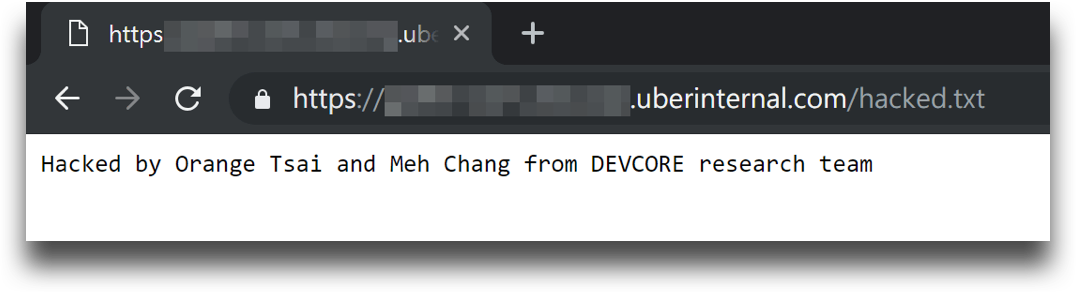
The researchers tested the bug on one of Uber’s internal Palo Alto-run servers, they said. Uber quickly fixed the bug, but said its internal infrastructure was safe.

1

A screenshot showing the researchers compromising an Uber VPN server. (Image: supplied)

The researchers also used the vulnerabilities to expose flaws in systems belonging to Twitter, said Tsai. “We got the root privilege on Twitter’s most important VPN server successfully and got the highest severity and the highest bounty from their bounty program,” he said.

When the researchers privately contacted Palo Alto about the bugs, the company said the bugs had already been “found internally” and did not issue a corresponding public security advisory. Following Tsai and Chang’s writeup, some were critical of Palo Alto’s response. Security researcher Kevin Beaumont said in a tweet that it looked like the security giant issued a “silent fix” for this “really serious bug” without alerting anyone. About one-third of the internet-connected boxes he tested were vulnerable as of last week, he tweeted.

Palo Alto eventually issued an advisory, a day after Tsai and Chang posted their blog post detailing the bugs.

Fortinet also released advisories for their respective bugs and have updated new firmware to fix the vulnerabilities. System administrators are advised to update their vulnerable gateways to the latest versions.

Pulse Secure’s chief marketing officer Scott Gordon said the company notified its customers in late-April of the vulnerability and an available patch. Gordon said the company is “not aware” of any exploit.

Palo Alto acknowledged it fixed the bugs but did not address criticism from the security community.

A spokesperson for Fortinet did not comment when reached prior to publication.

It’s the latest round of VPN-related bugs this year. In April, Homeland Security warned enterprises about a rash of vulnerabilities in many major corporate VPN providers — also affecting Palo Alto and Pulse Secure, as well as Cisco and F5 Networks.

Tsai and Chang are set to release details of the Pulse Secure and Fortinet flaws in the coming days.