Year: 2019

23 Jul 2019

WeWork accelerates IPO plans, plots September listing

WeWork chief executive officer Adam Neumann is already rich, but soon all of the early employees and investors of the co-working giant will be too.

The business, now known as The We Company, has accelerated its plans to go public, according to a new report from The Wall Street Journal. WeWork is expected to unveil is S-1 filing next month ahead of a September initial public offering.

WeWork declined to provide comment for this story.

The New York-based company, valued at $47 billion earlier this year, has long been rumored to be plotting a massive IPO. The WSJ reports it’s now in the process of meeting with Wall Street banks to secure an asset-backed loan upwards of $6 billion in what could be an effort to downsize its upcoming stock offering. WeWork disclosed massive 2018 net losses of $1.9 billion in March on revenue of $1.8 billion. To convince Wall Street it’s a business worthy of their investment will be a challenge, to say the least. Seeking capital elsewhere ahead of the IPO manages expectations and ensures WeWork ultimately has the cash it needs to continue its global expansion. Here’s a look at WeWork’s expanding revenues and losses:

  • WeWork’s 2017 revenue: $886 million
  • WeWork’s 2017 net loss: $933 million
  • WeWorks 2018 revenue: $1.82 billion (+105.4%)
  • WeWork’s 2018 net loss: $1.9 billion (+103.6%)

WeWork has raised a total of $8.4 billion in a combination of debt and equity funding since it was founded in 2011. Its IPO is poised to become the second largest offering of the year behind only Uber, which was valued at $82.4 billion following its May IPO on the New York Stock Exchange.

WeWork is said to have initially filed paperwork with the U.S. Securities and Exchange Commission for an IPO in December, in part so it was ready to hit the public markets if other avenues for cash fell through. The business is one of several tech unicorns to attract billions from the SoftBank Vision Fund. Recently, the Japanese telecom giant eyed a majority stake in the company worth $16 billion, but scaled back their investment down to $2 billion at the last minute.

WeWork, despite mounting losses, is growing — fast. The company established a 90% occupancy rate in 2018 as membership totals rose 116%, to 401,000.

Still, whether WeWork, backed by SoftBank, Benchmark, T. Rowe Price, Fidelity and Goldman Sachs, will be able to match its $47 billion valuation when it goes public this fall is questionable. Early investors will be sure to see a nice return, but late-stage investors may be nervous about their prospects.

Neumann, for his part, has reportedly cashed out of more than $700 million from his company ahead of the IPO. The size and timing of the payouts, made through a mix of stock sales and loans secured by his equity in the company, is unusual, considering that founders typically wait until after a company holds its public offering to liquidate their holdings.

23 Jul 2019

Google’s bigger smart display arrives this fall

Google is just a couple of months away from releasing its first smart home device with an onboard camera.

The company quietly updated one of its support pages today, detailing that the 10″ Nest Hub Max will be available September 9 for $229. After the page was first discovered by Droid Life, the text on the site has reverted to “coming soon.”

We’ve reached out to Google for comment.

The product is the first release in Google’s Nest rebrand of its smart home line. Compared to the company’s previous smart display — the Google Home Hub — the Nest Hub Max packs an onboard camera, which can function as a security camera in addition to enabling video calls.

One of the main differentiating factors of the Home Hub (now called the Nest Hub) was its lack of camera, something that positioned it better for privacy-conscious users wary to place a Google device on their nightstand. With the rebranding and the security camera repositioning, Google may have better luck in convincing users that it’s in their best interest to put a Google-connected camera in their home.

23 Jul 2019

Facebook and OpenStreetMaps empower the mapping community with AI-enhanced tools

If we’re going to map the world, we’re not going to do it with ever-greater volumes of elbow grease. There’s just too much work to do. AI and computer vision are helpful assistants in this task, however, as a collaboration between Facebook and OpenStreetMaps has shown, laying down hundreds of thousands of miles of previously unmapped roads in Thailand and other less well-covered countries.

The problem is simply that there’s a whole lot of Earth and only a handful of people actually making maps of it. Sure, Google and Apple have dueling products — but their focus is on businesses in cities and accurate navigation, not including every dirt path and gravel road.

Yet for millions of people, those dirt paths and gravel roads are important thoroughfares, and ought to be clearly marked on maps so that they can be reached by other modern services or, you know, get directions. With thousands and thousands of miles not just unmarked but difficult to make out, the mapping community has its work cut out for it.

“Most modern algorithms, training sets, and techniques were invented to work for the areas with highly developed infrastructure. In the developing world — for example, Africa, Southeast Asia, Latin America — where roads are not well-defined, maintained, or developed, even the best-trained human eye can struggle to identify and properly classify features,” said Dmitry Kuzhanov, a mapping expert in the ride-sharing industry, in a Facebook blog post about the AI-powered effort.

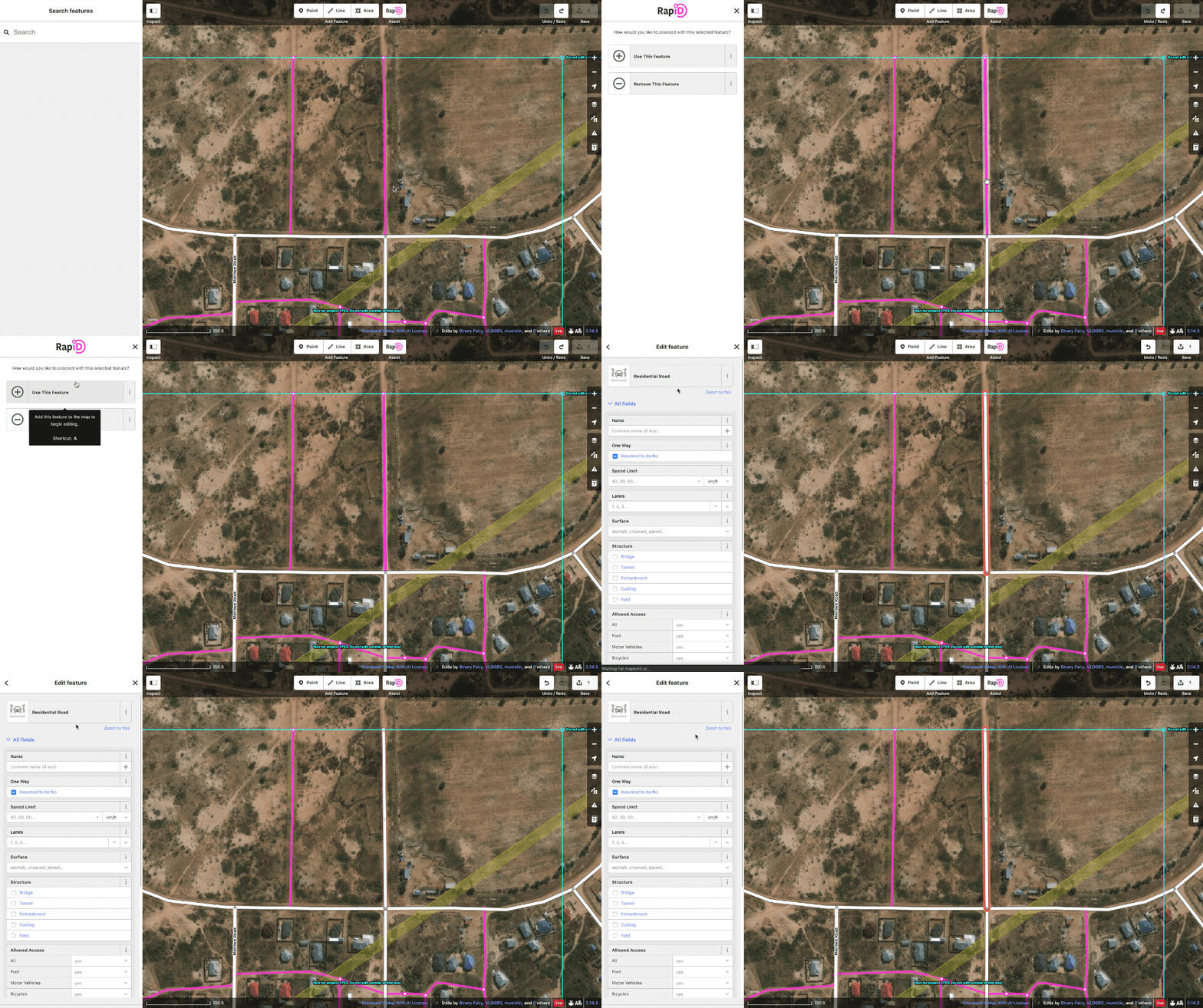
Facebook, of course, wants these far-flung folks to engage with its modern services. Over the last year and a half the company has collaborated with OpenStreetMaps and its users to map 300,000 miles of roads in Thailand, more than doubling what OSM had to begin with. The Map With AI effort resulted in RapiD, a machine learning-enhanced labeling tool that vastly accelerates the process of laying computer-readable roads on top of satellite imagery.

add ML road.gif. 1

As you can see in the first part of the video below, creating a road for the OSM system (called iD) ordinarily involves basically drawing the road on top of the satellite imagery using simple lines and curves. The second half of the video shows how in RapiD, the AI has already filled in what it suspects are roads, and the human’s job is more to confirm, negate, or slightly adjust them.

Map With AI: RapiD Editor Interface

Facebook AI researchers and engineers have developed a new method for using deep learning and weakly supervised training to predict road networks from commercially available high-resolution satellite imagery. The resulting model sets a new bar for the state of the art for accuracy, and the data is now publicly available through Map With AI (https://mapwith.ai/). This video shows Map With AI's RapiD editor interface.

Posted by Facebook AI on Thursday, July 18, 2019

Clearly the latter method is considerably faster, even though the machine learning agent that labels the roads is far from perfect. The team estimated that they did maybe five years of elbow-grease work in 18 months.

The system they created for mapping the missing roads of Thailand was robust and outperformed other street-detecting AIs out there, but the researchers found that it lost a lot of accuracy when applied to other countries. Makes sense — the features and cues that reliably define roads in one country or region may be totally absent in another. Ultimately they had to give the agent slightly fuzzier logic than that which the Thailand-centric approach had arrived at.

The deep learning techniques employed to create that improved agent are detailed in a semi-technical way in these two Facebook blog posts (much more technical information can be found in their paper). The system was trained on a huge number of map tiles from OSM’s already mapped areas, each known to have visible and semi-visible roads on them. It learned the features that define a small road and not, say, a retaining wall or creekbed; you can imagine how from orbit those might look similar.

satroads gif

The fuzzy logic approach panned out and the resulting model works well at a global scale; To show it, the project is releasing AI-powered street grids for Afghanistan, Bangladesh, Indonesia, Mexico, Nigeria, Tanzania, and Uganda, with more on the way.

The RapiD tool will be provided for the OSM community to use as well, of course. And it’s hard to put it better than Martijn van Exel, a frequent contributor to the project, who provided the following encomium for Facebook’s post:

The tool strikes a good balance between suggesting machine-generated features and manual mapping. It gives mappers the final say in what ends up in the map, but helps just enough to both be useful and draw attention to undermapped places. This is definitely going to be a key part of the future of OSM. We can never map the world, and keep it mapped, without assistance from machines. The trick is to find the sweet spot. OSM is a people project, and the map is a reflection of mappers’ interests, skills, biases, etc. That core tenet can never be lost, but it can and must travel along with new horizons in mapping.

Of course, unless you want to leave it all to Apple and Google, you could join the ranks of OSM yourself and literally help put some places on the map.

23 Jul 2019

DOJ announces investigation into big tech

The Department of Justice announced that its Antitrust Division is reviewing how the world’s largest technology companies have gotten that way and whether their business practices reduced competition or hurt consumers.

In a statement the DOJ said that it will consider “widespread concerns that consumers, businesses, and entrepreneurs have expressed about search, social media and some retail services online.”

The language appears to be targeting Alphabet (the parent company of search giant Google), Amazon, and Facebook specifically.

Last week representatives from technology companies were hauled in before Congress to testify about their companies policies and practices. They were met with withering criticism from both the left and the right sides of the aisle over their businesses practices.

Amazon was taken to task for its data collection and private label practices; Google for its ad business and manipulation of search results; and Facebook for just about everything involving the scope and breadth of its business or planned businesses.

Against that backdrop it’s no wonder the Department of Justice is getting in on the action.

“Without the discipline of meaningful market-based competition, digital platforms may act in ways that are not responsive to consumer demands,” said Assistant Attorney General Makan Delrahim of the Antitrust Division. “The Department’s antitrust review will explore these important issues.”

The U.S. government has already taken some fairly extraordinary (albeit toothless) steps to bring big technology companies to heel. Earlier this month Facebook was slapped with a $5 billion fine for violating the terms of its consent agreement with the Federal Trade Commission.

The fine, which is the largest ever leveled against a technology company, represents a fraction of Facebook’s revenue and was a watered down version of penalties that some members of the FTC were looking to bring against the social media giant.

The agency was hoping to hold Mark Zuckerberg personally accountable and do more to limit practices at Facebook that are viewed by many Senators as deficient when it comes to protection of privacy and personal data.

“If the FTC is seen as traffic police handing out speeding tickets to companies profiting off breaking the law, then Facebook and others will continue to push the boundaries,” Connecticut Democratic Sen. Richard Blumenthal and Missouri Republican Sen. Josh Hawley wrote in a joint letter to the FTC earlier in the month.

23 Jul 2019

AWS launches a new tool to help you optimize your EC2 resources

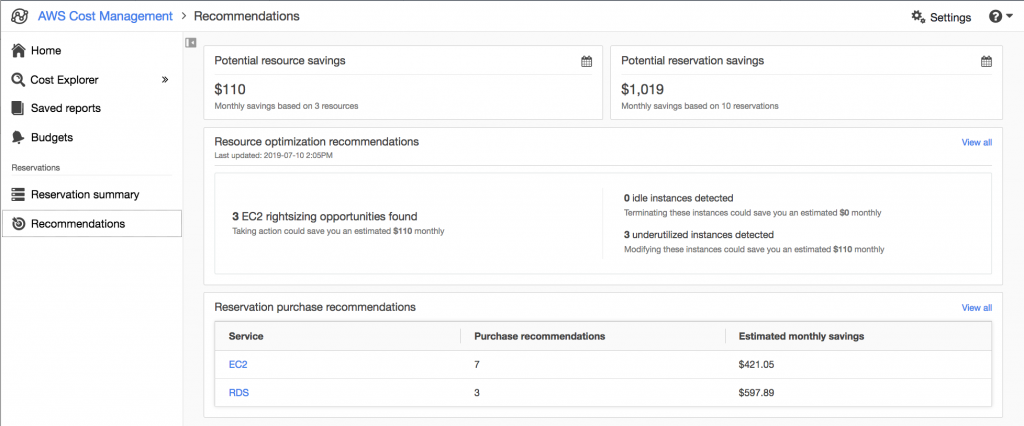
Here is a small but potentially handy update if you’re an AWS EC2 user. The company today launched a new feature called “EC2 Resource Optimization Recommendations,” which does exactly what the name promises. It’s not flashy, it’s not especially exciting, but it may just save you and your company a good amount of money (and maybe that’ll get you that raise you’ve been hoping for).

The resource optimization tool will look at your EC2 usage and give you personalized recommendations to find idle and underutilized instances. To do this, it looks at your usage history, CloudWatch metrics and your existing reservations.

Screen Shot 2019 07 10 at 11.20.43 AM 1024x426

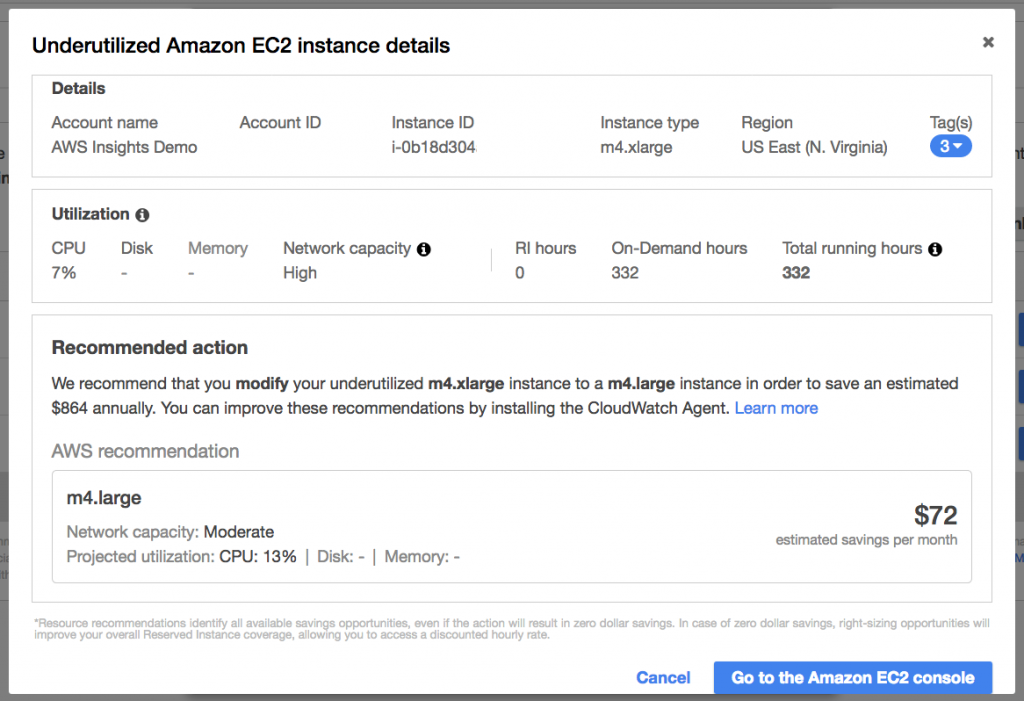
When it finds an idle instance, that is, one that has lower than 1% maximum CPU utilization, the tool will recommend that you shut it down. No surprises there. When it finds underutilized instances, it’ll present you with three different sizes that you can move to that’ll likely fit your usage patterns better than your current plan.

One caveat: this feature currently works for all standard EC2 instances, but it’s not available for GPU-based instances yet.

This new feature is now available to all AWS users. You can find it in the AWS Cost Management suite, where it’ll join the rest of AWS’ tools for keeping an eye on your budget and how you’re spending it. Nobody has ever accused AWS of having a straightforward pricing structure, so any little thing helps to make managing all of these resources a bit easier.

Screen Shot 2019 07 10 at 11.27.06 AM 1 1024x701


23 Jul 2019

Google’s Nest adds to its partnerships focused on the power grid with new Leap agreement

Google’s smart home device business, Nest, is increasing its ties to the utility industry by adding another partner to bring its smart thermostats into homes to reduce energy consumption and provide that unused power back to utilities in times of peak power demand.

Last year the company inked an agreement with OhmConnect and it has now signed another deal with the startup Leap. While the OhmConnect deal helped Nest manage end customer sign-ups, in its deal with Leap, sign-ups are handled through Nest’s Rush Hour Rewards program and Leap provides the exchange through which reduced power is provided to the utility.

The agreement will be another way for Leap to provide power to Pacific Gas & Electric under its existing 45 megawatt contract with the utility.

“Google Nest is an excellent partner to have as we continue our efforts to deliver much-needed flexible capacity in California – their decision to join the Leap Exchange is a wonderful example of using today’s increasingly smart and responsive appliances as assets that benefit the grid as a whole,” said Thomas Folker, CEO of Leap, in a statement.

According to Folker every consumer has about one kilowatt of load they can reduce over the course of a year. It’s about a $50 value per year and Folker’s Leap is installing the Nest home hub for free (a $120 value), Folker said.

It’s a way for consumers to get the Nest Hub (listening device, smart thermostat and internet of things control device) into their homes for free, while Leap handles selling the load onto the grid.

The company has about 2,500 Nest devices already enrolled in the program for about 2.5 megawatts of the 45 megawatts the company has promised to PG&E.

Ultimately, Leap thinks it can take this partnership on the road to other areas where the company’s operating including Texas and Southern California.

Nest has also done work directly with consumers in Southern California including projects with Southern California Edison, SDG&E’s programs and a load reduction deal for 50 megawatts with Southern California Edison.

23 Jul 2019

UPS forms a new subsidiary for drone delivery and seeks FAA approval to fly

UPS has big plans for drone delivery, and it’s taking two key steps to put them into action. First, it’s building its own dedicated subsidiary focused entirely on drone delivery called UPS Flight Forward, and it’s seeking FAA approval to operate its drones over populated areas, during nighttime hours and when not within view of a human operator, all of which are currently required for general commercial drone operation.

UPS will seek to gain the same certification that Alphabet’s Wing received back in April, which is a status that others including Uber Eats and Amazon Air have applied for but not yet received, as noted by The Verge.

One of the biggest shipping companies in the world, UPS basically needs to have some kind of play in the drone delivery field, whether or not that actually ends up being the future of last-mile logistics. Amazon, as mentioned, is seeking similar approval, and has been very aggressive in terms of their marketing and promotion of their drone delivery efforts.

Earlier this year, UPS partnered with drone startup Matternet to pilot medical sample deliveries in North Carolina, and the company demonstrated drones delivering packages from trucks back in 2017 in Florida, although the tests actually didn’t go as smoothly as UPS probably would’ve liked.

It’s nectar exactly how long it will take UPS to get approval, but the carrier seems confident it’ll be before year’s end, at which time we might see more in terms of actual commercial delivery service by drone rolling out.

23 Jul 2019

TD Ameritrade is bringing customers’ financial portfolios into the car

TD Ameritrade has integrated with in-vehicle software platforms Apple CarPlay, Android Auto and Amazon’s Echo Auto to give customers the ability to check their stock portfolio or get the latest financial news while sitting behind the wheel.

TD Ameritrade launched the suite of in-vehicle experiences this week, the latest move by the company to place investors just a voice command or click away from a stock price or other financial information.

TD Ameritrade Chief Information Officer Vijay Sankaran called this a “natural next step” and another way the company is “using complex technology to weave investing seamlessly into our daily lives.”

For now, customers won’t be able to make trades within the vehicle. Although that might be another “natural next step,” considering the trajectory of TD Ameritrade. Customers already can trade over the phone, via a desktop computer or mobile app and more recently through Amazon Alexa-enabled devices.

Instead, the features will depend on which in-vehicle software platform a customer is using. For those with Apple CarPlay, customers can keep track of real-time market news with a new TDAN Radio app from the TD Ameritrade Network. The network will broadcast news live via audio streaming optimized for CarPlay.

Drivers using the Android Auto and Echo Auto platforms have the option to use voice commands to unlock market performance summaries and sector updates, hear real-time quotes, check account balances and portfolio performance.

“In a connected world like ours, we have to meet investors where they are, whether at home, in the office, or on the go,” Sunayna Tuteja, head of strategic partnerships and emerging technologies at TD Ameritrade said in a statement. “In-vehicle technology offers a new type of connectivity that further breaks down barriers to accessing financial education and markets.”

23 Jul 2019

Healthcare startups struggle to navigate a business world that’s set up for them to fail

Digital health startups seem to be struggling to the point of failure. Many insights into why have addressed how technology’s traditional model of quickly putting out a minimum viable product then finding useful applications and business models isn’t working. The model might work in the general technology startup space, but it rarely goes well in the complex world of healthcare. Dr. Paul Yock, a cardiologist and founder of the Byers Center for Biodesign at Stanford University, built his brainchild program on one philosophy to help healthcare startups: need-based innovation.

Need-based innovation is a process in which problems are identified and sorted based on impact and opportunity. Once the top problem has been selected, solutions and commercialization are approached.

While I completely agree with need-based innovation, our healthcare system is set up to discourage all forms of  innovation right now. We also must tackle changing the ecosystem that healthcare startups need to navigate. As a physician-innovator, I have experienced how institutional policies, hierarchical and administrator-driven systems and pilot program dynamics are creating a stunted ecosystem that is not reaching its full potential.

When approaching any stakeholder a health startup usually works with — an advisor, a healthcare system, a pilot site — the wheel often needs to be reinvented. The entrepreneur is faced with a time-consuming and costly disadvantage that frequently forces them to enter deals that hurt them. The deals also counter-intuitively hurt the stakeholder that they are bringing on board because the technologies and companies on which they are counting are set up to fail. There needs to be a clear set of rules for everyone to play by to accelerate growth, with the philosophy that “a rising tide lifts all boats.”

These are the most crushing challenges of the current ecosystem that need a hard look and innovation themselves before healthcare startups can deliver.

Challenge 1: Institutional policies and hierarchical systems stunt innovation

Many healthcare startups are born during a founder’s time at a healthcare or educational institution. The institution promises to foster the innovation and make the nuances of the legal landscape easier. However, institutional innovation policies are not optimized to foster innovation, but rather to maximize ownership and financial returns. Most policies will require all filed patents to run through a “Tech Transfer Office,” which is assumed to provide value by performing Freedom to Operate searches and helping file for provisional patents.

Unfortunately, in today’s world of software, patents are somewhat less valuable and relevant than they once were. If any IP is filed, the institution will claim ownership and will consider licensing it to the inventor for a royalty agreement. Sometimes, if the institution does not believe in the ability of the inventor to carry the IP forward to commercialization, they will even cut them out entirely from the agreement.

An additional approach that is becoming more common within innovation policies is an equity stake in any companies started by an institutional employee, regardless of the existence of IP or whether the institution was interested in it. All of the above scenarios obviously take more from the healthcare startup than they give before an innovator even has time to blink.

Challenge 2: Healthcare doesn’t understand early-stage tech companies

Why are these policies designed this way? Part of the problem stems from stakeholders confusing medical technology with biotechnology (aka pharma). The innovation pathway within biotech is very well-defined, with established business models, established precedent and understandable risk profiles. It is quite common for drug discovery to start in the academic setting. Investors, boards and executive teams are accustomed to this model and can plan accordingly. Licensing patents and collecting a royalty on biotech sales is a market norm.

When it comes to early-stage technology companies, their challenges and early development are drastically different. The two critical resources an early-stage company has are cash and time. The goal is to unlock additional capital with product-market fit, and these companies need maximum flexibility to be able to move quickly to find it. Unfortunately, investors see the healthcare space as complex and high risk, which is true. So these startups face fundraising challenges for the space they are in, as well as unnecessary additional hurdles from the home institutions, increasing the likelihood of scaring away already skittish investors.

Challenge 3: Pilots are set up to hurt more than help

Startups are often completely dependent on partnerships or deals with larger healthcare organizations in order to grow and survive. These deals often start with a pilot. Unfortunately, the dynamic between giant healthcare institutions and tiny idealistic startups for pilots is not actually set up to be mutually beneficial.

In this scenario, healthcare systems have nothing to lose, orders of magnitude more resources and seemingly infinite amounts of time. Their incentive is to differentiate and “own” unique technologies so their competitors cannot get their hands on them. This is where startups often and understandably can make a big mistake — they believe the partner brings more value to the table than they do. For example, just having a pilot, even if it’s unpaid, with a major institution seems like it could help win over investors or additional customers. This leads to a spiral of events that frequently ends in sending startups into a trajectory toward failure (aka death by pilots).

We need innovators and administrators to come together and agree on common standards and rules to make the process more efficient, fair and effective.

Due to the lack of urgency and the intense bureaucracy, the sales cycle is long, sometimes one to two years, often lasting longer than startups have cash left to burn. Second, as mentioned, the pilot is frequently unpaid, or I have seen situations where an institution will even charge a startup for a pilot, leading to less cash and equity, which is already in short supply. Finally, onerous terms are often instituted, in which companies agree to unnecessary exclusivity or impossible goals. This doesn’t even take into consideration the challenges around deployment with HIPAA, security concerns and data sharing.

The ultimate result is that healthcare institutions that want to add value to their system by improving outcomes and decreasing costs will often doom the very technologies they believe are worthwhile. This dynamic is so well-established that many investors, even those well-versed in healthcare, will refuse to invest in institutional-oriented technology companies. My company, Osso VR, has had representatives of hospital systems approach us saying, “Don’t work with us. It will kill your company.”

Promising opportunities ahead

What if innovation policies were designed so that instead of focusing on what they can take from their spin-out companies, they focus on what value they can add? Stanford’s StartX accelerator program has a model where they commit to investing in 10% of any round a company raises after they leave the program, but it’s up to the company to choose whether or not they want StartX to participate. Unsurprisingly, almost all companies take advantage of the investment offer. These incentives help companies succeed and allow StartX to share in that success.

We need innovators and administrators to come together and agree on common standards and rules to make the process more efficient, fair and effective. One example we might follow is from Y Combinator. Raising money used to be expensive due to the amount of confusing legal documents required and corresponding legal fees. The time and expense could sometimes cause a deal to fall through, or a company would run out of money.

Its SAFE note investment document solves accounting difficulties and challenges around early-stage investment. This document has been validated by founders and investors, allowing entrepreneurs to raise money with little to no legal fees and a turnaround time of a day or two. Organizations like the American Medical Association, AdvaMed and the Consumer Technology Association have the buy-in, validation and potential to start tackling these processes. Standards could be set for protected innovation time, structured innovation positions and fellowships for organizational employees, and deal templates and best practices to shorten sales cycles and avoid onerous terms.

These problems are large, endemic and complex, but I am optimistic we can begin to work together to solve them to maximize our common interest: increasing the value of global healthcare.


23 Jul 2019

Snap’s 2019 comeback continues with heavy user growth in Q2

After a tumultuous public debut, the state of Snap is improving and Wall Street is responding.

The social media messaging company is up nearly 12% after-hours following a beat on Q2 earnings, announcing 388 million in revenue versus the Zack’s Consensus Estimate of $358.5 million, and a loss of $0.06 EPS versus an expected $0.10 loss. The financial were better than expected, but the real surprise was the healthy user growth.

Snap said they had hit 203 million daily active users (up 8% year-over-year), while that had only been expected to reach 191.7 million. The company announced they had 190 million DAUs last quarter and despite the year-over-year decrease, the stock had a strong rebound as investor expressed a renewed faith in the company’s ability to bring new users onto the platform.

In guidance for the next quarter, Snap is expecting revenue of $410 million and $435 million.

In its earning release, the company specifically highlighted how its Android app redesign had driven further engagement on that platform, saying they saw a “10% increase in the retention rate of people who open Snapchat for the first time.”

“The growth in our community, engagement, and revenue is the result of several transitions we completed over the past 18 months,” CEO Evan Spiegel said in a statement. “We look forward to building on our momentum and making significant ongoing progress in each of these areas.”

The company’s share price has nearly tripled since 2019’s start, though it still has a long way before it reaches its 2017 debut price.

We’ll have more details from the call starting at 2pm PT.