Year: 2019

23 Jul 2019

Daimler and Bosch’s driverless parking gets OK to operate without human supervision

We’ve reached a new milestone in the long road to getting AI-based self-driving systems to be truly autonomous.

Daimler and Bosch have now received approval from German regulators to run their automated driverless parking function without a human safety driver behind the wheel — making this the world’s first fully automated driverless SAE Level 4 parking function to be officially approved for everyday use. The nod comes four years after the companies started working together on the technology.

“This decision by the authorities shows that innovations like automated valet parking are possible in Germany first,” Bosch board member Dr. Markus Heyn said in a statement. “Driverless driving and parking are important building blocks for tomorrow’s mobility. The automated parking system shows just how far we have already progressed along this development path.”

Level 4 is a designation by SAE that means the vehicle can handle all aspects of driving in certain conditions without human intervention. Up to now, there have been other Level 4 trials in the works, but all of them have involved people behind the wheel as a back-up.

Bosch, one of the largest automotive tech and hardware suppliers in the world, handles the infrastructure piece of the automated parking function, which works in concert with Daimler’s vehicle tech on its Mercedes-Benz vehicles. Users access the autonomous valet service via a smartphone app.

Bosch and Daimler started developing fully automated driverless parking in 2015. That initial partnership included car2go, the car-sharing unit of Daimler. The companies debuted the so-called automated valet parking function in 2017 at the parking garage of the Mercedes-Benz Museum. The following year, and after intensive testing, museum visitors were able to test the automated parking service with one important caveat: a human safety driver was always behind the wheel.

Visitors were able to reserve vehicles from the facility using a smartphone app. Their vehicle would arrive autonomously to a designated pick-up spot in the parking garage. Once visitors were through with the vehicle, they could deliver it to the drop-off zone. The vehicle would then drive itself to its assigned parking spot, guided by the garage’s infrastructure and onboard sensors.

The pilot program was rather narrow in scope and restricted by the inclusion of a safety driver. But it served an important purpose for Bosch, Daimler and even other companies hoping to deploy automated driving functions in Germany.

Germany doesn’t have an official approval process for automated driving functions without a human driver. From the outset, Bosch and Daimler included authorities from Stuttgart and the state of Baden-Württemberg’s transportation ministry along with with experts from the German certification authority TÜV Rheinland.

As one might expect, the group assessed the safety of Bosch and Daimler’s parking function. But the process also helped regulators come up with a guidelines for testing and approval criteria that can be applied beyond this pilot project in one parking garage in Stuttgart.

For instance, Bosch and Daimler tested lighting concepts on the vehicles pilot project. The companies used turquoise lighting to indicate that a vehicle was in automated driving mode and informed passers-by and other road users that the vehicle is driving itself. The recently issued SAE standard 3134 reflects Bosch and Daimler’s insights on these lighting tests.

This isn’t the only Bosch-Daimler project in the works. The companies formed a partnership in 2017 to bring fully autonomous vehicles to urban roads “by the start of the next decade.” Last year, the companies announced plans to pilot a robotaxi service in San Jose, California.

The robotaxi trials, which will use automated Mercedes-Benz S Class vehicles, are supposed to begin in the second half of 2019 in a geofenced area in the San Carlos and Stevens Creek corridor between downtown and west San Jose. The pilot will use an on-demand ride-hailing service app operated by Daimler Mobility Services.

The rides will all be monitored by a safety driver.

Meanwhile, Bosch is building a $1.1 billion facility designed to produce semiconductors used in self-driving cars, smart homes and smart city infrastructure. The Dresden-based chip fab is set to start producing silicon commercially in 2021, and construction is supposed to be completed in 2019.
23 Jul 2019

Berlin’s Visionaries Club outs two new €40M micro funds for seed and growth-stage B2B

Visionaries Club, a new European VC focussing on B2B, is disclosing that it has raised two micro funds of €40 million each, aimed at pre-seed/seed and Series B, respectively. The Berlin-based VC firm is founded by Sebastian Pollok and Robert Lacher.

Pollok was a VC at e.ventures in San Francisco and also founded Amorelie, which exited to to Pro7Sat.1 Media Group at a valuation over $100m in 2018. Lacher was previously founding partner of La Famiglia, where he is said to have been an early investor in companies such as FreightHub, Coya, Asana Rebel, OnTruck, and Personio.

LPs in Visionaries Club include numerous successful European founders, such as Hakan Koc (Auto 1 Group), Jochen Engert and Daniel Krauss (Flixbus), Johannes Reck (GetYourGuide), Dominik Richter (Hello Fresh), and Florian Gschwandtner (Runtastic).

Investors in the funds also include family businesses of Markus Swarovski, Shravin Mittal, Felix Fiege (Fiege Logistics), Christian Miele, Max Viessmann (Viessmann Group), and members of the Siemens, Henkel and Bitburger families.

In an email Q&A with Pollok and Lacher, we dug a little more into Visionaries Club’s remit, its steadfast focus on B2B, why it is doing seed and Series B but not Series C, and the pair’s views on Brexit.

TechCrunch: Why B2B?

RL: We believe the next big wave of disruption will happen in the B2B space, with the potential to re-shape the backbone of our European economy. Reinventing the B2B IT stack is the here-and-now opportunity since there is no reason for any part of the value chain not to be digitized in the long run if there is potential to streamline and automate processes.

SP: In the past 15 years we had a great wave and momentum of consumer-driven companies. But if you look at our European industry landscape, our true DNA are especially those industrial world market leaders that we’re famous for. Most of them run a profitable business, but often fail to manage the digital transformation on their own. That´s where we see the opportunity for us!

With our network-driven approach, we want to bridge the information asymmetry of “what´s possible” in the technology startup space and “what is actually needed” in the industrial space. With Visionaries Club, we bring those two worlds together to fuel the next wave of disruption.

TC: Visionaries Club has two funds, one for pre-seed/seed and one for later growth rounds, and plans to invest in B2B startups across Europe. On the seed fund, can you be more specific regarding the size of cheque you write and the types of companies, technologies, business models or B2B sectors you are focussing on?

SP: Sure! We are planning to invest between €500K to €1.5M into great B2B founders in the pre-seed and seed stage taking around 10% ownership in their companies. We love to look at technologies that kill inefficiencies across the B2B value chain and create a significant (10x) improvement – starting from sourcing and procurement platforms, modular production systems, warehouse automation, new digitally-enabled logistics platforms to more digital after-sales solutions.

RL: The nice thing about these technologies is that almost every company has a supply chain and the same problems: So most technologies here are relevant across verticals and create big market opportunities to tap into for startups. Great examples of recent European champions in this space are Celonis for process mining, UiPath for RPA or Graphcore in the AI-driven processor space – all of them B2B fast scalers, and all of them relevant across verticals. And the next generation is in the starting blocks with companies like Munich-based Arculus which has re-invented production with a modular approach already serving their first customers Audi and Porsche and now expanding to other verticals.

TC: The Visionaries Club growth fund is targeting Series B and is designed to enable you to double down on the most promising startups in your portfolio and even later stage startups you haven’t yet invested in. Related to this, you explicitly say you have chosen Series B as you want to avoid overcrowded Series A rounds. What is your thinking here?

RL: There has been a significant influx of capital into the European VC ecosystem in the last two years with most VCs having raised bigger funds with €100 – 350M in size focusing on the Series A stage as an entry point. First and foremost: This is an amazing development for founders and our ecosystem, since great founders can choose with which fund they want to team up.

SP: At the same time the VC landscape has become a red ocean for the many Series A focused VCs competing for the same stage and ownership, with the value propositions of many funds being rather similar. We want to stay out of this game and build a complementary VC product for the early growth stage where B2B tech founders can choose one of the Tier I European or US funds as a lead while we co-invest with a smaller check bringing in our industrial LP network to help them scale.

TC: You say that the importance of money has decreased in venture capital and that in 2019 access and network has become the most important currency to get into the best deals. How do you plan to access to the most promising companies Europe and what makes your network standout (because, frankly, every new VC is trading on the same promise)?

SP: Fair point! What separates us from other VCs is that we really have 1) only leading entrepreneurs as investors in our fund 2) that these entrepreneurs are both from the old and new economy and 3) that we take our approach also to the early growth stage.

As to our seed fund: Our 12 unicorn founders are great satellites and scouts in the market to access deals via their entrepreneurial networks early before they get “into the market” for fundraising. At the same time they have already been a great support in our past investments joining board meetings and helping young teams to transition from a seed to a growth company because they have just went through this same process themselves.

RL: As to our growth fund: We believe our biggest USP is the family business entrepreneur network from the industrial space as we can help B2B companies refine their product market fit and scale within our network. Lead gen in B2B is one of the most difficult challenges for startups, since you don’t win customers via digital channels such as Facebook. It is a “foot on the ground” business – we can help companies build those relationships faster.

Compared with typical publicly-listed corporates, family business entrepreneurs have an entrepreneurial DNA themselves, make fast decisions, are willing to take bigger risks and think long-term: All ingredients which make them a great sparring partner for B2B entrepreneurs in their growth stage.

TC: Both funds are relatively small, and you say this is deliberate. What are the advantages of a micro fund and also the disadvantages?

RL: It gives us more agility to co-invest with other great funds instead of competing which is good for founders because it is all about getting the most value-add on board. We also do not expose founders to a signaling risk at the early stage since we only lead Seed rounds and then support our founders in raising their Series A with one of the larger Tier I founds from our network while keeping our pro-rata share.

On the downside: It gives us less management fee ;) But since this is really not what we’re optimizing for anyway that’s ok. We also put our own money into the funds and want to keep our Visionaries Club team small and agile.

TC: Is Brexit good or bad for European tech or arguably just bad for the U.K.? Perhaps you can provide your perspective on Brexit as an early-stage VC firm based in Europe but outside of the United Kingdom.

SP: It’s bad for both ecosystems! Take the Oxbridge-London triangle alone where you have some of the world’s best researchers and technologists and where one of the most important assets is a direct line of cooperation between ground-breaking research on the one hand and leading industrial corporates on the other side as key driver to commercialize promising technologies. We have now seen the first corporates from Germany and France re-locating or closing down their UK offices which will make it tougher to collaborate. As to our goal of helping to form more European champions this is a very sad development.

On the other hand the London startup & VC ecosystem has matured and brought up amazing funds and entrepreneurs to back the next generation of founders. We hope that the VC and startup ecosystem will ignore Brexit wherever it can and see this still as a collaborative European play to be successful: We promise that we will try to do that whenever possible!

23 Jul 2019

The cyber libel trial against independent news startup Rappler’s CEO and one of its former writers starts in Manila

The cyber libel trial against Maria Ressa, the CEO and executive editor of independent media startup Rappler, started today in Manila, in a case that will be closely watched because of its implications for press freedom in the Philippines. Also on trial is Reynaldo Santos Jr, a former researcher and writer for the site. If convicted, both potentially face years in jail.

Before co-founding Rappler, Ressa, a Time Magazine Person of the Year for her work exposing corruption and fighting misinformation, served as CNN’s bureau chief in Manila and then Jakarta. Ressa is an outspoken critic of the Philippine’s president, Rodrigo Duterte, and Rappler has often reported critically on Duterte’s administration. In turn, Duterte has accused Rappler of being funded by the CIA and publishing fake news.

Both Ressa and Santos were arrested earlier this year on cyber libel security charges for an article published in 2012 that reported on the alleged ties between Supreme Court Justice Renato Corona, who was impeached in 2011, and wealthy businessmen including Wilfredo Keng. Keng filed the cyber libel complaint against Ressa and Santos in 2017.

The five year gap between the publication of the article and Keng’s complaint is an important issue in the trial, because there is usually only a one-year prescriptive period for ordinary libel in the Philippines’ penal code. In order to charge Ressa and Santos, the Department of Justice extended that period to 12 years for cyber libel, which Rappler counsel J.J. Disini has argued could impact constitutionally-protected rights.

Prior to Ressa’s arrest, Rappler’s registration was revoked by the Philippines’ Securities and Exchange Commission, for allegedly breaking a law that prohibits overseas ownership of media companies, though Rappler said its investors, including Omidyar Network and North Bridge Media, used Philippine Depositary Receipts, which do not give voting rights or board membership and have also been used by other companies like ABS-CBN, the national broadcaster.

23 Jul 2019

US mobile bank MoneyLion raises $100 million at ‘near unicorn’ valuation

There’s a new fintech startup in the U.S. that is inching closer to the unicorn status. New York City-headquartered MoneyLion, which provides customers both financial advice and access to loans and other services, said today it has raised $100 million in a new round to accelerate its growth in the U.S. market.

The Series C round million for the six-year-old startup was led by Edison Partners and Greenspring Associates, MoneyLion said. MetaBank and FinTech Collective also participated in the round, while Capital One made a strategic investment.

MoneyLion also raised $60 million in venture capital and debt in Q2 2018, a spokesperson told TechCrunch. This was not previously disclosed. This means MoneyLion has raised over $200 million to date, with its current round valuing the startup at nearly $1 billion, a person familiar with the matter said.

MoneyLion, which describes itself as a mobile bank, operates a part lending, part savings and part wealth management app. The all-in-one platform allows users to connect all their bank accounts and credit cards and receive personalized advice on how to better spend their money and also secure loans from within the app.

The startup makes most of its money from subscription services — that cost $19.99 per month — it sells to consumers, Dee Choubey, founder and CEO of MoneyLion, told TechCrunch in an interview. The subscription offering bundles banking, core investment management, and access to financing.

Choubey didn’t say how many subscribers MoneyLion has, but noted that more than 5 million customers use the app. This includes free users, who are able to access some core banking features at no cost.

MoneyLion will use the new capital refine its subscription offerings, finance model, and add new features to keep its existing users enticed to the platform, Choubey said. The app bandied out over $12 million in cashback rewards to its members and 70% of its users saw their credit score climb up by 30 points.

“You will see us investing heavily in broker dealer capabilities, training capabilities, and stock investing capabilities. We think of ourselves approaching financial services just like Netflix approaches content. We want to keep users hooked to the platform,” he said.

In an interview with TechCrunch, Chris Sugden, Managing Partner at Edison Partners, said MoneyLion has focused the last one year on bringing the entire bank offerings to its platform. And this “comprehensive, bundling, first class opportunities around banking and financial literacy” for customers is what attracted him to the startup, he said.

As traditional banks make slow moves to help the growing financial needs of its customers, a growing number of fintech startups have emerged over the years across the globe to fill the gap. In many parts of the world, including the U.S., “neo banks” are helping small and medium sized businesses automate their finances and access many additional features.

On some fronts, MoneyLion competes with a handful of players such as Chime, another mobile bank that raised $200 million earlier this year, investment service Acorn, which has more than 3.5 million users, and online money lender SoFi, which quietly raised $500 million two months ago.

23 Jul 2019

Apple’s latest Tesla hire specializes in car interiors

Another high-level Tesla engineering executive has hopped over to Apple. Steve MacManus, who was vice president of engineering at Tesla, is now a senior director at Apple, according to an update on his LinkedIn profile.

Bloomberg was the first to report MacManus had taken the position at Apple. MacManus, whose was in charge of interior and exterior engineering, is the third Tesla executive to leave and take a position at Apple this year. He had been at Tesla since 2015.

His hiring follows two other high-profile moves from Tesla to Apple, including former chief engineer Doug Field and Michael Schwekutsch, who worked on drive systems at the electric automaker.

MacManus has a deep background in industrial design, specifically vehicle interiors and exteriors. Prior to Tesla, MacManus was chief engineer of body interior and exterior of trim and hardware at Aston Martin Lagonda. He was functional manager seating and restraints at Bentley Motors and also once worked at Jaguar Land Rover .

This latest hire, and the ones before, suggest that Apple’s Project Titan, the company’s not-so-secretive effort to build a self-driving car, might be in the midst of a revival. In January, news emerged that Apple had reassigned 200 employees previously involved in its development.

At the time, an Apple spokesperson said the company had an “incredibly talented team working on autonomous systems and associated technologies at Apple” and explained that some groups were being moved to projects in other parts of the company to support machine learning and other initiatives.

Apple could not be reached for comment. TechCrunch will update the article with any new information.

23 Jul 2019

Apple’s latest Tesla hire specializes in car interiors

Another high-level Tesla engineering executive has hopped over to Apple. Steve MacManus, who was vice president of engineering at Tesla, is now a senior director at Apple, according to an update on his LinkedIn profile.

Bloomberg was the first to report MacManus had taken the position at Apple. MacManus, whose was in charge of interior and exterior engineering, is the third Tesla executive to leave and take a position at Apple this year. He had been at Tesla since 2015.

His hiring follows two other high-profile moves from Tesla to Apple, including former chief engineer Doug Field and Michael Schwekutsch, who worked on drive systems at the electric automaker.

MacManus has a deep background in industrial design, specifically vehicle interiors and exteriors. Prior to Tesla, MacManus was chief engineer of body interior and exterior of trim and hardware at Aston Martin Lagonda. He was functional manager seating and restraints at Bentley Motors and also once worked at Jaguar Land Rover .

This latest hire, and the ones before, suggest that Apple’s Project Titan, the company’s not-so-secretive effort to build a self-driving car, might be in the midst of a revival. In January, news emerged that Apple had reassigned 200 employees previously involved in its development.

At the time, an Apple spokesperson said the company had an “incredibly talented team working on autonomous systems and associated technologies at Apple” and explained that some groups were being moved to projects in other parts of the company to support machine learning and other initiatives.

Apple could not be reached for comment. TechCrunch will update the article with any new information.

22 Jul 2019

The ‘Costco of cannabis’ raises $2.8 million for a membership weed delivery service

Weed may be legal in California, but the black market is still the top spot for buyers looking for bud on a budget.

Flower Co. graduated from Y Combinator’s latest class on the promise that they could cut customers better deals by focusing on partnering with growers directly to create their own house brands while pushing users to order ahead of time. The company calls itself the “Costco of cannabis.”

The company just announced the close of a $2.8 million seed round from investors including Slome Capital, Prehype, Rob Stavis, Adam Draper, Josh Abramson, and Camille Hyde.

Even in California where weed has been legalized, the black market is still king due to the high prices buoyed by high taxes, Flower Co.’s CEO Ted Lichtenberger says the regulated market is just 1/4 the size of the unregulated market. Flower Co.’s ultimate goal is less focused on getting people to ditch their existing dispensary as much as they are focused on getting black market regulars to go legit thanks to the better deals and conveniences of their platform.

Part of building allegiance to the Flower Co. brand is the company’s membership plan. Anybody can make a purchase on the site, but members save up to 40% on purchases, a number that makes a big sticker difference when you’re buying weed by the ounce. An ounce of “Forbidden Fruit” goes for $192 without a membership and $142 with one, for example. With a membership, the company’s “House Sativa” goes for $63 an ounce.

An annual membership to Flower Co. is $119, and in addition to the discounts, users get faster delivery and beta access to the company’s “private events and concert series.” The company just recently launched a two-day delivery service for customers in Sacramento.

The company is just flexing its muscles in a few city markets in California, but is hoping that by scaling slowly they can be ready to attack new opportunities as the regulatory environment shifts.

“We understand that we’re in the first inning of what’s probably a pretty long game, because this industry, as it goes federally legalized is going to have another massive transition moment just like it’s having right now as it’s getting legalized and regulated in California,” Lichtenberger says. “So if we have a great understanding of our customers and stay focused on keeping them delighted, and then be nimble in the face of that change, then we can come out as the dominant player in the delivery market.”

22 Jul 2019

Bird is raising Series D round led by Sequoia at $2.5 billion valuation

Bird is raising a Series D round led by Sequoia Capital at a $2.5 billion valuation, TechCrunch has learned. Sources, however, did not indicate the size of the round.

This round follows reports from The Information that Bird was looking to raise $200 million to $300 million by the end of this summer, at a post-money valuation of more than $2.3 billion.

Bird declined to comment on the funding round, saying it does not comment on rumors or speculation.

Sequoia Capital previously led Bird’s $300 million Series C round back in June, with Roelof Botha joining Bird’s board at the time. Sequoia declined to comment on the round, but Botha did say the Bird team “exemplifies grit.”

“What they’ve accomplished in achieving both rapid growth and strong unit economics is rare for a company this complex and so early on,” Botha said in an email to TechCrunch. “Bird’s innovation across a spectrum of disciplines to achieve operational excellence at scale, including hardware design and manufacturing, vehicle maintenance and repair, optimization of Bird charging and deployment, and city-level regulatory affairs is unparalleled.”

Last week, Bird CEO Travis VanderZanden said Bird has positive unit economics on its new Bird Zero scooters, which accounts for more than 75% of its fleet. But based on one of the images VanderZanden tweeted, it seems that figure is based on a period of four weeks in the summer when scooter ridership is likely higher.

In June, Bird acquired Scoot in a deal worth less than $25 million. That acquisition marked Bird’s first expansion into traditional bicycles and mopeds. Shortly before that, Bird unveiled a two-seater hybrid bike/moped vehicle called the Bird Cruiser. In addition to offering shared vehicles, Bird is also selling scooters directly to consumers.

Prior to this round, Bird had already raised more than $400 million in funding and reached a valuation of $2 billion last June.

*An earlier version of this story said the round had closed. Bird is still finalizing the round with Sequoia.

22 Jul 2019

Sony WF-1000XM3 wireless earbuds review

I would have had a review of the WF-1000XM3s up sooner, but they arrived while I was traveling. That was a bummer for two reasons. First and most obviously is the fact that I hate being late with a review. Second and more selfishly, I really wanted to try them out on those 16-hour flights I just took to Hong Kong and back.

It’s a use case for Sony’s new fully wireless earbuds. The company’s clearly got the Bose market firmly in its sights with a pair of premium buds sporting plentiful battery life and active noise cancelling.

As I noted in our preview a couple of weeks back, companies tend to go in one of two directions with these devices. There are the more active fitness products (see: Jaybirds and Powerbeats) and the general lifestyle ones (Airpods, et al.). It’s clear which market Sony is going after here — it’s exactly the same one it went after with its QuietComfort-besting over-ear headphones.

The XM3s (as we’ll refer to them from here on to save our poor “0” key) lack obvious fitness features like waterproofing and ear stabilizers for those who like to take their headphones for a run. If that last bit applies to you, these will do in a pinch, but you’ll want to look elsewhere for a running partner (Sony’s got the equally pithily named WF-SP700N for that).Those looking for a travel buddy, on the other hand, could do much worse.

IMG 4496

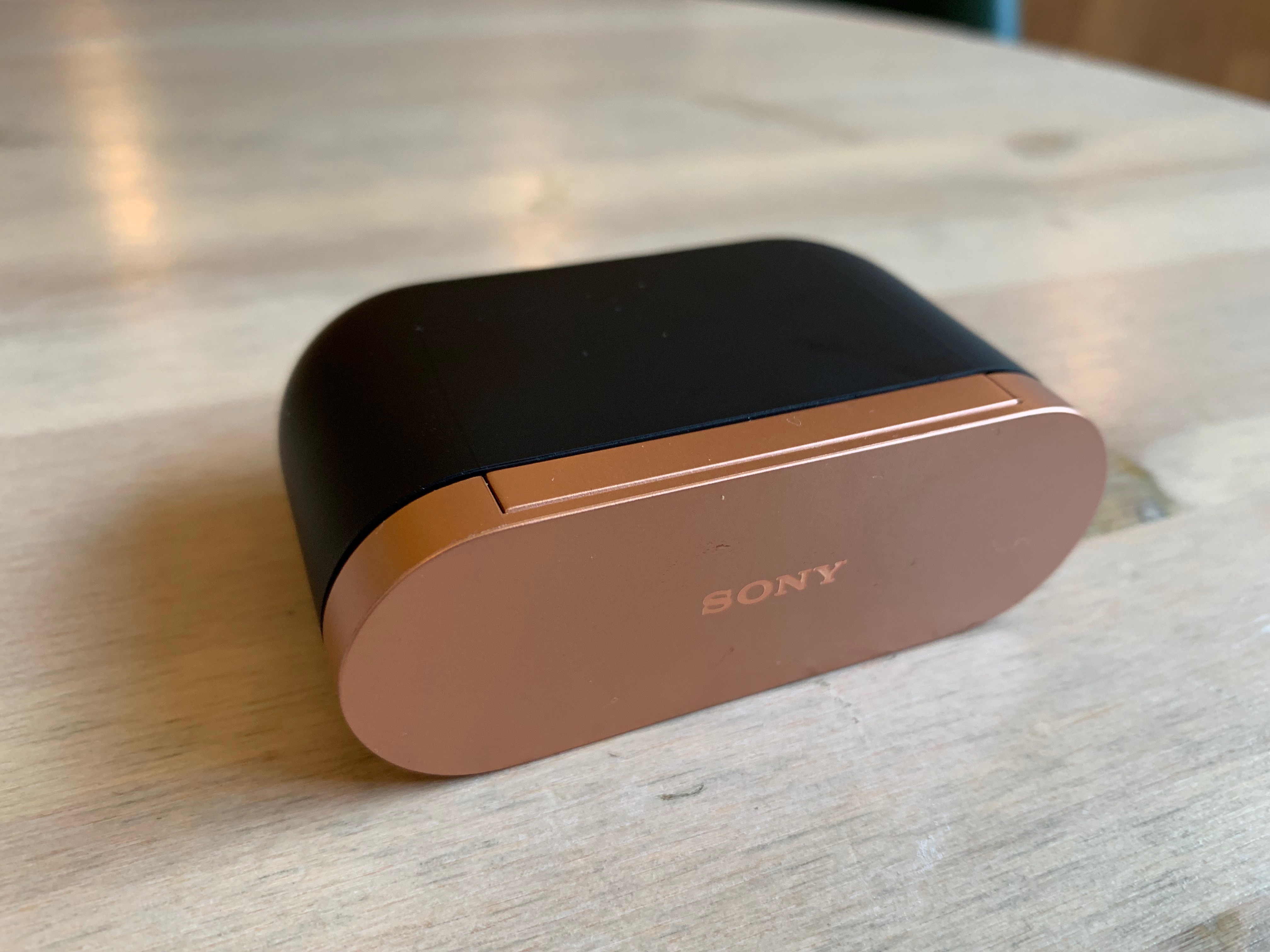
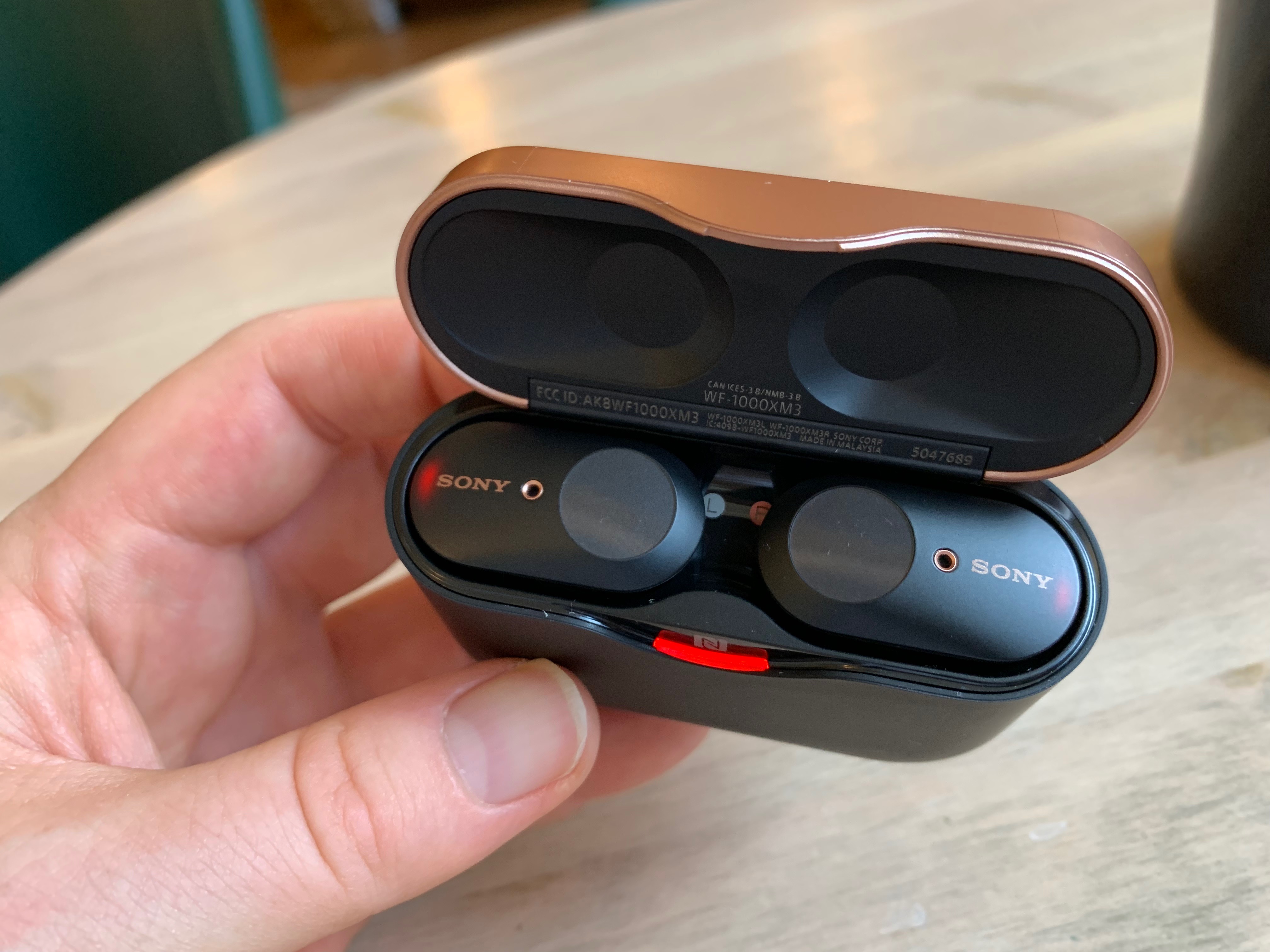
As Beats did with the Powerbeats Pro, Sony opted for battery life over portability with the XM3 case. Sony’s case isn’t quite as massive as Beats’, but it’s still probably too large for most pockets. The good news there, however, is that with a rated six hours of battery with active noise cancelling on (eight without), you should be fine leaving the case at home much of the time.

Add the charging case into the mix and that number comes out to a full day of music playback with ANC and 32 hours without. Using the USB-C port on the bottom should get you 90 minutes of playback with a 10-minute charge. There’s no wireless option for charging — much like AirPods, that’s got “gen two” written all over it.

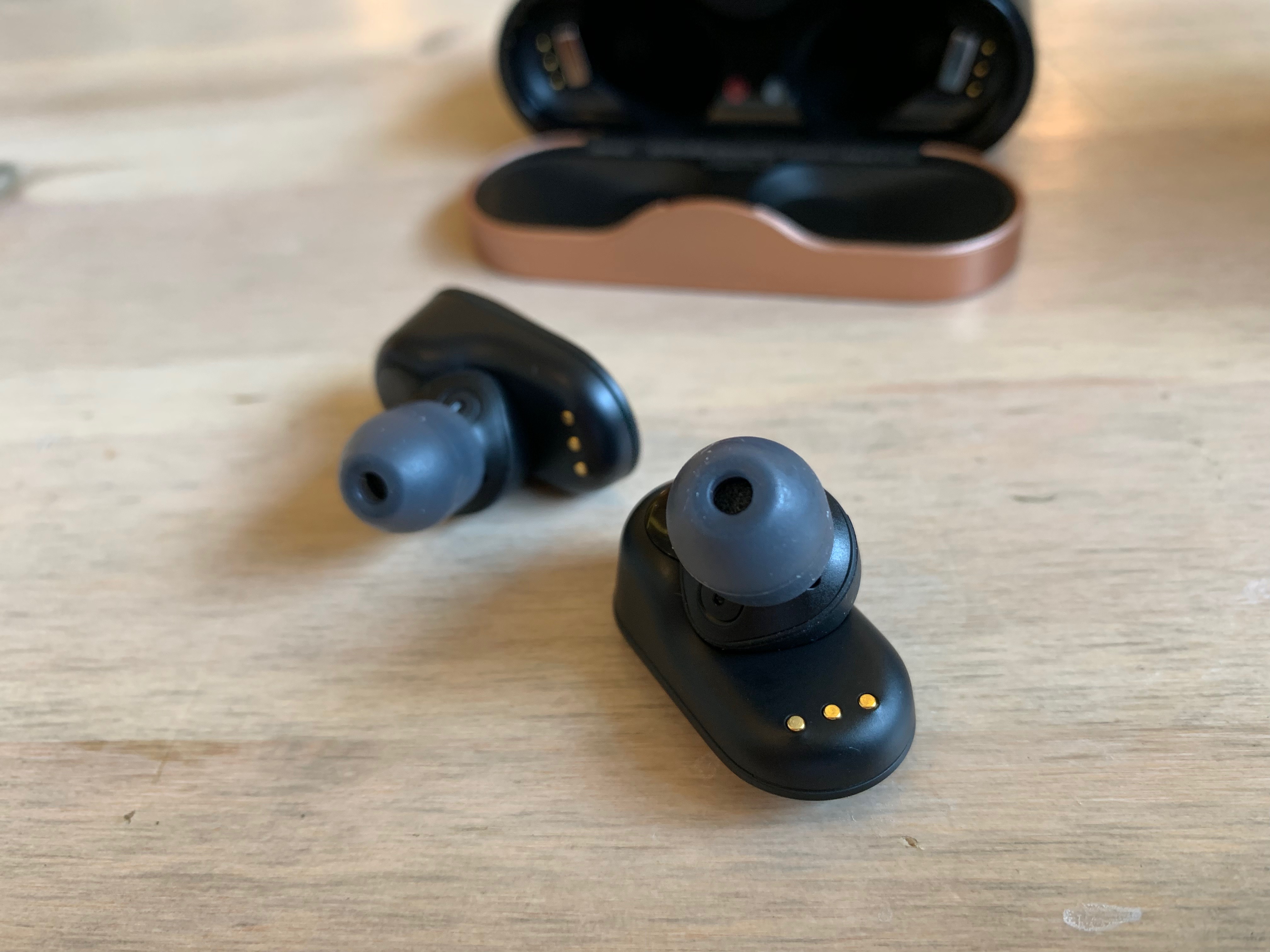
The XM3s maintain a similar oblong design as the sportier 700N. They’re small and subtle in black or silver, unlike the attention-grabbing bright white AirPods. In fact, they look a bit like Bluetooth headsets. To get the right fit, insert them into the ear facing down and twist up 90 degrees. I admit that I left it facing down the first time I tried them on in a demo. Rookie mistake.

The earbuds ship with swappable silicone tips, though I found the default set to be a pretty good fit for my own ears. There’s no mechanism for keeping them in place, but they’re small enough that they shouldn’t move around much, even with some light jogging. Though, again, I’d caution against that, as Sony hasn’t offered up anything in the way of sweatproofing here.

Audio quality has come a long way since the earliest days of the Bluetooth earbud. I was impressed with what Sony was able to pack into such a small form factor. This latest generation of earbuds has made it clear that the smaller size no longer means having to compromise on sound. And indeed, the XM3s offer solid sound for a pair of Bluetooth buds, with a full and rich sound featuring a good balance and plenty of bass.

IMG 4493

More impressive is the active noise cancellation — something that, up until recently, one assumed would have to be sacrificed on a pair of small wireless buds. A tap of the touchpad on the side will toggle in and out of noise cancelling and an ambient mode which lets in more sound for those instances when it’s required. The latter is probably another step toward a world where we carry on in-person conversations without taking the earbuds out. But we were heading that way anyway. At least Sony’s done a good job implementing the tech here.

Interestingly, the two earbuds form their own individual Bluetooth link to the synced device. That helps cut down on lag and also means they can operate independently from one another. In a few cases, I had issues with one bud cutting out, which was a bit annoying, but there’s something to be said for having the other one maintain its connection. The independence of left and right also means that audio reports like battery levels are reported separately.

IMG 4489

At $230, the XM3s slot in between AirPods and Powerbeats. iPhone users will miss the lack of automatic pairing with the W2 chip, but NFC means quicker pairing for Android users. All told, there’s a lot to like from these buds. They’ve got good sound, excellent noise cancelling and a long battery life.

They’re not great gym companions like the Powerbeats — but they’re not really designed to be. For those who travel a lot or are simply looking for a solid day to day headphone, the XM3s are among the best out there.

22 Jul 2019

Original Apollo 11 landing videotapes sell for $1.8M

VCRs didn’t really exist when the first men walked on the moon, but NASA was ahead of the curve and recorded the event for posterity on videotapes — which just sold at auction for $1.8 million. The Hasselblads may have captured more detail, but there’s nothing else in the world quite like these tapes.

On July 20, 1969, Buzz Aldrin and Neil Armstrong stepped out of the Lunar Module and onto the surface of the Moon, under the watchful eye of a camera custom-made by Westinghouse for the purpose. It was mounted just outside the hatch so Aldrin could turn it on and establish a connection before he and Armstrong performed their famous descent of the LM ladder.

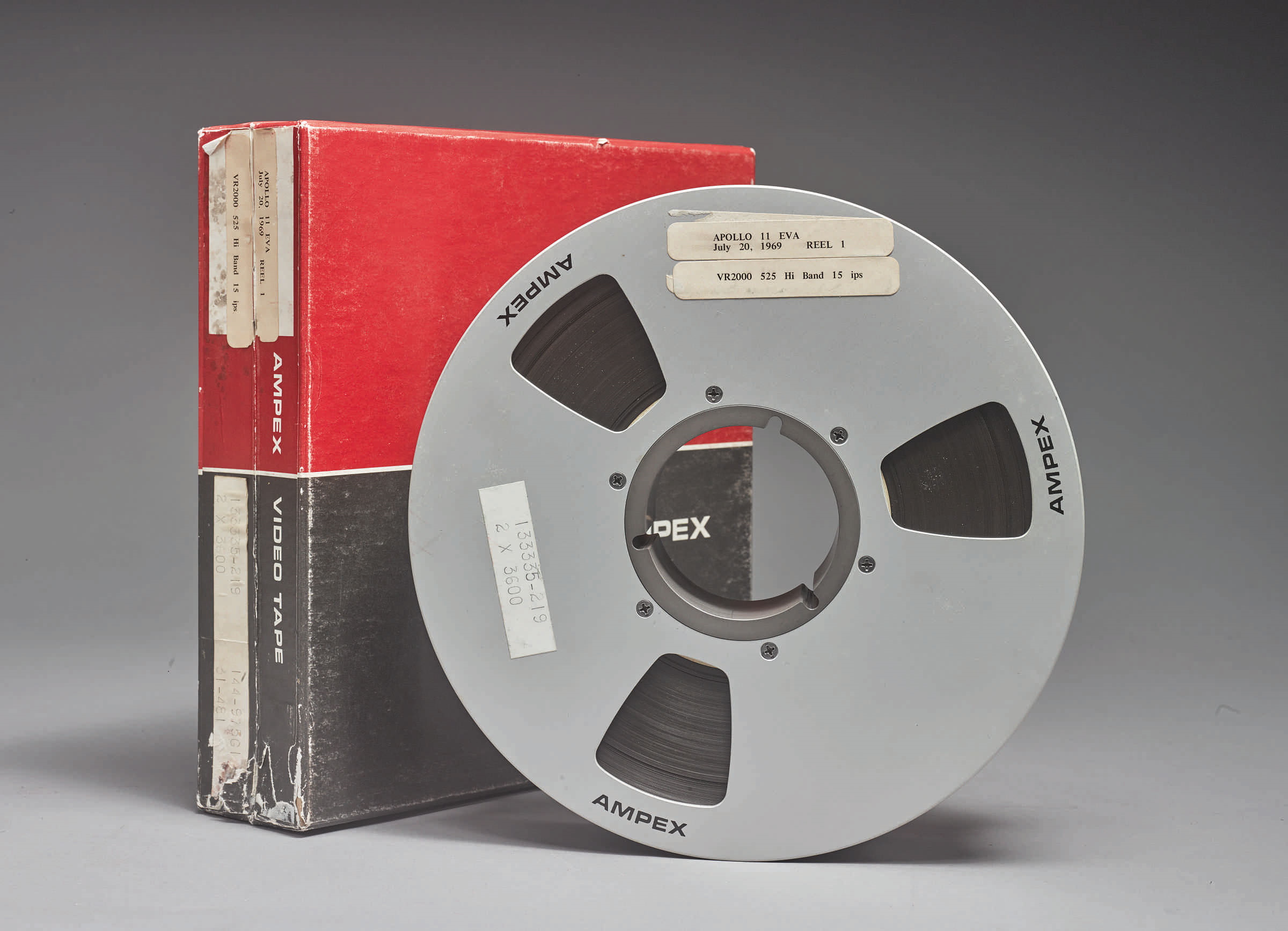
The camera, which was later detached and set on a tripod to capture the other surface activities, was transmitting 10 frames per second over the LM’s high-gain antenna back to Parkes Observatory in Australia. There they were recorded onto a set of large-format reel-to-reel videotape, then retransmitted to Houston, where they were recorded to 2-inch Quadruplex videotape on an Ampex VR-660B. Of course it was then formatted for TV and sent out to the world as well.

Sadly, the original Australian slow-scan tapes were apparently later reused for other purposes, in probably the most egregious taping-over incident of all time. That means the Ampex tapes were the best known motion picture recording of Apollo 11’s lunar EVAs.

Sadly again, those original tapes were sold for $217.77 at a government surplus auction in 1976 as part of a lot of over a thousand other reels of Ampex videotape obviously thought to be no longer needed. The purchaser, Gary George, was an intern at NASA’s Johnson Space Center, and he had bought the tapes because he thought he could make a bit of scratch re-selling them to TV stations.

Apollo 11 Tapes Reel 1

Fortunately for everyone, George noticed that three of the tapes had labels reading “APOLLO 11 EVA | July 20, 1969.” These, he reasoned, might be worth keeping. Turns out they were more than two hours of raw footage, including “One small step for man” and everything else that the world saw transpire live, but in better quality than any other copy on Earth. As Sotheby’s puts it:

The present videotapes are the only surviving first-generation recordings of the historic moon walk, and are sharper and more distinct than the few tapes that have survived from the contemporary network television broadcasts – all of which endured some loss of video and audio quality with each successive transmission from microwave tower to microwave tower.

Here’s a clip:

Fast forward 30 years and the tapes were finally brought out of storage for Apollo 11’s 40th anniversary, where they were shown for only the second time since he bought them in 1976, and digitized for posterity. They were played one more time by Sotheby’s experts while verifying these artifacts for auction over the weekend.

Tape is by no means indestructible and it’s amazing that these are in such great condition; that and the fervor surrounding all things Moon these days must have contributed to the tapes finally going for $1.82 million, nearly four times the half-million that the auction house had predicted. Gary George made out pretty well on that surplus buy.

Of course the purchaser has not yet revealed themselves, but perhaps in the near future we will find that it is one of the many billionaires afflicted with space madness who wanted to add this unique piece of media to their collection. And perhaps they will be generous enough to share it for public viewing — though honestly, the digital copy should be nearly indistinguishable.

Other items sold at auction for a total of hundreds of thousands more dollars are some signed Apollo 11 memorabilia, some original Apollo control panels from Kennedy’s Firing Room 1, and the first and last pages from the actual Apollo 11 flight plan that flew on the mission, which sold for about $300K by themselves. With luck those of us without disposable income in the 7-figure range will be able to view these as well.