Year: 2019

22 Jul 2019

Cyber threats from the U.S. and Russia are now focusing on civilian infrastructure

Cyber-confrontation between the U.S. and Russia is increasingly turning to critical civilian infrastructure, particularly power grids, judging from recent press reports. The typically furtive conflict went public last month, when The New York Times reported U.S. Cyber Command’s shift to a more offensive and aggressive approach in targeting Russia’s electric power grid.

The report drew skepticism from some experts and a denial from the administration, but the revelation led Moscow to warn that such activity presented a “direct challenge” that demanded a response.  WIRED magazine the same day published an article detailing growing cyber-reconnaissance on U.S. grids by sophisticated malware emanating from a Russian research institution, the same malware that abruptly halted operations at a Saudi Arabian oil refinery in 2017 during what WIRED called “one of the most reckless cyberattacks in history.”

Although both sides have been targeting each other’s infrastructure since at least 2012, according to the Times article, the aggression and scope of these operations now seems unprecedented.

Washington and Moscow share several similarities related to cyber-deterrence. Both, for instance, view the other as a highly capable adversary. U.S. officials fret about Moscow’s ability to wield its authoritarian power to corral Russian academia, the private sector, and criminal networks to boost its cyber-capacity while insulating state-backed hackers from direct attribution.

Moscow sees an unwavering cyber-omnipotence in the U.S., capable of crafting uniquely sophisticated malware like the ‘Stuxnet’ virus, all while using digital operations to orchestrate regional upheaval, such as the Arab Spring in 2011. At least some officials on both sides, apparently, view civilian infrastructure as an appropriate and perhaps necessary lever to deter the other.

Image courtesy of TechCrunch/Bryce Durbin

Whatever their similarities in cyber-targeting, Moscow and Washington faced different paths in developing capabilities and policies for cyberwarfare, due in large part to the two sides’ vastly different interpretations of global events and the amount of resources at their disposal.

A gulf in both the will to use cyber-operations and the capacity to launch them separated the two for almost 20 years. While the U.S. military built up the latter, the issue of when and where the U.S. should use cyber-operations failed to keep pace with new capabilities. Inversely, Russia’s capacity, particularly within its military, was outpaced by its will to use cyber-operations against perceived adversaries.

Nonetheless, events since 2016 reflect a convergence of the two factors. While the U.S. has displayed a growing willingness to launch operations against Russia, Moscow has somewhat bolstered its military cyber-capacity by expanding recruiting initiatives and malware development.

The danger in both sides’ cyber-deterrence, however, lies not so much in their converging will and capacity as much as it is rooted in mutual misunderstanding. The Kremlin’s cyber-authorities, for instance, hold an almost immutable view that the U.S. seeks to undermine Russia’s global position at every turn along the digital front, pointing to U.S. cyber-operations behind global incidents that are unfavorable to Moscow’s foreign policy goals. A declared expansion in targeting Russian power grids could ensure that future disruptions, which can occur spontaneously, are seen by Moscow as an unmistakable act of U.S. cyber-aggression.

In Washington, it seems too little effort is dedicated to understanding the complexity of Russia’s view of cyber-warfare and deterrence. The notion that Russia’s 2016 effort to affect the U.S. presidential election was a “Cyber” or “Political” Pearl Harbor is an appropriate comparison only in the sense that U.S. officials were blindsided by Moscow’s distinct approach to cyberwarfare: an almost seamless blend of psychological and technical operations that differs from most Western concepts.

Russian military operators conducted what should be considered a more aggressive cyber-campaign a year before their presidential election-meddling, when they posed as ‘CyberCaliphate,’ an online branch of ISIS, and attacked U.S. media outlets and threatened the safety of U.S. military spouses.

For their part, the Russians made a different historical comparison to their 2016 activity. Andrey Krutskikh, the Kremlin’s bombastic point-man on cyber-diplomacy issues, likened Russia’s development of cyber-capabilities that year to the Soviet Union’s first successful atomic bomb test in 1949.

A silhouette of a hacker with a black hat in a suit enters a hallway with walls textured with blue internet of things icons 3D illustration cybersecurity concept

Image courtesy of Getty Images/BeeBright

Western analysts, fixated on untangling the now-defunct concept of the ‘Gerasimov Doctrine,’ devoted far less attention to the Russian military’s actual cyber-experts, who starting in 2008 wrote a series of articles about the consequences of Washington’s perceived militarization of cyberspace, including a mid-2016 finale that discussed Russia’s need to pursue cyber-peace with the U.S. by demonstrating an equal ‘information potential’.

Despite Cyber Command’s new authorities, Moscow’s hackers are comparatively unfettered by legal or normative boundaries and have a far wider menu of means and methods in competing with the U.S. short of all-out war. Russian military hackers, for example, have gone after everything from the Orthodox Church to U.S. think tanks, and they launched what the Trump administration called the most costly cyber-attack in history.

In the awkward space between war and peace, Russian cyber-operations certainly benefit from the highly permissive, extralegal mandate granted by an authoritarian state, one that Washington would likely be loath (with good reason) to replicate out of frustration.

By no means should the Kremlin’s activity go unanswered. But a leap from disabling internet access for Russia’s ‘Troll Farm’ to threatening to blackout swaths of Russia could jeopardize the few fragile norms existing in this bilateral cyber-competition, perhaps leading to expanded targeting of nuclear facilities.

The U.S. is arriving late to a showdown that many officials in Russian defense circles saw coming a long time ago, when U.S. policymakers were understandably preoccupied with the exigencies of counterterrorism and counterinsurgency.

Washington could follow Moscow’s lead in realizing that this is a long-term struggle that requires innovative and thoughtful solutions as opposed to reflexive ones. Increasing the diplomatic costs of Russian cyber-aggression, shoring-up cyber-defenses, or even fostering military-to-military or working-level diplomatic channels to discuss cyber redlines, however discretely and unofficially, could present better choices than apparently gambling with the safety of civilians that both sides’ forces are sworn to protect.
22 Jul 2019

With Chandrayaan-2 launch, India’s ISRO shoots for the Moon on a shoe-string budget

India took a giant leap in its space program on Monday after its space agency launched a spacecraft that is scheduled to touch down on the Moon in September.

The Indian Space Research Organization (ISRO), which is India’s equivalent of NASA, confirmed the successful launch of the spacecraft as it inches closer to become only the fourth nation — after the United States, China, and the Soviet Union — to land a spacecraft on the Moon. Chandrayaan-2 aims to land on a plain surface that covers the ground between two of the Moon’s craters, Simpelius N and Manzinus C.

The spacecraft was originally scheduled to launch from the Satish Dhawan Space Centre, Sriharikota in Andhra Pradesh on July 15, but ISRO postponed it less than 20 minutes ahead of the deadline citing a “technical glitch.” ISRO said it resolved the issue last week.

Everything about India’s homegrown lunar mission — dubbed Chandrayaan-2 (Sanskrit for “moon vehicle”) — is a technological marvel.  The spacecraft — which is sitting atop of the country’s most powerful rocket to date, a Geosynchronous Satellite Launch Vehicle called Mark III — is carrying an orbiter, a lunar lander called Vikram and six-wheeled rover Pragyan (Sanskrit for “wisdom”). In early September, the lander, which is named after Vikram Sarabhai, the father of ISRO, is scheduled to detach from the orbiter. Until then, Chandrayaan-2 will embark on a slow journey to the Moon, staying in an elliptical orbit.

The mission’s budget is just $141, significantly lower than those of other countries, and less than half of the recently released blockbuster “Avengers: Endgame.” The orbiter is designed to operate for at least one year, but lander and rover are expected to operate for just a couple of weeks.

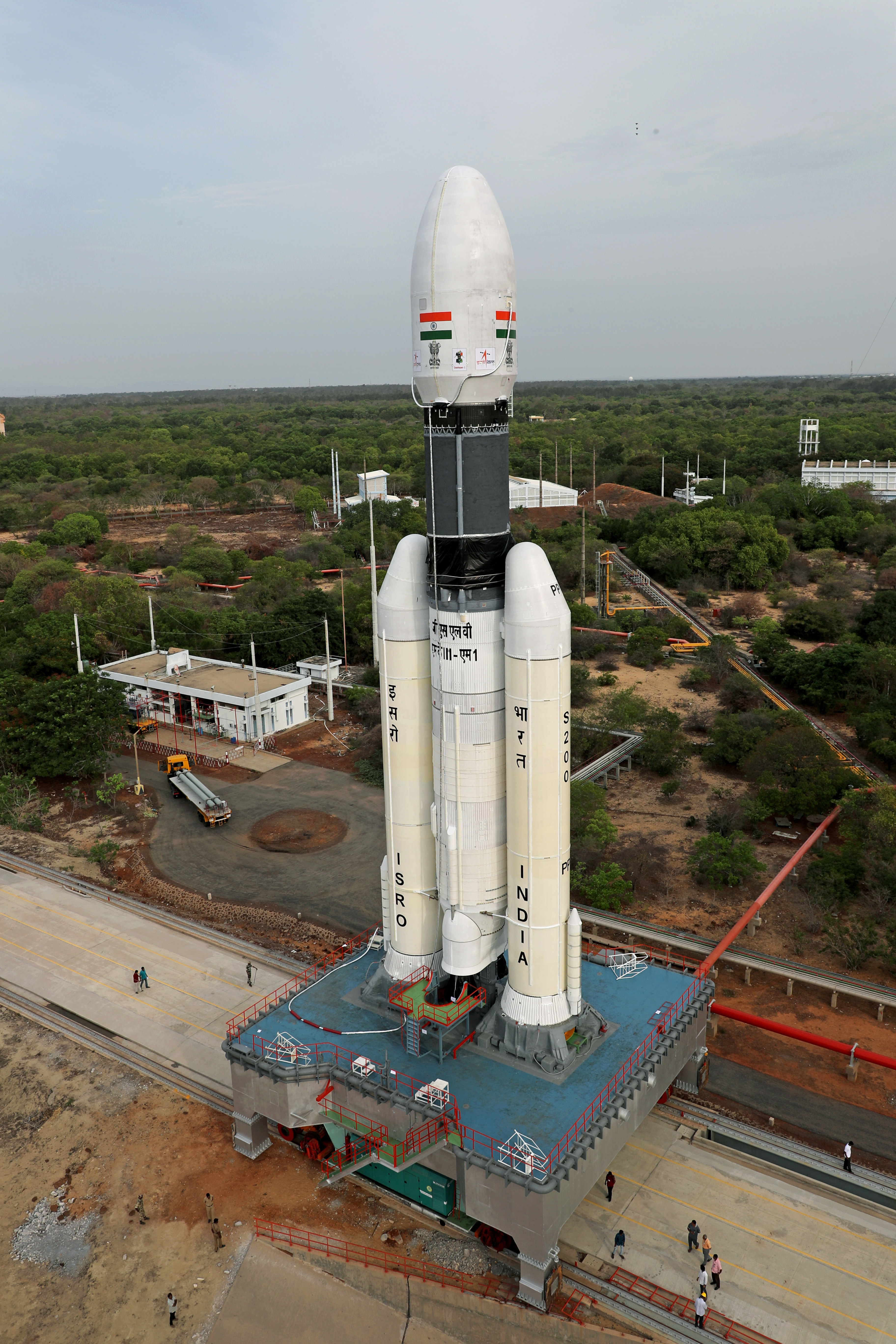
03gslvmkiii m1vehiclemountedonmobilelaunchpedestalmovingtowardsthesecondlaunchpad

The spacecraft that was launched today/ Image: ISRO

The Chandrayaan-2 mission is aimed at analyzing minerals on the south pole of the Moon, a region that has not been closely studied yet. So the Chandrayaan-2 lander is equipped with a suite of instruments, including spectrometer and cameras, among others to map the lunar surface, look for water, and measure moonquakes and temperature of the soil.

In a statement released earlier this month, ISRO said the Chandrayaan-2 will “boldly go where no country has ever gone before.”

As the name suggests, Chandrayaan is not India’s first lunar mission. In 2008, the nation sent orbiter Chandrayaan-1 that played an instrumental role in helping confirm the presence of water ice in the lunar craters. In 2013, ISRO also launched an orbiter to Mars in its maiden $74 million interplanetary mission — a fraction of the $671 million NASA spent for a Mars mission in the same year. In 2017, ISRO also deployed a record 104 satellites into the space in just 18 minutes. 

ISRO has come a long way and specialized in low-cost space launches since the early 1960s, when components of rockets were transported by bicycles and assembled by hand in the country.

Last month, ISRO unveiled its intentions to have its own space station in the future and conduct separate missions to study the Sun and Venus. It will begin working on its space station following its first manned mission to space, called Gaganyaan (which means “space vehicle” in Sanskrit), in 2022 — just in time to commemorate 75 years of the country’s independence from Britain. The government has sanctioned Rs 10,000 crores ($1.5 billion) for the Gaganyaan mission.

“While navigation, communication and Earth observation are going to be the bread and butter for us, it is missions such as Chandrayaan, Mangalyaan (Sanskrit for “Mars vehicle”) and Gaganyaan that excite the youth, unite the nation and also pave a technological seed for the future,” said Dr. Kailasavadivoo Sivan, chairman of Indian Space Research Organization (ISRO) at the time.

22 Jul 2019

Sennder raises $70M on $300M valuation to take on the freight forwarding industry

Logistics and the movement of freight from point A to B (and C and beyond) is one of the more antiquated, and less-understood aspects of the world of commerce. But one look at Amazon and how it has grown its empire on the strength of its logistics prowess (and another glance or two at the companies that have fallen down on supply and shipment costs and issues), and you can see just how much of a cornerstone it is for a business to get right. Today, a Berlin-based startup called Sennder is announcing a significant round of funding to take on that antiquated logistics market with an updated, digital platform. It has raised a Series C of $70 million, with a valuation that we understand is in the region of $300 million.

The funding — led by Lakestar with participation from Accel, Next47, H14, HV Holtzbrinck Ventures, Project A and Scania Growth Capital — is notable in that it’s the second round that Sennder has raised this year alone. (It announced a Series B of $30 million this past spring.) That underscores the current surge of investor and market interest in logistics, which is estimated to be a $400 billion market in Europe alone.

Other big funding rounds in the market have included others that compete directly with Sennder in the area of freight forwarding, such as Flexport out of the US bagging an investment from Softbank at a $3.2 billion valuation; Zencargo out of the UK raising $20 million; and FreightHub raising $30 million. In the wider market of logistics, Bringg has raised $25 million and NEXT raising $97 million.

That speaks to a very crowded market, which is where Sennder’s specialization comes into play. Its focus specifically is on one part of the market called the “full truck load” (FTL) market, which is aimed at organising, logging and optimising the cargo that lorry drivers are packing up onto their pallets, with a specific focus on smaller and mid-size trucking companies.

It’s an area that is estimated to be valued at $120 billion in Europe alone. As with other startups in logistics, the aim is to bring cloud-based communications and better record keeping, along with more efficient logistical mapping organization to an industry that has been operating largely by way of faxed or shipped invoices and even in some cases, handshakes.

In the case of Sennder, that includes not just better communication between truckers, those shipping the goods, and those receiving them, but GPS tracking to help with arrivals estimates and invoicing between truckers and shippers. Given its emphasis on small and medium trucking companies, it often works directly with the owners of the trucks themselves.

“We have pooled our knowledge and experience gathered in our previous roles to improve operational excellence in this highly complex market. Our relentless focus on product and industry pain points has helped us to deliver an impressive portfolio of global, highly satisfied enterprise clients,” said David Nothacker, who co-founded the company with Nicolaus Schefenacker and Julius Koehler, in a statement. “We believe that sennder is leading the way for the industry on digitisation, reliability and customer service.”


22 Jul 2019

Visa invests in India-based B2B payments platform PayMate’s $25M round

PayMate, a Mumbai-based startup that helps businesses automate and digitize their payments, is raising $25 million in a new round, its founder said, as it looks to expand its presence within India and in international markets.

In an interview with TechCrunch, Ajay Adiseshann, founder and CEO of PayMate, said the startup has already raised a substantial amount of the $25 million it is eyeing in its Series D. These funds came from Recruit Strategic Partners, Brand Capital, Visa, and existing investor Mayfair 101. Adiseshann said he expects the round to close in 60 days.

The 13-year-old startup, which had raised $18 million prior to Series D, began its journey as a consumer-facing payments service. But it quickly shifted its attention to opportunities in business-to-business payments market, Adiseshann said.

PayMate today develops and offers cloud-based solutions for SME and enterprise customers to help them manage invoices and payments from vendors and customers. It also works with Visa and issuing banks to offers crediting financial option to customers.

Last year, PayMate acquired Z2P Technologies, a startup that offers lending technologies, to bring lending stack on its platform. It looks at transactional data on its platform to score SMEs and offer them credits from third-party lenders. PayMate also serves as a discounting marketplace, allowing large enterprises to electronically negotiate offers with SMEs.

In India, and same is true of some other markets, small and medium businesses often struggle to secure financing options from major banks. “India is a very collateral-based in financing. On our platform, we have the visibility of their transactional data,” he said. This helps establish transparency and trust between all the stakeholders.

The startup has over 35,000 business customers that use its platform to process more than $5 billion in payments each year. It began operations in UAE earlier this year and will use the new capital to expand in Africa and parts of Europe, Adiseshann said.

22 Jul 2019

UVeye snaps up $31M for its hyper-detailed, AI-based drive-thru vehicle-scanning platform

The race is on for the car of the future, equipped with self-driving capabilities, on-board personalised information and entertainment, and an ever-smaller carbon footprint. Today, however, comes news of a startup that’s improving car performance from the outside.

UVeye, a Tel Aviv-based company that has built a set of drive-through external scanners that can take images of the exterior of a vehicle (including the tires and undercarriage) and then — using computer vision and AI — instantly read those scans to detect for anomalies, has raised $31 million in funding, money that it will be using to continue expanding its technology, as well as building out the rest of its business.

Today, UVeye is already finding applications in assessing the state of rental and used cars, helping with insurance adjustments, inspecting vehicles to diagnose mechanical or other problems, and as part of wider security efforts. Its customers include car giants, their OEM partners, insurance companies, security services and governments, rental companies, on-demand ride-hailing companies, and many others in the transportation industry whose businesses are based on maintaining or inspecting vehicles.

Amir Hever, the CEO and co-founder, noted that while there are, for example, six OEMs already working with his company, there is also a long waiting list of companies that want to work with the startup. So this is part of the reason for the funding, too: to scale up and meet that demand.

The key to UVeye is that its vertically-integrated system (which includes the scanning hardware as well as the software to read and understand the scans) is fully automated. “We give accurate reports of vehicle based on AI algorithms that are very accurate and will produce consistent results every time,” said Hever. “It’s harder to do this many inspections today because they are basically human based.”

Toyota Tsusho, Volvo Cars and previous investor W. R. Berkley Corporation are leading this round, along with another returning investor, F.I.T. Ventures, and others — strategic partners that underscore the company’s progress so far, and what trajectory it would like to follow.

UVeye said that Toyota Tsusho (a member of the Toyota Group that provides a number of car-related services such as exporting, alongside non-automotive interests) will be using its technology in used car centers and the wider automotive trading market. Volvo will be rolling UVeye out in its factories, dealerships and for aftermarket support — or “whole lifecycle” management, in the words of Hever. And W. R. Berkeley, an insurance company, has been working on business models incorporating the use of UVeye’s scanning technology to help with registrations and subsequent claims, as well as those security applications.

This funding is the first significant money that the startup has raised and brings the total raised by UVeye to about $35 million, with previous investors including two more strategic partners, Daimler and Skoda. (Impressive to note the traction so far, in fact, on so little capital.)

“Premium quality standards are at the core of the Volvo brand and we are intrigued by the possibilities that UVeye’s technology offers,” Zaki Fasihuddin, CEO of the Volvo Cars Tech Fund said in a statement. “This type of advanced scanning technology could allow us to take the next step in quality.”

“When we made our initial investment in UVeye two years ago, we believed its system could have game-changing impact within security and inspection applications globally,” said Mike Nannizzi, director of fintech investments at W. R. Berkley Corporation, in a statement. “Today’s announcement validates that early hypothesis.  We congratulate UVeye, Toyota Tsusho and Volvo Cars for building a cohesive partnership with enormous potential.”

UVeye’s technology is aiming to replace — or at least augment — a very antiquated and analog way of inspecting cars from the outside. Typically and traditionally, inspections are done by human mechanics, who then compare their findings against previous human-made assessments to identify issues. The vehicle also needs to be completely stationary during these checks. The whole process can take hours or days.

UVeye brings that down to seconds, Hever said. Currently a car can be moving up to 20 miles per hour and still be “read” as well as a car that is stationary, with the size of cosmetic anomalies — scratches and the like — capable of being as small as 2 millimeters in size. The system continues to get optimized all the time, Hever added.

Today the company continues to focus on vertical integration — that is, UVeye manufactures all its own hardware as well as develops the software that runs on it. I asked if at any point it might be able to work with the kind of camera you might typically find on a smartphone. These are improving all the time, and they are already being used as portable computers by, for example, customer service assistants at rental agencies to check-in vehicles after they have been returned by customers.

Hever said that while this may be the case, the aim for his company is to fully automate the inspection to the point that no human would need to be involved at all in that aspect.

“The market has really improved and cameras are chaning all the time,” said Hever, “But what is unique about our solution is that we are trying to make them automated.”

So, for example, scanning points could be set up at the car rental entrance / exit point to automatically take in the car details before and after it’s been used — or equally on an assembly line of a car maker or at an inspection station for an insurance company, eliminating the need for manual operators. (This obviously presents a higher IT cost to the customer, of course, although it might be justified by reducing the number of customer service agents that need to be on the payroll, and more importantly speed up the procurement and return of cars.)

Longer term, the plan will be to continue expanding UVeye’s capabilities and applications, as well as business partners. The possibilities for what it might tackle next are very interesting:

Tapping into the rise of autonomous vehicle technologies, one area that UVeye is starting to explore is how its exterior system might better communicate with the kinds of diagnostics that a car’s own internal systems are producing, to provide even more accurate assessments of problems a car might be having. (For example, in the case of engine problems and leaks, or small cracks in some of the parts, or problems with tires.)

And UVeye’s platform could potentially include expand to scanning what might be on the inside as well as the outside. Today, a lot of this is done with x-rays but there are new technologies involving sound waves and other parameters to be able to identify and verify cargo shipments — which could take the company into other verticals around shipping and logistics, as well as become even more relevant to security inspections.

22 Jul 2019

Streaming video service Iflix raises more than $50 million led by Fidelity International as it prepares to go public

Iflix, the streaming video service that competes with Netflix in Southeast Asia and other emerging markets, announced today that it has raised a new round of funding led by Fidelity International, with participation from returning investors Catcha Group, Hearst, Sky and EMC. The Malaysia-based company did not disclose the amount of the round, but said it totals more than $50 million and will be used for growth ahead of a potential public offering.

Iflix also added new media companies as investors, including MNC, Yoshimoto Kogyo and JTBC, from Indonesia, Japan and South Korea, respectively. The company currently claims 17 million active users, up from 9 million six months ago. In a press release, co-founder and chairman Patrick Grove said “These investments are a clear affirmation of IFlix’s business model and growth prospects, and strengthens our ties to some of the region’s largest providers of local content.”

The company announced seven months ago that it had sold off its remaining shares in its Africa business, called Kwesé Iflix, to focus on its markets in Southeast Asia and the Middle East. The latest round brings its total funding raised so far to more than $350 million, according to Crunchbase.

22 Jul 2019

China’s new Nasdaq-style board for tech shares starts trading with 25 companies listed

Trading on China’s new Nasdaq-style stock market began today, with 25 tech companies listed on the Science and Technology Innovation Board, operated by the Shanghai Stock Market. Called the STAR Market, the board is an initiative by the government to encourage more Chinese tech companies to list domestically by addressing concerns about governance.

Traders cautioned that initial trading may be volatile as investors buy and trade stocks, however, and that warning was borne out today with trading by several companies paused after a surge of buying triggered their circuit breakers, or measures put into place that temporarily halt buying and selling to prevent stock crashes.

Plans for the STAR Market were announced in November as part of the Chinese government’s efforts to launch capital market reforms and make listing in mainland China more appealing to tech companies by easing profitability requirements. Some of the highest-profile Chinese tech IPOs, including Alibaba, Tencent, Xiaomi, JD.com and Pinduoduo, have taken place in New York City or Hong Kong, and the STAR Market may encourage more local stock debuts and investment—a goal that holds especially high stakes as China’s trade war with the U.S. continues.

But CNBC notes that the success of the STAR Market is far from a sure thing, since China has launched two other equity markets (the ChiNext in 009 and the New Third Board in 2013) that still receive far less attention than its two primary stock exchanges in Shanghai and Shenzhen.

22 Jul 2019

White Star Capital eyes Asia growth with new Hong Kong office

For western startups looking to enter Asia and Asian startups expanding globally, more funding has become available as investors are increasingly looking to export local tech solutions to overseas markets.

Globally based venture capital firm White Star Capital has set up a new office in Hong Kong this month to capture entrepreneurs in the budding region as well as help its portfolio companies go to Asia. Founded by Eric Martineau-Fortin, who spent years conducting mergers and acquisitions at Merrill Lynch, and Jean-Francois Marcoux, who sold his gaming startup Ludia to FermantleMedia, White Star has over the last decade backed a spectrum of early-stage companies across several continents.

Currently investing with eight partners spread across seven cities, White Star’s portfolio spans from New York-based healthy meal startup Freshly, rewards app Drop out of Toronto, on-demand photo platform Meero from Paris and dog food startup Butternut Box in London.

Beginning in 2017, Martineau-Fortin and his partners began looking eastward. They decided to initially exclude China as the market was already crowded with no shortage of funding available, leading to much larger investment round sizes compared to the U.S. and Europe as well as notoriously high valuations.

The investor also believed “cultural differences in both consumer and enterprise behavior” require different regional strategies. Whilst certain Asian companies specializing in artificial intelligence, fintech, enterprise software and micro-mobility share some commonalities with Western counterparts, others such as e-commerce businesses remain, still, quite distinct in Asia.

“Having said this, there is also a number of fabulously interesting ecosystems and countries outside of Hong Kong and China that are sometimes forgotten by North American and European-based investors, such as Japan, Korea, Singapore and Taipei. Those are also very advanced regions with great schools, great engineers having certainly easy access to capital but not always the ability to connect and sell their product, services and technologies to other places than the U.S. West Coast,” said Martineau-Fortin in a phone interview with TechCrunch.

Upon that realization, White Star started to build connections with big corporations and investors in Japan and South Korea, which in 2018 led to opening its first Asian location in Tokyo headed by former World Economic Forum executive Shun Nagao.

The proven record in Japan eventually inspired the investment firm to launch in Hong Kong, adding to a list of offices in New York, London, Paris, Berlin and Stockholm. Joe Wei, a former investment banker at Deutsche Bank for more than 10 years before becoming a fintech entrepreneur, is taking the lead for White Star in Hong Kong.

The firm’s strategy is to allocate 10-15% of each fund outside of North America and Europe with the bulk of it reserved for Asia-based startups. It’s currently 75-80% through its $180 million second fund closed in 2018, and it’s looking to raise a bigger fund leading up to 2020.

Why Hong Kong

The founding partner believes Hong Kong offers great exposure to mainland China with easy access to fast-growing places as Shenzhen — which houses some of the world’s biggest tech firms such as Tencent, Huawei and DJI — while “offering a similar business environment” to the one it has experienced in New York and London.

“Not only do you have a lot of capital in Hong Kong, but you have also a bunch of new innovative ideas that are coming out of Shenzhen and other fast-growing cities in China and Southeast Asia. We think a number of these ideas could certainly be of interest for North America and Europe,” noted Martineau-Fortin.

Irrespective of where companies are based, White Star always selects them based on a set of criteria, which are: “Can we help our companies expand outside their own base? Can we offer them [help to] recruit talent from abroad? Can we offer our venture connection with certain companies that can be relevant to either the tech, distribution or manufacturing side?”

Trade tensions between the U.S. and China are not to be overlooked for anyone investing in the Greater China region. Martineau-Fortin pointed out while the trade war is negative for everyone, the impact on White Star is likely limited as its investment platform offer “unique neutrality to these challenges.”

“Perhaps the trade conflicts will have an impact on the relationship certain of our U.S. companies have with other jurisdictions, but I certainly hope it could be the opportunity for other of our portfolio companies in Europe and Canada to strengthen the strong bond which exists between Asia and China, and these regions where we have a strong presence”.

22 Jul 2019

Elon Musk says next Hyperloop competition will be in a six-mile, curved tunnel

Elon Musk planning to change up the Hyperloop student engineering competition that his company SpaceX has run for the past four years. Next year’s competition will be done in a tunnel that’s over six miles long, the SpaceX CEO said on Twitter on Sunday, with a curve instead of being in a straight line like the current, 3/4-mile test tunnel at SpaceX’s Hawthorne HQ.

That’s a big change, and one that it’s unclear how and where SpaceX will make it happen, given that the current test tunnel can support likely an additional “200 meters” according to Boring Company President Steve Davis speaking at this year’s Hyperloop Pod Competition finals earlier on Sunday.

Davis and Musk discussed extending the tunnel on stage, but it sounded like they were planning a relatively minor extension next year, with Musk musing that they’d likely be able to build a longer, Boring company-dug tunnel about three years from now for use in the annual student challenge.

“I don’t think we’ll have a long enough, straight enough underground tunnel a year from now but I think three years from now we definitely will,” Musk said during a Q&A at the competition. “So figure three years from now, we’ll at least have a couple miles […] now then you can really move.”

Musk also entertained the possibility of starting a new engineering competition around The Boring Co’s main mission: Tunnelling.

“We could maybe do a tunnelling competition, that might be good,” Musk said. “We’ll consider a tunnelling competition,” he concluded after a few seconds of thought.

“I think a tunnelling thing would be pretty exciting,” Musk said later in response to a follow-up question by one of the student team members on site. “Because as I just articulated the primary challenge is how do you tunnel effectively, especially how do you put in the reinforcing segments and get the dirt out effectively – it’s harder than it seems.”

Current digging technology can only manage a near-glacial pace, and Musk said that if we could get up to about one-tenth the speed of walking, or around a mile every three minutes, it would be a huge change in the feasibility of building a 3D network of underground transportation.

Based on his tweet later on Sunday evening, Musk has come up with a way to greatly increase the distance of the test tunnel, but based on his earlier comments about when we can expect to see a subterranean tunnel dug far and straight enough, it seems unlikely that the answer will be an underground tunnel just yet.

22 Jul 2019

Team TUM wins SpaceX Hyperloop Pod Competition with record 288 mph top speed

SpaceX hosted its fourth annual SpaceX Hyperloop Pod Competition finals on Sunday at the test tube it built outside its Hawthorne HQ. We were on site for the competition, and watched as Team TUM, from the Technical University of Munich, took home the win thanks to achieving the top speed overall of any team to run in the finals.

TUM (formerly known as team WARR Hyperloop in past competitions) is a repeat winner, and achieved a top speed of 288 mph in this year’s finals. That’s the fastest overall for a Hyperloop pod thus far – it beat its own record from last year of 284 mph set during the third SpaceX student run-off. It wasn’t without incident, however – near the end of its run, there was a spark and some debris appeared to fly off the craft, but it still survived the run mostly intact and satisfied SpaceX judges to qualify for the win.

TUM beat out three other finalist competitors, including Delft Hyperloop, EPFL Hyperloop, and Swissloop. Delft unfortunately had a communication error that cut their run short at just around 650 feet into the just over 3/4 mile SpaceX Hyperloop test track. EPFL managed a top speed of 148 mph and Swissloop topped out at 160 mph.

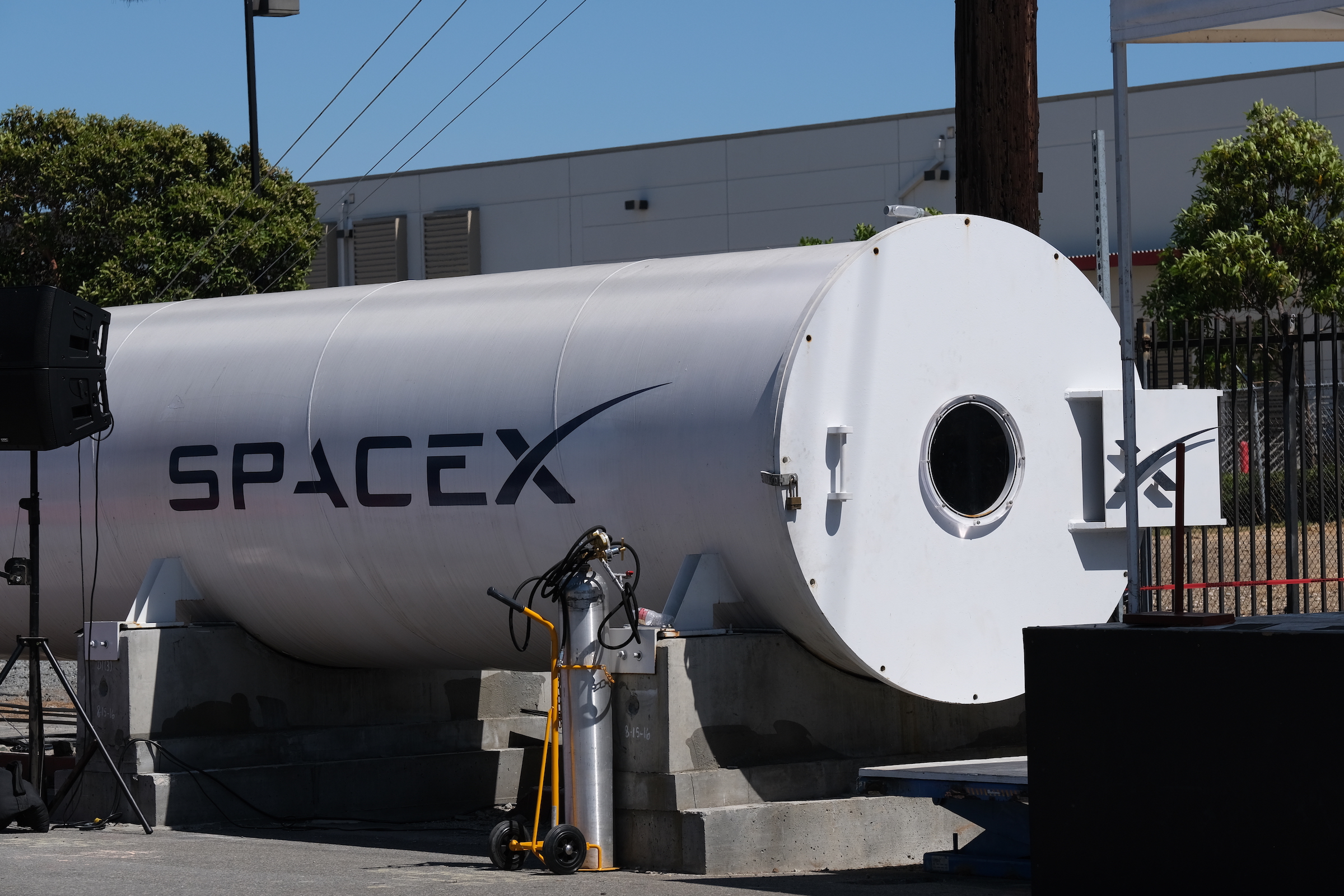
hyperloop pod competition DSCF2408

SpaceX Hyperloop Pod test track at its Hawthorne HQ. This is the end where student teams load in their test pod during the annual competition.

For the teams that did get to run on Sunday, the process involved loading their pod, which are roughly the size of bobsleds but little more than engines on wheels, onto the single track which runs the length of the interior of the Hyperloop test tube. The tube is then sealed and de-pressurized to near vacuum, which is essentially how Musk’s original Hyperloop concept envisioned the super-speed transportation method would work.

All the teams gave a good showing, and the total number of student teams was actually 21, with over 700 individual sin total taking part in the competition from a variety of schools including Cal Poly, the University of Wisconsin-Madison, the Indian Institute of Technology and my own alma mater the University of Windsor (who worked with St. Clair College on their pod).

Teams had to prove to their SpaceX and Boring Company staff advisors that they were ready to run in the tube in order to qualify for the finals, and spent two weeks prior to the finals on Sunday trying to do just that. Of those 21 teams, only the four finalists managed to get the green light to run in the final competition, based on advisor criteria that includes safety and survivability of their pod design. There’s a kind of ‘good luck’ mantra at the competition of saying ‘Break a pod’ prior to a run, but SpaceX engineers don’t actually want team pods to experience catastrophic failure inside the tube while on a run. This year, the competition was even more challenging because all pods have to use their own communication systems for the first time, and the pods must be designed to propel themselves to within 100 feet of the far end of the tube before they stop.

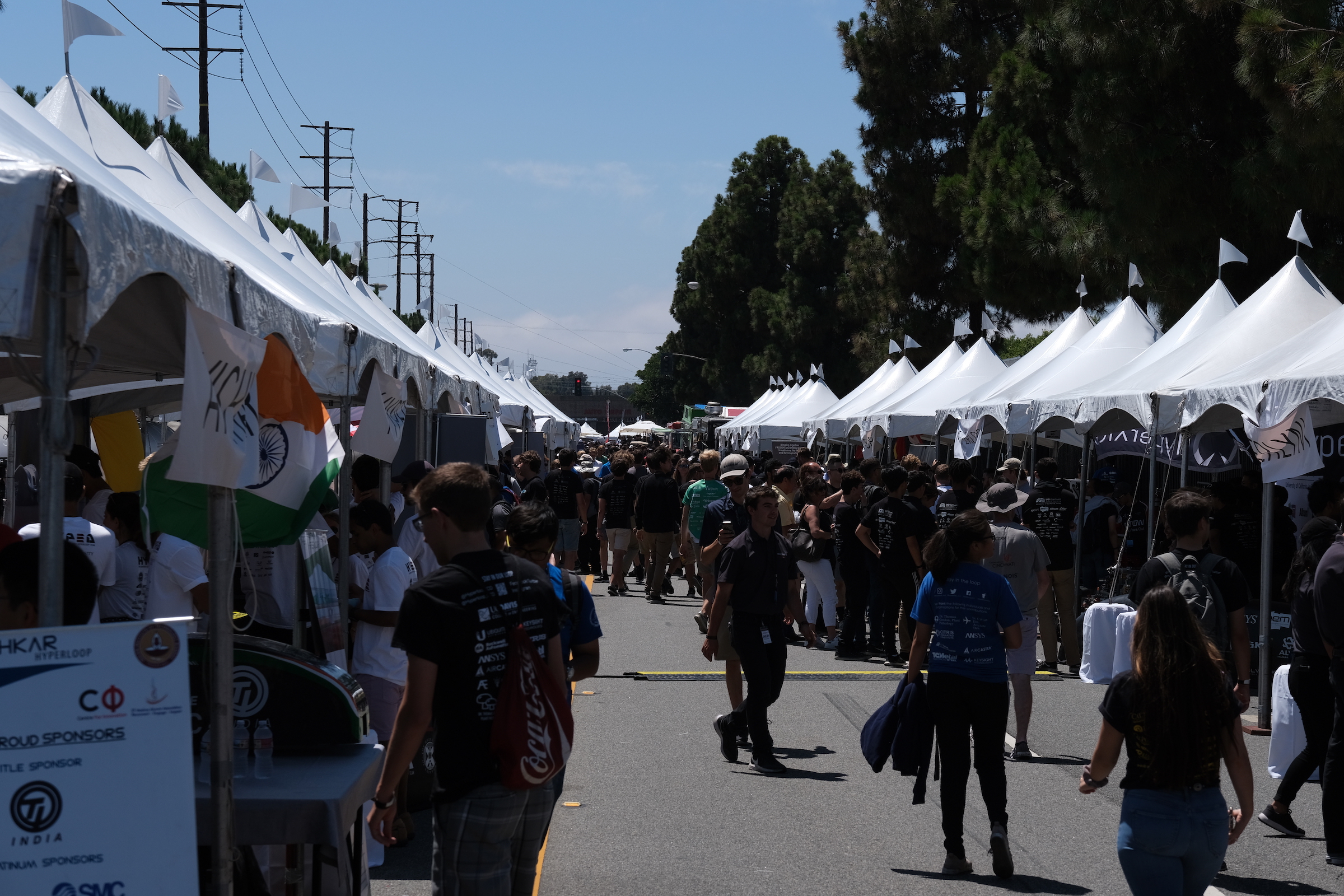
hyperloop pod competition 2019

21 teams in total competed in this year’s competition, and they all brought their pods to display on race day, even though only four finalists actually ran their pods through the test track.

Most of the teams I spoke to who failed to qualify were dismayed but also resolute on coming back and qualifying next year. Some did express a bit of frustration about the gap between some of the teams from smaller schools, and those in the final four (who do qualify repeatedly year after year). Many of the finalists have deep-pocketed corporate backers, including Airbus, while some of the smaller schools have next to no funding – resulting in a cost delta of hundreds of thousands of dollars when it comes to the total bill for the test pods built.

That said, all the teams are clearly thrilled to be able to participate, and see the competition as a chance to essentially get scored to work at one of Musk’s many high tech ventures, including SpaceX, Tesla and The Boring Company. For those companies, too, it seems like a no-brainer to attempt to recruit from the engineering ranks of these best-in-class technical undergrad and graduate students.

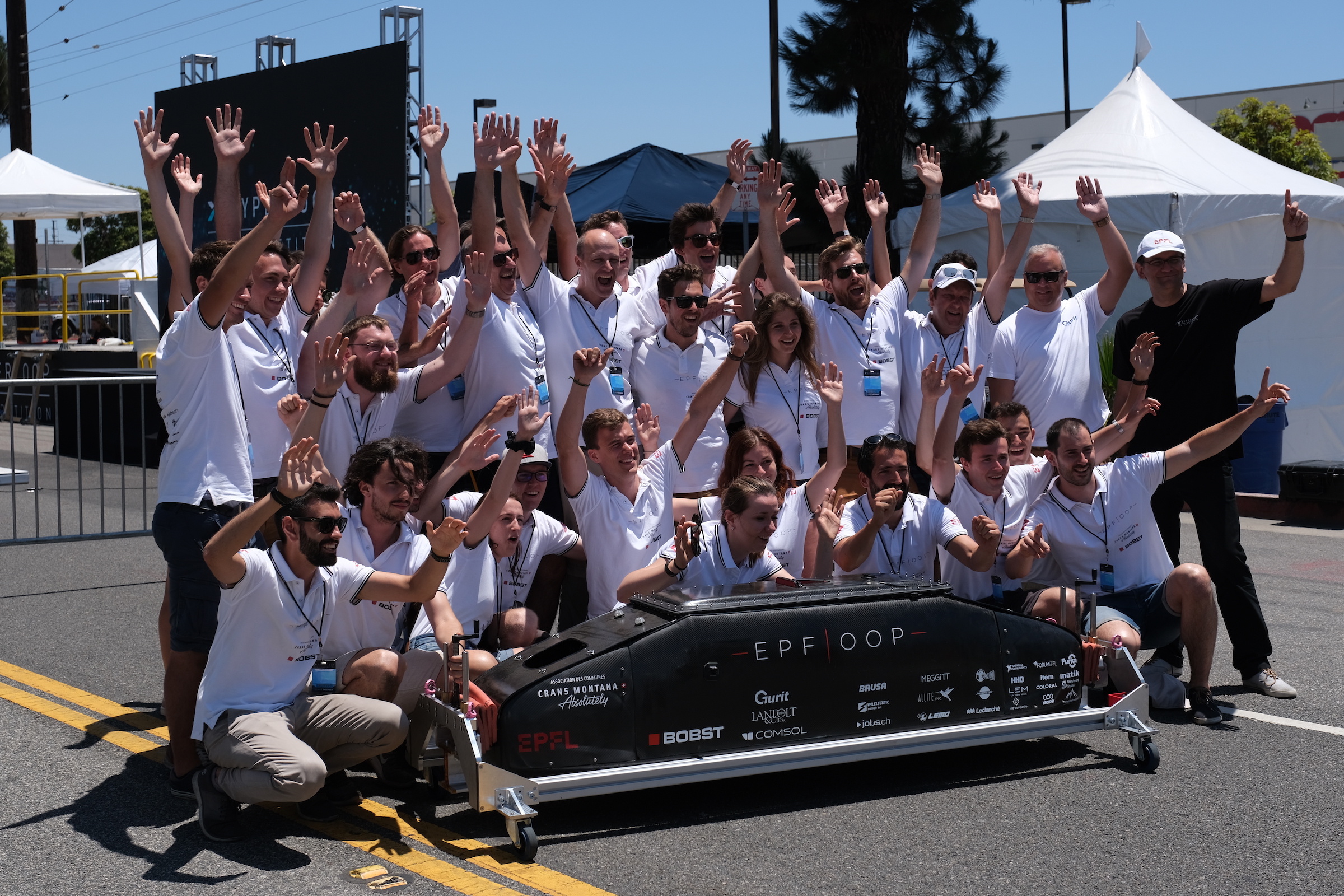
hyperloop pod competition epfl 1

EPFL Hyperloop didn’t win the competition – but they have reason to celebrate, since at least some graduates will probably ‘win’ jobs at Musk’s various companies.

“I think the competition is fun, and inspiring and also useful technology comes out of it,” Musk said regarding the purpose of the event, before answering a final question from Boring Company President Steve Davis about whether or not there will be another competition next year – “Oh yeah of course,” Musk replied, to much applause from the crowd of competitors.