Year: 2019

20 Jul 2019

Original Content podcast: We’re not on the same page about ‘Frankenstein’s Monster’s Monster, Frankenstein’

Just to get this out of the way: “Frankenstein’s Monster’s Monster, Frankenstein” is a great title. In fact, it’s probably the best thing about the new comedy special on Netflix .

That’s not a complaint about the special itself, which stars David Harbour (a.k.a. Chief Hopper on “Stranger Things”), as both David Harbour Jr — an actor taking on the role of Frankenstein in a play also called “Frankenstein’s Monster’s Monster, Frankenstein” — and David Harbour III, an actor who investigates his father’s life decades later.

If this sounds needlessly complicated don’t worry. As we explain on the latest episode of the Original Content podcast, the plot mostly serves as a springboard lots for jokes about actorly jealousy, Chekhov’s gun and the fact that no one can remember that Frankenstein and his monster are two different people. Anthony and Darrell, at least, found the whole thing to be pretty darn delightful.

Jordan, on the other hand, was baffled and unimpressed, and no matter how much time her co-hosts spent over-explaining the various gags, we couldn’t win her over.

In addition to our review, we discuss Netflix’s recent earnings report and try to figure out why, for one of the first times in its history, the streaming service reported a net loss in U.S. subscribers.

You can listen in the player below, subscribe using Apple Podcasts or find us in your podcast player of choice. If you like the show, please let us know by leaving a review on Apple. You can also send us feedback directly. (Or suggest shows and movies for us to review!)

If you’d like to skip ahead, here’s how the episode breaks down:
0:00 Intro
1:50 Netflix subscriber numbers
22:53 “Frankenstein’s Monster’s Monster, Frankenstein” review

20 Jul 2019

Startups Weekly: The opportunities & challenges for mental health tech

Hello and welcome back to Startups Weekly, a weekend newsletter that dives into the week’s noteworthy startups and venture capital news. Before I jump into today’s topic, let’s catch up a bit. Last week, I wrote about Zoom and Superhuman’s PR disasters. Before that, I noted the big uptick in VC spending in 2019.

Remember, you can send me tips, suggestions and feedback to kate.clark@techcrunch.com or on Twitter @KateClarkTweets. If you don’t subscribe to Startups Weekly yet, you can do that here.

Now let’s talk about mental health startups. VCs may be confident in the potential of teletherapy, but struggling companies in the space tell another story.

Nine months ago Basis launched a website and app for guided conversations via chat or video with pseudo-therapists or people trained in research-backed approaches but who lack the same certifications as a counseling or clinical psychologist. I wrote a story noting that the company, led by former Uber VP Andrew Chapin, had raised a $3.75 million round from Bedrock, Wave Capital and Lightspeed Venture Partners.

But last month, things took a turn for the worse. Basis quietly shut down its website and app, its co-founder and chief science officer, Lindsay Trent, a former research psychologist at Stanford, exited and a good chunk of eight-person team went out the door.

Basis was one of many startups to benefit from VCs’ growing appetite for innovative businesses in the mental health sector. As the stigma associated with seeking mental health support has dwindled and technology developments have allowed for personalized mental health tools and practices, more entrepreneurs have entered the space. Basis, despite having many of the ingredients needed for startup success, couldn’t achieve success with its direct-to-consumer approach to therapy.
Basis Team

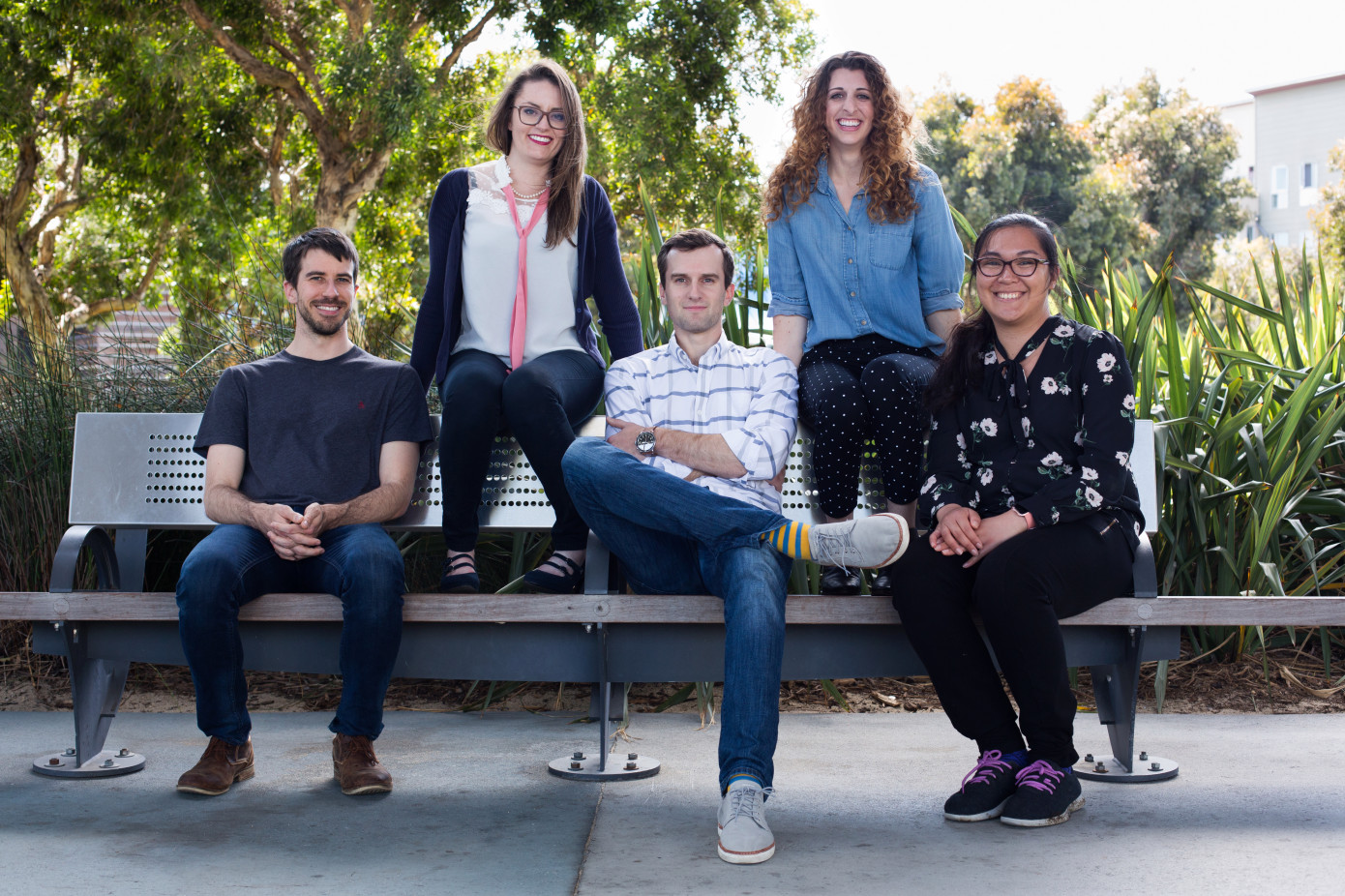
Basis co-founder and CEO Andrew Chapin (center) with the founding team last year

When asked why the Basis app and website were no longer active, Chapin said the company is in the process of “shifting business models.” He declined to provide further details. Lightspeed declined to comment. Wave Capital and Bedrock did not respond to requests for comment.

Basis, which did not claim to treat diagnosable conditions like bipolar disorder or schizophrenia, charged $35 per 45-minute phone call with its paraprofessionals. Its use of unlicensed therapists sparked concern in the mental health provider community. Harley Therapy founder Sheri Jacobson, an accredited counselor and psychotherapist, noted flaws with the service: “For me, replacing professional therapists and all of their lived experience and empathy with telepsychiatry administered by novice advisers could be potentially dangerous,” Jacobson said in a statement. “Would you let a learner driver navigate an oil tanker?”

Consumer mental health startups continue to attract capital from private market investors. Workplace mental health service Unmind, Blackthorn Therapeutics (a neurobehavioral health company using machine learning to create personalized medicine for mental health) and Talkspace (a leader in the online counseling space) have all closed funding rounds in 2019.

Whether Basis will find its footing is TBD. What’s clear is VCs are still willing to dole out checks as they experiment with the mental health space, but if startups don’t start proving viable business models and learn to navigate the complex adoption curve, we’ll see additional startups cease operations and mental health tech’s moment in the sun will end all too soon.

Now for a quick look at the top VC and startup news of the week:
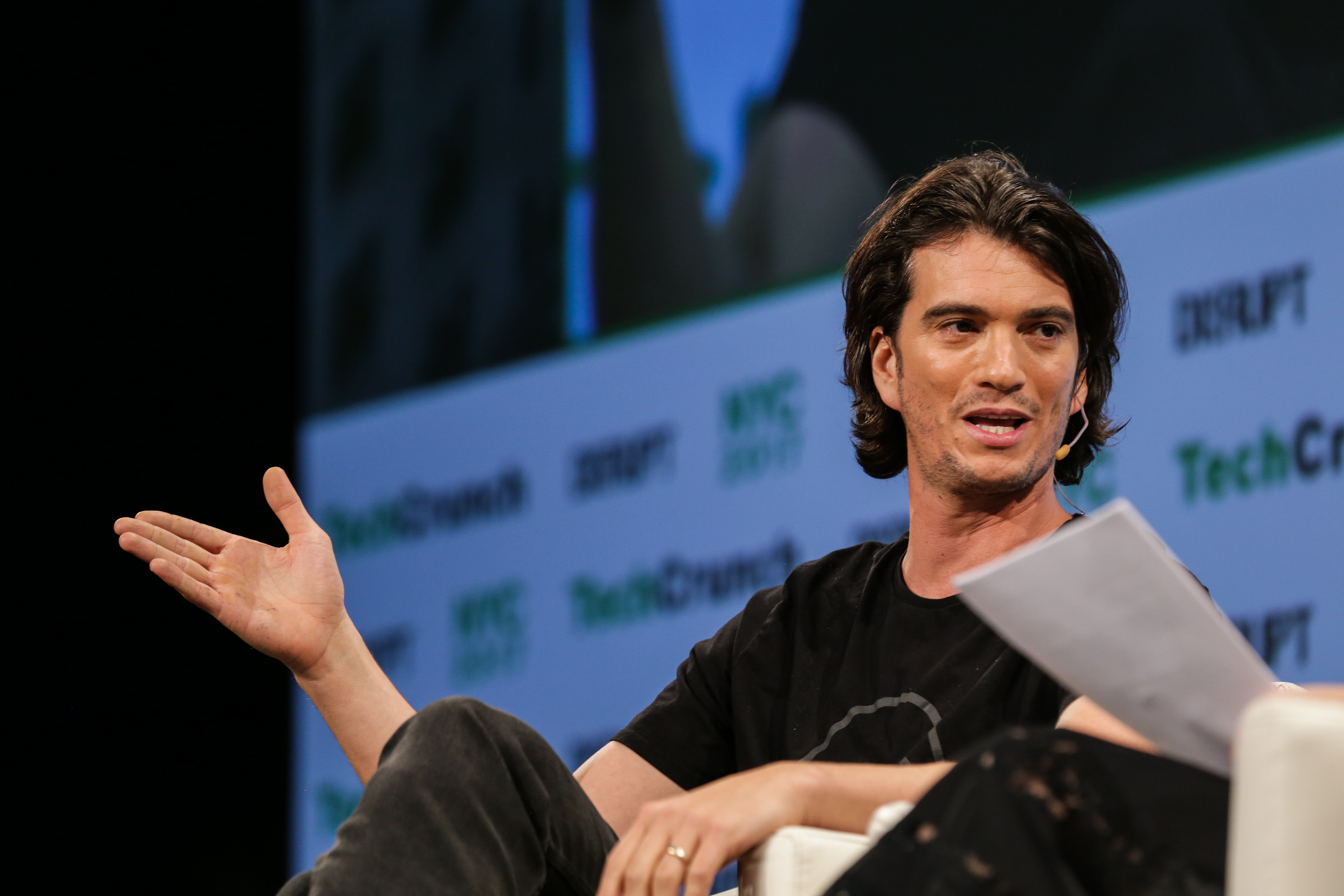
Adam Neumann (WeWork) at TechCrunch Disrupt NY 2017

Adam Neumann did what?

The eccentric co-founder and CEO of the international real estate co-working startup WeWork has reportedly cashed out of more than $700 million from his company ahead of its upcoming IPO. According to Axios, a majority of that capital came in the form of loans while the remaining $300 million came from stock sales. The size and timing of the payouts is unusual, considering that founders typically wait until after a company holds its public offering to liquidate their holdings. But even with the big sale, Neumann remains the single largest shareholder in WeWork.

Medallia soars

The customer experience management platform priced shares of its stock at $21 apiece Thursday, closing up Friday a whopping 76%. Money left on the table? I think so, and I bet Bill Gurley does too. The nearly two-decades-old company sold a total of 15.5 million shares in its IPO, raising $326 million at a $2.5 billion valuation in the process. Medallia’s $268 million in VC funding came from Sequoia Capital — which owned a roughly 40% pre-IPO stake — Saints Capital, TriplePoint Venture Growth and Grotmol Solutions.


Uber finally sets diversity and inclusion goals

Within the next three years, Uber aims to increase the percentage of women at levels L5 and higher (manager and above) to 35% and increase the percentage of underrepresented employees at levels L4 and higher to 14%. Currently, Uber is 9.3% black and 8.3% Latinx compared to just 8.1% black and 6.1% Latinx last year. Uber’s tech team, however, is just 3.6% black, 4.4% Latinx and 2.7% multi-racial. Unsurprisingly, there’s little representation of black and brown people in leadership roles. While Uber CEO Dara Khosrowshahi commented that he’s proud the promotion rates for women have improved over the last couple of years, he added, “I can’t yet say the same for promotions for people of color.”

Email platforms and productivity apps and subscription tools, oh my!

Startups focused on improving productivity and email are unstoppable this year. The latest to close VC rounds are Substack and Notion. Andreessen Horowitz is betting that there’s still a big opportunity in newsletters, leading a $15.3 million Series A in Substack. The company, which consists of just three employees working out of a living room, says that newsletters on the platform have now amassed a total of 50,000 paying subscribers (up from 25,000 in October) and that the most popular Substack authors are already making hundreds of thousands of dollars per year. As for Notion, The Information reported this week that it raised $10 million at an $800 million valuation. Notion is a note-taking and task management app that hasn’t sought much VC funding and, as a result, VCs have been desperately knocking at its door.

Other notable funding events of the week:

The trouble with blitzscaling

Silicon Valley has many dreams. One dream — the Hollywood version anyway — is for a down-and-out founder to begin tinkering and coding in their proverbial garage, eventually building a product that is loved by humans the world over and becoming a startup billionaire in the process. But when it comes to that Silicon Valley dream of a nice house from a decent return on exit, it’s getting narrower and less widely distributed. Blitzscaling is making a lot of people a lot of wealth, but early employees? Not so much.

Read more from TechCrunch editor Danny Crichton.
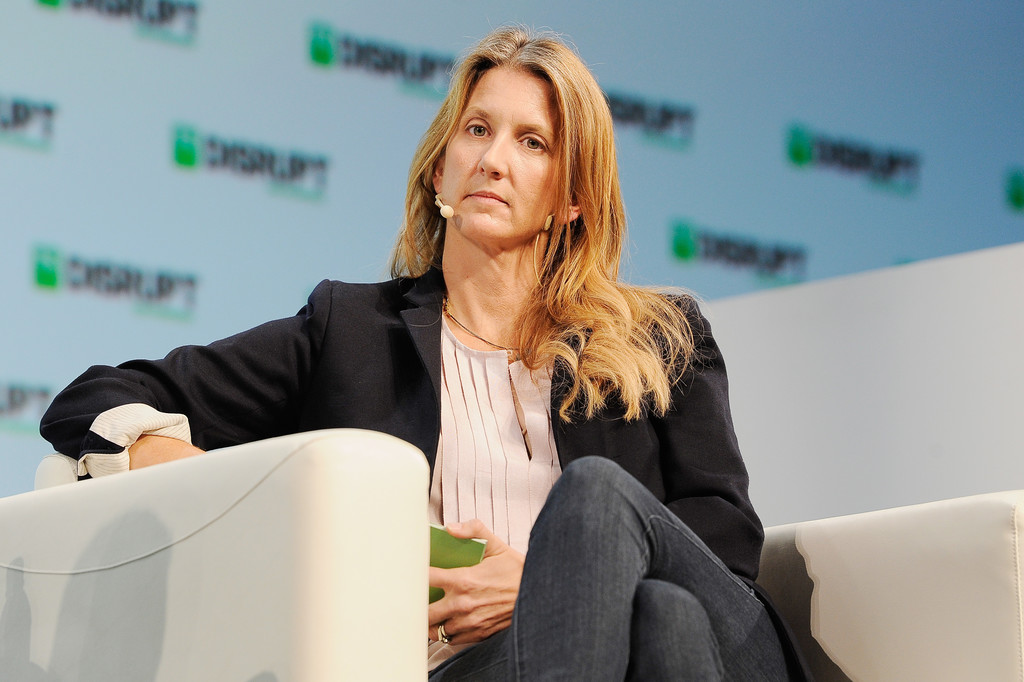
TechCrunch’s senior transportation reporter Kirsten Korosec.

Get ready for … The Station

TechCrunch senior transportation reporter Kirsten Korosec has something great in the works. All of us here at TechCrunch are very excited to announce The Station, a new TechCrunch newsletter all about mobility. Each week, in addition to curating the biggest transportation news, Kirsten will provide analysis, original reporting and insider tips on the fast-growing industry. Sign up here to get The Station in your inbox beginning in August.

~Extra Crunch~

While we’re on the subject of amazing TechCrunch #content, it’s probably time for a reminder for all of you to sign up for Extra Crunch. For a low price, you can learn more about the startups and venture capital ecosystem through exclusive deep dives, Q&As, newsletters, resources and recommendations and fundamental startup how-to guides. Here are some of my personal favorite EC posts from the past week:

#EquityPod

If you enjoy this newsletter, be sure to check out TechCrunch’s venture-focused podcast, Equity. In this week’s episode, available here, Equity co-host Alex Wilhelm and I debate Forbes’ latest next billion-dollar startups list.

Extra Crunch subscribers can read a transcript of each week’s episode every Saturday. Read last week’s episode here and learn more about Extra Crunch hereEquity drops every Friday at 6:00 am PT, so subscribe to us on Apple PodcastsOvercast, Pocket Casts, Downcast and all the casts.

That’s all, folks.

20 Jul 2019

Tesla drops request for restraining order against allegedly dangerous short seller

Tesla has withdrawn its request for a court-ordered restraining order against Randeep Hothi, documents submitted to the court where the complaint was filed revealed Friday. Hothi, an individual who is very vocal on social media about his short position in Tesla, had gone to extreme and potentially dangerous lengths in his avid attempts to collect materials to support his vocal criticism, according to the company.

The Alameda County Superior Court actually granted Tesla a temporary injunction in this matter back in April, after Tesla filed a complaint with supporting documents supporting its assertion that Hothi had injured a guard during a hit-and-run incident in February, and that he nearly caused an accident by driving dangerously in pursuit of a Tesla Model 3 undertaking a test driven on April 16.

After granting the temporary injunction based on Tesla’s description of events, supporting materials, and written affidavits submitted by employees, the court asked Tesla to produce both audio and video recordings related to these two incidents pursuant to a hearing. In withdrawing its complaint Friday, Tesla conveyed in documents filed with the court that it considered this requirement unnecessary in light of materials already provided, and an undue imposition on the privacy of their employees, since the recorded conversations regarding the incident contained “its employees’ private and personal conversations” as well as materials relating to the case.

Tesla maintains in its letter to the court that it still believes “a restraining order against Mr. Hothi is necessary and appropriate to protect its employees at their workplace,” it says that faced with the choice between said protection and exposing their employees’ private conversations to further public scrutiny, it will instead opt to pursue the protection of their safety “through other means.”

When contacted about the withdrawal, a Tesla spokesperson told TechCrunch that the company is now confident Hothi should be well aware at this stage that he’s not permitted to enter the company’s property, and that it will pursue legal action should he ever attempt to do so in future.

19 Jul 2019

Google is adding Find My Device and battery features to Fast Pair headphones

Introduced a few I/Os back, Fast Pair is Google’s attempt to make its own mark on the post-AirPod headphone landscape. Many of the features are similar to Apple’s offerings, but Google’s got a leg up in one key way: third-party hardware. Like Android, the company’s focused on bringing Fast Pair to as many manufacturers as possible.

That list now includes Libratone, Jaybird, JBL (four models), Cleer, LG (four models), Anker (one pair of headphones and speaker) and, of course, Google’s own Pixel Buds. This week, the company announced a number of key features coming to Fast Pair headphones.

New this time around is Find My Device functionality, aimed at helping owners locate missing headsets. The app will show the time and location they were last in use, and will send out a chime from buds that are still in Bluetooth range.

Also new is individual battery life for buds and case. Opening up the case near a paired handset will pop up that information. All of the above features will arrive on the 15 or so headphones that currently sport the feature.

19 Jul 2019

Moon bricks could keep the lights on and the heat up in Lunar colonies

There may be no “dark side” of the Moon, but when and where it is dark, it’s dark — and stays that way for two weeks. If we’re going to have colonists up there, they’ll need to stay warm and keep the lights (among other things) on for the long lunar night. Turns out bricks made of Moon dust could be part of the solution.

Of course they will use the readily available solar power during the lunar day, and you might think that they could just charge up some batteries to last them through the night. But batteries are large and heavy — not the kind of thing you want to pack for a trip to the Moon.

How else could lunar colonies store energy? The European Space Agency partnered with Azimut Space to find out whether a sort of improvised geothermal energy solution would be feasible.

The one thing they’ll have a lot of up there is dust — Lunar regolith, to be precise. And thanks to samples brought back by the Apollo missions, we’re pretty familiar with the stuff. So the team simulated some using terrestrial materials to see what they could do with it.

“In this study, we used Earth rock with comparable properties to Moon rock, crushed into a powder until the particles matched the size of those in the lunar regolith,” said the ESA’s Aidan Cowley, who oversaw the project.

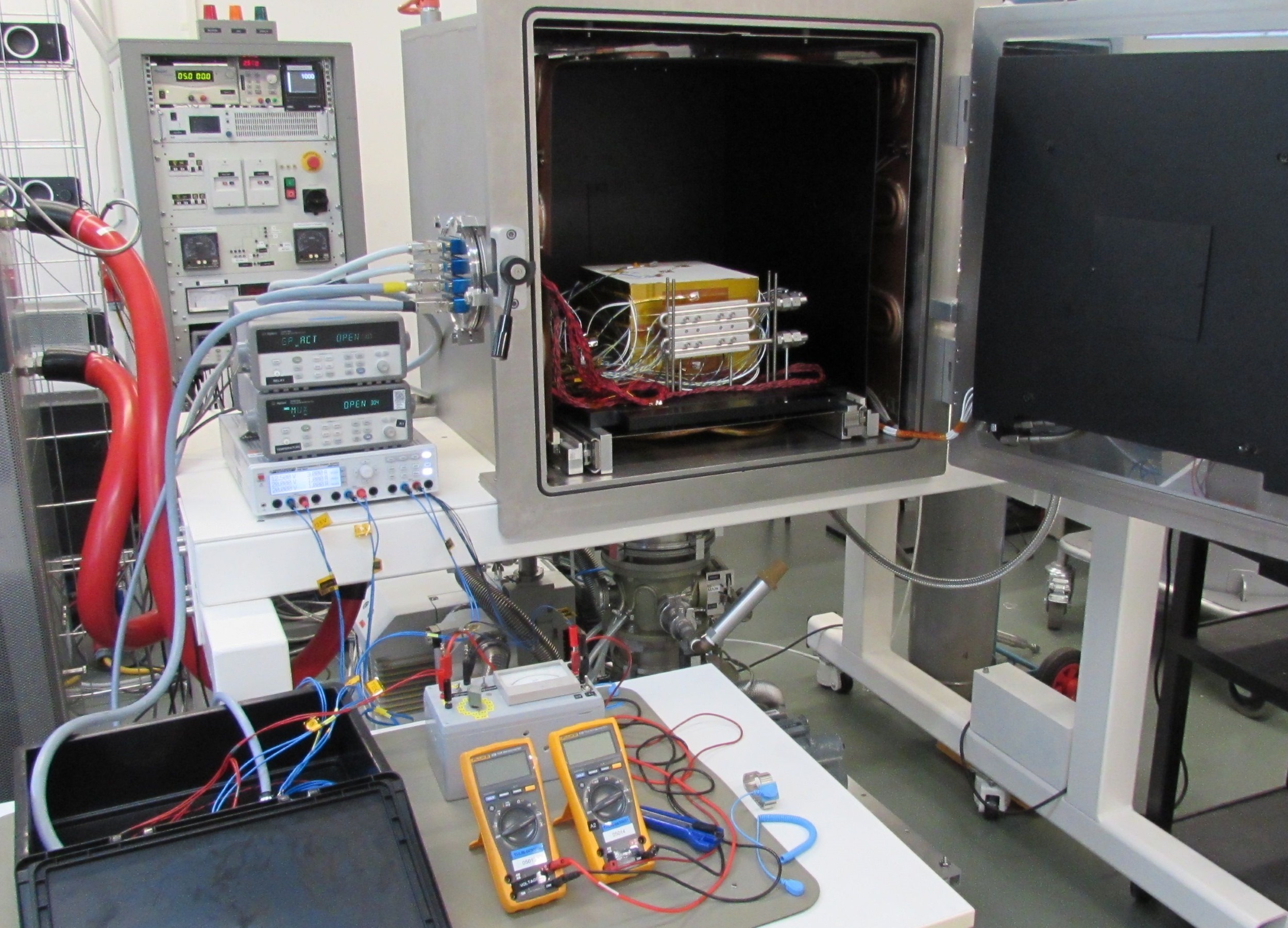
The faux-regolith was compressed into bricks, which were then wired up and heated using current like what they might be able to pull from solar cells on the Moon’s surface. The brick was then placed in an imitation lunar environment — near-vacuum and around -150 degrees C — and hooked up to a system that could withdraw heat from the bricks and convert it to electricity.

Artificial regolith brick in a vacuum chamber“Using lunar regolith to store heat on the Moon would provide us with an abundance of readily-available material meaning space travelers wouldn’t need to take much from Earth,” said Azimut’s Luca Celotti.

The ESA write-up says only that the process “worked well,” which isn’t particularly descriptive. I’ve contacted Azimut for more information. It seems, however, that if the method had worked but poorly, we wouldn’t be hearing about it at all.

There are plenty of fundamental challenges in creating what amounts to an enormous, crude battery out of Moon dust, but if it works even marginally well it could become an important part of the energy and heat storage suite that any lunar colony would have to employ.

19 Jul 2019

Medallia stock up 76% following first day trading on the NYSE

Customer experience management platform Medallia (NYSE: MDLA) rose up more than 70% in its New York Stock Exchange debut Friday.

The nearly two-decades-old business priced its shares at $21 apiece, the top of its proposed range, Thursday evening and traded as high as $39.54 the following morning. Medallia closed up roughly 76% at about $37 per share on Friday.

Medallia sold a total of 15.5 million shares in its IPO, raising $326 million at a $2.5 billion valuation in the process.

San Mateo-headquartered Medallia, led by chief executive officer Leslie Stretch, operates a platform meant to help businesses better provide for their customers. Its core product, the Medallia Experience Cloud, provides employees real-time data on customers collected from online review sites and social media. The service leverages that data to provide insights and tools to improve customer experiences.

The company is backed by four venture capital firms: Sequoia Capital — which owned a roughly 40% pre-IPO stake — Saints Capital, TriplePoint Venture Growth and Grotmol Solutions, the latter which invested a small amount of capital in 2010. Medallia has raised a total of $268 million in equity funding, including a $70 million Series F funding earlier this year.

Sequoia’s 40% stake was worth upwards of $1.8 billion at Medallia’s high price Friday.

19 Jul 2019

TikTok tests an Instagram-style grid and other changes

Short-form video app TikTok, the fourth most downloaded app in the world as of last quarter, is working on several new seemingly Instagram-inspired features — including a Discover page, a grid-style layout similar to Instagram Explore, an Account Switcher, and more.

The features were uncovered this week by reverse-engineering specialist Jane Manchun Wong, who published screenshots of these features and others to Twitter.

A TikTok spokesperson declined to offer further details on the company’s plans, but confirmed the features were things the company is working on.

“We’re always experimenting with new ways to improve the app experience for our community,” the spokesperson said.

The most notable change uncovered by Wong is one to TikTok’s algorithmically generated “For You” page. Today, users flip through each video on this page, one by one, in a vertical feed-style format. The updated version instead offers a grid-style layout, which looks more like Instagram’s Explore page. This design would also allow users to tap on the videos they wanted to watch, while more easily bypassing those they don’t. And because it puts more videos on the page, too, the change could quickly increase the amount of input into TikTok’s recommendation engine about a user’s preferences.


Another key change being developed is the addition of a “Discover” tab to TikTok’s main navigation.

The new button appears to replace the current Search tab, which today is labeled with a magnifying glass icon. The Search section currently lets you enter keywords, and returns results that can be filtered by users, sounds, hashtags or videos. It also showcases trending hashtags on the main page. The “Discover” button, meanwhile, has a people icon on it, which hints that it could be helping users find new people to follow on TikTok, rather than just videos and sounds.

This change, if accurately described and made public, could be a big deal for TikTok creators, as it arrives at a time when the app has gained critical mass and has penetrated the mainstream. The younger generation has been caught up in TikTok, finding the TikTok stars more real and approachable than reigning YouTubers.  TikTokers and their fans even swarmed VidCon this month, leading some to wonder if a paradigm shift for online video was soon to come.

A related feature, “Suggested Users” could also come into play here, in terms of highlighting top talent.

Getting on an app’s “Suggested” list is often key to becoming a top creator on the platform. It’s how many Viners and Twitter users initially grew their follower bases, for instance.

However, TikTok diverged from Instagram with the testing of two other new features Wong found which focused on popularity metrics. One test shows the “Like” counts on each video on the Sounds and Hashtags pages, and another shows the number of Downloads on the video itself, in addition to the Likes and Shares.

This would be an interesting change in light of the competitive nature of social media. And its timing is significant. Instagram is now backing away from showing Like counts, in a test running in a half dozen countries. The company made the change in response to public pressure regarding the anxiety that using its service causes.

Of course, in the early days of a social app, Like counts and other metrics are tools that help point users to the breakout, must-follow stars. They also encourage more posting as users try to find content that resonates — which then, in turn, boosts their online fame in a highly trackable way.

TikTok is also taking note of how integrations with other social platforms could benefit its service, similar to how the Facebook, Instagram, WhatsApp and Messenger apps have offered features to drive traffic to one another and otherwise interoperate.

A couple of features Wong found were focused on improving connections with social apps, including one that offered better integration with WhatsApp, and another that would allow users to link their account to Google and Facebook.

A few other changes being tested included an Instagram-like Account switcher interface, a “Liked by Creator” comment badge, and a downgrade to the TikCode (QR code) which moves from the user profile the app’s settings.

Of course, one big caveat here with all of this is that just because a feature is spotted in the app’s code, that doesn’t mean it will launch to the public.

Some of these changes may be tested privately, then scrapped entirely, or are still just works in progress. But being able to see a collection of experiments at one time like this — something that’s not possible without the sort of reverse engineering that Wong does — helps to paint a larger picture of the direction an app may be headed. In TikTok’s case, it seems to understand its potential, as well as when to borrow successful ideas from others who have come before it, and when to go its own direction.

19 Jul 2019

Deadline extended! Apply to the All Raise female founder program at Disrupt SF 2019

We’ve got great news for all the time-strapped female founders out there. Yeah, we’re looking at you, sister. We’re extending the application deadline to apply for the All Raise “ask me anything” (AMA) sessions at Disrupt SF 2019. Don’t miss this rare opportunity to meet with a leading female VC and, well, ask her anything. Apply for an AMA session by August 15.

Not familiar with All Raise? This startup nonprofit, dedicated to accelerating female founder success, will host a day-long AMA event on October 3 at Disrupt SF 2019 — in a dedicated section of Startup Alley. Each AMA session lasts 30 minutes and consists of three founders and one VC. All Raise expects more than 100 female founders to take part in at least 30 sessions scheduled throughout the day.

Don’t bring your pitches, bring your questions — the kind of questions that keep you up at night. It’s a rare opportunity to ask a leading VC advice on topics like your next raise, key hires, your competition. Imagine receiving business advice from any of these female VCs:

  • Dayna Grayson, NEA
  • Susan Lyne, BBG
  • Shauntel Garvey, Reach Capital
  • Eurie Kim, Forerunner
  • Jess Lee, Sequoia
  • Kara Nortman, Upfront
  • Sara Guo, Greylock,
  • Anarghya Vardhana, Maveron
  • Eva Ho, Fika Ventures
  • Sarah Smith, Bain Capital Ventures
  • Jess Lin, Work-Bench

You can apply for an All Raise AMA session if you’re a U.S.-based woman founder and you’ve raised at least $250,000 in a seed, A or B round. All Raise gives special consideration to founders from underrepresented groups (e.g. Black, Latinx or LGBTQIA women).

All Raise will review the applications and notify the founders. Acceptance is based on availability for session spots, investor fit with industry sector and company stage, as well as demand for certain categories.

If you’re selected, your next step is to buy any pass to Disrupt SF (including Expo Only). All Raise will send an email to let you know what time they’ve scheduled your session.

Networking opportunities of this caliber don’t come along very often — especially for women in tech. Build connections, learn from expert female VCs and move your startup forward. Take advantage of the deadline extension and apply for an AMA session before August 15. We want to see you in San Francisco!

If you are interested in sponsoring this event or exhibiting at Disrupt San Francisco 2019, fill out this form to get in contact with our sales team.

19 Jul 2019

Google’s SMILY is reverse image search for cancer diagnosis

Spotting and diagnosing cancer is a complex and difficult process even for the dedicated medical professionals who do it for a living. A new tool from Google researchers could improve the process by providing what amounts to reverse image search for suspicious or known cancerous cells. But it’s more than a simple matching algorithm.

Part of the diagnosis process is often examining tissue samples under a microscope and looking for certain telltale signals or shapes that may indicate one or another form of cancer. This can be a long and arduous process because every cancer and every body is different, and the person inspecting the data must not only look at the patient’s cells but also compare them to known cancerous tissues from a database or even a printed book of samples.

As has been amply demonstrated for years now, matching similar images to one another is a job well suited to machine learning agents. It’s what powers things like Google’s reverse image search, where you put in one picture and it finds ones that are visually similar. But this technique has also been used to automate processes in medicine, where a computer system can highlight areas of an X-ray or MRI that have patterns or features it has been trained to recognize.

That’s all well and good, but the complexity of cancer pathology rules out simple pattern recognition between two samples. One may be from the pancreas, another from the lung, for example, meaning the two situations might be completely different despite being visually similar. And an experienced doctor’s “intuition” is not to be replaced, nor would the doctor suffer it to be replaced.

Aware of both the opportunities and limitations here, Google’s research team built SMILY (Similar Medical Images Like Yours), which is a sort of heavily augmented reverse image search built specifically for tissue inspection and cancer diagnosis.

A user puts into the system a new sample from a patient — a huge, high-resolution image of a slide on which a dyed section of tissue is laid out. (This method is standardized and has been for a long time — otherwise how could you compare any two?)

smilygif

Once it’s in the tool, the doctor can inspect it as they would normally, zooming in and panning around. When they see a section that piques their interest, they can draw a box around it and SMILY will perform its image-matching magic, comparing what’s inside the box to the entire corpus of the Cancer Genome Atlas, a huge database of tagged and anonymized samples.

Similar-looking regions pop up in the sidebar, and the user can easily peruse them. That’s useful enough right there. But as the researchers found out while they were building SMILY, what doctors really needed was to be able to get far more granular in what they were looking for. Overall visual similarity isn’t the only thing that matters; specific features within the square may be what the user is looking for, or certain proportions or types of cells.

As the researchers write:

Users needed the ability to guide and refine the search results on a case-by-case basis in order to actually find what they were looking for…This need for iterative search refinement was rooted in how doctors often perform “iterative diagnosis”—by generating hypotheses, collecting data to test these hypotheses, exploring alternative hypotheses, and revisiting or retesting previous hypotheses in an iterative fashion. It became clear that, for SMILY to meet real user needs, it would need to support a different approach to user interaction.

To this end the team added extra tools that let the user specify much more closely what they are interested in, and therefore what type of results the system should return.

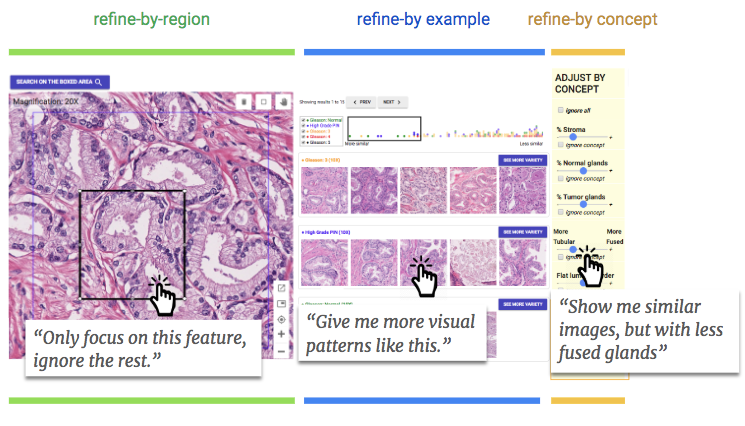
First, a user can select a single shape within the area they are concerned with, and the system will focus only on that, ignoring other features that may only be distractions.

Second, the user can select from among the search results one that seems promising and the system will return more like it, less closely tied to the original query. This lets the user go down a sort of rabbit hole of cell features and types, doing that “iterative” process the researchers mentioned above.

refinements

And third, the system was trained to understand when certain features are present in the search result, such as fused glands, tumor precursors, and so on. These can be included or excluded in the search — so if someone is sure it’s not related to this or that feature, they can just sweep all those examples off the table.

In a study of pathologists given the tool to use, the results were promising. The doctors appeared to adopt the tool quickly, not only using its official capabilities but doing things like reshaping the query box to test the results or see if their intuition on a feature being common or troubling was right. “The tools were preferred over a traditional interface, without a loss in diagnostic accuracy,” the researchers write in their paper.

It’s a good start, but clearly still only an experiment. The processes used for diagnosis are carefully guarded and vetted; you can’t just bring in a random new tool and change up the whole thing when people’s lives are on the line. Rather, this is merely a bright start for “future human-ML collaborative systems for expert decision-making,” which may at some point be put into service at hospitals and research centers.

You can read the two papers describing SMILY and the doctor-focused refinements to SMILY here; they were originally presented at CHI 2019 in Glasgow earlier this year.

19 Jul 2019

India’s Oyo valued at $10B after founder purchases $2B in shares

The fast-growing Indian hospitality business Oyo has garnered a valuation of $10 billion after its founder, Ritesh Agarwal, reportedly purchased $2 billion in shares from venture capital firms Sequoia Capital and Lightspeed Venture Partners.

Agarwal, 25, founded Oyo in 2013 at the age of 19. Following immense growth of the now global hotel chain business, Agarwal opted to increase his 10% stake to 30% via a Cayman Islands company called RA Hospitality Holdings, according to The Wall Street Journal. SoftBank has also increased its percent ownership as part of this round, now owning nearly half of the company.

Oyo has raised a whopping $1.6 billion in equity funding to date, reaching a valuation of $5 billion at its last funding round. Other investors in the company include Airbnb, Grab Holdings and Didi Chuxing.

Oyo is active in 800 cities in 80 countries with more than 23,000 hotels in its portfolio. Recently, the company announced plans to invest $300 million in the U.S. market, where it currently operates more than 50 Oyo Hotels in 35 cities and 10 states.

Earlier this week, the Gurgaon-headquartered firm introduced Oyo Workspaces. The new entity was born out of its acquisition of Innov8, a co-working startup with more than 200 employees. The four-year-old startup was acquired for about $30 million, according to reporting by TechCrunch’s Manish Singh.

We’ve reached out to Oyo for comment.