Year: 2019

18 Jul 2019

Submittable raises $10M to help publishers and other organizations manage their submissions

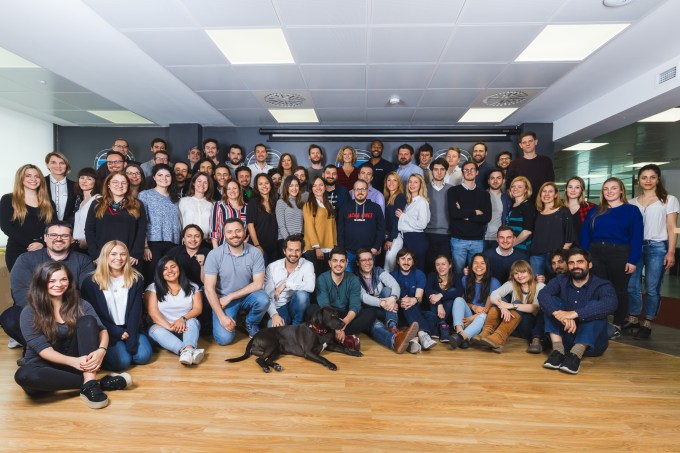
Submittable is announcing that it has raised $10 million in Series B funding.

When I first wrote about the company in 2012, it was focused on helping literary magazines manage their submissions — useful, but maybe not the kind of thing that venture capitalists write big checks for.

Since then, Submittable raised a $5 million Series A and expanded by helping companies in a number of industries manage their submissions and applications. Co-founder and CEO Michael FitzGerald said the company has built products for four main verticals (corporate, academic, philanthropy and publishing) and has signed up big customers like AT&T, HBO, Conde Nast, Harvard and MIT.

And while publishing may no longer be the main focus, FitzGerald — a published novelist himself — noted that “in the publishing world, we’re pretty much the way you do it.” I’ve certainly been seeing more Submittable submissions pages, (although FitzGerald acknowledged that the service hasn’t quite taken hold among science fiction magazines).

He also said the product has been getting increasingly sophisticated, for example allowing a publisher to review and rank submissions based on very specific qualities like sentence structure and voice.
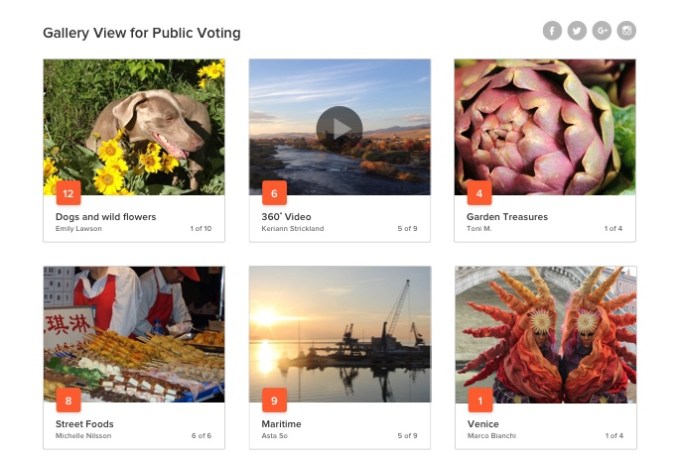
Submittable screenshot

Besides expanding into additional verticals and launching on mobile, one of FitzGerald’s main goals it to create what he called “ZipRecruiter for Opportunities,” a marketplace uses Submittable data to connect individuals and organizations that seem like a good fit, where they’re writers and magazines, scholarships and students or any other pairing for “any opportunity that isn’t a job.”

Submittable is based in Missoula, Montana, and the round was led by Next Coast Ventures, a firm that invests in startups outside the big coastal tech hubs. (Previous investors True Ventures and Next Frontier also participated.) Next Coast co-founder and managing director Michael Smerklo is joining the startup’s board of directors.

“Submittable is a perfect example of what is possible outside Silicon Valley,” Smerklo said in a statement. “The platform is modernizing the often painful undertaking of managing the submission process and leveraging that data for genuine opportunity creation.”

FitzGerald (who’s spoken elsewhere about his experience working as a startup CEO while also facing a Stage 4 cancer diagnosis) said the plan is to expand the Submittable team from 88 to 240 people by the end of 2020. He acknowledged that the location has created some challenges in hiring, particularly when it comes to experienced executives, but he said he’s been assisted by the fact that ClassPass and OnxMaps have also opened offices in Missoula.

Plus, he said that one of the most effective tactics involves searching LinkedIn for executives who went to high school in Missoula between 1985 and 2000: “Everyone is looking for a way home.”

18 Jul 2019

Azure revenue continues to slow down for Microsoft

Microsoft reported in its FY19, Q4 earnings report today that Azure, the company’s infrastructure as a service (IaaS) offering, grew at 64 percent. It may feel like a large number, but was part of a downward trend Microsoft has been experiencing throughout the entire fiscal 2019 earnings cycle.

The growth rates for FY19 were, Q1: 76 percent, Q2: 76 percent, Q3: 73 percent and all the way down to 64 percent this quarter. They’re probably not panicking in the hallways in Redmond today over these numbers as that is still a healthy growth rate, and the law of large numbers suggests that the bigger you get, the slower your growth is going to be. Gaudy numbers tend to be for upstarts.

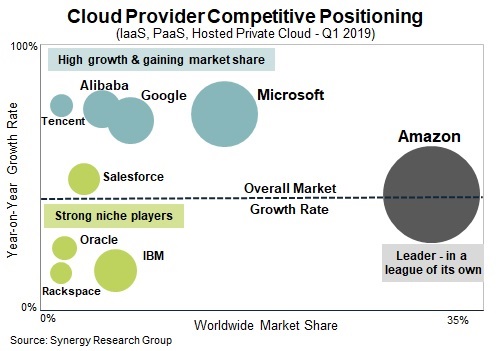
Microsoft is clearly not in that category, sitting strongly in the number 2 position in cloud infrastructure market, and as Synergy Research’s John Dinsdale pointed out, while that growth rate may be slowing down, the more important marketshare percentage has continued to grow steadily upward.

“Microsoft is a clear number two in cloud infrastructure services (IaaS, PaaS, hosted private cloud), still a long way behind AWS but well ahead of the rest of the pack. Its revenue growth rate is way above the overall market growth rate, so it is gradually gaining marketshare – 9% in 2016, 11% in 2017, 14% in 2018 and 16% in the first quarter of 2019,” he said in a statement today.

CIS Q119

And even as the growth slows, Microsoft announced a big win this week when AT&T announced it would be signing a contract worth $2 billion in Azure and Office 365 services. While Office 365 is not part of the IaaS market, it was still a significant customer acquisition for the company.

The cloud market is still growing at a rapid rate as companies are still in the relatively early stages of moving their workloads to public cloud vendors like Microsoft, Amazon and Google. There is a tremendous opportunity ahead for Microsoft and all of its rivals, and while Microsoft’s Azure earnings growth may be slowing down, there is still plenty of room for significant revenue for the foreseeable future.

18 Jul 2019

Boeing set to take $4.9 billion Q2 charge on 737 Max grounding

Boeing’s 737 Max fiasco has cast a dark shadow over the company’s reputation and is impacting the company’s financials in a major way as well.

The Seattle aviation company announced that it will be taking a hefty $4.9 billion post-tax hit in its second quarter due to the continued grounding of the 737 Max fleet. Boeing says the charge is “in connection with an estimate of potential concessions and other considerations to customers for disruptions related to the 737 Max grounding and associated delivery delays.”

Boeing is set to report its Q2 earnings next week. The company’s shares were up 2 percent after-hours Thursday following the announcement.

“We remain focused on safely returning the 737 MAX to service,” Boeing  CEO Dennis Muilenburg said in a statement. “This is a defining moment for Boeing. Nothing is more important to us than the safety of the flight crews and passengers who fly on our airplanes. The MAX grounding presents significant headwinds and the financial impact recognized this quarter reflects the current challenges and helps to address future financial risks.”

The $8.74 per share charge will undoubtedly wipe out any profits on the company’s Q2 revenue, which is expected to reach $20.27 billion.

The charge is a hefty number but this may just be the beginning when examining the impact of this debacle on future revenues, the company’s public reputation and any changes the company needs to make to its testing processes to ensure that these catastrophic mistakes aren’t repeated.

For these current estimates, Boeing is banking on regulatory approval of the 737 Max coming in the fourth quarter of 2019, but it acknowledges that the fleet’s grounding could stretch on even longer.

18 Jul 2019

Rent the Backyard wants to build a studio apartment in your yard

Rent the Backyard is one of the rare startups with a name that perfectly suits what it does.

The company, which is part of Y Combinator’s current batch, builds studio apartments in homeowners’ backyards, which are then rented out for income.

Of course, if you already own a house with a backyard, you could theoretically do this without getting a startup involved, but co-founder Brian Bakerman told me, “The goal is to have no headaches for the homeowners.”

That means Rent the Backyard works with a partner to build the apartment, finances the construction, lists the property, selects the tenant, collects the rent and serves as the landlord. In exchange for all that, it has an ownership stake in the unit and keeps 50 percent of the rent.

The startup also handles the permitting, which co-founder Spencer Burleigh said has become much easier with recent changes in California law. In fact, he pointed to stories about how these changes have led to skyrocketing applications (16 in 2016, 350 in 2018) to build “in-law” units in San Jose, which is where the startup is focused for now.

Bakerman said that many homeowners simply can’t afford the upfront cost of building these units, so by providing the financing, Rent the Backyard can unlock new income and make home ownership more affordable. At the same time, it’s also helping renters by creating more apartments.

Of course, for a homeowner, that means giving up a big piece of your backyard (which must be at least 30 feet by 30 feet in size), but Bakerman said that many yards are “underutilized” anyway.

“In places like the Bay Area … people are spending a ridiculous amount on their homes,” he added. “They often can’t afford those lifestyles, but everyone wants to attain home ownership.”

The company’s website includes a calculator of how much rental income you might earn, and it says that most owners will be able to make more than $10,000 of additional income each year.

Over time, Rent the Backyard will give the homeowner an increasing share of equity in the apartment, until they own it completely after 30 years. Homeowners can also buy out the startup’s equity and take full ownership at any time (which they’ll need to do if they sell their home and move out).

To be clear, Rent the Backyard hasn’t actually built any apartments yet, but it’s already signed up construction partners, and the goal is to 10 units permitted and ready for construction by the end of the summer.

“It’s a pretty fast process,” Bakerman said. “It could just be a handful of weeks before we’re able to start building” — and since the units use prefabricated construction methods, the actual building could take as little as a week and a half.

18 Jul 2019

Toyota creates accessible last-mile electric shuttle for 2020 Olympic Games

Toyota is readying for Tokyo’s Summer Olympic and Paralympic Games, which it’s hosting in 2020, with an all-new short range battery electric shuttle it designed to be maximally accessible for all attendees. It’s called the APM, or ‘Accessible People Mover,’ and 200 of them will be used in service of getting Games fans, athletes, and staff from venue to venue.

The APM comes in two model variants, including a ‘Basic’ edition that offers three rows of seating (including up front) for a total max capacity of six, including five passengers and the driver. The second row seat can be folded to accommodate passengers using a wheelchair (there are anchor plates in the floor, as well, for stability during travel), and you can enter and exit from either open side of the shuttle, with long low ramps for wheelchair access.

A second, ‘Relief’ configuration of the APM takes away half of the second and third-row seating to accommodate a stretcher than can be secured while the vehicle’s moving, with caretaker personal seated directly next to it. This is meant to help with any non-urgent medical transport needed during the Games, when the car’s top speed of 19 km/h (around 12 mph) isn’t an issue.

[gallery ids="1857630,1857629,1857628,1857627"]

These are designed for light duty, as mentioned, but they can still go up to 100 km (62 miles) on a single charge, which is probably plenty for venue-to-venue shuttle work required throughout a day at the Olympics.

In addition to this custom EV, which is still driven the old-fashioned, human way, Toyota has also previously discussed demonstrating working versions of some of its autonomous vehicles, including concept models its shown off at the annual CES conference in Las Vegas.

18 Jul 2019

This is one way Toyota plans to shuttle people around during the 2020 Olympics

When thousands of people converge in Tokyo for the 2020 Olympic and Paralympic Games, the city’s infrastructure will be tested. Toyota is getting into the mix to handle some of the ways people will get around the city and the Olympics venue.

Toyota unveiled Thursday a new product called APM or Accessible People Mover that is designed for the Olympics and Paralympic Games.

The aim, according to Toyota, is for this vehicle to provide “mobility for all” and to solve the so-called “last mile” problem. In Toyota’s view, that means a vehicle that can transport as many people as possible, including elderly, pregnant women, families with young children and people with disabilities.

Toyota will deploy 200 of these vehicles, which will operate in and around the event. There will be two models — basic and relief — in the fleet. The basic version is a low-speed short-distance battery electric vehicle that will be used to transport visitors and staff within the Olympic grounds. Each vehicle will hold six people, including the driver. When used for passengers in wheelchairs, the configuration can be modified by folding the seats to allow the wheelchair rider in the second row.

The “relief” model will be used for emergencies. The rows can be moved to provide space for a stretcher and two relief stretchers.

These APM vehicles are just a taste of what Toyota plans to deliver during the 2020 Olympics. The automaker has shown off eight other vehicles as well as assistive robotics, all under the mobility for all moniker, including the e-Palette vehicle, which is basically a flexible blank slate on wheels with an electric motor and a fully modular interior design.

Other vehicles include the JPN Taxi, which was introduced in 2017 and can accommodate people using wheelchairs, and the Toyota i-ROAD, a standing-riding device designed for support working staff at the Games, such as security officers.

Toyota plans to demonstrate automated vehicles that will be able to handle all driving functions in certain well-defined areas in the Tokyo Water Front City and Haneda areas in Tokyo. It also will demonstrate  the TOYOTA Concept-i, a car that recognizes drivers’ emotions and preferences and can make conversation using artificial intelligence.

18 Jul 2019

How Carl Pope helped drive a $500 million pledge to push the U.S. “Beyond Carbon” (Part 2)

Billionaire businessman and philanthropist Michael Bloomberg recently pledged to rapidly spend $500 million in a bid to push the U.S. “Beyond Carbon,” aiming to end this country’s use of coal and natural gas power in a generation or less.

In another recent piece, I featured an in-depth interview with Carl Pope, the veteran environmental leader who has essentially been the inspirational force behind Bloomberg’s evolution. The former New York City Mayor had never given a major gift to environmental causes as of a decade or so ago, until Pope “convinced” him to get involved.

Carl Mike Option 1

My previous piece was an attempt to understand the ethical vision influencing Bloomberg’s work, by looking at Pope’s personal story and the history of the environmental movement he has helped to shape. Below, Pope joins me again to look at the details of Bloomberg’s “Beyond Carbon” plan, including how he was able to persuade Bloomberg to take it on, and some areas of controversy that could arise as the $500 million is distributed.

Greg Epstein: You and Michael Bloomberg met around a decade ago or so, right?

Carl Pope: About 12 years ago, actually. 2007.

Epstein: Bloomberg had never given a major gift to an environmental group before he met you, and, as he writes in the book, you “convinced him” to get massively involved, to the tune now of many hundreds of millions of dollars. What do you think it is about you, the way that you approach things, or the work you do that made the two of you, in this relatively unlikely partnership, work so well?

Pope: We both like big ideas, and we both like to pursue them very pragmatically. We set very high expectations for what we want to get, and we’re willing to take necessarily small steps to get there. That’s one thing.

The second thing is, my original environmental frame was air pollution, [which] I worked on the first seven or eight years I was an environmentalist. Mike is a big public health advocate. So the fact that I was talking about saving people’s lives made a lot of sense to him.

Epstein: He talked about how you ‘showed him the numbers,’ back in 2011, on just how deadly coal actually is.

Pope: Yeah, that was the deal sealer.

Epstein: Interpersonally, what the interactions between you and him like?

Pope: We’re both public figures who are actually somewhat introspective, and so it works.

Epstein: I’ve read the “Beyond Carbon” plans as they’re presented by the Bloomberg organization. They do seem quite promising as far as broad, sweeping PR statements go.

But whether or not they will work is all in the details, right? You’re a detail-oriented person, as you just mentioned, so, what are some of the practical steps the plan calls for that you think deserve the most attention, beyond the headlines?

Pope: In A Climate of Hope, Mike and I articulated an approach to climate in which we gave our reasons for thinking that most climate leadership is going to come not from national governments but from businesses, cities, provinces, civic organizations, from the bottom up.

18 Jul 2019

Instagram will now warn you before your account gets deleted, offer in-app appeals

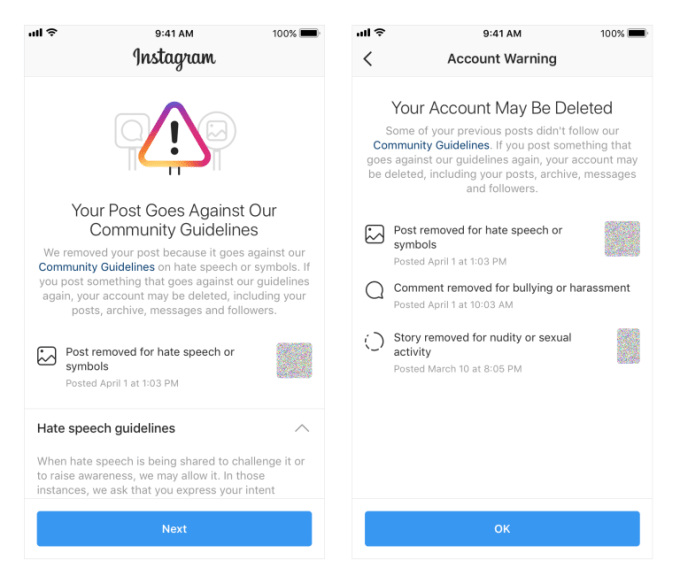
Instagram this morning announced several changes to its moderation policy, the most significant of which is that it will now warn users if their account could become disabled before that actually takes place. This change goes to address a longstanding issue where users would launch Instagram only to find that their account had been shut down without any warning.

While it’s one thing for Instagram to disable accounts for violating its stated guidelines, the service’s automated systems haven’t always gotten things right. The company has come under fire before for banning innocuous photos, like those of mothers breastfeeding their children, for example, or art. (Or, you know, Madonna.)

Now the company says it will introduce a new notification process that will warn users if their account is at risk of becoming disabled. The notification will also allow them to appeal the deleted content in some cases.

For now, users will be able to appeal moderation decisions around Instagram’s nudity and pornography policies, as well as its bullying and harassment, hate speech, drug sales, and counter-terrorism policies. Over time, Instagram will expand the appeal capabilities to more categories.

The change means users won’t be caught off guard by Instagram’s enforcement actions. Plus, they’ll be given a chance to appeal a decision directly in the app, instead of only through the Help Center as before.

Disable Thresholds 2 up EN

In addition, Instagram says it will increase its enforcement of bad actors.

Previously, it could remove accounts that had a certain percentage of content in violation of its policies. But now it will also be able to remove accounts that have a certain number of violations within a window of time.

“Similarly to how policies are enforced on Facebook, this change will allow us to enforce our policies more consistently and hold people accountable for what they post on Instagram,” the company says in its announcement.

The changes follow a recent threat of a class-action lawsuit against the photo-sharing network led by the Adult Performers Actors Guild. The organization claimed Instagram was banning the adult performers’ accounts, even when there was no nudity being shown.

“It appears that the accounts were terminated merely because of their status as an adult performer,” James Felton, the Adult Performers Actors Guild legal counsel, told the Guardian in June. “Efforts to learn the reasons behind the termination have been futile,” he said, adding that the Guild was considering legal action.

The Electronic Frontier Foundation (EFF) also this year launched an anti-censorship campaign, TOSSed Out, which aimed to highlight how social media companies unevenly enforce their terms of service. As part of its efforts, the EFF examined the content moderation policies of 16 platforms and app stores, including Facebook, Twitter, the Apple App Store, and Instagram.

It found that only four companies—Facebook, Reddit, Apple, and GitHub—had committed to actually informing users when their content was censored what community guideline violation or legal request had led to that action.

“Providing an appeals process is great for users, but its utility is undermined by the fact that users can’t count on companies to tell them when or why their content is taken down,” said Gennie Gebhart, EFF associate director of research, at the time of the report. “Notifying people when their content has been removed or censored is a challenge when your users number in the millions or billions, but social media platforms should be making investments to provide meaningful notice.”

Instagram’s policy change focused on cracking down on repeat offenders is rolling out now, while the ability to appeal decisions directly within the app will arrive in the coming months.

18 Jul 2019

How US national security agencies hold the internet hostage

Team Telecom, a shadowy US national security unit tasked with protecting America’s telecommunications systems, is delaying plans by Google, Facebook and other tech companies for the next generation of international fiber optic cables.

Team Telecom is comprised of representatives from the departments of Defense, Homeland Security, and Justice (including the FBI), who assess foreign investments in American telecom infrastructure, with a focus on cybersecurity and surveillance vulnerabilities.

Team Telecom works at a notoriously sluggish pace, taking over seven years to decide that letting China Mobile operate in the US would “raise substantial and serious national security and law enforcement risks,” for instance. And while Team Telecom is working, applications are stalled at the FCC.

The on-going delays to submarine cable projects, which can cost nearly half a billion dollars each, come with significant financial impacts. They also cede advantage to connectivity projects that have not attracted Team Telecom’s attention – such as the nascent internet satellite mega-constellations from SpaceX, OneWeb and Amazon .

Team Telecom’s investigations have long been a source of tension within Silicon Valley. Google’s subsidiary GU Holdings Inc has been building a network of international submarine fiber-optic cables for over a decade. Every cable that lands on US soil is subject to Team Telecom review, and each one has faced delays and restrictions.

18 Jul 2019

Daily Crunch: Netflix has a rough quarter

The Daily Crunch is TechCrunch’s roundup of our biggest and most important stories. If you’d like to get this delivered to your inbox every day at around 9am Pacific, you can subscribe here.

1. Netflix reports net subscriber loss in the US, misses global subscriber growth predictions

Netflix’s price hikes might finally be convincing some consumers to unsubscribe. The company reported net growth of 2.7 million subscribers worldwide, but it actually added 2.83 million new subscribers internationally while losing around 130,000 in the United States.

Growth was lower than expected across the board, but it underperformed more noticeably in regions where it introduced a price hike.

2. FaceApp gets federal attention as Sen. Schumer raises alarm on data use

In a letter to the heads of the FBI and FTC, the senator wrote, “FaceApp’s location in Russia raises questions regarding how and when the company provides access to the data of U.S. citizens to third parties, including potentially foreign governments.”

3. Facebook’s regulation dodge: Let us, or China will

The company’s top executives have each claimed that if the U.S. limits Facebook’s size, blocks its acquisitions or bans its cryptocurrency, Chinese companies without these restrictions will win abroad.

4. On a growth tear, work trip SaaS TravelPerk adds $60M to its Series C

TravelPerk now has more than 2,000 customers for its business travel booking platform.

5. Slack resets user passwords after 2015 data breach

Slack will reset the passwords of users it believes are affected by the historical data breach. The company says this does not apply to “the approximately 99% who joined Slack after March 2015” or those who changed their password since.

6. Google teams up with Apollo 11 astronaut to celebrate the 50th anniversary of the Moon landing

To mark the event, Google teamed up with NASA and Michael Collins — the astronaut who piloted the command module while Neil Armstrong and Buzz Aldrin descended to the Moon.

7. Learn how to change banking one dollar at a time at Disrupt SF

Chime CEO Chris Britt, a16z partner Angela Strange and Omer Ismail of Goldman Sachs are all coming to Disrupt to discuss how banks and payments will change in the future.