Year: 2019

18 Jul 2019

InCountry raises $15M for its cloud-based private data storage-as-a-service solution

The rise of data breaches, along with an expanding raft of regulations (now numbering 80 different regional regimes, and growing) have thrust data protection — having legal and compliant ways of handling personal user information — to the top of the list of things that an organization needs to consider when building and operating their businesses. Now a startup called InCountry, which is building both the infrastructure for these companies to securely store that personal data in each jurisdiction, as well as a comprehensive policy framework for them to follow, has raised a Series A of $15 million. The funding is coming in just three months after closing its seed round — underscoring both the attention this area is getting and the opportunity ahead.

The funding is being led by three investors: Arbor Ventures of Singapore, Global Founders Capital of Berlin, and Mubadala of Abu Dhabi. Previous investors Caffeinated Capital, Felicis Ventures, Charles River Ventures, and Team Builder Ventures (along with others that are not being named) also participated. It brings the total raised to date to $21 million.

Peter Yared, the CEO and founder, pointed out in an interview the geographic diversity of the three lead backers: he described this as a strategic investment, which has resulted from InCountry already expanding its work in each region. (As one example, he pointed out a new law in the UAE requiring all health data of its citizens to be stored in the country — regardless of where it originated.)

As a result, the startup will be opening offices in each of the regions and launching a new product, InCountry Border, to focus on encryption and data handling that keep data inside specific jurisdictions. This will sit alongside the company’s compliance consultancy as well as its infrastructure business.

“We’re only 28 people and only six months old,” Yared said. “But the proposition we offer — requiring no code changes, but allowing companies to automatically pull out and store the personally identifiable information in a separate place, without anything needed on their own back end, has been a strong pull. We’re flabbergasted with the meetings we’ve been getting.” (The alternative, of companies storing this information themselves, has become massively unpalatable, given all the data breaches we’ve seen, he pointed out.)

In part because of the nature of data protection, in its short six months of life, InCountry has already come out of the gates with a global viewpoint and global remit.

It’s already active in 65 countries — which means it’s already equipped to stores, processes, and regulates profile data in the country of origin in these markets — but that is actually just the tip of the iceberg. The company points out that more than 80 countries around the world have data sovereignty regulations, and that in the US, some 25 states already have data privacy laws. Violating these can have disastrous consequences for a company’s reputation, not to mention its bottom line: In Europe, earlier this month the UK data regulator is now fining companies the equivalent of hundreds of millions of dollars when they violate GDPR rules.

This ironically is translating into a big business opportunity for startups that are building technology to help companies cope with this. Just last week, OneTrust raised a $200 million Series A to continue building out its technology and business funnel — the company is a “gateway” specialist, building the welcome screens that you encounter when you visit sites to accept or reject a set of cookies and other data requests.

Yared says that while InCountry is very young and is still working on its channel strategy — it’s mainly working directly with companies at this point — there is a clear opportunity both to partner with others within the ecosystem as well as integrators and others working on cloud services and security to build bigger customer networks.

That speaks to the complexity of the issue, and the different entry points that exist to solve it.

“The rapidly evolving and complex global regulatory landscape in our technology driven world is a growing challenge for companies,” said Melissa Guzy of Arbor Ventures, in a statement. Guzy is joining the board with this round. “InCountry is the first to provide a comprehensive solution in the cloud that enables companies to operate globally and address data sovereignty. We’re thrilled to partner and support the company’s mission to enable global data compliance for international businesses.”


18 Jul 2019

Google creates massive-scale tribute to Apollo 11 software lead Margaret Hamilton

Google has a number of different celebrations of the 50-year anniversary of the Apollo 11 Moon landing going on right now, but one organized by the Maps team might be the most grandiose in terms of scale and effect. At the Ivanpah Solar Facility in the Mojave Desert, Google set about creating a huge portrait celebrating Apollo program lead software engineer Margaret Hamilton, using reflective solar panels and the light of the Moon.

The portrait is made up of over 107,000 mirrors, which cover an area spanning 1.4-square miles, which is actually bigger in surface area than Central Park in NYC – or, for a different sense of scale, it’s an area that would fit over 200 Eiffel Towers lined up side-by-side. You could spot the image created from as high up as 1,900 meters (about 6,233 feet).

[gallery ids="1857488,1857490,1857489,1857491,1857487"]

The gigantic image includes not only a portrait of Hamilton, but also her name along with the ‘Apollo 11’ mission title, and an image of the lunar lander used to bring astronauts to the surface for the first time. That’s in reference to Hamilton’s key role in ensuring that the Apollo 11 landing went as planned, thanks to her creation of a priority display that provided astronauts with the info they needed despite an overloaded guidance computer near the end of the lander’s trip to the surface.

Hamilton, now 82, recently provided an interview to The Guardian detailing her path to Apollo and her role leading the software team for the Apollo 11 mission.

18 Jul 2019

Google will now pay bigger rewards for discovering Chrome security bugs

Bug hunting can be a lucrative gig. Depending on the company, a serious bug reported through the proper channels can earn whoever found it first tens of thousands of dollars.

Google launched a bug bounty program for Chrome in 2010. Today they’re increasing the maximum rewards for that program by 2-3x.

Rewards in Chrome’s bug bounty program vary considerably based on how severe a bug is and how detailed your report is — a “baseline” report with fewer details will generally earn less than a “high-quality” report that does things like explain how a bug might be exploited, why it’s happening, and how it might be fixed. You can read about how Google rates reports right here.

But in both cases, the potential reward size is being increased. The maximum payout for a baseline report is increasing from $5,000 to $15,000, while the maximum payout for a high quality report is being bumped from $15,000 to $30,000.

There’s one type of exploit that Google is particularly interested in: those that compromise a Chromebook or Chromebox device running in guest mode, and that aren’t fixed with a quick reboot. Google first offered a $50,000 reward for this type of bug, increasing it to $100,000 in 2016 after no one had managed to claim it. Today they’re bumping it to $150,000.

They’ve also introduced a new exploit category for Chrome OS rewards: lockscreen bypasses. If you can get around the lockscreen (by pulling information out of a locked user session, for example,) Google will pay out up to $15,000.

Google pays additional rewards for any bugs found using its “Chrome Fuzzer Program” —a program that lets researchers write automated tests and run them on lots and lots of machines in the hopes of finding a bug that only shows up at much larger scales. The bonus for bugs found through the Fuzzer program will be increased from $500 to $1000 (on top of whatever reward you’d normally get for a bug in that category.)

Google says that it’s paid out over $5M in bug bounties through its Chrome Vulnerability Rewards Program since it was introduced in 2010. As of February of this year, the company had paid out over $15M across all of their bug bounty programs.

18 Jul 2019

Last chance! Apply for the All Raise female founder program at Disrupt SF 2019

Newsflash for all female founders of the early-stage startup variety. Your chance to meet with leading women VCs at Disrupt SF 2019 on October 2-4 ends on July 19 at 5 p.m. (PT). Apply for an AMA session before the deadline expires.

We’re serious when it comes to supporting women in tech, which is why we partnered with All Raise — a startup nonprofit dedicated to accelerating female founder success. They’re hosting a day-long AMA (“ask me anything”) event, where you and about 100 other female founders can schedule a session to pick the brain of a leading female VC.

Here’s what you need to know about the All Raise AMA event. It takes place on October 3 in a reserved area within Startup Alley. The sessions are 30 minutes, and there will be at least 30 scheduled throughout the day.

Each AMA session consists of three founders and one All Raise community VC. You’ll be face-to-face with one of the best investors around; someone who’s willing to share and support your dream — talk about a rare opportunity. In fact, here are some of the female VCs you might meet:

  • Dayna Grayson, NEA
  • Susan Lyne, BBG
  • Shauntel Garvey, Reach Capital
  • Eurie Kim, Forerunner
  • Jess Lee, Sequoia
  • Kara Nortman, Upfront
  • Sara Guo, Greylock,
  • Anarghya Vardhana, Maveron
  • Eva Ho, Fika Ventures
  • Sarah Smith, Bain Capital Ventures
  • Jess Lin, Work-Bench

You qualify to apply for an All Raise AMA if you meet the following criteria: you’re a U.S.-based woman founder and you’ve raised at least $250,000 in a Seed, A or B round. All Raise gives special consideration to founders from underrepresented groups (e.g. Black, Latinx or LGBTQIA women).

All Raise will review the applications and base acceptance on availability for session spots, investor fit with industry sector and company stage, as well as demand for certain categories.

If they select you to participate, all you need to do is buy any pass to Disrupt SF (including Expo Only). All Raise will contact you via email to let you know when your AMA session takes place.

An opportunity like this doesn’t come along every day, and your chance to take advantage of it ends soon. Don’t wait, apply to the All Raise AMA event before the deadline expires on July 19 at 5 p.m. (PT). Get your burning questions answered!

If you are interested in sponsoring this event or exhibiting at Disrupt San Francisco 2019, fill out this form to get in contact with our sales team.

18 Jul 2019

Facebook accused of contradicting itself on claims about platform policy violations

Prepare your best * unsurprised face *: Facebook is being accused of contradicting itself in separate testimonies made on both sides of the Atlantic.

The chair of a UK parliamentary committee which spent the lion’s share of last year investigating online disinformation, going on to grill multiple Facebook execs as part of an enquiry that coincided with a global spotlight being cast on Facebook as a result of the Cambridge Analytica data misuse scandal, has penned another letter to the company — this time asking which versions of claims it has made regarding policy-violating access to data by third party apps on its platform are actually true.

In the letter, which is addressed to Facebook global spin chief and former UK deputy prime minister Nick Clegg, Damian Collins cites paragraph 43 of the Washington DC Attorney General’s complaint against the company — which asserts that the company “knew of other third party applications [i.e. in addition to the quiz app used to siphon data off to Cambridge Analytica] that similarly violated its Platform Policy through selling or improperly using consumer data”, and also failed to take “reasonable measures” to enforce its policy.

The Washington, D.C. Attorney General, Karl Racine, is suing Facebook for failing to protect user data — per allegations filed last December.

Collins’ letter notes Facebook’s denial of the allegations in paragraph 43 — before raising apparently contradictory evidence the company gave the committee last year on multiple occasions, such as the testimony of its CTO Mike Schroepfer, who confirmed it is reviewing whether Palantir improperly used Facebook data, among “lots” of other apps of concern; and testimony by Facebook’s Richard Allen to an international grand committee last November when the VP of EMEA public policy claimed the company has “taken action against a number of applications that failed to meet our policies”.

The letter also cites evidence contained in documents the DCMS committee seized from Six4Three, pertaining to a separate lawsuit against Facebook, which Collins asserts demonstrate “the lax treatment of abusive apps and their developments by Facebook”.

He also writes that these documents show Facebook had special agreements with a number of app developers — that allowed some preinstalled apps to “circumvent users’ privacy settings or platform settings, and to access friends’ information”, as well as noting that Facebook whitelisted some 5,200 apps “according to our evidence”.

“The evidence provided by representatives of Facebook to this Select committee and the International Grand Committee as well as the Six4Three files directly contradict with Facebook’s answer to Paragraph 43 of the complaint filed against Facebook by the Washington, D.C. Attorney General,” he writes.

“If the version of events presented in the answer to the lawsuit is correct, this means the evidence given to this Committee and the International Grand Committee was inaccurate.”

Collins goes on to ask Facebook to “confirm the truthfulness” of the evidence given by its reps last year, and to provide the list of applications removed from its platform in response to policy violations — which, in November, Allan promised to provide the committee with but has so far failed to do so.

We’ve also reached out to Facebook to ask which of the versions of events it’s claimed are true is the one it’s standing by at this time.

18 Jul 2019

Haus, the real estate startup founded by Garrett Camp, raises $7.1M

Haus, a startup aiming to make home ownership more affordable and flexible, is announcing that it has raised $7.1 million in new funding.

This amount combines a $4.1 million seed equity investment led by Montage Ventures and $3 million in debt, which will help finance Haus’ new co-investment model.

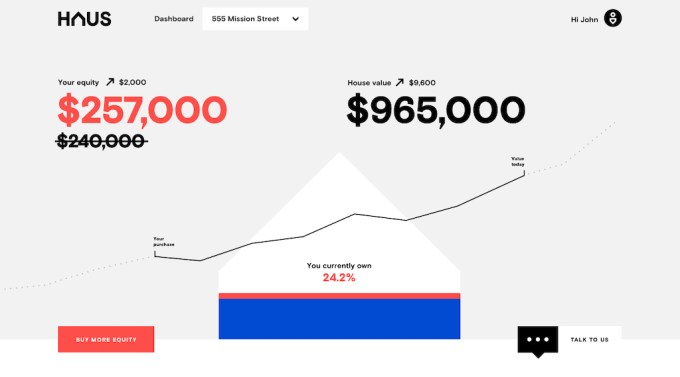
Haus was created by Uber co-founder Garrett Camp as part of his startup studio Expa . When it launched in 2016, it was focused on digitizing and bringing more transparency to the home-buying process. Since then, former Trulia executive Jonathan McNulty joined as CEO, and he’s introduced that co-investment model, where Haus helps to finance a purchase by buying equity in the home.

The idea is that instead of taking on debt, the homeowner is sharing both the risks and the rewards of changing home values with Haus. Nad instead of paying off a mortgage, the homeowner makes monthly payments Haus that both purchase more equity and the startup and its investors.

The company estimates that these payments are, on average, 30% lower than a traditional mortgage payment. In an email, McNulty said that Haus caps the “option” portion of the payment, so that homeowners are always purchasing as much equity as they did with their first payment, even if the home’s value increases.

haus screenshot

“From a consumer perspective, there have historically only been two ownership options, pay cash for your home, or borrow money from a bank or lender with a mortgage,” he said. “With Haus, we replace that mortgage relationship and create a direct partnership with the consumer, to create an entirely new way of financing a home.”

Haus can also work with existing homeowners to replace part or all of their mortgage —  McNulty noted that in some cases, it may make sense “to keep some mortgage debt active for tax purposes.”

When asked about how the consumers have responded so far, McNulty declined to provide specific numbers, but he said the service is active in Washington, California and Oregon, and that “the early demand is significant, which makes sense given the affordability challenges we see in these western states.”

Other new investors include RIT Capital Partners and Tim Ferriss. McNulty said the funding will allow the company to expand its team, particularly to do more marketing and to enter new geographies.

“The current real estate model has been broken for a long time,” Montage Ventures Partner Matt Murphy in a statement. “Homeownership … for people ages 25 to 34 is much lower than it should be. We are excited to partner with Haus to bring much needed relief to current homeowners and prospective buyers alike.”

18 Jul 2019

Only 24 hours left to apply for TC Top Picks at Disrupt SF 2019

Early-stage startup founders, you have just 24 hours left to complete one small task — a task that holds the potential to shift your venture into hyperdrive. Apply to be a TC Top Pick and the chance to exhibit for free at Disrupt San Francisco 2019 in October. There’s no time left to drag your feet, because this opportunity expires on July 19 at 5 p.m. (PT).

Does your startup qualify? We’re looking specifically for pre-Series A startups that fall into one of these tech categories: AI/Machine Learning, Biotech/Healthtech, Blockchain, Fintech, Mobility, Privacy/Security, Retail/E-commerce, Robotics/IoT/Hardware, SaaS and Social Impact/Education.

Applying is easy; however, earning a Top Pick designation — not so much. Our highly discerning TechCrunch editors thoroughly vet qualified applicants and choose up to five outstanding startups in each category.

Our TC Top Picks get the VIP treatment at Disrupt, starting with a free Startup Alley Exhibition Package good for one full day of exhibiting in Startup Alley. You also receive three Founder passes, access to the complete Disrupt SF 2019 press list and invitations to special events — like the investor reception. Opportunity, I hear you knocking!

You’ll exhibit in a dedicated space within Startup Alley and, because we promote the heck out of TC Top Picks in our pre-conference marketing, you can expect intense interest from investors, media, other founders and potential customers. Top Picks stand in a very bright spotlight.

One of the best perks provides value that lasts long after Disrupt ends. A TechCrunch editor will interview each Top Pick — live on the Showcase Stage in Startup Alley. We’ll record the interviews and promote them across our social media platforms.

Here’s another reason to apply. Every early-stage startup exhibiting in Startup Alley has a shot at participating in Startup Battlefield, our epic pitch competition. TechCrunch editors will pick two startups as Wild Card teams — and they’ll compete for $100,000 equity-free cash, the Disrupt Cup and even more investor and media attention.

Disrupt San Francisco 2019 takes place October 2-4, and one simple task can shift your business in a whole new direction. You have just 24 hours. Apply to be a TC Top Pick now — before the clock runs out on July 19 at 5 p.m. (PT).

Is your company interested in sponsoring at Disrupt SF 2019? Contact our sponsorship sales team by filling out this form.

18 Jul 2019

Storytelling community Wattpad launches its premium products worldwide

Online storytelling community Wattpad, also now a content feeder for streaming services and other media companies, is taking its two consumer-facing paid products global. Wattpad Premium, the ad-free subscription tier, first launched in 2017 and has only been available in a handful of countries to date. It’s now available to Wattpad’s 70 million-plus worldwide users, as of today. In addition, Wattpad’s Paid Stories, which offers exclusive, paywalled content to readers, is also now available to the global user base.

This product launched last November into beta testing, when it was then called Wattpad Next. It was initially available in the U.S. with plans for a global launch planned for this year.

Technically speaking, Wattpad quietly launched Paid Stories globally last week, but it has now completed its rollout to all users, the company says. The stories give readers another way to support their favorite writers as they can purchase the serialized content either when the story is finished, or as it’s still being written. This past month, readers spend more than 5.5 million minutes on Paid Stories, the company says.

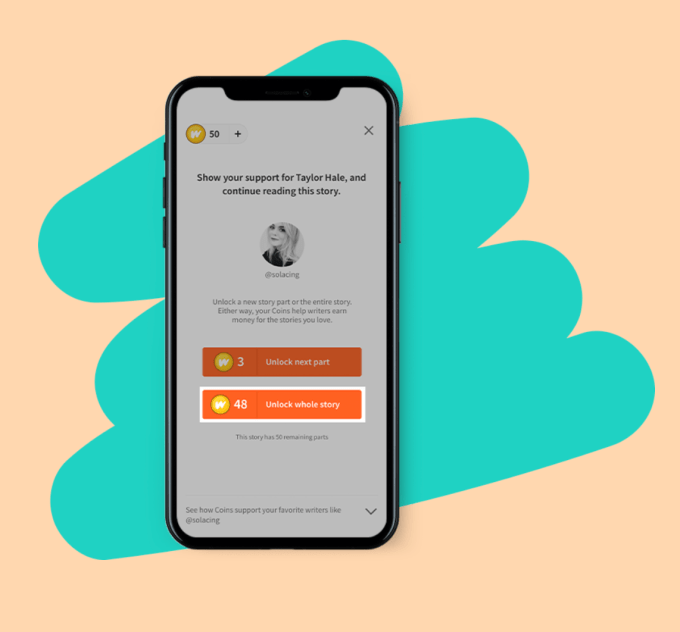
Users purchase access to the stories using Wattpad’s virtual currency, Coins. These Coins are sold in packs that start at $0.99 for 9 Coins, and go as high as $7.99 for 230 Coins.

With the global expansion, the two products are also being better integrated.

Screen Shot 2019 07 18 at 10.31.39 AMNow, Wattpad Premium subscribers will receive discounted Coins to buy the Paid Stories. They also receive bonus Coins — up to 66% more free Coins, the company says — every time they buy a Coin package to unlock a Paid Story.


“Our vision at Wattpad is to entertain and connect the world through stories, creating the best platform and community on the planet for every type of reader and writer,” said Wattpad General Manager, Jeanne Lam. “Every innovation and initiative at Wattpad supports that vision while improving the experience for users. Wattpad Premium and Wattpad Paid Stories give users everywhere more control over their Wattpad experience and options to enjoy the platform in new ways — whether it’s uninterrupted, ad-free reading or the chance to support the writers who make those stories possible.”

The products do generate some revenue for the company — Wattpad is No. 11 Top Grossing app in the Books category on the App Store and No. 8 on Google Play. However, the company’s bigger business these days is its content deals. Wattpad earlier this year inked a first-look deal with Sony Pictures Television, and has a development deal with Universal Cable Productions, among others. Internationally, it’s working with iflix, Bavaria Fiction, Huayi Brothers Korea, Penguin Random House India, Mediaset, NL Film, Mediacorp, and eOne.

Wattpad’s stories have been turned into feature films, as well as movies and TV shows for streaming services like Netflix (The Kissing Booth) and Hulu (Light as a Feather).

It now has its own print publishing arm, too, with Wattpad Books.

These broader efforts capitalize on Wattpad’s generally younger and devoted fanbase.

For example, one of the more popular Wattpad Books titles, The QB Bad Boy & Me by Tay Marley, was read more than 26.3 million times on Wattpad, and will become available in book form on August 20, 2019.

18 Jul 2019

Inside Harley Davidson’s EV shift with a ride on its LiveWire

Harley-Davidson will release its first production electric motorcycle in September, the LiveWire.

Yes, the American symbol for internal combustion, chrome and steel is going all in on two-wheeled EVs.

Founded in Milwaukee in 1903, Harley Davidson opened a Silicon Valley office in 2018 with plans to add a future line-up of electric vehicles—from motorcycles to bicycles to scooters.

With these moves HD joins a list of established transportation companies that are redefining themselves in the transformation of global mobility.

TechCrunch talked to the company’s senior management on the EV pivot and got a chance to test the  LiveWire on New York’s Formula E race track. 

The battery powered Harley will do 0-60 mph in 3 seconds, 110 mph, and charge to 100 percent in 60 minutes for a $29,799 MSRP.

The motorcycle’s 15.5kWh battery and magnet motor produce 105 horsepower and 86 ft-lbs of torque for a city range of 146 miles (and 95 for combined city/highway riding).

Harley Davidson Livewire static 1

In contrast to some of Harley’s minimalist gas motorcycles, the company teched out the LiveWire. The e-moto has five processors to manage performance and app-based connectivity, according to HD’s Chief Engineer for EV Technology, Sean Stanley.

The LiveWire’s tablet type dash synchronizes with smartphones and allows for preset and customized digital riding modes. From the dash or a smartphone one can calibrate and monitor the LiveWire’s power output, charge-status, traction-control settings, and ABS braking characteristics. The EV has navigation capabilities and a Bluetooth system for music, helmet comms, and to accept incoming phone calls.

Harley Davidson is famous for its internal combustion rumble—which warranted a new signature electric sound generated from the LiveWire’s mechanical movements. “We spent a lot of time optimizing it…The sound comes from a combination of the electric motor, the transmission, and the drive line,” explained Stanley.

You can power the LiveWire on a home outlet or get your electric motor running to head out on the highway with the same fast-charging networks that power Teslas—such as Chargepoint.

HD is also adding charging stations at its LiveWire selling dealers and announced a partnership last week with Electrify America to provide new owners 500 kW for free.

Harley Davidson’s electric-shift puts the iconic American company in a position to hedge competition from e-moto startups, as it jumps out front as the EV leader among established motorcycle companies.

The major gas names have been slow to embrace production e-motos. None of the big motorcycle manufacturers—Honda, Kawasaki, BMW—offer a street-legal, electric motorcycle in the U.S. KTM introduced its Freeride E-XC off-road motorcycle in 2018 and will soon offer a junior version for the first all electric Supercross racing class.

Harley’s electric moves come after a period of revenue decline for the company and stagnation in the powered two-wheeler market.

The U.S. motorcycle industry has been in pretty bad shape since the recession. New sales dropped by roughly 50 percent since 2008—with sharp declines in ownership by everyone under 40—and have never recovered.

LiveWire Charging Harley DavidsonAnalysts, such as UBS’s Robin Farley, have suggested that appealing to the preferences of more tech-savvy millennials, over those of baby boomers, should be a priority for Harley Davidson.

For the last several years, e-motorcycle startups have worked to produce models that rejuvenate interest from a younger generation, while creating gas rider converts. In addition to offering more tech features to attract new riders, companies such as California based Zero have worked to close gaps on price, range, charge times and performance compared to petrol powered motorcycles. The startup began shipping its 2020 $18,995 SR/F model—a potential LiveWire competitor—with a 161 mile city range, one-hour charge capability, and a top speed of 124 mph.

E-moto startup, Fuell, will debut its $10,995 Flow with 2.7 second 0-60 speed, 150 mile range, and 30 minute charge times in Europe this year, then the U.S., according to founder Erik Buell.

Harley Davidson LiveWire TrackSo market competition aside, what’s it like to ride Harley Davidson’s LiveWire? Nearly a dozen laps around NYC’s Formula E circuit offered a solid first impression. The LiveWire is everything that’s becoming the e-motorcycle experience: lightning-like acceleration with little noise beyond the wind cracking around you.

The biggest distinction between the LiveWire—vs. gas motorcycles—is its monster torque and uninterrupted forward movement. The machine has one gear, so there’s no clutch or shifting. With only a battery, processor, and drive-train there’s much less that needs to happen mechanically to deliver power from the throttle to the rear wheel. You simply twist and go.

As Harley Davidson rolls out its adrenaline inducing LiveWire, there are several things to watch. The first is how the $29K price-point fares in the market vis-a-vis startup competitors, such as Zero—who are launching comparable, yet less expensive e-motos. HD’s Paul James (see video) gives LiveWire an edge over Zero on performance attributes and Harley’s service and dealer networks. Sales figures will soon tell if buyers agree.

Harley Davidson’s EV foray could also create the spark that pushes the gas motorcycle industry toward electric—which would make HD a case of the almost disrupted transportation company becoming the disruptor.

And even more significant than the LiveWire release is what Harley Davidson offers next. The company has committed to produce a lighter, lower priced, e-motorcycle in the near future, as well as e-scooters and e-bicycles.

At an event this spring, Harley Davidson’s VP for Product Marc McAllister stressed the need for HD to remain a premium motorcycle transportation company, while developing products for a more on-demand, urban mobility era.

Harley Davidson’s LiveWire is a leap in that direction, but the company’s next round of two-wheel EVs—and the market response—will tell us more about HD’s relevance in the transformation of how people chose to move from place to place.


18 Jul 2019

Slack resets user passwords after 2015 data breach

Slack will reset the passwords of users it believes are affected by a historical data breach that affected the company more than four years ago.

Back in 2015 the company said it was hit by hackers who gained access to its user profile database, including their scrambled passwords. But the hackers inserted code that scraped the user’s plaintext password as it was entered by users at the time.

Slack said it was contacted through its bug bounty about a list of allegedly compromised Slack account passwords. The company believes the case may relate to the 2015 data breach incident.

Slack said the security incident does not apply to “the approximately 99% who joined Slack after March 2015” or changed their password since.

Accounts that require single sign-on through a company’s network are not affected.

Slack said 1% of accounts in 2015 were affected by the breach. An earlier report suggested that the figure may amount to 65,000 accounts. A Slack spokesperson would not comment further when reached.

Slack recently debuted on the New York Stock Exchange, valuing the company at about $15.7 billion.