Year: 2019

17 Jul 2019

SpaceX’s ‘Starhopper’ bursts into flames during static fire test

SpaceX’s test vehicle, a small-scale demonstration craft for some Starship components, caught fire after what appears to be a fuel leak or dump following an otherwise successful static fire test last night. It’s not clear why the craft suddenly burst into flames, or whether it was seriously or even superficially damaged.

The “Starhopper,” as SpaceX has been calling it, is a much smaller scale version of the Starship craft the company has in development, meant to test them out in a live-fire environment and even perform short flights called hops — hence the name. It’s being assembled and operated at SpaceX’s facilities in Boca Chica, Texas.

The big shiny craft looks a bit like a toy, but it’s a functioning rocket and it was planned that this week it would do an untethered hovering flight at some 20 meters, a step above the short tethered flights it has already accomplished. But last night’s test firing of the engines seems to have produced an anomaly.

hopper fire

As captured by several in the SpaceX community, the static fire started and stopped, but flames continued to burn around the base of the engines. A stream of liquid (very likely water) is directed towards it, at which point the whole rocket appears to ignite in an impressive fireball — then does it again a few seconds later. You can see the whole process (in 4K no less) in Everyday Astronaut’s video:

It’s unclear at this point what the cause of the fireball is, and whether it was in any part intentional. What’s certain is that this is not how previous test fires have gone, and generally speaking you don’t want your rocket to be on fire, even if it is highly heat-resistant.

Some have speculated that there was a fuel dump following the tests that produced lighter-than-air vapors, which rose and surrounded the rocket. The water jet may have caused the small fire to ignite the vapor, producing the fireball. I’ve asked SpaceX for any information they can share.

Images taken the next day don’t show a molten pile of slag, and in fact the vehicle doesn’t look any worse for wear on the outside. But while that’s testament to the test vehicle’s durability and stainless steel skin, it doesn’t mean there’s nothing wrong inside.

Anything unexpected happening during a test like this is reason to abort and reassess, so it won’t be a surprise if we hear that Starhopper tests have been indefinitely delayed. LabPadre, who took another video of the event, noted on Twitter that the local authorities told him SpaceX withdrew all road and beach closures, so testing is apparently off for now.

I’ll update this story if and when SpaceX provides further information on the event.

17 Jul 2019

Instagram will now hide likes in 6 more countries

Would the Internet be a better place if we all paid a little less attention to fake Internet points? Instagram is still trying to figure it out.

Just a few months back, Instagram started testing a design tweak that would no longer show the total number of “likes” other user’s posts had received. You could still see everyone that liked your photos and videos – but anyone else’s stuff? Don’t worry about it.

While the company hasn’t said much about how the tests are going so far, it seems they’re going well enough to expand them. Initially rolled out in just Canada, it’ll roll out to users in six more countries starting today:

  • Ireland
  • Italy
  • Japan
  • Brazil
  • Australia
  • New Zealand

Curiously, some users in Canada (the first country where hidden likes were tested) reported yesterday that likes had returned to their feed. Instagram confirmed to us that the testing in Canada is still ongoing. Meanwhile, likes seem to be gone again in Canada as of this afternoon.

We wrote about Instagram’s like-hiding experiments a few weeks prior to the public tests, after the pending rollout was discovered by reverse engineering extraordinaire Jane Manchun Wong.

So why hide likes? Instagram says it’s “because [they] want your followers to focus on the photos and videos you share, not how many likes they get.”

In other words: when likes are public, people care too much about them. People view it as a metric of success – teasing those who get too few, or buying likes to try to gain admiration. If a post doesn’t get enough likes, people delete them to make it seem like all of their photos are hits. In theory, hiding likes from the feed but making them visible to the creator lets people get some sense of whats working, without having to worry so much about whatever anyone else is taking away from the like count on any given photo.

Here’s what Instagram looks like with the design tweak. Note the banner up top giving the user a heads up of the change, and that the like bar just says “Liked by username and others” instead of any specific number of users:


17 Jul 2019

Microsoft has warned 10,000 victims of state-sponsored hacking

Microsoft said it has notified close to 10,000 people in the past year that they have been targeted by state-sponsored hackers.

The tech giant said Wednesday that the victims were either targeted or compromised by hackers working for a foreign government. In almost all cases, Microsoft said, enterprise customers were the primary targets — such as businesses and corporations. About one in ten victims are consumer personal accounts, the company said.

Microsoft said its new data, revealed at the Aspen Security Forum in Colorado, demonstrates the “significant extent to which nation-states continue to rely on cyberattacks as a tool to gain intelligence, influence geopolitics, or achieve other objectives.”

On top of that the company also said it has made 781 notifications of state-sponsored attacks on organizations using its AccountGuard technology, designed for political campaigns, parties and government institutions.

Almost all of the attacks targeted U.S.-based organizations, the company said, but a spokesperson would not disclose the percentage of successful attacks.

Most of the attacks were traced back to activity by hacking groups believed to be associated with Russia, North Korea and Iran.

One such group, the so-called APT 33 group operating out of Iran — which Microsoft calls Holmium — has been in Microsoft’s crosshairs before. In March the company said the Tehran-backed hackers stole corporate secrets and destroyed data in a two-year long hacking campaign. Weeks later the company sued to obtain a restraining order for another Iranian hacker group, APT 35, or Phosphorus. A year earlier it took similar legal action against Russian hackers, known as APT 28, or Fancy Bear, which was blamed for disrupting the 2016 presidential election.

“Cyberattacks continue to be a significant tool and weapon wielded in cyberspace. In some instances, those attacks appear to be related to ongoing efforts to attack the democratic process,” said Microsoft’s customer security chief Tom Burt in a blog post.

Microsoft said it expects to see the “use of cyberattacks to specifically target democratic processes” ahead of the upcoming 2020 presidential election.

17 Jul 2019

Apple gives a sneak peak of its new Peanuts series with ‘Snoopy in Space’ trailer

As the U.S. commemorates the 50th anniversary of the moon landing, Apple took to the internet to give audiences a peak into the first of its new Peanuts series, “Snoopy in Space”.

The series will follow Charles M. Schulz’s characters as they take afield trip to a NASA location where Snoopy and . Woodstock are selected for a space mission.

Charlie Brown and the rest of the characters will staff mission control, while Snoopy and Woodstock fly into the great beyond.

The series is set to launch on Apple TV+ in the Fall.

17 Jul 2019

Apple gives a sneak peak of its new Peanuts series with ‘Snoopy in Space’ trailer

As the U.S. commemorates the 50th anniversary of the moon landing, Apple took to the internet to give audiences a peak into the first of its new Peanuts series, “Snoopy in Space”.

The series will follow Charles M. Schulz’s characters as they take afield trip to a NASA location where Snoopy and . Woodstock are selected for a space mission.

Charlie Brown and the rest of the characters will staff mission control, while Snoopy and Woodstock fly into the great beyond.

The series is set to launch on Apple TV+ in the Fall.

17 Jul 2019

Netflix reports first net subscriber loss in the U.S., misses global subscriber growth predictions

Netflix’s continued subscription price hikes might finally have reached the end of some customers’ patience in the U.S., judging from an overall paid subscriber decline the company reported in its quarterly earnings for its fiscal second quarter 2019 results. The company’s overall growth for paid subscribers climbed by 2.7 million worldwide, but it actually added 2.83 million new subscribers around the world – while losing around 130,000 net in the U.S. to account for the difference.

Netflix’s price for consumers went up from $10.99 to $12.99 during its fiscal Q2 reporting period, which definitely could account for some of the fall-off. The company doesn’t seem to have anticipated such a strong reaction, however, since it had anticipated a net 5.0 million subscriber growth number as of last quarter, based at least in part on the 5.5 million it added in paying customers during Q2 2018.

The company specifically says that it missed its subscriber growth adds more significantly in regions where it introduced a price hike, vs. those where it did not – though its growth was lower than expected in all regions where it operates. You might think that some of its shedding of users in the U.S. has to do with competition, but the company points out that most of its material competitors are actually just announced, not available in market, so it thinks this isn’t really a significant cause.

Instead, Netflix points at its content library, as well as those pricing changes in markets where they do apply. The Q2 content slate caused fewer new sign-ups than the company expected, it said in its earnings release. That’s despite strong four-week performance numbers from When They See Us (25 million households), Our Planet (33 million), Murder Mystery (73 million), The Perfect Date (48 million) and Always Be My Maybe (32 million).

Still, the company thinks it will add a whole heap of new subscribers in Q3 this year, with an expectation of 7 million paid membership adds, which is significantly up from the 6.1 million it added last year. One big reason for this optimism might be that it’s going to launch a new, mobile-only and more affordable tier for India, which will launch during the quarter.

Netflix’s stock price is down more than 10 percent after hours as of this writing based on these results. The full Q2 Netflix earnings are available here.

17 Jul 2019

Twitter officially launches its ‘Hide Replies’ feature, initially to users in Canada

Twitter today is beginning its test of a radical and controversial change to its service with the launch of a new “Hide Replies” feature. Effectively, this option gives users the ability to wrestle back control over a conversation they’ve started, by hiding any replies they feel aren’t worthy contributions — for example, replies that are irrelevant or outright offensive.

One of the problems with Twitter — and with many social networks, for that matter — is that an otherwise healthy conversation can easily be disrupted by a single individual or a small number of people who don’t contribute in a positive fashion. They come into a thread to start drama or they make inappropriate, rude or even hateful remarks.

Of course, users can choose for themselves to either Mute or Block people like this, which limits their ability to affect their own personal experience on Twitter. But this doesn’t remove their comments from others’ view. The “Hide Replies” feature, however, will.

But it’s not the equivalent of a delete button. In other words, hidden replies are not removed from Twitter entirely, they are just placed behind an icon. If people want to see the hidden replies, they can press this icon to view them.

author1 1

Twitter’s goal with the feature is to encourage more civil conversation its platform. It could work, as those who want their comments seen by a wide audience will have to find a way to express themselves in an appropriate fashion — without taking the conversation off course or resorting to insults or trolling. Otherwise, they know their replies could be hidden from the default view.

But this change is not without significant downsides.

For example, a user could choose to hide replies that simply (and even politely!) disagreed with their view. This would then create a “filter bubble” where only people who shared the original poster’s same opinion would have their comments prominently displayed. In this case, the feature would be silencing of other viewpoints — and that’s in direct opposition to Twitter’s larger goal of creating a public town square on the web, where every voice has a chance to be heard.

More worryingly, a user could choose to hide replies that attempt to correct misinformation or offer a fact check. That’s a significant concern at a time when social media platforms have turned into propaganda dissemination machines, and have been infiltrated by state-supported actors from foreign governments looking to manipulate public sentiment and influence elections.

Twitter claims the feature provides transparency because hidden replies are still available for viewing to anyone who wishes to see them. But this assumes that people will notice the small “hidden replies” icon and bother to click it.

The ability to hide replies is initially available only to users in Canda, but tweets with hidden replies will be accessible by all Twitter users worldwide.

In a statement posted as a series of tweets and replies to others, Twitter explained its goals around the new addition:

“We’re testing a feature to hide replies from conversations. This experience will be available for everyone around the world, but at this time, only people in Canada can hide replies to their Tweets…They’ll be hidden from the main conversation for everyone behind a new icon. As long as it hasn’t been deleted and/or is not from an account with protected Tweets, everyone can still interact with a hidden reply by clicking the icon to view. We want everyone on Twitter to have healthy conversations, and we’re working on features that will help people feel more comfortable. We’re testing a way for people to hide replies they feel are irrelevant or offensive.”

Twitter had previously confirmed its plans to test a “Hide Replies” feature, and had announced its plan to launch the feature sometime this week.

Social media is due for a course correction, and Twitter at least isn’t afraid to try significant changes to its platform. (It’s even trying a new prototype of its app, called twttr.) However, some would argue that permanent bans on rulebreakers and more attention to enforcing existing policies would negate the need for features like this.


17 Jul 2019

HBO Max is bringing back ‘Gossip Girl’

“Gossip Girl,” the soapy CW drama about wealthy teenagers behaving badly in New York City’s Upper East Side, is returning to TV thanks to HBO Max.

Specifically, the streaming service has placed a 10-episode, straight-to-series order for an updated version of the show. According to The Hollywood Reporter, Joshua Safran (a writer and executive producer on the original show) will be spearheading the new series, while Josh Schwartz and Stephanie Savage (the original creators) have signed on as executive producers.

It’s not clear yet whether any “Gossip Girl” stars will return, but Safran described this as an “extension” of the previous show, focusing on a new generation of teenagers.

To be clear, this won’t be on HBO, but instead on the yet-to-launch WarnerMedia streaming service now known as HBO Max, which will include HBO and other streaming content (including new shows and also “Friends”).

“Gossip Girl” initially aired from 2007 to 2012. It was never a huge ratings hit, but it had passionate fans, and particularly in its early seasons, it spurred plenty of adoring and/or scandalized headlines — maybe that’s what a new streaming service is looking for.

And this is where I acknowledge that I was, for a while, one of those fans. I tried to binge the entire first season in a single night, but my interest rapidly faded during season two, and I only returned for the ridiculous finale. Still, when the show was working, it was about as fun and addictive as television gets.

17 Jul 2019

Peloton’s new automated vehicle system gives one driver control of two trucks

The trucking world has been inundated in recent years by startups and large companies alike pitching an array of automated driving technology and business strategies, all aiming to solve the big three problems with freight: safety, fuel costs and driver shortages.

For Peloton Technology, a Silicon Valley company that launched in 2011, the answer doesn’t strip out the human driver. Instead, it wants to augment a human truck driver’s ability with automated vehicle technology. The company, which has raised $78 million from BP Ventures, Intel Capital, Volvo Group and a dozen other venture and strategic investors, wants to commercialize a partially automated vehicle platooning system that enables two trucks (and maybe a whole string of them) to operate at close following distances.

Peloton Technology already has a product called PlatoonPro that six customers are using in their freight operations. Now, the company has unveiled an advanced product called Level 4 Automated Following that it says will double the productivity of truck drivers. Peloton Technology revealed details on the new automated platooning system Wednesday at the Automated Vehicle Symposium 2019 in Orlando.

PlatoonPro is considered a “Level 1” driver assistance system that requires drivers in both the lead and follow trucks. In this system, the driver in the follow truck must steer the vehicle. The system controls the powertrain and brakes to allow a close following distance and immediately reacts to acceleration or braking by the lead truck. The system boosts fuel savings by an average of 7%, the company says.

The new Automated Following system, a human driver is in the lead truck. But this time, the follow truck won’t have a human driver.  The system combines vehicle-to-vehicle communication with radar-based active braking and software. Together, the human driver in the lead vehicle is able to guide the steering acceleration and braking of the follow truck and connects the safety systems between the trucks with minimal latency, according to Peloton Technology.

“We’ve taken a different approach to commercial introduction of automation in class 8 vehicles.” Peloton Technology CEO Josh Switkes said. “We see the drivers as the world’s best sensors, and we are leveraging this to enable today’s drivers to be more productive through automated following platoons.”

And Switkes isn’t kidding. The human driver is front and center to this technology. The lead truck relies completely on the skill set of the professional truck driver. The system works alongside any of the driver assistance features like collision warnings or automatic emergency braking that might come with the Class 8 truck. But it does not provide additional driver assistance features.

The L4 Automated Following product, which is being tested internally, will double the amount of freight a truck driver can haul in a single trip, according to the company.

17 Jul 2019

For World Emoji Day, the Unicode Consortium redesigns its site to be more user-friendly

Ahead of World Emoji Day on Wednesday, July 17, Apple and Google announced plans to bring an expanded set of emoji to their respective platforms. Today, the Unicode Consortium, the nonprofit organization responsible for determining which emoji get the greenlight, is relaunching its website with an updated, modern design that aims to make its information more accessible to the general public.

Before, its website design was very basic — just text and links to various pages about the Consortium itself, the standard, miscellaneous FAQs, projects in progress, and other information. It looked like a technical resource, and certainly one that hadn’t been updated in years.

With an outdated layout, ancient social share buttons and boring font choices, it really looked more like an ancient government website than a resource designed for public consumption.

Screen Shot 2019 07 17 at 2.05.49 PM

Above: the old site 

That changes with the redesign. Not only is the site more mainstream-friendly, it more actively encourages participation and involvement from the public.

Unicode is a global technology standard that is one of the core building blocks of the internet,” said Unicode board member Greg Welch, in an announcement about the changes to the site. “Unicode has helped facilitate the work of programmers and linguists from around the world since the 1990s. But with the rise of mobile devices and public enthusiasm for emoji, we knew it was time to redesign the Unicode website to make information more easily accessible, and increase community involvement,” he says.

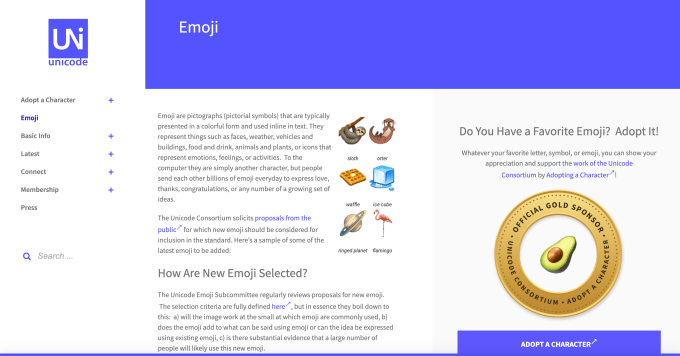
Screen Shot 2019 07 17 at 2.08.25 PM

Above: the Emoji section on the new site

Although the Consortium itself is focused more broadly on developing text standards, their work with emoji now gets the most attention. Today, emoji are used by 92% of the world’s online population, which has put the organization into the spotlight, it says.

The updated site was built with help from a team of designers from Adobe, and features a homepage covered in emoji. The main navigation directs visitors to information about emoji, including how to submit a proposal for a new emoji (which is still not a user-friendly a process), as well as information about “adopting” an emoji — that is, a way to offer a tax-deductible donation to the Unicode Consortium while gaining access to a custom badge you can show off on your own website or social media accounts.

There are currently 136,000 emoji available for “adoption,” the organization notes, including the newly announced additions like the sloth, sea otter, waffle and Saturn.

The new site is definitely more attractive and easier to use, following the redesign. But for those who miss the classic look, it’s still live at http://unicode.org/main.html. (Often, you’ll hit the old site when you click through links from the new one. The redesign only goes so deep, it seems.)

While the redesign is welcome, people in search of information about their favorite emoji — like, how it looks on different platforms, when it was officially added, or what the emoji means, for example — may find the website Emojipedia a better bet.