Year: 2019

17 Jul 2019

Facebook’s regulation dodge: Let us, or China will

Facebook is leaning on fears of China exporting its authoritarian social values to counter arguments that it should be broken up or slowed down. Its top executives have each claimed that if the U.S. limits its size, blocks its acquisitions, or bans its cryptocurrency, Chinese company’s absent these restrictions will win abroad, bringing more power and data to their government. CEO Mark Zuckerberg, COO Sheryl Sandberg, and VP of communications Nick Clegg have all expressed this position.

The latest incarnation of this talking point came in today and yesterday’s congressional hearings over Libra, the Facebook-spearheaded digital currency it hopes to launch in the first half of 2020. Facebook’s head of its blockchain subsidiary Calibra David Marcus wrote in his prepared remarks to the House Financial Services Committee today that:

“I believe that if America does not lead innovation in the digital currency and payments area, others will. If we fail to act, we could soon see a digital currency controlled by others whose values are dramatically different”

Senate Banking Committee Holds Hearing On Facebook's Proposed Crypto Currency

WASHINGTON, DC – JULY 16: Head of Facebook’s Calibra David Marcus testifies during a hearing before Senate Banking, Housing and Urban Affairs Committee July 16, 2019 on Capitol Hill in Washington, DC. The committee held the hearing on “Examining Facebook’s Proposed Digital Currency and Data Privacy Considerations.” (Photo by Alex Wong/Getty Images)

Marcus also told the Senate Banking Subcommittee yesterday that “I believe if we stay put we’re going to be in a situation in 10, 15 years where half the world is on a blockchain technology that is out of reach of our national-security apparatus” .

This argument is designed to counter House-drafted “Keep Big Tech Out Of Finance” legislation that Reuters reports would declare that companies like Facebook that earn over $25 billion in annual revenue “may not establish, maintain, or operate a digital asset . . .  that is intended to be widely used as medium of exchange, unit of account, store of value, or any other similar function.”

The message Facebook is trying to deliver is that cryptocurrencies are inevitable. Blocking Libra would just open the door to even less scrupulous actors controlling the technology. Facebook’s position here isn’t limited to cryptocurrencies, though.

The concept crystallized exactly a year ago when Zuckerberg said “I think you have this question from a policy perspective, which is, do we want American companies to be exporting across the world?” in an interview with Recode’s Kara Swisher.

“We grew up here, I think we share a lot of values that I think people hold very dear here, and I think it’s generally very good that we’re doing this, both for security reasons and from a values perspective. Because I think that the alternative, frankly, is going to be the Chinese companies. If we adopt a stance which is that, ‘Okay, we’re gonna, as a country, decide that we wanna clip the wings of these companies and make it so that it’s harder for them to operate in different places, where they have to be smaller,’ then there are plenty of other companies out that are willing and able to take the place of the work that we’re doing.”

When asked if he specifically meant Chinese companies, Zuckerberg doubled down, saying:

“Yeah. And they do not share the values that we have. I think you can bet that if the government hears word that it’s election interference or terrorism, I don’t think Chinese companies are going to wanna cooperate as much and try to aid the national interest there.”

WASHINGTON, DC – APRIL 10: Facebook co-founder, Chairman and CEO Mark Zuckerberg testifies before a combined Senate Judiciary and Commerce committee hearing in the Hart Senate Office Building on Capitol Hill April 10, 2018 in Washington, DC. Zuckerberg, 33, was called to testify after it was reported that 87 million Facebook users had their personal information harvested by Cambridge Analytica, a British political consulting firm linked to the Trump campaign. (Photo by Chip Somodevilla/Getty Images)

This April, Zuckerberg went deeper when he described how Facebook would refuse to comply with data localization laws in countries with poor track records on human rights. The CEO explained the risk of data being stored in other countries, which is precisely might happen if regulators hamper Facebook and innovation happens elsewhere. Zuckerberg told philosopher Yuval Harari that:

“When I look towards the future, one of the things that I just get very worried about is the values that I just laid out [for the internet and data] are not values that all countries share. And when you get into some of the more authoritarian countries and their data policies, they’re very different from the kind of regulatory frameworks that across Europe and across a lot of other places, people are talking about or put into place . . . And the most likely alternative to each country adopting something that encodes the freedoms and rights of something like GDPR, in my mind, is the authoritarian model, which is currently being spread, which says every company needs to store everyone’s data locally in data centers and then, if I’m a government, I can send my military there and get access to whatever data I want and take that for surveillance or military.

I just think that that’s a really bad future. And that’s not the direction, as someone who’s building one of these internet services, or just as a citizen of the world, I want to see the world going. If a government can get access to your data, then it can identify who you are and go lock you up and hurt you and your family and cause real physical harm in ways that are just really deep.”

facebook logo down glitch

Facebook’s newly hired head of communications Nick Clegg told reporters back in January that:

“These are of course legitimate questions, but we don’t hear so much about China, which combines astonishing ingenuity with the ability to process data on a vast scale without the legal and regulatory constraints on privacy and data protection that we require on both sides of the Atlantic . . .  [and this data could be] put to more sinister surveillance ends, as we’ve seen with the Chinese government’s controversial social credit system.”

In response to Facebook co-founder Chris Hughes’ call that Facebook should be broken up, Clegg wrote in May that “Facebook shouldn’t be broken up — but it does need to be held to account. Anyone worried about the challenges we face in an online world should look at getting the rules of the internet right, not dismantling successful American companies.”

He hammered home the alternative the next month during a speech in Berlin:

“If we in Europe and America don’t turn off the white noise and begin to work together, we will sleepwalk into a new era where the internet is no longer a universal space but a series of silos where different countries set their own rules and authoritarian regimes soak up their citizens’ data while restricting their freedom . . . If the West doesn’t engage with this question quickly and emphatically, it may be that it isn’t ours to answer. The common rules created in our hemisphere can become the example the rest of the world follows.”

COO Sheryl Sandberg made the point most directly in an interview with CNBC in May:

“You could break us up, you could break other tech companies up, but you actually don’t address the underlying issues people are concerned about . . . While people are concerned with the size and power of tech companies, there’s also a concern in the United States about the size and power of Chinese tech companies and the … realization that those companies are not going to be broken up.

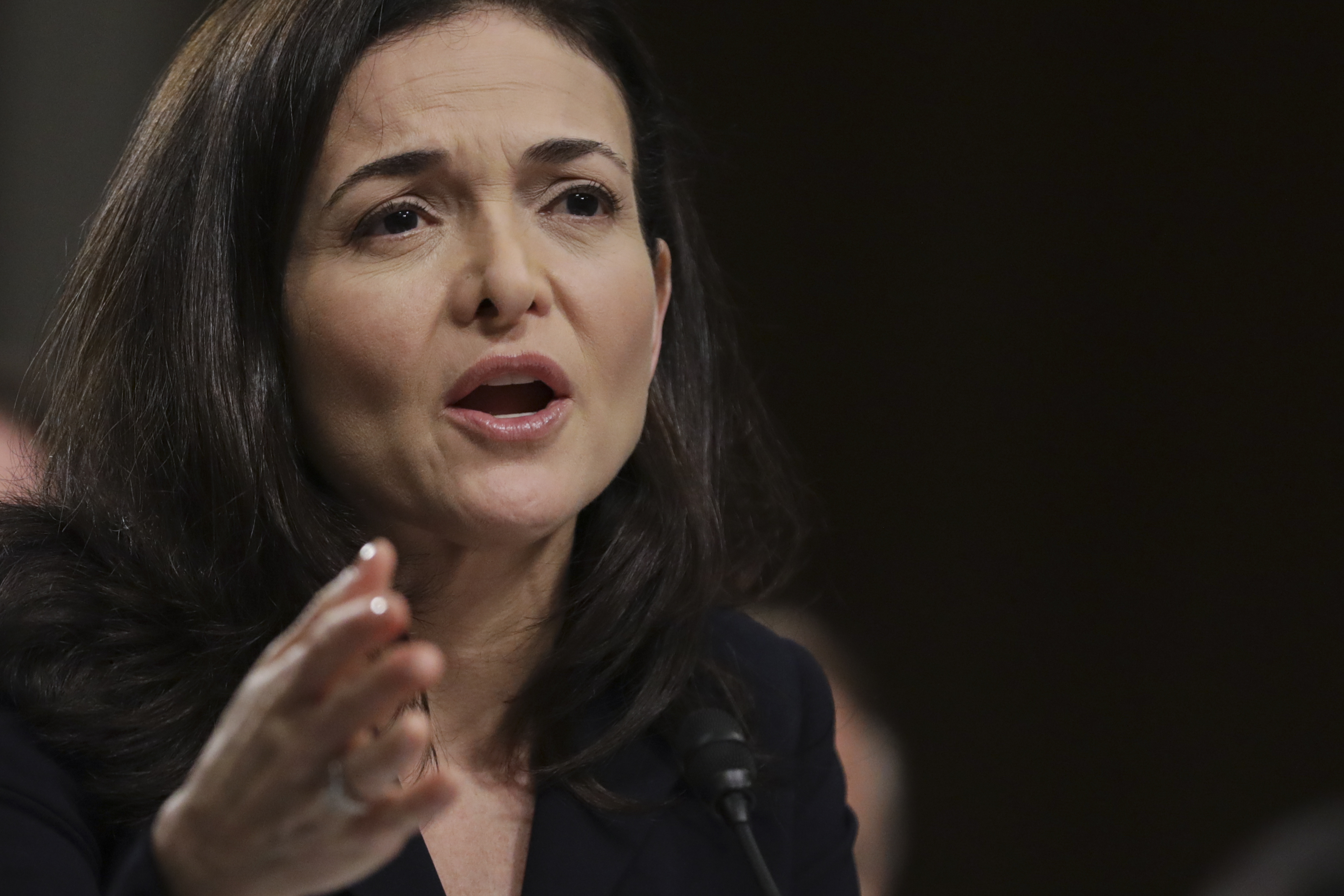
WASHINGTON, DC – SEPTEMBER 5: Facebook chief operating officer Sheryl Sandberg testifies during a Senate Intelligence Committee hearing concerning foreign influence operations’ use of social media platforms, on Capitol Hill, September 5, 2018 in Washington, DC. Twitter CEO Jack Dorsey and Facebook chief operating officer Sheryl Sandberg faced questions about how foreign operatives use their platforms in attempts to influence and manipulate public opinion. (Photo by Drew Angerer/Getty Images)
Scared Tactics

Indeed, China does not share the United States’ values on individual freedoms and privacy. And yes, breaking up Facebook could weaken its products like WhatsApp, providing more opportunities for apps like Chinese tech giant Tencent’s WeChat to proliferate.

But letting Facebook off the hook won’t solve the problems China’s influence poses to an open and just internet. If Framing the issue as ‘strong regulation lets China win’ creates a false dichotomy. There are more constructive approaches if Zuckerberg seriously wants to work with the government on exporting freedom via the web. And the distrust Facebook has accrued through the mistakes it’s made in the absence of proper regulation arguably do plenty to hurt the perception of how American ideals are spread through its tech companies.

Breaking up Facebook may not be the answer, especially if it’s done in retaliation for its wrong-doings instead of as a coherent way to prevent more in the future. To that end, a better approach might be stopping future acquisitions of large or rapidly growing social networks, forcing it to offer true data portability so existing users have the freedom to switch to competitors, applying proper oversight of its privacy policies, and requiring a slow rollout of Libra with testing in each phase to ensure it doesn’t screw consumers, enable terrorists, or jeopardize the world economy.

Resorting to scare tactics shows that it’s Facebook that’s scared. Years of growth over safety strategy might finally catch up with it. The $5 billion FTC fine is a slap on the wrist for a company that profits more than that per quarter, but a break-up would do real damage. Instead of fear-mongering, Facebook would be better served by working with regulators in good faith while focusing more on preempting abuse. Perhaps it’s politically savvy to invoke the threat of China to stoke the worries of government officials, and it might even be effective. That doesn’t make it right.


17 Jul 2019

Daily Crunch: Neuralink prepares for brain-computer testing

The Daily Crunch is TechCrunch’s roundup of our biggest and most important stories. If you’d like to get this delivered to your inbox every day at around 9am Pacific, you can subscribe here.

1. Elon Musk’s Neuralink looks to begin outfitting human brains with faster input and output starting next year

Musk said that in the long term, Neuralink really is about figuring out a way to “achieve a sort of symbiosis with artificial intelligence.”

For now, however, the plan is to use a robot that operates somewhat like a “sewing machine” to implant threads, which are incredibly thin, deep within a person’s brain tissue, where it will be capable of performing both read and write operations at very high data volume.

2. AI photo editor FaceApp goes viral again on iOS, raises questions about photo library access

In this current wave of virality, some new questions are floating around about FaceApp, like whether it uploads your camera roll in the background. We found no evidence of this, and neither did security researcher and Guardian App CEO Will Strafach or researcher Baptiste Robert.

3. Europe is now formally investigating Amazon’s use of merchant data

European regulators have announced a formal antitrust investigation of Amazon’s use of data from third parties selling on its e-commerce platform.

Lora DiCarlo’s debut product, Osé, set to release this fall. The company says the product is currently undergoing changes and will look different upon release.

4. CES will allow sex tech on a one-year trial basis, and finally bans booth babes

This comes after the CTA royally messed up with sex tech company Lora DiCarlo last year. The CTA revoked an innovation award from the company, only to later re-award it and apologize.

5. Amazon sells over 175M items during Prime Day 2019, more than Black Friday & Cyber Monday combined

While Prime Day 2018 became the biggest sales day in Amazon history, it’s getting harder to directly compare one Prime Day sale with another, because Amazon keeps stretching them out.

6. With help from ‘Game of Thrones,’ HBO conquers Netflix in Emmy nominations

When the Emmy nominations were announced last year, Netflix had a big win, overtaking HBO for the first time. But this year, HBO is back in the lead, with 137 nominations compared to Netflix’s 117.

7. The need-to-know takeaways from VidCon 2019

VidCon, the annual summit for social media stars and their fans to meet each other, drew more than 75,000 attendees over the past week. (Extra Crunch membership required.)

17 Jul 2019

Let CrunchMatch simplify your networking at Disrupt SF 2019

Set in the city where startup dreams began, TechCrunch’s flagship tech conference — Disrupt San Francisco 2019 — takes place October 2-4. And with more than 10,000 attendees converging on Moscone North Convention Center, the networking possibilities can seem downright daunting. More like a contact sport than a business opportunity, right?

Why waste your valuable time talking to the wrong people? Reap the benefits of simplified networking with CrunchMatch. This free business match-making platform — available to attendees with Innovator, Founder or Investor passes — helps you find and connect with the people who can move your business forward.

How does it all work? Qualified pass holders will be able to access the platform via the Disrupt app to fill out their CrunchMatch profile outlining their specific roles, goals and the type of people they want to meet. Founders, for example, would list category, stage, location, funding status, etc. Investor profiles might include investment categories, preferred funding stage, geographic preferences and the like.

It’s not just for founders and investors. Whether you’re a developer looking for founders, a technology service provider searching for new customers or a startup looking for marketers, CrunchMatch can help you zero in on the right people, too.

CrunchMatch gets to work matching people based on their mutual business interests. It suggests meetings and sends out invitations (which recipients can easily accept or decline). Here’s another real time-saver: CrunchMatch lets you reserve dedicated meeting spaces where you can network in comfort. No more shouting just to be heard.

At a conference this size, an efficient strategic planning tool like CrunchMatch comes in handy. You’ll gain access to the Disrupt app in September, which gives you plenty of time to view the CrunchMatch platform and vet meeting requests before you step foot inside the Moscone Center.

Here’s what Michael Kocan, managing partner at Trend Discovery, had to say about his experience with CrunchMatch:

I scheduled more than 35 meetings with startups that I pre-vetted using CrunchMatch, and we made a significant investment in one of them.

On the other side of the investor/founder coin, Caleb John, co-founder of Cedar Robotics, appreciated the platform’s time-saving efficiency:

CrunchMatch is a great way to pitch your ideas to investors quickly. Instead of approaching each one individually, just type up your pitch and send it to 50 people. Even if only 10 percent get back to you, you still have five investors. It’s one of the best benefits.

Make the most of your time at Disrupt San Francisco 2019. Buy an Innovator, Founder or Investor pass and take advantage of the many networking benefits CrunchMatch has to offer. We’ll see you in October!

Is your company interested in sponsoring or exhibiting at Disrupt San Francisco 2019? Contact our sponsorship sales team by filling out this form.

17 Jul 2019

AT&T signs $2 billion cloud deal with Microsoft

While AWS leads the cloud infrastructure market by wide margin, Microsoft isn’t doing too badly, ensconced firmly in second place, the only other company with double-digit share. Today, it announced a big deal with AT&T that encompasses both Azure cloud infrastructure services and Office 365.

A person with knowledge of the contract pegged the combined deal at a tidy $2 billion, a nice feather in Microsoft’s cloud cap. According to a Microsoft blog post announcing the deal, AT&T has a goal to move most of its non-networking workloads to the public cloud by 2024, and Microsoft just got itself a big slice of that pie, surely one that rivals AWS, Google and IBM (which closed the $34 billion Red Hat deal last week) would dearly have loved to get.

As you would expect, Microsoft CEO Satya Nadella spoke of the deal in lofty terms around transformation and innovation. “Together, we will apply the power of Azure and Microsoft 365 to transform the way AT&T’s workforce collaborates and to shape the future of media and communications for people everywhere,” he said in a statement in the blog post announcement.

To that end, they are looking to collaborate on emerging technologies like 5G and believe that by combining Azure with AT&T’s 5G network, the two companies can help customers create new kinds of applications and solutions. As an example cited in the blog post, they could see using the speed of the 5G network combined with Azure AI-powered live voice translation to help first responders communicate with someone who speaks a different language instantaneously.

It’s worth noting that while this deal to bring Office 365 to AT&T’s 250,000 employees is a nice win, that part of the deal falls on the under the SaaS umbrella, so it won’t help with Microsoft’s cloud infrastructure marketshare. Still, any way you slice it, this is a big deal.

17 Jul 2019

Crowdfunded spacecraft LightSail 2 snaps amazing photos ahead of solar sail deployment

LightSail 2 may still have at least a few days to go before it begins its primary purpose, by unfurling the solar sail it has on board and finding out more about propelling a spacecraft using only the force of photons, but it’s not wasting any time on its orbital voyage. New photos from the crowdfunded spacecraft, which is operated by The Planetary Society, provide a stunning high-resolution look at the Earth from its unique vantage point.

The spacecraft just got a firmware update that corrected some issues with its orientation control after a test of its solar sailing mode, absent the actual use of the sail itself. The patch was uploaded successfully, according to The Planetary Society, and the spacecraft overall is “healthy and stable” as it stands. The earliest possible date for solar sail deployment is June 21, which is this Sunday, but that’ll depend on the mission team’s confidence in it actually being ready to unfurl and use successfully.

20190717 ls 2 mexico

LightSail 2’s development was funded in part via a successful crowdfunding campaign run by the Bill Nye-led Planetary Society, and continues to seek funding for its ongoing operation on Crowdrise. Its goal is to test a spacecraft’s ability to fly powered only by the force of photons from the Sun striking a solar sail constructed of mylar. This method of space-based transportation is extremely slow to get started, but thanks to the inertia-free medium of outer space, it could be an extremely energy-efficient way for research craft to travel long distances.

It launched on June 25 as part of the shared payload of SpaceX’s most recent Falcon Heavy launch.

17 Jul 2019

How much HR does a scale-up need?

There is a special chaos that happens when a startup reaches 30 employees. People have a harder time tracking what’s going on, and it’s easy for some to feel left out or ignored.

Right when you want employees focusing on taking the company to the next level, they’re suddenly focused on their own futures. Insecurities and politics can abound, and the work can suffer.

How to stop the madness? In my experience, it all comes down to structure. It might seem early, or scary to a company used to succeeding on grit, but 30 is a key time to begin putting processes into place.

You’re no longer 10 people sitting around a table together, and communication can start to break down. Looking to large companies is no help either. It’s easy to get lost in a sea of frameworks, and you don’t want to overwhelm your team.

What steps can you take to keep things on track and scale effectively? How much is too much?

My company, Bright + Early, works with companies at exactly this stage, helping them grow up without losing the culture that makes them special. For a company just on the verge of scaling, here’s what I recommend.

Values

17 Jul 2019

In-space shuttle service, Momentus, raises $25.5 million as investments climb for “new space” tech

With commercial launch services expected to reach $7 billion by 2024, there’s increasing demand for an array of new technologies that can offer advantages to companies looking to get communications infrastructure in orbit.

That’s one of the reasons behind the new $25.5 million financing for Momentus, which sells in-space shuttle services to move satellites between orbits.

The company joins other satellite and telecommunications technology vendors like Akash Systems, which raised $14.5 million for its advanced telecommunications chipsets used in satellites, that have raised money from investors who are looking beyond basic launch services.

A motley assortment of venture capital firms, hedge funds family offices and other institutional investors came in to finance the new round of funding for Momentus including:  Y Combinator, the Lerner Family, the University of Wyoming Foundation, Quiet Capital, Mountain Nazca, ACE & Co., Liquid 2 Ventures, and Drake Management. The financing was led by Prime Movers Lab.

With $34 million in funding to date, Momentus said it will use its new cash to continue the development of its two shuttles designed to move payloads between different orbits. As the space in space fills up, the ability to maneuver payloads once they reach low earth orbit will become more important.

“In the past 18 months, Momentus has rapidly matured their water plasma propulsion system to deliver the world’s safest and most affordable in-space transportation services. They recently launched their first demonstration and are on track to radically reshape the landscape of the space economy,” said Dakin Sloss, Founder, and General Partner at Prime Movers Lab, in a statement. “I look forward to Momentus delivering on their massive backlog of contracts and partnerships with NASA, SpaceX and other top players in the space ecosystem.”

A backlog of contracts is impressive, but the down payment on a potential flight is minimal compared to the ability to get on a vehicle, so companies tend to spread the wealth.

The money will also pay for building in house research and development for the company’s technology and additional flight demonstrations throughout 2020, according to Momentus chief executive Mikhail Kokorich. The company expects to generate its first revenue next year as well, Kokorich said.

The company has three flights scheduled for 2020.

17 Jul 2019

Spotify partners with Disney on a new streaming hub aimed at families

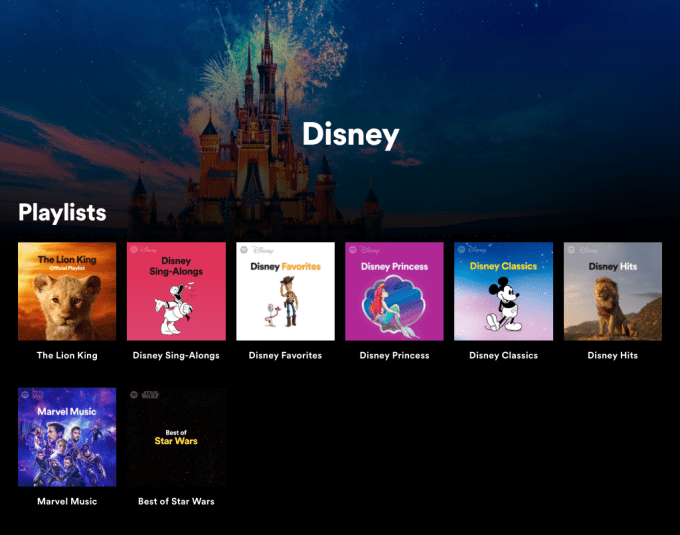
In an effort likely aimed at boosting family memberships, Spotify this morning announced a new partnership with Disney on the creation of a Disney Hub on its streaming service. Here, Disney fans in select markets including the U.S. will find a selection of Disney playlists like soundtracks from Disney, Pixar and Marvel movies, Star Wars instrumentals, classics, sing-alongs and more.

The Disney Hub is also live in the U.K., Ireland, South Africa, Canada, Australia, and New Zealand. It can be discovered by doing a search for “Disney” in the Spotify app.

Disney songs in particular appeal to families with children, and Spotify memberships that offer multiple profiles for both parents and kids alike are of more value to the streaming service. For example, Spotify Premium in the U.S. is $9.99 per month, but the Family membership is $14.99 per month. Of course, kids could just listen in under mom or dad’s account, but every parent knows that ruins one of Spotify’s best value propositions — its personalized playlists, like Discover Weekly.

Though Spotify isn’t always thought of as a family service, that’s increasingly changing as kids get their own devices at earlier ages, and music streaming because commonplace in the car and in the home, via smart speakers — often placed in kids’ rooms.

Screen Shot 2019 07 17 at 11.44.31 AM

Spotify says Disney songs are popular on its service, with users having streamed over 2 billion minutes of Disney music this year so far. The top song to date is still “Let it Go” from Frozen, but Disney’s new slate of remakes is helping push others up the charts, with “A Whole New World” from the live-action Aladdin now the most-repeated song in the past month.

The Disney Hub will also include the following playlists:

  • Disney Hits: Top songs from the biggest Disney and Pixar films.  
  • Disney Favorites: Everyone’s favorite current tunes, plus popular classics.
  • Disney Classics: A nostalgic playlist that includes songs from the Disney Parks, live-action and animated classic soundtracks, as well as songs from Disney Channel originals.
  • Disney Singalongs: Songs to sing along to. 
  • Disney Princess: Love ballads as well as the coming-of-age breakaways.
  • Marvel Music: All the best songs and scores from Marvel films and shows.
  • Best of Star Wars: John Williams and the London Symphony Orchestra’s music from Star Wars. 

It’s worth noting, too, that Spotify already has a close partnership with Hulu, which is now majority-owned by Disney. In the past, the companies have offered a Hulu-Spotify bundle at a discounted price to gain more subscribers. In March 2019, for example, the two launched an even more steeply discounted bundle than before, at $9.99 per month for both — or effectively Spotify Premium with Hulu for free.

As for Disney, working with Spotify can help it build interest in its new movies by creating more of a connection with fans. Spotify notes that the Disney Hub will, in fact, continue to be updated with music as more Disney films launch over the course of the summer and the rest of the year.


17 Jul 2019

Fifth Wall Ventures raises $503M for second real estate fund

Fifth Wall Ventures, an investor in Clutter, b8ta, ClassPass, Lime and others, has raised $503 million for its sophomore venture capital fund.

The firm, which closed on $212 million for its debut fund in May 2017, prefers to invest in the burgeoning real estate industry but has made opportunistic investments in other sectors.

The Los Angeles firm counts real estate owners as limited partners, as well as a number of global partners including U.S.-based Cushman & Wakefield, Japan’s Mitsubishi Estate, and the U.K.s’ British Land and SEGRO.

“Fifth Wall sees powerful network effects in our unique fund model as it becomes a centralized platform for the world’s largest real estate companies to share insights and access new technologies to enhance their businesses,” Fifth Wall managing partner Brendan Wallace said. “For our entrepreneurs, Fifth Wall efficiently opens distribution channels for their products to more than 50 corporate strategic investors globally and we have dedicated a team to support the success of those partnerships and integrations.”

17 Jul 2019

FaceApp responds to privacy concerns 

FaceApp, the AI-powered selfie-editing app that’s been having another viral moment of late, has now responded to a privacy controversy that we covered earlier here.

We’ve pasted the company’s full statement at the bottom of this post.

The tl;dr here is that concerns had been raised that FaceApp, a Russian startup, uploads users’ photos to the cloud — without making it clear to them that processing is not going on locally on their device.

Another issue raised by FaceApp users was that the iOS app appears to be overriding settings if a user had denied access to their camera roll, after people reported they could still select and upload a photo — i.e. despite the app not having permission to access their photos.

As we reported earlier, the latter is actually allowed behavior in iOS — which gives users the power to choose to block an app from full camera roll access but select individual photos to upload if they so wish.

This isn’t a conspiracy, though Apple could probably come up with a better way of describing the permission, as we suggested earlier.

On the wider matter of cloud processing of what is, after all, facial data, FaceApp confirms that most of the processing needed to power its app’s beautifying/gender-bending/age-accerating/-defying effects are done in the cloud.

Though it claims it only uploads photos users have specifically selected for editing. Security tests have also not found evidence the app uploads a user’s entire camera roll.

FaceApp goes on to specify that it “might” store the photos users have chosen to upload in the cloud for a short period, claiming this is done for “performance and traffic” — such as to make sure that a user doesn’t repeatedly upload the same photo to carry out another edit.

“Most images are deleted from our servers within 48 hours from the upload date,” it adds.

It also claims no user data is “transferred to Russia”, even though its R&D team is based there. So the suggestion is that storage and cloud processing are being performed using infrastructure based outside Russia. (We’ve asked it to confirm where this is done.)

“We don’t sell or share any user data with any third parties,” it adds.

FaceApp also says users can request their data is deleted. Though it doesn’t yet have a very smooth way to do this — instead it asks users to send delete requests via the mobile app using “Settings->Support->Report a bug” with the word “privacy” in the subject line, adding that it’s “working on a better UI for that”.

It also points out that the vast majority of FaceApp users don’t log in — making the point that it’s not able to link photos to identities in most cases.

Here’s its statement in full:

We are receiving a lot of inquiries regarding our privacy policy and therefore, would like to provide a few points that explain the basics:

1. FaceApp performs most of the photo processing in the cloud. We only upload a photo selected by a user for editing. We never transfer any other images from the phone to the cloud.

2. We might store an uploaded photo in the cloud. The main reason for that is performance and traffic: we want to make sure that the user doesn’t upload the photo repeatedly for every edit operation. Most images are deleted from our servers within 48 hours from the upload date.

3. We accept requests from users for removing all their data from our servers. Our support team is currently overloaded, but these requests have our priority. For the fastest processing, we recommend sending the requests from the FaceApp mobile app using “Settings->Support->Report a bug” with the word “privacy” in the subject line. We are working on the better UI for that.

4. All FaceApp features are available without logging in, and you can log in only from the settings screen. As a result, 99% of users don’t log in; therefore, we don’t have access to any data that could identify a person.

5. We don’t sell or share any user data with any third parties.

6. Even though the core R&D team is located in Russia, the user data is not transferred to Russia.

Additionally, we’d like to comment on one of the most common concerns: all pictures from the gallery are uploaded to our servers after a user grants access to the photos (for example, https://twitter.com/joshuanozzi/status/1150961777548701696).  We don’t do that. We upload only a photo selected for editing. You can quickly check this with any of network sniffing tools available on the internet.