Year: 2019

16 Jul 2019

With help from ‘Game of Thrones,’ HBO conquers Netflix in Emmy nominations

When the Emmy nominations were announced last year, Netflix had a big win, overtaking HBO for the first time. But this year, HBO is back in the lead, with 137 nominations compared to Netflix’s 117.

The Hollywood Reporter has tallied up the just-announced nominations, with Amazon Prime Video getting 47 nods and Hulu receiving 20.

HBO, meanwhile, didn’t just beat Netflix — it also beat its own record for most nominations in a single year. That’s good news for WarnerMedia, which is hoping that HBO branding can help its upcoming streaming service stand out from the crowd.

That said, its most-nominated show is one that just ended — “Game of Thrones,” which received 32 nominations, making it the most-nominated show of the year, and setting the record for the most nominations that any show has received for a single year.

That’s right: These are nominations for the show’s divisive final season, including nods for Outstanding Drama Series, Lead Actress in a Drama Series (Emilia Clarke), Lead Actor in a Drama Series (Kit Harington), Supporting Actress in a Drama Series (Gwendoline Christie, Lena Headey, Sophie Turner and Maisie Williams) and Supporting Actor in a Drama Series (Alfie Allen, Nikolaj Coster-Waldau and Peter Dinklage).

Also, I didn’t hate the finale, but I definitely raised my eyebrows when I saw that “The Iron Throne” had been nominated for Best Directing and Best Writing.

Coming in second among individual shows was Amazon’s “Marvelous Mrs. Maisel,” which won a whole bunch of comedy Emmys last year and snagged 20 nominations this year, including Outstanding Comedy Series.

Among Netflix’s shows, “When They See Us” scored 16 nominations (including Best Limited Series) and “Russian Doll” received 13 (including Outstanding Comedy Series). Amazon’s “Fleabag” and Hulu’s ” Handmaid’s Tale” received 11 nominations apiece.

The Primetime Emmy Awards will air on Sunday, September 22.

16 Jul 2019

Jeffrey Katzenberg’s Quibi partners with NBC News for a daily news show aimed at millennials

NBC News today announced an exclusive partnership with Jeffrey Katzenberg’s upcoming mobile streaming service, Quibi, which will see the media company becoming the first major producer for the service’s “Daily Essentials” news programming, aimed at millennial viewers. As part of the deal, NBC will produce both a 6-minute morning and evening news show for the service. The programming will air 7 days a week and will feature dedicated news hosts as well as original news content.

This is not the first time NBC News has targeted millennial viewers in particular. The company also runs a Snapchat news show called Stay Tuned that reaches millions, and it just launched its own digital streaming news network, NBC News Now, which is delivered through its NBC app.

NBC News Now will also power the breaking news coverage for Quibi, says NBC.

However, the deal is not just about repurposing NBC’s existing news content for a new platform. Instead, NBC will build out a full production team exclusively for the Quibi programming, while also providing access to NBC News resources and technical support.

In addition, the Quibi news show will be filmed in a custom-built studio in 30 Rockefeller Plaza in New York, and will be staffed by morning and evening news hosts and dedicated correspondents.

“NBC News’ worldwide reach brings in millions of viewers across its many platforms, and we are excited to work with them to deliver an innovative new way for millennials to get news in a format that fits into their lives,” said Jeffrey Katzenberg, Quibi Founder and Chairman of the Board, in a statement. “NBC News’ powerful original reporting for Quibi will take viewers around the world in six minutes and provide them with the important stories they care about at the start and end of each day.”

Quibi had earlier discussed some of its ideas about programming, including its concept for short-form news and sports.

The mobile-only streaming service is due to launch in April 2020, and has recently issued a steady stream of content announcements as more deals fall into place.

Some of the highlights include commitments from filmmakers Sam Raimi, Guillermo del Toro and Antoine Fuqua and producer Jason Blum to create series for the service, plus a show called “Inspired By” with Justin Timberlake and “Under the Gun” with Kobe Bryant.

There will also be a show about Snapchat’s founding, an action-thriller starring Liam Hemsworth, a murder mystery comedy from SNL’s Lorne Michaels, a documentary series from Tyra Banks, a Steven Spielberg horror show, a comedy from Thomas Lennon, and more.

Quibi’s idea is to produce higher-quality programming than what you’d find from the creator community YouTube, but distribute in a way that resonates with a younger audience — that is, shorter segments optimized for mobile viewing. These “quick bites” of content are also how Quibi got its odd name.

It’s at the very least a unique idea in a market now teeming with subscription video services, with launches from WarnerBros (HBO+), Apple, and Disney still on the way.

That said, most subscription video today is still watched on the television’s big screen, not on mobile devices. Quibi’s emphasis on being an “on-the-go” app may not quite work in the end, given the competition for users’ time and attention from social apps and games that are often our go-to time-fillers these days when we have a few minutes to spare. Even if Instagram, Facebook, YouTube and TikTok aren’t direct Quibi rivals because of their vast differences in content and business models, they still eat up a ton of people’s downtime — while commuting, waiting in line, or taking a break from work, for example.

Quibi believes that younger people will launch its app instead in order to catch up with favorite shows. That’s a challenge that will require more than just good content — and it remains to be seen how Quibi will address this.

But with $2 billion in funding, $100 million in pre-launch ad revenue commitments, and Katzenberg at the helm,  it’s too soon to count Quibi out yet.


16 Jul 2019

What we can learn from DTC success with TV ads

One of the most-discussed plot twists in recent advertising has been the pivot of Direct-to-Consumer (DTC) brands to linear TV. These data-driven, digital-first players are expanding well beyond Facebook and Instagram—and becoming serious players on the largest traditional medium in advertising.

A January 2019 Video Advertising Bureau study found that in 2018, 120 DTC brands collectively spent over $2 billion in TV ads—up from $1.1 B in 2016. 70 of those 2018 advertisers ran TV ads for the first time.

But while we know that they’re advertising on TV, what may be less discussed is whether they’re succeeding on television—and what strategies they use to achieve their success.

At EDO, we have a unique and differentiated ability to measure how DTC advertisers perform on TV by tracking incremental online searches above baseline in the minutes immediately following individual TV ad airings as viewers translate their interest in advertised brands and products directly into online engagement with them.

By measuring incremental search activity across 60 million national TV ad airings since 2015, we are able to effectively isolate the effects of TV ad placement and creative decisions that are most likely to cause online engagement.

We ran the numbers on DTCs as well as advertisers in various other categories to better understand how DTCs specifically are succeeding in TV ads—and what DTCs who are considering TV advertising can do to achieve success on TV.

Table of Contents

Does the David vs. Goliath story play out on TV?

The DTC revolution is a quintessential David and Goliath story. In vertical after vertical, small, digital-native upstarts are changing the game and overtaking major brands. Does that story play out on TV as well—or is TV advertising one area where DTC marketers have finally met their match?

To answer that question, EDO looked at how effectively TV ads elicited viewer activity since September 2018 across eight major industry categories including DTC. Guided by historical ad performance across billions of ads, we rated ad performance based on how closely the DTC ads came to meeting the benchmark volume of brand-related online activity in the minutes following each TV ad airing.

We index each industry accordingly—giving an index value of 100 to an ad that meets benchmark standards, and below-par ads getting a score under 100 while higher-scoring ads receive a score over 100. We chose to set our index baseline of 100 to the average Consumer Packaged Good (CPG) ad since it is such a large and broad ad category. Our results are as follows:

16 Jul 2019

Billie raises €30M for its B2B invoicing and payments platform

Billie, the Berlin-based fintech startup that offers a B2B invoicing and payments platform, has raised €30 million in Series B funding. Leading the round is Creandum, alongside SpeedInvest, Rocket Internet’s GFC and Picus.

Founded in 2017 by the same team behind SME online lending platform Zencap, which exited to Funding Circle in 2015, Billie wants to bring the same level of convenience seen in B2C payments and e-commerce to B2B invoicing and payments.

Claiming to be Germany’s leading “one-stop shop” for handling all outgoing invoices of B2B sellers, including sending invoices, collecting payments and invoice financing, Billie’s customers range from SMEs, large e-commerce players, and transnational marketplaces.

“As B2B transactions are more than twice the volume of B2C transactions, the potential to help our customers is enormous. And, up to now, this market is unserved,” Billie co-founder Dr. Matthias Knecht tells me.

“We’re able to place ourselves in the middle of B2B payments because B2B sellers often face long payment terms until getting paid, administrative burden to handle collections on unpaid invoices, and severe economic risks from payment defaults. Meanwhile, B2B buyers often face rigid one-size-fits-all payment terms that are not tailored to the cash-cycle needs of their business. As a result they revert to old-fashioned working capital loans to cover their liquidity needs”.

To fix this, Billie currently provides two core solutions.

The first is a checkout financing solution for B2B online stores, which embeds a financing option in the online checkout process. “It enables instant financing of the customer’s purchase directly at the online point-of-sale, and takes away all administrative hassle and default risk from the seller,” explains Knecht.

The second is SME invoice factoring, which the Billie co-founder describes as a fully automated platform that handles all outgoing invoices of SMEs.

“Small and medium sized businesses can handle all their outgoing invoices through our platform, get instant financing for each invoice (i.e. they do not need to wait 90 days to get paid by their customers), and also outsource the collections process as well as coverage of default risk to Billie,” he says. “It’s an exciting, highly automated ‘piece of mind’ product that let’s SMEs focus on what they do best and have Billie handle the operational burden of invoice management and default coverage”.

With today’s injection of capital, Knecht says the startup plans to offer new solutions that are specifically targeted at the buyer side of B2B transactions by handling all processes around payables. This could include letting B2B buyers flexibly choose payment terms and reducing the bookkeeping hassle by acting as a single creditor.

“We will furthermore start rolling out our solutions across Europe at some point, as the need to turn B2B transactions into a frictionless experience exists across countries,” he adds.

16 Jul 2019

How to watch Elon Musk’s Neuralink brain control interface startup presentation live

One of Elon Musk’s stealthier endeavors is set to become a lot less stealthy tonight, with a presentation set for 8 PM PT (11 PM ET) streaming live from its website in which we’ll learn a lot more about Neuralink, the company Musk founded in 2017 to work on brain control interfaces (BCIs) and essentially part of his larger strategy to help mitigate the risks of AI and enhance its potential benefits.

Here’s what we do know about Neuralink already: It’s initial goal, at least as of two years ago, was to figure out how brain interfaces could be helpful in alleviating the symptoms of chronic medical conditions, including epilepsy. This goal will involve the development of “ultra high bandwidth brain-machine interfaces to connect humans and computers,” which is the only formal description Neuralink provides of its overall mission on its own website.

In a post on Wait Buy Why back when the company first broke cover, we got a lot more in-depth background about what problem Musk wants to solve and why. Summarized, Neuralink’s mission is very much on trend with Musk’s other ventures, in that it hopes to help humans avoid something he perceives as an existential threat in order that we may survive, thrive, and I guess come up with other potential existential threats for him to also then solve.

Ultimately, Neuralink seems to be aiming well beyond its initial exploration of medical technology, which was really just a way to potentially get testing faster with a practical application that’s easier to work with in terms of rules and regulators. Musk’s goal, per the Wait But Why explainer, is actually to eliminate the “compression” that happens when we translate our thoughts into language, and then into input via keyboard, mouse, etc. before actually transmitting it to a computer. Taking away the need to compress and then decompress the signal, in other words, will make communication between people and computers much faster, lossless, and very high bandwidth.

This has an existential angle because this is a key step, Musk believes, in ensuring that humanity can keep up with the increasingly advanced AI it’s developing. So to avoid a doomsday scenario where the robots take over, basically Musk proposes more or less mind-melding with the robots instead.

That was a lot to digest two years ago – it’s wild to think about what Neuralink may have done in the interim to work towards or modify this goal. Luckily, we won’t have to wait with much longer. That stream kicks off at 8 PM PT (11 PM ET) and will be carried live on Neuralink.com. We’ll update this post if there’s a direct stream, too.

16 Jul 2019

Voyant Photonics raises $4.3M to fit lidar on the head of a pin

Lidar is a critical method by which robots and autonomous vehicles sense the world around them, but the lasers and sensors generally take up a considerable amount of space. Not so with Voyant Photonics, which has created a lidar system that you really could conceivably balance on the head of a pin.

Before getting into the science, it’s worth noting why this is important. Lidar is most often used as a way for a car to sense things at a medium distance — far away, radar can outperform it, and up close ultrasonics and other methods are more compact. But from a few feet to a couple hundred feed out, lidar is very useful.

Unfortunately even the most compact lidar solutions today are still, roughly, the size of a hand, and the ones ready for use in production vehicles are still larger. A very small lidar unit that could be hidden on every corner of a car, or even inside the cabin. It could provide rich positional data about everything in and around the car with little power and no need to disrupt the existing lines and design. (And that’s not getting into the many, many other industries that could use this.)

Lidar began with the idea of, essentially, a single laser being swept across a scene multiple times per second, its reflection carefully measured to track the distances of objects. But mechanically steered lasers are bulky, slow, and prone to failure, so newer companies are attempting other techniques like illuminating the whole scene at once (flash lidar) or steering the beam with complex electronic surfaces (metamaterials) instead.

One discipline that seems primed to join in the fun is silicon photonics, which is essentially the manipulation of light on a chip for various purposes — for instance, to replace electricity in logic gates to provide ultra-fast, low-heat processing. Voyant, however, has pioneered a technique to apply silicon photonics to lidar.

In the past, attempts in chip-based photonics to send out a coherent laser-like beam from a surface of lightguides (elements used to steer light around or emit it) have been limited by a low field of view and power because the light tends to interfere with itself at close quarters.

Voyant’s version of these “optical phased arrays” sidesteps that problem by carefully altering the phase of the light traveling through the chip. The result is a strong beam of non-visible light that can be played over a wide swathe of the environment at high speed with no moving parts at all — yet it emerges from a chip dwarfed by a fingertip.
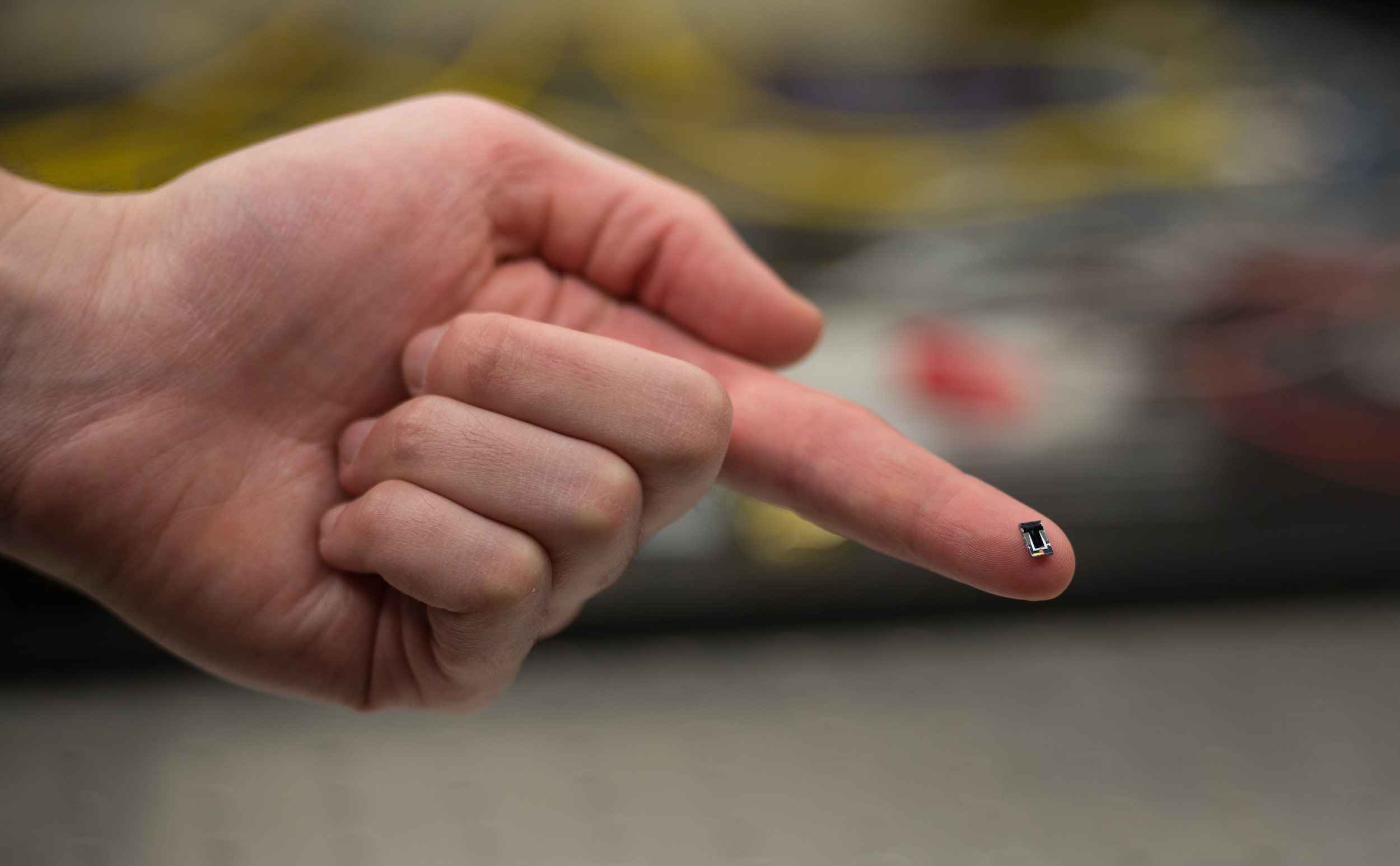
LIDAR Fingertip Crop

“This is an enabling technology because it’s so small,” said Voyant co-founder Steven Miller. “We’re talking cubic centimeter volumes. There’s a lot of electronics that can’t accommodate a lidar the size of a softball — think about drones and things that are weight sensitive, or robotics, where it needs to be on the tip of its arm.”

Lest you think this is just a couple yahoos who think they’ve one-upped years of research, Miller and co-founder Chris Phare came out of the Lipson Nanophotonics Group at Columbia University.

“This lab basically invented silicon photonics,” said Phare. “We’re all deeply ingrained with the physics and devices-level stuff. So we were able to step back and look at lidar, and see what we needed to fix and make better to make this a reality.”

The advances they’ve made frankly lie outside my area of expertise so I won’t attempt to characterize them too closely, except that it solves the interference issues and uses a frequency modulated continuous wave technique, which lets it measure velocity as well as distance (Blackmore does this as well). At any rate their unique approach to moving and emitting light from the chip lets them create a device that is not only compact, but combines transmitter and receiver in one piece, and has good performance — not just good for its size, they claim, but good.

“It’s a misconception that small lidars need to be low-performance,” explained Phare. “The silicon photonic architecture we use lets us build a very sensitive receiver on-chip that would be difficult to assemble in traditional optics. So we’re able to fit a high-performance lidar into that tiny package without any additional or exotic components. We think we can achieve specs comparable to lidars out there, but just make them that much smaller.”
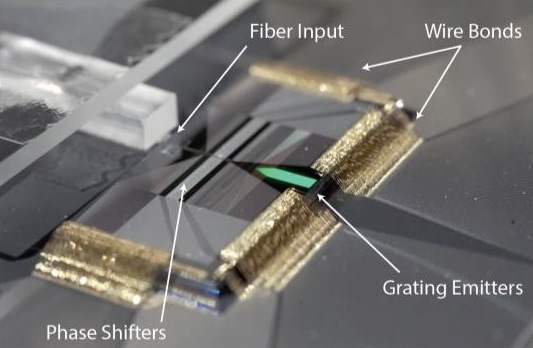
photonics testbed

The chip-based lidar in its test bed.

It’s even able to be manufactured in a normal fashion like other photonics chips. That’s a huge plus when you’re trying to move from research to product development.

With this first round of funding, the team plans to expand the team and get this tech out of the lab and into the hands of engineers and developers. The exact specs, dimensions, power requirements and so on are all very different depending on the application and industry, so Voyant can make decisions based on feedback from people in other fields.

In addition to automotive (“It’s such a big application that no one can make lidar and not look at that space,” Miller said), the team is in talks with numerous potential partners.

Although being at this stage while others are raising 9-figure rounds might seem daunting, Voyant has the advantage that it has created something totally different from what’s out there, a product that can safely exist alongside popular big lidars from companies like Innoviz and Luminar.

“We’re definitely talking to big players in a lot of these places, drones and robotics, perhaps augmented reality. We’re trying to suss out exactly where this is most interesting to people,” said Phare. “We see the evolution here being something like bringing room size computers down to chips.”

The $4.3 million raised by Voyant comes from Contour Venture Partners, LDV Capital, and DARPA, which naturally would be interested in something like this.


16 Jul 2019

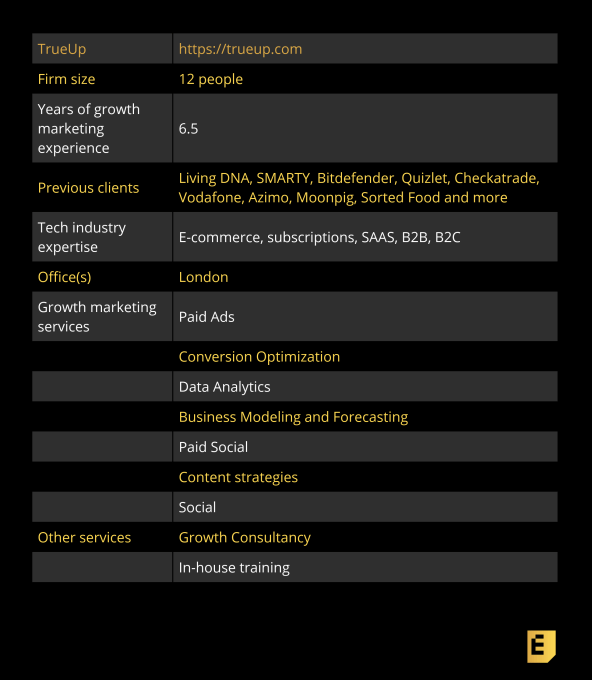
Verified Expert Growth Marketing Agency: TrueUp

It was the perfect storm when CEO and Founder Liam Reynolds finally decided to start TrueUp, a data-driven growth marketing agency/consultancy based in London. After decades of working for large creative advertising agencies, Liam quit his job right around the beginning of Silicon Valley’s growth hacking trend and plunged headfirst into running growth for early-stage startups.

TrueUp has since evolved from a one-man shop into an award-winning agency with a team of dedicated data, paid marketing and conversion specialists. Learn more about how they collaborate with clients and help them develop short- and long-term growth frameworks.

TrueUp’s approach to growth marketing:

“Rather than just saying ‘Look at these amazing results we’ve achieved,’ we would say, ‘Look, these are your growth opportunities, this is the process you need and here’s the framework unlock your true potential,’ We would build business models around this to show the opportunity in numbers, revenue and ROI.

Our approach to growth is anchored in delivering the right message to the right target audience in the right channel at the right time. It sounds simple but we’re amazed at how wrong people get this.

So we’ve created our own bespoke methodologies and frameworks to really explore and identify these hidden killer messages that drive action. We’ve built our own tools that allow us to do a lot of high-tempo, high-intensity testing.

It’s quite common that we have 500 to 600 tests running concurrently on Facebook for any given client. We’re continuously testing, learning, iterating, improving. As a result we’ve achieved some amazing results for our clients.”

Advice to founders:

“We approached True Up to help us establish and scale a UK paid marketing function. The team was highly professional from their initial pitch through the end of the project.” Maninder Saini, SF, International Operations Manager, Quizlet, Inc.

“For earlier stage startups, it’s to focus on achieving product-market fit and having awesome user experiences before worrying about growth. We worked with and mentored a lot of startups that immediately jump to, “Look I need to get X number of customers in X months.” However their products/services are often seriously lacking. This creates very weak foundations for growth. So their efforts would be better spent on creating products that genuinely meet a customer need. Once they’ve achieved product-market fit, it’s to communicate benefits not features. There’s always at least one killer message that cuts through but more often than not it’s hidden and not what the founders think it is. So a structured test program to explore this is also very much needed!”

designer fast facts 31

Below, you’ll find the rest of the founder reviews, the full interview, and more details like pricing and fee structures. This profile is part of our ongoing series covering startup growth marketing agencies with whom founders love to work, based on this survey and our own research. The survey is open indefinitely, so please fill it out if you haven’t already. 


Interview with TrueUp CEO & Founder Liam Reynolds

Liam photo

Yvonne Leow: Tell me about how you got into growth marketing and why you decided to start TrueUp.

Liam Reynolds: I started my career at a data marketing company called Dunnhumby. They were famous for managing the data science and intelligence behind TESCO’s Club Card, a very large loyalty program in the UK.

16 Jul 2019

Qualtrics’ Julie Larson-Green will talk customer experience at TC Sessions: Enterprise

We’re less than two months out from our first TC Sessions: Enterprise event, which is happening in San Francisco on September 5, and did you know our buy 1 get 1 free sale ends today too! Among the many enterprise and startup executives that’ll join us for the event is Qualtrics’ Julie Larson-Green. If that name sounds familiar to you, that’s most likely because you remember her from her 25 years at Microsoft. After a successful career in Redmond, Larson-Green left Microsoft in 2017 to become the Chief Experience Officer at SAP’s Qualtrics.

In that role, she’s perfect for our panel about — you guessed it — customer experience management.

Larson-Green joined Microsoft as a program manager for Visual C++ back in 1993. After moving up the ladder inside the company, she oversaw the launch of Windows 7 and became the co-lead of Microsoft’s hardare, games, music and entertainment division in 2013. At the time, she was seen as a potential replacement for then-CEO Steve Ballmer.

Later, during a period of reshuffling at the company in the wake of the Nokia acquisition, became the Chief Experience Officer of Microsoft’s My Life and Work group.

Larson-Green joined Qualtrics before it was acquired by SAP for $8 billion in cash. Qualtrics offers a number of products that range from customer experience tools to brand tracking and ad testing services, as well as employee research products for gathering feedback about managers, for example. At the core of its product is an analytics engine that helps businesses make sense of their employee and customer data, which in turn should help them optimize their customer experience scores and reduce employee attrition rates.


Our buy one get one free ticket deal ends today! Book a ticket for just $249 and you can bring a buddy for free. Book here before this deal ends.

We’re still selling startup demo tables, and each package comes with 4 tickets. Learn more here.

16 Jul 2019

China startup deals shrink as fundraising for investors plummets

Chinese startups continue to weather tough times as private investors, caught in a cash crunch, are concentrating money into fewer deals.

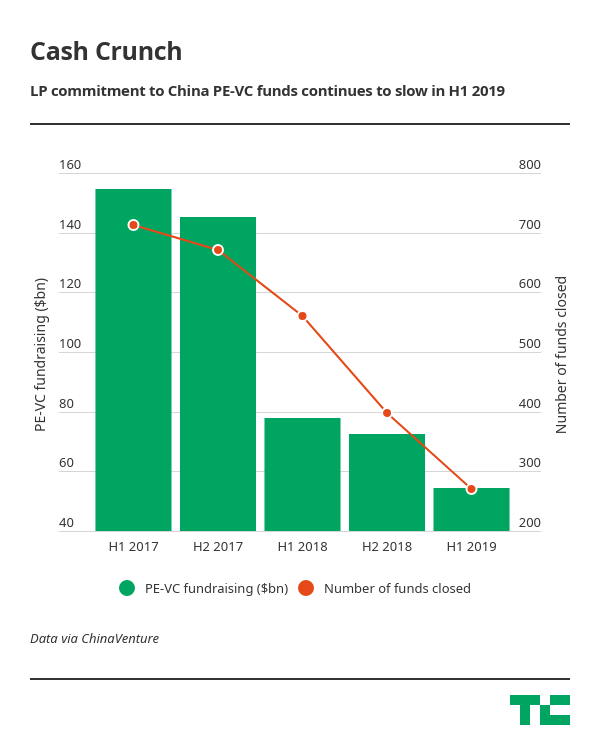
China’s deal-making activity for startups in the six months ended June halved from a year ago to 1910, according to data from consulting firm ChinaVenture’s research arm. The amount invested in domestic startups during the first half of 2019 plummeted 54% to $23.2 billion.

The slide in startup investment comes as the money behind the money shrinks amid a cooling economy in China that is exacerbated by a trade war with the U.S. Fundraising for investors was already showing signs of slowdown a year earlier. In the first half of this year, private equity and venture capital firms in China secured 30% less than what they had raised over the same period a year ago, amounting to a total of $54.44 billion. 271 funds managed to raise, down 52%.

vc funding china

That money from limited partners is also flowing to a small rank of investors. 12 institutions accounted for 57% of all the capital landed by VCs and PEs in the period. Investment coffers that have gotten a big boost include the likes of TPG Capital, Warburg Pincus, DCG Capital, Legend Capital, and Source Code Capital.

Healthcare was the most backed sector during the six months, although proptech startups scored the biggest average deal size. Some of the highest funded companies from the period were artificial intelligence chip maker Horizon Robotics, shared housing upstart Danke and China’s Starbucks challenger Luckin.

16 Jul 2019

Highlights from Facebook’s Libra Senate hearing

Facebook will only build its own Calibra cryptocurrency wallet into Messenger and Whatsapp, and will refuse to embed competing wallets, the head of Calibra David Marcus told the Senate Banking Committee today. Calibra will be interoperable so users can send money back and forth with other wallets, and Marcus committed to data portability so users can switch entirely to a competitor. But solely embedding Facebook’s own wallet into its leading messaging apps could give the company a sizable advantage over banks, PayPal, Coinbase, or any other potential wallet developer.

Other highlights from the “Examining Facebook’s Proposed Digital Currency and Data Privacy Considerations” hearing included Marcus saying:

  • The US should “absolutely” lead the world in rule-making for cryptocurrencies
  • “Yes” Libra will comply with all US regulations and not launch until the US lawmakers’ concerns have been answered
  • “You will not have to trust Facebook” because it’s only one of 28 current and potentially 100 or more Libra Association members and it won’t have special privileges
  • “Yes I would” accept his compensation from Facebook in the form of Libra as a show of trust in the currency
  • It is “not the intention at all” for Calibra to sell or directly monetize user data directly, though if it offered additional financial services in partnership with other financial organizations it would ask consent to use their data specifically for those purposes.
  • Facebook’s core revenue model around Libra is that more online commerce will lead businesses to spend more on Facebook ads

But Marcus also didn’t clearly answer some critical questions about Libra and Calibra.

Chairman Crapo asked if Facebook would collect data about transactions made with Calibra that are made on Facebook, such as when users buy products from businesses they discover through Facebook. Marcus instead merely noted that Facebook would still let users pay with credit cards and other mediums as well as Calibra. That means that even though Facebook might not know how much money is in someone’s Calibra wallet or their other transactions, it might know how much the paid and for what if that transaction happens over their social networks.

Senator Tillis asked how much Facebook has invested in the formation of Libra. TechCrunch has also asked specifically how much Facebook has invested in the Libra Investment Token that will earn it a share of interest earned from the fiat currencies in the Libra Reserve. Marcus said Facebook and Calibra hadn’t determined exactly how much it would invest in the project. Marcus also didn’t clearly answer Senator Toomey’s question of why they Libra Association is considered a not-for-profit organization if it will pay out interest to members.

The hearing is ongoing and we’ll continue to update this article with more highlights