Year: 2019

16 Jul 2019

Echo Dot and Fire TV Stick are again Prime Day’s best selling devices (so far!)

Amazon Prime members again snapped up loss leaders like the Echo Dot and Fire TV Stick with Alexa Remote on the first day of Amazon Prime Day 2019, which has now been stretched out to a 48-hour sale. This is the third year in a row that the entry-level Alexa smart speaker, the Echo Dot, has been a Prime Day bestseller. The Fire TV Stick was a top seller last year, too, and sold well in years past — including in 2016, when it emerged at the overall best-selling device globally on Prime Day.

Amazon never provides hard numbers on Prime Day sales, but claims “millions” of these devices — the Echo Dot and Fire TV Stick combined — were sold on Monday to customers worldwide during the first day of Prime Day 2019.

Last year, Amazon claimed customers bought “millions” of Fire TV Stick devices alone, for comparison’s sake.

The retailer also said this morning that U.S. shoppers saved “millions” on Prime Day sales on Monday. This includes other bestsellers like the Instant Pot DUO Plus 60 6 Qt, LifeStraw Personal Water Filter, and Crest 3D White Professional Effects Whitening Strips. The Instant Pot and LifeStraw filter were also two of the non-Amazon top sellers last Prime Day, which says something about the consistency of this sales event as it enters its fifth year.

Though Amazon didn’t officially list the Echo Dot in its round-up of July 15 Prime Day sales, the smart speaker had already been discounted to its then lowest price ever of $24.99 (half off list) before Prime Day even started. As the event kicked off, it dropped again to $22.
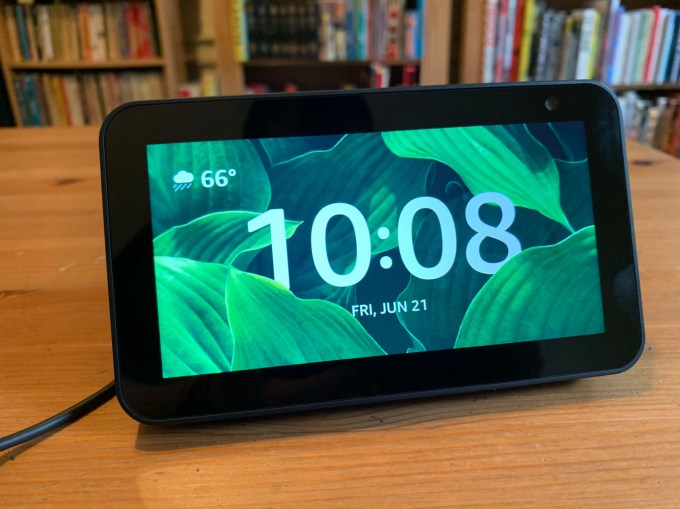
echo show 5

Today, Amazon is keeping the Echo Dot at $22 but is sold out of Charcoal, leaving only the lighter sandstone color available for purchase.

Other notable Day 2 Prime Day deals include:

A $49.99 Echo Show 5 (the smaller, more compact revamp of the Alexa speaker with a screen); savings of up to $140 on Fire TV Edition smart TVs; the $14.99 Fire TV Stick with Alexa Remote; a $59.99 Fire 7 Kids Edition tablet (or 2 for $99.98); and the $139 Ring Video Doorbell 2.

A list of the announced Prime Day, day 2 deals are below:

Amazon Devices:

  • $27.99 off Echo Dot, $22
  • $40 off the all-new Echo Show 5, $49.99
  • $25 off Fire TV Stick with Alexa Voice Remote, $14.99
  • Save up to $140 on Fire TV Edition Smart TVs
  • $20 off the all-new Fire 7 tablet, just $29.99, or get two for $49.98—a $50 savings
  • $40 off all-new Fire 7 Kids Edition tablet, just $59.99, or get two for $99.98—a $100 savings
  • $60 off Ring Video Doorbell 2, $139
  • Save up to $200 on eero WiFi systems
  • Save up to $50 on Kindle Paperwhite, plus get a $5 eBook credit and three months free Kindle Unlimited

Amazon Brands and Exclusives:

  • Save up to 50% on kids and baby styles from Simple Joys by Carter’s, LOOK by crewcuts, Spotted Zebra, and Amazon Essentials
  • Save up to 30% on furniture and décor from Rivet, Stone & Beam, and Ravenna Home

Electronics:

  • Save up to 25% on select Canon Mirrorless and DSLR cameras
  • Save up to 30% of select Sony and Samsung TVs

Apparel:

  • Save up to 40% off Ray-Ban sunglasses
  • Up to 50% off Dockers clothing and more
  • Deep discounts on Champion hoodies and Herschel Little America backpacks

Smart Home:

  • Save up to 50% off select Sony LED Smart TVs
  • Save up to 30% on Tile
  • Save up to 30% on iRobot Robotic Vacuums

Home, Kitchen & Furniture:

  • Save up to 30% on Blue Pure Air Purifier
  • Save on select Winix Air Purifiers
  • Save on Hoover ONEPWR vacuums
  • Save on Philips XXL Air Fryer
  • Save 30% on Keurig K-Café Single-Serve Coffee Maker
  • Save 30% on Crock Pot 6qt Slow Cooker
  • Save up to 30% on Brother Sewing Machines
  • Save on Philips Smoke-less Indoor BBQ Grill
  • Save up to 35% on Dash Egg Cookers

Toys & Games:

  • Save 30% on games from What Do You Meme?
  • Save up to 40% on select toys and games including favorites from LEGO and Melissa & Doug

Video Games:

  • Save up to 50% on Astro A40 TR headset

Tools & Home Improvement:

  • Save up to 30% on CRAFTSMAN power tools

Lawn & Garden:

  • Save up to 35% on Greenworks yard equipment

Sports & Outdoors:

  • Save up to 20% on Skywalker 15’ Jump and Dunk trampolines
  • Save 20% on Bushnell Trophy trail camera
  • Save 20% on Marvel Spiderman kids bikes

Automotive:

  • Save up to 30% on Pennzoil Motor Oil
  • Save up to 30% on NOCO Jump Starters and Battery Chargers

 

16 Jul 2019

Quirk wants to make cognitive behavioral therapy more accessible

Quirk, a YC-backed company, is looking to bring cognitive behavioral therapy (CBT) to more people suffering from anxiety or depression.

CBT aims to lessen or stop harmful behavior by changing the way people think, stopping them from falling into established patterns of negatively distorting their reality to justify or account for unhelpful habits.

“CBT has 40 years of research behind it,” says CEO and founder Evan Conrad. “I’ve had severe panic attacks my whole life and saw different therapists who tried what I now know is CBT. I assumed it was a pseudo science. It wasn’t until 10 months ago that I re-discovered CBT on my own and learned about its efficacy. It’s the gold standard.”

The app helps users practice one of the most common exercises in CBT: the triple-column technique.

Here’s how it works:

Users jump into the app whenever they have anxiety or a depressive thought to record it. They then identify any distortions that apply to that thought, such as Catastrophizing, Magnification of the Negative, Fortune Telling, or Over-Generalization, among others. From there, the user can challenge the thought with reasons why that thought might have been illogical to begin with. Finally, the user replaces the thought with something more reasonable.

For example, if I was worried about not getting a response to a text, I might believe (irrationally) that it has something to do with how that person feels about me, rather than the more obvious explanation: they’re just busy.

The hope of CBT is that identifying thought distortions, and manually replacing them with beliefs grounded in reality retrains the brain to experience the world in a realistic way and relieves patients from their depression and/or anxiety.

Conrad says that he went from having two anxiety attacks a week to two every six months.

The problem that Quirk is trying to solve is two-fold. First, people may not know the benefits or the empirical data supporting CBT. Secondly, the process of manually recording this on pen and paper can be more tedious and feel less private out in a public space.

Quirk’s attempt to solve these problems is to make CBT accessible to more people and to make the process of doing CBT slightly more private.

We asked Conrad about the potential negative affects of practicing CBT without the oversight of a mental health professional.

“As for self-administered CBT, we’ve run this by a number of therapists and all of them have said it’s generally a net-benefit,” Conrad said via email. “What would be harmful is if someone with a severe condition decided that they should use Quirk instead of seeing a therapist. But in practice we’ve seen the opposite effect. People who would have otherwise done nothing about their condition use Quirk as ‘first step’ towards therapy or will use Quirk when they would otherwise have no option (either because their isn’t a treatment in their country/area or because they can’t afford it).”

Dr. Daniel A. Fridberg, a practicing CBT psychiatrist from the University of Chicago, says that the triple-column technique is a great CBT exercise, but that it’s just part of the whole package of Cognitive Behavioral Therapy. He also said that the only way to know if a product like this can do harm is through a study, but that CBT itself is an evidence-based psychotherapy and has been proven effective.

“CBT is an effective, time-limited, reasonably cost-effective psychotherapy for things like depression, anxiety, substance abuse, etc,” said Dr. Fridberg. “The problem is that finding a good CBT therapist who delivers evidence-based treatment isn’t always easy in smaller communities where there isn’t easy access to a research hub. In some respects, an app that is packaged in an attractive way, gets people’s attention and promotes CBT as effective is a good thing.”

Dr. Fridberg also stated that anyone suffering from an issue that’s disrupting their day-to-day functioning should seek professional help.

Conrad says that he hopes Quirk can be a jumping off point for folks suffering from anxiety and depression, with the app suggesting that those suffering seek professional help in conjunction with using the app. He also shared that Quirk hopes to be able to connect users to professionals in their area as soon as they have the scale to do so.

Quirk costs $4/month for users.

16 Jul 2019

Aavgo security lapse exposed hotel bookings

A security lapse at a hotel management startup has exposed hotel bookings and guests’ personal information.

The security lapse was resolved Monday after TechCrunch reached out to Aavgo, a hospitality tech company based in San Francisco, which secured a server it had left online without a password.

The server was open for three weeks — long enough for security researcher Daniel Brown to find the database.

He shared his findings exclusively with TechCrunch, then published them.

Aavgo bills itself as a way for hotels to organize their operations by using several connected apps — one for use by guests using tablets installed in their hotel rooms for entertainment, ordering room service and checking out, and another for staff to communicate with each other, file maintenance tickets and manage housekeeping.

Several large hotel chains, including Holiday Inn Express and Zenique Hotels, use Aavgo’s technology in their properties.

The database contained daily updating logs of the back-end computer system. Although most of the records were logs of computer commands critical to the running of the system, we found within personal booking data — including names, email addresses, phone numbers, room types, prices, the location of the hotel and the room and the dates and times of check-in and check-out.

There was no financial information in the database beyond the credit card issuer.

The database also contained room service orders, guest complaints, invoices and other sensitive information used for accessing the Aavgo system, the researcher said.

Many of the records were related to its corporate hotelier customers.

One of those customers included Guestline, a property management company for hoteliers, which uses Aavgo as the underlying technology for its property management system. Guestline says it facilities 6.3 million bookings a year.

When reached, Guestline’s data protection officer James Padkin said data protection is of “paramount importance” and the company has “ceased our very limited trial of the AavGo housekeeping app.”

After the company failed to respond to the researcher’s initial email, Aavgo shut down the database a few hours after TechCrunch made contact with its chief executive, Mrunal Desai.

“We had no data breach; however, we did find a vulnerability,” said Desai. He said data on 300 hotel rooms was exposed. Brown said based on his review of the data, however, that the number is likely higher. Desai added that the company has “already started informing our customers about this vulnerability.”

Midway during our correspondence, Desai copied the company’s outside counsel, a Texas-based law firm, which threatened “immediate legal action” ahead of publishing this report.

Aavgo becomes the latest hospitality company embroiled in a hotel-related security incident in recent years.

In 2017, hotel booking service Sabre confirmed a seven-months long data breach of its SynXis reservation system, affecting more than 36,000 hotels globally and millions of credit cards.

A year later, Marriott-owned Starwood admitted a breach that affected up to 383 million hotel guests around the world. Earlier this month U.K. authorities said they would fine the company $123 million for the breach under the new GDPR regime, which affected about 30 million customers in the European Union.

Read more:

16 Jul 2019

Apply to TC Top Picks before the deadline & exhibit free at Disrupt SF 2019

Does your company have what it takes to be part of an elite cadre of early-stage startups and exhibit for free at Disrupt San Francisco 2019? There’s only one way to know for sure, but time is running out. Apply to be a TC Top Pick now — before the application window closes for good at 5:00 p.m. (PT) on July 19.

Why should you apply? For starters, it doesn’t cost anything, and all TC Top Picks receive a free Startup Alley Exhibition Package good for one full day of exhibiting in Startup Alley, the heart of every Disrupt. It’s the intersection of tech present and tech future — where more than 1,200 pre-Series A startups and sponsors exhibit their products, platforms and services. It’s a breeding ground of opportunity, and you never know who you might meet and where that connection might lead.

TechCrunch editors vet all applications and choose up to five startups in each of these (and only these) tech categories: AI/Machine Learning, Biotech/Healthtech, Blockchain, Fintech, Mobility, Privacy/Security, Retail/E-commerce, Robotics/IoT/Hardware, SaaS and Social Impact/Education.

TC Top Picks also receive three Founder passes and plenty of other perks, starting with the VIP treatment. You’ll exhibit in a dedicated space within Startup Alley, and we promote the Top Pick startups in our pre-conference marketing. Everyone wants to see who made the cut, including journalists covering the show and investors looking to add to their portfolios.

In a classic “but wait, there’s more” moment, a TechCrunch editor conducts a live interview with each Top Pick on the Showcase Stage in Startup Alley. We record the interviews for posterity and promote them across our social media platforms. That’s the kind of marketing tool that keeps on giving.

Take a page from DiaMonTech’s playbook. The company, the maker of a non-invasive glucose monitoring device, earned a Top Pick designation for Disrupt Berlin 2018. Markus Teuber, head of strategic partnerships, had this to say about the Top Pick experience.

“Exhibiting as a TC Top Pick helped us build credibility right away, and it still pays off during pitches as an anchor point for further discussion. The interview and media coverage helped us generate awareness for our groundbreaking approach, and it also helped us identify leads and build substantial cooperation agreements.”

Pro Tip: Every startup that exhibits in Startup Alley has a shot to win a Wild Card entry to Startup Battlefield. Yet another great reason to apply to be a TC Top Pick.

Disrupt San Francisco 2019 takes place October 2-4. Don’t miss out on this opportunity to place your startup in the Disrupt spotlight. Apply to be a TC Top Pick before the deadline clocks out precisely at 5:00 p.m. (PT) on July 19. Show us what you’ve got!

Is your company interested in sponsoring or exhibiting at Disrupt San Francisco 2019? Contact our sponsorship sales team by filling out this form.

16 Jul 2019

Mercari’s new Instant Pay feature transfers verified sellers’ balances to their debit cards within minutes

For online sellers, waiting three to five days for e-commerce platforms to transfer their balance is one of their biggest pain points. Mercari is going after rivals with its new Instant Pay feature, which deposits money in a few minutes. Once sellers are verified, they can instantly transfer up to $500 per month of their Mercari balance to a debit card for a $2 processing fee.

Bradford Williams, Mercari’s head of communications, told TechCrunch in an email that the new feature is a first for peer-to-peer selling apps. “Uber and Lyft made instant payments table stakes for U.S. drivers; we’re extending that to casual sellers. Mercari U.S. is focused on casual sellers (versus power sellers); therefore, we’d like to attract sellers from all marketplaces/platforms,” he said. “Frankly, we see our biggest opportunity in influencing U.S. consumer behavior versus taking share incrementally from established competitors.”

To use Instant Pay, sellers need a debit card and to register for ID Check, Mercari’s new verification system. The feature, currently available only through Mercari’s mobile app, involves uploading a government-issued ID and a selfie. Mercari checks to see if the user’s selfie matches the ID’s photo before verifying them, a process that can take up to 48 hours.

Mercari, which has been downloaded about 45 million times in the United States and currently has 150,000 new listings every day, is typically used by people looking to declutter or make extra cash by offloading items they no longer need. It competes with eBay and Amazon, but its most direct rivals are apps designed for peer-to-peer transactions like Poshmark, Depop, OfferUp and LetGo, as well Facebook Marketplace. Mercari competes with a low selling fee, easy listing process (it says most items can be listed in about three minutes). Its Instant Pay feature will help it attract sellers who want to make quick cash.

The platform also offers free direct deposit for transfers over $10, with a waiting time of up to five days, in-line with its competitors.

Mercari was founded in Japan, where it raised $1.1 billion in its initial public offering last year (Instant Pay will be available only in the U.S.). The company entered the U.S. in 2017.

16 Jul 2019

Sony’s new A7R IV camera is a 61 MP full-frame mirrorless beast

Sony unveiled the latest in its line of interchangeable lens mirrorless cameras on Tuesday, debuting the A7R IV, its top-of-the-line full-frame digital shooter aimed at pros. The new camera packs a walloping 61-megapixel sensor, and will retail for $3,500 when it goes on sale this September.

The camera’s image resolution is a “world first” for a 35mm equivalent full-frame digital sensor, Sony notes, and that’s not where the improvements on this successor to the wildly popular A7R III ends: The A7R IV also has 10fps rapid shooting with continuous autofocus and autoexposure tracking capabilities; 567 phase-detect autofocus points that cover 74% of the frame; real-time eye autofocus tracking for stills and movies, which can handle both human and animal subjects; 4K movie recording without any pixel binning and with S-Log 2/3 support for editing (although without a 60p mode, as it caps out at 30p); ISO range of 100-32000 (and 50-102400 expandable); battery life of around 539 shots with the EVF or 670 shots without, and much more.

sony alpha a7r iv

This Sony camera is clearly a shot across the bow at recent entrants into the full-frame mirrorless camera market including Nikon and Canon, and it looks like Sony will be upping one of its biggest advantages by offering even better subject-tracking autofocus, which is a category where it already has a strong lead. The high-resolution sensor is another area where the competition will be left behind, since the Nikon Z7 captures at 45.7 MP and the Canon R maxes out at 30.3 MP.

Real-time eye autofocus in movie recording will also help a lot for video shooters, after Sony introduced it to still shooting for the A7 and A7R III via a firmware update in April. Touch tracking allows shooters to just tap the thing they want to maintain autofocus on using the back display LCD while shooting, and a new digital audio interface added to the camera’s hot shoe connector means recording with shotgun mic that support the feature without any additional cable clutter.

The A7R IV also offers five-axis in-body image stabilization, a 5.76 million-to UXGA OLED EVF, boosted weather and dust resistance, wireless tethered shooting capabilities and dual UHS-II SD card slots for storage.

4c655fcd857f3705932f315b2c74b332

16 Jul 2019

Learn how to change banking one dollar at a time at Disrupt SF

Fintech startups are the hot new thing. Everybody wants to reinvent the way you manage money, invest and pay for things. That’s why we’re inviting three fintech experts to TechCrunch Disrupt SF to help you learn everything about the space.

They know that the bank of the future is not necessarily a bank and that the payment method of the future is not necessarily a card. And they’re going to tell you all about it.

First up is Chris Britt, the founder and CEO of Chime. While there are plenty of challenger banks in Europe, Chime is a rare success in the U.S. market.

The company has managed to attract over 3 million customers and $300 million in funding with a simple value proposition — a better user experience, an automatic way to save money and no fees for basic features. But Chime isn’t an overnight success. Britt has amassed a ton of experience in retail banking as Chief Product Officer at Green Dot and as a senior product leader at Visa.

We also invited Angela Strange, a general partner at VC firm Andreessen Horowitz . As a founder of a fintech startup, you might want to know what investors are looking for. And Strange is an expert on this front.

She focuses on financial services of all sorts, including insurance, real estate and increasing inclusivity. She’s a board observer at Branch, Earnin, HealthIQ, Mayvenn, PeerStreet and Point. As you can see, it’s an impressive portfolio and she has encountered a ton of different situations in the fintech industry.

And finally, Omer Ismail from Goldman Sachs has seen both sides of the banking coin. After many years working in private equity investing and investment banking, he was asked to lead an unusual team — the consumer business of Goldman Sachs.

Goldman Sachs hasn’t been a powerful brand when it comes to consumer products — until very recently. The company successfully launched Marcus, a banking product focused on personal loans and online savings with high interest rates, and Clarity Money, a mobile app that acts as a financial dashboard.

More recently, Ismail was in charge of the surprising partnership with Apple for the Apple Card. It’s clear that he knows where the industry is heading, so you’ll want to learn a few tips from Ismail.

Buy your ticket to Disrupt SF to listen to this discussion and many others. The conference will take place on October 2-4 at the Moscone Center in San Francisco.

In addition to fireside chats and panels, like this one, new startups will participate in the Startup Battlefield to compete for the highly coveted Battlefield Cup.

16 Jul 2019

3 lessons from Roblox’s growth to gaming dominance

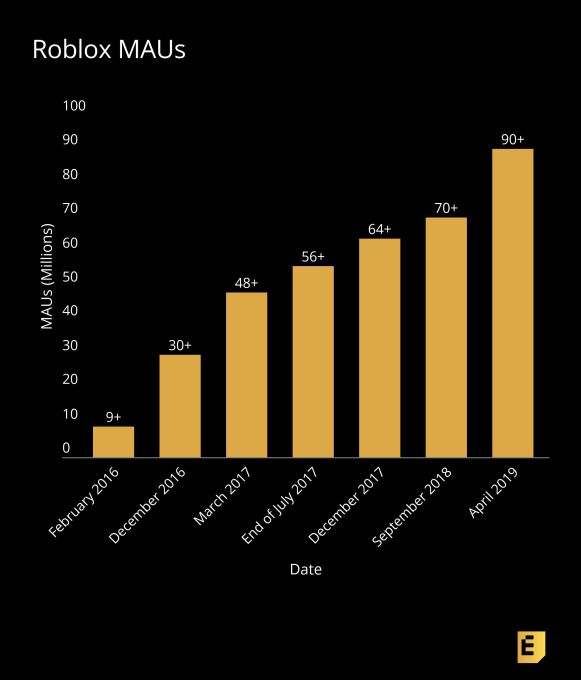
Our recently published EC-1 on Roblox recounts the origin story and growth prospects of the company. But there’s one more piece to the story: what Roblox’s impact will be on gaming and the broader startup industry, if the company manages to multiply its current 90 million users.

roblox maus 1

Sources: TechCrunch, VentureBeat, Roblox

We’ve distilled three key ideas out of the EC-1 — lessons that may apply not only to game developers and gaming entrepreneurs, but also to the broader startup industry.

Lesson 1: UGC is a missed opportunity in games

Roblox has shown that user-generated content (UGC) is a missed opportunity for much of the game industry. The company aspires, in a way, to be the YouTube of games. And it is succeeding, with 2 million experiences to date.

The game industry generally has two problems with UGC. One is the games themselves: AAA games today are too complex, and lack the flexibility and simplicity needed for robust UGC. Roblox shows that a simpler look and feel is a valid alternative to today’s super-sized, beautiful AAA games. (Minecraft proved much the same.)

The other problem is the greater complexity of making games than, say, videos or music. Roblox solved this problem by building its own game engine, which is designed solely to output Roblox-style experiences.

But increasingly, engines like Unity are capable of accomplishing similar feats: games are getting easier to build. It’s now possible that savvy entrepreneurs could build a platform like Roblox, without building an entire game engine.

Lesson 2: New opportunities in gaming are still coming

The game industry is infamously cyclical. New platforms emerge, become promising, then grow overcrowded and competitive. Usually, this cycle relates to hardware (the iPhone, virtual reality helmets, game consoles like the Nintendo Switch) or massive changes in consumer behavior (the emergence of Facebook, the early growth of the internet). But Roblox, a pure software play, shows that exceptions could exist.

It’s still early days. Roblox reported that it paid out $30 million to game developers in 2017, doubling to $60 million in 2018. Since Roblox keeps 65 percent of revenue from its games, that means it made around $230 million total in 2018. Its top 10 developers made about $2.5 million each. Seven of its games have also entered a “billion plays” club:

Adopt Me, a newer game, hit 440,000 concurrent users in June, a new record for the platform.

When a new platform appears, it’s usually found by amateur developers first. That’s certainly the case with Roblox: its successes are being created almost exclusively by first-time game developers in their teens and twenties. At some point, professional developers are likely to conclude they can do at least as well. The current market is particularly exciting because many games are fairly simple and lightweight — recent breakout hits like Camping 2 and Weight Lifting Simulator 3 are significantly smaller than comparable games on other platforms.

For entrepreneurs interested in creating new platforms or portals Roblox’s success as a combined game engine and self-contained platform also shows that opportunities still exist — if you have the patience to wait for them to mature.

Lesson 3: Patience can create amazing growth cycles

It took Roblox 15 years to grow to its current point. But most of that growth is recent: as seen in the chart above, Roblox experienced 10x growth in about 3 years, from 9 million users in February 2016 to 90 million in April 2019.

So what went into the decade or so during which Roblox was a much smaller platform? As we tell it in the origin story: a great deal of work, and very little paid acquisition.

In its early years, Roblox did buy users, to seed a user base while it worked on an impossibly large vision that included a game engine, platform, social features, a creator community, and its own games. But after a few years, it stopped buying users.

All of its growth since has been organic. That’s from two main sources: word of mouth, and YouTube users who watch one of the many Roblox streamers. Of course, any company can try to do the same. But Roblox had the patience to build a unique product — one which took years of work to even reach partial completion.

The key to it all was long-term adherence to a long-term goal: the creation of a new category, which it calls “human coexperience”. Today, Roblox still can’t be called part of a new category; it’s a game platform. But with more years of work, it may eventually get there.

For more on the Roblox story, see Part 1: The Origin Story, and Part 2: The Business Plan.

16 Jul 2019

Large retailers saw 64% increase in sales on Monday, thanks to Amazon Prime Day

It’s no longer a winner-take-all scenario for Amazon Prime Day — in fact, that hasn’t been true for years. As soon as other large retailers realized they could piggyback on Amazon’s annual sales event to boost their own revenues from counter-sales, they’ve been doing just that. According to new data from Adobe Analytics out this morning, large retailers have already seen a big jump — a 64% increase — in their U.S. e-commerce spending thanks to Prime Day on Monday, July 15, when compared with an average Monday.

That’s up quite a bit from the 54% increase seen by these large retailers (those with over a billion in annual revenue) last year, the report notes.

Smaller retailers did well yesterday, too. Niche retailers with less than $5 million in annual revenue saw a 30% increase in their online sales on Monday, due to more people shopping online for deals.

Adobe earlier predicted Amazon Prime Day 2019 would push U.S. e-commerce sales to over $2 billion, when it all wraps. That will make it the third time outside the holiday shopping season that sales will hit that milestone, following Labor Day 2018 and Memorial Day 2019.

The increase in sales on non-Amazon sites so far can be attributed to the increased visitor traffic, which accounted for 66% of the revenue lift. Another 27% was caused by an increase in conversions, and 7% to bigger basket sizes.

Yesterday’s best non-Amazon deals were on electronics, Adobe also noted — particularly smart devices including smartwatches (12% off), smart TV (10% off), and smart home items (9% off).

Adobe’s data comes from its analytics business and is based on an analysis of one trillion visits to over 4,500 retail sites and 55 million SKUs. The company measures transactions for 80 of the top 100 U.S. e-commerce retailers.

Amazon, meanwhile, is reporting a successful Prime Day on Monday, without detailing revenues. It says that customers already saved “hundreds of millions of dollars” in the U.S., including on top sellers like the Fire TV Stick with Alexa Voice Remote and Echo Dot, with millions sold.

16 Jul 2019

Newsletter platform Substack raises $15.3M round led by A16Z

Andreessen Horowitz is betting that there’s still a big opportunity in newsletters — the venture capital firm is leading a $15.3 million Series A in Substack.

To be clear, although Substack started out two years ago as a way turn newsletters into a paid subscription business, it’s since added support for podcasts and discussion threads . As CEO Chris Best put it, the goal is to allow writers and creators to run their own “personal media empire.”

Writers using Substack include Nicole Cliffe, Daniel Ortberg, Judd Legum, Heather Havrilesky and Matt Taibbi. The startup says that newsletters on the platform have now amassed a total of 50,000 paying subscribers (up from 25,000 in October), and that the most popular Substack authors are already making hundreds of thousands of dollars a year.

A16Z’s Andrew Chen — a blogger and newsletter writer himself — is joining the Substack board of directors. In Chen’s view, the startup represents the combination of the old and the new, allowing writers to reach longstanding “passionate online communities,” while also pursuing “a new way of doing micro-entrepreneurship,” where they make money directly from their audience.

“When you combine the two — wow, this is something special,” Chen said.

Y Combinator, where Substack was incubated, is also participating in the funding.

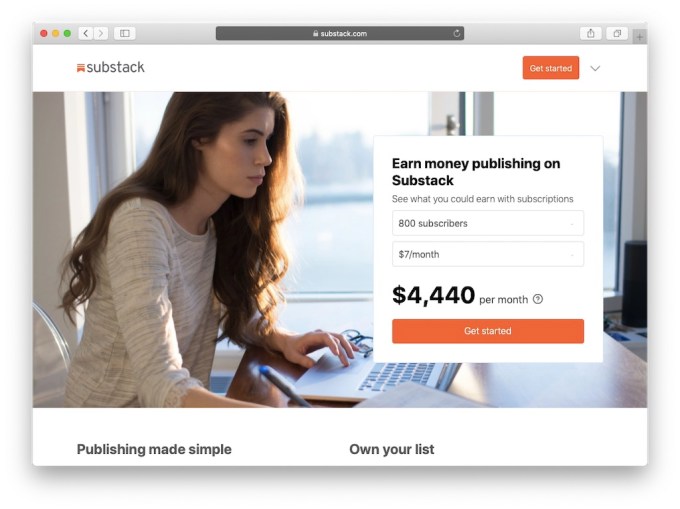
Substack screenshot

Best told me that until now, the team consisted entirely of the three co-founders — CTO Jairaj Sethi, COO Hamish McKenzie and Best himself — “working out of my living room.” (The three of them are pictured above.) Even with the new funding, Best and McKenzie said they want to grow cautiously.

“We’re conscious of the writers depending on a reliable and stable Substack for their income,” McKenzie said. “We don’t want to go out there and do a bunch of crazy startup stuff.”

Still, they will be moving out of that living room and hiring a bigger team. Best also said they have plans to build more “writer success” tools that help creators get the most out of the platform, and to expand into other formats, like video.

Even as Substack grows, McKenzie said it will maintain a focus on subscription products for “people who are attracted to the idea of owning their relationship with their audience.” Best argued that that this approach avoids the incentives that have pushed online news in the direction of “cheap outrage, attention and addiction.”

He added, “It’s just a better model for creating culture.”

As for whether the newsletter boom might eventually reach a saturation point, making it harder for new titles to find an audience, Best acknowledged that there’s probably “some finite limit” to the number of newsletters that most readers will subscribe, but he said, “Even if that’s the case, it can still be a very successful model. The magical thing about paid subscriptions is that you don’t need to have millions of people in your audience.”