Year: 2019

16 Jul 2019

Esports org 100 Thieves raises $35 million in Series B

100 Thieves has today announced the close of a $35 million Series B funding round. Artist Capital Management led the round, with ACM’s Chief Investment Officer Josh Dienstag joining Mike Sepso, MLG cofounder, on the board of directors. Group Arnault, the investment arm of LVMH, also participated in the round.

CEO and founder Matthew “Nadeshot” Haag confirmed to TechCrunch that this latest round brings 100 Thieves’ post-funding valuation to $160 million, which is up from the $90 million valuation it had in October 2018.

100 Thieves was founded in 2017. Haag is a former pro gamer and content creator with one of the biggest followings in esports.

“The most important lesson I’ve learned going from gaming to leadership is ‘over-communicate, over-communicate, over-communicate’,” said Haag, explaining that he went from working by himself creating content to working with many people each day. “Making sure we’re all aligned on our goals for each day and each week and each month, to have an open and transparent environment, really builds a culture where everybody enjoys working with one another. Over-communication helps drive success.”

The org has investment from Drake, Dan Gilbert, and Scooter Braun. 100 Theives has three revenue channels.

The first is esports. Right now, the organization competes in Call of Duty (where its team has won the last two tournaments), League of Legends, and Fortnite (100 Thieves is sending six of its players to the Fortnite World Cup).

The second channel is content creation. 100 Thieves includes big-name streamers such as Jack “Courage” Dunlop, who has nearly 1.9 million Twitch followers, and Rachell “Valkyrae” Hofstetter, who has more than 800K Twitch followers.

Finally, 100 Thieves has gotten into apparel, with limited edition hats, sweaters, jackets and t-shirts. As of right now, everything in the 100 Thieves Shop is sold out.

“What’s hurt me the most is having so many community members not be able to purchase this apparel for themselves,” said Haag. “We want to 100 Thieves to be all inclusive. If you want to support us, you should be able to.”

According to Haag, one goal is to expand into new esports titles — a few titles in consideration include “Counter-Strike: Global Offensive”, “Rainbow 6 Siege”, and “Rocket League”.

Another top-of-mind goal is building out a new HQ facility in Los Angeles that will house the esports, content creation and apparel divisions all under one roof. The 15,000 square-foot facility will include streaming stations, a content production sound stage for 100 Thieves two podcasts, and will serve as the storefront for 100 Thieves apparel lines.
16 Jul 2019

Workplace, Facebook’s service for business teams, is raising its prices for the first time since launch

Three years into its life with 2 million paying users signed up, Workplace — Facebook’s platform for businesses and and other organizations to build internal communities and communications — is about to make a significant business shift of its own. Come September 2, Workplace is changing its pricing tiers, how it charges its users, and the services that it provides customers.

Up to now, Facebook has taken a very simple approach to how it charges for Workplace, unique not just because of it being a paid service (unlike Facebook itself, which is free), but for how it modelled its pricing on the basic building block of Facebook-the-consumer product: a basic version was free, with an enhanced premium edition costing a flat $3 per active user, per month.

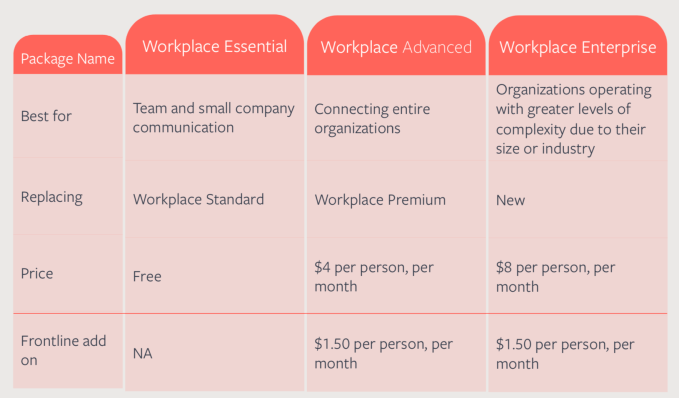
In September, that will change. The standard (basic) tier is getting rebranded as Workplace Essential, and will still be free to use. Meanwhile, the premium tier is being renamed Workplace Advanced and getting charged $4 per person, per month. And Facebook is introducing a new tier, Workplace Enterprise, which will be charged at $8 per person, per month, and will come with a new set of services specifically around guaranteed, quicker support and first-look access at new features. (Those who are already customers have the option of being grandfathered for a year, the company said, before switching to a new plan.)

Screenshot 2019 07 16 at 14.16.02

Those are not the only changes. Two other notable shifts are getting introduced with these new tiers. First, these prices will be for all users, regardless of whether they are active in the month.

And second, they are specifically prices for people who access Workplace as general “knowledge workers” — marked by having email addresses and specific job functions. Frontline workers — for example cashiers or baristas or others mostly on their feet all day helping customers — will be an add-on at $1.50 per person per month, also regardless of whether they are active or not.

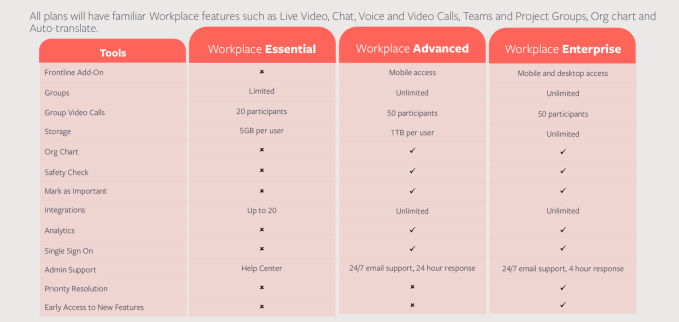
For now, the rest of the features in the different tiers are remaining the same:

Screenshot 2019 07 16 at 14.16.33

The changes at Workplace come amid a number of other developments among workforce collaboration and communication platforms.

First and foremost, Slack has how gone public, subjecting it and its ups and downs to a lot more public scrutiny, but also putting it on the map as a business of some standing, helping it make a bigger move into brokering more deals with the larger enterprises that Workplace has been winning over. The latter’s customers include the likes of Walmart, the worlds biggest employer; as well as Nestle, Vodafone, GSK, Telefonica, AstraZeneca and Delta Airlines, and Facebook says that there are more than 150 companies signed up with more than 10,000 employees each.

Teams, meanwhile, has now passed Slack in user numbers, and in a way is a more direct competitor: it has positioned itself (like Workplace) as a tool for both knowledge and frontline workers, helping with actual back-office collaboration, as well as a way to broadcast communications to a wider group of employees.

Julien Codorniou, the VP of Workplace, said that the changes in pricing tiers was not a reaction to competition, but rather a reaction to customers. Although the pricing for Workplace was an interesting twist on how enterprises tend to procure IT, it turned out to be too novel by half: it turned out that most actually like the predictability of paying the same amount for a service upfront, rather than having the pricing change each month depending on usage.

“Today, customers’ bills change every month, for example when a coworker goes on vacation or whatever,” he said. “It’s a nightmare for the accounting department, who needs to know how much to pay two years out.”

He added that this doesn’t mean you can’t change how much you pay: you could change the pricing each month if necessary.

So far,  no one has made the shift to the new tiers, so it will be interesting to see how and if they have much of an impact. I do know that from retail theory, customers in stores are more likely to select a middle-priced product if they are given an option of something cheap and something expensive at either end, and so this could be an interesting way to drive more users to Workplace’s paid tier.

What is more clear is that this is also a way for Facebook to raise its prices for the first time since the service launched, and lays the groundwork for more differentiation between different kinds of offerings.


16 Jul 2019

Patreon raises $60M Series D, targets international growth and more customization

Patreon, the San Francisco-based platform that helps over 100,000 online content creators manage paid membership communities for their most dedicated fans, has raised $60 million in Series D funding.

Glade Brook Capital, a late-stage fund based in Greenwich, Connecticut, led this round with participation from prior investors like Index Ventures, CRV, Thrive Capital, Initialized, and DFJ Growth. This totals $165 million in funding that Patreon has raised since its founding in 2013.

In February, I published a 5-part series analyzing Patreon’s founding story, product evolution, business, competition, and overarching vision. The company has prioritized established creators who can generate $1,000+ per month in membership revenue as its core customer and is focused on being the underlying platform they use to manage relationships with superfans through a CRM, payment processing, and gating of exclusive access to content and discussion groups.

It makes money by taking a cut of each creator’s monthly revenue earned from their fans’ Patreon memberships.

Co-Founder & CEO Jack Conte shared news of the Series D via a blog post and tells me the new funds will contribute toward these priorities:

  1. Benefits functionality: integrating with more tech platforms using the Patreon API to ensure only paying members receive access to creators’ exclusive discussion groups on Discord or Discourse, receive special badges that mark them as a patron on Reddit, etc.
  2. Premium features: adding more features to the new Pro and Premium pricing tiers it launched in March which provide extra services and functionality to creators in exchange for a higher cut of their membership revenue (8% and 12%–plus payment processing fees–respectively, compared to 5% for the original Lite tier).
  3. Page customization: enabling creators to customize their Patreon pages more by changing colors, layout, and font to fit their own brand.
  4. Merchandising: expanding Patreon’s fulfillment of merchandise for creators who offer merch as a reward to their fans who subscribe to a given membership tier by adding international shipping options and more merch products to select for custom branding.
  5. International expansion: ensuring Patreon is available in more languages and can easily handle international payments, plus staffing new offices in Dublin (Ireland), Porto (Portugal), and other locations yet to be finalized.

When I asked Conte whether he plans to use this new funding to make more acquisitions — Patreon acquired the white-label membership management platform Memberful last summer — he responded that there are no deals currently in the pipeline but M&A is certainly on the table if they identify the right opportunity:

“It’s been a few years that we have been seeing the ‘Patreon for X’ trend of startups focused on a specific niche like podcasting. We’re looking at those companies and always open to joining forces if the mission is aligned and product is great.”

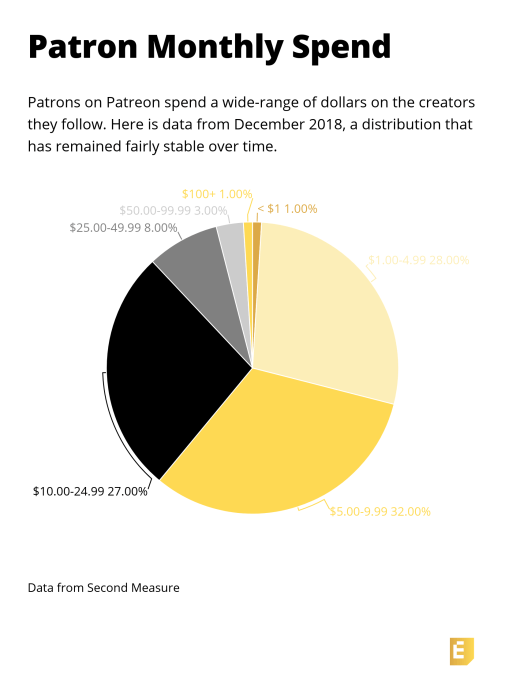
As it announced in January, Patreon expects to surpass $500 million in payments processed during 2019, which would result in it having processed over $1 billion cumulatively since founding. Roughly 40% of those payments are international and the overall monthly spend of fans who use Patreon is $12 on average.


Glade Brook Capital’s managing partner Paul Hudson, who originally founded the firm as a hedge fund, shared a statement with TechCrunch on why he invested in Patreon:

“Too many talented creators struggle to monetize their efforts in the digital era. Patreon is growing so fast because creators recognize the value in building recurring fan-based revenue streams and improving engagement with their most passionate fans.”

Conte also revealed that a handful of artists, including musician Serj Tankian and comedian Hannibal Buress, invested in Patreon as part of this new round. He hopes that the Pro and Premium tiers will draw more creators who don’t already use Patreon and support existing customers who need more advanced toolset given the size of their fanbase.

16 Jul 2019

Watch 5,000 rockets attempt a world record simultaneous launch to celebrate Apollo 11

50 years ago today, at 9:32 AM ET, Apollo 11 took off from Kennedy Space Center in Florida aboard a Saturn V rocket. At 9:32 AM ET this morning in 2019, you can watch as the U.S. Space & Rocket Center in Huntsville, AL attempts a record of its own.

The Space & Rocket Center will play host to a launch of 5,000 model rockets all blasting off at once, in what will be an attempt at a Guinness world record for the most rockets launched at once. It’s a demonstration with sponsors including Boeing, Lockheed Martin and the United Launch Alliance, which all of course manage actual rocket launches with fair frequency.

Those model rockets may be small, but 5,000 of anything that’s propelled by controlled explosions into the sky is bound to be quite the show, so keep an eye on the stream above for the fireworks.

16 Jul 2019

Grammarly goes beyond grammar

Grammarly, the popular grammar and spellcheck tool, is launching a major update to its browser extensions, web app and native desktop apps today. In its early days, Grammarly was all about the mechanics of writing correctly. With this update, the tool will go well beyond finding standard spelling, punctuation and grammar errors and add a number of new features that are meant to address issues that can hold your writing back.

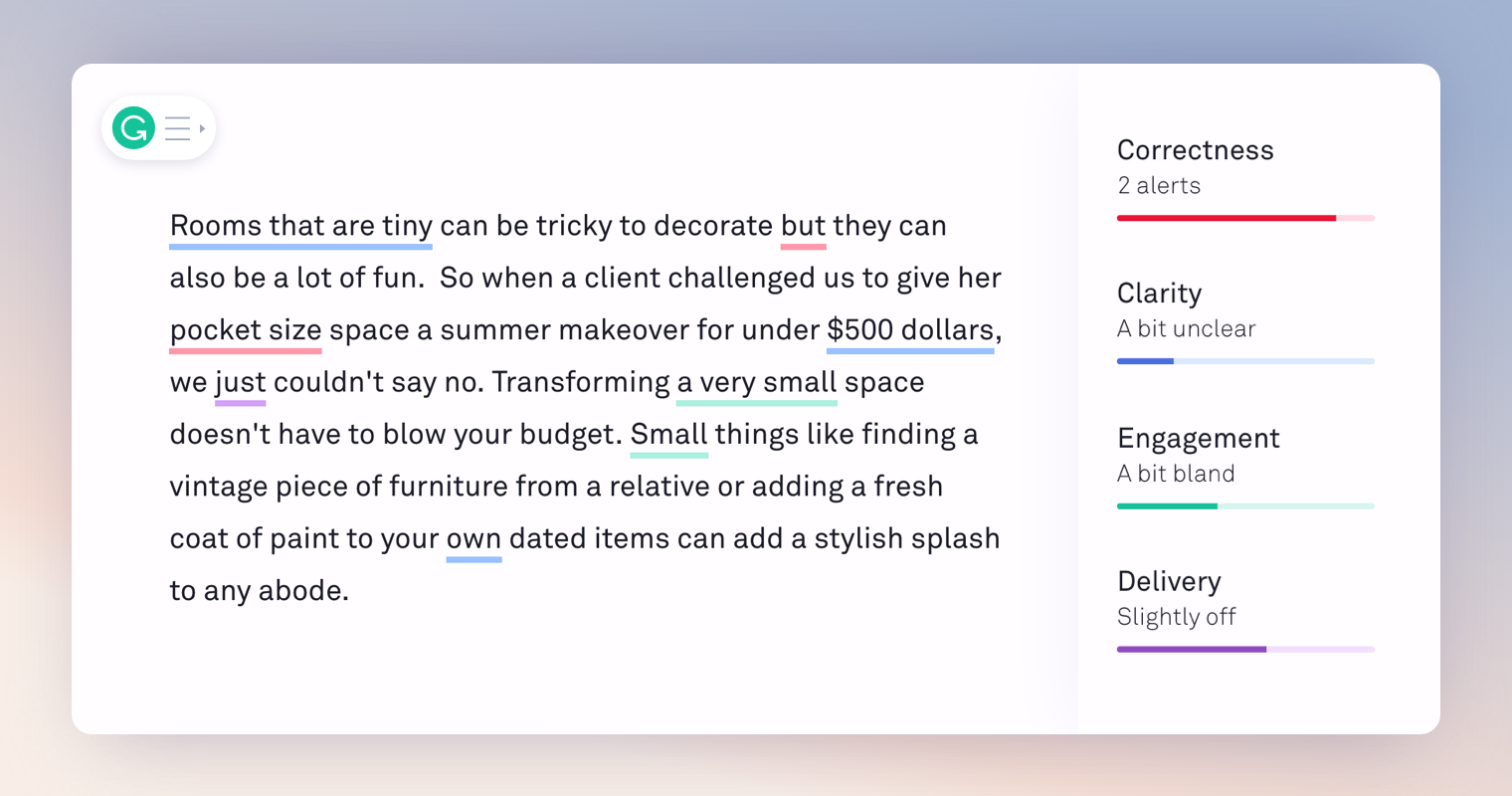
To do this, the tool will now also highlight sentences and phrases that are potentially unclear, for example. It’ll also help you find the right tone for your text and choose the right words to keep your text varied and engaging. There’s nothing worse than having to read the same words over and over again when switching up a few words could make your text more varied and engaging, after all.

Grammarly 4Categories

As some of these suggestions depend on what you’re trying to achieve with a given document, Grammarly now also allows you to provide more information about whether you’re trying to write a professional document or a travel blog, for example.

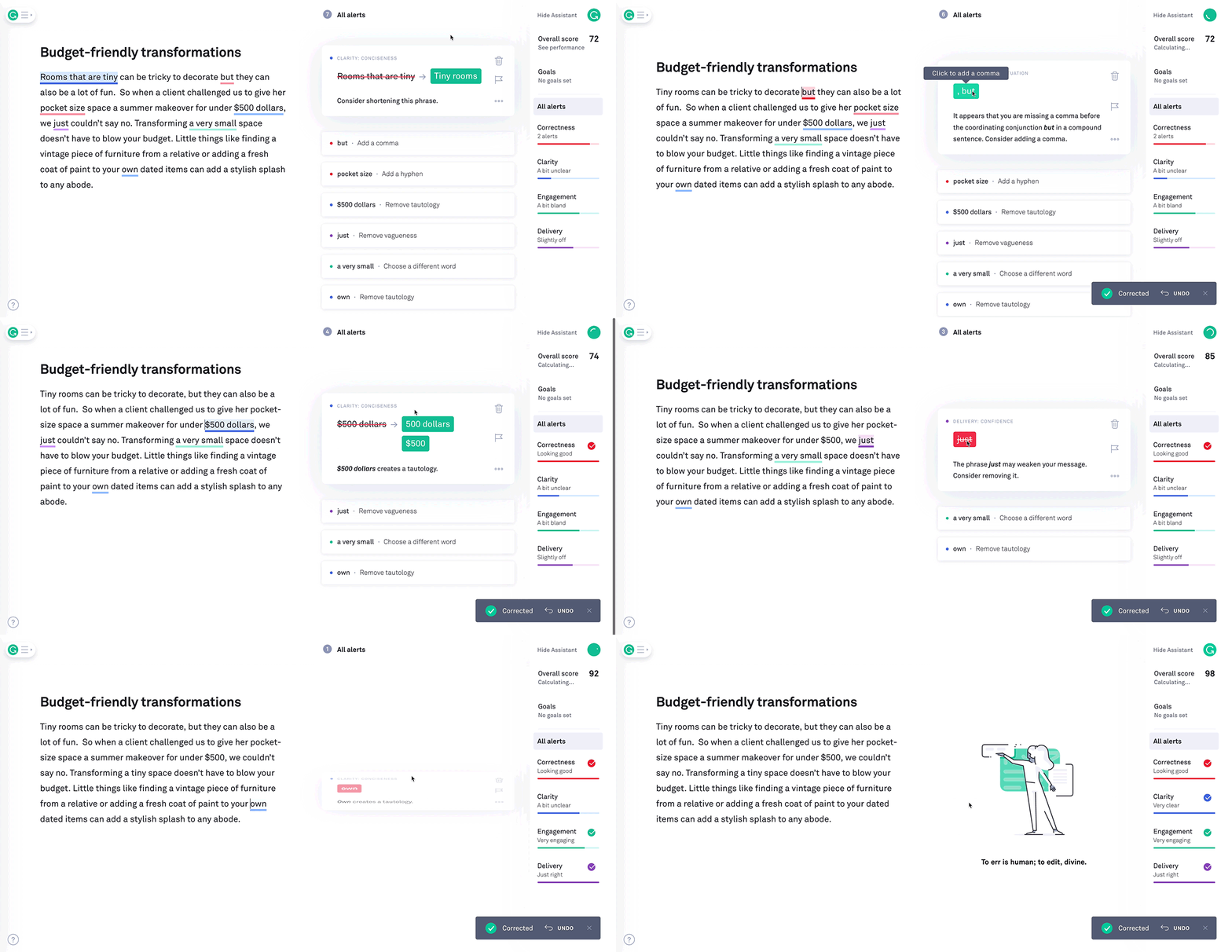
In its products, Grammarly will highlight these issues under new clarity, engagement and delivery sections (on top of the existing correctness tab). Inside the editor, the tool will now use four different colors to underline words and phrases that its algorithms believe could be improved. “The more Grammarly knows about what you want to accomplish with a piece of writing, the better it can tailor its suggestions to suit your needs,” the team explains in today’s announcement. “For example, when you specify the audience you’re writing for, Grammarly will adjust its suggestions to help you focus your writing for that type of reader.”

Grammarly 4Categories applied

Somewhat unsurprisingly, most of these advanced features will only be available to paying Grammarly Premium users (starting at $30/month for the monthly plan, though the company offers significant discounts for annual subscriptions and regularly offers free users discount subscriptions, too). Some of the clarity suggestions around clarity and conciseness will be available to free users, though. Everyhing else? You’ll have to pay.


16 Jul 2019

Arm’s new licensing option lets its partners experiment and test for free before they pay

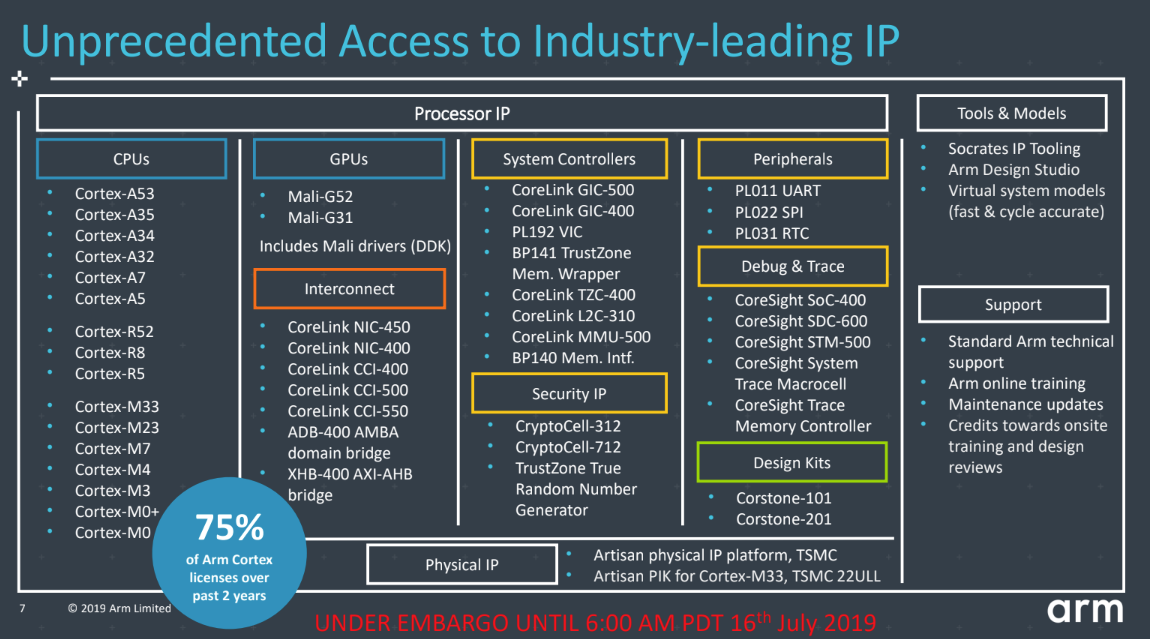
Arm today launched Flexible Access, a new licensing scheme in addition to its existing model, that will make it easier for startups to gain access to a wide range of Arm’s intellectual property (IP) without any upfront licensing costs.

Intellectual property licensing schemes for chips may not strike you as the most exciting thing. But as the number of companies that are building their own silicon, often for very specialized use cases, having access to the IP from companies like Arm is something that more companies than ever a looking to have. Until now, the only way to get access to Arm’s IP was to select the products you wanted to license upfront. That works for large companies that know exactly what they want, but for smaller companies, that’s a bit of a barrier, given that they are likely still trying to figure out what exactly they need.

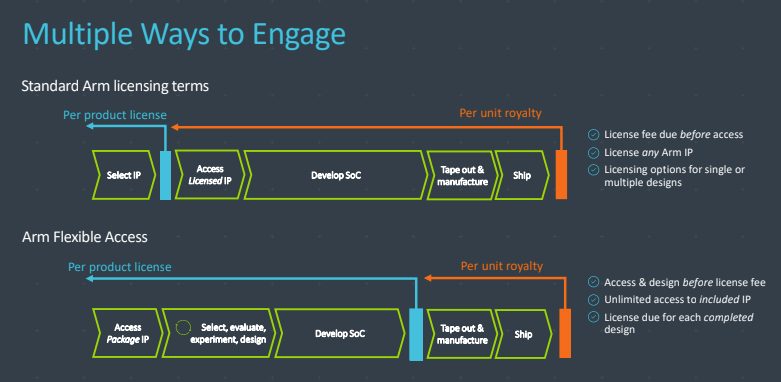
Under the Flexible Access terms, partners get access to the IP and only pay a per-unit royalty fee once they go into production. Under the existing scheme, license fees were due before partners could access the IP.

2019 07 15 2038

“The reason we’re doing this is because we see that the industry is evolving quite significantly — lots of transformation that’s happening, new companies coming into doing custom silicon,” Dipti Vachani, Arm’s SVP and GM of  its automotive and IoT business, told me. “We believe that enabling this is easy access to IP and experimentation allows for the growth and the usage of our IP across the trillion connected devices.”

Vachani stressed that the company believes that this move will allow a whole range of new companies to use Arm’s IP portfolio since it significantly lowers the barrier of entry.

“This allows for a  lower barrier to entry for for anyone. It’s very straightforward. You go online, there’s a process to do so,” Vachani said. “And smaller companies that may not have the infrastructure that our traditional silicon companies have had — this makes this really simple and easy for them.”

That flexibility, the company hopes, will result in even more companies using its IP and hence driving more revenue as those companies sell their products. “I expect that this will
increase the scale,” Vachani said. “It’ll allow for the trillion connected devices that we internally talk about at ARM and enable those trillion connected devices to be on Arm and it builds on top of the ecosystem that we already have and that it will absolutely be accretive to our company and our business.”

Flexible Access includes about 75 percent of all Arm Cortex licenses from the past two years. This includes CPU architectures from the Arm Cortex A, R and M families, in addition to select GPUs, interconnects, security IP, system controllers and more — essentially everything you need to build your own system. It also includes software development tools and additional tools and models for building systems on a chip.

2019 07 15 1606

You’ll notice, though, that some of the newest high-end CPU architectures are not part of this license.  This, Vachani said, is due to the fact that the companies that need a high-performance CPU — say an A75 — typically know what they are creating from the outset.

Flexible Access, it’s worth stressing, does not replace Arm’s existing licensing system. The two will live in parallel. “What we did here is we looked at what is necessary for these endpoints in the IoT market […]. That’s where there’s a disruption happening and where the transformation is happening. We looked at the portfolio of IP that’s absolutely necessary for that kind of testing in that plane. […] When you look at the low end, that’s where all the experimentation is – the mid- and low-end.”

The program is now live and available to all chip companies that want to move to this licensing model, no matter whether they are a large chipmaker or a startup that is only dipping its toes into this business.

16 Jul 2019

Tesla drops ‘Standard Range’ Model S and Model X, lowers prices of ‘Long Range’ variants and Model 3

Tesla has made a tweak to its model lineup, eliminating the entry-level ‘Standard Range’ variants of its Model S and Model X vehicles. The change means that it’s now more expensive overall to get into either the all-electric Model S sedan or the Model X SUV, but the automakers also lowered the price of the new entry-level ‘Long Range’ variants of each vehicle – and dropped the starting price fo the Model 3 to $38,990.

“To make purchasing our vehicles even simpler, we are standardizing our global vehicle lineup and streamlining the number of trim packages offered for Model S, Model X and Model 3,” Tesla said in a statement to Reuters regarding the reason behind the pricing and lineup changes. “We are also adjusting our pricing in order to continue to improve affordability for customers.”

Reducing the number of model variants at the top end of Tesla’s lineup should help it minimize costs and focus high-end buyer appetite on trim levels with greater profit potential for the automaker with less production complexity. And the upside it gains there can be applied beneficially to cost of the Model 3, which is increasingly the source of the automaker’s growth.

Tesla’s second quarter vehicle deliveries were the highest on record, totalling 95,200 vehicles with the most affordable car in the lineup, the Model 3, accounting for around 80 percent of the overall mix.

16 Jul 2019

Netflix removes depiction of suicide in ’13 Reasons Why’ season one finale

Netflix has modified an episode of the controversial series ’13 Reasons Why’ two years after its original airing, citing sensitivity to the ‘ongoing debate’ that’s been occurring regarding the show’s depiction and characterization of teen suicide. In a statement provided to The Hollywood Reporter, the streaming explained why it removed a scene that depicted the suicide of main character Hannah (played by Katherine Langford) which lasted nearly three minutes, opting instead to have this take place entirely off-camera in the updated edit.

“We’ve heard from many young people that 13 Reasons Why encouraged them to start conversations about difficult issues like depression and suicide and get help — often for the first time,” Netflix wrote in the statement. “As we prepare to launch season three later this summer, we’ve been mindful about the ongoing debate around the show. So on the advice of medical experts, including Dr. Christine Moutier, chief medical officer at the American Foundation for Suicide Prevention, we’ve decided with creator Brian Yorkey and the producers to edit the scene in which Hannah takes her own life from season one.”

This scene was part of the original seasons one finale, but now skips the direct depiction and instead leads right into the reaction of Hannah’s parents to her death. Netflix also told THR that it will be actively monitoring and issuing take-down requests for pirated distribution of versions of the show that feature the unedited clip.

Showrunner Brian Yorkey also issued his own statement about the change separately, sharing this via Twitter in a Notes screenshot capture:

It was our hope, in making 13 Reasons Why into a television show, to tell a story that would help young viewers feel seen and heard, and encourage empathy in all who viewed it, much as the bestselling book did before us. Our creative intent in portraying the ugly, painful reality of suicide in such graphic detail in Season 1 was to tell the truth about the horror of such an act, and make sure no one would ever wish to emulate it. But as we ready to launch Season 3, we have heard concerns about the scene from Dr. Christine Moutier at the American Foundation for Suicide Prevention and others, and have agreed with Netflix to re-edit it. No one scene is more important than the life of the show, and its message that we must take better care of each other. We believe this edit will hep the show do the most good for the most people while mitigating any risk for especially vulnerable young viewers.

Earlier this year, a study published in the Journal of the American Academy of Child & Adolescent Psychiatry found that the show coincided with a bigger increase in suicides than was predicted by researchers among people aged 10 to 17, and the graphic depiction of Hannah’s suicide was cited as a particular risk factor among experts in the field. The study’s designers noted that they could only determine correlation, not causation, but it was enough to deepen the conversation around the show’s potential impact, which had begun along with its debut in 2017.

Meanwhile, the third season of the show is set to debut later this summer, and while Netflix told THR that it will not include any depictions of suicide, it is likely to reignite the conversation about the show’s impact, and Netflix is likely hoping this pre-emptive edit will help curb some of the negative reaction to the ongoing production of the series.

If you or someone you know needs help, call 1-800-273-8255 for the National Suicide Prevention Lifeline. You can also text HOME to 741-741 for free, 24-hour support from the Crisis Text Line. Outside of the U.S., please visit the International Association for Suicide Prevention for a database of resources.

16 Jul 2019

Flybits nabs $35M to build consumer recommendation engines for the financial sector

Financial service companies like banks have seen some of their business cannibalised over the years with the rise of digital-based alternatives — often in the form of apps — that provide lower fees, faster responsiveness, and more flexibility to consumers. Today, Toronto-based startup called Flybits is announcing $35 million in funding for a platform that it believes can offer these banks a way of continuing to capture their users’ attention, and to help them pivot into the next generation of services, financial or otherwise.

Today, a typical end product for a customer of Flybits’ services will use insights to upsell a customer by offering financial services, for example a bank providing an offer of a specific kind of loan or credit card that you are more likely to take; or to offer a loyalty program or rewards for usage. But the longer-term goal, said CEO and co-founder Hossein Rahnama, is to help its customers take on a bigger role as repositories that can be used for more than just money, and used beyond the walls of the bank.

“We don’t think banks will go away as some do, but we think that they could have a role not just as money vaults, but as data vaults: a place where you can deposit data, which you trust,” he said in an interview. Indeed, some of the funding will be used to put into action some of the AI and machine learning patents the startup has amassed, with the building of a “data” marketplace for banks, fintechs, and other data providers to partner and build more services together.

The Series C comes from an interesting group of investors that includes both strategic backers using Flybits’ services, as well as backers of the more non-strategic, financial kind. Led by Point72 Ventures (hedge fund supremo Steve Cohen’s VC fund), the list also includes Mastercard, Citi Ventures, and Reinventure (the fund backed by Australia’s Westpac Banking Corporation), Portag3 Ventures, TD Bank and Information Venture Partners. Valuation is not being disclosed, and prior to this the company had raised around $15 million.

Much like another marketing tech company, Near — which today announced $100 million in funding — the premise that underpins Flybits’ technology is that there is a lot of disparate data out there that, if it’s treated correctly, can uncover a lot more insights about consumer behavior, and that by and large many companies are missing this opportunity because they haven’t found the right way of merging the data to unlock insights.

While Near is applying this to location-based data and a range of different verticals, Flybits’ primary target has been banks and the data that they and other financial services providers already posses.

Many smaller startups in the world of financial services have stolen a march on bigger incumbents by building personalization into their products from the ground up. (Indeed, some like Step, aimed at teens, are so personalised that they will actually change their service mix as their customer base grows up and needs new products.) This is something that incumbents might have been more readily able to do in the old days, when people knew their bank managers and tellers and made daily trips into branches to transact. In the digital age they have fallen behind and are now catching up.

Flybits’ investors have spotted that and this in part is why they are banking on technologies like this to help bigger companies catch up, not just in financial services (although with banking alone estimated to be a €6.9 trillion industry, this is clearly a good start).

“Personalization is mission-critical for all D2C businesses in the digital age. Flybits’ integrated platform allows financial services firms to offer contextualized experiences, driving product awareness and adding significant value to the lives of their customers,” said Ramneek Gupta, Managing Director and Co-Head of Venture Investing at Citi Ventures, in a statement. “We look forward to partnering with Flybits in its next phase of growth as it continues to set the bar for hyper-personalized customer experiences.”

Indeed, it’s not just banks that are working on upselling, or that have large repositories of data that are not used as well as they could be.

“Mastercard and Flybits share a vision on using data driven insights to enrich consumers’ experiences.” said Francis Hondal, President, Loyalty & Engagement at Mastercard, in a statement. “Our ultimate goal is to develop products and services that engage consumers in a highly contextual manner. Through this collaboration with Flybits, we’ll be able to offer rich, personalized experiences for them throughout their journeys.”

16 Jul 2019

Watch how Apollo 11 set the course for Apple’s alternate history space race TV drama

One of the shows coming to Apple’s forthcoming streaming original content video service, Apple TV+, is ‘For All Mankind,’ a series led by showrunner Ronald D. Moore, whose most notable previous credit is creating Syfy’s ‘Battlestar Galactica’ remake series. ‘For All Mankind’ is an alternate history fiction series that imagines what happens if the Russians beat the U.S. to being the first to land an astronaut on the Moon.

In a new featurette, Moore and his fellow series creators, along with some of their technical advisors, talk about the show, and what the actual Apollo 11 Moon landing meant to thew world. The 40th anniversary of that real historical event is coming up on July 20, but you’ll have to wait a bit longer to see the Joel Kinnaman-starring ‘For All Mankind’ – it’s arriving this Fall along with Apple TV+, but we don’t yet have specifics on exactly when, or on how much the service will cost when it does become available.

The official first trailer for ‘For All Mankind’ is below, in case you missed its debut last month. There’s not much to go on here but the premise definitely seems engaging, and I do detect a very BSG -ish vibe from what scenes are available to see here.