Year: 2019

16 Jul 2019

Near raises $100M for an AI that merges online and offline behavior to build consumer profiles

One of the holy grails in the world of advertising and marketing has been finding a way to accurately capture and understand what consumers are doing throughout the day, regardless of whether it’s a digital or offline activity. That goal has become even more elusive in recent years, with the surge of regulations around privacy and data protection that limit what kind of information can be collected and used. Now, a startup believes it’s cracked the code, and it’s raised a large round of funding that underscores its success so far and what it believes is untapped future demand.

Near, which has built an interactive, cloud-based AI platform called AllSpark that works across 44 countries to create anonymised, location-based profiles of users — 1.6 billion each month at present — based on a trove of information that it sources and then merges from phones, data partners, carriers and its customers, but which it claims was built “with privacy by design”, has raised $100 million.

The company believes that this Series C — from a single backer, Great Pacific Capital out of London — is one of the biggest rounds ever to be raised in this particular area of marketing technology. That’s not to say that others haven’t also been attracting investor attention (as one example, a direct competitor, Factual, raised $42 million last September).

Near is not disclosing its valuation, but founder and CEO Anil Mathews said in an interview that the company has been growing at a rate of 100% year-on-year and described it as “healthy” with its customer list including News Corp, MetLife, Mastercard and WeWork.

Near (not to be confused with the blockchain startup that raised $12 million last week; yes sometimes startups have the same name…) has to date raised $134 million, with other backers including Sequoia, JP Morgan, Cisco and Telstra (Canaan Partners had been an investor too but sold its stake in a secondary deal).

The problem that Near is tackling is not a new one. The wider swing that we’ve seen in consumer behavior to digital platforms and using connected devices has created an opportunity for (and demand from) companies to better track who is using their products and services, and also to proactively figure out who would be the best audiences to target for future business.

But there have been two catches to that pull: how best to capture activity when it’s not specifically digital (for example, going into a physical store), and how best to capture activity in a way that doesn’t encroach on customers’ privacy and right to be anonymous if they so choose — with the latter becoming more than just a principle in many jurisdictions, but fully-fledged rule of law.

Near’s approach is not entirely novel. Like many others that currently exist or preceded Near, the startup uses a collection of data points sourced from a variety of providers — in Near’s case, the list can include your mobile carrier, data providers that work with dozens or hundreds of apps to source activity, app providers directly, retailers and WiFi operators.

The similarities end there, however, said Mathews. He says Near has a (patented) technique based on machine learning algorithms and other inferential AI technology, which it uses to accurately merge all of these details together to create individual profiles, all without ever attaching a name or real identifiers of any kind to that profile.

“If you ask me, that’s actually the hardest problem we’ve solved,” he said. “There is no other company out there that works with all this data to unify it into individual identities.”

Using mobile device IDs, he said Near can “with a high degree of confidence” connect specific profiles with transactions. “But it’s the fact that we can perform the data fusion in a compliant way, marrying that data in a world where privacy and data safety matter,” that makes the company unique, Mathews added.

Rubicon Project, Factual and Blis are other providers that are building similar technology, he noted, but Near is the first to extend the offering far (so to speak): none others have the same global reach, making it a popular partner for multinationals researching for campaigns and product development.

Marketing research is one of the main features of AllSpark, the company’s flagship platform, where non-technical people can ask questions in natural language — example, show me how many women shop at Whole Foods in San Francisco — and you can get a data-based response, which you can then tweak with more tailored questions about the profile of a user, or use a dragging graphic tool on an interactive map to modify the geography, and so on.

Mathews notes that the “real” numbers that come up from such questions — in the case of the above query, it’s 71,904 women, by the way — are based on the figures of who is actually connected to the Near network. The ratios vary by city and country, but typically, he said that in the Bay Area, it’s capturing around 45% of any live audience (meaning, the actual number of female visitors is probably more like 150,000).

From there, you can save a query to return to it, or even use the Near platform to connect through to other services to craft and launch marketing campaigns. Notably, some features — such the ability for a client to upload or use cookie data into the platform to use it to build profiles — are not available in all markets, part of how Near keeps itself on the right side of company’s own data compliance policies as well as data protection rules in different markets.

Those kinds of integrations is likely one area that will start to get developed even more with this round of funding, to keep Near’s technology from being too siloed and removed from how marketers and researchers typically work.

Companies like Facebook, Google, and Amazon have made a huge business out of figuring out how to identify and target audiences and specific users with products and services, by way of advertising and more. I asked, and Mathews said, that he doesn’t see them as threats in this area simply because it would open a can of worms for them.

“They would get into a big privacy issue if they tried,” he said. “Companies like Google and Facebook have done [frankly] an amazing job at identifying audiences, but they are not designed for privacy. We started with privacy by design.”

Indeed, it was Near’s position as one of the “outliers” by emphasizing data protection and anonymity that Mathews said helped it get over the line with investors. “It’s a very tough funding environment for the industry we’re in, but we found interest because of our approach to privacy. That really helped us.”

Ketan Patel, CEO, GPC, echoed that sentiment. “Near provides insights into human behavior by analyzing where people are, and combining that with a multitude of data points to predict and influence behaviour,” he said in a statement. “Given it does this across the globe in a privacy protected manner, it is well-positioned to create an exciting new space that delivers value to both people, and those that wish to build relationships with them.”
16 Jul 2019

UK DeepTech VC IQ Capital launches new $125M growth fund, closes third VC fund at $175M

IQ Capital, a UK-based deep tech fund which has invested in startups such as Paragraf, Senseye and Funderbeam, has launched a new $125 million ‘Growth Opportunities Fund’ and closed its third venture fund, IQ Capital Fund III, at $175 million. This brings the total new capital to be invested to over $300 million. National Grid Partners have joined British Patient Capital and a number of other global institutions, as an investor in IQ Capital Fund III.

The move is part of a wider shift in VC investing across Europe towards so-called deep tech (AI, BioTech, Blockchain etc).For instance, Adara Ventures, a spanish VC firm recently closed its third fund with commitments in excess of €65 million to back European early-stage deep tech startups.

IQ says the $125 million fund will provide later-stage capital to the best-performing companies in their existing portfolio. The first to benefit from this is Privitar, a startup in data privacy engineering which IQ Capital funded from seed stage, as part of its $40 million Series B funding round announced last month.

Alongside the launch of the new fund, IQ Capital has reached the final closing for its third venture fund at $175 million, which focuses on investing into companies at Seed and Series A stage. In the last year, IQ Capital has invested in 12 companies, including Causalens, Concirrus, and Iotic. Previous Fund II startups include Thought Machine, Fluidic Analytics, Paragraf, and Speechmatics.

Max Bautin, Co-Founder and Partner at IQ Capital, said a statement: “The partners, Ed Stacey, Kerry Baldwin, and I, have been investing in deep-tech for over 20 years, and during this time we’ve seen investment in the sector grow from tens of millions p.a. to $1.75 billion deployed across Europe in 2018 alone. Half of this capital was invested into UK start-ups, reinforcing the UK as a leader in Europe, with well-established technology ecosystems formed in Cambridge, Bristol, Oxford, and London.

“IQ Capital has grown its funds under management over 10x in the last five years, following exits to Google, Apple, and Facebook, and a double-dragon to Oracle. The investment team has tripled in size over the same period with recent joiners Rick Hao, Daniel Carew and Marek Chalupnik. IQ Capital is now firmly established as the leading deep tech investor in the UK.”

Lisa Lambert, Founder and President of National Grid Partners said: “IQ Capital… is positioned as the go-to deep-tech fund in the EU, and the team has a proven ability to connect with founders through all stages, from seed to exit.”

16 Jul 2019

UK Facebook users now have a tool to report scam ads

Facebook has launched a tool for UK users to report ads they suspect of being scams.

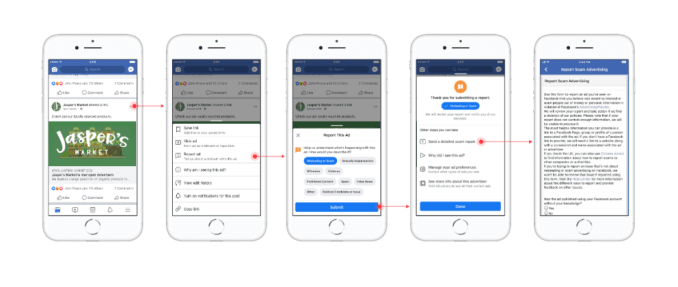
The feature can be accessed by clicking the three dots in the top right corner of each ad on Facebook, then selecting ‘Report ad’, then ‘Misleading or scam ad’ and finally: ‘Send a detailed scam report’.

So if you want to think of it as a reporting ‘button’ it’s a button that actually requires four presses to function as intended…

Flow of reporting mock up.png.rendition.992.992

Once a scam ad report has been filed, the feature will alert a dedicated internal ops team at Facebook that is tasked with handling reports — so will be reviewing reports and removing violating ads.

The new consumer safety feature follows a defamation lawsuit filed in April last year by consumer advice personality, Martin Lewis, who had become exasperated by the volume of scam ads misappropriating his image on social media to try to trick users into parting with their savings.

Earlier this year Lewis announced he was withdrawing his lawsuit after Facebook agreed to beef up its response to the problem by saying it would add the scam ad reporting feature — which is exclusive to the UK for now — and establish a local team to monitor ad trends for dubious activity.

Facebook also agreed to donate £3M worth of support in cash and Facebook ad credits to UK consumer advice charity, Citizens Advice, to fund the setting up of a Citizens Advice Scams Action (Casa) service — which has also launched today.

This service will provide specialist one-on-one help to those worried they’re being scammed or who have already lost money as a result of fake ads. It will also undertaken scam prevention work, including by raising awareness of online scams in the UK.

Writing in a blog post today on the money saving advice website he founded, Lewis confirms both the Facebook scam ad report tool and Casa have launched — the former some three months tardier than Facebook had suggested at their joint press conference in January.

As regards Casa, UK Internet users who think they have been, or are being, scammed online — either by ads or other methods — can now call the service on 0300 330 3003 for one-on-one help, or access http://www.citizensadvice.org.uk/scamsaction for more info or a web chat.

Face to face appointments will also be available in England, Wales and Scotland at local Citizens Advice bureaus. Lewis writes that the service is expected to help at least 20,000 people in the first year.

“These initiatives, which are available from today, are crucial, as scam ads can have devastating consequences,” he adds, noting that his own complaints to Facebook vis-a-vis scam ads bearing his image led to more than 1,000 ads being taken down.

“The adverts, placed by criminals, often use fake celebrity images or endorsements to dupe people into investing in fake ‘get rich quick’ schemes, buying diet pills and more.

“They can lead to many people being conned out of their cash – in the case below a man in his 80s lost almost £50,000 – and have a serious impact on people’s mental health and self-esteem.”

We’ve reached out to Facebook with questions, including whether it has plans to extend the scam ads reporting tool to other markets.

In a statement provided to Lewis, Steve Hatch, Facebook’s vice president for northern Europe, said: “Scam ads are an industry-wide problem caused by criminals and have no place on Facebook. Through our work with Martin Lewis, we’re taking a market leading position and our new reporting tool and dedicated team are important steps to stop the misuse of our platform.

“Prevention is also key. Our £3 million donation to Citizens Advice will not only help those who have been impacted by scammers, but raise awareness of how to avoid scams too. At a global level we’ve tripled the size of our safety and security team to 30,000 people and continue to invest heavily in removing bad content from our platform.”

Also commenting in a statement, Gillian Guy, chief executive of Citizens Advice, added: “We know online scams affect thousands of people every year. We’re pleased the agreement between Martin Lewis and Facebook meant we could set up this dedicated service to give more help to people who have fallen victim to online scams.

“This project means we can not only support people who have been targeted, but also raise awareness of what to look out for to help prevent online scams happening in the first place. Citizens Advice Scams Action will work alongside the free and impartial help we already offer to anyone who needs advice — whoever they are, whatever their problem.”

While celebrating the launch of Casa, Lewis’ blog post points out that the initial funding “won’t last for ever” — and he calls on other big online ad players to “follow Facebook’s lead, and put their hands in their pockets”.

At the press conference in January Lewis was especially critical of Google for being less responsive to the issue and for not having easy ways for users to report scam ads running on its networks.

We’ve reached out to Google for a response.

In another recent change to its ads platform, Facebook is also now providing users with more information about why they are seeing an ad — if they click through the menu to the option ‘why I am seeing this ad?’.

The company had been criticized for displaying only extremely general targeting criteria — making the feature appear more like a smokescreen than a genuine step towards ad targeting transparency. But last week Facebook said it was now showing “more detailed targeting, including the interests or categories that matched you with a specific ad”.

It also said it will be “clearer where that information came from (e.g. the website you may have visited or Page you may have liked)”. 

Facebook also announced updates to the Ad Preferences menu to provide its users with more information about businesses and third parties that upload lists containing their personal data, such as their email address or phone number, to Facebook to target them with ads — though limiting the data to a 90-day snapshot.

“This section aims to help you understand the third parties and businesses who have uploaded and shared lists with your information,” it wrote of the changes. “In this section, you’ll see the business that initially uploaded a list, along with any advertiser who used that list to serve you an ad within the last 90 days.”

Despite this, Facebook still does not let users deny advertiser uploads of their personal data to Facebook via Facebook itself.

In order to do that a Facebook user would have to contact each and every advertiser individually.

16 Jul 2019

N26 announces N26 You, a revamped premium account

Challenger bank N26 has unveiled a new premium plan called N26 You. This plan replaces N26 Black with the same benefits and a few tweaks.

N26 is keeping its three-tier system with a free basic bank account, a premium account (N26 You) and a super premium account (N26 Metal). With N26’s free plan, you can pay anywhere in the world without any foreign transaction fee, but there’s a 1.7% markup on ATM withdrawals in a foreign currency.

N26 You costs the same price as the previous premium plan N26 Black, €9.90 in the Eurozone and £4.90 in the U.K. In addition to a travel and purchase insurance package, you can withdraw money without any foreign transaction fee. €9.90 is roughly what you’d pay in fees if you withdraw the equivalent of €580 with a free N26 account.

You can also create up to 10 Spaces to organize your money with savings goals, separate sub-accounts and more — free accounts can only create two Spaces.

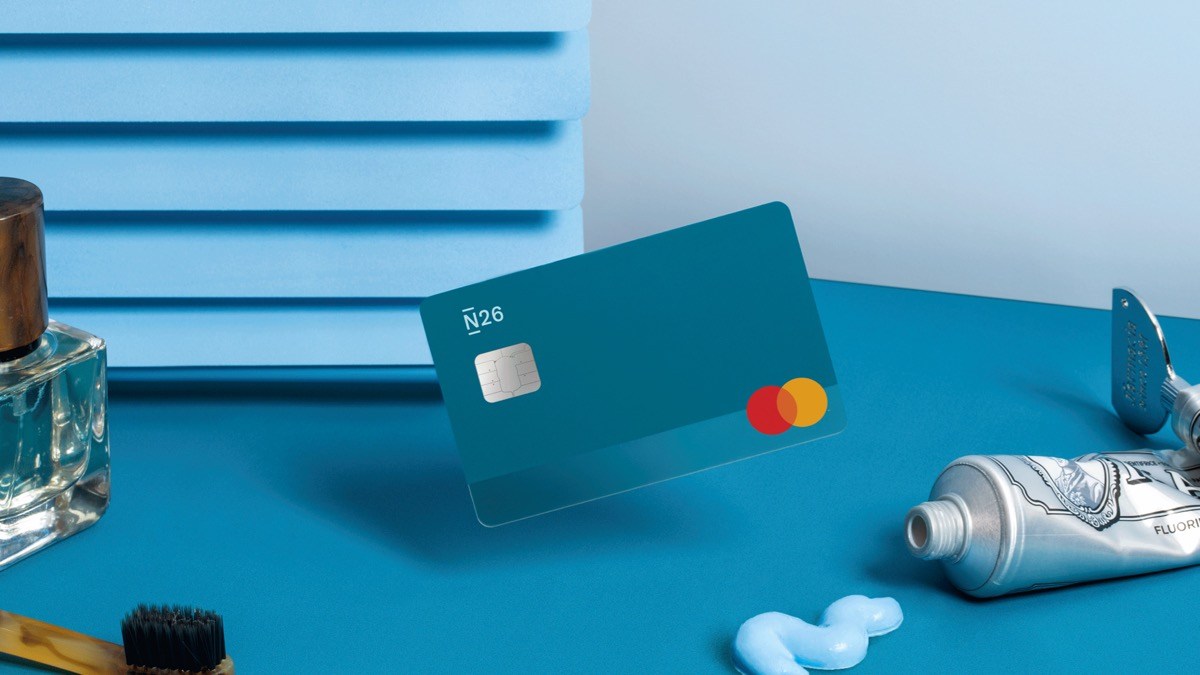
And of course, you get a better looking card. N26 is reusing its pastel color palette to give you more options. You can now choose between five different colors — Aqua, Rhubarb, Sand, Slate and Ocean. The card has a minimal design with a tiny N26 logo in the top left corner, a transparent line at the bottom of the card and a solid color background.

N26 also plans to add perks to the N26 You plan, such as discounts on Hotels.com, WeWork, GetYourGuide, Babbel, Blinkist and Bloom & Wild. Those perks were limited to N26 Metal customers in the past, so it’s going to be interesting to see how the lineup will work once those perks are added to N26 You. If you’re an existing N26 Black customer, you automatically become an N26 You customer.

Changing N26 Black to a premium plan with multiple card designs might seem like a small detail, but it potentially opens up a lot of possibilities. You’ll soon be able to order an additional card.

Eventually, you could imagine having a blue card associated with your main account and a yellow card associated with a shared Space sub-account for instance. At least, that’s what I hope the company will do.

ocean

16 Jul 2019

India’s budget hotel startup Oyo enters co-working business with $30 million Innov8 acquisition

India’s Oyo has expanded its hotel chain business to over 80 countries and entered co-living spaces segment in recent years. The firm, which has raised about $1 billion in the last two quarters from several big names including Airbnb, has now identified a new business to target: co-working spaces.

The Gurgaon-headquartered firm on Tuesday announced Oyo Workspaces that is already operational across 10 cities in India with over 20 centres. It already has the capacity to serve more than 15,000 people.

At a press conference in New Delhi, Rohit Kapoor, CEO of New Real Estate Businesses, said Oyo plans to have 50 Oyo Workspaces centres by the end of the year and aims to make it the largest co-working business in Asia by the end of next year.

As part of the announcement, Oyo confirmed that it has acquired Innov8, a co-working startup with over 200 employees and 16 operational centres. The four-year-old startup, which had raised about $4 million to date, was acquired for about $30 million, two sources familiar with the matter told TechCrunch.

IMG 20190716 115738

Innov8 is one of the three in-house brands that is part of Oyo Workspaces. The other two brands — Workflo and Powerstation — are aimed at people who are looking for more economical offering. A user could access one of these co-working spaces for as low as Rs 6,999 ($102) a month. Innov8 has been positioned as a premium option.

The co-working space market is worth about $390 million in India. Kapoor said Oyo believes it can not only become a market leader in the nation but also expand the size of the market itself.

Oyo Workspaces will offer a range of services such as a Wi-Fi connection, in-house kitchen, housekeeping, storage and parking spaces,across all of its centres. It is also offering users monthly monthly and quarterly passes — currently being offered at heavily discounted rates — to further lower the price points of its co-working spaces.

More to follow shortly…

16 Jul 2019

Amazon adds Hindi to the Alexa Skills Kit

Users of Amazon’s voice assistant will soon be able to talk to Alexa in Hindi. Amazon announced today that it has added a Hindi voice model to its Alexa Skills Kit for developers. Alexa developers can also update their existing published skills in India for Hindi.

Amazon first revealed that it would add fluent Hindi to Alexa last month during its re: MARS machine learning and artificial intelligence conference. Before, Alexa was only able to understand a few Hinglish (a portmanteau of Hindi and English) commands. Rohit Prasad, vice president and head scientist for Alexa, told Indian news agency IANS that adding Hindi to Alexa posed a “contextual, cultural as well as content-related challenge” because of the wide variety of dialects, accents and slang used in India.

Along with English, Hindi is one of India’s official languages (Google Voice Assistant also offers Hindi support). According to Citi Research, Amazon holds about a 30 percent market share, about the same as its main competitor, Walmart-backed Flipkart.

16 Jul 2019

Snap turns to search giant Baidu to court Chinese advertisers

Two years have passed since Snap Inc first struck a deal with Baidu that authorized China’s largest search engine to be a reseller of Snapchat ads for companies in Greater China as well as Japan and South Korea, where Baidu runs a portfolio of mobile apps.

This week, the pair announced they have renewed the sales partnership without revealing how revenues are divided between the two and when the extended agreement expires.

Despite being blocked in China like most other western social media services, Snap has shown interest in China in various capacities, including a research and development center in Shenzhen for Spectacles. It’s also serving the country’s game developers, e-commerce merchants and other export-led advertisers who wish to capture the network’s 190 million daily active users around the world.

Facebook and Twitter are in the same overseas ad business in China. Facebook, with an “experience center” in Shenzhen for clients to learn how its ads work, counted China as its second-largest ad spender in 2018, according to Pivotal Research Group. Twitter also holds an annual summit in China for small and medium enterprises going global.

None of the western social giants can go it alone in China, which is why Snap chose Baidu to be its local partner to not only overcome regulatory restrictions on foreign entities but also tap the latter for language support, account management and an extensive advertiser network.

Baidu also intended to resell Facebook ads but did not manage to get a license, a former Facebook employee who wishes to remain anonymous told TechCrunch. Instead, Facebook works with Cheetah Mobile, PapayaMobile and seven other advertising representatives in China.

Through the deal, companies that purchase media through Baidu gain access to all forms of ad slots in Snap’s videos, real-time selfie effects, overlays and more. The return can be satisfying. Besides the opportunity to capture a predominantly young user base, advertisers are reaching a sticky group who, on average, opens Snapchat over 20 times and spends over 30 minutes on the app every day.

“With its young, vibrant user base, Snap’s advertising platform has been instrumental in driving growth for our game AFK Arena,” said Chris Zhang, vice president of Shanghai-based Lilith Games, in a statement.

“Our partnership with Snap Inc. provides Chinese companies new avenues to expand their businesses through Snapchat advertising,” said Sheng Hu, head of U.S. strategy and partnership at Baidu’s Global Business Unit that operates a range of overseas products such as Japanese keyboard app Simeji. “We look forward to connecting with marketing executives in China and beyond on behalf of Snap to discuss the benefits of these advertising solutions.”

16 Jul 2019

Raisin picks up $28M backing from Goldman Sachs for its savings and investment marketplace

Raisin, the fintech startup that offers a pan-European marketplace for savings and investment products, has picked up additional funding. Goldman Sachs has invested $28 million (€25m), following the company’s $114 million in Series D in February.

The new capital will be used by Raisin to build out its U.S. presence ahead of a 2020 launch across the pond. The startup announced its U.S. plans in May, saying that it wanted to enable U.S. savers to more easily shop around for a better interest rate and remove the friction associated with switching savings and deposit accounts. The deposits market in the U.S. is said to be $12.7 trillion.

Raisin also plans to enter two new European markets by the end of this year. The Raisin marketplace currently has six country specific savings platforms: Germany, U.K., France, The Netherlands, Spain, and Austria, in addition to a generic site for 28 European countries.

Founded in 2012 by Dr. Tamaz Georgadze (CEO), Dr. Frank Freund (CFO) and Michael Stephan (COO), and launched the following year, Raisin says that to date it has brokered €14 billion for more than 185,000 customers across Europe.

The Raisin marketplace offers more than 480 savings products from 80 European partner banks via its “deposits-as-a-service”. The fintech also has distribution partnerships with N26, Commerzbank, 02 Banking of Telefónica Germany and Yolt among others, as it attempts to ride the marketplace banking trend.

Cue statement from Rana Yared, Managing Director, Goldman Sachs Principal Strategic Investments: “Raisin has developed a unique savings marketplace with a solid business model, impressive growth and a loyal customer base. We are excited to support the company’s outstanding management team in executing their vision”.

In addition to Goldman Sachs, Raisin’s backers include PayPal, Index Ventures, Ribbit Capital and Thrive Capital.

16 Jul 2019

Meredith Whittaker, AI researcher and an organizer of last year’s Google walkout, is leaving the company

Meredith Whittaker, founder of Google’s Open Research Group and one of the leaders of last year’s employee walkouts, is leaving the company. Google confirmed her departure to Bloomberg today after it was first disclosed on Twitter by a Google engineer.

Whittaker and another one of the walkout’s organizers, Claire Stapleton, said they had faced retaliation from Google after the protest. Other employees also claimed that they had experienced fallout as a result of their participation, which Google denied.

Thousands of employees around the world took part in the massive walkout last November to protest how Google handles sexual harassment and misconduct allegations. They asked the company to implement several measures against harassment and discrimination, including an end to forced arbitration, a publicly disclosed sexual harassment transparency report and a safe and anonymous process to report sexual misconduct.

The walkout came after a New York Times report that despite credible allegations of sexual misconduct against Android co-creator Andy Rubin, he had left Google with a $90 million payout package.

Over the past year, Google employees have also protested Project Dragonfly, the company’s censored search engine for China, and its contract with the Pentagon for the use of its AI tech to analyze drone videos. Google announced in June it would not renew the contract.

Whittaker, who is co-director of AI Now, an ethics committee affiliated with New York University, tweeted at the time that she was “incredibly happy about this decision, and have a deep respect for the many people who worked and risked to make it happen. Google should not be in the business of war.”

TechCrunch has contacted Whittaker and Google for comment.

16 Jul 2019

Meredith Whittaker, AI researcher and an organizer of last year’s Google walkout, is leaving the company

Meredith Whittaker, founder of Google’s Open Research Group and one of the leaders of last year’s employee walkouts, is leaving the company. Google confirmed her departure to Bloomberg today after it was first disclosed on Twitter by a Google engineer.

Whittaker and another one of the walkout’s organizers, Claire Stapleton, said they had faced retaliation from Google after the protest. Other employees also claimed that they had experienced fallout as a result of their participation, which Google denied.

Thousands of employees around the world took part in the massive walkout last November to protest how Google handles sexual harassment and misconduct allegations. They asked the company to implement several measures against harassment and discrimination, including an end to forced arbitration, a publicly disclosed sexual harassment transparency report and a safe and anonymous process to report sexual misconduct.

The walkout came after a New York Times report that despite credible allegations of sexual misconduct against Android co-creator Andy Rubin, he had left Google with a $90 million payout package.

Over the past year, Google employees have also protested Project Dragonfly, the company’s censored search engine for China, and its contract with the Pentagon for the use of its AI tech to analyze drone videos. Google announced in June it would not renew the contract.

Whittaker, who is co-director of AI Now, an ethics committee affiliated with New York University, tweeted at the time that she was “incredibly happy about this decision, and have a deep respect for the many people who worked and risked to make it happen. Google should not be in the business of war.”

TechCrunch has contacted Whittaker and Google for comment.