Year: 2019

15 Jul 2019

Pokémon GO battles will soon be less tappy, more Fruit Ninja-y

At the end of last year, Pokémon GO finally got a player-versus-player battling system. While it was a very much welcomed addition, it has always seemed a bit… monotonous. It just requires so… much… tapping.

You repeatedly tap the screen to make your Pokémon attack, simultaneously building up its “Charge” move with each tap. Once it’s time to unleash the charge, you tap a button on screen to fire off the move, then tap as fast as you can to make that move more powerful. Tap! Tap! Tap! Taptaptaptaptaptap. Repeat until the battle is over. It’s a great thumb workout, but it arguably wasn’t very much fun.

In a tweet this afternoon, Niantic announced that they’re changing things up. The core mechanics of the battle system will remain the same, but charge attacks will now be less about tapping quickly, and more about accurate swiping. Once you’ve fired off your charge move, you’ll swipe your finger across a trail of icons falling across your screen. The more you collect before time runs out, the more powerful your attack will be.

go battle small

You can see a quick demo of the new charge system in the video below beginning around 13 seconds in. (The first 13 seconds, meanwhile, demonstrate an overhauled appraisal system for helping you figure out your particular Pokémon’s unique stats):

These changes to battle mechanics are bound to be at least a little divisive because… well, they’re changes. Some people will love’m, some people will always prefer the old tap-tap-tap charge mechanics, and others will keep yelling that the game should just use the same turn-by-turn battle system found in the main Pokémon series.

At first glance, though, I like this new concept. It reminds me a bit of glyph hacking in Niantic’s first game, Ingress, or the spell casting mechanics in its most recent title, Harry Potter: Wizards Unite. Swiping up icons seems just a pinch more entertaining than furiously bashing at the screen, without really messing with the underlying battle mechanics. At the very least, my thumb appreciates the change.

15 Jul 2019

Curve, the ‘over-the-top’ banking platform, raises $55M at a $250M valuation

Curve, the London-based “over-the-top banking platform,” has raised $55 million in new funding. The startup lets you consolidate all of your bank cards into a single Curve card and app to make it easier to manage your spending and access other benefits.

Curve’s Series B round is led by Gauss Ventures, the U.S-based fintech investor, alongside Creditease, IDC Ventures, and previous backer Outward VC (formerly Investec’s INVC fund). A number of other early investors, including Santander InnoVentures, Breega, Seedcamp and Speedinvest, also followed on.

The new round of funding values Curve at $250 million (or one quarter unicorn, so to speak), and will be used by the company to continue adding more features to its platform and for further European expansion. The company claims 500,000 users and says it is on track to reach 1 million by the end of the year.

Curve is currently available in 31 countries across Europe, with around 30 percent of its customer base coming from outside the U.K. “We [have] identified a few countries where the organic pull is fantastic, and we are about to double down on them,” Curve founder and CEO Shachar Bialick tells me.

Like a plethora of fintech startups, Curve is building a platform that essentially turns your mobile phone into a financial control centre that re-bundles disparate financial products or functionality to offer a single app to help you manage “all things money”.

However, rather than building a new current account — as is the case with the challenger banks such as Monzo, Starling and Revolut — Curve’s “attack vector” is a card and app that lets you connect all of your other debit and credit cards (sans Amex) so you only ever have to carry a single card.

Once you’ve added your cards to Curve, you use the app to switch which underlying debit or credit cards you wish the Curve MasterCard to spend from, and can track and see a single and consolidated view of your spending regardless of which card was charged (and therefore which of your bank accounts the money was pulled from).

In other words, Curve isn’t asking to replace your existing bank accounts but is pitched as a cloud-based platform that runs “over-the-top” of existing banking and payments infrastructure. Historically, the over-the-top terminology has been used to describe the way video streaming services such as Netflix run “over-the-top” of existing broadband infrastructure.

“For Curve to succeed in its mission of bringing banking to the cloud, we need [to continue] to build the product; tiny experiences that together create a whole new offering,” Bialick continues. “Our money is everywhere and the job of connecting it all together to one seamless experience requires many resources, and especially many talented people. The latest Series B will enable Curve to re-bundle more of your money: experiences such as Curve Send (peer-to-peer payments), and Curve Credit (post transaction instalments for any payment, anywhere)”.

Curve Cash in App 1Alongside Curve’s all-your-cards-in-one functionality, the Curve app lets you lock your Curve card at a touch of a button, provides instant spend notifications, “zero FX fees” when spending abroad or in a foreign currency and the ability to switch payment sources retroactively. The latter is dubbed “Go Back in Time” and means if you make a purchase via Curve that gets charged to a card other than the one you intended, you have two weeks to change your mind.

More recently, Curve has re-vamped its cashback feature in a bid to draw in more customers for the premium versions of the Curve card. With the new Curve Cash programme, customers get 1% instant cashback on top of any existing rewards cards that they have plugged into the app, potentially earning customers double rewards on purchases. You simply pick from the list of retailers supported for cashback — you are allowed to choose between three and six retailers, depending on which Curve plan you are on — and then get 1% cashback for any purchases made at those stores.

Bialick claims that Curve’s over-the-top model is also producing higher engagement than many challenger banks, with customers spending on average £1,500 per month through the Curve platform. (As an imperfect reference point, challenger bank Monzo says that around 30% of its users top up their account by £1,000 or more per month). I’m also told that 15% of Curve’s users have added a challenger bank card to their Curve account, which also makes for an intriguing and even more nuanced comparison.

And whilst Curve is arguably trying to define a new market category — at least here in the West — and therefore isn’t the easiest of products to explain, Bialick says that existing Curve customers are the startup’s biggest advocates.

“There isn’t just one thing that pulls customers to Curve, there are as many pulls as [there are] the number of ‘money jobs’ one has. All your cards in one, fee free spending abroad, ‘Go Back In Time’, to name a few, all attract and retain our customer base. Indeed awareness and brand building is key, especially amongst all the noise, but that’s where our customers are proving invaluable, telling their friends about Curve, which drives most of our adoption with 2,000 plus new accounts per day”.

To win in this new category of banking, Bialick says the company needs to steadfastly stick to its mission to reduce the number of steps it takes to carry out everyday money-related tasks. “The winners will be the companies… [that] create the most seamless experience, removing as much friction between the customer and their money”.


15 Jul 2019

What to expect from tomorrow’s antitrust hearing featuring big tech

Tomorrow, representatives from Facebook, Google, Amazon and Apple will testify before Congress in the second hearing organized as part of the House Judiciary Committee’s antitrust investigation into the world’s largest technology companies.

While the first hearing focused on the ways technology companies busted the traditional news business, this one promises to look at the “impact of market power of online platforms on innovation and entrepreneurship,” according to the committee.

Unlike the previous hearing, which featured representatives from media outlets and industry trade organizations attacking or defending the ways in which online advertising had gutted the news business, this latest outing led by Rhode Island Democratic Rep. David Cicilline will have actual tech company execs on hand to answer congressional queries.

One section of the testimony will feature Google’s economic policy head, Adam Cohen; Amazon’s associate general counsel, Nate Sutton; Facebook’s global head of policy, Matt Perault; and Kyle Andeer, Apple’s chief compliance officer.

Others expected to appear include Tim Wu, the Columbia Law professor who’s been an outspoken critic of technology consolidation and an advocate for more stringent antitrust oversight of tech companies, and Maureen Ohlhausen, a partner at Baker Botts and the former acting chairman of the Federal Trade Commission in charge of its antitrust actions.

Wu and his views sort of encapsulate much of the thinking from critics of these companies’ current dominance in the market.

“I would love, in fact, if a serious Facebook challenger took down Facebook, and I would stop calling for any antitrust action. It’s just when you become suspicious that the barriers have gotten strong enough that a company could survive, then maybe we need to have antitrust law loosened up, get things moving, and provide for the market cycle to take its place. Now eventually it will happen, but we can’t wait for 50 years,” Wu told the American Enterprise Institute in an interview earlier this year.

“It’s also possible that history would suggest that a company like Facebook, and perhaps Amazon, will soon try to get government on their side to defend themselves against competition. I don’t know what it will look like, but maybe Facebook agrees to some kind of privacy law, which for some reason is very hard for new entrants to adhere to. Amazon may try and instantiate itself as basically the national e-commerce monopolist, kind of like a Bell-regulated monopoly. That’s a next natural step, especially as a big star, to become less competitive. And so before that happens, I think we give the antitrust law its turn.”

Policy watchers can expect market criticisms of the big technology platforms to come from a few different angles (each company has different, slightly overlapping, issues that policymakers find worrisome).

For Alphabet, criticism stems primarily from the company’s dominance in online search and the ad networks it controls through its ownership of DoubleClick and AdMob (along with its ownership of YouTube’s wildly popular video platform). At Amazon, it’s the ways in which Jeff Bezos’e-commerce behemoth hoovers up sales information  and uses it to inform pricing and potentially anticompetitive practices that stymie the development of new e-commerce players by promoting its own brands and products.

For Facebook, it’s the dominance of the company’s social media platforms (including Instagram and the messaging service WhatsApp) that are a cause for concern — as is its unwillingness to open its social graph for other startups. The company also elicits howls from consumer advocates for its abysmal ability to protect user privacy and data.

Finally, Apple’s control over the entire ecosystem it pitches to consumers — and the pricing policies it enforces that some critics have called extortive are cause for concern among the political class.

These competitive concerns also play out against the outsized ambitions that these technology companies have in other areas. Facebook is trying to make an end run around the existing global financial system through the launch of its Libra cryptocurrency; Alphabet, Amazon and Facebook all have designs to dominate the development of artificial intelligence in open markets; and then there’s the work these companies are conducting in areas as diverse as healthcare, mobility technologies and even space travel and high-speed networking.

With so many interests in so many areas and core businesses generating so much money, it’s easy to conflate a broader unease with these companies’ ambitions and the core anti-competitive arguments that are worthy of discussion.

For this hearing — and indeed the Congressional investigation to be successful — the focus should be less on the global ambitions of these technology companies and more on the practices they’ve enacted to stifle competition.

15 Jul 2019

Facebook snags former Vine GM to run product for its new experimental app division, NPE Team

Is Facebook preparing to launch a serious competitor to TikTok? If so, the company just picked up some key talent to make that happen. Last week, Facebook announced plans for a new division, called the NPE Team, which will build experimental consumer-focused apps where it will try different ideas and features, then see how people react. Now, Facebook has picked up former Vine GM Jason Toff to join the NPE team as a Product Management Director.

Toff’s experience also includes time spent at Google, most notably as a Product Lead for YouTube before exiting to Vine in 2014. At the short-form video app maker, Toff worked as Head of Product for a year, then became Vine’s General Manager.

Vine, of course, was later snatched up by Twitter — and there, Toff moved up to Director of Product Management before boomeranging back to Google, where his initial focus was on AR and VR projects.

Most recently, Toff worked as a Partner at Google’s Area 120, Google’s in-house incubator where employees work on experimental projects.

That’s not all that different from what Facebook appears to have in store with its own NPE Team ambitions. Similar to Area 120 or Microsoft Garage, for example, the NPE Team plans to deliver apps that will “change very rapidly” in response to consumer feedback. It will also be quick to close down experiments that aren’t useful to people in fairly short order.

That’s not how Facebook itself operates. Its more experimental apps have had longer runs, as the company used them to gain feedback to inform its larger projects. For example, its photo-sharing app Moments ran from 2015 through early 2019, and its TrueCaller-like app Hello for emerging markets ran for several years, despite fairly limited adoption.

Facebook has also tried and failed with a number of other offshoots over the past decade, like Facebook Paper, Notify, a Snapchat clone called Lifestage, and others, as well as those it picked up through acquisitions, then later shut down like tbh or Moves. It also previously ran an internal incubator of sorts called Facebook Creative Labs, which birthed now-failed projects like Slingshot, Riff, and Rooms.

Many of these efforts were fairly high-profile at launch, which made their eventual shut down more problematic for Facebook’s image. With NPE Team — as with Area 120 or Microsoft Garage — there’s a layer of separation between the test apps and the larger company. Many of the apps that the NPE Team puts out will bomb, and that’s the point — it wants to get the failures out of the way faster so others can find success.

While Toff can’t yet say what he’ll be working on at Facebook, there’s a lot of speculation that NPE Team will try to come up with some sort of answer to TikTok, the Beijing-based short-form video app that sucked up Musical.ly in 2018 and now is a Gen Z social networking hit with some 500 million-plus monthly users. Toff’s background with Vine could certainly be helpful if that were the case.

Facebook, of course, already tried to get a TikTok clone off the ground with Lasso, but the experiment didn’t take off and the app lead, Brady Voss, left Facebook soon after its launch. It

Toff says he’s hiring for NPE Team, including both UX designers and engineers.

15 Jul 2019

SpaceX and NASA detail cause of Dragon test failure, crewed flight this year looks ‘increasingly difficult’

SpaceX held a press conference on Monday to discuss the results of a months-long investigation conducted by itself and NASA into an anomaly that took place during a static fire test in April. The investigation found that the “anomaly” which occurred during the test was the result of oxidizer mixing at very high pressure with the helium component of the SuperDraco rocket engine propellant system.

On April 20, SpaceX held an abort engine test for a prototype of its Crew Dragon vehicle (which had been flow previously for the uncrewed ISS mission). Crew Dragon designed to be the first crew-carrying SpaceX spacecraft, and is underling a number of test to prove its flight-readiness to NASA. The test encountered a failure that was instantly visible after the first few tests proved successful, with an unexpected explosion that produced a plume of fire visible for miles around the testing site at its Landing Zone 1 facility in Cape Canaveral, Florida.

SpaceX BP of Build & Flight Reliability Hans Koenigsmann and NASA Commercial Crew Program Manager Kathy Lueders took members of the media through the results of their joint investigation into the cause of this anomaly. Koenigsmann explained that thanks to identifying burn marks around a check valve in the system that’s meant to separate the oxidizer and fuel components under pressure. These check valves contain a spring which can be opened and allow flow in the direction you want the propellant components to go, but in this case a ‘leaky’ check valve resulted in a ‘slug’ composed of high pressure oxidizer striking a titanium component that resulted in a very violent reaction, hence the explosion.

Both Lueders and Koenigsmann noted that it was in many ways “a gift” that this happened during a ground test, because it mean that there were many high-speed cameras that could capture the incident, and it was relatively easy to comb the site and recover components to best figure out the cause of the anomaly. Koenigsmann also noted that while the team is confident in sharing these results, they are actually only approximately 80 percent the investigation and there is about 20 percent left to do in terms of figuring out additional details, mostly around the physics involved.

Koenigsmann said that SpaceX is already implementing a crucial hardware fix for this, which is to replace the check valve with a burst valve. A burst valve completely separates the oxidizer and fuel from any pressurization liquid, which will mitigate this issue and definitely “make Crew Dragon a safer vehicle,” he said.

So far this year, SpaceX has succeeded in launching an uncrewed version of its Crew Dragon 2 spacecraft to the ISS during a mission in March, and had planned to run the first crewed test mission this July, with a mission duration of two weeks. That definitely won’t occur on that timeline, and now ongoing production of Crew Dragon craft will bump back the designated machines one generation, meaning the intended Crew Dragon 1 craft meant for crewed mission flight is now Test 2, and so on.

Asked repeatedly about timeliness, neither Koenigsmann nor Lueders would offer anything concrete, but both expressed some skepticism about managing a launch by end of year, without dismissing the possibility outright.

“There’s always the chance that we’re gonna fly crew on a SpaceX vehicle this year,” Lueders said, but continued that “right now” NASA is paying attention to all the ongoing testing of various systems and “all those things need to occur before we’re gonna be confident that the system can safely fly our crew.” “I hope it’s this year,” she added.

Koenigsmann noted that this is an issue he’s fairly confident can be addressed in parallel with other things that need to be addressed with Crew Dragon before crewed flight. “I don’t think it’s impossible but it’s getting increasingly difficult, too,” he said, however, when asked directly about a crewed Dragon launch occurring before the end of 2019.

Lueders ended by expression appreciation for SapceX’s openness with NASA and its astronauts throughout this process, and Koenigsmann reinforced the superiority of the burst valve vs. the check valve it’s replacing for this application.

15 Jul 2019

Computing pioneer and LGBT icon Alan Turing will grace the £50 note in 2021

Alan Turing, one of the pioneering figures in modern computing, and also a tragic one in LGBT history, will soon appear on the U.K.’s £50 note. He was selected from a shortlist of scientists and bright minds so distinguished that it must have made the decision rather difficult.

The nomination process for who would appear on the new note was open to the public, with the limitation this time that those nominated were British scientists of some form or another. Hundreds of thousands of votes and nearly a thousand names were submitted, and ultimately the list was winnowed down to the following dozen (well, 14, with two pairs; descriptions taken from the Bank of England’s summary):

  • Mary Anning (1799-1847) – a self-taught palaeontologist known around the world for the fossil discoveries she made in her hometown of Lyme Regis.
  • Paul Adrien Maurice Dirac (1902-1984) – whose research revolutionised our understanding of the universe’s smallest matter.
  • Rosalind Franklin (1920-1958) – who drove the discovery of DNA’s structure, a critical breakthrough in our understanding of the biology of life.
  • Stephen Hawking (1942-2018) – who made outstanding contributions to our understanding of gravity, space and time.
  • William (1738-1822) and Caroline Herschel (1750-1848) – a brother and sister astronomy team devoted to uncovering the secrets of the universe.
  • Dorothy Crowfoot Hodgkin (1910-1994) – whose research using x-ray crystallography delivered ground-breaking discoveries which shaped modern science and helped save lives.
  • Ada Lovelace (1815-1852) and Charles Babbage (1791-1871) – visionaries who imagined the computer age.
  • James Clerk Maxwell (1831-1879) – who made discoveries which laid the foundations for technological innovations which have transformed our way of life.
  • Srinivasa Ramanujan (1887-1920) – whose incredible talent for numbers helped transform modern mathematics.
  • Ernest Rutherford (1871-1937) – who uncovered the properties of radiation, revealed the secrets of the atom and laid the foundations for nuclear physics.
  • Frederick Sanger (1918-2013) – whose pioneering research laid the foundations for our understanding of genetics.
  • Alan Turing (1912-1954) – whose work on early computers, code-breaking achievements and visionary ideas about machine intelligence made him one of the most influential thinkers of the 20th century

Some of the best intellectual company conceivable, to be quite honest. Each of these people was enormously influential in their respective field, although as usual some didn’t get the credit they deserved while living.

Turing was of course an example of this. His work on codebreaking during World War II (alongside his many colleagues at Bletchley Park and beyond, naturally) contributed hugely to the Allied war effort by allowing them to secretly read Axis communications thought to be rendered unreadable by the ingenious Enigma system.

Part of that work, and Turing’s papers on general computing theory written at the time, laid the foundation for many of the concepts that underpin computational systems today. The modern computer is a collaboration among many people in many countries over several decades, but Turing was among the vanguard in theory and execution.

Unfortunately, not only was much of his work required to be kept secret for decades afterwards, limiting the knowledge of his accomplishments to a select few, but after the war he was later persecuted by the British government for being a gay man.

Charged with indecent acts, he was subjected to mandatory chemical “treatment” for his sexuality: humiliating and unjust compensation for a man who saved thousands, perhaps millions, of lives and helped create the defining technology of the 20th century in the process. He was found dead in his apartment, having apparently committed suicide, on June 7, 1954.

He was officially pardoned in 2014 after years of consideration and outcry, especially following both the increasing visibility and action of LGBTQIA figures in the present/, and a resurgence of interest in Turing and his collaborators’ contributions to the history of computing and the war effort.

Even with such an extraordinary story, it must have been difficult to pick Turing out from the crowd of luminaries nominated alongside him. You can check out some of the people and thought behind the decision in this video put out by the Bank of England:

The note itself isn’t finalized, but it will resemble the top image. It uses the most famous image of Turing, and will feature notes from his papers and notebooks, a picture of the Automatic Computing Engine (an early digital computer), a quote and signature, and more. Should be a handsome little bill. You’ll see it in circulation starting in 2021.

15 Jul 2019

Why commerce companies are the advertising players to watch in a privacy-centric world

The unchecked digital land grab for consumers’ personal data that has been going on for more than a decade is coming to an end, and the dominoes have begun to fall when it comes to the regulation of consumer privacy and data security.

We’re witnessing the beginning of a sweeping upheaval in how companies are allowed to obtain, process, manage, use and sell consumer data, and the implications for the digital ad competitive landscape are massive.

On the backdrop of evolving privacy expectations and requirements, we’re seeing the rise of a new class of digital advertising player: consumer-facing apps and commerce platforms. These commerce companies are emerging as the most likely beneficiaries of this new regulatory privacy landscape — and we’re not just talking about e-commerce giants like Amazon.

Traditional commerce companies like eBay, Target and Walmart have publicly spoken about advertising as a major focus area for growth, but even companies like Starbucks and Uber have an edge in consumer data consent and, thus, an edge over incumbent media players in the fight for ad revenues.

Tectonic regulatory shifts

GettyImages 912948496

Image via Getty Images / alashi

By now, most executives, investors and entrepreneurs are aware of the growing acronym soup of privacy regulation, the two most prominent ingredients being the GDPR (General Data Protection Regulation) and the CCPA (California Consumer Privacy Act).

15 Jul 2019

UK-based women’s networking and private club, Allbright, raises $18.8 million as it expands into the

AllBright, the London-based women’s membership club backed by private real estate investment firm Cain International, has raised $18.8 million to expand into the U.S.

The company’s new round was led by Cain International and was designed to take AllBright into three U.S. locations — Los Angeles, New York, and Washington.

The company said that the new facilities would be opening in the coming months.

Coupled with the launch of a new networking application called AllBright Connect and the company’s AllBright Magazine, the women’s networking organization is on a full-on media blitz.

Other investors in the round include Allan Leighton, who serves as the company’s non-executive chairman; Gail Mandel, who acquired Love Home Swap (a company founded by AllBright’s co-founder Debbie Wosskow); Stephanie Daily Smith, a former finance director to Hillary Clinton; and Darren Throop the founder, president and chief executive of Entertainment One.

A spokesperson for the company said that the new financing would value the company at roughly $100 million.

The club’s current members include actors, members of the House of Lords, and other fancy pants, high-falutin folks from the worlds of politics, business, and entertainment.

The club’s first American location will be in West Hollywood, and is slated to open in September 2019. The largest club, in Mayfair has five floors boasts over 12,000 square feet and features rooftop terraces, a dedicated space for coaching and mentoring a small restaurant and bar.

15 Jul 2019

Paige details first AI pathology tech with clinical-grade accuracy in new research paper

Medical tech and computational pathology startup Paige has published a new article in the peer-reviewed medical journal Nature Medicine, detailing its artificial intelligence-based detection system for identifying prostate cancer, skin cancer and breast cancer, which the company says achieves “near-perfect accuracy.” Paige’s tech, which employs deep learning trained on a dataset of almost 45,000 slide images taken from over 15,000 patients spanning 44 countries, is novel in that it can eschew the need to curate data sets for training first, which greatly decreases cost and time required to build accurate AI-based diagnostic tools.

Last February, Paige announced $25 million in Series A funding, and a partnership with Memorial Sloan Kettering Center (MSK) to gain access to one of the largest single repositories of pathology slides in the world. MSK is also home to the lab of Dr. Thomas Fuchs, Paige’s co-founder and Chief Scientific Officer, and possibly the world’s foremost authority in computational pathology.

Paige’s approach uses much larger data sets than are typically employed in AI-based diagnostics, but without the tight curation that focuses other efforts much more narrowly on specific types of cancer diagnostics. The result, according to the company, is not only better performance, but also a resulting system that its much more generally applicable.

Next up for Paige is to commercialize its technology, which is something it’s already pursuing. The work described in the article published in Nature Medicine has already been employed in technology currently under review by the FDA, albeit for a different final application than the ones described in the study published by the magazine.


15 Jul 2019

Dish’s AirTV launches an $80 streaming stick for accessing Sling TV, Netflix & broadcast channels

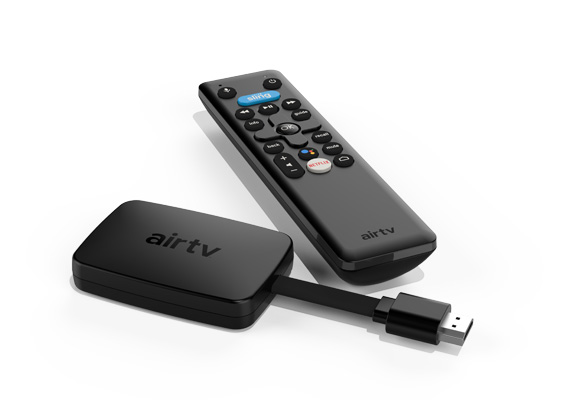
Dish is expanding its hardware lineup today with the launch of a new 4K streaming stick, the AirTV Mini, designed to make it easier for cord cutters to access its live TV service Sling TV, plus Netflix and over-the-air channels from one user interface. The Android TV-powered device is meant to complement an existing setup that already includes an OTA digital antenna and an AirTV WiFi-enabled network tuner, the company says.

For a limited time, new and existing Sling TV customers can get the latter two items for free — an AirTV Wi-Fi-enabled network tuner and an indoor antenna — by prepaying for 3 months of Sling TV’s service.

In addition, the AirTV Mini also includes support for 2×2 802.11AC Wi-Fi, a lost remote finder feature, support for Google Assistant and Google Play, as well as support for VP94K decoding, which allows you to watch YouTube or Netflix content in 4K.

airtv mini

The company has been offering streaming devices for a couple of years. Dish first unveiled its AirTV Player, a 4K media streamer set-top box, at CES 2017. In 2018, it expanded its hardware lineup again to include a new device just called the AirTV,

This year, it expanded its hardware lineup to include a new device, just called the AirTV, a networked TV tuner that streams local programming via Wi-Fi.

Despite the new AirTV Mini’s streaming stick form factor, it’s not meant to compete with rival streaming sticks like the low-cost Amazon Fire TV Stick, Roku streaming stick or Chromecast in terms of price. Instead, it’s a $79.99 alternative to the $119.99 AirTV Player bundle — perhaps for someone who doesn’t care for the sort of Playskool-inspired design of the original streaming box, but still wants over-the-air channels, 4K support, and easy access to Sling TV and Netflix.

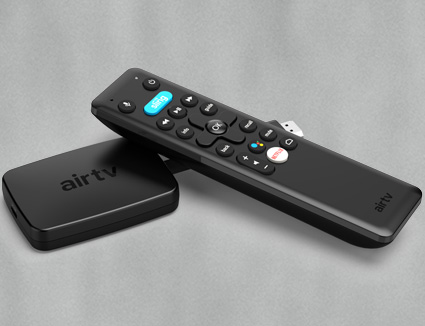
The remote for the Mini is improved as well, in a more typical shade of black instead of the AirTV Player’s white and blue design. It’s also a more standard length and width than the stubby and seemingly childish AirTV Player remote. And it still has dedicated buttons for Sling TV, Netflix, and Google Assistant.

row1 img large 2

Through the remote, users can issue voice commands to control their TV experience. For example, you can use voice search to find favorite shows and movies, or say things like “go to guide,” “show me my DVR” or “rewind 10 seconds.”

“The AirTV brand is committed to making local TV relevant and easily accessible to streamers,” said Mitch Weinraub, director of product development for AirTV, in a statement. “The AirTV Mini is a powerhouse streaming stick with more memory and a faster processor than anything else in the category. When combined with the AirTV network tuner and the Sling TV app, the Mini delivers a superior streaming experience, especially for Slingers who want premium features in a small package at an affordable price.”

The audience for this sort of product — or any AirTV device, for that matter — is fairly niche. While there’s certainly some demand for access to over-the-air programming among cord cutters, there are other solutions that don’t lock you into Sling TV, specifically.

For instance, you can easily switch to your connected antenna from a Roku TV or you could buy the (currently $179.99) Fire TV Recast, which offers a Fire TV interface plus access to stream and record from live TV with its built-in DVR. Neither the AirTV Mini nor the AirTV tuner come bundled with a DVR — you have to provide your own, and plug it into the tuner.

Overall, the solution makes sense for DIY’ers who also subscribe to Sling TV and prefer a Google Assistant-powered experience instead of Alexa.