Year: 2019

11 Jul 2019

Microsoft’s $399 Azure Kinect AI camera is now shipping in the U.S. and China

Earlier this year, at MWC, Microsoft announced the return of its Kinect sensor in the form of an AI developer kit. The $399 Azure Kinect DK camera system includes a 1MP depth camera, 360-degree microphone, 12MP RGB camera and an orientation sensor, all in a relatively small package. The kit has been available for pre-order for a few months now, but as the company announced today, it’s now generally available and shipping to pre-order customers in the U.S. and China.

Unlike the original Kinect, which launched as an Xbox gaming accessory that never quite caught on, the Azure Kinect is all business. It’s meant to give developers a platform to experiment with AI tools and plug into Azure’s ecosystem of machine learning services (though using Azure is not mandatory).

To help developers get started, the company already launched a number of SDKs, including a preview of a body-tracking SDK that is close to what you may remember from the Kinect’s Xbox days.

kinect developers

The core of the camera has more to do with Microsoft’s HoloLens than the original Kinect. As the company notes in its press materials, the Azure Kinect DK users the same time-of-flight sensor the company developed for the second generation of its HoloLens AR visor. And while the focus here is clearly on using the camera, Microsoft also notes that the microphone array also allows developers to build sophisticated speech solutions.

The company is positioning the device as an easy gateway for its users in health and life sciences, retail, logistics and robotics to start experimenting with using depth sensing and machine learning. We’ve seen somewhat similar dev kits from others, including Microsoft partner Qualcomm, though these devices don’t usually have the depth camera that makes the Kinect DK a Kinect.

11 Jul 2019

Microsoft says Teams now has 13M daily active users

Teams, Microsoft’s two-year-old Slack competitor, is the company’s fastest-growing application in its history. That’s something Microsoft has said in the past, but for the first time, Microsoft today also announced actual user numbers for the service ahead of its Inspire partner conference next week. Teams now has 13 million active daily users, Microsoft said, and 19 million weekly active users. Microsoft also today said that Teams is now in use by 91 of the Fortune 100 companies.

The company isn’t afraid of putting those numbers up against Slack, which IPOed only a few weeks ago. Jared Spataro, Microsoft Corporate VP for Microsoft 365, doesn’t mention Slack by name in his blog post, but the company put together a little graphic that clearly shows why it is now willing to share these numbers.

The last official number from Slack is that it had 10 million daily active users in January. Without updates numbers from Slack, it’s hard to say if Teams now has more users, but unless Slack’s growth accelerated in recent months, that’s probably the case.

2019 07 11 1047In addition to disclosing these numbers, Microsoft also announced a number of updates to Teams that range from features like priority notifications, which take the annoyance of chat notifications to a new level by pinging you every two minutes until you respond, to read receipts, new moderation and cross-posting options for Teams channels and a time clock feature that lets employees clock in and out of work shifts right from the Teams mobile apps.

Since Inspire is an event for Microsoft partners, it doesn’t come as a surprise that Microsoft is also launching a few new Teams features that involve its resellers and other partners. These include the ability to integrate teams with compliance recording partners like ASC, NICE and Verint Verba, as well as a contact center solution in partnership with Five9, Nice InContact and others. The most important of these announcements, though, is surely the fact that Microsoft is launching a new partner-led Teams trial (PDF) that will enable Microsoft 365 partners to offer their customers that are on the Exchange-only or Office 365 Business plan a free six-month trial of Teams. This will surely bolster Microsoft’s user numbers for Teams in the coming months, too.

11 Jul 2019

Cannabis processing startups hope to unlock new chemicals and treatments

Jeff Ubersax knows yeast.

The chief executive officer of Demetrix studied yeast genetics and biochemistry in school and was an early employee at Amyris Biotechnologies, a technology company that was using fermentation to make biofuels back in the early days of the first clean technology boom back in 2008. 

Now, the same technology that Ubersax and Jay Keasling, the celebrated professor from the University of California at Berkeley who co-founded Amyris and Demetrix, used to make biofuels is being applied to the production of cannabis.

The company launched with an $11 million seed round led by Horizons Ventures, a Hong Kong-based investment fund backed by the multi-billionaire real estate mogul Li Ka-shing, to begin commercializing the technology that Keasling had been researching in his lab.

The goal was to refine a process that would enable yeasts to make a range of cannabinoids that are found in the marijuana plant which could be used to develop new pharmaceuticals, additives and supplements for use in clinical and consumer applications. The technology works much the same way as brewing beer. Except instead of fermenting to produce alcohol, the fermentation process produces cannabinoids from genetically modified yeast cells.

While the technology holds promise, it’s still got a long way to go before it becomes competitive with extracts from the marijuana plant, but given new capital infusions the tide is turning.

Demetrix, for instance, has raised another $50 million from Horizons Ventures and Tuatara Capital, an investment firm focused on the legal cannabis industry, to significantly expand its production while simultaneously pursuing initial tests on the efficacy of rare strains of cannabinoids as treatments for certain illnesses.

“Natural cannabinoids have been used for a really long time,” says Ubersax. And last June the U.S. Food and Drug Administration approved the first pharmaceutical derived from cannabis, Epidiolex, as a treatment for patients with epilepsy.

11 Jul 2019

New Google Area 120 project Shoelace aims to connect people around shared interests

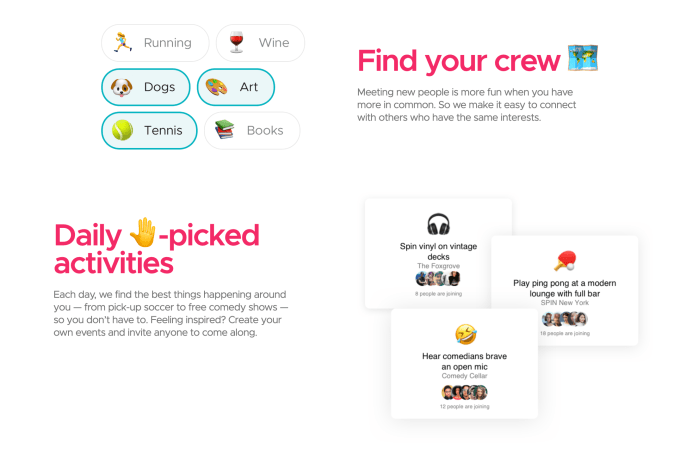
A new project from Google’s in-house incubator, Area 120, aims to help people find things to do and others who share your same interests. Through a new app called Shoelace — a name designed to make you think of tying things together — users can browse through a set of hand-picked activities, or add their own to a map. For example, someone who wanted to connect with fellow dog owners could start an activity for a doggie playdate at the park, then start a group chat to coordinate the details and make new friends.

The end result feels a bit like a mashup of Facebook Events with a WhatsApp group chat, perhaps. But it’s wrapped in a clean, modern design that appeals more to the millennial or Gen Z user.

Like Meetup and others in the space, Shoelace’s focus is not on building yet another social networking app, but rather on leveraging a social app to inspire real-world connections.

This is not a novel idea. In fact, startups many times over have tried to create an alternative to Facebook by offering tools to connect users around locations or shared interests, instead of only re-creating users’ established friend networks online. And many cities today have their own social clubs designed to help people make new friends and participate in fun, local activities.

Screen Shot 2019 07 11 at 2.06.41 PM

Shoelace is still in invite-only testing and only offered in New York City, for the time being.

However, its website says that the long-term goal is to bring the app to cities nationwide after the team learns what does and does not work. There’s also a form that will allow you to request Shoelace in your own community.

Google has had a rocky history when it comes to social networking products. Its largest effort to date, Google+, finally wound down its consumer business in April. That said, Shoelace is not really a “Google” product — it’s a project built by Googlers as a part of the Area 120 incubator, where employees can experiment with new ideas full-time without having to leave the company.

“One of the many projects that we’re working on within Area 120 is Shoelace, an app that helps people meet others with similar interests in person through curated activities,” a Google spokesperson confirmed to TechCrunch. “Like other projects within Area 120, it’s an early experiment so there aren’t many details to share right now,” they said.

The app is live on Google Play and iOS (TestFlight) for those who have received an invite.

11 Jul 2019

Google is investigating the source of voice data leak, plans to update its privacy policies

Google has responded to a report this week from Belgian public broadcaster VRT NWS, which revealed that contractors were given access to Google Assistant voice recordings, including those which contained sensitive information — like addresses, conversations between parents and children, business calls, and others containing all sorts of private information. As a result of the report, Google says it’s now preparing to investigate and take action against the contractor who leaked this information to the news outlet.

The company, by way of a blog post, explained that it partners with language experts around the world who review and transcribe a “small set of queries” to help Google better understand various languages.

Only around 0.2 percent of all audio snippets are reviewed by language experts, and these snippets are not associated with Google accounts during the review process, the company says. Other background conversations or noises are not supposed to be transcribed.

The leaker had listened to over 1,000 recordings, and found 153 were accidental in nature — meaning, it was clear the user hadn’t intended to ask for Google’s help. In addition, the report found that determining a user’s identity was often possible because the recordings themselves would reveal personal details. Some of the recordings contained highly sensitive information, like “bedroom conversations,” medical inquiries, or people in what appeared to be domestic violence situations, to name a few.

Google defended the transcription process as being a necessary part of providing voice assistant technologies to its international users.

But instead of focusing on its lack of transparency with consumers over who’s really listening to their voice data, Google says it’s going after the leaker themselves.

“[Transcription] is a critical part of the process of building speech technology, and is necessary to creating products like the Google Assistant,” writes David Monsees, Product Manager for Search at Google, in the blog post. “We just learned that one of these language reviewers has violated our data security policies by leaking confidential Dutch audio data. Our Security and Privacy Response teams have been activated on this issue, are investigating, and we will take action. We are conducting a full review of our safeguards in this space to prevent misconduct like this from happening again,” he said.

As voice assistant devices are becoming a more common part of consumers’ everyday lives, there’s increased scrutiny on how tech companies are handline the voice recordings, who’s listening on the other end, what records are being stored, and for how long, among other things.

This is not an issue that only Google is facing.

Earlier this month, Amazon responded to a U.S. senator’s inquiry over how it was handling consumers’ voice records. The inquiry had followed a CNET investigation which discovered Alexa recordings were kept unless manually deleted by users, and that some voice transcripts were never deleted. In addition, a Bloomberg report recently found that Amazon workers and contractors during the review process had access to the recordings, as well as an account number, the user’s first name, and the device’s serial number.

Further, a coalition of consumer privacy groups recently lodged a complaint with the U.S. Federal Trade Commission which claims Amazon Alexa is violating the U.S. Children’s Online Privacy Protection Act (COPPA) by failing to obtain proper consent over the company’s use of the kids’ data.

Neither Amazon nor Google have gone out of their way to alert consumers as to how the voice recordings are being used.

As Wired notes, the Google Home privacy policy doesn’t disclose that Google is using contract labor to review or transcribe audio recordings. The policy also says that data only leaves the device when the wake word is detected. But these leaked recordings indicate that’s clearly not true — the devices accidentally record voice data at times.

The issues around the lack of disclosure and transparency could be yet another signal to U.S. regulators that tech companies aren’t able to make responsible decisions on their own when it comes to consumer data privacy.

The timing of the news isn’t great for Google. According to reports, the U.S. Department of Justice is preparing for a possible antitrust investigation of Google’s business practices, and is watching the company’s behavior closely. Given this increased scrutiny, one would think Google would be going over its privacy policies with a fine-toothed comb — especially in areas that are newly coming under fire, like policies around consumers’ voice data — to ensure that consumers understand how their data is being stored, shared, and used.

Google also notes today that people do have a way to opt-out of having their audio data stored. Users can either turn off audio data storage entirely, or choose to have the data auto-delete every 3 months or every 18 months.

The company also says it will work to better explain how this voice data is used going forward.

“We’re always working to improve how we explain our settings and privacy practices to people, and will be reviewing opportunities to further clarify how data is used to improve speech technology,” said Monsees.


11 Jul 2019

How Roblox avoided the gaming graveyard and grew into a $2.5B company

There are successful companies that grow fast and garner tons of press. Then there’s Roblox, a company which took at least a decade to hit its stride and has, relative to its current level of success, barely gotten any recognition or attention.

Why has Roblox’s story gone mostly untold? One reason is that it emerged from a whole generation of gaming portals and platforms. Some, like King.com, got lucky or pivoted their business. Others by and large failed.

Once companies like Facebook, Apple and Google got to the gaming scene, it just looked like a bad idea to try to build your own platform — and thus not worth talking about. Added to that, founder and CEO Dave Baszucki seems uninterested in press.

But overall, the problem has been that Roblox just seemed like an insignificant story for many, many years. The company had millions of users, sure. So did any number of popular games. In its early days, Roblox even looked like Minecraft, a game that was released long after Roblox went live, but that grew much, much faster.

Yet here we are today: Roblox now claims that half of all American children aged 9-12 are on its platform. It has jumped to 90 million monthly unique users and is poised to go international, potentially multiplying that number. And it’s unique. Essentially all other distribution services offering games through a portal have eventually fizzled, aside from some distant cousins like Steam.

This is the story of how Roblox not only survived, but built a thriving platform.

Seeds of an idea

GettyImages 1027412388

(Photo by Steve Jennings/Getty Images for TechCrunch)

Before Roblox, there was Knowledge Revolution, a company that made teaching software. While designed to allow students to simulate physics experiments, perhaps predictably, they also treated it like a game.

“The fun seemed to be in building your own experiment,” says Baszucki. “When people were playing it and we went into schools and labs, they were all making car crashes and buildings fall down, making really funny stuff.” Provided with a sandbox, kids didn’t just make dry experiments about mass or velocity — they made games, or experiences they could show off to friends for a laugh.

Knowledge Revolution was founded in 1989, by Dave Baszucki and his brother Greg (who didn’t later co-found Roblox, but is now on its board). Nearly a decade later, it was acquired for $20 million by MSC Software, which made professional simulation tools. Dave continued there for another four years before leaving to become an angel investor.

Baszucki put money into Friendster, a company that pre-dated Facebook and MySpace in the social networking category. That investment seeded another piece of the idea for Roblox. Taken together, the legacy of Knowledge Revolution and Friendster were the two key components undergirding Roblox: a physics sandbox with strong creation tools, and a social graph.

Baszucki himself is a third piece of the puzzle. Part of an older set of entrepreneurs, which might be called the Steve Jobs generation, Baszucki’s archetype seems closer to Mr. Rogers than Jobs himself: unfailingly polite and enthusiastic, never claiming superior insight, and preferring to pass credit for his accomplishments on to others. In conversation, he shows interests both central and tangential to Roblox, like virtual environments, games, education, digital identity and the future of tech. Somewhere in this heady mix, the idea of Roblox came about.

The first release

11 Jul 2019

Andrew Ng to talk about how AI will transform business at TC Sessions: Enterprise

When it comes to applying AI to the world around us, Andrew Ng has few if any peers. We are delighted to announce that the renowned founder, investor, AI expert and Stanford professor will join us on stage at the TechCrunch Sessions: Enterprise show on Sept. 5 at the Yerba Buena Center in San Francisco. 

AI promises to transform the $500 billion enterprise world like nothing since the cloud and SaaS.  Hundreds of startups are already seizing the AI moment in areas like recruiting, marketing and communications, and customer experience. The oceans of data required to power AI are becoming dramatically more valuable, which in turn is fueling the rise of new data platforms, another big topic of the show

Last year, Ng  launched the $175 million AI Fund, backed by big names like Sequoia, NEA, Greylock, and Softbank. The fund’s goal is to develop new AI businesses in a studio model and spin them out when they are ready for prime time. The first of that fund’s cohort is Landing AI, which also launched last year and aims to “empower companies to jumpstart AI and realize practical value.” It’s a wave businesses will want to catch if Ng is anywhere near right in his conviction that AI will generate $13 trillion in GDP growth globally in the next 20 years. You heard that right. 

At TC Sessions: Enterprise, TechCrunch’s editors will ask Ng to detail how he believes AI will unfold in the enterprise world and bring big productivity gains to business. 

As the former Chief Scientist at Baidu and the founding lead of Google Brain, Ng led the AI transformation of two of the world’s leading technology companies. Dr. Ng is the Co-founder of Coursera, an online learning platform, and founder of deeplearning.ai, an AI education platform. Dr. Ng is also an Adjunct Professor at Stanford University’s Computer Science Department and holds degrees from Carnegie Mellon University, MIT and the University of California, Berkeley.

Early Bird tickets to see Andrew at TC Sessions: Enterprise are on sale for just $249 when you book here, but hurry prices go up by $100 soon! Students, grab your discounted tickets for just $75 here.

11 Jul 2019

Matterport acquires AI special effects startup Arraiy

Real estate computer vision platform startup Matterport is set to acquire Arraiy, an AI startup aiming to automate special effects processing in film.

Arraiy raised $13.9 million according to Crunchbase, most recently a $10 million Series A in March of 2018. Lux Capital and Softbank Ventures Asia led the round. Lux Capital notably also led Matterport’s Series A back in 2013. In comparison, Matterport has raised about $114 million to date.

Arraiy used AI tech to more seamlessly overlay digital content on physically captured spaces. The company had been firmly focused on changing the way digital effects houses in Hollywood made films. While plenty of computer vision startups were aiming to use AI and AR technologies to bring live Snapchat-like AR functionality to different corners of the web, Arraiy was banking on the high-fidelity world of film where special effects production is an expensive, time-intensive process.

Arraiy’s founders previously started Industrial Perception, a robotics startup which Google acquired in 2013.

The startup tackling Hollywood special effects and a startup best known for digitizing real estate properties to give potential buyers 3D tours might not seem like the most idyllic pairing, but the acquisition might allow Matterport to expand its ambitions further beyond its real estate customer base.

11 Jul 2019

Daily Crunch: Apple disables Walkie Talkie app

The Daily Crunch is TechCrunch’s roundup of our biggest and most important stories. If you’d like to get this delivered to your inbox every day at around 9am Pacific, you can subscribe here.

1. Apple disables Walkie Talkie app due to vulnerability that could allow iPhone eavesdropping

The Walkie Talkie app on Apple Watch allows two users who have accepted an invite from each other to receive audio chats via a “push to talk” interface reminiscent of the PTT buttons on older cell phones.

Apple has apologized for the bug and for the inconvenience of being unable to use the feature while a fix is made.

2. Amazon invests $700 million to retrain a third of its US workforce by 2025

The company’s stated goal is to “upskill” 100,000 of its U.S. employees for more in-demand jobs by 2025. That’s one in three of Amazon’s U.S. workers.

3. Hospitality business Sonder confirms new investment, $1B+ valuation

Sonder, which rents serviced apartments akin to boutique hotels, has raised $225 million at a valuation north of $1 billion.

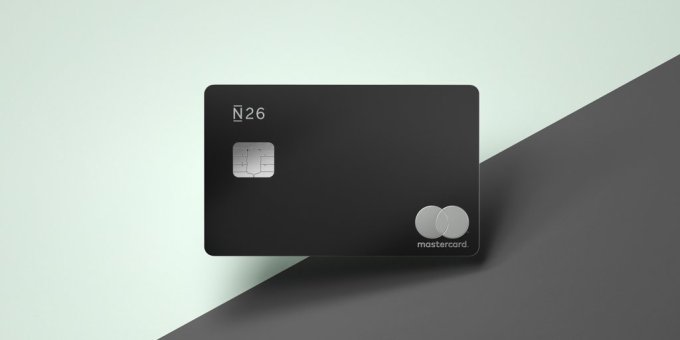
4. N26 launches its challenger bank in the US

If you’re familiar with N26, the product going live today won’t surprise you much. Customers in the U.S. can download a mobile app and create a bank account from their phone in just a few minutes.

5. Apple has pushed a silent Mac update to remove hidden Zoom web server

Zoom took flack from users following a public vulnerability disclosure on Monday by Jonathan Leitschuh, in which he described how “any website [could] forcibly join a user to a Zoom call, with their video camera activated, without the user’s permission.”

6. OneTrust raises $200M at a $1.3B valuation to help organizations navigate online privacy rules

It’s an outsized round for a Series A, being made at an equally outsized valuation, but according to CEO Kabir Barday, that’s because of the wide-ranging nature of the issue, and OneTrust’s early moves tackling it.

7. The future of car ownership: Cars-as-a-service

Previously, we explored the different startups attempting to change car buying. But not everyone wants to buy a car. (Extra Crunch membership required.)

11 Jul 2019

Facebook tries to make ad targeting explanations more useful

Facebook has been adding new tools to provide more transparency about why users are seeing certain ads and content (and what they can do about it), but in a blog post today, Product Manager Sreethu Thulasi wrote, “We heard feedback from people that they can still be hard to understand and difficult to navigate.”

To address that, the company said it’s making two changes. First, when you select the “Why am I seeing this ad?” option on an advertisement, you’ll get more info:

In the past, “Why am I seeing this ad?” highlighted one or two of the most relevant reasons, such as demographic information or that you may have visited a website. Now, you’ll see more detailed targeting, including the interests or categories that matched you with a specific ad. It will also be clearer where that information came from (e.g. the website you may have visited or Page you may have liked), and we’ll highlight controls you can use to easily adjust your experience.

An accompanying video shows how a user might dig into an an ad to see how their interests, location, demographic information and a past visit the advertiser’s website all played a role in the targeting. If you don’t like what you see, you can adjust your interests on Facebook, or your can click through to the “What You Can Do” section, which will point out options like blocking all ads from that advertiser or limiting the personal data that’s shared by third-party companies.

Speaking of third-party data, Facebook said it’s also telling you more about the businesses that are uploading data about you, dividing the listing (found in your Ad Preferences) into two sections — one that shows advertisers who have uploaded a list with your information and used it to run an ad in the past seven days, and another of businesses that have shared lists with your data, along with advertisers who have used that data to show you an ad in the past seven days.

Like many privacy tools, these may not get used by most Facebook users. But for those who are curious or concerned, this seems like a clear way to make the information accessible without dumbing it down too much.

And of course, this just one of a number of steps Facebook has taken recently to increase transparency as it faces regulatory scrutiny (and even proposals for a break-up).